

Key takeaways
• Real-time means <500 ms end-to-end. Captions after 500 ms feel delayed; voice-to-voice above 2 s breaks conversation flow. Budget every stage — ASR, MT, TTS, network — or the pipeline falls apart.
• The API you pick swings cost 20×. Streaming ASR runs $0.0025–$0.0077 / min (AssemblyAI Universal Streaming up to Deepgram Nova-3); an all-in-one speech-to-speech API such as OpenAI GPT-Realtime-Translate runs about $0.034 / min — several times the ASR line, though it folds three API calls into one. Price the whole chain, not one box.
• WER and diarization are the real blockers. A 6 % word error rate sounds small on a slide; on a one-hour medical consult it’s 360 wrong words. Overlapping speech and code-switching still break most off-the-shelf pipelines.
• Compliance is non-negotiable in healthcare, courts, and enterprise. HIPAA fines reach $1.5 M per year; GDPR up to €20 M or 4 % of revenue. Data residency, BAAs, and PII redaction belong in the RFP, not the retrofit.
• A production integration ships in 10–14 weeks with an experienced team. Longer only if you self-host your own models on GPU or need courtroom-grade human-in-the-loop interpretation.
More on this topic: read our complete guide — 7 Best Video Call Translation Tools Compared (2026).
Why Fora Soft wrote this playbook
A real-time translation API turns a live video call into a multilingual one: it pulls speech off a WebRTC track, transcribes it, translates it, and hands back captions or a translated voice — inside the half-second window before a conversation starts to feel laggy. Fora Soft has built real-time video and audio software since 2005 — 250+ projects, 50+ in-house specialists — and the same three questions come up every time a team wires translation into a product: which API to call at each stage, how to hold the latency budget, and how to pass a HIPAA or GDPR audit. This guide answers all three, API by API.
Two projects ground the advice: TransLinguist and the software we developed for Blaze Streaming Media’s Volo. In Volo, attendees scan a QR code, pick a language, and get AI subtitles or a translated voiceover with no app install; the software runs on Vonage, Speechmatics and Google, and Blaze runs Volo at conferences such as Black Hat USA, GDC and HIMSS. TransLinguist is an interpreter video platform we engineer that carries 75+ languages and a marketplace of 30,000+ certified interpreters, and it won the NHS national framework in the UK — speech-to-speech in 16+ languages, captions in 22, wired into Zoom, Google Meet, and Microsoft Teams. These live in our custom video & audio processing practice; when the job is production-grade interpretation, our AI language-interpretation experts own that side. Want the deep wiring instead — how the translated track is published back, how the worker pool scales? Our real-time video translation integration playbook goes there; this guide stays on the APIs.
Scoping a real-time translation feature and need a second opinion?
30 minutes with our video engineering lead — we’ll map your latency budget, pick a provider mix, and sketch a realistic 12-week plan. Free.
How real-time video translation actually works
At the pipeline level every live translation system is one of two shapes. The dominant shape today is cascaded: audio is captured from a WebRTC track, fed into a streaming automatic speech recognition (ASR) engine, the partial text is pushed into a machine translation (MT) model, and the translated text is either rendered as captions or voiced by text-to-speech (TTS). Every stage adds latency, every stage has a failure mode, but every stage is swappable.
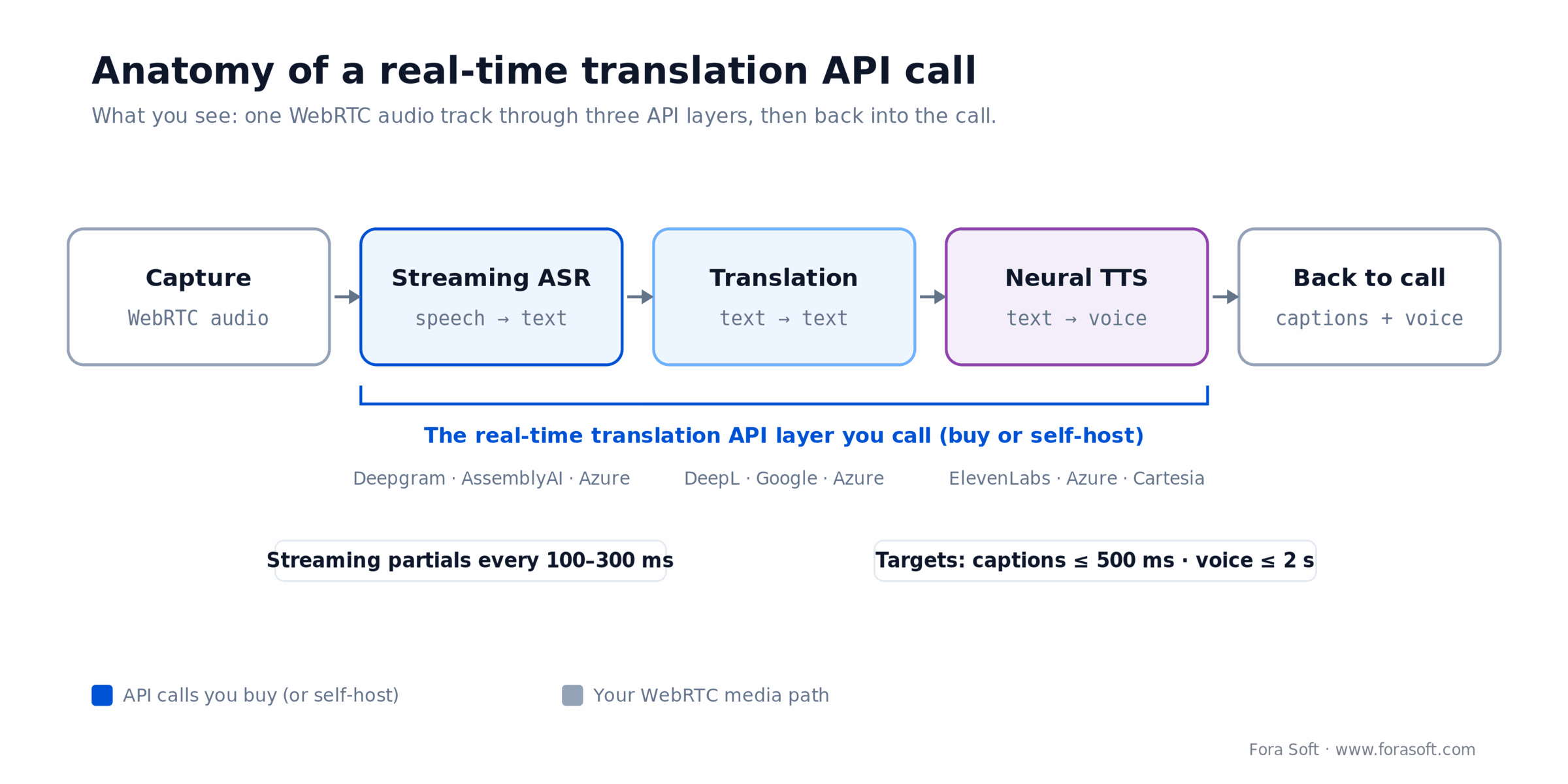
Figure 1. One WebRTC audio track through three API layers — the buy-or-build boundary is the middle three boxes.
The second shape is end-to-end speech-to-speech, where one model takes audio in one language and emits audio in another with no text in between. In 2026 this path got a lot more callable: OpenAI’s GPT-Realtime-Translate streams translated audio from 70+ input languages into 13, Google’s Gemini 3.5 Live Translate exposes voice-to-voice through the Gemini Live API, and Meta’s open M4T v2 covers 100+ input languages if you self-host. Speech-to-speech preserves prosody and hides ASR errors, and can cut 300–600 ms. The trade-off is control: you can’t drop a medical glossary between ASR and MT when there is no text in the middle, and you can’t show captions unless you run ASR in parallel anyway.
Most shipping products we see in 2026 are cascaded pipelines with streaming ASR and streaming MT, delivering translated captions with sub-second latency and translated voice with 1.5–2 s latency. End-to-end models are used as a secondary voice channel where the accent and voice of the original speaker matter — legal interpretation, high-touch sales calls, cross-border executive meetings.
The five stages of a cascaded pipeline
1. Capture. Browser or mobile client publishes an audio track over WebRTC into an SFU (LiveKit, Mediasoup, Janus, Jitsi, or a managed service like Agora / Daily / 100ms). Network jitter and codec choice matter: Opus at 48 kHz is the baseline; G.711 at 8 kHz will destroy ASR accuracy.
2. Voice activity detection and language ID. A lightweight VAD (Silero, WebRTC VAD) chunks the stream into utterances. A language-ID model tags each chunk. Get this wrong and the rest of the pipeline wastes cycles translating silence or music.
3. Streaming ASR. Deepgram Nova-3, AssemblyAI Universal-Streaming, Azure Speech, Google Cloud Speech-to-Text, or self-hosted faster-whisper emit partial transcripts every 100–300 ms. Partials let you translate and display before the sentence is done — the trick that makes captions feel instant.
4. Streaming MT. DeepL streaming, Google Translation, Azure Translator, or a self-hosted NLLB / MADLAD model translates each partial. Well-engineered pipelines cache stable prefixes so they don’t re-translate the same words as more context arrives.
5. Render. Translated text is pushed to remote participants over a data channel for captions, or streamed into a low-latency TTS (ElevenLabs, Azure Neural TTS, Cartesia Sonic) for synthesized voice. For voice output you still publish the original audio at lower volume so participants can hear the source speaker’s energy.
Reach for a cascaded pipeline when: you need captions plus voice, domain glossaries, language-pair flexibility, or auditability — i.e. 80 % of real use cases.
Reach for end-to-end (Meta M4T v2) when: voice-preserving translation and 300 ms of saved latency outrank the need for captions, glossaries, or easy debugging.
The 500 ms rule: what “real time” actually means
Human turn-taking in conversation runs on roughly a 200 ms response window. People perceive delays above 300 ms; they notice — and adjust their speech around — delays past 500 ms. For real-time video translation that gives you two separate latency targets:

Figure 2. Where the milliseconds go: a naive cascade blows the budget; streaming and fused S2S land under the caption and voice targets.
Captions: first partial visible ≤ 500 ms from word onset; stable final inside 1 s. Anything slower and viewers read ahead of the speaker, which produces a disorienting mismatch between lip motion and text.
Voice-to-voice: translated audio starts ≤ 2 s after the source speaker pauses; back-to-back handoff feels natural up to about 3 s. Beyond that, participants talk over each other.
A naive cascaded pipeline without streaming easily blows that budget: 200 ms capture buffer + 800 ms ASR final + 400 ms MT + 1200 ms TTS + 200 ms network round-trip = 2.8 s. Streaming everything, caching stable prefixes, and co-locating ASR/MT in the same region brings that down to 700–900 ms for captions and 1.5–2 s for voice — the realistic target you should architect toward in 2026.
Where the milliseconds go
| Stage | Naive cascaded | Streaming, well tuned | End-to-end S2S |
|---|---|---|---|
| Capture & buffer | 200 ms | 80 ms | 80 ms |
| ASR (first partial) | 800 ms | 150 ms | — (fused) |
| MT | 400 ms | 120 ms | — (fused) |
| Speech-to-speech model | — | — | 900 ms |
| TTS (first audio chunk) | 1200 ms | 350 ms | — |
| Network (round-trip) | 200 ms | 100 ms | 100 ms |
| Total to first translated audio | ~2.8 s | ~800 ms | ~1.1 s |
The table above shows the gap between “API plugged in” and a streaming pipeline is 2 seconds — enough to make the feature usable versus unusable. Budget every stage when you scope.
The provider shortlist: who actually ships streaming translation in 2026
A real-time translation API isn’t one product — it’s up to four layers you can buy instead of build: streaming ASR, MT, TTS, and packaged platforms that bundle all three with interpreter workflows on top. Below is the shortlist we vet against for every new client engagement.
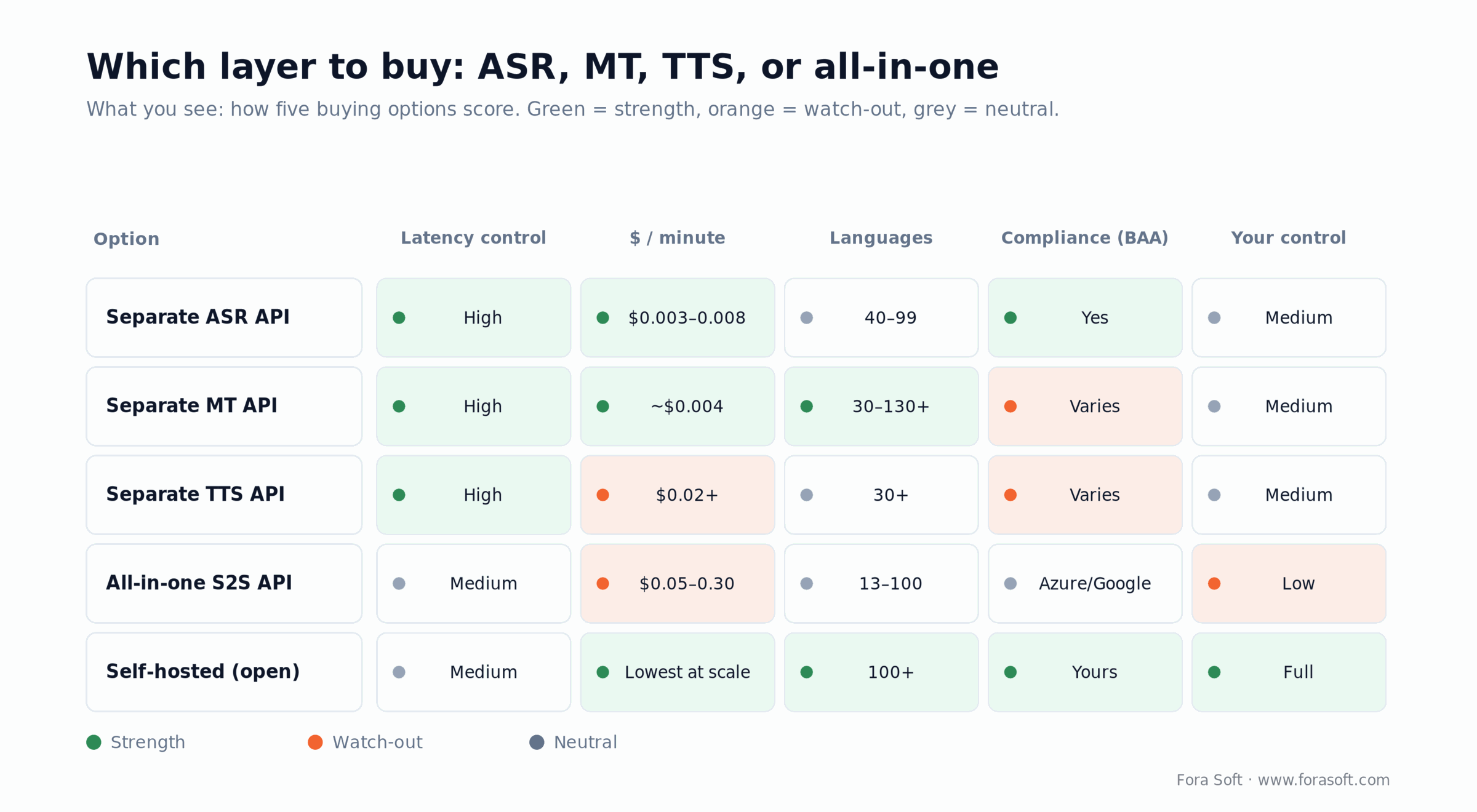
Figure 3. Buy the layers separately for control and price, or an all-in-one API for speed — self-hosting wins on cost and control at scale.
| Provider | Layer | Languages | Typical latency | Price (indicative) | Compliance |
|---|---|---|---|---|---|
| Deepgram Nova-3 | Streaming ASR | 40+ | ~300 ms | ~$0.0077 / min | HIPAA, SOC 2, GDPR |
| AssemblyAI Universal-Streaming | Streaming ASR | 99 | ~300–500 ms | $0.0025–$0.0075 / min | HIPAA, SOC 2, GDPR |
| Azure Speech Translation | ASR + MT | 100+ (ASR) / 143 locales (MT) | ~500–800 ms | ~$2.50 / audio-hour + $10 / M chars | HIPAA BAA, GDPR, FedRAMP |
| Google Cloud Speech + Translation | ASR + MT | 125+ (ASR) / 130+ (MT) | ~600–900 ms | ~$1.44 / audio-hour + $20 / M chars | HIPAA BAA, GDPR, ISO 27018 |
| DeepL Translate API | MT | 30+ | ~150 ms | ~$25 / M chars | GDPR (EU-hosted) |
| ElevenLabs Flash TTS | Low-latency TTS | 30+ | ~75–200 ms | ~$0.05 / 1 K chars | GDPR, SOC 2 |
| Meta M4T v2 (self-hosted) | End-to-end S2S/S2T | 101 input / 35 speech output | ~1–2 s on A100 | GPU cost only | Self-hosted → your controls |
| Agora Real-Time AI / Translation | Platform | 20+ | ~1–3 s | per-minute bundles | HIPAA add-on, GDPR |
| KUDO AI / Interprefy / Wordly | Turnkey event platforms | 32–60+ | 1–3 s (AI) / 1–2 s (human) | per-event / per-minute | GDPR, ISO 27001 |
Numbers above are drawn from each vendor’s public pricing pages and the 2025–2026 benchmark runs our team executes when we lock in a stack. They shift quarterly — always re-check before signing. Newer in 2026 is the all-in-one lane: OpenAI GPT-Realtime-Translate (70+ input languages into 13, streaming translated audio), Google Gemini 3.5 Live Translate, and Azure’s speech-translation endpoint each collapse ASR, MT, and TTS into a single API call. You trade the per-stage control a cascade gives you for a much shorter integration. One licensing footnote: Meta’s open M4T v2 weights are CC-BY-NC 4.0 — research and evaluation only. To self-host inside a commercial product, reach for permissively-licensed models: Whisper or faster-whisper (MIT) for ASR, NLLB or MADLAD for MT, or NVIDIA Riva.
Reach for Deepgram + DeepL + ElevenLabs when: you want the fastest, cheapest tuned cascaded pipeline and you’re fine stitching three SDKs together.
Reach for Azure Speech Translation when: you need one vendor, one BAA, and built-in MT with enterprise-grade compliance and your users live in Teams or Microsoft 365.
Reach for self-hosted models when: data residency forbids third-party APIs, you need voice preservation, or you want to own the economics past ~50,000 translated minutes per month — using permissively-licensed Whisper or NLLB (Meta’s M4T v2 is CC-BY-NC, research-only).
Reach for KUDO / Interprefy / Wordly when: the product you’re building is a single event (conference, board meeting, training) rather than continuous in-app translation, and you need a human-in-the-loop option.
Accuracy: WER, BLEU, and the errors users actually notice
Vendors love to show word error rate (WER) on clean benchmark datasets. Production audio is not a clean benchmark. A 6 % WER on librispeech becomes 10–15 % on a mobile caller in a café and 20 %+ if two participants talk over each other. Treat every WER number in a marketing deck as a ceiling, not a floor.
1. Background noise and bad mics. Laptop fans, open offices, and bluetooth headsets all cost 2–5 WER points. Mitigate with RNNoise or Krisp pre-processing on the client; the CPU cost is negligible and the accuracy uplift is real.
2. Accents and non-native speakers. Generic ASR models are heavily weighted toward US / UK speech. For a platform with users from 190 countries, always test separately on Indian English, Nigerian English, Filipino English, and non-native European English. Deepgram Nova-3 and Whisper large-v3 currently lead our internal tests on accented English.
3. Domain vocabulary. Medical terminology, legal citations, product SKUs, and team-specific jargon break off-the-shelf models. The fastest fix is a custom vocabulary / hint list sent with each stream (all major APIs support this); the deeper fix is a fine-tuned language model. Budget 2–4 weeks of data collection and annotation per domain.
4. Code-switching. A Spanish-English bilingual speaker who drops English technical terms into Spanish sentences still confuses most production systems. Either enable multi-language detection per utterance (Azure, Google) or constrain the session to one source language with a permissive MT on the other side. Soniox advertises live handling of crosstalk, speaker overlap, and mid-sentence language switching across 60+ languages if you’d rather buy the problem away.
5. Overlapping speech and diarization. When two speakers talk at once a single-channel ASR emits word salad. Two defenses: capture per-speaker tracks from the SFU (LiveKit and Mediasoup expose this cleanly) and run one ASR stream per track, or use a diarization-aware model such as pyannote 3.1 in front of ASR. The first option is cheaper and more accurate when your transport supports it.
WebRTC integration: where the ASR actually runs
The choice that shapes the rest of the architecture is where audio leaves WebRTC and enters the AI pipeline. Three patterns work in production; everything else is a variation.
Pattern A: SFU egress to a translation worker
The SFU forwards per-participant audio tracks to a headless translation worker (a server-side process that joins the room like a participant). The worker pipes each track into streaming ASR, emits translated captions over a data channel, and optionally publishes a translated audio track back into the room. LiveKit Agents, Mediasoup’s RTP/RTCP plain-transport, and Janus Gateway’s SIP/RTP endpoints all make this straightforward.
This is the pattern we use on the majority of Fora Soft projects because it puts the expensive compute in your infrastructure (easy to scale, easy to audit) and keeps clients dumb.
Pattern B: Client-side capture to cloud ASR
The browser or mobile client captures microphone audio, ships it over a WebSocket to Deepgram / AssemblyAI / Azure, and receives transcripts directly. The server relays transcripts to other participants over a data channel. Simpler to build, but you pay per-client and you can’t easily centralize logging or redaction.
Works well for 1:1 calls and low-concurrency tools; breaks down for webinars with hundreds of listeners where you don’t want every listener paying for ASR on their own device.
Pattern C: Edge inference on self-hosted GPU
SFU forwards audio to a GPU node running faster-whisper, NVIDIA Riva, or Meta M4T v2. You pay for GPUs (an A10G or A100 handles roughly 20–40 concurrent ASR streams depending on model size), but per-minute cost collapses. For products doing 100,000+ translated minutes per month this is usually cheaper than any managed API at the 6–12 month mark.
The downsides: GPU capacity planning is real work, model updates are your problem, and supporting 40+ languages means loading multiple models or accepting quality trade-offs.
Not sure whether to self-host or buy an API?
We’ll model your volume, latency, and compliance constraints and show the break-even point where self-hosting wins. No deck, just a spreadsheet.
A reference architecture we actually ship
For an e-learning or telemedicine product with 50–2 000 concurrent translated sessions, this is the default stack our team proposes and defends in RFP meetings. The signal path underneath — jitter buffers, VAD, low-latency audio — is its own discipline, and our audio-for-video engineering course goes deep on it:
Transport. LiveKit Cloud or self-hosted LiveKit on Hetzner / AWS for SFU, with Cloudflare in front for TURN and global edge fan-out. Per-participant audio tracks exposed to server-side agents.
Pre-processing. Client-side Krisp or RNNoise for noise suppression. Silero VAD on the server to chunk each track before it hits ASR.
ASR. Deepgram Nova-3 streaming for the 12 highest-volume languages, Azure Speech as a secondary provider for long-tail languages and regulated workloads. faster-whisper on A10G for self-hosted tenants.
MT. DeepL where supported, Google Translation for anything DeepL can’t handle, with a custom glossary service in front for per-tenant vocab.
TTS. ElevenLabs Flash for English / major European languages where voice quality matters; Azure Neural TTS for long-tail languages and enterprise tenants that already have Azure contracts.
Delivery. Translated captions over LiveKit data channel, translated voice published as a secondary audio track. Clients pick the mode per participant (captions, voice, both), and captions are timestamped against the RTCP sender-report clock (RFC 3550) rather than wall time so they stay locked to speech when a client reconnects.
Observability. OpenTelemetry spans from capture to render on every utterance, first-partial-latency SLO wired into Grafana, per-language WER sampled weekly against human-labelled clips.
HIPAA, GDPR, and the compliance gates nobody likes to talk about
The moment your product sends audio of a doctor, lawyer, banker, or HR manager to a third-party API you’ve entered regulated territory. Treat compliance as a first-class architectural concern, not a retrofit. Three anchor points:
1. HIPAA (US healthcare). Patient audio is protected health information (PHI). You need a Business Associate Agreement with every vendor that touches it — Deepgram, AssemblyAI, Azure, Google, AWS, and Meta all offer BAAs; DeepL and ElevenLabs currently don’t on their standard plans. Fines can reach $1.5 M per violation category per year.
2. GDPR (EU). Voice is biometric personal data under Article 9. You need a lawful basis, a DPA with every processor, explicit consent when required, the ability to delete transcripts on request, and EU-region processing if you claim EU data residency. Fines up to €20 M or 4 % of annual revenue. DeepL (Germany-hosted) and Azure (EU regions) are the typical EU-friendly choices.
3. Data residency by customer. Enterprise buyers in regulated industries increasingly ask for regional pinning: audio from German employees processed only in Frankfurt, audio from Japanese employees only in Tokyo. Solve this in the router, not the ASR vendor — route each session to the regional worker pool that speaks to a regional provider endpoint.
Two product decisions that save compliance pain later: don’t persist audio by default (stream, translate, discard); redact PII from transcripts before logging. Both cost a week of engineering and save months of audit work.
Cost model: what translated minutes actually cost
Real numbers matter more than ranges. Here is the arithmetic for a typical 30-minute translated two-party call in 2026, using the streaming cascaded stack we prefer, and assuming ~12,000 characters of speech in a normally talkative two-party call:
| Component | Unit cost | Per 30-min call | Per 10 000 calls/month |
|---|---|---|---|
| Streaming ASR (Deepgram Nova-3, 2 speakers) | $0.0077 / min | $0.46 | $4 620 |
| MT (DeepL, ~12 000 chars / 30 min) | $25 / M chars | $0.30 | $3 000 |
| TTS (ElevenLabs Flash, optional voice) | $0.05 / 1k chars | $0.60 | $6 000 |
| WebRTC transport (LiveKit Cloud, 2 participants) | ~$0.003 / participant-min | $0.18 | $1 800 |
| Captions only (no TTS) | — | ~$0.94 | ~$9 400 |
| Captions + translated voice | — | ~$1.54 | ~$15 400 |
Self-hosting on two A10G nodes (~$1 600/month each, reserved) handles roughly 50 concurrent streams, which covers ~72 000 minutes of peak translation per month. Break-even versus managed ASR at $0.0077/min lands in the mid-hundreds of thousands of translated minutes per month — useful to know, easy to miscalculate if you forget VAD, MT, TTS, and on-call engineering.
Development cost for a production-grade integration on top of an existing WebRTC product sits in the $40–$90 K range for a Fora Soft team running Agent Engineering tooling. A green-field product from scratch — clients, SFU, translation, admin, billing — is a different conversation; we scope those live.
Industry lenses: e-learning, telehealth, enterprise, courts
Real-time translation has different anchor metrics depending on the industry you’re selling into. Here are the four we see most often and the things that actually move a deal.
1. E-learning and corporate training. Completion rates and learner retention are the business KPIs. Captions are mandatory; translated voice is a premium SKU. Global virtual-classroom platforms are the textbook case — translation opens markets you otherwise couldn’t sell into. Our e-learning engineering team ships this stack as a feature flag behind a pricing tier.
2. Telemedicine. HIPAA, every time. PHI redaction in transcripts. BAA with every vendor. Clinical-grade ASR vocabularies matter more than raw speed — misrecognizing “hypertension” as “hyper tension” breaks billing codes. We solve this on the CirrusMed engagement by combining Deepgram’s medical model with a custom post-processing pass, then shipping transcripts into the EHR. See our broader telemedicine practice for the HIPAA patterns we reuse.
3. Enterprise meetings and webinars. SSO, admin controls, tenant-level language packs, and integration with Teams / Zoom / Webex / Google Meet matter more than shaving 200 ms off latency. KUDO, Interprefy, and Wordly own this market; if you’re building a competing platform the differentiator is usually vertical depth (legal, medical, financial) rather than raw tech.
4. Courts and regulated proceedings. Human interpreter in the loop is usually mandatory; AI is at best a review aid. The engineering focus shifts to turn management, speaker labelling, tamper-evident transcripts, and integration with case-management systems. Latency budgets soften; evidentiary quality tightens.
Mini case — real-time translation software for Blaze Streaming Media’s Volo
Situation. Blaze Streaming Media wanted live captions and translation for in-person conferences, with nothing for attendees to install.
Plan. We developed a browser app that attendees open from a QR code, a producer console and an admin panel. Speech recognition runs on Speechmatics, translation on Google Translate and voiceover on Google TTS; Vonage carries the speaker’s audio, and captions reach phones over WebSockets.
Outcome. Blaze runs Volo at conferences such as Black Hat USA, GDC and HIMSS. The engineering lesson that transfers to any product: keep the join frictionless and keep the ASR → MT boundary swappable, because event audio punishes a brittle pipeline faster than any benchmark will.
A decision framework — pick your stack in five questions
1. What’s the primary consumption mode — captions, voice, or both? Captions alone let you run Deepgram + DeepL for pennies per minute. Voice doubles your bill because TTS is the expensive stage.
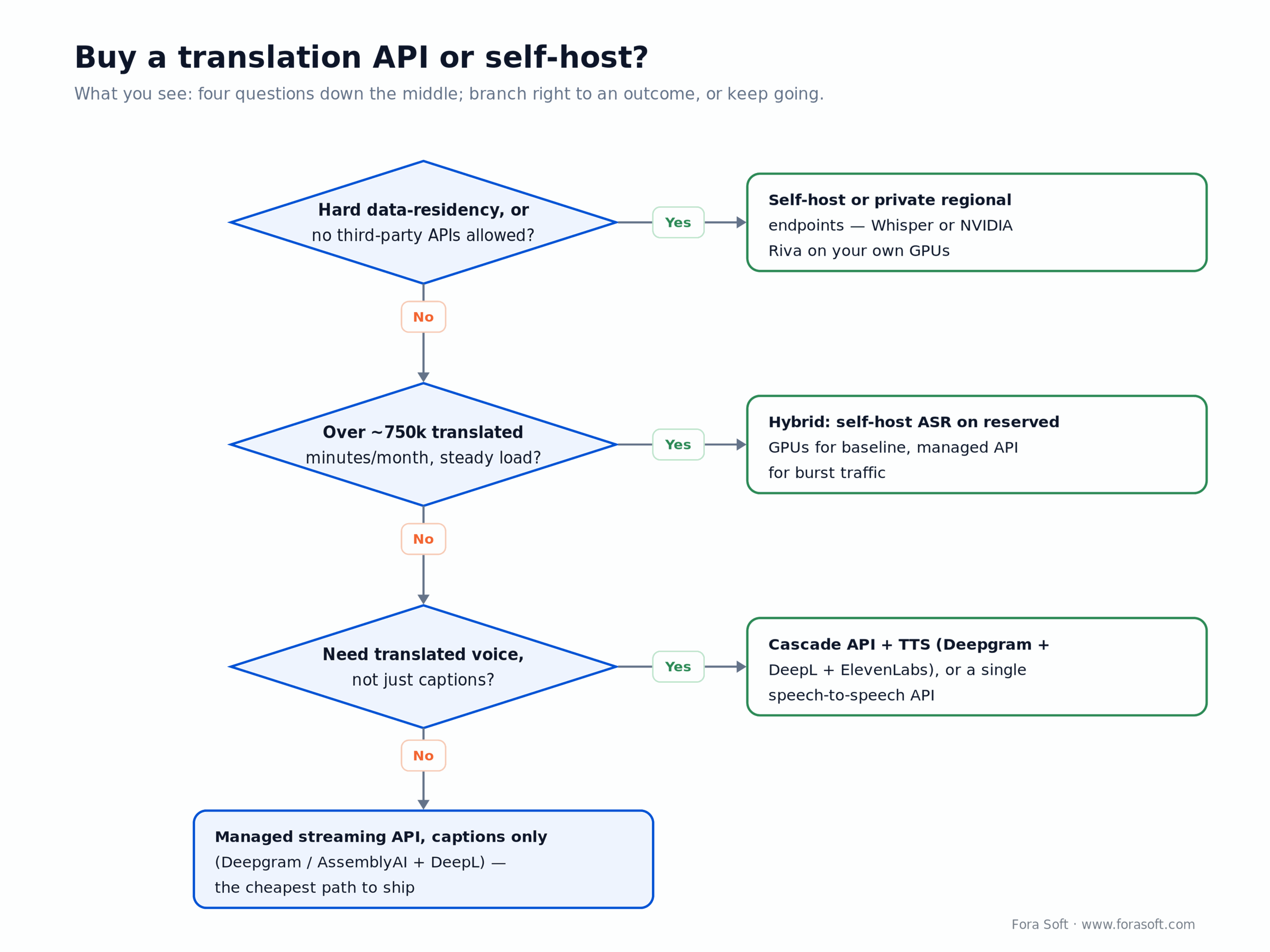
Figure 4. A buy-vs-self-host call in four questions: residency, monthly minute volume, and whether you need translated voice.
2. How many languages, and how long is the long tail? Ten majors fit almost every vendor. Thirty-plus, with Swahili, Tagalog, and Thai in there, narrows you to Azure, Google, and Meta M4T v2.
3. What’s your regulatory envelope? HIPAA, GDPR, data residency, SOC 2. If the answer is “all of the above” you’re routing more than half your traffic through Azure or Google and putting BAAs in place before you write a line of code.
4. What’s your peak concurrency and your annual minute volume? Under ~100 K minutes/month, buy. Over ~750 K minutes/month with steady load, self-host seriously. Between the two, hybrid — managed API for peaks, self-hosted for baseline.
5. Do you need human interpreters in the loop? If yes for any workflow (medical consents, legal, c-suite), you’re talking to KUDO or Interprefy before anyone else. Build the AI layer on the assumption that humans can override it.
Five pitfalls that sink real-time translation projects
1. Benchmarking on clean audio only. Vendor demos run on studio mics in quiet rooms. Your users join from iPhones in airports. Always benchmark on the real distribution of your audio, not the distribution the vendor sales engineer sends you.
2. Treating translation as stateless. MT quality improves dramatically with context. Throwing each 300 ms partial into a stateless translate call produces choppy, inconsistent output. Maintain a rolling context window; translate partials with the last 2–3 finalized sentences prepended.
3. Ignoring partial-stability flicker. Streaming ASR revises its own partials as more audio arrives. Displaying raw partials produces caption text that visibly rewrites itself mid-word — hard to read, and it looks broken. Wait for stable-partial hints or debounce by 150 ms before rendering.
4. One language pipeline for every tenant. Enterprise tenants will ask for custom vocabularies, forbidden-terms lists, and per-tenant glossaries on day two. Build the pipeline so these live in config, not code, from day one.
5. Shipping without a kill-switch. When a provider degrades — and they all do, every few months — you need to fall back cleanly. Instrument per-provider success rates and first-partial latency; auto-route to the secondary when the primary breaches your SLO for N consecutive minutes.
KPIs: what to measure from day one
Quality KPIs. Word Error Rate sampled weekly against human-labelled clips per top-10 language (target ≤ 8 % on real production audio). BLEU or COMET on MT output against a golden set (target ≥ 40 BLEU for majors). Caption coverage — percentage of spoken words that reach a viewer (target ≥ 90 %).
Business KPIs. Attach rate — share of sessions where translation is enabled by at least one participant (target ≥ 30 % for a global product). Revenue uplift from non-English markets post-launch (track quarterly). Churn delta in previously poorly-served regions (target meaningful drop inside two quarters).
Reliability KPIs. P50 / P95 first-partial latency (target 500 ms / 1 s). Translation pipeline error rate (target < 0.5 % of utterances failing). Provider failover events per month (target < 2; if higher, renegotiate).
When NOT to add real-time translation
Three situations where the honest answer is “not yet”. First, if your user base is 95 %+ in one language and you’re shipping translation to tick an RFP box, accurate post-meeting transcripts plus on-demand translation are usually enough and cost a tenth as much. Second, if you’re in a domain where errors can literally cost lives — emergency medicine, aviation ATC, high-stakes negotiation — use human interpreters with AI as an aid, not a replacement. Third, if your product is entirely async (recorded video, podcasts, on-demand courses), non-real-time translation with human review gives you better quality at far lower cost.
We’d rather tell a client their project doesn’t need real-time than watch it fail under its own ambition.
Ready to put numbers on a translation roadmap?
Bring your latency target, language list, and concurrency. We’ll walk you through a 12-week plan, a provider mix, and a monthly cost envelope in 30 minutes.
Realistic 12-week timeline for an existing WebRTC product
| Week | Workstream | Deliverable |
|---|---|---|
| 1–2 | Discovery & benchmarking | Labelled audio set; provider shortlist with WER / latency on your audio |
| 3 | Compliance design | BAA/DPA checklist; data-flow diagram; residency routing plan |
| 4–5 | Backend: translation agent | Server-side agent that joins rooms, runs per-track ASR+MT, emits data channel |
| 6–7 | Client UI | Caption rail, language picker, transcript download, admin controls |
| 8 | TTS / voice layer (optional) | Translated voice track publication; participant-level opt-in |
| 9 | Load & chaos tests | 3× peak simulation; provider failover validated |
| 10 | Observability & SLOs | Grafana dashboards; alerting on first-partial-latency and ASR failure rate |
| 11 | Staged rollout | Feature-flagged release to 10 % → 50 % → 100 %; WER sampling live |
| 12 | Handover & runbooks | On-call runbooks; glossary ingestion workflow; cost dashboards |
The timeline above lands a production-grade translation feature on top of an existing WebRTC stack. Green-field products and complex compliance add weeks; scale down the UI layer if you already have caption infrastructure.
What’s coming: voice preservation, simultaneous interpretation, smaller models
Three trends worth tracking. Voice-preserving translation — outputting translated audio that keeps the source speaker’s timbre — is moving from lab demos to production. ElevenLabs and Microsoft’s Live Interpreter both expose early APIs; expect real commercial rollouts through 2026. Simultaneous interpretation research — StreamSpeech, Meta streaming S2S — is shrinking the latency gap between captions and full sentences by translating partial utterances with explicit wait-k policies. Small specialised models — 1–3 B parameter speech-to-text models fine-tuned for a narrow domain — are getting cheap enough to self-host per tenant and are already beating generic cloud APIs on domain-specific vocab.
None of this changes the architecture we’re recommending today. It does mean the cascaded pipeline you build in 2026 should keep the ASR → MT → TTS boundaries swappable so you can drop a better model into any stage without rewriting the rest.
FAQ
What does “real-time” actually mean for video translation?
For captions, first partial visible within 500 ms of the word being spoken, stable text inside 1 s. For translated voice, speech starts inside 2 s of the source speaker pausing. Anything slower breaks conversational flow — participants start talking over each other or reading ahead of the speaker.
Should you build on Zoom, Teams, or Webex, or run your own WebRTC?
If your users already live inside one of those platforms and you don’t need product-level control over the video experience, a KUDO / Interprefy / Wordly integration is faster and cheaper. If translation is part of your own product experience — e-learning, telemedicine, industry-specific conferencing — own the WebRTC stack and integrate translation directly. You’ll ship a better product and pay less per minute at scale.
How accurate is AI translation compared to a human interpreter?
On clean audio in one of the top dozen languages, a well-tuned AI pipeline reaches roughly 90–95 % of human quality for informal business conversation. That gap matters for legal, medical, and high-stakes negotiations, where human interpreters remain the default. For training, support calls, and most enterprise meetings, AI is already the pragmatic choice.
How do you handle overlapping speakers and code-switching?
Capture per-speaker audio tracks from your SFU rather than a mixed stream, and run one ASR instance per track. For code-switching (a speaker mixing languages mid-sentence), enable multi-language ASR modes in Azure or Google, or constrain sessions to one declared source language with a relaxed MT on the other side. Single-channel mixed-speaker audio will fail no matter which vendor you pick.
What’s the realistic monthly cost for a small SaaS with 200 translated hours per month?
At 200 hours = 12 000 minutes: Deepgram ASR ~$92, DeepL MT ~$60, WebRTC transport ~$72, plus infrastructure and observability (~$150). Captions-only landing around $400–$500/month in API costs. Translated voice via ElevenLabs Flash adds roughly $120, so about $550–$650/month. Development is a one-time $40–$90 K window, not a recurring cost.
Is HIPAA-compliant real-time video translation actually possible?
Yes, with the right vendor selection and discipline. Sign BAAs with every processor that touches audio (Deepgram, Azure, Google, AWS all offer them). Encrypt in transit and at rest. Don’t persist audio by default; redact PII from transcripts before logging. Regional processing for patient data. We ship this pattern on the CirrusMed telemedicine product; the first implementation takes 10–12 weeks including audit prep.
When does self-hosted Whisper / Meta M4T v2 make sense?
Above a few hundred thousand translated minutes per month with steady load, self-hosted ASR on reserved A10G or A100 instances undercuts any managed streaming API. Below that, or with spiky usage, managed APIs win once you factor on-call engineering, model updates, and GPU capacity planning. Hybrid setups — self-hosted for baseline, managed for burst — are what we recommend in most growth-stage products.
How do you add custom vocabulary for jargon or product names?
Every major streaming ASR API supports per-session hint lists or custom vocabulary. Deepgram has keywords and custom models; Azure has phrase lists and custom speech; Google has speech adaptation. Build a per-tenant glossary service that ships hint lists with each session. For deep domain accuracy (medical, legal), plan a fine-tuning pass — budget 2–4 weeks of data collection and annotation.
What to read next
Architecture
P2P, SFU, MCU, Hybrid: Which WebRTC Architecture Fits Your 2026 Roadmap?
The transport layer your translation agent will sit on — pick wrong and the latency budget is blown before ASR even starts.
Enterprise
Multilingual Video Conferencing: Enterprise Guide
How large orgs buy and deploy translation features across Teams, Zoom, and custom platforms.
Streaming
Real-Time Video Streaming: Low Latency Solutions
A closer look at the transport-layer optimizations that keep translated video feeling natural.
E-learning
AI Video Analytics for Online Learning
The other AI-driven feature that pairs naturally with translation in modern virtual classrooms.
Integration
Real-Time Video Translation Integration Playbook
A sharper focus on the integration patterns and project mechanics for bolt-on translation.
Ready to ship real-time translation without blowing the latency budget?
A real-time translation API is no longer an R&D project — it’s an integration project with hard latency rules, sharp vendor trade-offs, and very real compliance gates. The 500 ms rule for captions and the 2 s rule for translated voice set the architecture. A streaming cascaded pipeline (Deepgram or Azure for ASR, DeepL or Google for MT, ElevenLabs or Azure Neural for TTS) handles 80 % of production cases today, with Meta M4T v2 self-hosted as the answer when data residency or voice preservation outrank speed-to-market. For the architecture-level view of real-time speech translation, our pillar guide is the companion to this API-focused one.
The projects that succeed budget every stage, measure WER on real audio, sign compliance paperwork early, and ship behind a feature flag with observability wired in from day one. The projects that fail benchmark on clean audio, treat translation as stateless, and leave the kill-switch for “later.” You already know which side of that line you want to be on. We can help you get there in 10–14 weeks.
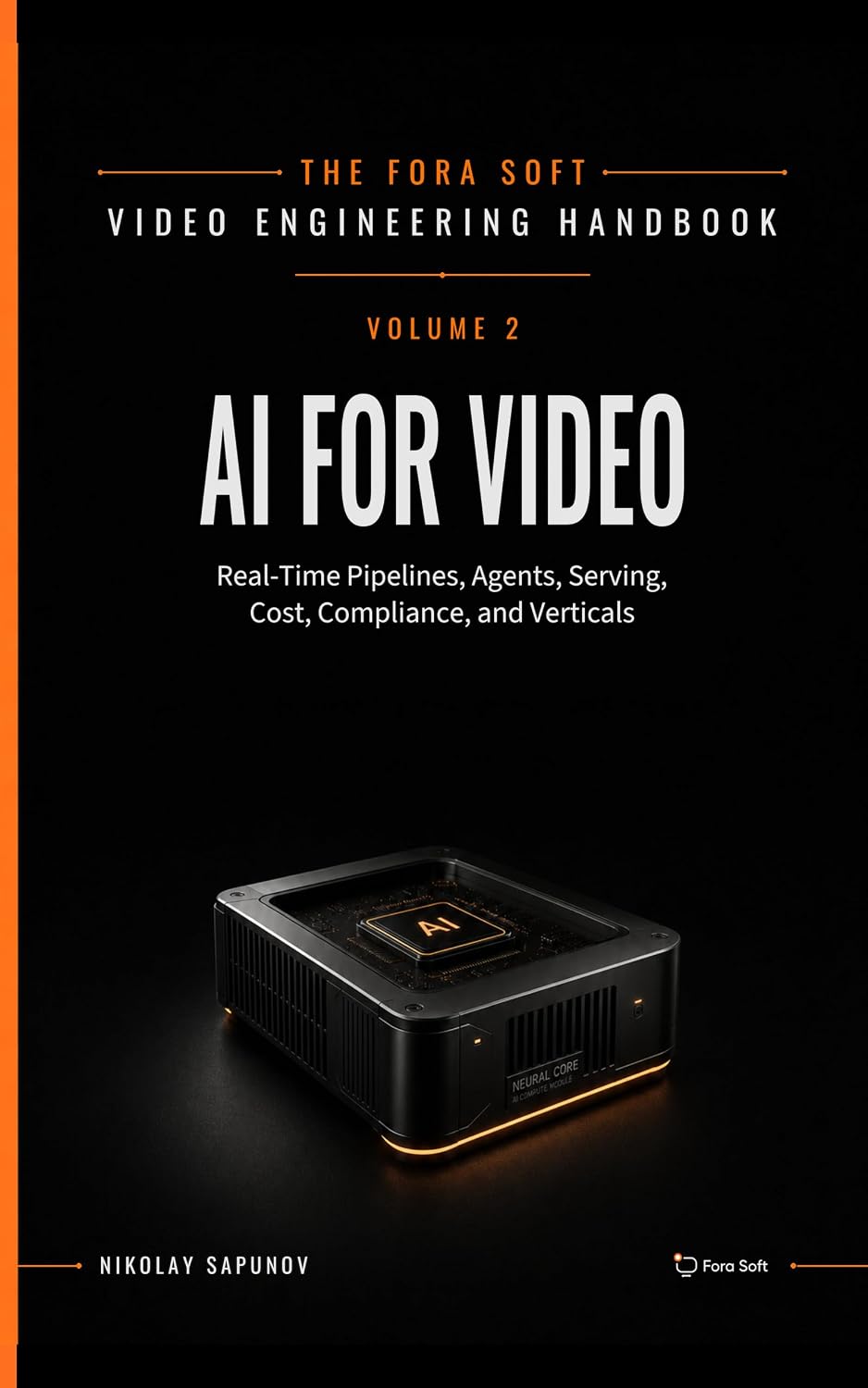
The book · Volume 7 of 7
AI for Video: A Complete Guide to Intelligence in Video Products: From Real-Time Pipelines and Agents to Serving, Cost, Compliance, and Verticals
The 500 ms rule in this guide is a budget, and Volume 7 shows where each millisecond goes. It covers latency inside the call, where ASR and translation plug into a WebRTC pipeline, live subtitles and voice output, serving infrastructure, and cost per stream-hour. Product teams use it to keep translation inside the call instead of bolted beside it. Written by Nikolay Sapunov, CEO at Fora Soft.
Read it on Amazon →Kindle & paperback · Fora Soft Video Engineering Handbook
Let’s put a plan on paper
Bring your current stack, languages, compliance envelope, and target launch date. In 30 minutes we’ll give you a provider mix, a cost envelope, and a realistic timeline — no slide deck, no sales script.

