

Key takeaways
• Sub-second is a different product than 5-second. Below 500 ms you are in WebRTC territory (telemedicine, live betting, conferencing). Between 0.5 and 3 s is LL-HLS / DASH. Above 3 s is classic HLS broadcast. The protocol picks the product.
• Latency is a budget, not a feature. End-to-end is the sum of capture, encode, packaging, network, CDN, player buffer, and display. Missing the budget on any one stage ruins the stream, so the fix is always a stage-level fix.
• WebRTC + SFU is the 2026 default for interactive. P2P for 2–6 users, SFU for 5–500, MCU only when CPU server-side mixing is non-negotiable. Hybrid wins at scale.
• Codec and CDN choices drive cost more than protocol. HEVC cuts bitrate 40–50% vs H.264; AV1 another 20–30% but at ~4× software encode cost. Edge-aware CDNs (Cloudflare, Fastly) keep p95 latency honest under load.
• Most teams overspend by 30–50%. Wrong protocol, wrong CDN tier, wrong player buffer, wrong encode ladder. An honest one-week audit usually pays for itself three times over in the first year.
More on this topic: read our complete guide — Streaming App UX Best Practices: 7 Pillars (2026).
“Low-latency streaming” means different things to different products. A cardiac specialist running a live telemedicine session needs 200 ms. A live auction platform needs 400 ms. A sports broadcaster needs under 3 seconds. A cooking show on social needs under 10. Every one of these can be built, and every one of them has a different architecture, cost profile, and failure mode.
This playbook is written for CTOs, product owners, and streaming engineers who are scoping or operating a live video product in 2026. It walks through the real end-to-end latency budget, the three protocol lanes (WebRTC / LL-HLS / classic HLS), the codec and CDN choices that drive cost, and the five pitfalls that cause most missed SLAs. Numbers and patterns reflect what our teams and peers ship at broadcast- and evidentiary-grade scale today.
Why Fora Soft wrote this playbook
Fora Soft has been building video software since 2005: 250+ projects, with real-time streaming as a core competency. We built Speed.Space, a remote video production platform that delivers 1080p at 8 Mbps (roughly 5× a standard video-call bitrate) so directors on productions that ship to Netflix, HBO, and EA can cut on the footage the same day it is shot. We shipped V.A.L.T, an evidentiary video platform used by 770+ US organizations and 50,000+ users, where lossy streaming is a non-starter.
Low-latency streaming is a systems problem with a physics ceiling. Light speed across a coast-to-coast hop is ~40 ms one-way. Everything else (encode, packaging, player buffer, re-request logic) has to fit under whatever your product’s interactivity ceiling is. Teams that ship it well have spent years in that layer. Teams that are starting fresh usually rebuild the lessons the hard way.
We use Agent Engineering on every build, which lets our MVPs land in weeks rather than quarters. That also means the estimates further down tend to sit below industry numbers quoted elsewhere, and we’re honest where the number could swing either way. When a team would rather hand off the whole pipeline, that is our video and audio streaming development service.
Scoping a low-latency streaming build?
Bring your audience size, your latency target, and the stack you’re considering. We’ll map it to WebRTC / LL-HLS / HLS in 30 minutes with a week-level estimate.
What “low latency” really means end-to-end
Glass-to-glass latency is the sum of every stage between the camera sensor and the viewer’s display. Most teams measure one or two stages and miss the real end-to-end number. The three tiers worth naming (our Video Streaming hub goes deeper on each protocol):
- Interactive (< 500 ms): telemedicine, live betting, video conferencing, remote production, live auctions. WebRTC territory.
- Near-real-time (0.5–3 s): sports, news, esports chat-layer streaming, live commerce. LL-HLS / LL-DASH / CMAF.
- Classic broadcast (3–30 s): mainstream OTT, social VOD replay, SVOD premieres. Standard HLS / DASH.
Under 100 ms is physically constrained — cross-country one-way is ~40 ms before any encoding, so 80 ms round-trip plus encode plus decode puts a hard floor. Above 30 seconds latency is a product choice (VOD-ish distribution), not a technology limit.
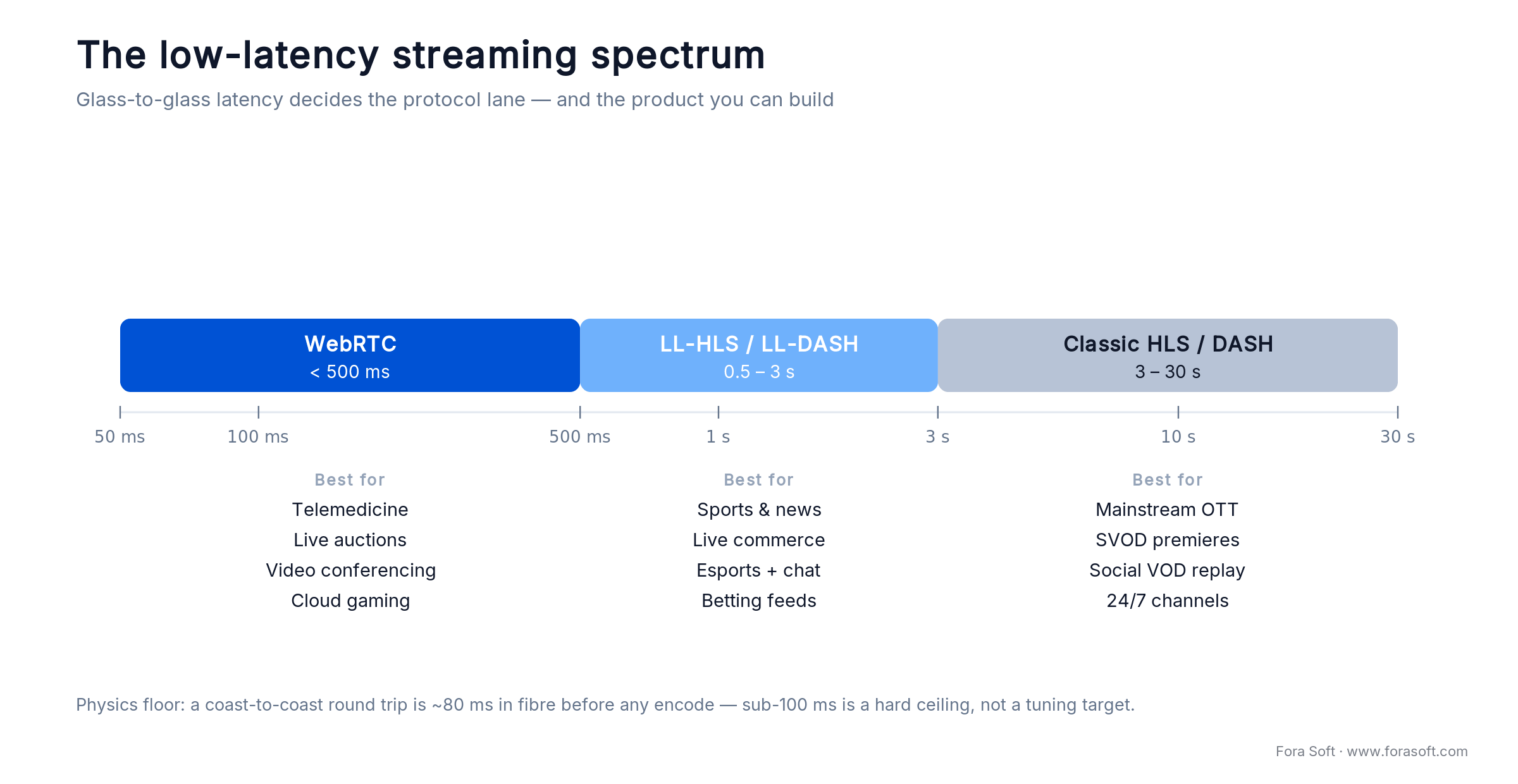
Figure 1. The latency your product needs decides the protocol lane: WebRTC, LL-HLS, or classic HLS.
The real stage-by-stage latency budget
Breaking glass-to-glass down into measurable stages is how every fast streaming pipeline ships. These are the numbers we target on a production WebRTC + CDN deployment:
| Stage | WebRTC (interactive) | LL-HLS (near-real-time) | Classic HLS (broadcast) |
|---|---|---|---|
| Capture + encode | 20–60 ms | 50–200 ms | 200–1,000 ms |
| Packaging | n/a (frame streams) | 200–400 ms (CMAF chunks) | 2–6 s (segments) |
| Network to CDN | 20–80 ms | 50–150 ms | 100–300 ms |
| CDN fan-out | n/a (SFU direct) | 50–200 ms | 200–500 ms |
| Player buffer | 20–100 ms (jitter) | 500–2,000 ms | 6,000–30,000 ms |
| Decode + display | 10–30 ms | 30–60 ms | 30–60 ms |
The player buffer is the single largest variable. LL-HLS can get under a second in practice only when the player is tuned; an unoptimised HLS.js or Shaka Player sits closer to 6 seconds even on an LL-HLS feed.
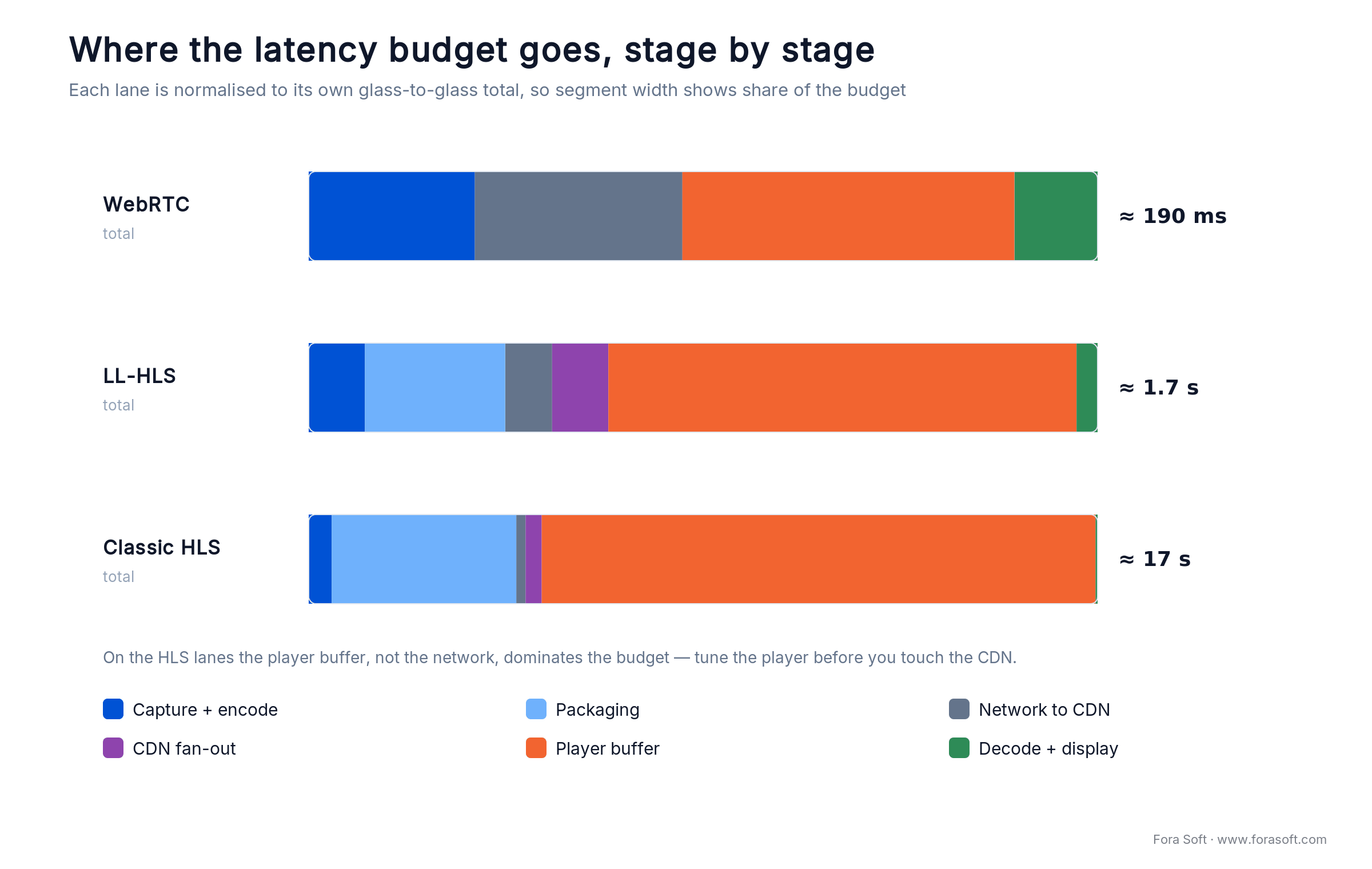
Figure 2. Where the milliseconds go. On the HLS lanes the player buffer, not the network, dominates the budget.
WebRTC: the interactive lane
WebRTC is the only protocol that consistently hits sub-500 ms glass-to-glass across 2026 browsers and mobile, and it is still the right default whenever the audience is small and the experience is bi-directional.
P2P. The lightest topology, no server in the media path. Works cleanly up to about six users; collapses on CPU and bandwidth past that, because each client uploads to every other client.
SFU (Selective Forwarding Unit). The 2026 default. One upload, many forwards, server never decodes. Scales from 5 to ~500 participants per room before CPU cost spikes. LiveKit, Mediasoup, Janus are the common stacks; managed services include Agora, Daily, and LiveKit Cloud.
MCU (Multipoint Control Unit). Server-side mixing into a single stream. Burns CPU but produces a single canvas for recording or broadcast. Use only when you have to (legacy clients, recording into one file, broadcast-out from an MCU).
Hybrid. SFU for the interactive layer, a separate HLS / LL-HLS ladder for the passive audience. This is what live-commerce, esports, and webinar products ship at scale.
Our WebRTC architecture guide for 2026 covers each of these topologies with reference numbers and when each one wins.
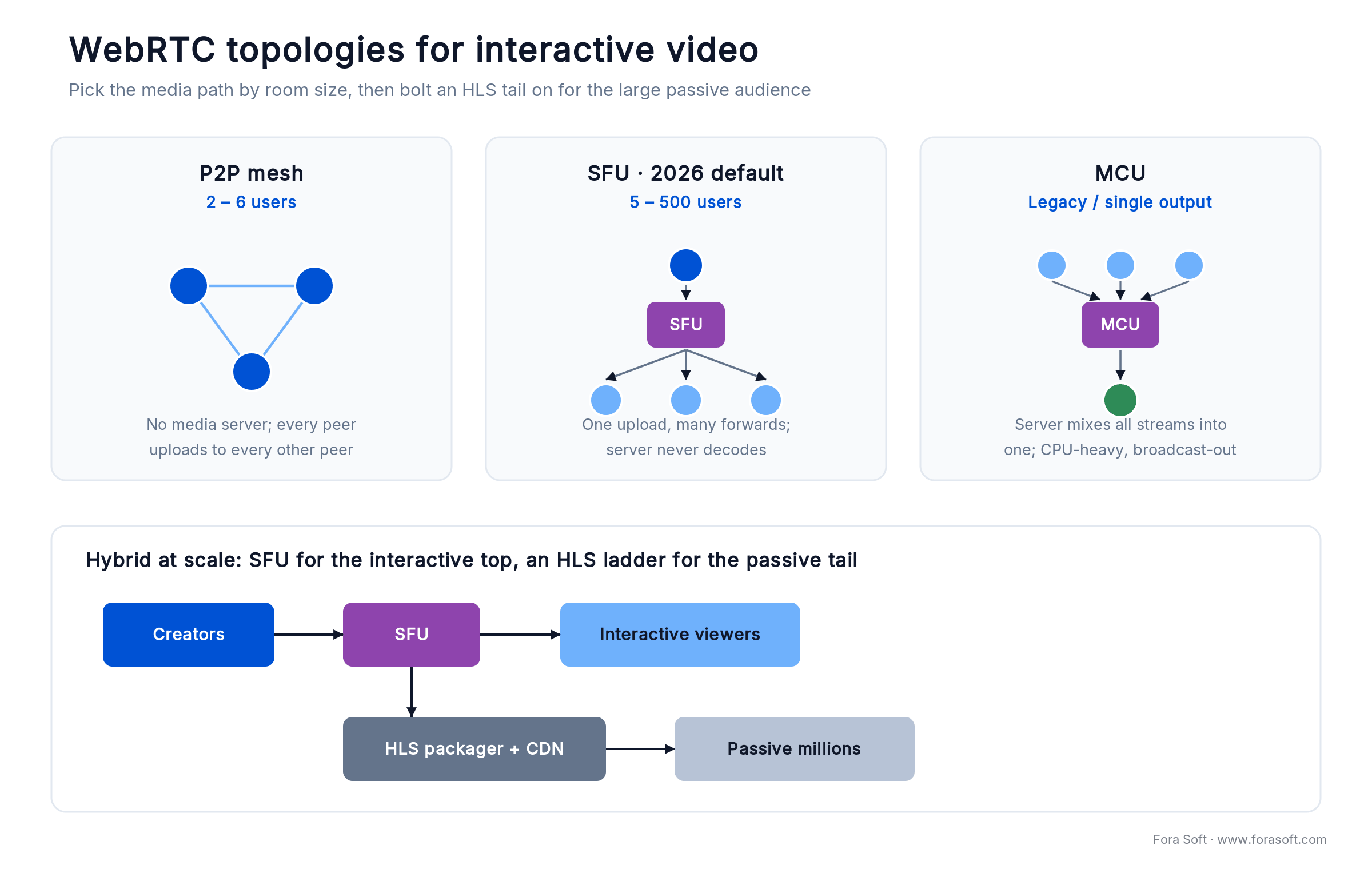
Figure 3. P2P for a handful of peers, SFU to ~500, MCU only for a single mixed output; hybrid adds an HLS tail.
Reach for WebRTC + SFU when: your room sizes are under 500 participants and the experience is interactive. Drop to a simulcast HLS ladder for the passive million, keep the interactive top-of-the-funnel on SFU.
LL-HLS and LL-DASH: the near-real-time lane
Low-Latency HLS and LL-DASH bring the HTTP streaming family down from 6–30 seconds to 1–3 seconds by shrinking segments to CMAF chunks (200–400 ms) and using blocking playlist reload with preload hints to hand them to the player as they are produced.
Where LL-HLS wins. Sports, news, esports, live commerce, live auctions with large audiences. CDN reach of HLS plus latency that is actually acceptable when a chat layer is synchronised with the video.
Where it struggles. Bi-directional conversation (use WebRTC), very low bandwidth networks where segment fetches stall (use an adaptive ladder or fall back to standard HLS), and legacy Safari versions with incomplete LL-HLS support.
Tuning the player. A naive HLS.js configuration sits at 6 s latency even over LL-HLS. Target buffer of 0.9–1.2 s, chunk size 200 ms, and aggressive early fragment fetching are the three knobs. Shaka Player and THEOplayer have matured LL-HLS modes; dash.js does the same for DASH.
Reach for LL-HLS when: your audience is 10K+ concurrents on Safari and mobile, chat synchronisation matters, and 1–2 s latency is acceptable. WebRTC is overkill at that audience size for a passive experience.
Classic HLS / DASH: broadcast distribution
Standard HLS (RFC 8216) with 6-second segments and a 3-segment buffer sits around 18 seconds glass-to-glass. DASH with similar segments tracks it. This is the cheapest per concurrent viewer because the CDN handles all the fan-out, and there is no back-pressure on the origin.
Pick it when the product does not depend on interactivity, DVR playback matters (rewinding, replay), and distribution is global-scale. A well-packaged HLS ladder (3–5 bitrates, 720p / 1080p / 4K) serves millions at pennies per viewer-hour. It is also the lane that reaches connected TVs cleanly: on Roku, Samsung, LG, and Google TV, WebRTC is effectively off the table for primary playback, so an HTTP-based protocol is the default there.
Codecs: H.264, HEVC, AV1
Codec choice hits your bill twice — encoder cost (CPU/GPU cycles) and delivery cost (bits on the wire). The three real choices in 2026:
| Codec | Bitrate vs H.264 | Encode cost | Device support (2026) | Best for |
|---|---|---|---|---|
| H.264 (AVC) | baseline | 1× | Universal | WebRTC default, legacy devices |
| HEVC (H.265) | 40–50% less | ~2× | Apple + most Android/smart TV | Premium OTT, HDR |
| AV1 | ~48–50% less | ~4× (SW), ~1.5× hw | Wide (Chromium, iPhone 15 Pro+, flagship Android) | Long-form OTT, archive |
For WebRTC in 2026, H.264 is still the safe default because of universal hardware decode and universal compatibility with SFU relays. HEVC is lighting up in newer Chromium and Apple stacks. AV1, the royalty-free codec from the Alliance for Open Media, is the right bet for long-form OTT where you can amortise the encode cost across millions of viewers, but a premature pick for a real-time interactive product. Netflix measured AV1 at 48.1% lower average bitrate than H.264 on real content in December 2025, roughly a 20–30% edge over HEVC; the measured detail is in our codec comparison on real content.
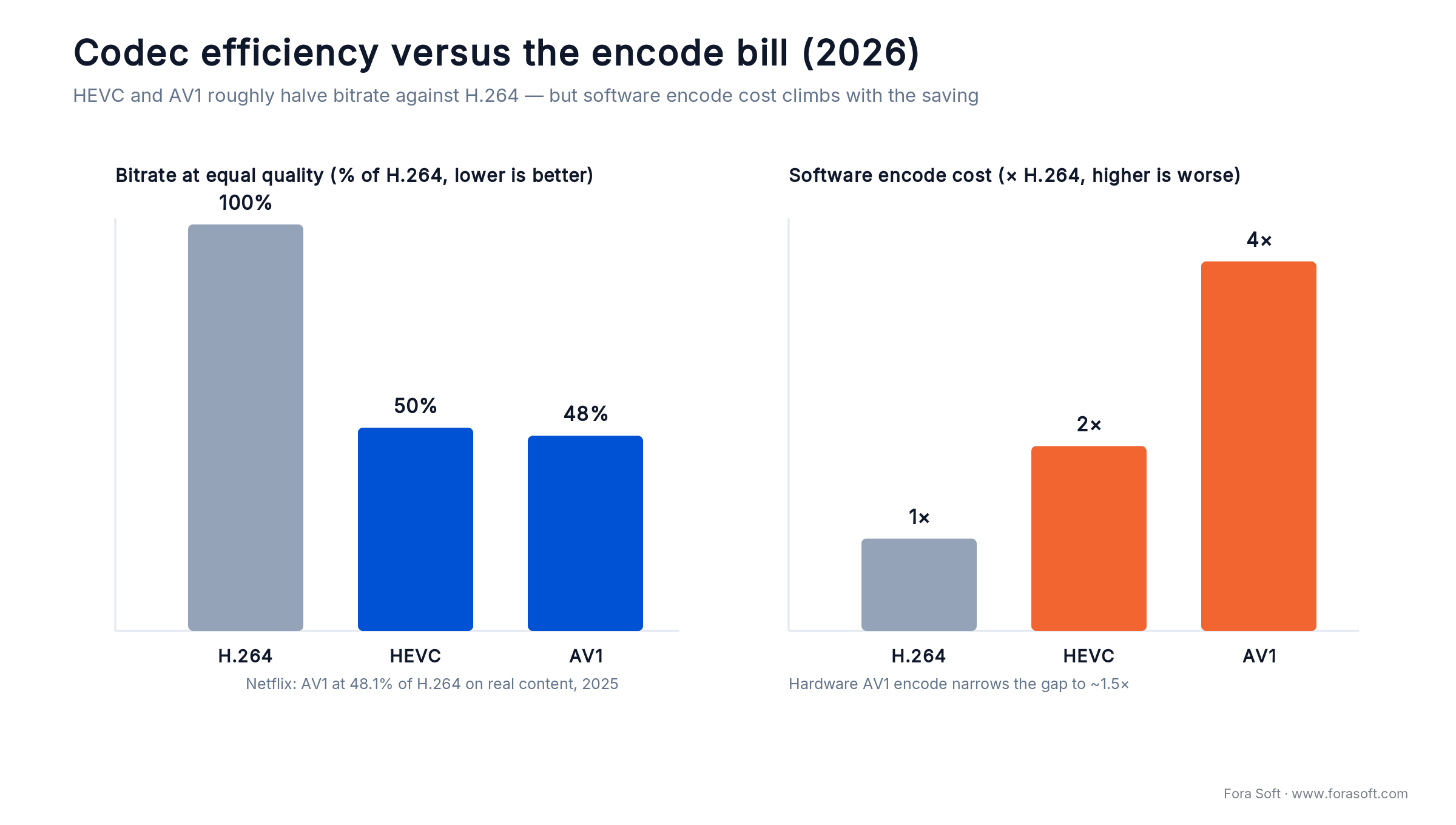
Figure 4. HEVC and AV1 each cut bitrate roughly in half versus H.264, but the encode bill rises with the saving.
Reach for AV1 when: your audience is 1 M+ concurrents on premium content and you can afford a ~4× software encode farm. Otherwise HEVC gives you 90% of the saving at a third of the pain.
CDN and edge: where the p95 latency is decided
Average-latency numbers sell; p95 and p99 numbers retain customers. The CDN and edge tier is where most of the tail variance is either contained or unleashed.
Cloudflare. Anycast, global footprint, aggressive caching, first-class HTTP/3. Good for LL-HLS/DASH and general video delivery. Stream product provides WebRTC streaming at scale.
Fastly. Programmable edge (VCL / Compute). Excellent for live DVR, personalised ads, and anything needing edge-side logic on the video path.
AWS CloudFront + MediaLive / MediaPackage. The “everything in one place” option when the rest of your stack is already on AWS. MediaLive handles the encode, MediaPackage the just-in-time packaging.
Akamai / Limelight. Still the incumbents in enterprise-scale premium broadcast. Best p95 performance in many markets, at premium cost.
Edge compute. Cloudflare Workers, Fastly Compute@Edge, and Lambda@Edge let you run packaging and just-in-time encode near the viewer, which is often how LL-HLS hits its sub-2-second number at scale. For the deeper story see our edge-computing guide for live streaming.
Reach for edge packaging when: your p95 latency target is below 2 s on LL-HLS at global scale. Origin-only packaging is how p95 latency quietly triples in the second continent.
Mini case: 1080p at 8 Mbps for live production
Situation. Speed.Space, a remote video production platform we built, needed to stream 1080p at 8 Mbps (roughly 5× a standard video-call bitrate) to production teams that cut footage the same day it is shot. Directors needed sub-second preview; editors needed full-fidelity record; colorists needed HDR metadata to survive transport. We wrote up how that workflow runs day to day, from double-ender capture to the same-day editorial handoff, in our remote video production workflow breakdown.
12-week plan. We split the stack into a WebRTC-based preview path for interactive review, a parallel record ladder for post, and a HEVC + HDR10 metadata chain for color. The alignment work was moving tone mapping into the device GPU so latency dropped ~40% vs edge-node tone mapping. The WebRTC layer, our home territory since 2005, shipped on schedule.
Outcome. Before Speed.Space, post-production teams waited hours for dailies; after, they cut live at 5× bitrate. The lesson for low-latency streaming is direct: optimise the stage-with-the-biggest-budget first, not the one that’s easiest to measure. Want a similar breakdown of your pipeline?
Stream missing its latency SLA?
We will run a week-long audit across capture, encode, packaging, CDN, and player buffer, and hand you a prioritised fix list with week-level estimates.
A decision framework — pick your streaming lane in five questions
1. Is the experience interactive? If the viewer is talking back, clicking in real time, or making decisions that depend on < 1 s feedback, you are in WebRTC territory. Skip LL-HLS.
2. What is the concurrency profile? Under 500 concurrent interactive participants: SFU is fine. Above 500 and the audience is mostly passive: hybrid SFU + HLS. Above 50K and it is HLS / LL-HLS-led.
3. What is the acceptable latency at p95? Not the average — the tail. LL-HLS can hit 2 s median and 6 s p95 on poorly tuned players. Budget the tail explicitly.
4. What is the device distribution? Chromium-heavy: AV1 and HEVC are viable. Safari-heavy: LL-HLS is a safer bet than DASH-only. Legacy smart TV: you are stuck with classic HLS or HEVC.
5. What does the recording / DVR experience look like? If viewers rewind, LL-HLS / HLS has to be the source of truth. WebRTC is a preview layer; combine the two if needed.
Five pitfalls that burn streaming quarters
1. Measuring only average latency. Viewers notice the tail. Instrument p95 and p99 across every session, not a synthetic probe on your office network.
2. Default player settings in production. HLS.js, Shaka, dash.js all ship with conservative buffers. LL-HLS without player tuning is indistinguishable from classic HLS.
3. Wrong codec for the audience. AV1 on a Safari-heavy audience means fallback transcoding on every stream; HEVC on a Chromium-heavy audience means missed compression gains. Measure the device mix before you commit.
4. Ignoring the CDN tier. A $20K/year saved-on-CDN becomes a $2M churn line when p95 latency bounces around during peak events.
5. No fallback path. WebRTC blocked by corporate firewalls, LL-HLS choppy on weak networks. Every live product needs a graceful degradation ladder, all the way down to plain HLS, or support spends its life answering “the stream is dead.”
KPIs: what to measure after you ship
Quality KPIs. Glass-to-glass latency p95 and p99 per region; rebuffering ratio (< 1% is the bar); startup time (< 2 s target); bitrate serving distribution; failure rate per player/device. Measure from the client, not the origin.
Business KPIs. Dwell time per session, drop-off at minute 1 / 5 / 15, concurrent peak, viewer-to-interaction conversion, CDN cost per viewer-hour. Tie the dashboard to the product’s north-star metric on day one.
Reliability KPIs. Uptime > 99.9% for live events, stream abandon rate < 5%, CDN failover time under 30 s, end-to-end monitoring on every PoP. Without these, the first disappointing event is also the last.
Cost model: what live video pipelines actually cost
Three order-of-magnitude cost pictures, per concurrent viewer-hour. Real numbers swing with codec, CDN deal, bitrate ladder, and region mix.
WebRTC SFU. $0.002–0.01 per participant-minute on a self-hosted Jitsi/Mediasoup/LiveKit cluster; 2–4× higher on managed (Agora, LiveKit Cloud) for turnkey ops. Cost scales with CPU on the SFU and bandwidth on the egress.
LL-HLS with Cloudflare Stream / AWS MediaPackage. $0.003–0.008 per viewer-hour at typical 720p bitrates; HEVC shaves 30–40% off the bandwidth line.
Classic HLS (global CDN). $0.001–0.003 per viewer-hour in volume; the cheapest per-hour tier, unsurprisingly.
Custom engineering on top of these numbers lands well when you need branded player experiences, DRM (Widevine / FairPlay / PlayReady), proprietary features, or tight integration with an existing back-end. With Agent Engineering we compress the engineering line-item on these projects; ranges, not promises.
When a custom low-latency build is not worth it
Four patterns where a managed solution beats a bespoke build:
1. Generic conferencing. If the product is a Zoom-clone, use Zoom SDK, Daily, or LiveKit Cloud. Bespoke SFU + codec pipeline only earns its keep when the experience is meaningfully different.
2. Small audiences. Under 10K peak concurrents, a managed LL-HLS service is cheaper than the fully-loaded cost of operating your own encode and CDN.
3. No in-house video expertise. Real-time streaming has long-tail operational work — codec changes, CDN negotiations, browser quirks, DRM rotations. Without an owner, a custom build decays.
4. The latency target is 5 s+. Classic HLS on a commodity CDN is the right answer; there is nothing to optimise below.
Second opinion on your streaming architecture?
We have shipped this stack (WebRTC, LL-HLS, HEVC, edge packaging) at Netflix-, HBO-, and evidentiary-grade scale. Tell us your bottleneck.
Compliance and security: DRM, GDPR, HIPAA
DRM. Widevine (Google), FairPlay (Apple), PlayReady (Microsoft) cover the three platforms. Multi-DRM packaging is the standard; most managed services (BuyDRM, ExpressPlay, AWS) handle key rotation.
Encryption. SRTP on WebRTC is the floor. CMAF CBCS / CENC for HLS/DASH. TLS 1.3 everywhere; end-to-end encryption available in LiveKit, Daily, and Zoom for ultra-sensitive use cases.
GDPR and HIPAA. For telemedicine, HIPAA BAA with the SFU provider is non-negotiable; GDPR pushes most EU video streams to regional PoPs with a processor agreement. Schrems II analysis is still the right starting frame for EU–US data flow on any streaming product.
Privacy and recording. Jurisdictions vary: one-party consent vs two-party-consent recording laws in different US states, and explicit consent under GDPR. Bake the UX in, not on.
Integration checklist: before engineering begins
Lock these five decisions before spec-writing begins, or expect each one to cost weeks mid-build.
- Latency target (p95, not median). State the number; state how it is measured.
- Peak concurrency and geographic mix. Drives CDN and region selection.
- Codec commitment. H.264 / HEVC / AV1 — single or multi-ladder. Device mix drives this.
- Player. Bespoke vs Shaka / HLS.js / video.js / native. A commitment now saves weeks of QA later.
- Recording / DVR requirement. Changes everything from packaging to storage.
Emerging trends that will reshape streaming through 2027
Media over QUIC (MoQ) moves from draft to deployable. MoQ is a new IETF publish/subscribe transport that carries media over QUIC and WebTransport, organising each stream as tracks and objects that subscribe-once, fan-out-many relays can cache like a CDN. As of draft-ietf-moq-transport-17 (2 March 2026) it is Standards Track but not yet an RFC, so production deployments still carry interop risk. Our MoQ deep dive tracks where it is safe to bet today.
WebTransport is now Baseline. Since Safari 26.4 shipped in March 2026, WebTransport works in every current Chromium browser, Firefox, and Safari, including iOS, with no polyfill. That is what makes MoQ and the next generation of WHIP ingest practical straight from a browser, no WebRTC data channel required.
AV1 hardware decode goes mainstream. iPhone 15 Pro and flagship Android have shipped AV1 decode since 2023; 2026–27 pushes it into smart TVs and set-top boxes. With Netflix reporting 48.1% lower bitrate than H.264, the savings finally land on delivery bills instead of encode farms.
AI runs inline on the stream. Live captioning, translation, super-resolution, background masking, and moderation increasingly run in the live path. Our real-time AI video playbook covers the patterns that keep them inside the latency budget.
Edge-rendered personalisation. Ad insertion, overlays, and interactive layers rendered in Cloudflare Workers or Fastly Compute near the viewer keep latency honest while personalising each feed.
FAQ
What counts as “low latency” in video streaming?
Three tiers in practice. Interactive (< 500 ms) — WebRTC territory, telemedicine, live auctions, conferencing. Near-real-time (0.5–3 s) — LL-HLS / LL-DASH, sports, live commerce, news. Classic broadcast (3–30 s) — standard HLS / DASH, mainstream OTT. The protocol and the product are tightly coupled.
WebRTC or LL-HLS — which should we pick?
WebRTC if the audience is under ~500 concurrent participants and the experience is interactive. LL-HLS if you need CDN-scale distribution with near-real-time latency to large passive audiences. Most products end up hybrid — WebRTC for the interactive top, LL-HLS or HLS for the broadcast tail.
Should we use AV1 in 2026?
For long-form OTT on Chromium-heavy audiences, increasingly yes — AV1 runs about 48% lower bitrate than H.264 (Netflix measured 48.1% on real content in 2025) and hardware decode is now widespread. For real-time WebRTC interactive products, H.264 is still the safe 2026 default because of universal SFU / browser support; HEVC is the next step up.
How do we cut LL-HLS latency below 2 seconds in practice?
Reduce CMAF chunk size to 200 ms, tune the player’s target buffer to 0.9–1.2 s, use HTTP/2 push or preload hints, and deploy the packager at the edge (Cloudflare, Fastly, CloudFront with Lambda@Edge). All four together land you reliably at ~1.2–1.8 s glass-to-glass on modern players.
How long does a low-latency streaming build take?
A focused WebRTC-based MVP — capture, SFU, web / mobile player, record to disk — lands in 8–12 weeks with a team that ships real-time video regularly. An enterprise build with DRM, multi-codec ladders, LL-HLS fallback, and SOC 2 / HIPAA readiness runs 4–8 months. Agent Engineering compresses both ends of that range meaningfully.
What is the difference between SFU and MCU?
An SFU forwards each participant’s stream without decoding, keeping CPU low and scaling well to 500 participants per room. An MCU decodes all streams, mixes them into one, and re-encodes a single output — CPU-heavy but useful when the downstream client can only consume one stream (legacy systems, SIP gateways, recording). In 2026, SFU is the default; MCU is reserved for constraints.
Do we need multi-DRM?
For premium OTT content, yes — Widevine for Android / Chromium, FairPlay for Apple, PlayReady for Microsoft. Most managed services handle packaging and key rotation across all three. For non-premium live streams (webinars, sports with commodity rights), DRM is usually overkill — TLS + signed URLs and token-gated access cover 95% of use cases.
How much does a 100K-concurrent live event cost to deliver?
Order of magnitude: $150–400 per hour of streaming on a global CDN at 720p H.264 for 100K concurrents; HEVC trims ~30%, AV1 about half. Custom encode farms change the fixed-cost side. Expect $20K–50K engineering investment to tune the pipeline before the first event and another $5K–15K of ops per event at that scale.
What to Read Next
WebRTC
WebRTC Architecture Guide for Business 2026
P2P, SFU, MCU, and hybrid — the topology choices that shape interactive latency.
Infrastructure
Edge Computing for Live Streaming
Where to place encoders and packagers to defend the p95 latency number.
AI & Video
Real-Time Video Processing with AI: 2026 Playbook
How inline AI reshapes a live streaming pipeline without blowing the latency budget.
OTT
OTT Platform Development: Ultimate Guide
The broader picture when HLS and DRM carry the product, not WebRTC.
Ready to ship streaming that hits its latency target?
Low-latency streaming in 2026 is a stage-by-stage systems problem. WebRTC for interactive, LL-HLS for near-real-time broadcast, classic HLS when latency is negotiable. Codec, CDN, and player tuning shape cost more than the protocol choice; p95 latency is the metric that keeps customers, not the average.
If you are scoping a live streaming product, the fastest move is a 30-minute call with a team that has shipped WebRTC, LL-HLS, and HLS at Netflix-, HBO-, and evidentiary-grade scale. We will look at your audience, latency target, and cost ceiling and tell you where to build, where to buy, and where the quiet week-eaters are hiding.
Talk to engineers who ship low-latency streaming
30 minutes, no slides. Bring your current stack; we’ll map it to a week-level plan.

