

Key takeaways
• IoT video surveillance runs on a $72–95B market in 2026. Estimates span Mordor Intelligence ($71.65B, 10.65% CAGR) to Fortune Business Insights ($95B, 13.5%); edge AI and VSaaS drive the growth.
• Edge analytics cut latency 10–40x vs cloud. < 50 ms at the camera vs 500–2,000 ms via cloud, plus up to 70% bandwidth savings when only metadata leaves the site.
• AI analytics cut false alarms sharply. Vendor benchmarks (Scylla, Lumana) claim 85–99% fewer false alerts than pixel motion; Gartner pegs about 75% of enterprise data as created and processed outside the datacenter, up from 10% in 2018.
• Pick your VMS before you pick your cameras. ONVIF Profile S/T + a mature VMS (Milestone, Genetec, or a custom build on top of NVIDIA DeepStream) decides what your IoT ecosystem can connect to.
• Fora Soft runs VALT for 770+ US organizations and 50,000+ users. We’ve built the architecture in this guide for real customers in law enforcement, courts, transit and industrial, with zero evidence-chain incidents over 14 consecutive release months.
Why Fora Soft wrote this playbook
Fora Soft has spent 20+ years shipping video-centric products, and IoT video surveillance is our home turf. V.A.L.T, our AI video surveillance and interview-recording SaaS, serves 770+ US organizations and 50,000+ users; we built the entire camera-to-cloud pipeline, including edge ingest, analytics, evidence-chain integrity, and client applications. We’re a software development company with 250+ projects since 2005.
This guide is the architecture document we walk product owners through when they ask how to build an IoT video surveillance product from scratch. You’ll see the reference architecture, the tool choices, the cost math, the compliance checklist, the pitfalls, and the five-question framework we use to decide “custom build” vs “VMS + plugin” vs “cloud-only.” Every claim is grounded in a live project or a cited benchmark. Related reading: Industrial Video Surveillance AI and our video surveillance development service page.
If you’re short on time, skip straight to section 11 (reference architecture) and section 13 (the five-question decision framework).
Building or scaling an IoT video surveillance product?
Tell us about your camera count, use case, and compliance surface. We’ll map a 12-week plan with real numbers in a 30-minute call.
The 2026 market snapshot and why IoT flips the economics
Connected-camera economics changed twice in the last three years. First, edge silicon got cheap enough that real-time AI inference now runs on a single Jetson Orin or an Axis ARTPEC camera, without a datacenter round-trip. Second, VSaaS (Video Surveillance as a Service) hit mainstream adoption for smaller deployments, which blew up the “DVR in a closet” model most integrators grew up on.
| Metric | 2025 | 2026 (projection) | Source / note |
|---|---|---|---|
| Global market size | $64–84B | $72–95B | Mordor 10.65% · Fortune BI 13.5% CAGR |
| VSaaS share | $12B | $14B+ | 15%+ CAGR, IPVM |
| Analytics running at the edge | ~40% | 50%+ | Industry est.; Gartner: ~75% of data off-datacenter, up from 10% in 2018 |
| H.265 adoption on new cameras | 85% | 95%+ | Saves 25–50% vs H.264 |
| ONVIF-certified devices in circulation | 30M+ | 35M+ | ONVIF.org member roster |
The punch line: cameras became edge computers, the network became the bottleneck, and analytics became the product. Precedence Research projects the wider video surveillance market past $267B by 2035, so the tailwind is real. Whoever gets the edge-analytics, VMS and cloud integration right ships something customers actually pay for.
Reference architecture for IoT video surveillance in 2026
This is the canonical five-tier pipeline we deploy for any serious IoT video surveillance product. Each tier has a clear responsibility; crossing them by accident is how most builds fail.
| Tier | Responsibility | Common tech | Protocols |
|---|---|---|---|
| 1. Edge cameras & sensors | Capture, encode, on-device inference | Axis, Hanwha, Hikvision, LPR cameras, PTZ | RTSP, ONVIF Profile S/T, MQTT |
| 2. Gateway / on-site NVR | Aggregation, local buffer, fallback recording, edge analytics | NVIDIA Jetson Orin, Axis edge NVR, Intel SmartEdge | gRPC, MQTT, Kafka, WebRTC |
| 3. VMS / core services | Stream management, recording, access control, user roles | Milestone XProtect, Genetec, custom on Kubernetes | REST, gRPC, GraphQL |
| 4. Analytics & storage | Cloud inference, long-term retention, search | NVIDIA DeepStream, AWS Rekognition, Azure Video Indexer, Wasabi, S3 tiering | S3, Kafka, Kinesis |
| 5. Client applications | Live view, investigation, alerting, export | Web app (React), iOS/Android, operator desktop | WebRTC, LL-HLS, WebSocket |
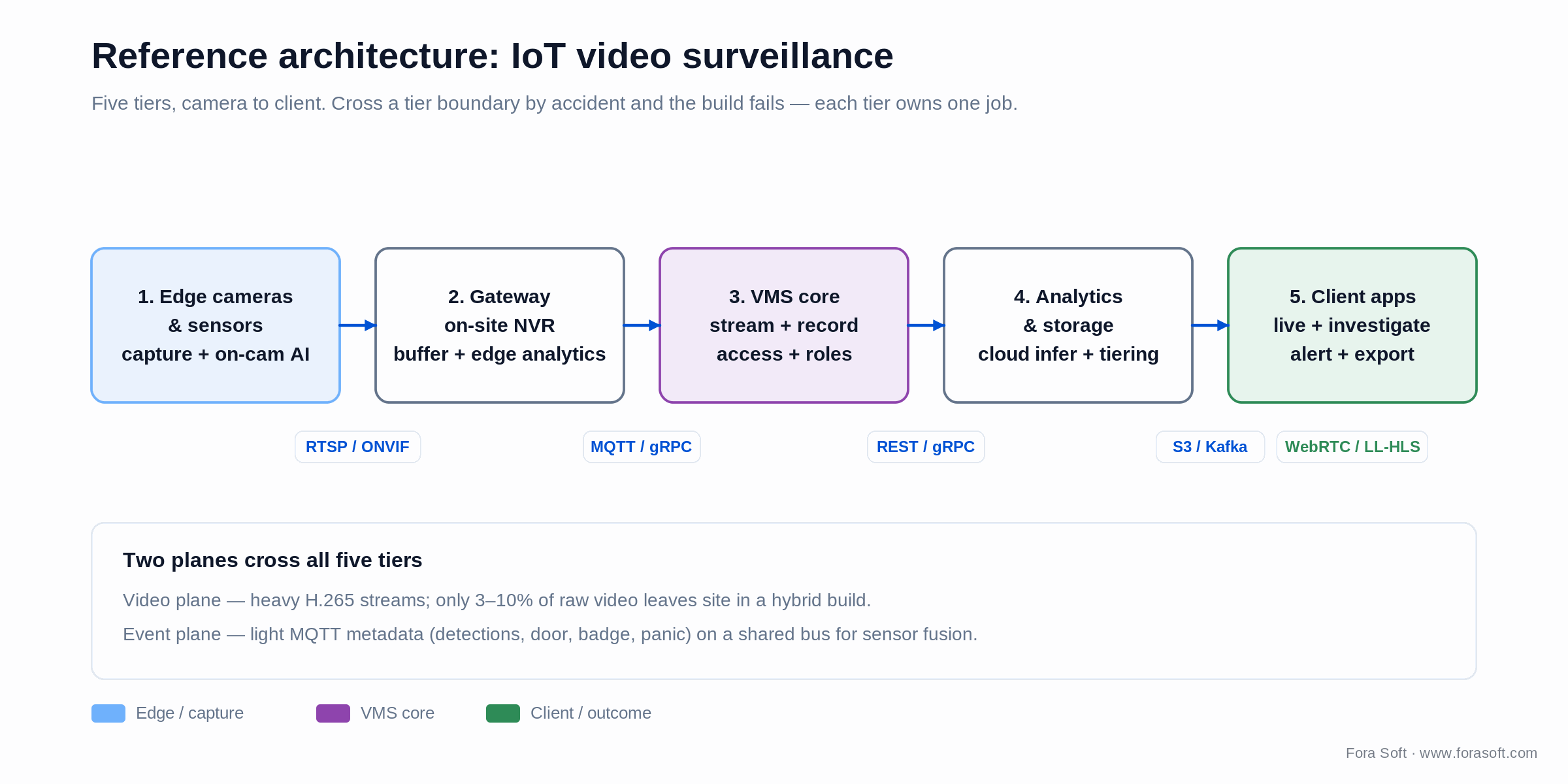
Figure 1. The five-tier reference architecture we deploy for IoT video surveillance — each tier owns one job, with the protocols that cross each boundary.
Reach for a custom VMS when: you need tight control over analytics pipelines, custom metadata, or evidence-chain integrity — what we built on top of NVIDIA DeepStream for VALT. For generic multi-site retail or office surveillance, start with Milestone or Genetec and add plugins.
Edge vs cloud analytics: the latency-bandwidth tradeoff
Default to hybrid: run detection and real-time alerts at the edge (under 50 ms) and ship only metadata plus event clips to the cloud for deep search and re-identification. This is the single most consequential architecture decision. Get it wrong and either your analytics is too slow to matter or your uplink bill eats your margin.
| Dimension | Edge (on-camera / gateway) | Cloud | Hybrid (what we default to) |
|---|---|---|---|
| Inference latency | < 50 ms | 500–2,000 ms | Edge for real-time, cloud for deep search |
| Bandwidth to cloud | Metadata only, up to 70% savings | Full video uplink | Metadata continuous, video on event |
| Model update frequency | Quarterly OTA | Continuous | Edge OTA monthly, cloud continuous |
| Failure mode under network loss | Degraded gracefully | Service unavailable | Local buffer, sync on recovery |
| Good for | Intrusion, LPR, crowd count | Cross-site search, re-ID, training | Everything serious |
Our hybrid default: detection and real-time alerts run on-edge with quantized models (YOLO-family or vendor SDKs); clips and metadata ship to cloud for deep search, re-identification, and model retraining. Only 3–10% of raw video typically leaves the site, enough to drop a 400-camera deployment’s uplink cost from thousands to hundreds of dollars per month.
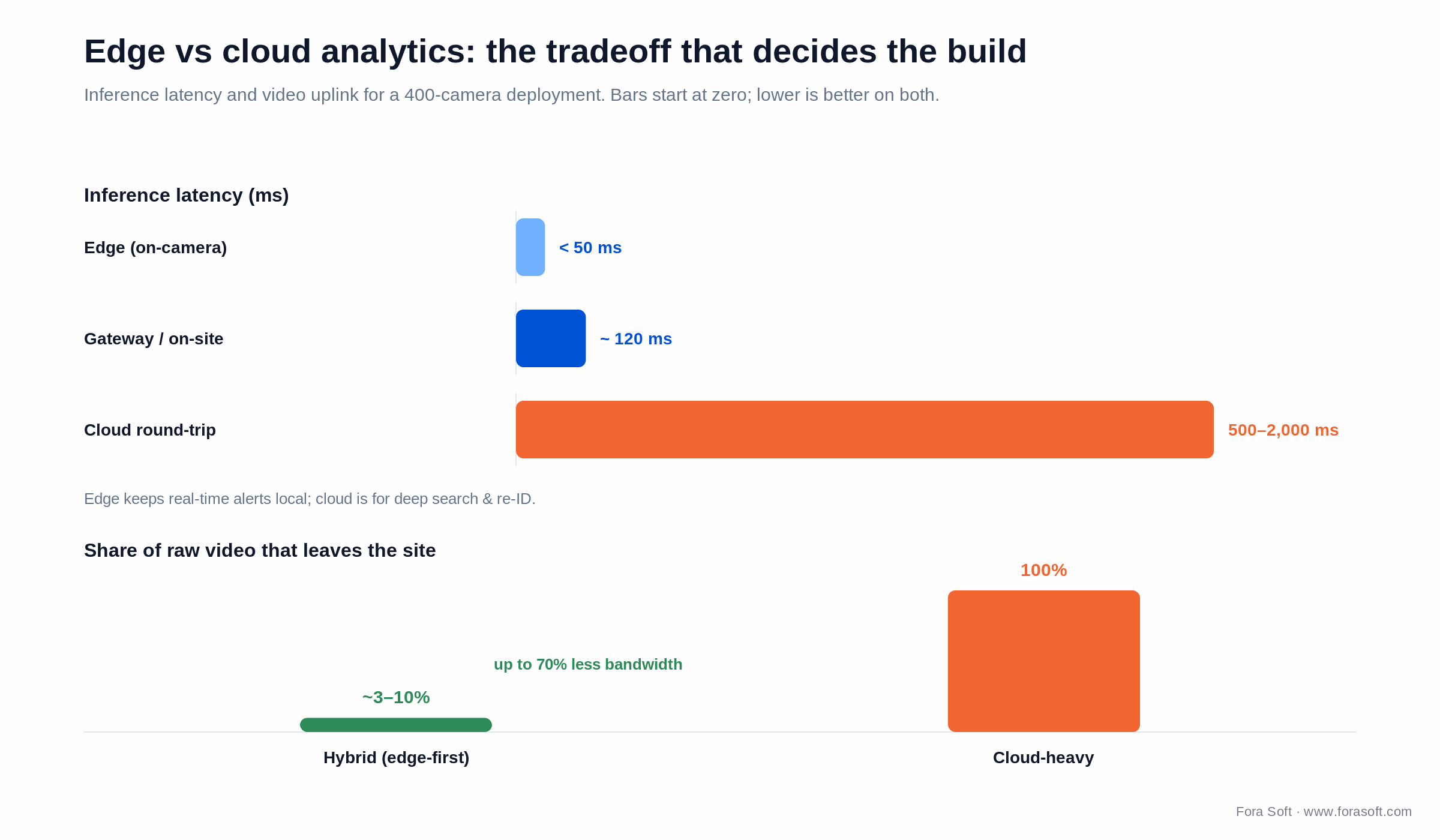
Figure 2. Edge keeps inference under 50 ms and lets only 3–10% of raw video leave the site; the cloud round-trip costs both latency and bandwidth.
Protocols: RTSP, WebRTC, HLS, ONVIF, MQTT — when to use each
Protocol selection is where most “surveillance-meets-web” projects quietly die. Here’s the decision grid we use.
| Protocol | Role | Typical latency | When to pick |
|---|---|---|---|
| RTSP | Camera → gateway ingest | 100–500 ms | Native camera protocol; local network only. |
| WebRTC | Operator live view | 200–500 ms | Real-time dashboard, PTZ control, two-way audio. |
| LL-HLS | Multi-viewer live | 1–3 s | 100s of concurrent operators; CDN-friendly. |
| HLS | Archive replay | 5–20 s | Investigations, playback, mobile. |
| ONVIF Profile S/T | Streaming, PTZ, metadata events | n/a | Multi-vendor camera interoperability (default yes). |
| MQTT | Sensor & analytics events | < 100 ms | Low-bandwidth eventing, alerts, sensor fusion. |
A common mistake: pushing RTSP through the public internet to a browser. Browsers don’t natively play RTSP. Terminate RTSP at your gateway, re-encode to WebRTC or LL-HLS for delivery. Standardize discovery and PTZ on ONVIF Profile S/T so you aren’t locked to one camera brand; our guide to ONVIF profiles in security systems breaks down the choice. For the delivery-protocol internals, see our Learn hub on video streaming and testing WebRTC stream quality.
AI analytics that actually works in production
Analytics is the feature list customers pay for; everything else is plumbing. In production we run detectors on NVIDIA DeepStream at the edge and reserve the cloud for cross-camera search. These are the six capabilities that earn their keep in 2026:
Person / vehicle / animal detection
Baseline feature. YOLO v8/v10 or vendor SDKs quantized to INT8 run 60–120 FPS on a single Jetson Orin Nano, covering 8–16 cameras per device. False-positive rate after tuning typically lands at 1–3%.
License plate recognition (LPR/ANPR)
High ROI for parking, gated communities, transit, fleet. Dedicated LPR cameras with built-in ANPR beat generic cameras by 20–40% accuracy. Budget a tuning phase — country-specific plate fonts and weather still trip general-purpose models.
Intrusion / perimeter breach
Classic motion-detection’s smart successor. Polygon zones + classification (person vs dog vs leaf) cut false alarms by 85–99% vs pixel-based motion — numbers from Scylla AI and Lumana benchmarks.
Face detection, matching, and re-ID
Most regulated analytic. GDPR Art. 22 and similar rules restrict solely-automated decisions on people, so production deployments put a human in the loop for every match. Re-identification across cameras is where deep-feature cloud models beat any on-edge option.
Crowd density and flow
Retail, transit, stadium use cases. Heatmaps + directional counting drive space planning. We built this on top of NVIDIA DeepStream for a transit-hub client; one PoE camera replaces three traditional people counters.
PPE and safety compliance
Industrial-safety win. Hardhat / vest / glove detection pays back inside a quarter on any site with insurer-imposed PPE requirements. Detail in industrial video surveillance AI.
Reach for AI analytics when: you have > 20 cameras, pay for human monitoring, or your customers are measured on response time. Below that, smart motion detection is usually enough.
Sensor fusion: when video meets everything else
The biggest lift from true IoT integration is correlating video with non-video signals. Access control badges, door sensors, environmental data (temperature, smoke, CO), license plate readers, gunshot detection, and RFID tags all reduce the “what just happened?” window to seconds.
Practical pattern. Non-video sensors talk MQTT into the same event bus that your video analytics publishes to. An operator dashboard subscribes to correlated events (door opened + no badge + person detected = alert). Latency from sensor event to operator screen stays under a second across a typical site.
Real example. In our VALT deployments, interview-room cameras, microphones, door sensors, and recording-signal LEDs all join a single evidence-chain record — tamper-evident, court-admissible.
Need to fuse IoT sensors into a tamper-evident video timeline?
We built exactly that pipeline for 770+ US organizations and 50,000+ users. Let’s talk about your stack.
Storage tiering and the retention-cost trap
Storage is the single largest line item for any IoT surveillance product at scale, and the mistake we see most often is picking one tier and letting video rot. Tiering by access frequency typically saves 60–80% over a flat S3 Standard setup.
| Tier | Access pattern | Typical price / TB / month | Notes |
|---|---|---|---|
| On-site NVR (hot) | 24–72 h rolling | ~$5 amortized | Network-loss fallback, instant replay |
| Cloud hot (S3 / Wasabi) | 7–30 days | $7–23 | Wasabi: no egress fees — preferred for frequent retrieval |
| Cloud warm (S3-IA) | 30–180 days | $12.50 | Retrieval has a fee; pick based on investigation cadence |
| Cloud cold (Glacier) | 180 days–18 months | $4 | Retrieval 3–12 hr; audit and compliance |
| Glacier Deep Archive | 18m–7 years | ~$1 | Legal hold / long-tail evidence |
Always keep 24–72h on-site for network-resilience and instant replay. Lifecycle rules move video to Glacier/Deep Archive on the compliance schedule. Watch egress fees: they can silently eat 30–60% of a naive cloud setup. The codec choice sets the whole storage bill, so standardize on H.265 (see our Learn hub on video encoding).
Reach for hybrid storage when: you retain more than a few days of multi-camera footage. Keep 24–72h hot on-site, tier the rest to cloud warm and Glacier, and you cut the storage bill 60–80% versus flat S3 Standard.
Mini case: how VALT runs IoT video for 770+ organizations
Situation. A law-enforcement SaaS needed to capture interviews, interrogations, and booking-room video across a base that now spans 770+ US organizations and 50,000+ users, with evidence-chain integrity, tamper detection, redaction tooling, and multi-camera sync.
Architecture. Axis IP cameras (H.265) on PoE at every interview room; Jetson-based edge gateway per agency for local buffering and audio-triggered segmentation; custom VMS on Kubernetes; AWS S3 + Glacier tiering for long-term evidence; WebRTC for live monitoring; LL-HLS for multi-jurisdiction playback; MQTT for sensor events (door, mic, panic button).
Outcome. Zero evidence-chain incidents over 14 consecutive release months; average live-view latency under 500 ms across 48 US states; retention cost cut 62% after Glacier tiering; 23-second average case-retrieval time during audits.
Similar patterns show up on smaller-scale deployments: see NetCam and Smart IPTV for mid-sized installs. Want a similar assessment of your stack? Book a 30-minute call and we’ll walk your architecture.
Cost model: what a 400-camera IoT surveillance product really runs
A 400-camera IoT video surveillance build runs roughly $3.4k–5.2k a month fully loaded on a hybrid architecture, versus $10.2k–14k cloud-heavy and $2.7k–4.3k edge-heavy. Ranges below are fully-loaded monthly operating cost for a 400-camera multi-site deployment running hybrid analytics at 1080p30 with 30-day hot retention + 12-month cold. Your numbers will vary; use as sanity check.
| Line item | Cloud-heavy | Hybrid (recommended) | Edge-heavy |
|---|---|---|---|
| Uplink bandwidth | $4,500–6,000 | $900–1,400 | $400–700 |
| Storage (hot + cold) | $3,200–4,500 | $1,400–2,000 | $900–1,400 |
| Cloud compute (analytics) | $2,500–3,500 | $600–1,000 | $200–400 |
| Edge hardware amortization | $0 | $500–800 | $1,200–1,800 |
| Total | $10.2k–14k | $3.4k–5.2k | $2.7k–4.3k |
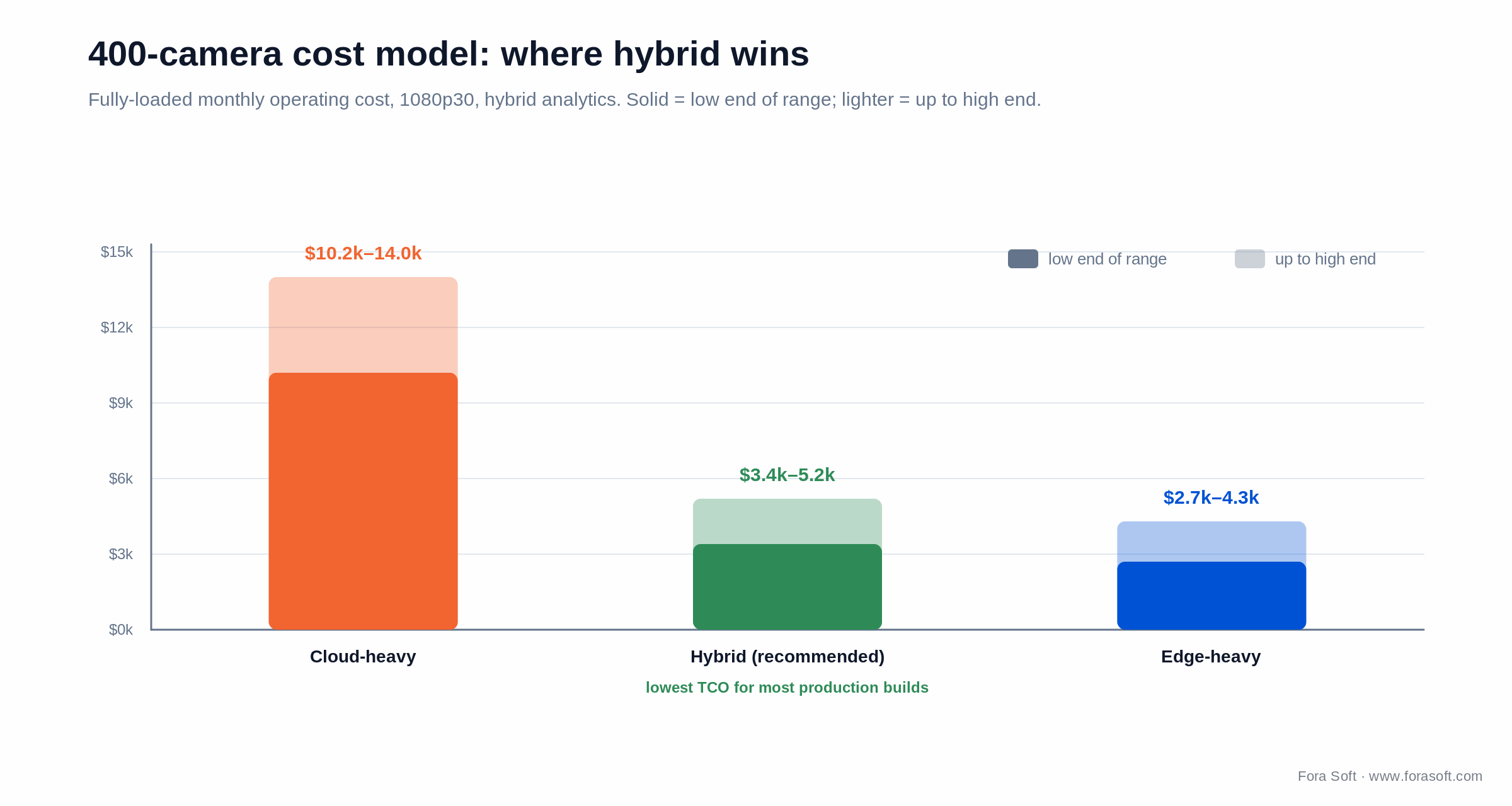
Figure 3. Fully-loaded monthly cost for a 400-camera build. Hybrid lands lowest for most production deployments; edge-heavy wins on bad uplinks.
Hybrid wins the total-cost-of-ownership fight for most production deployments. Edge-heavy wins if your customer has unreliable uplinks (transit, remote industrial, maritime).
A decision framework in five questions
Ask these before a single RFP goes out. Your answers drive 80% of the architecture.
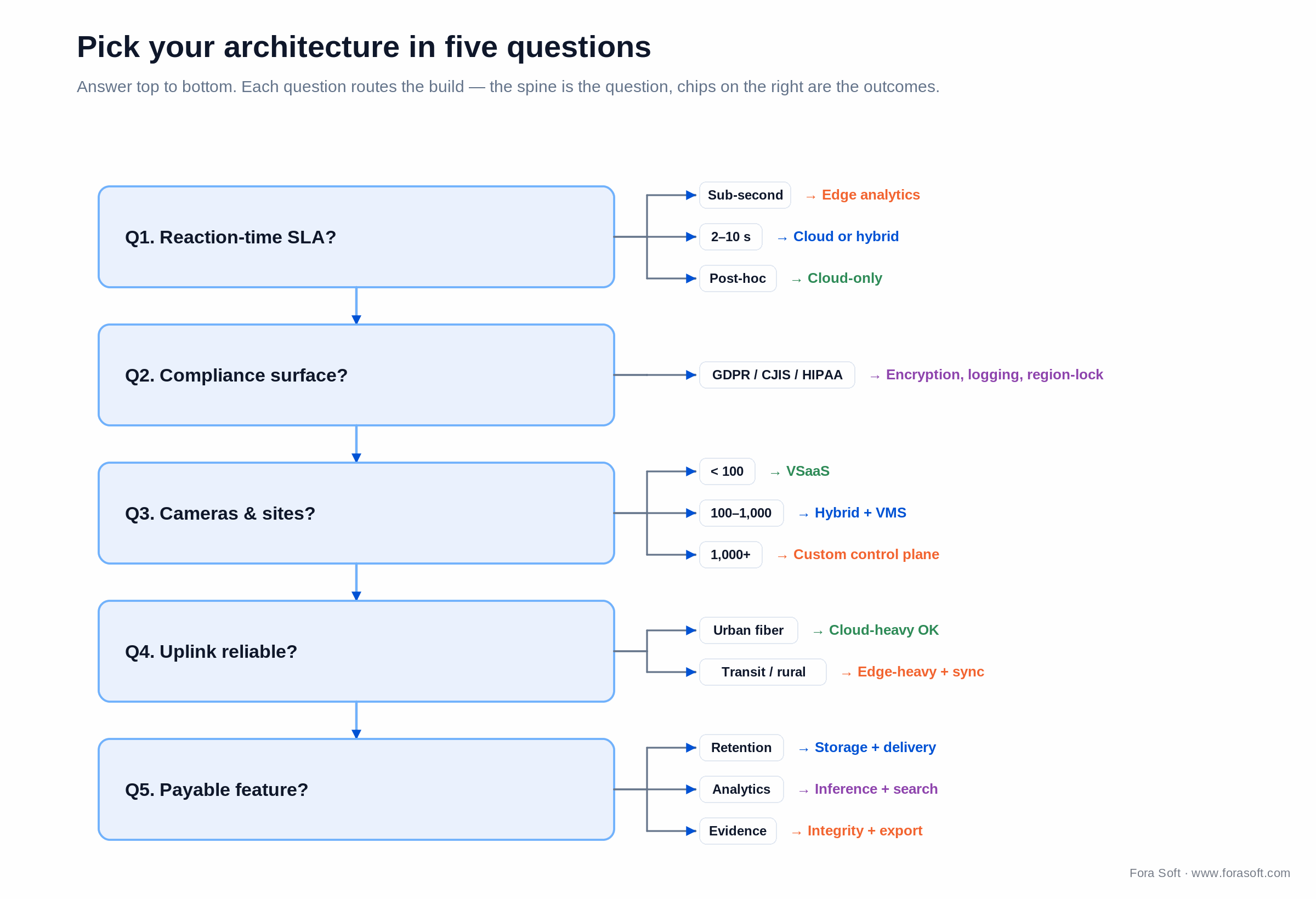
Figure 4. The five questions we ask before an RFP goes out — each answer routes the architecture.
Q1. What’s your reaction time SLA? Sub-second (intrusion, critical safety) requires edge analytics. 2–10 seconds (retail, loss-prevention) can be cloud or hybrid. Post-hoc investigation (audit, review) is cloud-only.
Q2. What’s the compliance surface? GDPR, HIPAA, CJIS, PCI, or sector-specific like CJIS body-cam rules. Each dictates encryption posture, retention minimums, access logging, and who can host.
Q3. How many cameras and how many sites? Under 100 cameras, VSaaS is usually the right answer. 100–1,000: hybrid with a VMS and edge gateways. 1,000+: custom control plane, multi-region, likely custom VMS.
Q4. Is uplink reliable? Urban fiber: cloud-heavy is fine. Transit, maritime, rural, industrial: edge-heavy with sync-on-recovery is the only sane answer.
Q5. What does the customer actually pay for? Video retention alone: focus on storage + delivery. Analytics: focus on inference + metadata search. Evidence handling: focus on integrity, chain of custody, export, redaction. Build for the payable feature first.
Security: the camera is the attack surface
IoT cameras have been a favorite target since Mirai in 2016, and the 2025 wave keeps coming. CVE-2025-1316 in Edimax IP cameras (CVSS 9.3) has been driven by multiple Mirai variants, and the Murdoc botnet is hijacking AVTECH cameras through CVE-2024-7029. The common thread is default credentials on internet-exposed cameras. The non-negotiable baseline for any product we ship:
1. No default passwords in production. Enforce first-boot credential reset; refuse to record until complete. One badly-provisioned camera on a customer site is a liability for your brand.
2. Disable Telnet, HTTP, UPnP, P2P. Period. HTTPS/TLS 1.3 only.
3. Firmware management pipeline. Automated OTA, signed images, rollback on failure, CVE subscription per vendor. One unpatched CVE takes down trust in the whole fleet.
4. Segmented VLAN + strict east-west rules. Cameras in their own VLAN, no outbound to the internet except the VMS call-home endpoint.
5. Encryption at rest AND in transit. AES-256 at rest, TLS 1.3 in transit, per-customer KMS keys.
Worried your cameras are a botnet waiting to happen?
We’ll audit your firmware pipeline, network segmentation and credential hygiene, then hand you a prioritized fix list in a 30-minute call.
Compliance: GDPR, CCPA, HIPAA, CJIS in plain English
We’ve shipped in all four regimes. The short version:
| Regime | Core requirement | Product implication |
|---|---|---|
| GDPR (EU) | Lawful basis; Art. 22 on automated decisions | Human-in-loop for face match, signage at sites, DPO sign-off, EU-region hosting |
| CCPA (California) | Right to delete, opt-out | Per-subject deletion tooling, consent logs, redaction workflow |
| HIPAA (US health) | PHI encryption, audit logs, access controls | RBAC, 6-year audit log retention, BAA with every cloud provider |
| CJIS (US law enforcement) | Chain-of-custody, advanced auth, encryption | MFA, tamper-evident logs, dedicated US-region gov-cloud, background-checked ops |
For healthcare-adjacent products, our healthcare software development guide covers HIPAA specifics beyond what video alone demands.
Five pitfalls that sink IoT surveillance projects
1. Bandwidth flooding. Teams spec 1080p30 per camera on cloud upload, then discover their uplink. Dual-stream (analytics on full-res local, thumbnail to cloud) and H.265 fix this — ignore them at your peril.
2. Vendor lock-in via proprietary protocols. “Just use HikConnect” kills you the moment the customer wants a second camera brand. ONVIF-first, proprietary-as-plugin — always.
3. Retention cost blowup. Flat S3 Standard for everything looks cheap in the PoC; at 400 cameras it’s a $50k/year surprise. Tier day one.
4. Model drift nobody watches. An MIT/Harvard study of 128 model-dataset pairs (2022) found 91% of production ML models degrade over time. Seasonal lighting, camera angle changes, new camera models all break inference silently. Build a drift monitor and a retraining cadence on day one.
5. “We’ll integrate access control later.” If you’re doing IoT, integrate the sensors early. Retrofitting event correlation is 3–5x more expensive than building for it upfront.
KPIs: what to actually measure
Quality KPIs. Analytics precision > 95% and recall > 90% on the customer’s test set; false-alarm rate < 1 per camera per day; live-view glass-to-glass latency < 800 ms.
Business KPIs. Active cameras per operator (target > 80 with AI, > 20 without), mean investigation time (target < 2 min to find a 10-second clip of interest), cost per camera per month (< $8 for retail, < $20 for regulated).
Reliability KPIs. Camera uptime > 99.5%, recording gap rate < 0.1%, P1 incidents per 90 days < 1, evidence-chain integrity incidents — zero, forever.
Build vs buy vs extend: how to decide
The default instinct — “build a VMS from scratch” — is almost always wrong unless your product is the VMS. Three honest paths:
| Path | When it fits | Time to value |
|---|---|---|
| VSaaS + custom front-end | Your product is the UX and analytics on top of a third-party VMS (Eagle Eye, Verkada API, Meraki). | 6–12 weeks |
| VMS platform + plugin | Customer wants Milestone / Genetec and you sell analytics / vertical features on top. | 10–20 weeks |
| Custom VMS on DeepStream / Kubernetes | Your differentiator is the pipeline itself — evidence chain, vertical analytics, custom hardware, scale beyond 10k cameras. | 24–40 weeks for MVP |
Our Agent Engineering practice typically trims 20–30% off the custom-build timeline by handing repetitive scaffolding (ONVIF shims, VMS adapters, storage lifecycle rules, device registration flows) to AI agents with strong human review. For a vendor-level overview of what a VMS actually does, our guide to video surveillance management systems is the companion read.
Reach for VSaaS + a custom front-end when: your product is the UX and analytics, not the recorder. You ship in 6–12 weeks on Eagle Eye, Verkada or Meraki APIs and skip the VMS build entirely.
When NOT to integrate IoT with video surveillance
Not every surveillance product needs an IoT layer. You can skip it when:
Single-site, single-vendor, single-purpose. A 12-camera office with a Hikvision DVR doesn’t benefit from building a sensor-fusion platform. Use the vendor app.
Your customer’s operator is the only “sensor.” Retail with a single guard watching three cameras needs better UX, not MQTT.
Regulatory risk outweighs benefit. High-end residential, healthcare waiting rooms, or privacy-heavy public spaces sometimes lose more in compliance friction than they gain in “fusion.” Talk to legal before you build.
FAQ
How do you choose between cloud, on-prem, and hybrid VMS?
Under 100 cameras and no strict retention requirement: cloud (VSaaS). 100–1,000 cameras across sites: hybrid — edge analytics + cloud VMS + tiered storage. Above 1,000 cameras or hard compliance (CJIS, GDPR Schrems): hybrid with on-prem anchor, cloud for ops. Cost crossovers usually sit between 80 and 120 cameras for multi-year TCO.
What’s the realistic latency between camera and operator screen?
WebRTC end-to-end sits at 300–500 ms on a healthy network; LL-HLS around 1–3 s; regular HLS 5–20 s. If you need sub-second for PTZ control or live interrogation, WebRTC is the only answer — and you need a MediaSoup / Janus-style SFU to scale beyond a handful of viewers.
Can existing analog or older IP cameras be brought into a modern IoT pipeline?
Yes, via an edge encoder / gateway. Analog gets transcoded with an HD-SDI or HDMI-to-IP encoder; older IP cameras that speak RTSP but not ONVIF sit behind an ONVIF shim gateway. Quality is capped by the original camera — don’t expect AI analytics on a 480p 2007-vintage analog feed to match a modern 4K H.265 camera.
What happens to footage if the internet goes down?
If you’ve built it right, nothing. The edge gateway buffers 24–72 hours locally; analytics continues at the edge; operators on the same LAN retain live view. When uplink recovers, the sync daemon pushes metadata and selected clips to cloud in priority order. Any product that goes dark on network loss isn’t ready for production.
Should you use H.264 or H.265 for IoT video surveillance?
H.265 on everything new. 25–50% bandwidth savings translates directly to storage and egress cost. All 2024+ cameras support it; the only reason to stay on H.264 is a browser-direct playback path that still trails WebRTC/LL-HLS compatibility — solvable by transcoding at the gateway.
How do we prevent our cameras from becoming a botnet?
Five non-negotiables: forced credential reset on first boot; disable Telnet, HTTP, UPnP, and P2P; firmware pipeline with signed OTA and CVE monitoring per vendor; VLAN isolation with strict egress rules; HTTPS/TLS 1.3 only. Products that skip any of these become a Mirai entry point inside a year.
How do you handle AI model drift across hundreds of sites?
Ship a drift monitor that samples predictions + ground truth from each site weekly, flags performance drops, and pushes a retraining job automatically. Canary-deploy new models to 5–10% of sites before a fleet-wide OTA. Without this, a model that starts at 95% recall can silently drop to 70% inside a quarter.
How long does a realistic build take?
VSaaS-plus-frontend MVP: 6–12 weeks. VMS-plus-plugin: 10–20 weeks. Full custom VMS with analytics and evidence-chain: 24–40 weeks for an MVP, longer for enterprise. Our Agent Engineering practice trims that by 20–30% on the custom path because the ONVIF / storage / adapter scaffolding is automatable.
What to Read Next
Industrial
Industrial Video Surveillance AI: 5 Advanced Security Benefits
PPE detection, perimeter control, intrusion analytics in plants and yards.
AI & Video
AI-powered video streaming: how AI and ML change the game
Which ML capabilities move the needle for video products in 2026.
WebRTC
How to test WebRTC stream quality
Measuring MOS, freeze rate, and latency for live video products.
Healthcare
Healthcare software development challenges
HIPAA, PHI, and audit-log realities for any video product in health.
Services
Fora Soft video surveillance development
What we build, for whom, and how — including VALT and NetCam references.
Ready to ship an IoT video surveillance product customers actually pay for?
The playbook compresses down to five moves: pick hybrid over pure cloud or pure edge; standardize on ONVIF + WebRTC / LL-HLS at the edges; invest in analytics that cut false alarms to near zero; tier your storage on day one; and treat the camera as an attack surface, not a sensor. Get those right and the product runs.
If you’re somewhere in the middle of that — cameras in place but analytics is noisy, or analytics is solid but uplink costs are eating margin, or you’re staring at a blank whiteboard and need to start — that’s the conversation we have every week with new clients.
Talk to the team behind VALT and 50+ video products
A 30-minute call; we’ll map your IoT video surveillance architecture, give realistic cost ranges, and hand you a 12-week plan whether we end up working together or not.

