

Key takeaways
• AI in video streaming is no longer an experiment. AV1 now powers 30% of Netflix streaming with 33% less bandwidth than AVC and 45% fewer rebuffers; recommendations drive 80% of watch time; real-time moderation and AI captions are shipping in production.
• The CDN bill is where AI pays for itself first. Per-title encoding plus AI preprocessing (SimaBit-class) stacks 22–35% bitrate savings on top of AV1. For a platform streaming 1 PB/month that is $30K–$90K/month saved on egress alone — usually more than the AI program costs.
• Pick AI features by KPI payoff, not demo sparkle. Recommendations lift session time 15–25%; scene-aware ad insertion lifts eCPM 12–20%; AI moderation is table-stakes for UGC and live; AI dubbing opens 3–5 new markets per language at $5K–$20K per finished hour.
• Build vs buy sorts cleanly by volume. Under 10 TB/month of egress — buy Mux, Cloudflare Stream, or Bitmovin and move on. Over 50 TB/month — custom pipelines on AWS MediaConvert or self-host start to dominate on cost.
• Realistic cost bands. An AI-enhanced streaming MVP lands at $45K–$90K in 12–16 weeks. A full AI-native OTT or live platform runs $180K–$500K. Plan 15–25% annual maintenance. Our Franchise Record Pool and TradeCaster projects sit inside that band.
Why Fora Soft wrote this playbook
We have been shipping video streaming software since 2005 — 250+ projects delivered, most of them video-first, across OTT, live streaming, IPTV, music streaming, sports, connected fitness, and UGC. Relevant work: Franchise Record Pool (AI-powered music track library and Shazam-style identifier for professional DJs), TradeCaster (live trading broadcast platform), Smart IPTV and Smart STB (multi-platform IPTV players), Bellicon Home (connected fitness streaming), and Shortclips (vertical-feed short video).
This is the playbook we hand a CTO or product lead who is scoping AI video streaming features for a product in 2026. It replaces “AI-powered” marketing speak with the specific models, vendors, cost shapes, and KPI deltas from real builds. We use Agent Engineering internally, which compresses scaffolding and QA by roughly 30% on familiar ground — the cost numbers here are conservative and run below 2024-era benchmarks on purpose.
Adding AI to a streaming product?
Tell us the use case, the catalog, and the session profile — we come back with the three AI features that actually move the needle and a cost band for each.
Market snapshot — where AI video sits in 2026
The global video streaming market is tracking from $129B in 2024 to roughly $417B by 2030 at ~21.5% CAGR (Grand View Research). AI video streaming has moved from pilot decks into the core delivery, discovery, and monetisation stack. SVOD alone is $128B in 2024, on track to $209B by 2030 with 1.8B subscribers. Live streaming holds 62% of that pie and is still the fastest-growing slice, pulled up by live commerce (now converting at 30% vs. 3% for traditional e-commerce) and sports OTT.
AI is no longer a side-deck. Netflix reports 30% of its streaming is now AV1 (December 2025), AI dubbing is projected from $31.5M in 2024 to $397M by 2032 (IntelMarketResearch), and Deepgram’s Nova-3 ASR transcribes a one-hour stream in under 10 seconds. The question for a streaming CTO has shifted from “should we use AI?” to “which three AI features do we build first, and which do we buy?”
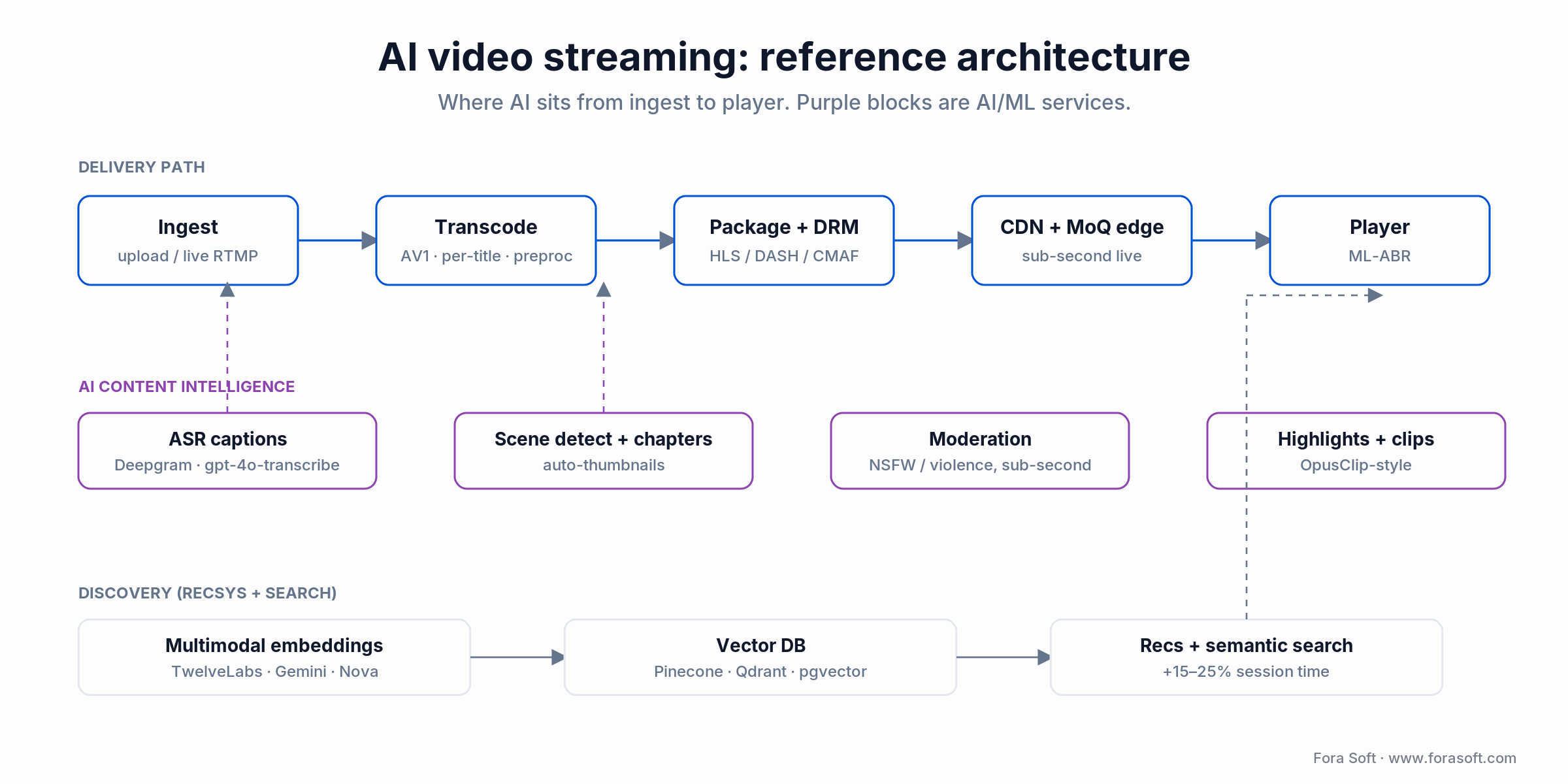
Figure 1. Where AI sits in an AI video streaming stack — delivery path on top, AI content-intelligence and recsys feeding it.
The ten AI capabilities actually worth shipping
AI streaming vendor marketing lists 50+ features. On real products, ten of them carry all the weight. We rank them by KPI impact per dollar spent. If you are still choosing which features belong on the roadmap, our guide to AI video streaming platform features ranks them by the cost or risk each one removes.
1. Per-title and per-scene encoding. Optimise the bitrate ladder per asset, not per platform. Saves 15–20% bitrate across the catalogue.
2. AI preprocessing (SimaBit-class). Perceptual preprocessor before the encoder. Adds another 20–35% compression on top of per-title AV1.
3. ML-based ABR. Pensieve / Fugu / Puffer-style reinforcement-learning ABR improves QoE by 12–25% vs. rule-based BOLA / BB.
4. Recommendations and personalisation. Hybrid collaborative + content-based + contextual re-ranking. Drives 15–25% session-time uplift.
5. Scene understanding and metadata. Scene classification, chapter extraction, highlight generation, auto-thumbnails. CTR on thumbnails up 15–25%.
6. Real-time content moderation. Sub-second detection of NSFW, violence, hate speech on UGC and live streams. Non-negotiable for social / UGC platforms.
7. Captions, subtitles, and dubbing. AI ASR at 95–99% accuracy, AI dubbing that opens 3–5 markets per language.
8. Semantic video search. Multimodal embeddings indexing narrative, objects, moods. Sub-100ms queries over millions of clips.
9. Dynamic ad insertion with scene awareness. Smart-cut ad breaks at natural scene transitions, scene-aware targeting. Lifts eCPM 12–20%.
10. Short-form clip auto-editing. OpusClip / Chopcast-style automatic highlight clipping for social distribution. Cuts editorial labour 70–80%.
Encoding economics — where AI actually saves money
The single biggest financial win from AI in streaming is the bandwidth bill. Every percent shaved off average bitrate shows up as egress cost on your CDN invoice and as fewer rebuffers in your QoE dashboard. The stack that compounds best in 2026 is AV1 as the codec baseline, per-title encoding for asset-aware ladders, and AI preprocessing ahead of the encoder.
| Technique | Typical bitrate saving | Build cost (one-time) | Payback at 100 TB/month egress |
|---|---|---|---|
| AV1 migration from H.264 | ~33% (Netflix data) | $20K–$60K | 1–3 months |
| Per-title encoding | 15–20% | $30K–$80K | 2–4 months |
| AI preprocessing (SimaBit-class) | +20–35% stacked | $10K–$30K integration + per-minute fee | 3–6 months |
| Context-aware ABR | 5–10% bitrate + QoE uplift | $25K–$70K | QoE-driven, not pure CDN math |
| AV2 (future, 2027+) | +18–25% over AV1 | Planning only today | Scope 2027 migration |
For a platform pushing 1 PB a month through a mainstream CDN at roughly $0.01–$0.03 per GB, a stacked 40% reduction is $40K–$120K/month saved. That is usually enough to self-fund the rest of the AI programme.
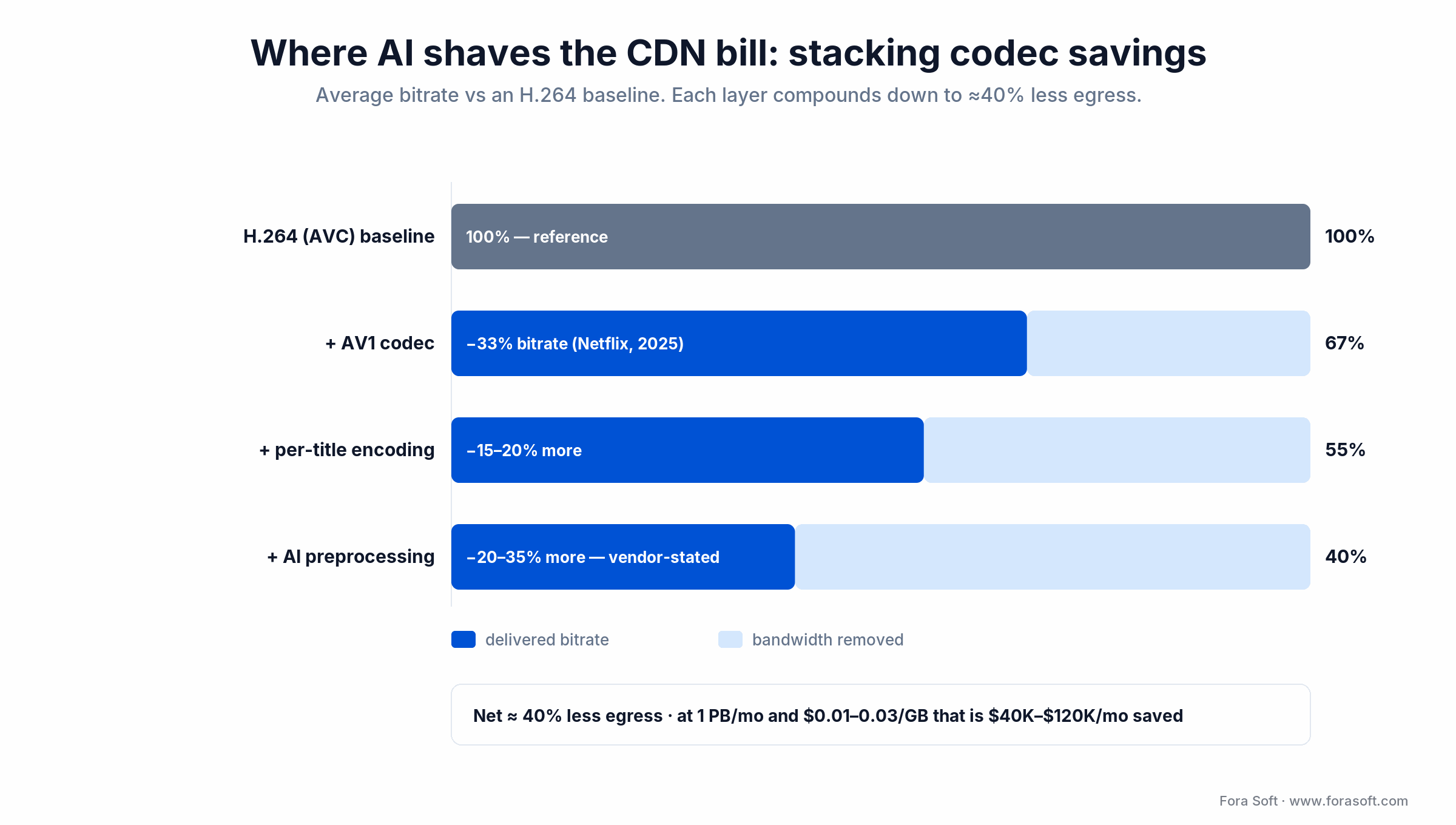
Figure 2. Codec savings compound: AV1, per-title, then AI preprocessing take average bitrate to ~40% of the H.264 baseline.
Adaptive bitrate — why ML beats rules in 2026
Rule-based ABR (BOLA, Buffer-Based, throughput-based) was the industry baseline for a decade. It still works. It is also leaving QoE on the table: MIT’s Pensieve (SIGCOMM 2017) reported 12–25% higher average QoE than the best rule-based schemes in simulation. Here’s the catch, and it’s an honest one: Stanford’s Puffer “Learning in situ” study (NSDI 2020) put ABR in front of real users and found a simulation-trained Pensieve actually underperformed plain BBA, while a simpler model trained in situ (Fugu) came out ahead. The takeaway: ML-based ABR beats rules when it learns from your own real traces — not when it is lifted straight out of a paper.
The trade-off is operational. ML ABR needs rich telemetry (RTT, loss, bandwidth, buffer state, device class), retraining pipelines, and a fallback to rules when the model underperforms. Build it yourself only if streaming is your product and you have >1M concurrent viewers. For everyone else, rent it — Mux, Bitmovin, and AWS IVS all ship ML-informed ABR without the retraining overhead.
Content understanding — scenes, chapters, thumbnails, highlights
AI scene detection now runs in real time at 720p–4K. For a VOD catalogue, that means every asset can carry chapter breaks, auto-selected thumbnails, and a pre-computed highlight reel without a human editor touching it. Bitmovin reports 15–25% click-through uplift on AI-picked thumbnails vs. editorial defaults, and 12–20% eCPM lift when ad breaks land on natural scene transitions instead of fixed timecodes.
For live, the bar is tighter. Real-time highlight extraction for sports needs sub-5-second latency from event to clip, which pushes you into GPU-backed inference on the ingest side. Magnifi, Chopcast, and WSC Sports are the production-ready third parties here. If sports or live commerce is your vertical, integrate one of them before you write your own.
Recommendations — how to earn the 80% of watch time
Netflix publicly reports 80% of watch time comes from recommendations. That number holds for every streaming product we have instrumented. The mistake most teams make is to start with collaborative filtering and stop there. The right 2026 stack is three layers.
1. Collaborative filtering. User-user and item-item similarity. Solves cold homepage. Matrix factorization or two-tower dense embeddings are the production defaults.
2. Content-based signals. Metadata, genre, tags, visual embeddings, audio embeddings, transcript embeddings. Solves cold start for new titles and new users.
3. Contextual re-ranking. Time of day, device, session context, recency, diversity constraints. This is where the session-time uplift actually comes from once the first two layers are healthy.
Vector databases (Pinecone, Weaviate, Qdrant, PGVector) make the content-based layer cheap to ship in 2026 — multimodal embeddings from TwelveLabs, Google Gemini, or OpenAI go in, semantic recommendations and search come out. Under 100M users, this is a rent-don’t-build decision.
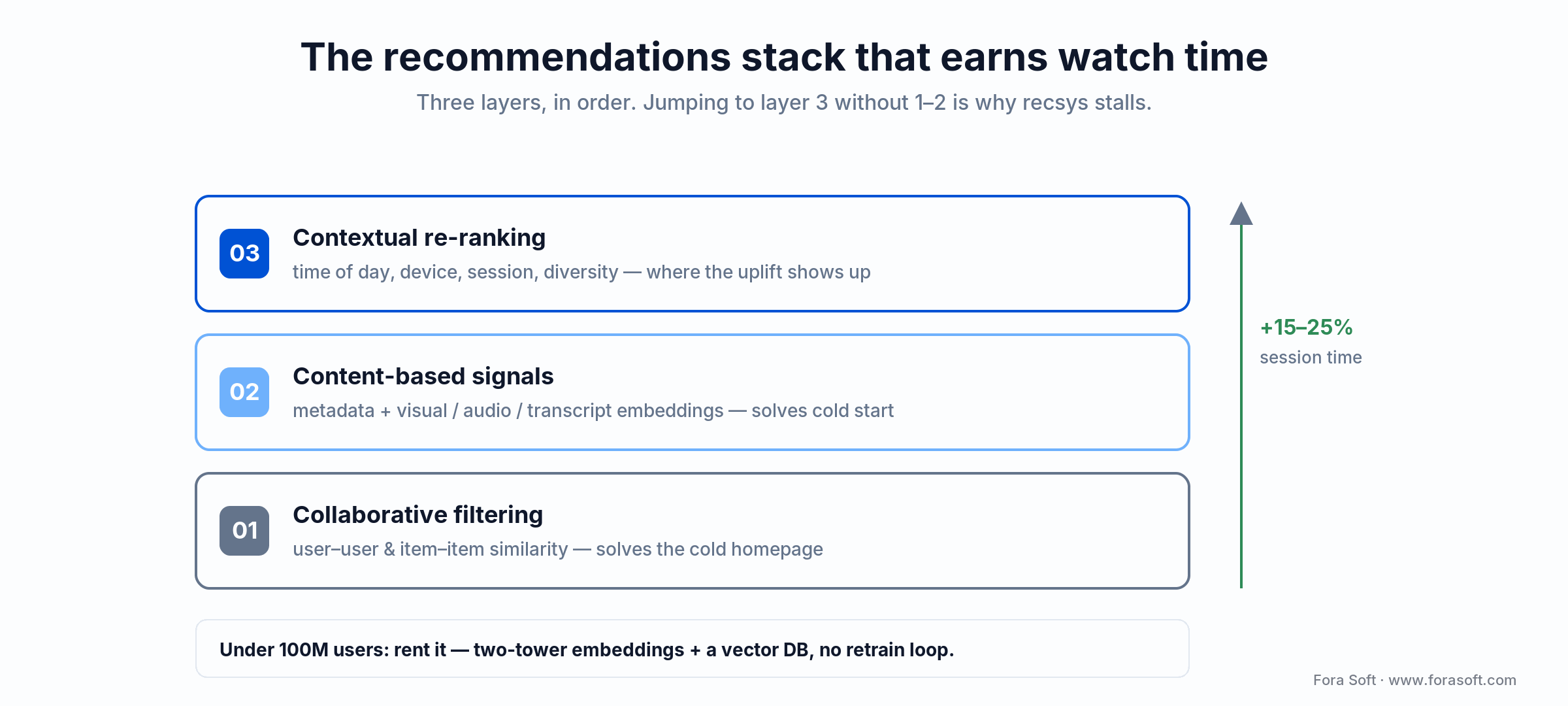
Figure 3. The recommendations stack in order — collaborative, content-based, then contextual re-ranking earns the session-time lift.
Need a recommendations stack that actually lifts retention?
We have shipped production recsys across music, OTT, fitness, and sports. Thirty minutes is enough to scope what you need vs. what you can rent.
Live streaming AI — moderation, commentary, low-latency
Live is where AI features turn from nice-to-have to table stakes. Three capabilities are now mandatory for any UGC, social, or live-commerce product shipping in 2026. Real-time content moderation catches NSFW, violence, and hate speech in sub-second windows. AI captions stream alongside the broadcast at 500 ms latency and 95 %+ accuracy on clear audio. Dynamic highlight extraction clips the replay-worthy moments and pushes them to social within a minute of the event.
The other thing 2026 brought is usable low-latency protocols. Cloudflare’s Media over QUIC (MoQ) relay network went live across 330+ cities in August 2025, delivering sub-second glass-to-glass latency — today it fits interactive live (commerce, betting, auctions, second-screen) rather than replacing HLS wholesale. For those use cases that latency is a 15–25% retention lift vs. HLS’s 10–30-second lag. If your roadmap includes live and you have not scoped a MoQ pilot, add it — we break the protocol down in our Media over QUIC deep dive.
Accessibility and localisation at AI speed
AI captions, subtitles, and dubbing have crossed the line from “close to human” to “launchable in production” over 2024–2025. Deepgram Nova-3 transcribes an hour of clean audio in under 10 seconds and claims ~5% word error rate, though independent tests land nearer 7–10%. OpenAI’s gpt-4o-transcribe (March 2025) pushed error rates below Whisper on noisy audio. Google Cloud Speech-to-Text and AWS Transcribe cover 100+ languages.
AI dubbing went from novelty to production in the same window. CAMB.AI delivered the first AI-dubbed commentary for a European football match — live, expressive Italian for the 2026 Trophée des Champions (PSG vs. Marseille). ElevenLabs, HeyGen, Murf, and Papercup are shipping human-in-the-loop pipelines at $5K–$20K per finished hour, vs. $40K–$80K for traditional dubbing. For catalogue expansion into new markets, the math usually pays back within the first 10–20 hours of dubbed content.
Semantic video search — the feature users will ask for by 2027
“Show me the goal in the last 20 minutes.” “Find the scene where the character says they’re moving to Paris.” “Cut me a highlight of funny moments from this podcast.” These queries are now realistic. TwelveLabs, Google Gemini Video, and Amazon Nova Multimodal produce embeddings that span narrative, actions, mood, and audio, indexed in a vector database for sub-100ms retrieval.
Most products will not need to build this from scratch. Rent the embedding model, stream it through a vector DB, expose a search endpoint. Reserve custom work for cases where the domain vocabulary is unusual (sports plays, medical procedures, DJ transitions) and generic embeddings underperform.
Streaming vendor matrix — who ships which AI
The 2026 vendor field has sorted into three camps. Developer-first API platforms (Mux, Cloudflare Stream, api.video) ship AI features as part of the product. Enterprise media suites (Bitmovin, Brightcove, JW Player) offer deep AI add-ons for large catalogues. Cloud primitive toolkits (AWS Elemental, AWS IVS, Azure Media Services, GCP Transcoder) expose the lowest-level building blocks for teams that want to assemble their own pipeline.
| Vendor | Model | AI features shipped | Best fit |
|---|---|---|---|
| Mux | Developer API | Per-title, ASR, chapters, summaries, dubbing, MCP server | Developer-first VOD + live |
| Cloudflare Stream | Global edge | AV1, MoQ low-latency, captions | Global latency-sensitive apps |
| Bitmovin | Enterprise encoder + player | Scene analysis, per-title, AI upscaling | Large OTT, broadcasters |
| Brightcove | Enterprise workflow | 8+ AI features including dubbing, captions | Enterprise media, marketing |
| AWS IVS | Managed live | Low-latency live, Transcribe, moderation | AWS-native live products |
| api.video | Developer API | Captions, chapters, analytics | Fast-ship VOD products |
| Self-host (FFmpeg + AI workers) | Custom | Anything you build | >500 TB/month egress, unique pipeline |
Reach for Mux when: you are developer-first, shipping VOD + live, and you want AI metadata, captions, and chapters as a single API surface.
Reach for Cloudflare Stream when: global edge latency and MoQ low-latency live are your top concerns.
Reach for Bitmovin when: you are a large OTT with custom ladders, HDR pipelines, and scene analysis requirements.
Reach for self-hosting when: egress is >500 TB/month, data residency matters, or your AI pipeline is the product.
Mini case — Franchise Record Pool’s Shazam-for-DJs audio AI
One of our projects that demonstrates what AI on streaming audio looks like in production: Franchise Record Pool, founded by Funkmaster Flex, is a music distribution and intelligence platform for professional DJs. It ships Shazam-style music recognition that names the original behind any remix, plus an AI voice assistant that builds a set list from a plain-English prompt (“Italian pop from the 90s, BPM 140”), over a catalogue of 720,000+ licensed tracks from Sony, Universal, and Virgin. The stack runs on the OpenAI API, Whisper, and Amazon Polly, and the whole loop lives inside the app without the DJ leaving the booth.
The product lessons transfer directly to any video streaming AI build. Pick one high-value AI capability and make it excellent instead of shipping ten mediocre features. Put the heavy inference behind a queue and treat it as an async enrichment of the content, not a blocker on upload. Keep the AI model swappable — the state of the art on audio and video models moves fast, and a clean abstraction saves a rewrite every 12–18 months. More in our write-up on FRP’s AI track library.
Implementation roadmap — a 14-week AI enablement
The shape of most AI enablement programmes we run on an existing streaming product is three workstreams in parallel over 12–16 weeks. Encoding + CDN on one track, recommendations + discovery on a second, content-intelligence features (captions, chapters, moderation) on a third.
| Phase | Weeks | Deliverables |
|---|---|---|
| Discovery & baseline | 1–2 | QoE baseline, CDN cost audit, AI feature prioritization |
| Encoding track | 2–9 | AV1 ladder, per-title, optional AI preprocessor |
| Recsys track | 3–12 | Collab baseline, content embeddings, re-ranker, A/B rig |
| Content-intelligence track | 3–12 | Captions, chapters, moderation, thumbnails, highlights |
| Hardening & launch | 13–14 | Load tests, QoE dashboards, rollback plan, pilot |
Cost model — what AI video streaming actually runs
Conservative Fora Soft bands with Agent Engineering assist. Market averages tend to run higher — larger offshore teams or agency overhead lift quotes 30–60%.
| Scope | Window | Fora Soft band | Included |
|---|---|---|---|
| AI streaming MVP | 10–14 weeks | $45K–$90K | Managed CDN + per-title + captions + basic recsys |
| AI enablement of an existing OTT | 10–16 weeks | $60K–$140K | Encoding + recsys + content-intel on existing stack |
| Full AI-native streaming platform | 6–10 months | $180K–$500K | VOD + live + mobile + recsys + content-intel + analytics |
| Self-hosted encoder + AI preprocessor | 4–8 weeks | $30K–$80K | FFmpeg + AV1 + per-title + preproc integration |
| Annual maintenance | Ongoing | 15–25% of build | Model retraining, dependency updates, QoE tuning |
Runtime cost is split between CDN, inference, and storage. A 1 PB/month OTT on AV1 + per-title + AI preprocessing lands around $12K–$30K/month on the CDN after the 40% stack savings, plus $2K–$8K on ASR and scene-intelligence APIs, plus $1K–$5K on vector DB for recsys. For most products the AI spend is 5–15% of the CDN bill and pays for itself many times over in retention and ad yield.
Decision framework — five questions before you buy
Q1. What is your current CDN bill? Under $10K/month → buy a managed vendor, do not optimize encoding yet. Over $50K/month → encoding optimisation is the fastest AI ROI you have.
Q2. VOD, live, or both? Pure VOD can live on Mux or Bitmovin. Live needs AWS IVS, Cloudflare Stream, or self-hosted ingest. Both → assemble.
Q3. Is the catalogue licensed or UGC? Licensed catalogues need strong metadata and recsys. UGC needs moderation first, everything else second.
Q4. How critical is low latency? Sub-second needed (live commerce, sports, interactive) → MoQ or WebRTC + SFU. 5–10s acceptable (standard OTT) → HLS or LL-HLS.
Q5. Is recsys the product or a feature? Product → build (proprietary signals, ranker, retrain loop). Feature → rent (two-tower embeddings + off-the-shelf re-ranker).
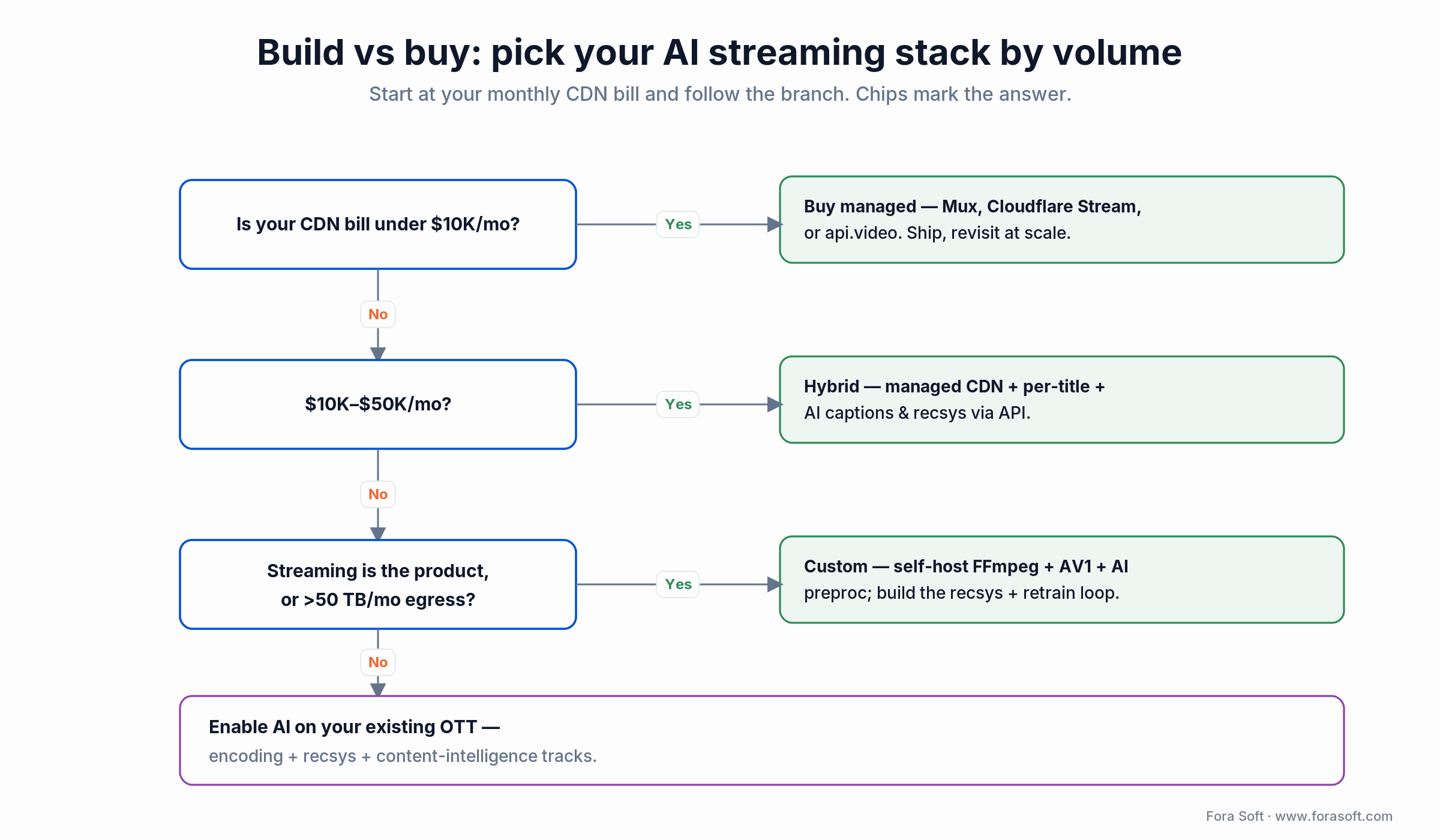
Figure 4. Build vs buy, by volume: your monthly CDN bill decides managed, hybrid, or a custom AI streaming pipeline.
Five pitfalls that sink AI streaming projects
1. Treating AI features as one workstream. Encoding, recsys, and content-intelligence have different owners, different data needs, and different release cadences. Running them as one team delivers all three late. Split them from day one.
2. Shipping recommendations without an experiment rig. If you cannot A/B test two ranker variants at 10% traffic and read out session-time uplift with statistical confidence in a week, you cannot iterate the model. Build the experiment rig before the model.
3. Overbuilding encoding at low volumes. Per-title encoding and AI preprocessing pay off above 10–20 TB/month. Under that threshold, a managed vendor like Mux with default AV1 ladders is cheaper end-to-end.
4. No fallback for AI inference failures. Your ASR provider goes down at 3 a.m. What happens to live captions? The recsys model starts returning NaNs. What does the homepage render? Every AI feature needs a rules-based or cached fallback.
5. Ignoring model drift. Recsys models decay. Moderation models miss new slang. Dubbing voices get dated. Plan a quarterly retrain cycle and budget for it — 15–20% of the original build cost per year is a sensible number.
KPIs — what to measure after AI rollout
Quality KPIs. Startup time <1.5s p50, <4s p95. Rebuffer ratio <0.5% of playback time. VMAF >85 at the bitrate tier users actually receive. Caption accuracy WER <10% on clean audio.
Business KPIs. Average session time up 15–25% after recsys launch. Thumbnail CTR up 15–25% after AI selection. eCPM up 12–20% after scene-aware ads. Monthly CDN cost per streamed hour down 30–40% after encoding stack.
Reliability KPIs. 99.95% availability on playback. 99.9% on recsys API (with fallback). ASR pipeline SLA 99.9%. Drift detector running on every model with weekly reviews.
When NOT to build AI features in-house
Three shapes where custom AI is the wrong answer. First, a CDN bill under $5K/month — encoding optimisation is not worth the engineering spend. Second, a catalogue under 500 titles — recsys gives you nothing meaningful; editorial curation wins. Third, a team with no ML ops capability — any model you deploy will drift faster than you can retrain it. In all three cases, pick a managed vendor, ship the product, and revisit AI at the next scale milestone.
Second opinion on your AI streaming roadmap?
250+ projects since 2005, video and AI at the core. Thirty minutes will tell you which three features to ship first and what they should cost.
Why Fora Soft for AI video streaming development
A 50-engineer team shipping video, audio, and AI products since 2005 — AI video streaming is squarely in our wheelhouse. Our video and audio streaming practice is our oldest specialisation, and our AI integration practice runs production inference pipelines across music, video, medical imaging, and EdTech. Relevant projects: Franchise Record Pool, TradeCaster, Smart IPTV, Bellicon Home, Shortclips.
Agent Engineering compresses scaffolding and QA by roughly 30% on familiar ground, which is why our cost bands sit below 2024-era benchmarks. We run dedicated development teams embedded in your process and a product planning practice that starts greenfield builds with discovery rather than code. For readers interested in what AI does to development productivity, our case study on how AI cut 40% off development time in a 1M+ line video streaming platform is the internal numbers behind the claim.
FAQ
How long does AI-enabled video streaming development take?
An AI-enhanced streaming MVP lands in 10–14 weeks with a 3-engineer pod. AI enablement of an existing OTT runs 10–16 weeks in parallel tracks (encoding, recsys, content intelligence). A full AI-native platform is 6–10 months. Agent Engineering compresses those numbers by roughly 30% on familiar ground.
Should we migrate to AV1 in 2026?
Yes if you stream at scale (10+ TB/month egress). AV1 is now supported across all modern browsers, iOS 17+, Android 12+, and most 2022+ smart TVs. Keep H.264 as a fallback ladder for legacy devices. Plan an AV2 evaluation for 2027 — early benchmarks suggest another 18–25% bandwidth improvement.
Can we use OpenAI Whisper for production captions?
Yes, with the right hosting. Whisper is a strong offline / batch ASR. For real-time live captions, Deepgram Nova or OpenAI’s gpt-4o-transcribe via the Realtime API are better fits at sub-500 ms latency. For regulated content (healthcare, legal), route through Amazon Bedrock or Google Vertex under a BAA.
How do we A/B test a new recsys model safely?
Ship the new model to a small traffic slice (5–10%), keep the old model serving the rest, and measure session time, retention, and revenue uplift with bucketed users over a full weekly cycle. Use a multi-armed bandit or orthogonal experiments framework if you run several tests in parallel. Never roll a new recsys out to 100% in one shot.
What is the cheapest way to add AI captions to our product?
For VOD, the cheapest is to plug Mux or api.video into your upload pipeline — captions come out of the box. For live, AWS Transcribe Streaming or Deepgram Streaming with a 30–90 day free tier is the fastest ship. Expect $0.015–$0.05 per minute of audio in production.
Is MoQ ready for production in 2026?
It is production-ready as a pilot, not as your only playback protocol. Cloudflare’s MoQ relay network is live in 330+ cities as of August 2025, and LL-HLS / WebRTC remain fine fallbacks. For live commerce, sports, and interactive video, pilot MoQ for the subset of users on supported clients and measure retention.
Do we need a GPU cluster for AI video features?
Rarely. Most streaming AI (captions, scene detection, moderation, recommendations) runs fine on serverless inference or a small fleet of T4/L4/G5 instances. A dedicated GPU cluster only makes sense for live sports highlight generation, proprietary encoder models, or generative video at scale.
How do we handle AI moderation false positives?
Every automated moderation decision needs a human appeal path and an SLA on review. For live streams, use AI to flag suspected violations to a human moderator within 2–5 seconds rather than to block automatically. For VOD, hold a shadow queue and require a moderator click before removing content — false positive rate drops to <1% with the right human-in-the-loop.
What to Read Next
Case Study
How AI Cut 40% Off Dev Time on a 1M+ Line Streaming Platform
The internal numbers behind Agent Engineering on a real video streaming build.
Audio AI
FRP: AI Track Library and Shazam for DJs
How we shipped Shazam-style music recognition over a 720K+ licensed-track catalogue.
OTT
OTT Platform Development
Full build playbook for OTT: architecture, monetisation, DRM, and rollout.
Mobile AI
How AI Can Transform Your Mobile App
Where AI actually moves product KPIs on a mobile app vs. marketing fluff.
Ready to ship AI that pays for itself?
The shortest path to AI in a streaming product in 2026 is to attack the CDN bill first, the retention loop second, and the content-intelligence features third. AV1 plus per-title plus AI preprocessing stacks 35–45% bandwidth savings. A hybrid recommendations stack lifts session time 15–25%. AI captions, chapters, and auto-thumbnails remove editorial drag and lift CTR and eCPM at the same time.
Budget realistically: $45K–$90K for an AI-enhanced MVP, $60K–$140K to enable an existing OTT, $180K–$500K for a full AI-native build, plus 15–25% annual maintenance. If you want a second opinion on your roadmap — what to ship first, what to rent, what to build — we run a 30-minute call and come back with a written plan.
The handbook · 7 volumes
Fora Soft Video Engineering Handbook
This playbook lists ten AI capabilities worth shipping in a streaming app, and each one touches a different layer of the stack. We wrote seven volumes covering that stack end to end: encoding, delivery, audio and AI. Start with Volume 6 for computer vision, speech and video search, then Volume 1 for encoding economics and Volume 3 for ABR, CDNs and QoE. Written by Nikolay Sapunov, CEO at Fora Soft.
Browse the handbook on Amazon →7 volumes · 9,000+ pages · Kindle & paperback
Scope your AI streaming roadmap with us
Thirty minutes with Vadim is enough for the three features to ship first, a cost band, and the KPI you will move. No slides, no pitch deck — just answers.

