
Key takeaways
• AI lesson-plan generators save teachers 5.9 hours per week, or roughly six weeks of reclaimed time per school year (Walton Family Foundation / Gallup 2025). That is the headline adoption number you can quote in any board deck.
• MagicSchool AI, Khanmigo, Eduaide, Diffit, and Curipod own the free-tool conversation. For serious K-12 deployments, MagicSchool, SchoolAI, and Education Copilot lead on standards alignment and LMS integration.
• EdTech platforms win by embedding lesson generation natively. Building an AI lesson-planner module into an LMS typically costs $30K–$150K and opens a new SaaS upsell plus lock-in through curriculum-aligned content.
• Three risks dominate: AI hallucinations in content, FERPA / COPPA / GDPR student-data compliance, and erosion of teacher agency. Each is manageable with RAG + fact-checking + human-in-the-loop workflows.
• Do not ship AI for IEPs, high-stakes assessments, or creative arts analysis without human review. These are where AI-generated content is most likely to fail — and most likely to cause legal or pedagogical damage.
This guide explains what the best AI lesson-plan generators actually do in 2026, which teachers and schools pick each, and how to build a production-grade AI lesson-planning feature into your own product. Every section is anchored in 2025–2026 data you can take to a budget meeting.
The short version: the AI-in-education market hits $9.58 billion in 2026 and compounds toward $136 billion by 2035 at a 34% CAGR. 60% of K-12 teachers used AI at work in 2024–25, up from 25% a year earlier. 92% of students use generative AI. The market moves whether you participate or not; the question is which tool to pick, or what to build.
Why Fora Soft wrote this playbook
Fora Soft has built e-learning and virtual-classroom platforms since 2005 (20+ years). We shipped the world’s first WebRTC HTML5 virtual classroom for BrainCert (now $3M ARR, 100K+ customers, 500M+ classroom minutes delivered), an AWS Most Innovative EdTech Award-winning platform for Scholarly (15,000+ users, 2,000 concurrent students on live classes), and the InstaClass virtual-tutoring platform with a firewall-bypassing WebRTC core. We also embed AI components — GPT and Claude-powered hints, content summarisation, adaptive assessment — across client products.
We work in Agent Engineering mode: senior engineers pair with AI coding agents for boilerplate, test generation, and refactors. That is why our AI lesson-planner MVPs typically ship in 6–8 weeks at $30K–$80K — about 30% faster and cheaper than agency averages. When we quote a dollar figure in this article, it is a number we have actually billed on a Fora Soft EdTech project.
Planning an AI lesson-planner feature for your LMS?
Book a 30-minute scoping call and we will return with an architecture diagram, stack recommendation, and a dollar-accurate estimate — no sales pitch.
The 2026 AI-in-education numbers you can quote
| Signal | 2025–2026 number | Source / implication |
|---|---|---|
| Market size | $9.58B (2026) → $136.79B (2035) | 34.52% CAGR — consolidation coming |
| K-12 teacher adoption | 60% in 2024–25 (up from 25%) | RAND / Walton — doubling YoY |
| Time saved by weekly AI users | 5.9 hours/week = 6 weeks/year | Walton Family Foundation — the headline ROI |
| Student AI use | 92% in 2025 (up from 66%) | Students already assume AI fluency |
| Personalised learning gains | +54% test scores, +30% outcomes, 10× engagement | Meta-analyses of AI-personalised classrooms |
| Schools with AI policy | 26% larger time-saving benefit | Governance correlates with outcomes |
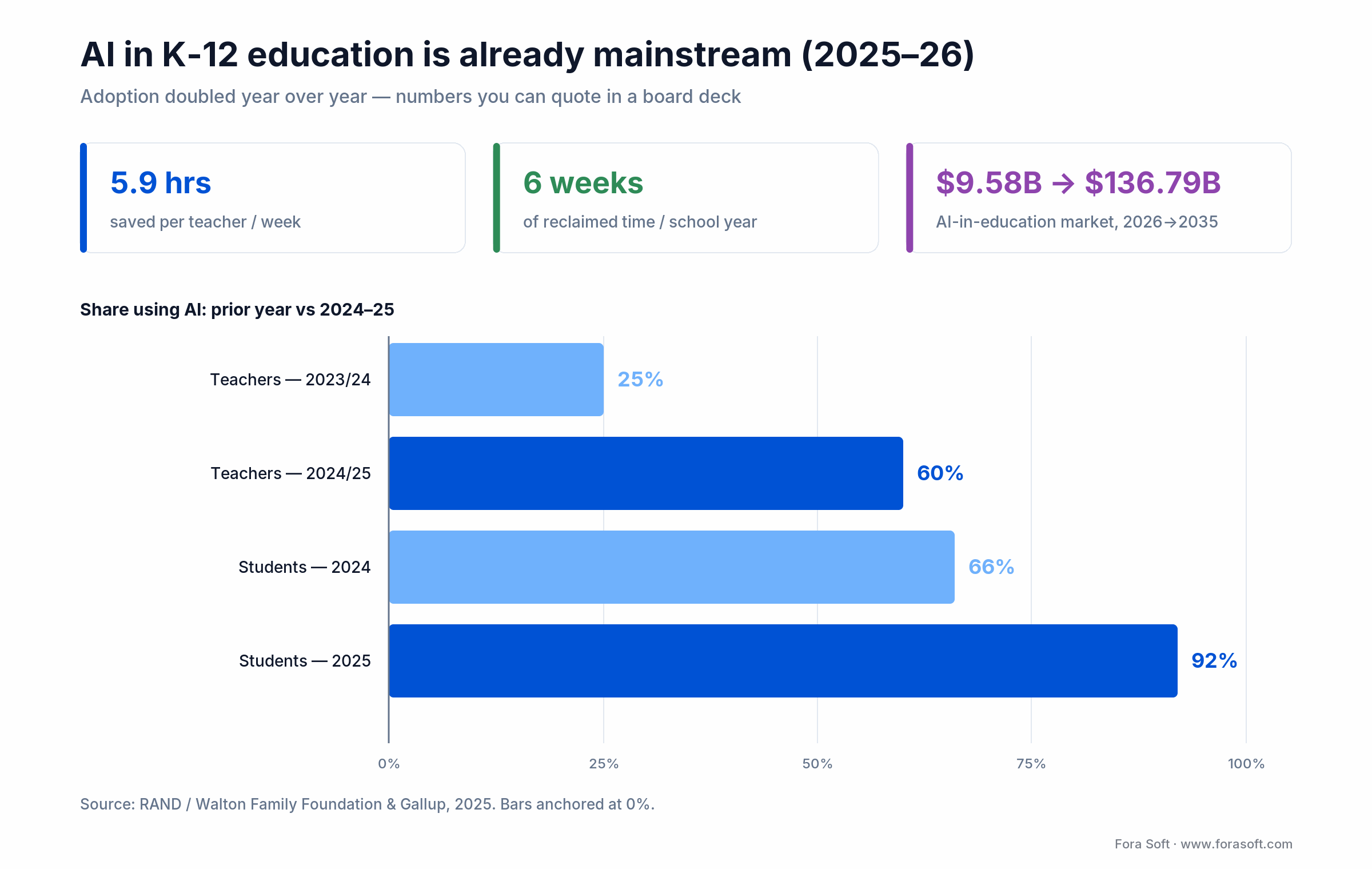
Figure 1. AI adoption in K-12 doubled year over year; weekly AI users reclaim 5.9 hours a week (RAND / Walton / Gallup, 2025).
The top AI lesson-plan generators in 2026 — honest comparison
Twelve tools cover roughly 95% of real usage. Pick one or two; more than three creates workflow fragmentation.
| Tool | Best for | Free tier? | Limitation |
|---|---|---|---|
| MagicSchool AI | All-round K-12 (80+ tools, Google Classroom / Canvas) | Yes, limited | Generic without context |
| Khanmigo | Standards-aligned math & science, free | Fully free | Tied to Khan curriculum |
| Eduaide.ai | 100+ generators, beginner-friendly | Yes | Steeper UI curve |
| Diffit | Differentiation / ELL / SpEd | Yes | Content adaptation only |
| Curipod | Interactive live lessons + real-time feedback | Yes | Live-delivery focused |
| Brisk Teaching | Chrome side-panel for any web content | Yes | Chrome-dependent |
| Twee | Language teaching, CEFR-aligned | Yes | Language only |
| SchoolAI | Google / Canvas integrations, data-informed | Yes | Integration-dependent |
| Education Copilot | Fast standards-aligned drafts, 125K teachers | Yes | Generic templates |
| Canva Magic Studio | Visual slides, brainstorming | Free for education | Visual > pedagogy |
| Kahoot + Copilot | Gamified assessment | Yes | Game-based only |
| ChatGPT for Education | Flexible, custom GPTs | Free for US K-12 through 2027 | No native LMS integration |
How AI concretely improves lesson planning
Time saved — the six-week dividend
Teachers who use AI weekly recover 5.9 hours per week (Walton / Gallup 2025). That is six weeks of reclaimed time per school year. Schools with explicit AI policies capture 26% more of that benefit than those without. That reclaimed time usually goes back into differentiated feedback and targeted 1:1 work, not more lessons on paper.
Reach for AI planning when: your teachers spend more than 5 hours a week on lesson documentation, differentiation drafts, or parent communications — exactly the tasks LLMs compress.
Differentiation at scale
A single prompt can produce reading-level-adapted versions, ELL scaffolds, SpEd accommodations, and enrichment for stronger learners. Special-education teachers using AI scored 9.1–10/10 on IEP quality versus 5.5–9.2 without AI — but only when a human reviews every IEP before it ships (see pitfalls below).
Assessment and rubric generation
Exit tickets, short-answer quizzes, rubrics aligned to Bloom’s taxonomy and state standards. The LLM renders them in under a minute. Humans still own high-stakes summative assessments.
Reach for AI rubric generation when: you need rubrics aligned to state standards or Bloom’s taxonomy at scale — for low-stakes formative checks only, and always with a human final review before grading.
Multilingual and accessibility
Instant translation into 20+ languages, plus text-to-speech, auto-captioning, and WCAG-aligned graphic organisers. For a district with a growing multilingual population this turns a months-long effort into a days-long one.
Reach for AI multilingual tooling when: your student population speaks more than two primary languages, or you serve EU schools where translation is a daily requirement, not a nice-to-have.
Non-negotiable features of a 2026 AI lesson planner
- Standards alignment — Common Core, NGSS, IB, state standards — with explicit reporting.
- Differentiation engine covering SpEd, ELL, and advanced learners.
- Multi-modal output — text, slides, quizzes, graphic organisers, interactive exit tickets.
- Auto-rubric generation with Bloom’s taxonomy tagging.
- Parent-communication templates — newsletter, progress report, intervention letter.
- Content validator (fact-checking, bias detection) before classroom deployment.
- LMS integration — Google Classroom, Canvas, Schoology, Moodle, Blackboard.
- Teacher customisation surface — every AI output is editable before it ships.
- FERPA / COPPA / GDPR-compliant data pipeline with DPAs on every vendor.
Build versus buy — the decision for EdTech founders
If you run a school or district, buy MagicSchool, SchoolAI, or Education Copilot. The tools are good enough, the pricing is reasonable, and the governance burden is manageable.
If you run an LMS, training platform, or a vertical-specific e-learning product, building a lesson-planner module into your own stack is usually the better play. You differentiate your product, own the curriculum context, keep student data inside your compliance perimeter, and add a SaaS upsell (often $10–$50 per teacher per month).
Reach for a custom build when: you already have > 10,000 teacher users on your platform, your curriculum content is proprietary, and the biggest LMS integrations (Google Classroom, Canvas) are already wired into your product.
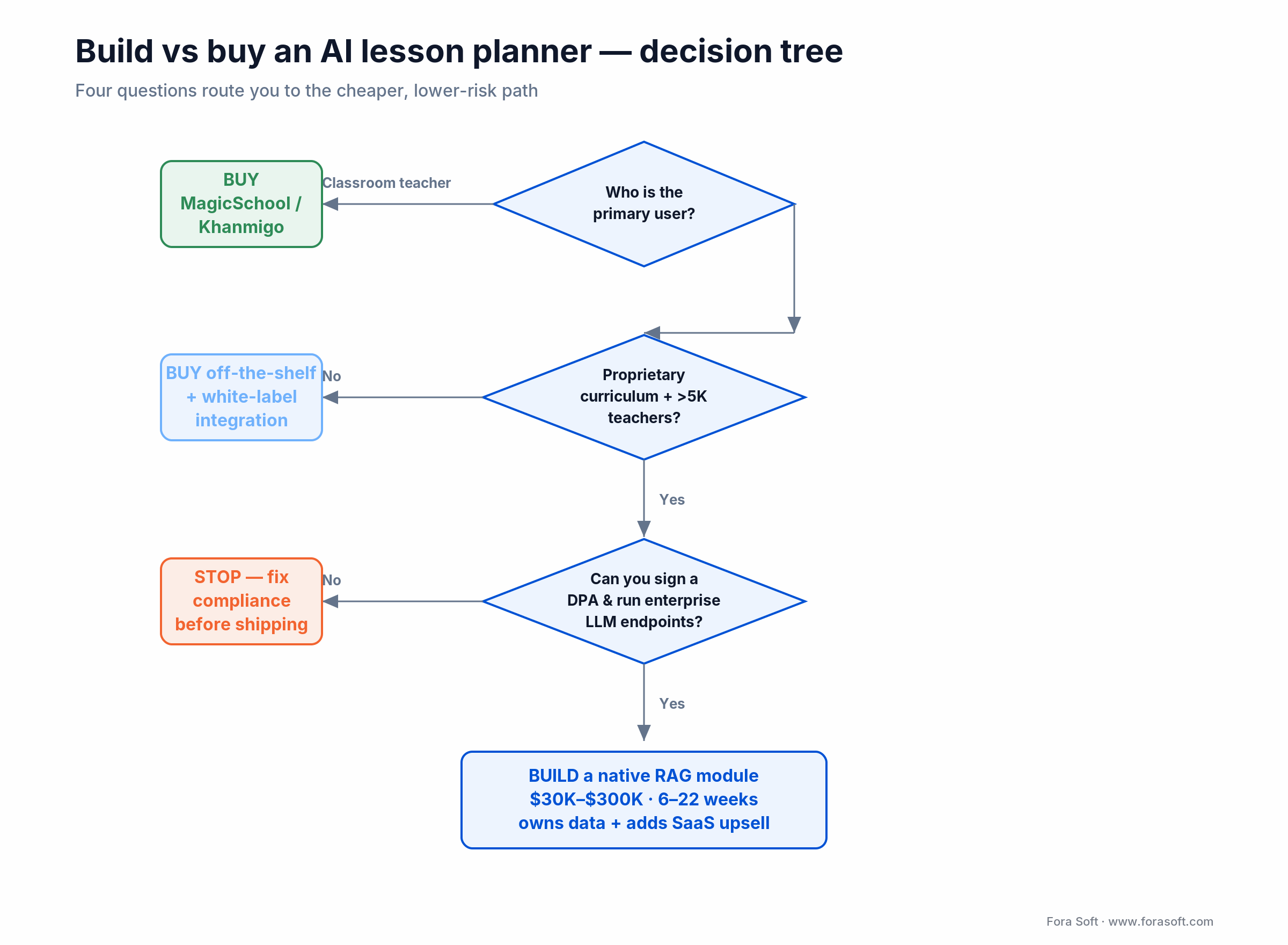
Figure 2. Build-vs-buy decision tree: four questions route you to the cheaper, lower-risk path for AI lesson planning.
Reference architecture for a custom AI lesson-planner module
Every lesson-planner module we ship follows the same six-layer pattern. The layers are technology-agnostic — you can swap the LLM, vector DB, or front-end without changing the shape.
1. Input layer. A structured form: grade, subject, standard code, duration, differentiation needs, optional seed content. Keep it under 10 fields; more and teachers bounce.
2. RAG layer. Vector DB (Pinecone, Chroma, FAISS, pgvector) seeded with the district’s curriculum, state standards, rubric library, and approved-source passages. This is where LLM hallucinations are controlled.
3. LLM inference layer. GPT-5 or Claude Opus for the primary draft; Gemini Flash or Haiku 4.5 as cheap router for utility tasks (summarisation, translation). Prompt caching cuts cost 50–90%.
4. Validator layer. Standards-alignment checker, fact-checker against retrieved passages, bias detector, reading-level checker (Flesch-Kincaid). Flag low-confidence outputs for human review.
5. Teacher customisation surface. Side-by-side editor with accept / edit / reject controls. Every AI output is a draft, never a shipped lesson.
6. Compliance & audit layer. PII tokenisation, audit log of every prompt, DPA-bound LLM vendor (enterprise endpoints only, no training use of student data), FERPA / COPPA / GDPR reporting.
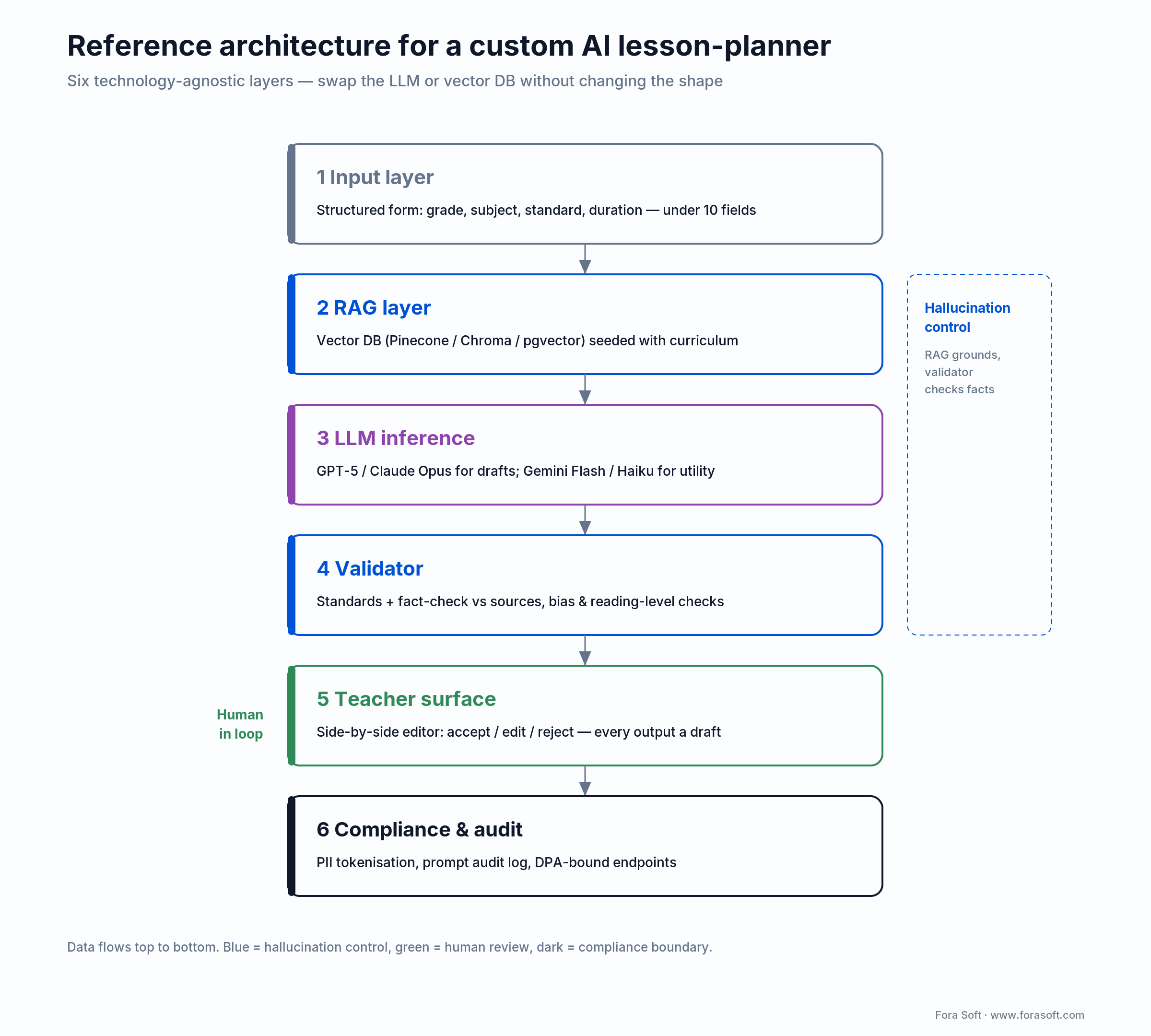
Figure 3. Reference architecture: RAG plus a validator layer control hallucinations; the teacher keeps final say before any lesson ships.
Want us to prototype it in four weeks?
We ship AI lesson-planner MVPs on a fixed-fee basis. Tell us your curriculum, LMS, and compliance scope — we return with an architecture diagram and a firm quote within one business day.
Build cost, timeline, and monthly inference budget
| Scope | Features | Timeline | Build cost |
|---|---|---|---|
| MVP | Lesson + rubric generation, one LMS integration | 6–8 weeks | $30K–$80K |
| Mid-size | +Differentiation, validator, two LMS, FERPA | 10–14 weeks | $80K–$150K |
| Full platform | +RAG on district curriculum, multilingual, teacher analytics | 16–22 weeks | $150K–$300K |
Monthly inference budget depends on teacher volume. At 5,000 monthly active teachers generating 10 lessons each, expect roughly $1,500–$4,500/month on GPT-5 with prompt caching, or $200–$600/month on Gemini Flash if the quality tier can be mixed. Add hosting ($300–$1,500), vector DB ($100–$500), and monitoring.
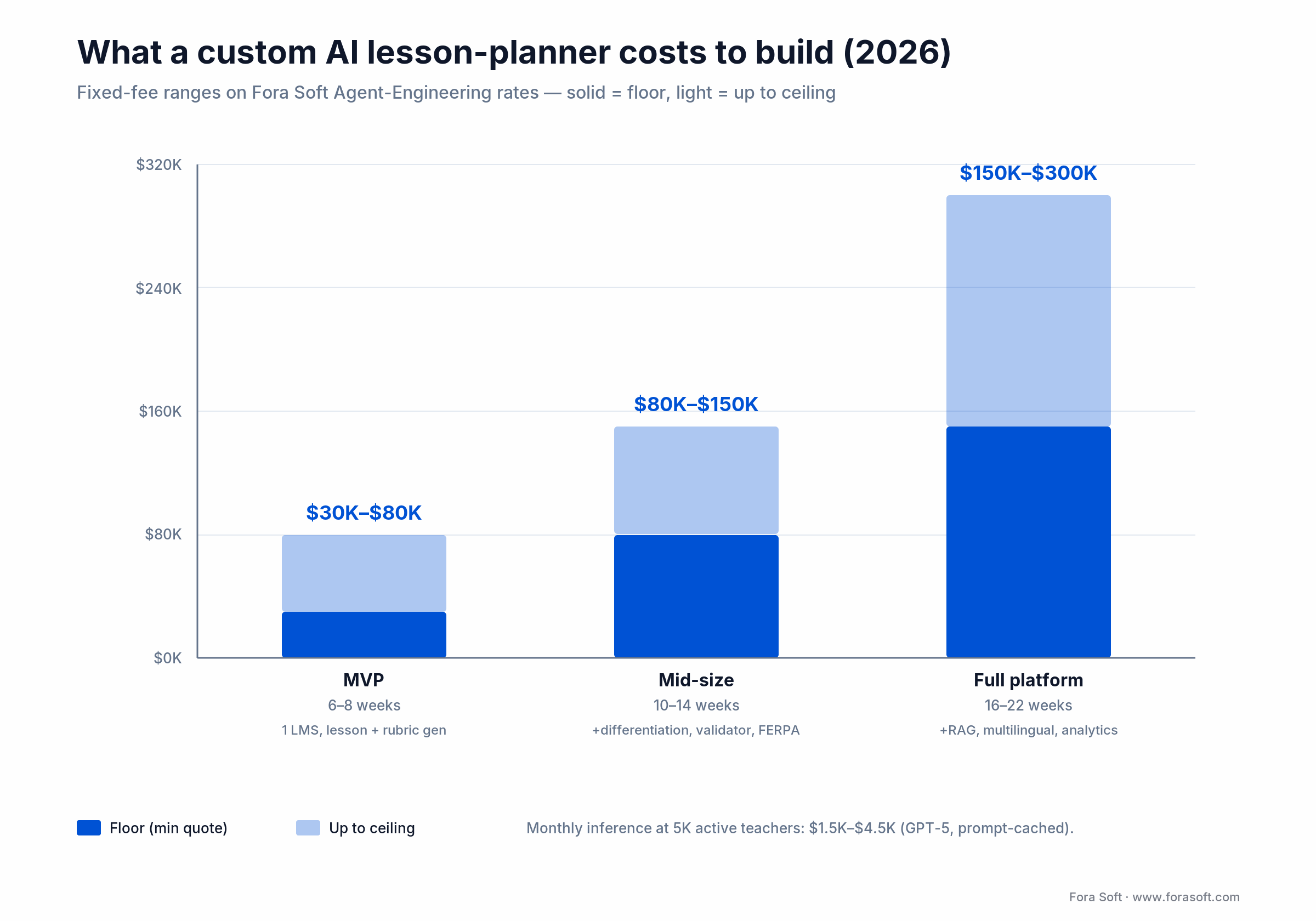
Figure 4. Build cost by scope on Agent-Engineering rates: MVP $30K-$80K through full platform $150K-$300K, 6-22 weeks.
Mini case — scaling Scholarly with AI course creation
A global higher-education platform came to us needing to help instructors create full courses — lessons, quizzes, rubrics — without hiring an instructional-design team for every cohort. Live-class scale had to hit 2,000 concurrent students without degrading video quality.
Our plan combined a WebRTC live-class core with AI-assisted course generation: GPT-based drafts from an instructor’s syllabus outline, Claude-based rubric generation, on-device Whisper transcription, and an interactive-whiteboard module. The AI layer was RAG-grounded on the platform’s existing course catalogue and pedagogy guidelines to keep outputs consistent.
Outcome: 15,000+ users, 2,000 concurrent students on live classes, and an AWS Most Innovative EdTech Award (Asia Pacific) for the result. Full details on the Scholarly case study page. Want a similar assessment?
FERPA, COPPA, GDPR — the four rules you cannot skip
1. Do not send student PII to a cloud LLM without a DPA. FERPA (US Dept of Education, Student Privacy) requires Data Processing Agreements with every vendor touching student records. The 2024 CDT survey found 42% of districts using AI had not signed DPAs. If you are building, default to enterprise LLM endpoints (OpenAI Enterprise, Anthropic Claude for Business, Azure OpenAI, AWS Bedrock) where data is not used for training.
2. Comply with COPPA 2.0 by April 2026. The updated US Children’s Online Privacy Protection Act requires explicit verifiable parental consent for under-13 users and bans ad-targeting. Build opt-in flows and parental-dashboard access before launch.
3. GDPR for any EU student. Right to access, right to erasure, data-residency controls. Keep a per-student data map. Penalties reach €20M or 4% of global revenue.
4. Tokenise PII before it hits the LLM. Replace student names / IDs with tokens upstream; re-hydrate in the UI. Simple and effective.
Five pitfalls that sink AI lesson-planning rollouts
1. Hallucinations in generated content. LLMs confidently invent facts, especially in long-tail subjects. Mitigation: RAG against vetted sources, a fact-checker validator, and a visible “AI-generated — please verify” banner on every draft.
2. Student data leakage. A single unsigned DPA or a teacher pasting names into the free tier of ChatGPT triggers FERPA, COPPA, and GDPR headaches at once. Mitigation: enforced enterprise endpoints, pre-flight PII redaction, mandatory staff training.
3. Equity gaps widening. Rich schools adopt AI and compound their advantage; under-resourced schools fall further behind. Mitigation: equitable licensing, open-source alternatives, bias audits, explicit offline / low-bandwidth fallbacks.
4. Teacher agency erosion. Blindly following AI drafts turns teachers into script-followers. Mitigation: co-creative workflow (teachers edit every output), professional development on critical evaluation, analytics on how often teachers change the draft.
5. Context loss in generic outputs. An LLM without district curriculum, pacing guides, and student demographics produces bland, disconnected lessons. Mitigation: RAG on local context, teacher customisation surface, feedback loop that retrains from edits.
KPIs to track from day one
Teacher-side KPIs. Hours saved per week (target > 4), teacher NPS (target > 40), adoption rate (target > 70% in 12 months), edit rate on AI drafts (target 40–60% — too low signals blind acceptance, too high signals bad output).
Student-side KPIs. Engagement lift (target ≥ 20% over baseline), completion rate on AI-generated lessons, time-to-mastery reduction, differentiated-material usage rate.
Content-quality KPIs. Standards-alignment score (target 95%), fact accuracy (target 98%+), rubric alignment to objectives (target 90%+), differentiation coverage (percentage of lessons with 2+ learner-level variants).
When not to let AI write the lesson
IEPs and 504 plans. Common Sense Education specifically warns against AI-generated IEPs that look professional but miss the individualisation IDEA legally requires. Use AI to assist drafting; require a human special-education expert to approve.
High-stakes summative assessments. AI can draft options; humans must validate rigour, equity, and alignment. Never ship a graded test from an AI draft.
Deep creative and arts analysis. AI handles foundational skill drills fine. Interpretation, critique, and artistic voice require a human teacher.
Behaviour-intervention plans. These require understanding the whole child, family, context. AI assists with documentation; teachers decide.
How to roll out AI lesson planning in four phases
Phase 1 — Governance first (week 1–2)
Before you touch a tool: write the AI-use policy, sign DPAs with vendors, train staff on FERPA / COPPA, and appoint a teacher champion. Schools with a policy capture 26% more of the time-saving benefit than those without.
Phase 2 — Pilot (week 3–8)
10 volunteer teachers, one tool, one grade level, one subject. Baseline time-on-task and NPS. Exit criterion: > 4 hours/week saved and NPS > 40.
Phase 3 — Scale (week 9–20)
Roll the tool to the whole school or district. Add professional-development sessions. Publish an internal gallery of best AI-assisted lessons. Track the KPIs monthly.
Phase 4 — Mature (ongoing)
Quarterly retros on equity, hallucinations, and teacher agency. Annual compliance audit. Retrain staff as the tool releases features. Treat the AI tool as infrastructure, not a project.
A decision framework — pick your approach in five questions
1. Who is the primary user? Classroom teacher → buy MagicSchool / Khanmigo / Education Copilot. LMS / platform customer → build a native module.
2. What is the compliance surface? Under-13 students → COPPA mandatory. EU students → GDPR mandatory. US K-12 → FERPA DPAs mandatory. If you cannot sign a DPA, do not send data.
3. Do you have proprietary curriculum? Yes → RAG it into your platform and build a custom planner. No → buy an off-the-shelf tool.
4. What is the scale? < 500 teachers → commercial SaaS. 500–5,000 → commercial SaaS or a lightweight white-label integration. > 5,000 → custom build breaks even quickly.
5. What is the differentiation requirement? Heavy SpEd / ELL → Diffit, SchoolAI, or a custom differentiation engine. Standard mixed-ability → any major tool works.
Common mistakes we keep seeing
Adopting a tool without an AI-use policy. The 26% benefit gap is real — governance is not paperwork, it is outcome.
Letting teachers paste student names into free ChatGPT. That is a FERPA violation waiting to become a headline. Use enterprise endpoints.
Skipping professional development. A teacher who does not know the tool uses it for one feature and abandons it. Budget 4–8 hours of PD per teacher in year one.
Generating an IEP and shipping it. Always a human SpEd reviewer. The quality gain holds only with review.
Measuring success by “lessons generated”. That is a vanity metric. Measure hours saved, engagement lift, standards alignment, and content accuracy.
Pre-launch checklist — the twelve items we never skip
Before an AI lesson-planning tool goes school-wide or platform-wide, we walk the client through these twelve checks. Any red and the rollout is paused.
- AI-use policy is written, approved by leadership, and shared with staff.
- DPAs are signed with every tool and LLM vendor touching student data.
- Enterprise LLM endpoints are enforced; free-tier use is blocked by policy and network controls.
- COPPA 2.0 verifiable parental consent flow is live (for under-13 students).
- GDPR data-residency, access, and erasure workflows are tested end-to-end.
- PII tokenisation happens upstream of the LLM call.
- Fact-checking validator is live and blocks low-confidence drafts from auto-shipping.
- Human review step exists on IEPs, assessments, and creative analysis.
- Teacher-customisation surface is visible and every draft is editable.
- Professional development plan exists (4–8 hours per teacher in year one).
- Metrics dashboard tracks hours saved, edit rate, and accuracy score.
- Kill-switch feature flag can disable the AI module remotely without a new release.
FAQ
Is AI lesson planning actually free?
MagicSchool, Eduaide, Diffit, Curipod, and Brisk all offer free tiers. Khanmigo is fully free. ChatGPT for Education is free for verified US K-12 educators through June 2027. Full features usually require paid plans at $10–$50 per teacher per month, or district bulk licences at $5–$15 per educator per year.
Can AI lesson planners align to Common Core, NGSS, IB, or state standards?
Yes. MagicSchool, Khanmigo, SchoolAI, and Education Copilot all ship built-in standards matching for Common Core and NGSS; most cover state standards in the US and major international frameworks (IB, Cambridge). Verify your specific standards are supported; custom local standards usually require a RAG implementation.
How do we prevent AI from generating misinformation in lessons?
Three layers: (1) RAG against a vetted source library so the LLM quotes curriculum, not its training memory; (2) a fact-checker validator that cross-references generated content with sources before it reaches the teacher; (3) a human review step for every lesson, with a visible “AI-generated — verify before use” banner.
Is AI lesson planning FERPA, COPPA, and GDPR compliant?
It can be — it is not by default. Requirements: signed DPA with every LLM and tool vendor, tokenised / redacted PII before it leaves your infrastructure, explicit parental consent flows for under-13 students (COPPA 2.0 from April 2026), data-residency controls for EU students (GDPR), and a documented deletion-on-request process. Fora Soft designs these flows for every EdTech client.
What does it cost to build a custom AI lesson planner into our LMS?
An MVP with lesson + rubric generation and one LMS integration: $30K–$80K in 6–8 weeks on our Agent-Engineering rates. A full platform with differentiation, multilingual, RAG, and compliance: $150K–$300K in 16–22 weeks. Monthly inference runs $1,500–$4,500 at mid-scale if you route intelligently between model tiers.
Will AI replace teacher lesson planning entirely?
No. AI works as augmentation: compresses routine drafts, differentiation and documentation so teachers spend the saved time on feedback, on relationships, and on higher-order design. Districts that used AI as a staffing-cut justification usually reverse the decision within two quarters once the teacher-agency erosion shows up in student outcomes.
How do we pitch AI lesson planning to our school board?
Lead with 5.9 hours/week / 6 weeks/year time saved; the 26% benefit gap between schools with and without an AI-use policy; a governance-first plan that addresses FERPA / COPPA upfront; and a small pilot with measurable exit criteria. Attach the Walton / Gallup 2025 report for external validation.
What is the single biggest risk?
Student data leakage via untrained staff using free LLM tiers with PII. It is simultaneously a FERPA, COPPA, and GDPR violation and it shows up in local news fast. Mitigate with enforced enterprise endpoints, pre-flight PII redaction, and a clear “never paste student names into the free tool” policy with staff training.
What to read next
AI streaming
AI in Video Streaming & Learning Apps
ML-driven recommendations and adaptive bitrate for EdTech streaming.
AI patterns
Fora Soft & AI: 6 Production Patterns
The AI components we drop into LMS and EdTech products in production.
AI agents
How Video AI Agents Work
Patterns for AI agents inside a live virtual classroom.
Engagement
ML-Based Emotional Analysis
Using emotion detection to adapt lesson pacing and feedback.
Agent engineering
Spec-Driven Agentic Engineering
The methodology behind our faster-than-agency EdTech rollouts.
Ready to ship AI lesson planning to teachers or build it into your platform?
The playbook is clear. If you are a school or district, start with MagicSchool or Khanmigo on a governance-first rollout — AI-use policy, DPAs, small pilot, measurable exit criteria, and professional development before scaling. If you are an EdTech platform, build a native RAG-grounded lesson-planner module to differentiate your product, protect student data inside your compliance perimeter, and add a new SaaS upsell.
Either way, keep the human in the loop on IEPs, high-stakes assessments, creative analysis, and behavioural plans. Measure hours saved, engagement lift, standards alignment, and content accuracy — not lessons generated. Ship enterprise LLM endpoints, sign DPAs, tokenise PII. Train your staff. Review drafts.
Fora Soft has shipped e-learning and AI-assisted EdTech products since 2005 across virtual classrooms, LMSs, tutoring platforms, and AR gamification. Newer to EdTech engineering? Our e-learning video course covers the streaming and classroom foundations these AI features sit on top of. If you want a second pair of eyes on your roadmap or a team to build it with you, a 30-minute scoping call is the shortest path.
Let’s build your AI lesson planner
Tell us your curriculum scope, LMS, and compliance context — we will come back with an architecture diagram, tool recommendation, and a dollar-accurate estimate within one business day.

