

Key takeaways
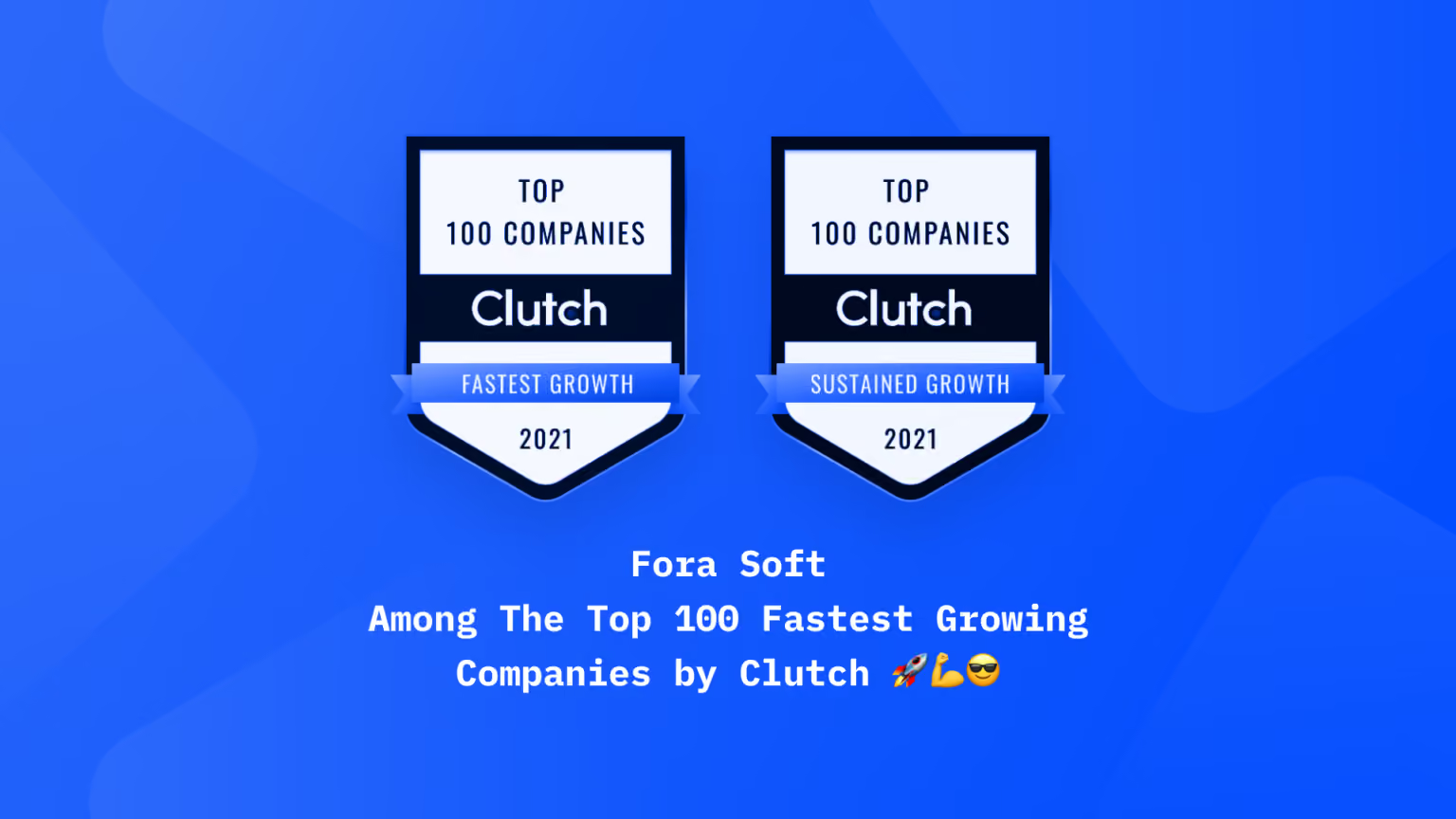
• Clutch ranked Fora Soft on its global Top-100 lists for both Fastest-Growing and Sustained-Growing B2B service providers. 58% revenue growth from 2019–2020, 158% growth from 2017–2020, all on verified financial submissions.
• Why this matters when you’re hiring a software partner. Sustained growth + 5-star verified reviews are a much better signal than a flashy portfolio site — they prove clients are renewing and referring.
• Use Clutch the way procurement teams actually use it. Filter by 5-star reviews, verified by phone, in your industry, with a project size band that matches yours; ignore vanity badges.
• Twenty-one years, 250+ shipped products, real-time video and AI as the spike. Below we explain how that growth happened and how to apply the same evaluation lens to any vendor on your shortlist.
• If you’re short-listing right now, talk to us. A 30-minute call usually saves 4–6 weeks of vendor screening.
Why Fora Soft wrote this update
Clutch is the most-trusted B2B review platform in the software-services market. When the Washington-DC team behind it publishes a "fastest-growing" or "sustained-growth" Top-100 list, they verify each entry against company-supplied financials and a baseline of phone-verified client reviews. Making either list once is hard. Fora Soft made both.
Most of our prospects don’t care about the badge itself. They care about what it implies: that we’ve been growing through repeat business and referrals (the kind of growth that’s hard to fake), and that more than ten of our clients picked up the phone to give Clutch a 5-star review on the record. So instead of running this article as a self-congratulatory press post, we re-wrote it as something useful: a buyer’s guide to reading Clutch — and any other vendor signal — the way professional procurement teams do.
If you’re evaluating an outsourced software partner right now, the next 15 minutes will save you weeks of vendor screening. Read on.
Short-listing a vendor this quarter?
Send us your project brief. We’ll give you a 30-minute honest read — whether we’re the right fit, who else to consider, and the questions to ask every shortlist vendor.
The recognition: two Clutch Top-100 lists, verified financials
Fora Soft is included in two Clutch Top-100 lists: 100 Fastest-Growing Companies and 100 Sustained-Growing Companies. Clutch reserves these lists for B2B service providers that record the highest verified revenue change over fixed reporting periods:
- Fastest-Growing — revenue change from 2019 to 2020.
- Sustained-Growing — revenue change from 2017 to 2020.
Fora Soft grew 58% from 2019 to 2020 and 158% from 2017 to 2020 — on top of an existing 17-year base. That trajectory has continued; in 2025 we crossed 21 years and 250+ shipped products, with real-time video, computer vision and applied AI as our consistent spike (see 21 Years of Fora Soft for the long view).
Why a Clutch listing is more than a badge
Plenty of awards in this industry are pay-to-play. Clutch is not. To make either Top-100 list a vendor has to:
1. Submit verified revenue figures. Clutch matches what you submit against tax filings, audited statements, or other independent records before publication.
2. Maintain a baseline of verified reviews. Clutch analysts call your clients to confirm the engagement, the budget band, the deliverables and the satisfaction score — and they refuse to publish a review they cannot verify.
3. Hold an active and accurate profile. Stale or misleading profiles get demoted or de-listed, regardless of badges.
Reach for Clutch as a primary signal when: you’re sourcing a long-term outsourced engineering partner ($50K+ engagements, 6+ months of work). It’s less useful for $5K one-off freelancing — for that, GitHub or Toptal profiles tell you more.
What sustained growth tells you about a vendor
Revenue growth in services businesses is mostly fueled by two things: client retention and referral. Marketing spend can pump up a single year; only repeat business and referrals stretch growth over four. So when you see a vendor on a Sustained-Growth list, you’re reading three things at once:
| Signal | What it implies | What it does NOT prove |
|---|---|---|
| Multi-year double-digit growth | Repeat business is high; clients are renewing. | That every team inside the vendor is equally strong. |
| High verified-review density | Clients are willing to go on the record — rare without a real outcome. | A specific reviewer’s outcome will repeat for you. |
| Domain concentration on profile | There’s real depth in that domain (e.g., real-time video). | They’ll be equally strong outside their domain. |
| Stable senior leadership in profile | Lower delivery risk; institutional knowledge is intact. | That junior staff turnover is also low. |
| Project-size distribution | They’re used to engagements your size. | They’ll keep an A-team on every engagement. |
For services buyers, this is the single most undervalued lens: growth is a proxy for honest delivery, because in services markets dishonest delivery extinguishes itself in three years.
How to read a vendor’s Clutch profile in 5 minutes
Procurement teams use the same five-minute reading protocol on every Clutch profile. Steal it.
1. Look at the most recent five reviews, not the headline rating. Headline ratings are slow to move. Recent reviews show what working with the vendor is like today.
2. Filter by your project size band. A vendor that delivers $5M projects flawlessly may not be set up to delight you on a $50K MVP — and vice versa.
3. Filter by your industry or domain. A 5-star LegalTech build doesn’t prove the vendor can ship a real-time video product, or vice versa. Look for repeat patterns in your space.
4. Read the “What could be improved?” section. A reviewer who can articulate the trade-offs trusts the vendor enough to be honest. Empty “nothing” answers are a yellow flag.
5. Cross-reference reviewer titles with LinkedIn. Real Clutch reviews come from real CTOs, COOs and product leads. If you can’t find them, the review may be ghostwritten.
Reach for the “What could be improved?” field first when: you’re close to a decision and want to surface delivery risk early. The most useful sentence on Clutch is rarely the praise.
What changed at Fora Soft after the recognition
The award itself was a moment; the work that produced it was four years in the making, and it has continued. Three things changed structurally between the original announcement and today:
1. Real-time video & AI became our spike. What started as a WebRTC and streaming practice grew into a deep stack: SFU/MCU expertise (LiveKit, mediasoup, Janus, Jitsi), VMS work like our flagship V.A.L.T. surveillance platform (700+ organizations, 25K daily users), and applied AI for transcription, translation, anomaly detection and content recommendation.
2. Agent Engineering changed the cost curve. We adopted multi-agent code generation paired with senior architectural review around 2024. It compresses our discovery and prototyping cycles by roughly 30–40%, which lets us quote faster and cheaper than firms still hand-coding the same scaffolding.
3. We doubled down on long engagements. Our average client relationship is now multi-year. Some, like INSTACLASS, started as fixed-scope MVPs and turned into ongoing product partnerships.
A 9-point checklist to evaluate any software vendor
Forget badges. The same checklist works whether the vendor is on Clutch, GoodFirms, DesignRush or just in your inbox. Score them out of 9; below 6, walk.
- Verified financial growth across at least 3 fiscal years.
- 5+ phone-verified reviews in the last 18 months.
- 3+ case studies in your domain with named clients.
- Engagements at your size band within the last 12 months.
- Stable senior leadership — 5+ years tenure on the leadership page.
- An honest "what we don’t do" — a vendor that says yes to everything is dangerous.
- Public engineering culture — blog, GitHub, conference talks — or a believable explanation why not.
- References on demand — not just a single curated client.
- A clear estimation methodology (see our Guide to Software Estimating).
Want this checklist applied to your shortlist?
Send us the names of your 2–3 finalist vendors. In a 30-minute call we’ll walk the checklist with you, including a check on us if we’re on the list.
Reviews vs portfolio: which one to trust more
Glossy portfolio sites are easy to fake; phone-verified reviews are not. Use them in this order:
1. Verified reviews answer the question "What is it like to work with these people?"
2. Case studies answer "Have they shipped something like mine?"
3. Live products (open them in your browser) answer "Does the actual UX hold up?"
When the three disagree, trust the reviews. Portfolio language and screen mockups can survive a bad delivery; an angry client on a recorded Clutch call cannot.
Quick rule of thumb: if a vendor’s portfolio looks better than their reviews, assume the portfolio is aspirational. If the reviews look better than the portfolio, you’ve found an under-marketed team — often the best kind to hire.
Our review-collection philosophy
When the original 2022 announcement went out, our CEO Nikolay Sapunov said something we still stand by:
"We are always hesitant about asking clients for a review. They are busy people, and a real review takes time and mental effort. That is why we don’t have many. However, the ones we have are all 5-stars."
We could’ve quintupled our review count by automating the ask. We didn’t, because the second-best signal of an honest vendor is the willingness to leave reviews on the table when getting them would feel transactional. Quality over quantity is also why our average review length is twice the Clutch median — reviewers who don’t want to write don’t.
Where Fora Soft delivers most reliably
Sustained-growth recognition gets vendors invited to projects outside their wheelhouse. We try to be honest about what we’re actually best at:
- Real-time video & WebRTC products — SFU/MCU, recording, broadcasting, telehealth, virtual events, virtual classrooms.
- Video surveillance & VMS — cloud-first VSaaS, edge-cloud hybrids, AI loss prevention, evidentiary storage.
- Computer vision & applied AI — YOLO-based detection pipelines, anomaly detection, recommendation engines, transcription / translation.
- EdTech — learning platforms with live classes, asynchronous content, AI tutors and assessment.
- Mobile (iOS / Android / Flutter) — production iOS architectures (MVVM-C, SwiftUI Observable), accessibility-first builds.
How vendors cheat the signals (and how to spot it)
Not every "Top Software Developer" badge is real. The most common tricks:
1. Pay-to-play directories. If the badge appeared the day the vendor signed up, that’s a paid listing, not an award. Check whether the directory has a methodology page.
2. Identical 5-star reviews. Same sentence structure across reviewers, posted within 48 hours, all in the same week of the year — classic ghostwriting pattern. Real reviews are messy.
3. Glamour case studies with no client name. "A leading US fintech" usually means an unverified prototype. Real clients eventually agree to be named.
4. Outsourced sales presenters who never ship. The senior architect on the call should answer technical questions in week 1, not "we’ll get back to you with the team."
5. Inflated headcount. 200 engineers on the website, 35 on LinkedIn, contractors filling the rest. Check LinkedIn employee counts before you trust capacity claims.
How we quote and why it’s usually faster than peers
Two structural choices keep our cycle times short. First, we run discovery in two weeks, not eight, by separating “decisions you must make” from “decisions we can defer.” Second, our Agent-Engineering pipeline emits the boring 70% of any new system — auth, multi-tenant scaffolding, IaC, RBAC schemas — while senior engineers refactor and harden. The result is that a typical 16–20-week engagement at peer firms lands in 12–14 weeks with us, on the same scope.
If you want a sense of how we estimate, our Guide to Software Estimating walks through the methodology and the typical accuracy bands.
Mini case: turning an INSTACLASS MVP into a multi-year partnership
Situation. INSTACLASS came to us with a tight runway, a vision for a virtual classroom built around live video and instructor tooling, and a need for a vendor that could ship a credible MVP in a single quarter without compromising the architecture for what came next.
Plan. A two-week discovery, a 12-week MVP build on a real-time video stack we knew well, and a deliberate "no premature scaling" architectural posture. Their COO later wrote on Clutch: "Their skills impressed us, they can do anything in a short amount of time."
Outcome. The MVP shipped on time and the engagement turned into an ongoing product partnership. You can read the project page here; the broader portfolio sits at /projects.
Want a similar diagnostic for your shortlist? Book a 30-min call and we’ll walk through the questions you should be asking us — and the other vendors on your list.
A decision framework: pick the right vendor in five questions
1. Has the vendor delivered something within 20% of your size and complexity in the last 12 months? If not, you are paying for their learning curve.
2. Will a senior engineer be on the project, not just on the sales call? Get the named lead in writing before signing.
3. Is the proposed methodology specific or generic? “Agile” is not a methodology; a 14-week breakdown with named deliverables is.
4. What does the “goes-wrong” clause look like? Honest vendors tell you what happens when scope or velocity slips. Dodgers don’t.
5. Can you reach two reference clients on a single phone call? Within 72 hours, no warm-up. If not, ask why.
Five vendor-selection pitfalls we see every quarter
1. Picking on price alone. The lowest bidder usually wins by underestimating, then bills the delta in change orders. Net cost is higher.
2. Ignoring time-zone overlap. Less than four hours of daily overlap with a partner doubles your decision latency. Test it before you sign.
3. Skipping the technical reference call. Sales references are nice. Technical leads from the reference’s engineering team are diagnostic.
4. Letting the vendor own discovery alone. If you don’t shape the discovery output, you get a scope that fits their bench, not your needs.
5. No exit ramp. Always reserve the right to take the codebase, the IaC and the docs in-house at any quarter boundary, with no penalty.
The cheapest fix for these pitfalls: run a paid 2-week discovery sprint before signing the main SOW. It’s the best $10–20K of insurance in any software purchase — and the vendor that declines it is telling you something.
KPIs to track on the engagement, week by week
Quality KPIs. Defect-escape rate (production bugs / sprint), code-review turnaround <24 hours, automated-test coverage ≥70% on touched files, no Sev-1 in the last sprint. These tell you the team is shipping responsibly.
Business KPIs. Velocity in story-points and shipped features per sprint, scope-to-budget ratio ≤1.1, time-to-decision <48 hours on blocked items. These tell you the partnership is moving the business.
Reliability KPIs. Staffing stability (no unannounced rotation), monthly retro action-item completion >80%, production uptime ≥99.9%, MTTR <30 minutes for Sev-1. These tell you the team is institutionally reliable, not just briefly impressive.
When NOT to pick Fora Soft
We turn down 1 in 4 leads because the fit isn’t right. The pattern usually looks like this:
- You need 50+ engineers in a single quarter. Body-shop scale is not our model; we partner with focused product teams, not staff augmentation.
- The project has zero video, AI, mobile or accessibility surface area. A pure on-prem ERP migration is not where our spike helps.
- Discovery has been replaced with "just build what the deck says." We push back hard on this; some clients prefer a yes-vendor.
- Budgets are below ~$30K total. Below that, freelancers serve you better; we won’t pretend otherwise.
- You need a vendor that will say yes to everything. We won’t. A senior partner’s job is to tell you what won’t work before you build it.
FAQ
Is Fora Soft still on Clutch’s Top-100 lists?
The Top-100 lists are issued for fixed reporting windows, so each annual list reflects a specific period. Our 2021 inclusion (covering 2017–2020 sustained and 2019–2020 fastest growth) is a permanent record. We’ve continued to grow since then; the most current snapshot of our profile, reviews and project breakdown is on our Clutch page.
How do I tell a real award from a paid listing?
Three quick checks. (1) Does the directory publish a methodology page that’s older than the badge? (2) Did the badge appear after a verified review or financial submission, not after a payment? (3) Are the other companies on the list reputable and well-reviewed independently? Clutch passes all three; many badge mills do not.
What size of project is Fora Soft set up for?
Our sweet spot is product engagements in the $50K–$2M range, ranging from a 12–16 week MVP to a multi-year SaaS build. We’ve delivered both ends of the band. For shorter / smaller work, we’ll often refer you to a freelancer who’ll serve you better.
Can I see real client references on a call?
Yes — once the engagement is past the early-discovery phase. We typically arrange two or three reference calls (mix of CTO and product lead) before contract signature. Many of our references are also publicly named on our projects page.
How does Agent Engineering affect what we’ll be charged?
It compresses our typical project length by 30–40% on the boilerplate-heavy phases (auth, multi-tenant, IaC, CRUD APIs, scaffolding tests). For a 16-week scope, that usually translates into 4–6 weeks of engineer-time saved — which lands as a lower fixed-price quote, not as us pocketing the savings.
What happens if the engagement isn’t working?
We write quarter-boundary exit ramps into every contract. At any quarter you can pause, take the codebase / IaC / docs in-house, or switch vendors with no penalty — we just want a 30-day handover window. Vendors that won’t agree to this clause are usually the ones you most need it from.
What if I want to compare Fora Soft to two other vendors objectively?
That’s the right move. Walk all three through the 9-point checklist and the five decision questions in this article. We’ll happily score ourselves first on a discovery call so you have an honest baseline. Book a 30-min call to start.
What to Read Next
About
21 Years of Fora Soft
Real-time video, AI, and 250+ shipped products — the long-form story.
Estimating
Guide to Software Estimating
How honest estimates are built — methodology, ranges, accuracy.
Cost
Mobile App Development Costs
What a real estimate for a mobile product looks like in 2026.
Engineering
Code Refactoring in Plain Words
When and why refactoring is worth the budget — without the jargon.
Portfolio
Fora Soft Project Portfolio
Named clients, shipped products and outcomes across 21 years.
Ready to apply this lens to your shortlist?
A Clutch Top-100 listing is a useful signal, not the answer. The same is true of every badge, case study and pitch deck. The question that actually matters is whether the vendor on your shortlist will deliver the specific thing you need at the size you need it — and the framework above is how you find out in 30 minutes instead of 30 days.
Whether or not we end up working together, walk every shortlist vendor through the same nine-point checklist and the same five decision questions. Trust verified reviews more than glossy portfolios. Reserve a quarter-boundary exit ramp. And insist on senior people in the room from week one. We’d love to be the first conversation in that process.
Talk to a senior architect, not a salesperson
Bring your project brief and your vendor shortlist. We’ll walk through both honestly in 30 minutes — including whether we’re the right fit.

