
Key takeaways
• Voice cloning software split into two buys. Managed APIs (ElevenLabs, Cartesia, Deepgram) versus self-hosted open models. The choice is a volume and licensing call, not a “voice is core” feeling.
• Quality stopped being the moat. Top engines score 4.3–4.8 MOS against a ~4.5 human baseline; Chatterbox (MIT, open) beats ElevenLabs in about 65% of blind listening tests. Latency and license now decide the pick.
• Open-source licensing is the trap. XTTS-v2 (CPML) and F5-TTS (CC-BY-NC) are non-commercial; only Chatterbox (MIT), Kokoro (Apache-2.0) and Piper (MIT) are safe to ship in a paid product — and Kokoro cannot clone a voice at all.
• Compliance is live, not theoretical. EU AI Act Article 50 transparency applies from 2 August 2026 (fines up to €15M or 3% of turnover). The US NO FAKES Act is still a pending bill; Tennessee’s ELVIS Act is already in force.
• Build vs license is a volume rule. Under ~1M characters/year, license. Past ~10M/year, or with on-prem or EU-residency needs, self-host on a permissive model. We compress both calendars with Agent Engineering.
Why Fora Soft wrote this playbook
Voice is not a side project for us. We have shipped 250+ products since 2005 with a 50-engineer in-house team, and a growing slice of that work is speech AI: voice agents, real-time captions and translation, dubbing pipelines, and accessibility features that only work if the synthetic speech is credible. We built TransLinguist, a real-time interpretation platform now on the NHS UK national framework with 75+ languages, and VocalViews, a research marketplace used by Samsung, Google, and Netflix. Both lean hard on streaming audio and low latency.
This is the playbook we hand to founders and CTOs scoping a voice feature. It covers which voice cloning software to pick, the licensing traps that sink self-hosting, the build-vs-license math, the latency and streaming architecture, the 2026 compliance floor, and a real cost model. When we quote a build, we use Agent Engineering — an AI-assisted internal delivery process — to keep the number below the usual agency baseline. If you want the short version for your stack, book a call through our custom software development team.
Scoping voice cloning software or a voice agent?
A 30-minute call with our voice-AI leads gets you an engine shortlist, a latency budget, a compliance plan, and a realistic timeline.
Voice cloning vs. voice synthesis — the terms buyers confuse
Voice synthesis is the umbrella: turning text into speech. Voice cloning is one branch of it — synthesis that reproduces a specific person’s voice from a sample. Standard text-to-speech uses a pre-built voice and needs no sample at all. The three answer different commercial questions, so scope with the working definitions below.
| Approach | Sample needed | Time | Similarity | When to use |
|---|---|---|---|---|
| Standard TTS | None — stock voices | Instant API call | n/a | IVR, voice agents, audiobooks with stock voices |
| Zero-shot clone | 3–6 sec audio | Instant | 0.70–0.82 cosine | Demos, ephemeral personalization, NPCs |
| Few-shot / instant clone | 30–90 sec | Minutes | 0.80–0.88 | Brand voices, tutors, mid-volume production |
| Professional clone (PVC) | 30+ minutes | Hours to days | 0.90–0.96 | Audiobooks, broadcast, named brand voice |
Under the hood, every request runs the same path: text goes in, a normalizer expands numbers and dates, the model produces acoustic features, a vocoder renders the waveform, a watermark is stamped, and the audio streams out. The compliance gate below sits on every synthesised second.
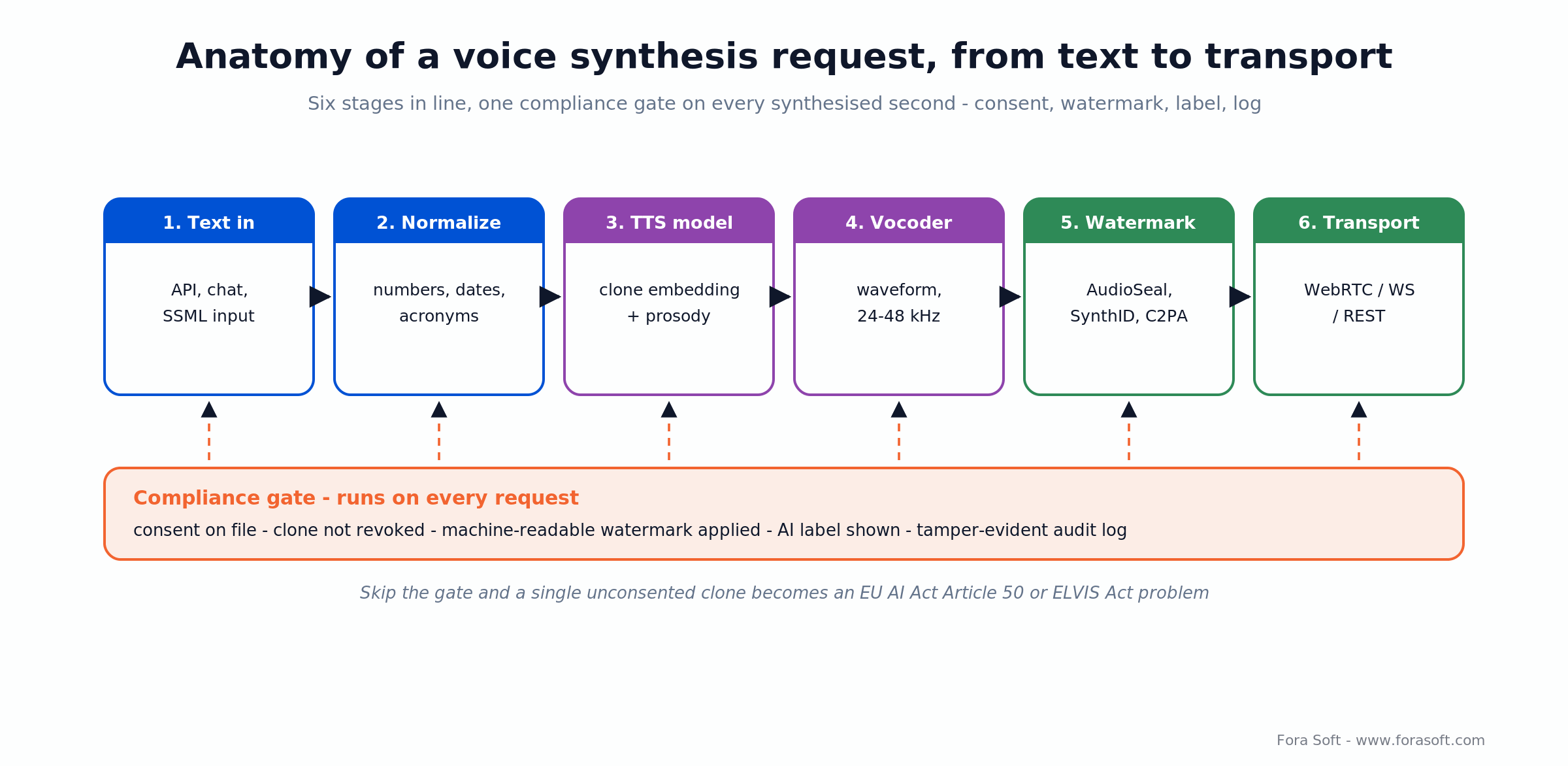
Figure 1. The six stages of a voice synthesis request, with the compliance gate that runs on every synthesised second.
Reach for a few-shot clone when: you want “sounds like our brand” without the studio time and budget of full PVC. The gap to PVC has narrowed sharply, and 60–90 seconds of clean audio covers most production needs in 2026.
Best voice cloning software in 2026 — and why there is no single winner
There is no single best voice cloning software. The right pick swings on four axes: latency, sample size, language coverage, and license. A real-time sales agent and an audiobook studio want opposite tools. The matrix below maps the credible options to the job they win, and where each one breaks.
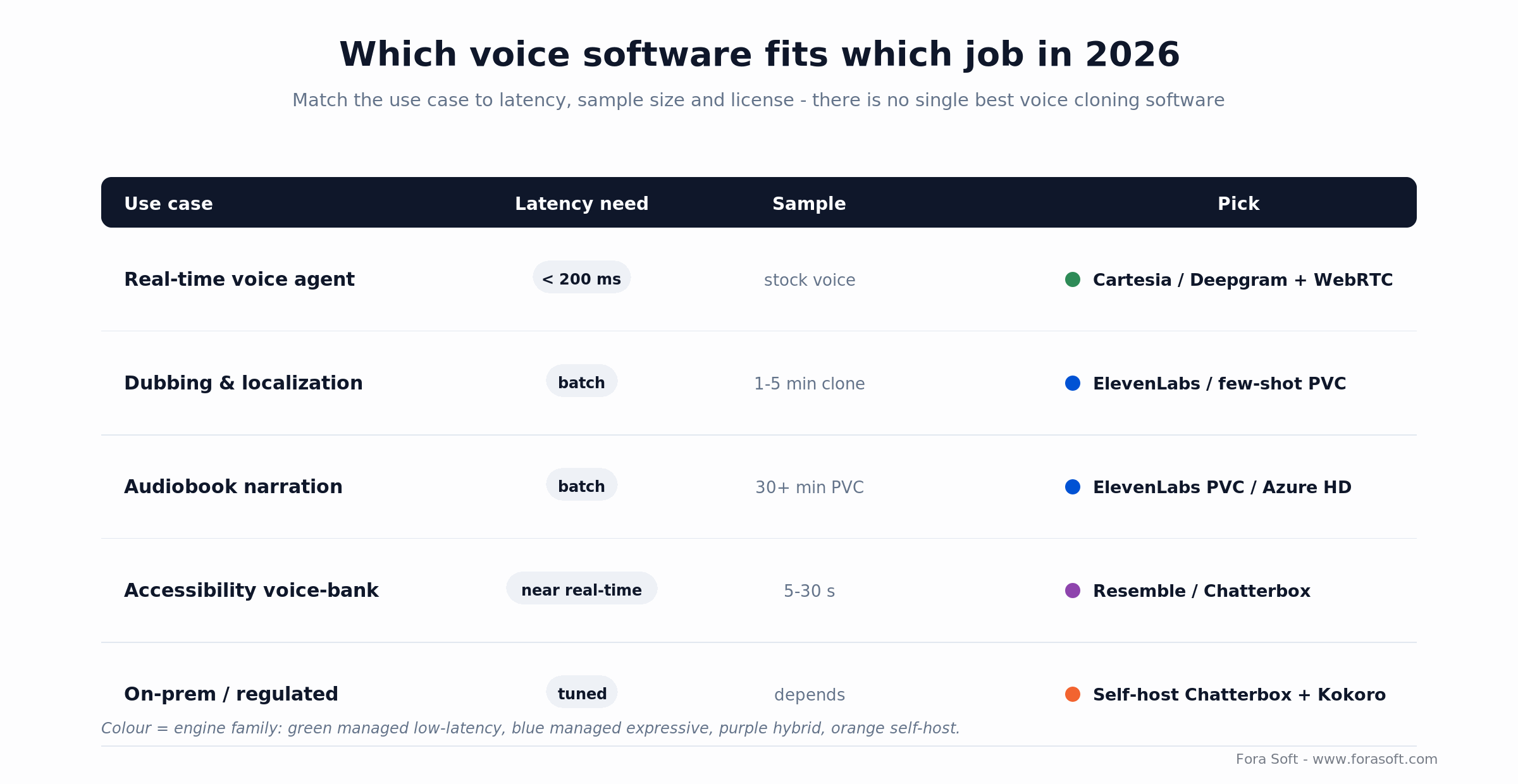
Figure 2. Match the use case to latency, sample size, and license — the pick changes with the job.
| Software | Where it wins | Where it breaks |
|---|---|---|
| ElevenLabs | Cloning fidelity, expressiveness, 70+ languages, PVC | Priciest per character at scale; credit accounting gets fiddly |
| Cartesia Sonic | Lowest latency in the field (~40 ms), cheap per character | Expressiveness trails ElevenLabs on long-form narration |
| Resemble AI | ~5 sec clone, SOC 2, ships Chatterbox for self-host, deepfake detection | Enterprise-shaped pricing and onboarding |
| Speechify | Top of the 2026 quality leaderboard; fast zero-shot clone | Consumer-first; check API terms for commercial cloning |
| Azure / Google Cloud | Widest languages (Azure 140+), HIPAA-friendly, gated custom voice | Custom voice is access-controlled; higher first-audio latency |
| Self-host (Chatterbox / Kokoro) | Data stays on your infra; no per-character bill; permissive license | You own the GPU, watermarking, and consent plumbing |
A note on vendor risk: Play.ht (later PlayAI) was acquired by Meta and its consumer product shut down on 31 December 2025. If a voice you depend on lives entirely inside one vendor, an acquisition can end your product overnight — a reason to wrap synthesis behind a thin internal API you control. For a per-vendor pricing teardown, see our ElevenLabs alternatives guide.
Reach for a managed API when: your annual volume is under ~1M characters, you ship in many languages, and you want the vendor to carry GPU, watermarking, and uptime. Below that line, the math almost never favours self-hosting.
Market snapshot — the numbers behind the build
Two forces pull in opposite directions: demand is compounding, and so is fraud. Both change how you scope the build.
| Indicator | Number | Why it matters |
|---|---|---|
| AI voice market (multiple trackers) | ~$3–4B (2024), ~30% CAGR | Estimates vary widely; the direction, not the decimal, is the signal. |
| Believability gap | MOS 4.3–4.8 vs ~4.5 human | Naturalness is no longer the differentiator; latency and license are. |
| Voice-clone fraud (2025) | $1.1B drained from US firms | Consent and watermarking are risk controls, not paperwork. |
| Deepfake vishing surge | +1,633% Q1 2025 vs Q4 2024 | Your synthesis product is judged against a rising threat baseline. |
| EU AI Act Article 50 | In force 2 Aug 2026 | Disclosure and marking of synthetic audio are now legal obligations. |
Top voice synthesis engines — pricing, languages, and latency
Numbers below are publicly listed pricing and benchmark times to first audio as of mid-2026. Production figures differ by region, tier, and volume commit. Cross-check the live rate card before you sign — see ElevenLabs pricing for a current example.
| Engine | Strength | Languages | First-audio | Indicative price |
|---|---|---|---|---|
| ElevenLabs | Cloning quality, expressiveness | 70+ | ~75–200 ms (Flash) | $0.06–$0.12 / 1K chars; Flash ~half |
| Cartesia Sonic | Lowest latency in the field | 42 | ~40 ms | ~$0.038 / 1K chars |
| Deepgram Aura-2 | Streaming-first voice agents | 7 | ~90 ms | ~$0.03 / 1K chars |
| Google Cloud (Chirp 3) | Broad language coverage | 50+ | ~150–400 ms | $30–$160 / 1M chars |
| Azure Neural / Custom Voice | HIPAA-friendly enterprise | 140+ | ~150–300 ms | ~$22 / 1M chars (commit tiers lower) |
| OpenAI gpt-realtime | One API for STT + LLM + TTS | Multilingual | ~300 ms end-to-end | ~$0.10 / min (bundled) |
Two picks anchor the ends: Cartesia for the tightest latency at a low per-character rate, ElevenLabs for the richest cloning and language range. OpenAI’s gpt-realtime is priced per minute because it bundles three services — compare it per conversation, not per character. For a real-time deep dive, our sibling guide to real-time voice cloning technology covers the vendor architecture in detail.
Open-source voice models — the license decides commercial use
Open-source has caught up on quality, and that is exactly where teams get burned. Great audio is not the same as a license you can ship. The single most expensive mistake we see is a self-hosted product built on a model whose weights bar commercial use. Read the license before the benchmark.
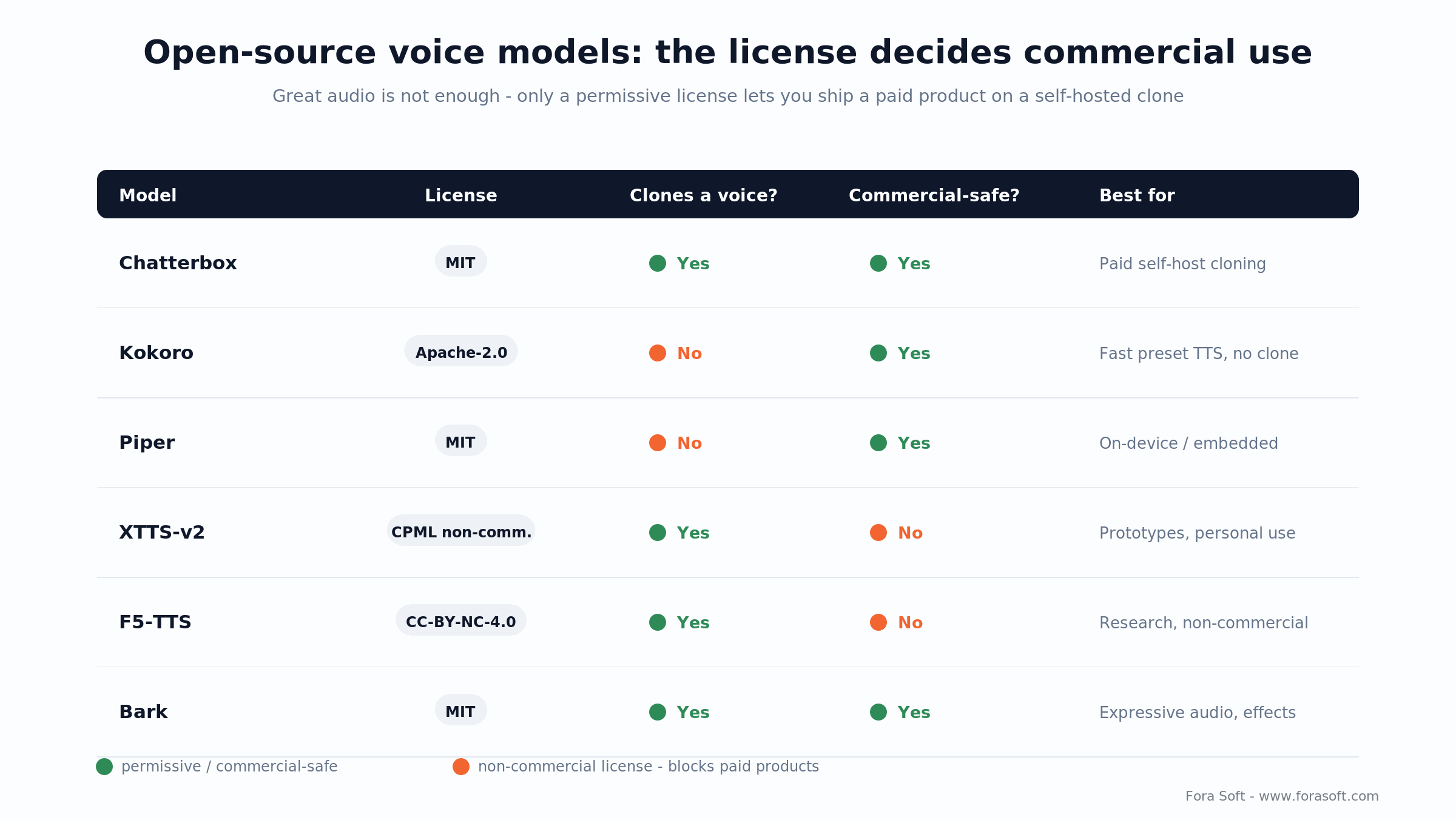
Figure 3. Only a permissive license lets you ship a paid product on a self-hosted clone — and Kokoro cannot clone at all.
1. Chatterbox (Resemble AI, MIT). The commercial-safe cloning pick. Clones from ~5 seconds, self-hostable behind an OpenAI-compatible API, and it beat ElevenLabs in about 65% of blind listening tests. If you need self-hosted cloning in a paid product, start here. Weights and code are on GitHub.
2. Kokoro (Apache-2.0). An 82M-parameter model that is fast and cheap to run, with a permissive license. The catch: it cannot clone a voice. It plays preset voices only, so it fits IVR and narration where a stock voice is fine, not brand cloning.
3. XTTS-v2 and F5-TTS. Both clone well and both are non-commercial. XTTS-v2 ships under the Coqui Public Model License; Coqui the company wound down in early 2024, so there is nobody left to sell you a commercial license. F5-TTS is CC-BY-NC-4.0. Excellent for prototypes and research, off-limits for a paid product.
4. Piper and Bark. Piper (MIT) is a light, on-device TTS for embedded use; Bark (MIT) is expressive and handles sound effects. Both are commercial-safe, neither is a precision cloning tool.
Reach for self-hosted open-source when: annual volume passes ~10M characters, the buyer needs on-prem or EU data residency, or the legal team wants full control of training-data lineage. Pick a permissive model (Chatterbox, Kokoro, Piper) and budget for the GPU, watermarking, and consent plumbing the vendor used to handle.
The voice agent latency budget — where milliseconds go
A voice agent that feels human needs total round-trip under ~800 ms; pauses over ~1.5 s collapse the illusion of intelligence. Here is the realistic budget for a streaming ASR + LLM + TTS pipeline.
| Stage | Realistic latency | Levers |
|---|---|---|
| VAD + audio capture | ~50 ms | Endpointing tuning, jitter buffer |
| Streaming ASR | ~150 ms | Deepgram, AssemblyAI, Whisper-streaming |
| LLM time-to-first-token | ~300–400 ms | Smaller routing model, prompt caching, tool pre-filter |
| TTS first audio chunk | 40–200 ms | Cartesia, Deepgram, ElevenLabs Flash |
| Network overhead | ~50 ms | WebRTC + nearest region; avoid HLS for live |
The LLM is almost always the dominant cost. Compress it with a smaller routing model, prompt caching, and aggressive tool pre-filtering before you chase the next 50 ms in TTS. Overlapping the stages — starting TTS on the first LLM tokens — is what turns a ~725 ms naive pipeline into a ~430 ms one. Our guide to the LiveKit stack for AI agents walks the transport layer.
Need a voice-agent latency plan?
In one call we pick the engine, set the latency budget, design the WebRTC transport, and quote the build — compliance layer included.
Streaming TTS architecture — WebRTC, WebSocket, REST
Three transport patterns dominate. Pick by latency target, not vendor preference.
1. WebRTC. Sub-200 ms total round-trip is achievable. Audio streams in 20–40 ms frames; a 50–100 ms jitter buffer absorbs network variance; it is bidirectional. The only credible choice for live voice agents and conversational AI.
2. WebSocket streaming. The engine returns audio chunks as it synthesises. First chunk lands in 40–200 ms; later chunks arrive every 40–80 ms. Right for in-app playback and dashboards where you control the client.
3. REST batch. Whole-utterance synthesis returned as one MP3, WAV, or Opus file. Fine for audiobook generation, IVR prompts, and dubbing pipelines — never for live conversation.
Use cases worth building for in 2026
Real-time voice agents
Customer service, sales qualification, and in-product copilots. A streaming ASR + LLM + Cartesia stack lands near $0.05–$0.09 per minute all-in — cheaper than human staffing on high-volume queues within months. Our deep dive is AI call assistants — the API guide, and the build-vs-buy for meeting agents is in voice command tools for virtual meetings.
Dubbing and localization
A cloned actor voice speaking a translated script across 30+ languages, at a fraction of traditional dubbing cost. It pairs with the patterns in real-time video translation and AI language translation in live streaming. The same cloned-voice layer drives AI avatar video; our HeyGen alternatives comparison maps where TTS plugs into each avatar pipeline.
Audiobook narration at scale
Clone the author’s voice, batch-generate per chapter, and fan out to multiple languages. Studio weeks become hours of QA review. The trade-off is the consent and watermarking layer, which you ship from day one, not day ninety.
Accessibility and voice banking
Voice banking for ALS and aphasia patients restores a person’s own voice as their condition progresses. Small in revenue, high in mission for healthcare and edtech buyers — and a use case where a ~5-second clone from Chatterbox or Resemble earns its keep.
Gaming and language learning
NPC lines generated per dialogue branch keep memory and disk small versus pre-recording every line. In language apps, cloned multi-speaker conversation drives pronunciation and accent practice, paired with multilingual ASR for an end-to-end loop.
Ethics, regulation, and watermarking — what legal will ask
1. EU AI Act, Article 50 (in force 2 Aug 2026). Deployers must label deepfakes and AI-generated audio; providers must make synthetic content detectable via machine-readable marking. The marking and detection duty (Article 50(2)) has a proposed extension to 2 December 2026 under the Digital Omnibus, but the deployer labelling duty applies now. Fines reach up to €15M or 3% of worldwide turnover. The consolidated text sits on artificialintelligenceact.eu.
2. US NO FAKES Act (pending, not yet law). The federal bill was introduced in 2024 and reintroduced in 2025; it would create a national digital-replica right over voice and likeness plus platform liability. As of August 2026 it has not been enacted, so treat it as a coming obligation to design toward, not a live statute.
3. State law is already here. Tennessee’s ELVIS Act took effect 1 July 2024 and bars unauthorised digital voice replicas. Illinois BIPA treats voiceprints as biometric identifiers, with a private right of action of $1K–$5K per violation. California’s AB 602, AB 1836, and AB 2602 cover deepfakes and performer replicas. Get written, scoped consent before you record a sample.
4. Watermarking and provenance. Meta’s AudioSeal stamps a frame-level watermark, Google’s SynthID marks audio, and C2PA Content Credentials attach cryptographic provenance. Pick at least one and enforce it on every synthesis path — retrofitting after an incident is far harder than shipping it from sprint one. The flip side is detection: our guide to voice biometrics authentication covers holding up when the caller might be a clone.
Reach for a managed vendor’s compliance stack when: you ship into the EU and cannot staff a watermarking and consent pipeline yourself. ElevenLabs, Resemble, and Azure carry marking and consent tooling; self-hosting means you own that layer end to end.
Build vs. license — the volume rule
Plenty of buyers default to building because “voice is core.” The honest answer is volume-driven, and it fits on one decision tree.
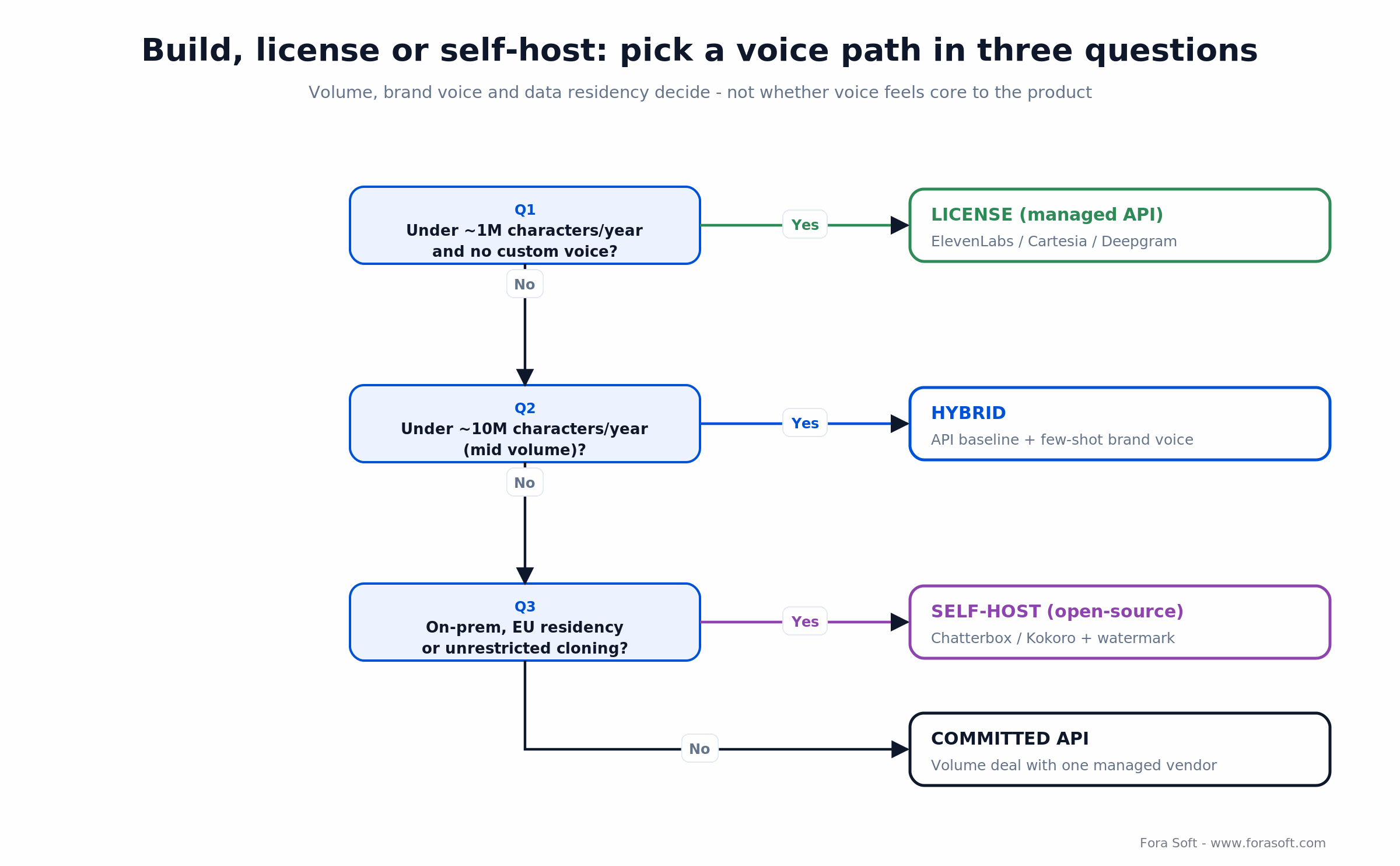
Figure 4. Volume, brand voice, and data residency decide the path — not whether voice feels core.
| Annual TTS volume | Recommendation | Why |
|---|---|---|
| Under 1M chars / yr | License (ElevenLabs / Cartesia / Google) | API spend is trivial next to GPU + ops; vendor carries compliance. |
| 1M–10M chars / yr | Hybrid — API + few-shot brand voice | Brand voice via PVC tier; baseline volume on the cheapest engine. |
| Over 10M chars / yr | Self-host a permissive model (Chatterbox / Kokoro) | Per-character cost drops sharply once GPU is amortised. |
| Regulated / on-prem | Self-host, MIT/Apache model only | Data residency and audit trail are easier when you own the stack. |
Reach for hybrid when: you need one branded voice but most traffic is generic. Run the brand voice through a PVC tier and push the bulk volume to the cheapest engine that clears your latency bar. It caps cost without a full self-hosting team.
Cost model — what a voice product actually runs
Two numbers matter: the per-minute run cost and the one-time build. Start with the run cost, because it decides build-vs-license. Assume ~850 characters per talk-minute (about 150 words).
On the TTS layer alone, Cartesia works out to roughly 0.85 × $0.038 = $0.032 per minute; ElevenLabs Flash to about $0.043. Add streaming ASR (~$0.004/min on Deepgram) and a streaming LLM (~$0.02/min) and a full managed voice agent lands near $0.05–$0.09 per minute. An all-OpenAI gpt-realtime path is about $0.10/min but replaces three services. Self-hosting at scale drops to $0.03–$0.05/min, mostly fixed GPU and ops. Against human offshore agents at $0.40–$1.00 per talk-minute, AI stays 5–15× cheaper even after correcting the TTS figure upward.
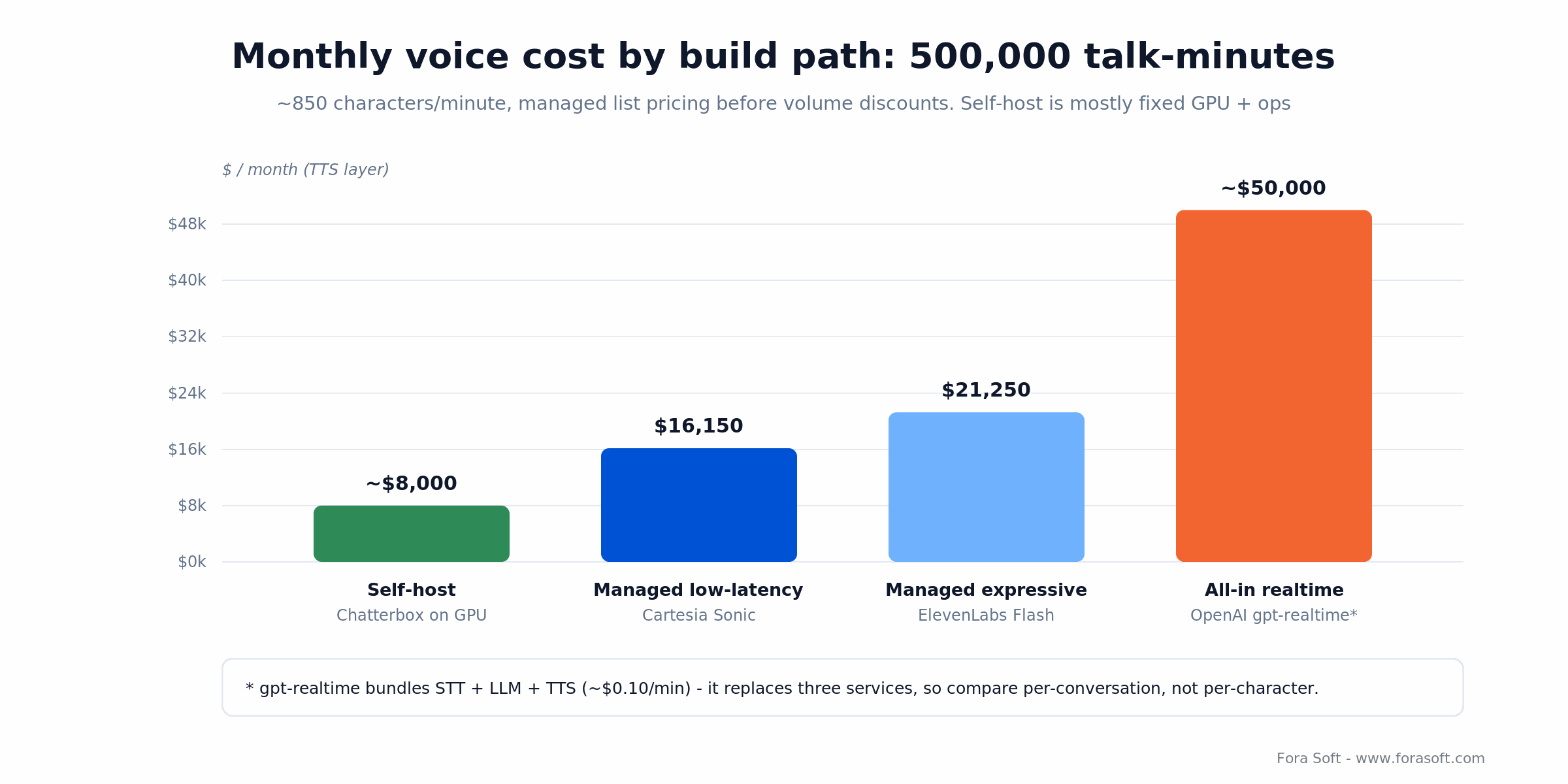
Figure 5. Monthly TTS cost at 500,000 talk-minutes by build path, managed list pricing before volume discounts.
| Scope | Included | Indicative range | Calendar |
|---|---|---|---|
| Voice MVP (API-based) | Stock-voice TTS, WebSocket playback, basic UI | $15K–$30K | 3–5 weeks |
| Real-time voice agent | ASR + LLM + TTS over WebRTC, telephony bridge, dashboards | $50K–$120K | 8–14 weeks |
| Custom voice clone (PVC) + brand pack | PVC training, watermarking, evaluation, license workflow | $25K–$60K | 6–10 weeks |
| Self-hosted open-source stack | Chatterbox / Kokoro deployment, GPU autoscaling, latency tuning | $60K–$140K | 10–14 weeks |
| Compliance & watermarking pack | Consent flow, AudioSeal/SynthID, audit log, EU AI Act readiness | $15K–$35K | 2–4 weeks |
Mini-case — a real-time multilingual speech platform at national scale
Situation. A UK client needed compliant, real-time interpretation across dozens of languages, delivered inside video calls with sub-second audio. Off-the-shelf conferencing could not route interpreters, hold the latency line, or meet the audit requirements a public-sector framework demands.
Plan. We built TransLinguist on a WebRTC audio core with interpreter routing, a streaming captions-and-translation layer, and consent and audit logging baked in — the same discipline this guide argues for on synthesised voice. Latency budgeting and clean streaming were the whole game.
Outcome. The platform scaled to 75+ languages and 30,000+ interpreters and was accepted onto the NHS UK national framework. The lesson that carries to any voice synthesis build: get the streaming transport and the consent trail right first, and the model choice becomes the easy part. Want a similar assessment of your voice stack? Book a 30-minute call.
A decision framework — pick a voice path in five questions
1. What is the latency target? Sub-200 ms total → Cartesia or Deepgram over WebRTC. Sub-1 s → ElevenLabs, OpenAI, or Google over WebSocket. Batch → any engine over REST.
2. How many languages ship? Over 50 → Azure or Google. 10–70 → Cartesia or ElevenLabs. Major languages only → Deepgram or OpenAI.
3. Cloned or stock voices? Stock → cheapest and fastest. Few-shot clone → a brand voice without PVC budget. PVC → broadcast or audiobook quality.
4. Where does the data live? US or EU cloud is fine for most products. On-prem or air-gapped → self-host a permissive model with watermarking added separately.
5. What is the legal floor? Any EU exposure → Article 50 labelling and machine-readable marking baked in from sprint one. Cloning a real person → written, scoped consent on file first.
Pitfalls we have watched voice teams fall into
1. Reading the benchmark, not the license. A model can top the quality charts and still bar commercial use. XTTS-v2 and F5-TTS sink more self-hosted products than any latency problem. Check the license first.
2. Optimising the wrong stage. The LLM is almost always the dominant latency cost. Compress the model, cache prompts, and pre-filter tools before chasing 50 ms in TTS.
3. Treating cloning as just a voice. Cloning without consent invites ELVIS Act and EU AI Act exposure on day one. Put the consent flow into onboarding before generating a single second of audio.
4. Premature self-hosting. Under ~10M characters a year, GPU and ops cost beats the API saving. Migrate to open-source after volume, not before.
5. Single-vendor lock-in. Tying every call to one SDK guarantees a painful migration the day pricing, quality, or ownership changes — ask anyone who built on Play.ht. Wrap synthesis behind a thin internal API from day one.
KPIs — what to measure and budget
Quality KPIs. MOS above 4.3, speaker similarity (ECAPA cosine) above 0.85 for a brand voice, mispronunciation under 0.5% per 1K words, and a prosody sign-off from an internal panel.
Business KPIs. Cost per minute or per 1K characters, conversion lift on voice-enabled flows, agent containment rate (resolved without a human handoff), and expansion revenue from premium voice tiers.
Reliability KPIs. p95 first-audio under 250 ms, end-to-end voice-agent round trip under 800 ms, watermark coverage on 100% of synthesised seconds, and complete audit logs for consent and synthesis events.
When NOT to ship a voice feature
Skip voice when the product’s core loop has no audio surface and bolting voice on only adds onboarding friction; when your users sit in regulated geographies and you have no consent infrastructure; or when the budget is under ~$15K and any vendor lock-in is unacceptable. Voice is a force multiplier, not a default. And if you only need preset narration — no cloning — a stock TTS voice or Kokoro is cheaper and carries none of the consent burden. Honesty about that saves everyone a sprint.
Want a voice plan in writing?
A 30-minute call gets you a software shortlist, a build-vs-license verdict, a compliance plan, and a realistic budget for the next sprint.
FAQ
What is the best voice cloning software in 2026?
There is no single winner. For real-time agents, Cartesia or Deepgram win on latency; for expressive dubbing and audiobooks, ElevenLabs leads; for a commercial-safe self-hosted clone, Chatterbox (MIT) is the pick. Match the software to latency, sample size, languages, and license — not to a leaderboard.
Is there free, open-source voice cloning software I can ship commercially?
Yes, but check the license. Chatterbox (MIT) clones and is commercial-safe; Kokoro (Apache-2.0) is commercial-safe but cannot clone; Piper (MIT) is light TTS. XTTS-v2 (CPML) and F5-TTS (CC-BY-NC) clone well but are non-commercial, so they are fine for prototypes only.
How much audio do we need to clone a voice?
Zero-shot needs 3–6 seconds. Few-shot or instant cloning needs 30–90 seconds for a very-good result. Professional voice cloning (PVC) needs 30+ minutes of clean studio audio for broadcast quality.
Is voice cloning legal?
Cloning your own voice, or one you have explicit consent for, is legal in most places with disclosure duties. Cloning a third party without consent is barred under Tennessee’s ELVIS Act and exposed to Illinois BIPA and the EU AI Act. The US NO FAKES Act, which would add a federal right, is still a pending bill. Run consent and watermarking from sprint one.
What total latency does a real-time voice agent need?
Under 800 ms feels human; over 1.5 s breaks the illusion. Target TTS first-audio under 200 ms, streaming ASR under 200 ms, and treat LLM time-to-first-token (~300–400 ms) as the stage to compress first.
When does self-hosting beat a paid API?
Above ~10M characters a year, once GPU is amortised, or when on-prem and EU data residency are hard requirements. Below that, a managed API is cheaper because the vendor spreads GPU, watermarking, and consent tooling across customers.
How do we comply with the EU AI Act for synthetic audio?
Three things: a machine-readable watermark on every synthesised second (AudioSeal, SynthID, or C2PA), a visible label that the audio is AI-generated, and consent plus audit logs. Article 50 has applied since 2 August 2026, so build all three into the synthesis pipeline before EU traffic starts.
Has Fora Soft shipped voice-AI products?
Yes — real-time interpretation, captions and translation, voice agents, and accessibility features, across 250+ products since 2005. Our broader work sits in how video AI agents work and AI streaming platform solutions.
What to read next
Voice cloning
Real-time voice cloning technology
The vendor and architecture deep dive that pairs with this software guide.
Vendors
ElevenLabs alternatives
Per-vendor pricing and when it pays to build instead.
Voice agents
AI call assistants — the API guide
The deeper build for voice-agent stacks and engine selection.
Translation
AI simultaneous interpretation
Where voice synthesis meets cross-language, real-time pipelines.
AI agents
How video AI agents work
A broader map of multimodal agents that combine vision, voice, and language.
Ready to pick your voice cloning software?
Voice cloning and synthesis are no longer the chokepoint. The engines are credible, latency is real-time, and self-hosting is viable past ~10M characters a year on a permissive model. The decisions that matter moved up-stack: which software fits your latency and languages, whether the license lets you ship, how you carry consent and watermarking, and where build beats license.
If you are scoping a voice agent, a dubbing pipeline, an accessibility product, or an audiobook engine, the fastest next step is a call. We will pick the engine, set the latency budget, draft the compliance pack, and quote the build — including which steps to skip on the first sprint.
Talk to our voice-AI leads
Book a 30-minute call. We scope the software, the cloning workflow, the latency target, and the compliance plan in one session.

