

Key takeaways
• Choosing a software development company? A Clutch 1000 badge — the top 0.3% of B2B providers, where Fora Soft sits for 2025 — is a useful proof point, but only one signal to triangulate before you sign.
• Every Clutch review is human-checked, and many are confirmed in a recorded phone or video interview. That verification depth is rare in the directory market — and the reason serious enterprise buyers still use Clutch as a shortlisting layer in 2026.
• The Clutch 1000 is ranked, not paid for. Top sponsored placements on category pages are paid; the Clutch 1000 itself uses verified-review volume, recency, ratings, and project complexity to rank.
• Use Clutch for shortlisting, not for the final decision. Cross-check against GoodFirms and Techreviewer, then talk to two or three current clients off-script before you commit.
• Fora Soft’s deeper signal lives outside Clutch. Real shipped projects, public process playbooks, and our Agent Engineering benchmarks — not the badge — are how we’d like you to evaluate us.
Clutch publishes its annual Clutch 1000 every year. Of the roughly 350,000 service providers globally listed on the platform, about 1,000 make the cut — the top 0.3%. Fora Soft is in that 0.3% for 2025, on the strength of verified client reviews, project portfolio depth, profile completeness, and overall market reputation.
A press release on the recognition would be a fine thing to ship and forget. We think the more useful version, especially if you are a CTO or founder evaluating a software development partner, is the one that explains how to actually use Clutch (and similar directories) as a procurement tool in 2026. What the Clutch 1000 means and does not mean. How Clutch verifies reviews. Where the directory market still falls short. And what other signals to demand before you commit budget. This is that article.
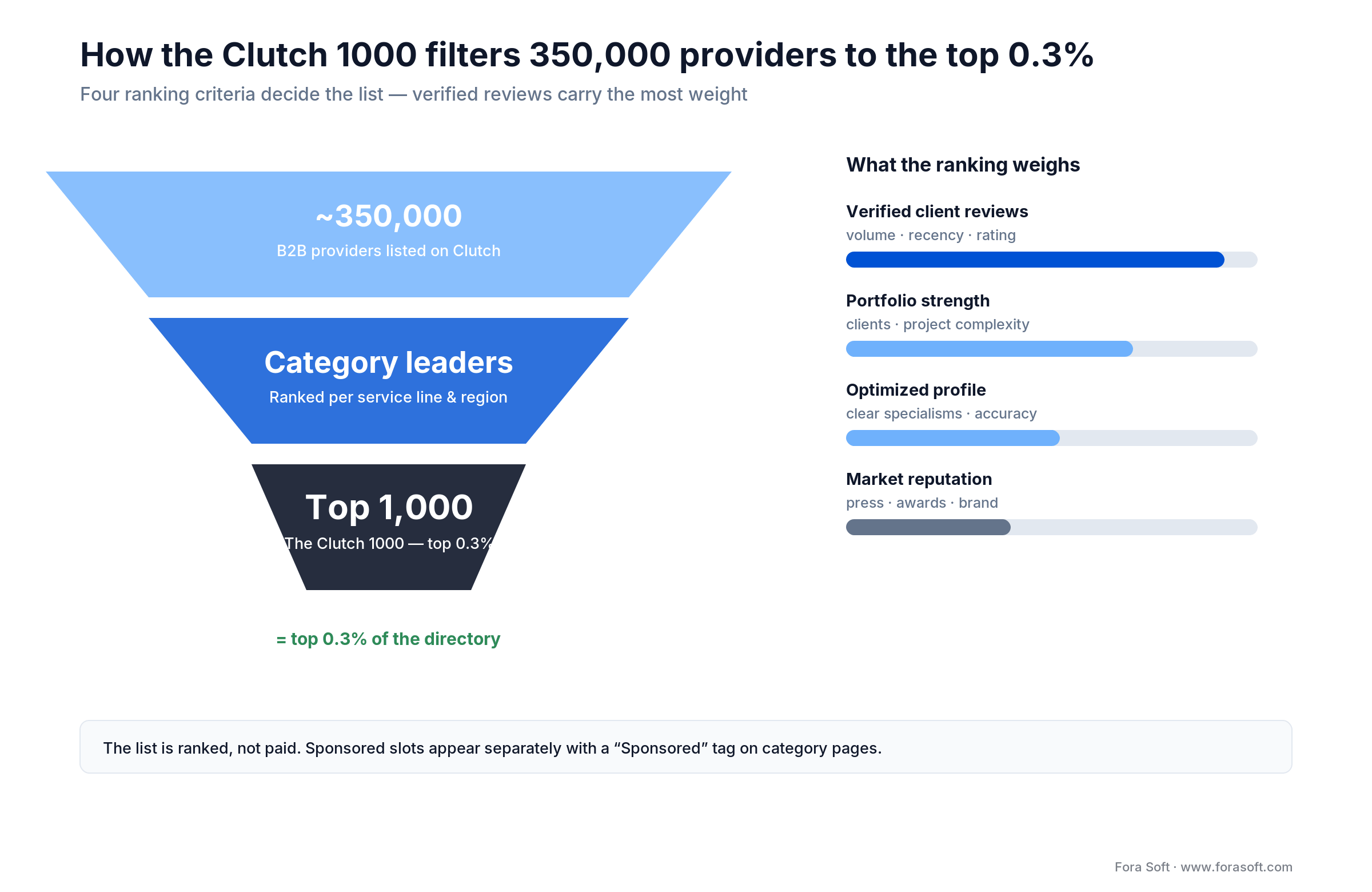
Figure 1. How Clutch filters roughly 350,000 listed providers down to the top 1,000 — and the four criteria behind the ranking.
Why Fora Soft wrote this playbook
Fora Soft is a software development company that has delivered 250+ projects since 2005, with a deep specialism in video, audio, AI, and real-time communication products. We have shipped MVPs and scaled them across fitness, EdTech, healthcare, media, and B2B SaaS — recent reference points include BrainCert (a virtual classroom platform we have evolved across multiple major releases), Scholarly (a learning platform with 15,000+ users, named the most innovative EdTech startup in Asia-Pacific by AWS), AppyBee (a fitness booking platform live in 800+ studios across iOS and Android), and Blaze Streaming Media’s Volo (software for live-event captions and translation).
We use Agent Engineering internally, which compresses delivery time on most workstreams by 30–40% versus a baseline team — documented in our AI software development case study. So when we recommend reading Clutch reviews critically and triangulating with other signals, that view comes from running real procurement conversations with founders and CTOs, including the ones who chose someone else after we spoke.
Already shortlisting partners on Clutch?
A 30-minute scoping call — we will tell you what we’d build, how we’d budget it, and how to compare us against the other names on your list. No slide decks.
What the Clutch 1000 actually is
The Clutch 1000 is Clutch’s annual ranking of the top 1,000 B2B service providers globally, across all categories — software development, marketing, design, IT consulting, BPO, and more. The pool is the entire Clutch directory, which is in the hundreds of thousands of providers. Making the 1000 puts a company in roughly the top 0.3%. 2025 is the eighth consecutive year Clutch has published the list.
The four selection criteria Clutch publishes are straightforward.
1. Verified client reviews. Volume, recency, and ratings — with a strong weight on reviews submitted in the last 12 months. Every review is checked by a human editor, and clients of vendors on a Clutch Verified subscription can confirm theirs in a recorded phone or video interview. That verification step is the single biggest reason Clutch carries weight with serious enterprise buyers.
2. Portfolio strength. Range of clients, project complexity, and the breadth of evidence the company can show through documented case studies on the platform.
3. Optimized profile. Clear specialisations, complete service descriptions, accurate company information, and a focused positioning that matches actual client work.
4. Market reputation. External signals like press coverage, awards, brand recognition, and the kinds of clients the company is associated with.
The list is not paid placement. Sponsored slots exist on Clutch — they appear at the top of category leaders pages with an explicit “Sponsored” tag — but the Clutch 1000 itself is generated from the criteria above.
Reach for Clutch as a procurement signal when: you are shortlisting unknown partners across regions and need an external, third-party verified data point on review quality and client mix — not as the deciding factor on its own.
How Clutch verifies reviews — and what that means for buyers
When a vendor invites a client to leave a Clutch review, the client fills out a structured questionnaire — project overview, scope, results, communication quality, value for money, and willingness to recommend. A human editor checks every submission for conflicts of interest and signs of falsification; in 2025 Clutch rejected about 10% of submitted reviews on those grounds. Clients of vendors on a Clutch Verified subscription can also confirm their review in a recorded interview with a Clutch analyst, usually under 15 minutes, before it is published.
The implications for a buyer are practical. First, fake reviews are much harder on Clutch than on directories without the verification step — the call is the friction. Second, the structured questionnaire makes reviews comparable across vendors, so a 4.7 on Clutch with 80 verified reviews carries genuine signal that a 5.0 on a directory without verification does not. Third, recent reviews matter more than old ones. A vendor with 200 reviews from 2018–2022 and 5 from 2024 has a different signal than a vendor with 80 reviews concentrated in 2024–2025.
When you read a Clutch profile, look at three things in this order: review recency (last 12 months), review density (volume relative to company size), and the specific outcomes mentioned in the verbatim text. Headline scores are coarser than the verbatim quotes.
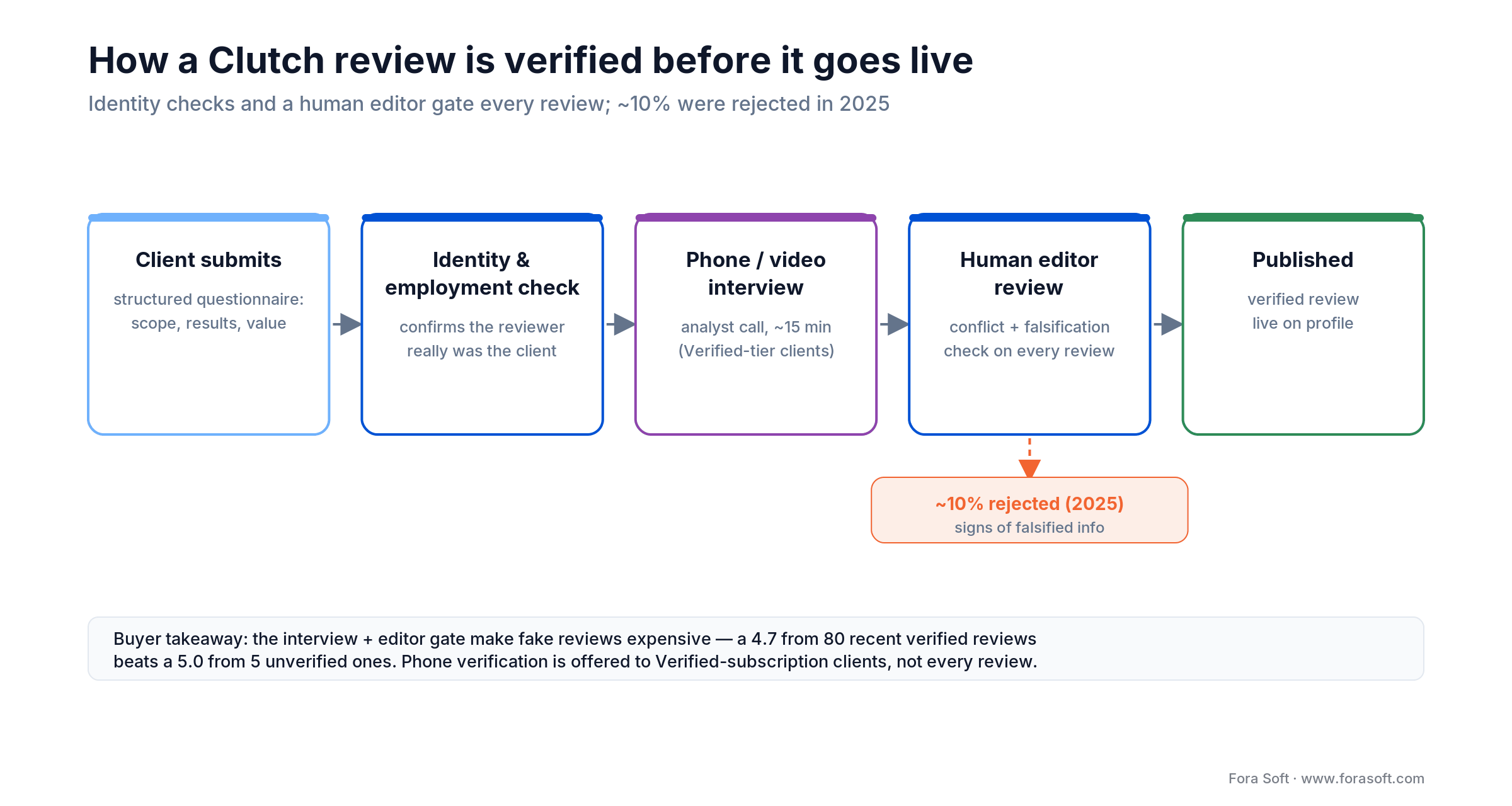
Figure 2. Clutch’s review path: identity and editor checks gate every review; the phone interview is a Verified-tier option.
Clutch vs GoodFirms vs Techreviewer vs Manifest
Most procurement teams treat the directories as interchangeable. They are not. Use them in combination, weighted to their strengths.
| Directory | Verification | Best for | Watch out for |
|---|---|---|---|
| Clutch | High — editor check on every review + phone/video (Verified tier) | Enterprise shortlisting, comparing review quality | Sponsored top placements on category pages |
| GoodFirms | Medium — research-driven, lighter check | Filtering by service type and market | Smaller pool of phone-verified reviews |
| Techreviewer.co | High — legal status checks, continuous monitoring | Cross-check after Clutch / GoodFirms shortlist | Smaller catalogue than Clutch |
| The Manifest | Light — aggregated business directory | Quick “does this firm exist” sanity check | Not a serious procurement primary source |
Practical workflow we see working: shortlist 6–8 vendors on Clutch by category and review density, cross-check the same vendors on GoodFirms and Techreviewer for consistency, then narrow to 3 for direct conversations. Anything that looks dramatically different across the three directories — for example, a 5.0 on one and a 3.5 on another — is worth investigating.
How to actually read a Clutch review
A high score is necessary but not sufficient. The review’s verbatim sections are where the signal lives.
1. Specificity of outcomes. “They built our app and it works” is a low-information review. “They reduced our average response time from 2 seconds to 250 ms and shipped iOS, Android, and web in 14 weeks against a 16-week plan” is high-information. The latter is what to look for.
2. The “what could be improved” section. Honest reviewers fill this in with something concrete (“timezone overlap with our team in Sydney was tight”, “we wished they had pushed back harder on our scope creep”). Reviews that say “nothing” or leave the field blank are either polished or polite — both are weaker signal.
3. Project context. A review of a $30K landing-page build tells you nothing about a vendor’s ability to ship a $300K SaaS platform. Filter for reviews where the project size and complexity actually match what you are about to commission.
4. Reviewer role. A founder review is different from a head-of-engineering review. The latter usually carries more technical depth; the former carries more strategic signal.
5. Recency cluster. Twenty reviews concentrated in 2024–2025 mean the firm is currently shipping. Twenty reviews from 2018–2020 mean the firm used to ship; the team that wrote those reviews has likely moved on.
Reach past Clutch reviews when: you are about to commit more than ~$50K of budget — at that level the marginal value of two off-script reference calls with current clients is much higher than ten more profile reads.
Badges vs substance — what really earns trust in 2026
Awards and badges work as filters, not as decisions. The substance you should look for sits in four buckets, and a serious vendor has all four publicly available.
1. A real portfolio with real outcomes. Specific projects, named clients (with permission), the role the vendor played, and quantified results. Generic logo grids without context are filler. Our own BrainCert, Scholarly, and AppyBee case studies are the format we think serious vendors should publish.
2. Public process documentation. A vendor who can show you how they plan, build, and ship — not just claim it — tells you what working with them will actually feel like. Ours is broken into project planning, product development, product launch, and the Customer Success Manager role — pick two and check whether the vendor you are evaluating could write the equivalent.
3. Honest engineering content. Blog posts that take a position, share data, and admit trade-offs — not vendor-puff. Our AI software development case study and software estimation guide are written in that voice deliberately, because we believe trust is built by what you commit to in writing.
4. Direct client references you can call yourself. Two or three current or recent clients, willing to talk for 20 minutes off the marketing script. The willingness alone is signal; the conversations are the data.
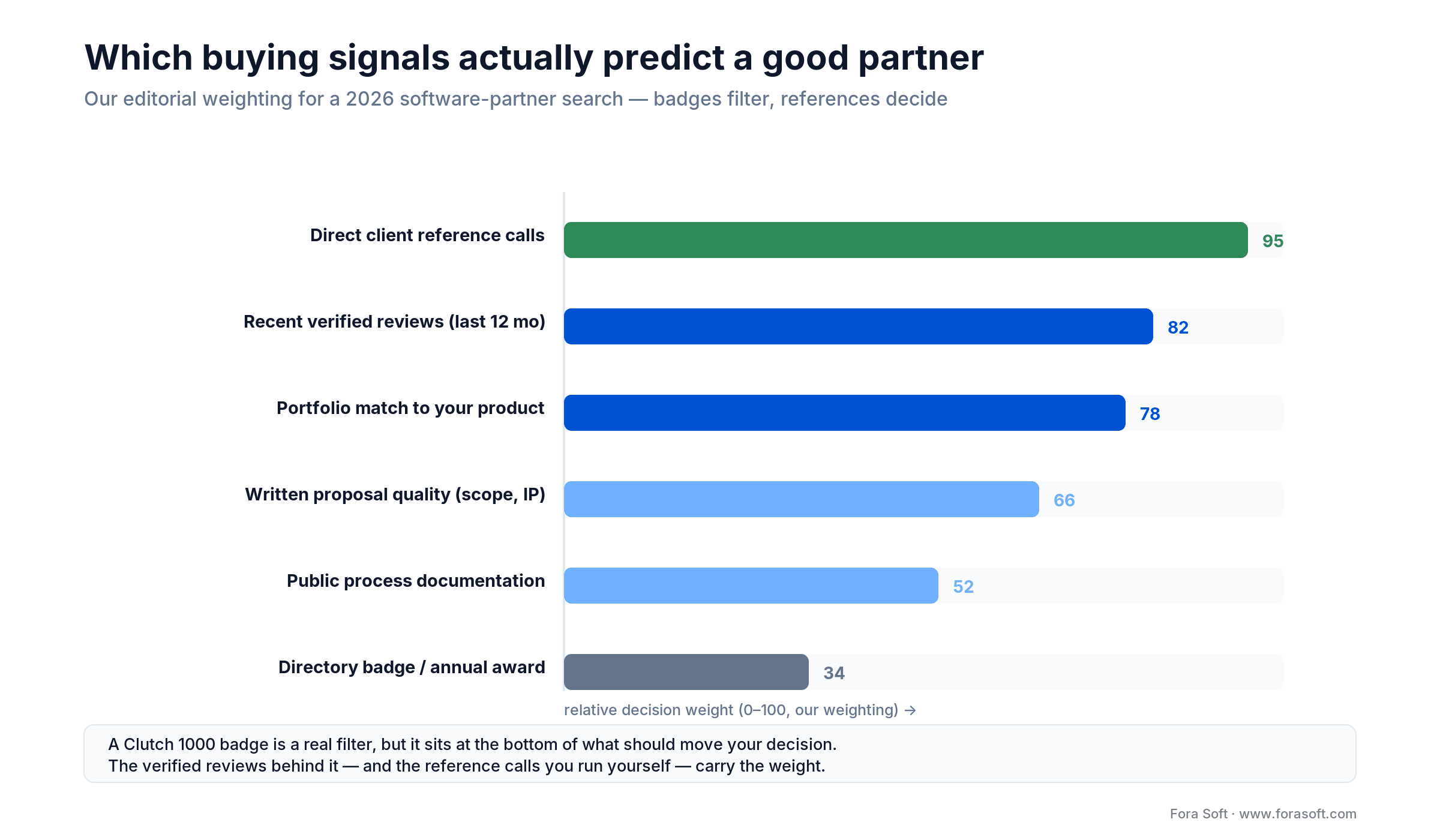
Figure 4. How much each buying signal should weigh in a 2026 software-partner decision (our editorial weighting).
A practical shortlist workflow for 2026
A repeatable process beats an inspired one-off. The version that works for the founders and CTOs we talk to most often goes like this.
Step 1 — define the one-paragraph scope. Product type, target users, MVP feature scope, hard constraints (compliance, regions, integrations), budget range, target launch date. If you cannot write this in one paragraph, you are not ready to shortlist; spend two more weeks on user research first.
Step 2 — shortlist 6–8 vendors. Use Clutch as the primary directory; cross-check on GoodFirms and Techreviewer. Filter by domain experience, region, and review density. Save vendor profiles to a single document.
Step 3 — first contact email or form. Send the same one-paragraph scope to all 6–8. Score the responses on three things: response time (under 24 hours is good), specificity of follow-up questions (the more specific, the better), and whether the email is from a real person or a templated form.
Step 4 — discovery calls with the top 3. 30–45 minutes each. Bring the same questions. Compare answers side-by-side after.
Step 5 — reference calls with two of the top 3. Ask each reference one off-script question (“What do you wish they did differently?”) and one specific scope question (“Did they push back on your scope?”).
Step 6 — written proposals from the final two. Compare on scope, assumptions, milestone breakdown, and IP terms — not just price.
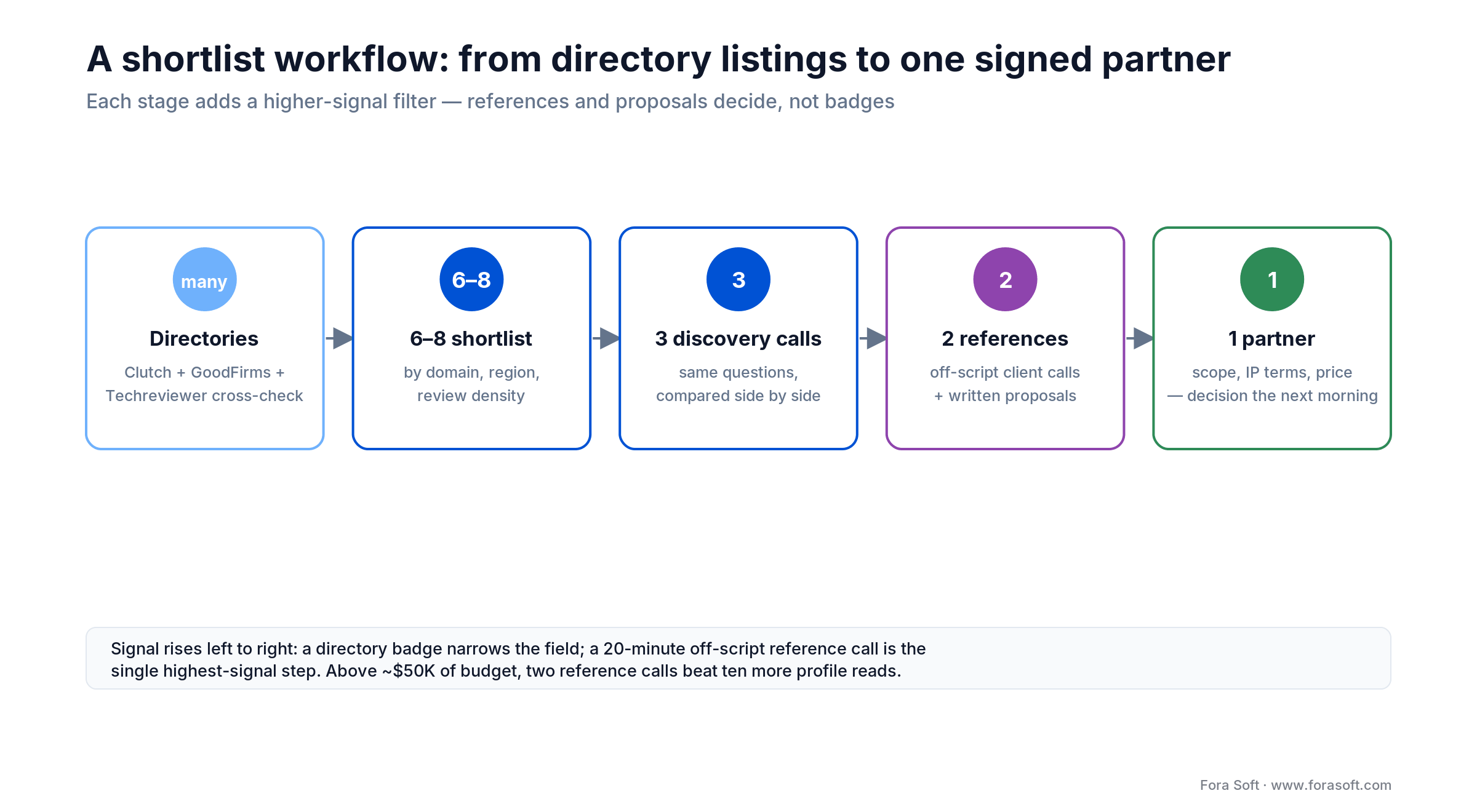
Figure 3. A shortlist funnel — directory listings narrow to one signed partner, with signal rising at every stage.
Want to make Fora Soft one of your top 3?
Send us your one-paragraph scope. We’ll respond inside a business day with the questions we’d ask on a discovery call — that itself is a useful comparison signal against the others.
Mini case — what a Clutch review of Fora Soft actually looks like
Our Clutch profile holds verified reviews from clients across video streaming, EdTech, healthcare, fitness, and B2B SaaS. The pattern across them is consistent — not because we curate the reviewers, but because the verification step filters for substance.
Three signals show up in almost every recent review. First, scope discipline: clients consistently mention that we push back on requests we think will damage product or timeline, rather than agreeing reflexively. Second, communication cadence: weekly written updates plus video demos, with named owners on every action. Third, technical depth in the niches we play in: real-time video, low-latency audio, AI feature integration, and cross-platform mobile.
The reviewers are right that we still get things wrong — estimation on novel work is the most frequent honest critique, and one of the reasons we publish a public software estimation guide with the methodology and the rules we follow. The same review framework that earned us the Clutch 1000 also keeps us honest about where we still need to improve.
A decision framework — pick a partner in five questions
1. Have they shipped something like your product before? Specific domain experience cuts months off discovery. Generic “custom software” experience is a much weaker signal.
2. Can you talk to a real client without a chaperone? Direct reference calls are the highest-signal step in procurement.
3. Will they push back on your scope? A vendor who says yes to everything is selling, not collaborating.
4. How do they use AI — and where do they refuse to? The presence of AI in the workflow plus clear governance is the 2026 baseline; absence costs you 10–20% on every sprint.
5. Who actually owns the code? If the answer is anything other than “you, on day one, no exceptions” — walk.
Five pitfalls in directory-driven procurement
1. Treating a directory ranking as a finishing post. It is a starting point. The real work is in references and proposals.
2. Confusing sponsored top placements with rankings. Sponsored slots on category leaders pages are paid; the Clutch 1000, GoodFirms Leaders, and Techreviewer top lists are ranked by criteria.
3. Reading the average score, ignoring the distribution. A 4.7 average from 80 reviews is structurally different from a 5.0 from 5 reviews.
4. Skipping the verification phone call. Asking for direct references and actually calling them is what separates serious procurement from box-ticking.
5. Filtering by region too narrowly. The right partner for a niche AI-video product may not live in your time zone. A two- to four-hour overlap with structured async updates is usually enough.
KPIs to track once the engagement starts
Quality KPIs. Escaped-defect rate (target <3% of shipped tickets), pull-request review cycle (target <48 hours median), and design-validation completion before build (target 100% for major epics).
Business KPIs. Estimate vs. actual cycle-time variance (target within ±15%), lead time from idea to production, and stakeholder satisfaction score per quarter.
Reliability KPIs. Sprint commit completion rate (target 80–90% — higher signals padding, lower signals chaos), team turnover (<15%/year for technical roles), and number of retrospective actions actually shipped per sprint (target ≥1).
When NOT to use Clutch as your primary signal
If you are looking for an extremely niche specialism — for example, low-latency RIST/SRT broadcast pipelines, on-device WebRTC tuning for emerging-market handsets, or HIPAA-compliant medical imaging — the Clutch category filters are too coarse. You will get a better shortlist by reading engineering blogs in the niche and asking for vendor recommendations from peer founders or CTOs.
If you have already hired and managed a similar build before, your own reference network is a higher-signal source than any directory. Directories are most useful for first-time buyers and for buyers entering a new domain.
If you are pre-product-market fit and your scope will likely change in the next four weeks, no amount of vendor research will make up for unclear requirements. Spend the time on user research first.
Vetting an AI-augmented vendor in 2026 — the four questions that work
Almost every vendor on Clutch in 2026 will claim to be “AI-powered”. That phrase carries no signal on its own — what matters is how a team actually applies AI in engineering, the discipline we break down in our AI for video engineering course. The four questions that separate marketing from operating capability:
1. Which specific tools do you use, and where in the workflow? A real answer names tools (Cursor, Claude Code, internal agents, GitHub Copilot) and the parts of the SDLC where each fits (code review, test generation, refactors, documentation). Vague “we use AI” answers are noise.
2. What governance do you have around AI output? Mandatory human PR review, security scanning, license-compliance checks, and a senior engineer signing off on AI-suggested architecture. Without this, AI velocity becomes AI debt.
3. Where do you refuse to rely on AI? Novel architecture, compliance-sensitive code, anything without historical analogues. A vendor who cannot name those zones has no real governance.
4. What are your before-and-after cycle-time numbers? Real teams have data: cycle-time delta, PR-review delta, escaped-defect rate before and after AI adoption. We share ours in our AI software development case study. If a vendor cannot produce equivalents, the “AI-powered” claim is a sales line.
A short RFP template that respects everyone’s time
Long, lawyered RFPs filter out the smart small partners and reward the big sales-led ones. A one-page brief gets you a much better signal in much less time. The five sections that work.
1. Context (3–4 sentences). Who you are, who your users are, what stage the company is at, and what you have learned so far.
2. Goal of this engagement (2–3 sentences). Not the full product vision — the specific outcome of the next 3–6 months. “Ship a 6-feature MVP on iOS and Android by Q3” is good. “Build the future of telemedicine” is not.
3. Scope and constraints. A 6–10 bullet feature list, hard constraints (compliance, regions, integrations), budget range (real ranges, not “$10K–$10M”), and target timeline.
4. What you want from the vendor. Estimate methodology, team composition, weekly cadence proposal, IP terms, and how they would use AI in the workflow.
5. How you will choose. Tell vendors how you will compare proposals (price, scope, team, references). Hidden criteria waste both sides’ time.
Reach for a one-page RFP when: you want to compare vendors quickly and you trust your scope is roughly stable — full, lawyered RFPs only make sense for procurement of $500K+ or in regulated industries with formal vendor onboarding.
How to compare proposals side by side without losing your mind
Once you have two or three written proposals, the temptation is to read them sequentially and pick whichever one feels best last. That biases you toward whoever you read most recently. The disciplined version takes about 90 minutes and yields a much better decision.
Step 1. Build a simple spreadsheet with proposals as columns and these rows: scope match, assumptions made, team composition, milestone breakdown, total cost, weekly cadence, IP terms, references provided, AI use, what could go wrong.
Step 2. Fill in each cell with the literal claim from the proposal. Resist the urge to interpret — just transcribe.
Step 3. Highlight cells that are vague, missing, or wildly different from the others. These are the questions you ask in the final round.
Step 4. Do reference calls before reading the proposals again, not after. Your post-reference reading is much sharper.
Step 5. Sleep on it. Make the decision the next morning, not in the hot seat of the last call.
Want to test our written proposal against the others?
Send us your one-page brief. Within a business week we’ll send back a written proposal with team, milestones, IP terms, and an honest list of what could go wrong. No fluff.
A reference-call script that actually flushes out the truth
Vendor-supplied references are usually friendly. The conversation is still useful if you steer it past the polished script. Five questions consistently produce real signal.
1. “What was the most surprising thing about working with them?” Surprises are where the real stories live — positive or negative.
2. “Was there a moment they pushed back on your scope or estimate?” A real partner does this; a sales-only partner avoids it.
3. “If you started over today, what would you do differently?” The honest answer reveals process gaps and communication issues that scores never capture.
4. “How did they handle the worst week of the project?” Every project has one. How the partner handled it tells you almost everything.
5. “Would you hire them again for a different product?” The strongest endorsement; the most honest filter.
Where the Clutch 1000 sits among other awards we have earned
Recognition is most useful when you can see the pattern, not the single trophy. Recent recognitions for Fora Soft include the Clutch 1000 for 2025, top iOS app development company listings on Techreviewer in 2024 and 2026, top education software development company by GoodFirms in 2025, top custom audio & video software development company in 2025, and Clutch Global Leader recognitions for Fall 2024 and Spring 2024.
The pattern matters more than any one entry. Multiple verified directories, multiple independent rating bodies, across multiple specialisms (mobile, video / audio, education, AI), all in the same 12–24 month window. Pattern recognition is what filters serious vendors from one-hit wonders.
Reach past a single award when evaluating any vendor: ask for the last 12 months of recognitions and check whether they cluster around the specialism you actually need — broad recognition without specialism is weaker signal than focused recognition in your domain.
FAQ
Is the Clutch 1000 a paid placement?
No. The Clutch 1000 is generated from verified reviews, portfolio strength, profile quality, and market reputation across the full Clutch directory. Sponsored placements exist on Clutch — they appear on category leaders pages with an explicit “Sponsored” tag — but the Clutch 1000 itself is not pay-to-play.
How does Clutch verify a review?
After a client submits a structured questionnaire, a human editor checks it for conflicts and falsification — Clutch rejected about 10% of 2025 submissions on those grounds. Clients of Verified-subscription vendors can also confirm their review in a recorded phone or video interview, usually under 15 minutes. That depth is why Clutch reviews carry more weight than reviews on directories without verification.
What does “top 0.3% of all Clutch service providers” actually mean?
Clutch lists hundreds of thousands of B2B service providers globally across all categories. The Clutch 1000 picks the top 1,000 by the four published criteria. That places the included companies in the top ~0.3% of the directory. It is a useful filter; it is not a substitute for direct reference calls.
Should I trust reviews from years ago?
Recent reviews matter much more than old ones. A team that shipped beautifully in 2019 may not be the same team in 2026. Concentrate on reviews from the last 12–18 months, and check whether the reviewer’s project type and scale matches what you are about to commission.
How many vendors should I shortlist?
Six to eight on the directory shortlist, three on the discovery-call shortlist, two on the proposal shortlist. Beyond that, you are spending more on procurement than the marginal vendor difference is worth.
Should I cross-check Clutch with GoodFirms and Techreviewer?
Yes. The directories use different criteria and different verification depth. A vendor who looks consistent across all three is a stronger signal than one who only shines on one. Inconsistency is a flag worth investigating.
Where can I find Fora Soft’s reviews?
On our Clutch profile, on Techreviewer, and on GoodFirms. We publish project case studies on forasoft.com and our process playbooks across the blog. Direct client references are available on request once we are in a real procurement conversation.
What domains does Fora Soft specialise in?
Video and audio streaming, real-time communication, AI feature integration, and cross-platform mobile (iOS, Android, web, desktop). We work across EdTech, healthcare, fitness, media, and B2B SaaS. Our public deeper guides are around video / audio software development and AI integration.
What to read next
Build vs hire
DIY vs hiring app development
When to build with a small in-house team and when to bring in a partner — with the trade-offs that actually matter.
Budgeting
Mobile app development costs — 2025 guide
A defensible breakdown of what a serious iOS or Android app actually costs to build and maintain in 2025–2026.
Estimation
Software estimation — the working guide
How we run estimation on real client projects, including the rules for when AI helps and when it gets the team into trouble.
Case study
How AI cut 30–40% off our delivery time
A first-person case study of Agent Engineering on a 1M+ line video streaming platform — numbers, methodology, trade-offs.
Process playbook
Our product development process
A step-by-step look at how we plan, build, and ship software products with our clients — the playbook behind the cases above.
Ready to use the Clutch 1000 properly — and pick the right partner?
Being in the Clutch 1000 for 2025 is meaningful. It means we have shipped enough recent work that real clients took the time to talk to Clutch on the phone and say so. It also means the bar for the next year is even higher — and we welcome that.
If you are running a procurement process for a software development partner, use Clutch the way we recommend: as a verified shortlisting layer, cross-checked with GoodFirms and Techreviewer, finished with direct reference calls and written proposals. If we are on your list and you would like a 30-minute scoping conversation rather than a slide deck, that is the version we run.
The handbook · 7 volumes
Fora Soft Video Engineering Handbook
If this playbook helps you shortlist partners, the fastest way to test one is a technical conversation about your own product. We wrote a seven-volume handbook on the video stack we build on: encoding, delivery, audio and AI. Start with Volume 3 on WebRTC and streaming delivery, then Volume 1 on encoding and Volume 7 on production AI, and use them to pressure-test any vendor's answers. Written by Nikolay Sapunov, CEO at Fora Soft.
Browse the handbook on Amazon →7 volumes · 9,000+ pages · Kindle & paperback
Let’s talk about your project
A free 30-minute call — we challenge your scope, validate your stack, and give you a written priority list whether you hire us or not.

