

Live streaming in 2026 is not one product category. It’s a dozen products sharing a video stack — sports, auctions, classrooms, telehealth, shoppable commerce, corporate broadcasts, and creator communities. The “trends” that matter aren’t trends at all. They’re engineering decisions about latency, codecs, AI, monetisation and moderation that decide whether people stay in your live experience or bounce in the first ten seconds.
We’ve built live video since 2005, so here’s the honest version of the future of live streaming: which shifts deserve a line in your 2026 roadmap, which are hype, and how to sequence the work so every dollar maps to a business metric. Every number below carries a year and a source, and the tech claims cite the spec, not a vendor blog.
Key takeaways
• Latency is the moat. Sub-second WebRTC and LL-HLS are table stakes wherever viewers react, bid, teach or buy in real time.
• AI is a platform layer, not a feature. Encoding, captions, moderation, search and highlights share one inference tier — treat it like a database.
• Live commerce is the money story. Live shopping converts at 9.5–15.2% versus 2–3% for static pages (industry benchmarks, 2026).
• Moderation is now compliance. The EU DSA, UK Online Safety Act and EU AI Act require auditable decisions, age assurance and AI-content labels in 2026.
• Buy the plumbing, build the product. Buy encoding, delivery and commodity AI; build the interactive layer, moderation policy and monetisation logic.
Why Fora Soft wrote this playbook
Fora Soft has shipped live video products since 2005, across 250+ projects with a 50-engineer in-house team and a 100% job-success record on Upwork. The portfolio spans interactive live (ProVideoMeeting), financial and concert broadcast (Tradecaster, Worldcast Live), mission-critical video (VALT, used by 770+ US organisations), creator tooling (Super Power FX) and learning (BrainCert).
Everything here is what we build and maintain for clients today, packaged into our video streaming development practice. Trends are easy to name. The useful question is which ones actually move retention, cost per hour, or lifetime value, and which quietly burn a quarter of engineering time.
Building a live streaming product in 2026?
Tell us your use case, concurrency target and latency budget. You’ll get a sequenced plan covering transport, AI, moderation and monetisation — not a sales pitch.
The one-page answer: live streaming in 2026
The live streaming market is worth roughly USD 97–157 billion in 2026 depending on how analysts draw the boundary, growing at a 21–27% CAGR through the early 2030s (market-research estimates, 2026). Demand is real: 35% of marketers now use live video and 80% of consumers say they prefer it to a blog post (DemandSage, 2026). But the growth hides a split — the money is moving to sub-second interaction and shoppable formats, while passive broadcast becomes a low-margin commodity.
Ten shifts are reshaping the category. The rest of this guide unpacks each; the headline view fits in one list.
- Sub-second latency goes mainstream: WebRTC, LL-HLS and CMAF-CTE as the baseline.
- AI moves from feature to platform layer: captions, moderation, encoding, discovery.
- Live commerce graduates from Asia-only to global shoppable video.
- Creator economies shift from ad-only to subscriptions, tipping and commerce.
- Vertical platforms out-grow general-purpose ones: education, fitness, healthcare, B2B.
- Next-gen codecs (AV1 now, VVC later) reach production economics.
- Multi-CDN and content steering become the reliability default.
- WHIP replaces RTMP for ingest; Media over QUIC waits in the wings.
- Regulation tightens: EU DSA, UK Online Safety Act, EU AI Act, app-store rules.
- Monetisation diversifies: server-side ads, subs, tips, commerce and B2B licensing.
Reach for sub-second live when: viewers react, bid, bid up, teach, learn or buy in real time. Stick with chunked HLS/DASH at scale when the audience passively watches broadcast-style live — sports finals, concerts, keynotes.
Low and ultra-low latency as the new baseline
The gap between 500 ms and 5 s of glass-to-glass latency is the gap between a conversation and a broadcast. Premium services already cut average delay from about 12 s to 4 s over the last cycle (industry data, 2026), and anything interactive has moved to sub-second stacks. Figure 1 maps what each transport delivers and what its latency buys you.
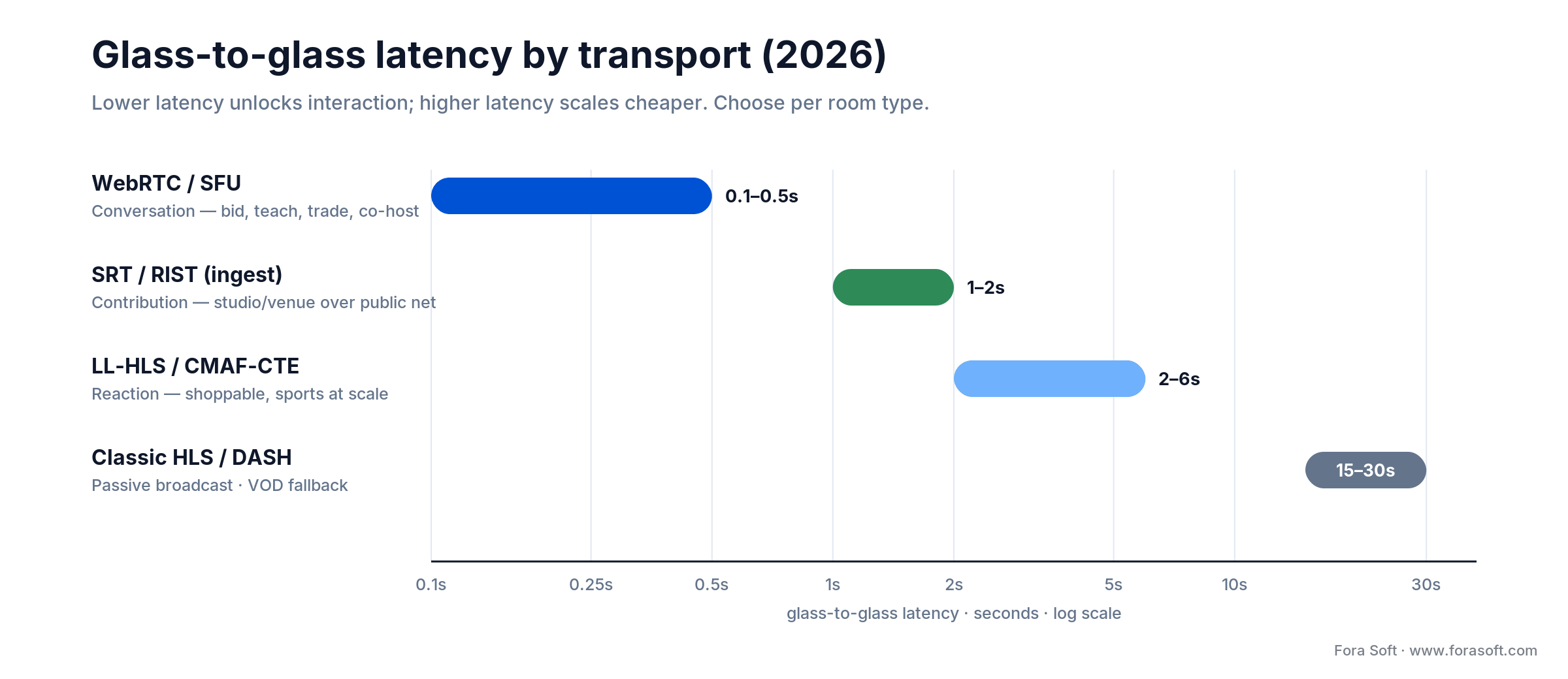
Figure 1. Lower latency enables interaction; higher latency scales cheaper. Pick per room type.
WebRTC and SFU. Open, standardised in the W3C WebRTC spec and the RFC 8825–8866 family, and the right tool wherever participants speak, react, bid or trade. Pair it with Pion, mediasoup, LiveKit, Janus or a managed SFU (Amazon IVS Real-Time, 100ms, Dolby) depending on scale and budget.
WHIP and WHEP. WHIP became a published standard as RFC 9725 in March 2025, and encoders plus media servers (Cloudflare, Dolby.io, Red5 Pro, Wowza) now ship it. It gives WebRTC a clean HTTP handshake that’s finally as easy to publish as RTMP was — adopt it now. We go deeper in our Learn write-up on WHIP over WebTransport.
LL-HLS and CMAF-CTE. For large-audience broadcast where 2–6 s is fine, chunked transfer cuts delay by a factor of 3–5 versus legacy HLS while reusing existing CDNs. It’s the standard for sports, conferences and shoppable video at scale.
AI baked into every layer of the stack
In 2024 AI was a thing you bolted on. In 2026 it’s a platform layer — live captions, moderation, semantic search, auto-highlights, noise reduction, encoding optimisation and discovery all share one inference tier. Treat AI in your streaming product the way you treat a database: a first-class service with versioning, evals and audit. Figure 2 shows where it plugs in.
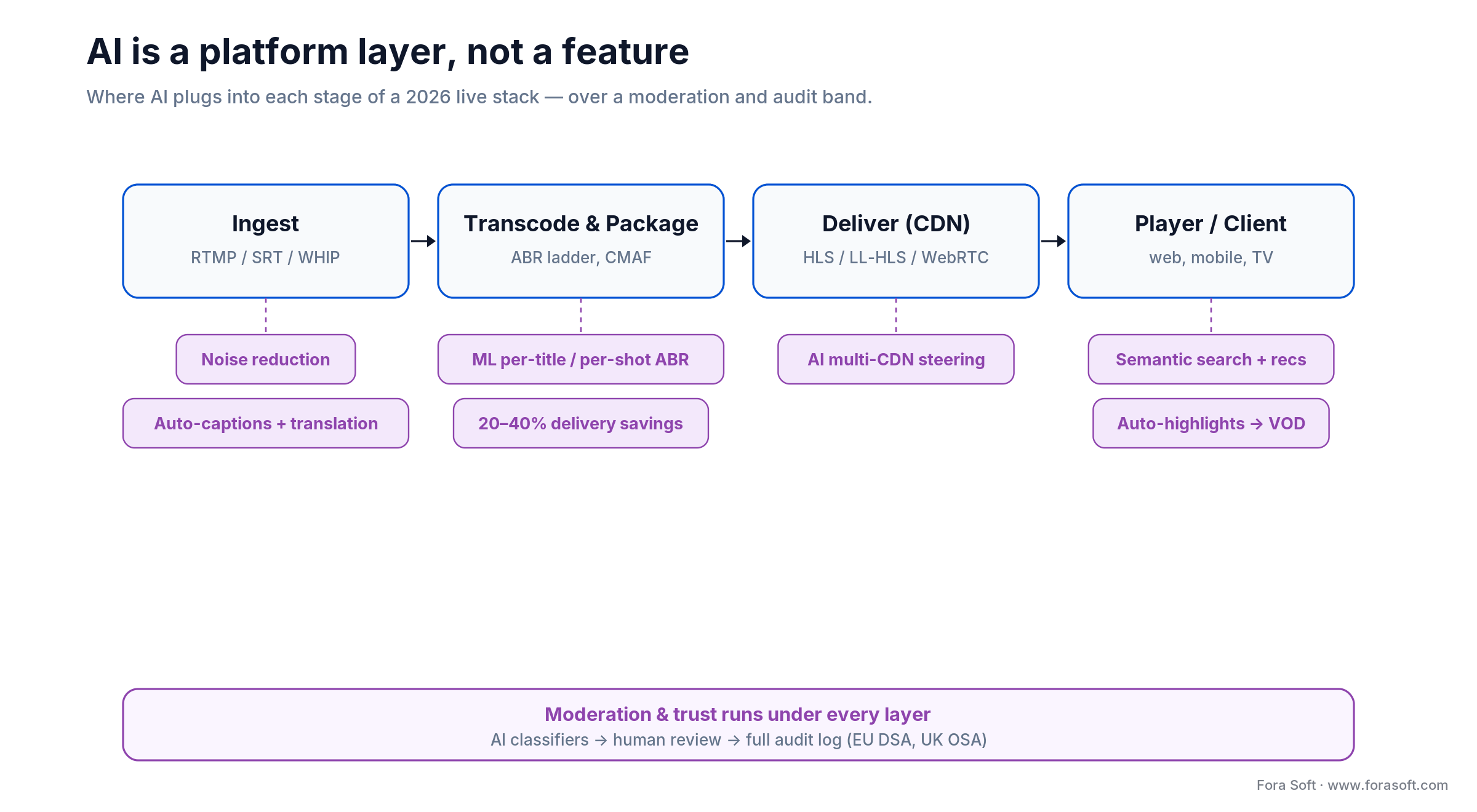
Figure 2. AI as a cross-cutting layer, sitting over a moderation and audit band that every stage feeds.
The AI bets that pay off best inside live are the boring, measurable ones:
- ML-driven encoding — per-title and per-shot ABR, typically 20–40% delivery savings on the same corpus.
- Real-time captions and translation — compliance, accessibility and retention in one move.
- Hybrid moderation — AI catches the obvious, humans review the edges, every decision logged.
- Auto-highlights and chapters — turn a two-hour live into VOD and short-form the moment it ends.
- Semantic search and recommendation — index embeddings over transcripts and visual tags.
One caution we’ve learned the hard way: AI moderation now runs on roughly 44% of enterprise live platforms (industry data, 2026), but the ones that pass an audit are the ones that logged every model version and every human override from day one. Retrofitting that log is misery. If you want the full breakdown, our guide to AI in video streaming covers each layer.
Live commerce and shoppable video
Live commerce is the biggest monetisation story in live video, full stop. The global market was about USD 172.9 billion in 2025 and is projected near USD 230 billion in 2026, on its way to roughly USD 2.5 trillion by 2033 at a ~41% CAGR (Grand View Research, 2026). Asia-Pacific still holds about 67% of that spend, but North America is now the fastest-growing region.
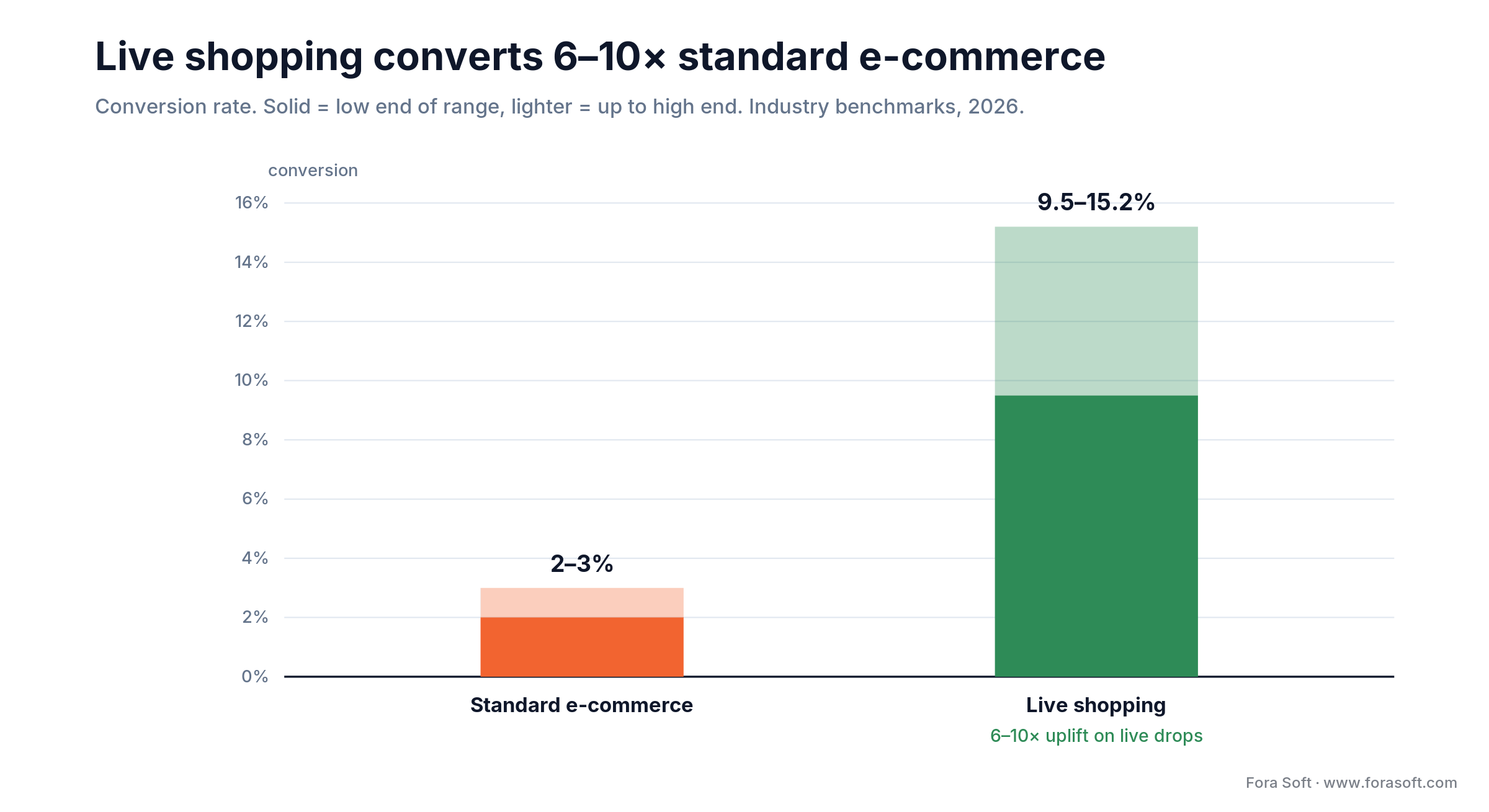
Figure 3. Live shopping converts at 6–10× standard e-commerce on well-run drops (industry benchmarks, 2026).
The conversion gap is why. Live shopping events convert at 9.5–15.2% against the 2–3% baseline for static product pages, and repurposed live clips as shoppable short video drive a growing share of the revenue (industry benchmarks, 2026). What makes a live-commerce stream actually convert:
- Sub-second latency. Flash sales, auctions and Q&A only work if the host reacts in real time.
- One-tap checkout overlays. Apple Pay, Google Pay and saved cards. Never break the stream to check out.
- Stock and price sync. Inventory-aware overlays kill the top churn case: “I clicked, it was sold out.”
- Creator-friendly economics. Transparent revenue share, fast payouts, analytics the host can read.
- Fraud and IP moderation. Scams and counterfeit claims scale with the GMV, so build the review queue on day one.
Reach for live commerce when: you already have an audience and inventory, and your margins can absorb a 10–30% creator/payout share in exchange for a 6–10× conversion lift. Skip it if you have no host talent and no fulfilment story. The format amplifies both strengths and gaps.
The creator economy grows up
Creators want fewer middlemen and more predictable income. Platforms that offer diversified monetisation keep their creators; ad-only platforms keep losing them. For context on where audiences already are: YouTube Live holds about 47% of live viewing share, TikTok Live sits second, and Twitch still leads gaming at ~54% with roughly 31 million daily users (DemandSage, 2026).
The mature monetisation mix in 2026 stacks at least three of these:
- Subscriptions and paid communities. Recurring revenue that survives algorithm changes.
- Tips and virtual gifts. Works across cultures, low friction, real money at scale.
- Live commerce and affiliate. Transparent, performance-based, easy to explain to a host.
- Ads with yield management. Server-side ad insertion with viewable-impression accounting.
- B2B licensing. Repurpose live clips as stock footage or training content.
Ship at least three from the start. One income stream is a single point of failure the day a platform changes its rev-share.
Vertical platforms out-grow general-purpose ones
“Twitch for X” is a hard pitch in 2026. The platforms that win are vertical: education, fitness, telehealth, niche fandom, B2B and regulated industries, because the product fits a specific compliance and workflow need a general platform can’t match. Immersive live (Apple Vision Pro, Meta Quest) fits here too, but only where the medium itself is the product; skip it if the plan is “VR for everyone.” Three wedges worth tracking:
- EdTech live. Async plus synchronous, AI captions and assessment, SSO with the LMS. Our work on BrainCert (500M+ classroom minutes, 100K+ customers) lives here, and so does our e-learning development practice.
- Healthcare live. Telehealth plus remote monitoring plus HIPAA — compliance is the moat. Example: CirrusMED.
- Mission-critical video. Regulated surveillance, industrial monitoring, public safety. VALT serves 770+ US organisations because we shipped chain-of-custody evidence tooling they couldn’t buy off the shelf.
Want a second opinion on your live architecture?
We ship WebRTC, LL-HLS and CMAF stacks with AI and multi-CDN. A 30-minute review usually gets you a clear build plan and a realistic cost envelope.
Next-gen codecs hit production economics
AV1 is the 2026 efficiency default. It’s roughly 50% smaller than H.264, royalty-free, and now hardware-decoded across modern phones, browsers and TVs. YouTube serves AV1 to capable devices and Netflix uses it for mobile (Streaming Media, 2026). With ML-guided encoder presets the compute cost is finally acceptable at scale.
VVC (H.266) is a watch item, not a deployment. On paper it beats AV1 by 10–15% at 4K, but no major browser (Chrome, Firefox, Edge, Safari) ships native VVC decode as of early 2026, and consumer hardware reach is thin. It earns a place in premium broadcast and 8K contracts, not a mainstream web catalogue yet. Our Learn breakdown of H.266/VVC and our codec strategy for OTT lay out the trade-offs.
H.264 and HEVC stay the safe default. Ship AV1 alongside them, not instead, and let device telemetry tell you when to flip the ratio. A codec you can’t decode on the client is a bandwidth saving nobody sees.
Reach for AV1 when: your VOD library or large-scale live drives real egress cost and your device mix skews modern. Keep an H.264/HEVC ladder underneath for older clients; the win is a lower blended bitrate, not a hard cutover.
Multi-CDN and steering manifests
One CDN is one outage. Modern live platforms run multi-CDN with client- or server-side steering, picking the best path per viewer from real-time quality signals. Two approaches worth knowing:
- DASH Content Steering. Standard signalling (the 2021 HLS / 2022 DASH-IF extension) that the player respects, letting you swap CDNs mid-stream without breaking playback.
- Third-party routing (NPAW, Cedexis, Citrix ITM). Data-driven routing based on aggregate quality signals from the field.
Either is now standard for any live operator above a few thousand concurrent viewers. Below that, a single tier-one CDN with a documented failover runbook is usually enough. Don’t pay for steering you can’t yet fill.
Moderation, trust and compliance
Live user-generated content in 2026 sits inside a compliance pincer, and the rules got sharper this year.
- EU Digital Services Act. Transparency reports, user appeal rights, risk assessments; active information requests to large platforms on minor safety through 2025–26.
- UK Online Safety Act. A duty of care for user content, and “highly effective age assurance” for sites hosting or linking adult content, in force since July 2025 (Bird & Bird DSA/OSA tracker).
- EU AI Act. From 2026, synthetic audio, images and video must carry machine-readable “AI-generated” labels — directly relevant if you run AI avatars or dubbing in live.
- App-store policies. Apple and Google enforce their own moderation minima, often stricter than the law.
- Payment-processor rules. Stripe, Adyen and the card networks have their own content rules for live commerce.
Build a two-layer system: AI classifiers for volume, human review for the edges, and a complete audit log for every decision. Without the log, the transparency report is impossible to produce, and that’s the artefact a regulator asks for first.
Transport choice compared
Every live streaming decision starts with transport. This is the cheat-sheet we use with clients on the first call.
| Transport | Glass-to-glass | Scale | Best for | When it breaks |
|---|---|---|---|---|
| WebRTC (SFU) | < 500 ms | Thousands per room | Classrooms, auctions, telehealth, live commerce | SFU ops get hard past tens of thousands |
| SRT / RIST (ingest) | ~1–2 s | Point-to-point | Studio / venue ingest over public internet | Not for end-user delivery |
| LL-HLS / CMAF-CTE | 2–6 s | Millions | Sports, conferences, shoppable at scale | Origin + CDN tuning required |
| Classic HLS / DASH | 15–30 s | Massive | VOD, non-interactive live fallback | Interactivity suffers |
| RTMP (legacy ingest) | N/A | N/A | Legacy encoder ingest, then repackage | Being replaced by WHIP |
Cost model: what a modern live platform runs at
Live streaming costs come from four lines. We build with Agent Engineering, so our estimates usually land below the industry average. But if a number matters to your board, treat the ranges below as a starting conversation, not a quote.
| Cost bucket | Scope | Typical driver | Lever |
|---|---|---|---|
| CDN / egress | Delivering bytes to users | Concurrent viewers × bitrate | ABR tuning, AV1, multi-CDN commit |
| Transcoding | Encoding ladders, packaging | Ingest hours × renditions | Spot compute, managed services |
| SFU / real-time | WebRTC infrastructure | Peak concurrent participants | Simulcast, SVC, regional SFUs |
| AI inference | Captions, moderation, search | Minutes of content processed | Self-host at scale, API below it |
| Storage / archive | VOD from live, compliance | Retention policy × bitrate | Tiered storage, AV1 in archive |
Worked example — egress for one event. Say 10,000 concurrent viewers at a 5 Mbps average rendition, for a 2-hour broadcast. Peak bandwidth is 10,000 × 5 Mbps = 50,000 Mbps, or 50 Gbps. Over 7,200 seconds that’s 50 × 7,200 = 360,000 Gb, and dividing by 8 gives 45,000 GB — about 45 TB delivered. At a committed-volume CDN rate near USD 0.01/GB (2026), egress is 45,000 × 0.01 = USD 450 for the event. Rates realistically span USD 0.005–0.02/GB by commit and region, so plan for roughly USD 225–900. Move the same audience to an AV1 ladder that shaves 30% off the bitrate and the bill drops to about USD 315.
That one line is why codec and ABR choices dominate the budget at scale, and why we model egress before we write a line of player code. For a fuller breakdown see our guide to streaming platform development cost.
Mini case: Tradecaster and BrainCert
Situation. Tradecaster is a live financial-broadcast platform where minute-by-minute commentary moves trading decisions. Seconds matter. BrainCert is a WebRTC virtual-classroom LMS that now serves 100K+ customers and 500M+ classroom minutes.
Plan. On Tradecaster we built WebRTC-first delivery with an LL-HLS fallback for scale audiences, multi-CDN steering, and AI highlight reels for post-show repurposing. On BrainCert we invested in SFU efficiency (simulcast, SVC), AI captions, and classroom-scale moderation with explicit audit trails.
Outcome. Tradecaster’s audience consumes commentary within seconds of the trigger, and BrainCert grew to eight-figure scale on infrastructure that didn’t buckle as the classroom count climbed. Want a similar assessment of your stack? Grab a 30-minute slot and we’ll walk your architecture.
Five pitfalls that kill live streaming products
1. Picking the wrong transport. Using HLS where you need WebRTC adds latency you can’t earn back. Using WebRTC where you need HLS blows up the infra bill. Answer the interaction question first.
2. Skipping moderation until launch. Regulators and app stores treat moderation as first-class. Retrofitting it onto a live UGC product is months of painful, audit-driven work.
3. One CDN, one region. A single upstream failure takes down the whole platform. Multi-CDN with steering is the baseline above a few thousand concurrents.
4. No QoE observability. Without time-to-first-frame, rebuffering ratio and exit-before-video-start, you’re guessing about the viewer. Mux Data, Conviva and NPAW exist for a reason.
5. Monetisation monoculture. Ad-only or sub-only platforms lose creators and viewers when the market shifts. Ship at least three revenue streams on day one.
A decision framework in five questions
Most transport arguments end in ten minutes once you answer these in order. Figure 4 is the same logic as a tree.
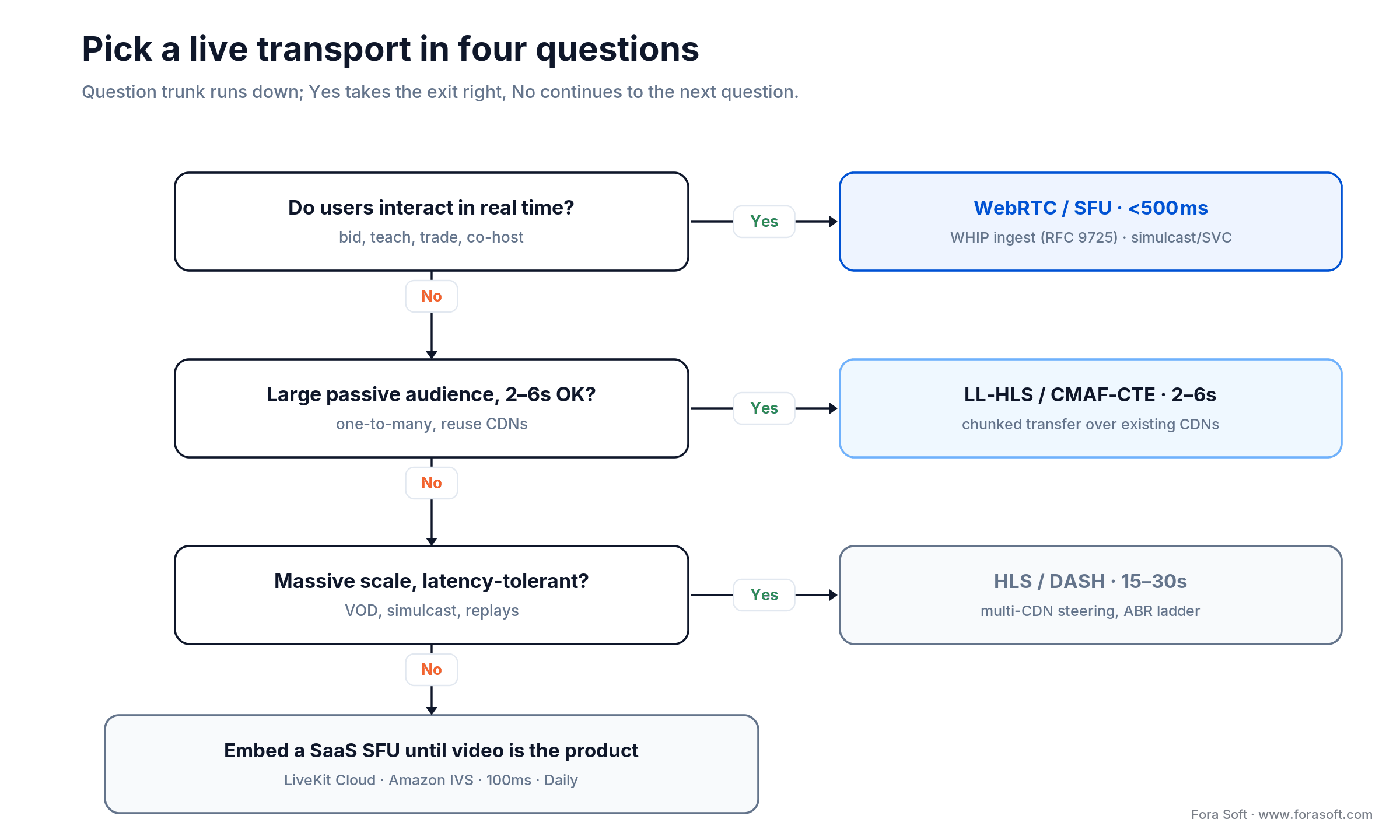
Figure 4. Pick a live transport in four questions; Yes takes the exit, No continues down the trunk.
Q1. How do users interact? Conversation goes to sub-second WebRTC. Reaction goes to LL-HLS. Passive goes to HLS/DASH.
Q2. Who hosts the content — you, partners, or users? User-generated means moderation and audit by design. Owned content needs compliance only where it’s regulated.
Q3. What concurrency peak must you survive? 10k versus 1M is an architectural choice, not a config value.
Q4. What’s your monetisation hypothesis? Subs, tips, commerce, ads, B2B — pick at least three, not one.
Q5. Which regulation applies? EU, UK, US state-level, app-store, payment processor. Design for the strictest jurisdiction you serve.
Stuck between WebRTC and LL-HLS?
Send your use case, concurrency target and latency budget. We’ll tell you which transport fits and what it costs to run — in plain numbers.
KPIs worth tracking
1. Quality KPIs. Time-to-first-frame p50/p95, rebuffering ratio, exit-before-video-start rate, join-failure rate, and VMAF on delivered renditions.
2. Business KPIs. Retention (D1, D7, D30), session starts per daily active user, ARPU, live-to-VOD re-watch rate, and commerce conversion on live drops.
3. Reliability KPIs. Origin and SFU uptime, multi-CDN failover rate, moderation-decision latency p95, and the percent of decisions with a full audit trail.
When NOT to build a live streaming platform
Three signals that embedding a third-party SaaS (LiveKit Cloud, Amazon IVS, 100ms, Daily) is the better call for now:
- Your product isn’t live-first; video is a secondary feature.
- You don’t have an on-call engineering culture for video infrastructure.
- Regulation is light and moderation needs are minimal.
Build custom when: video IS the product, latency or moderation is a competitive edge, and per-minute SaaS pricing would eat your margin at scale. Integrate a SaaS SFU when video merely supports the product — you can always migrate later once the unit economics justify owning the stack.
Custom live streaming is a strategic investment. Build when video is the product; integrate when it supports one. If you’re not sure which side of that line you’re on, our video streaming app development guide walks the build-versus-buy math.
FAQ
What is the future of live streaming in 2026?
The future of live streaming in 2026 is sub-second, AI-native and shoppable. Interactive use cases move to WebRTC and LL-HLS, AI runs as a platform layer across captions, moderation and encoding, live commerce becomes a core revenue line, and moderation turns into a compliance function under the EU DSA, UK Online Safety Act and EU AI Act.
How big is the live streaming market in 2026?
Estimates put the live streaming market at roughly USD 97–157 billion in 2026, growing at a 21–27% CAGR into the early 2030s (market-research estimates, 2026). The range is wide because analysts include different revenue models — ads, subscriptions, live commerce and infrastructure — so use it as a directional signal, not a precise figure.
WebRTC or LL-HLS — which should I pick?
Choose WebRTC when users interact in real time (chat, bid, teach, trade) and you need sub-500 ms latency. Choose LL-HLS when the audience is large and passively watching with 2–6 s of tolerance. Many products ship both and route per room type.
Is live commerce a fad or a lasting trend?
Lasting. Asian platforms proved the model at scale for nearly a decade, Western platforms have replicated it, and live shopping converts at 9.5–15.2% versus 2–3% for static pages (industry benchmarks, 2026). The market is projected to grow at roughly a 41% CAGR through 2033, so expect it to become a standard monetisation line for consumer live.
Do we need to support AV1 in 2026?
Yes, for VOD and large-scale live. AV1 is roughly 50% smaller than H.264, royalty-free, and hardware-decoded broadly in 2026, with YouTube and Netflix already serving it. Ship AV1 alongside an H.264/HEVC ladder, not instead of it, and let device telemetry decide the mix. VVC (H.266) remains a watch item — no browser ships native decode yet.
Is RTMP dead, and what replaces it?
RTMP is fading for ingest, replaced by WHIP, which became RFC 9725 in March 2025 and is now supported by Cloudflare, Dolby.io, Red5 Pro and Wowza. WHIP gives WebRTC a clean HTTP handshake for sub-second ingest. Media over QUIC is the longer-term successor but is still months from an RFC as of 2026, so WHIP is the practical choice today.
How do 2026 regulations affect live UGC platforms?
The EU DSA requires transparency reports, appeals and risk assessments; the UK Online Safety Act adds a duty of care plus age assurance for adult content, in force since July 2025; and the EU AI Act requires machine-readable labels on synthetic media from 2026. Practically, you need AI-assisted moderation, a human review queue, and a complete audit log for every decision.
What’s the fastest way to cut live streaming delivery costs?
Tune ABR with per-title or per-shot encoding, upgrade to AV1 where the device mix supports it, and add multi-CDN steering to avoid paying top-tier rates. Most platforms find 20–40% savings on the first optimisation pass — egress usually dominates the bill at scale.
What to read next
AI
AI in video streaming
How AI reshapes every layer of a streaming stack, end to end.
Cost
Streaming platform development cost
How to budget a live build — SaaS versus custom, honest numbers.
Engineering
Video streaming app development
A reference guide to building video streaming apps end to end.
WebRTC
How to choose a WebRTC development company
What to check before you trust a partner with real-time video.
Case study
Tradecaster — live financial broadcast
Sub-second commentary with multi-CDN and AI highlights.
Ready to build a live streaming product that earns its keep?
The 2026 live streaming roadmap is a sequence, not a shopping list. Nail transport first; add AI as a platform layer; design moderation and audit up front; diversify monetisation; measure relentlessly with QoE and retention. Do that in order and the rest — live commerce, creator economics, AV1, spatial — plugs in cleanly.
We’ve spent 20 years shipping live video across finance, education, healthcare and surveillance. If you’re sizing a 2026 roadmap, we can help you sequence it for measurable business impact — and tell you honestly where a SaaS SFU beats a custom build.
Ready to scope your live streaming platform?
Send your use case, concurrency target and monetisation hypothesis. You’ll get a sequenced plan and a realistic cost envelope, no obligation.

