

Key takeaways
• AppyBee in numbers. 800+ fitness centres and personal trainers, 4.6/5 over 57 reviews, 10–15 hours/week of admin saved, +20% member retention — built and re-built by Fora Soft starting in 2017.
• The market is real. Gym management software is a USD 2.23 B market in 2026 growing at 12.5% CAGR to USD 4.02 B by 2032 — but 91.2% of boutique studios are not yet sustainably profitable, so software has to fix something specific.
• Booking SaaS earns its price by killing no-shows. SMS reminders alone cut no-shows 38%; full automation drops them 20–40% in six months and recovers 28+ hours/month of billing admin.
• Multi-tenancy is the make-or-break decision. Retrofitting tenant isolation, GDPR data residency and PCI-DSS scope into a live SaaS costs more than building the product the second time — design it on day one.
• What it costs to build. A focused multi-tenant booking MVP runs USD 55–140 K in custom development; expect USD 100–250 K all-in for year one. Fora Soft uses Agent Engineering to compress that envelope.
Why Fora Soft is writing this case study
Fora Soft has shipped 250+ products since 2005 (20+ years). AppyBee has been with us since 2017 — long enough to live through every architecture trade-off a booking SaaS will eventually face. We built the first MVP, watched a cheaper team try to take over and fail, then rebuilt the platform end-to-end in React Native, React and PHP. Today AppyBee runs in 800+ fitness centres and personal-trainer studios, with a 4.6/5 rating across 57 verified reviews and a customer-reported +20% lift in member retention. Read this as a working playbook, not marketing — the design choices below are the ones we would make again.
If you are evaluating how to build a booking system for fitness, wellness, beauty or co-working, the rest of this article walks through the market math, the architecture that scales, the features users actually pay for, the comparison set you will be measured against, and a realistic cost envelope.
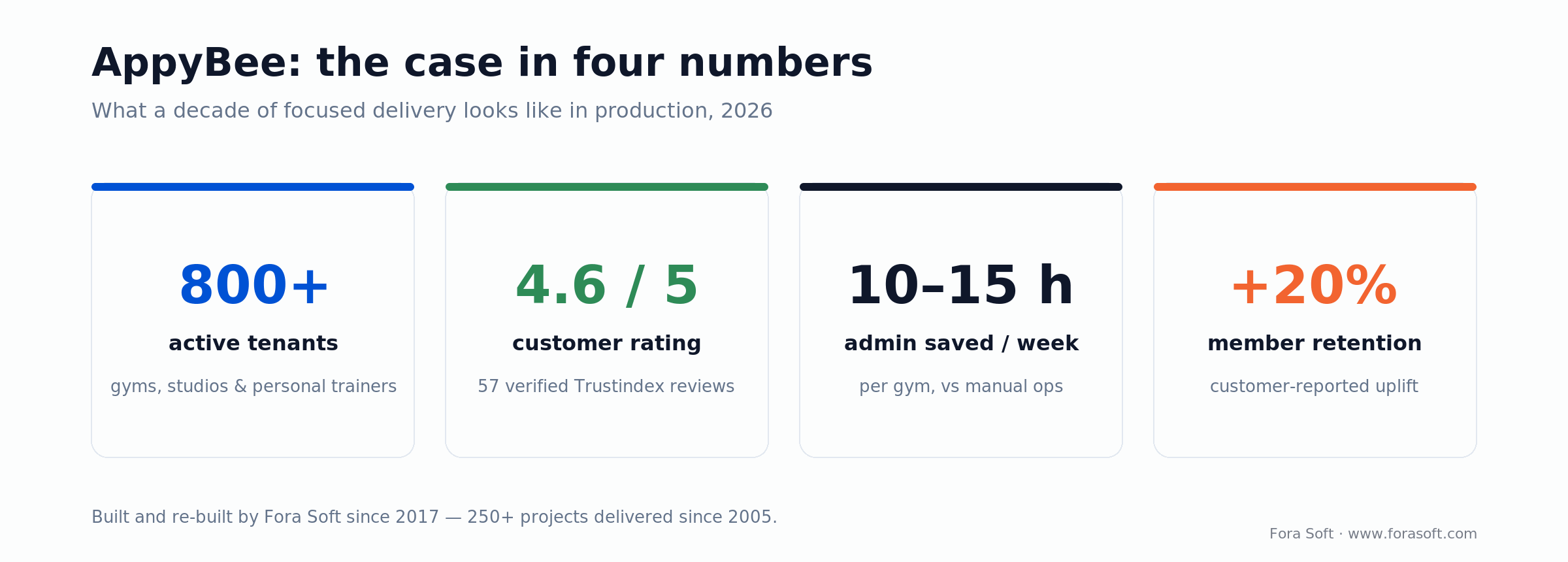
Figure 1. The AppyBee case in four production numbers after a decade of focused delivery.
Building or rescuing a booking SaaS?
Book a 30-minute call. We will pull your spec apart, point at the multi-tenant landmines, and tell you whether the right answer is a custom build, a rescue, or an off-the-shelf SaaS.
What AppyBee actually does
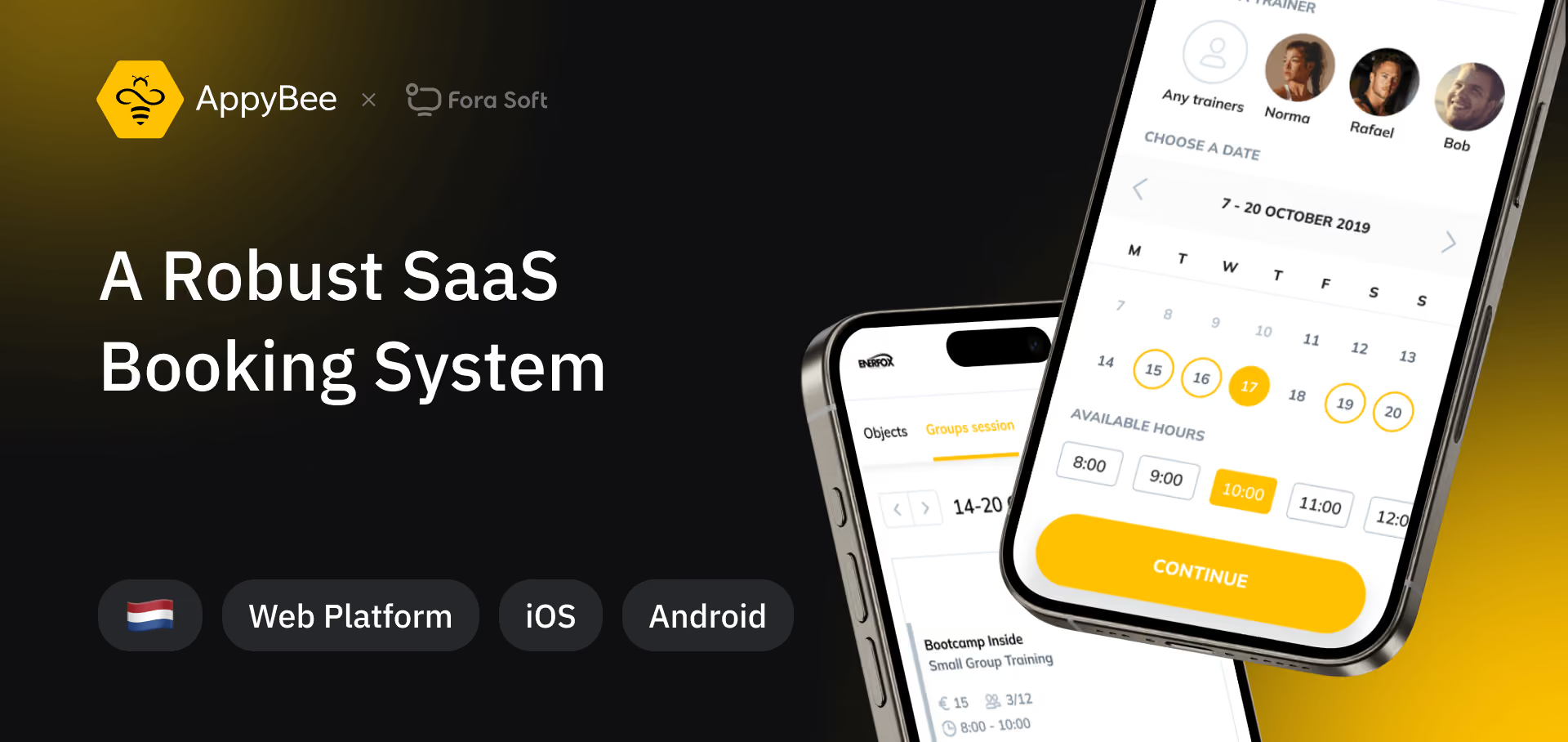
AppyBee is a multi-tenant SaaS that handles class scheduling, recurring memberships, payments, member CRM and branded mobile apps for service businesses: primarily fitness clubs, personal trainers, beauty salons, spas and co-working spaces. Each tenant gets a configurable web admin, an embeddable booking widget for their own marketing site, native iOS and Android apps for members, and a payment stack pre-wired to the Dutch market (iDEAL, Bancontact, Pay.nl, Pay.pro) plus international cards.
The control surface is intentionally narrow. Studio owners spend their day on three jobs: filling classes, billing reliably, and not letting members slip away. Everything in the product points at one of those three. The result is a small admin dashboard, an aggressive automation layer for billing and reminders, and a set of self-service flows that mean members rarely need to call the front desk.
The product that came back: a rescue narrative
AppyBee’s history is the most useful part of this case. In 2017 we built the original Bootstrap MVP for a single beauty salon. It worked. The owner expanded the scope to fitness clubs and SaaS multi-tenancy, and we built that too. Then the client wanted React Native cross-platform apps at a moment when we were still focused on web. They went to a cheaper team. The cheaper team shipped, but stability collapsed, build pipelines broke and the app store rejections piled up.
A few months later AppyBee came back. We rewrote the mobile clients in React Native with a unified codebase across iOS, Android and the embeddable widget, fixed the back-end performance issues, and stabilised the deployment pipeline. The pattern is unfortunately common in our pipeline: clients go cheap, then return when their growth stalls because the foundation is wrong. We have a dedicated troubleshooting and optimisation service exactly for this scenario.
Field note. When a SaaS rescue lands on our desk, the cheapest fixes are almost always database schema and CI/CD, rarely the UI. If a vendor is selling you a “visual redesign” before they have looked at the indexes and the build pipeline, that is the wrong vendor.
The business impact, by the numbers
Software is only as interesting as the operational changes it produces. AppyBee’s reported metrics are the ones that pay for the licence:
| Metric | AppyBee value | Industry benchmark |
|---|---|---|
| Active tenants | 800+ gyms, studios, PTs | Boutique SaaS <500 typical |
| Customer rating | 4.6/5 (57 verified Trustindex reviews) | 3.8/5 sector average |
| Admin time saved | 10–15 hours per gym per week | 7+ hrs/wk lost without automation |
| Member retention lift | +20% (customer-reported) | 5% lift = up to 95% profit lift (Bain) |
| Subscription tiers | EUR 89 / EUR 299 per month, unlimited members | Mindbody USD 99–699 per location |
Two of those numbers deserve underlining. First, 10–15 hours/week is the cost of an extra part-time front-desk hire that the gym does not have to make. Second, AppyBee’s pricing, flat per-tenant with unlimited members, is unusual in the sector. Most competitors charge per-location and per-staff, which is where boutique studios get squeezed as they scale.
The market for booking SaaS in 2026
The gym management software category sits at USD 2.23 B in 2026 and is forecast to compound at 12.5% to roughly USD 4.02 B by 2032 (Technavio, 360iResearch). That headline hides two interesting sub-trends. First, the wider fitness software market, including AI coaching, wearables and on-demand video, is growing more like 18% CAGR (Market Research Future), pulling investment toward AI features. Second, AI-in-fitness specifically is forecast to leap from USD 9.8 B in 2024 to USD 46 B+ by 2034.
Translation for an SMB gym SaaS: the shelf is crowded but the customers are paying. The product moat is not booking, which is table-stakes. It is the operational layer around it: payments, retention, branded mobile, AI nudges. Pure scheduling apps like Calendly or Acuity are cheap, but they cannot run a 12-location yoga chain.
Churn economics: why booking SaaS exists at all
Half of new gym members quit inside six months (Health & Fitness Association). 23% of cancellations are pure non-use: the member never showed up enough to feel attached. The Wellness Living 2024 boutique benchmark put 91.2% of studios in “not sustainably profitable” territory. A 500-member studio with average operations leaks roughly USD 94 K/year to no-shows, billing failures and admin drag (Kind Katch).
That is the wedge. SMS and push reminders alone cut no-shows 38%. Full automation (reminders, automated waitlists, dunning for failed cards, AI re-engagement) cuts no-shows 20–40% inside the first six months and trims support cost 15–30% (Digiqt, GymMaster). The same software lets a gym recover 28+ hours/month of billing admin that previously went to chasing late payers.
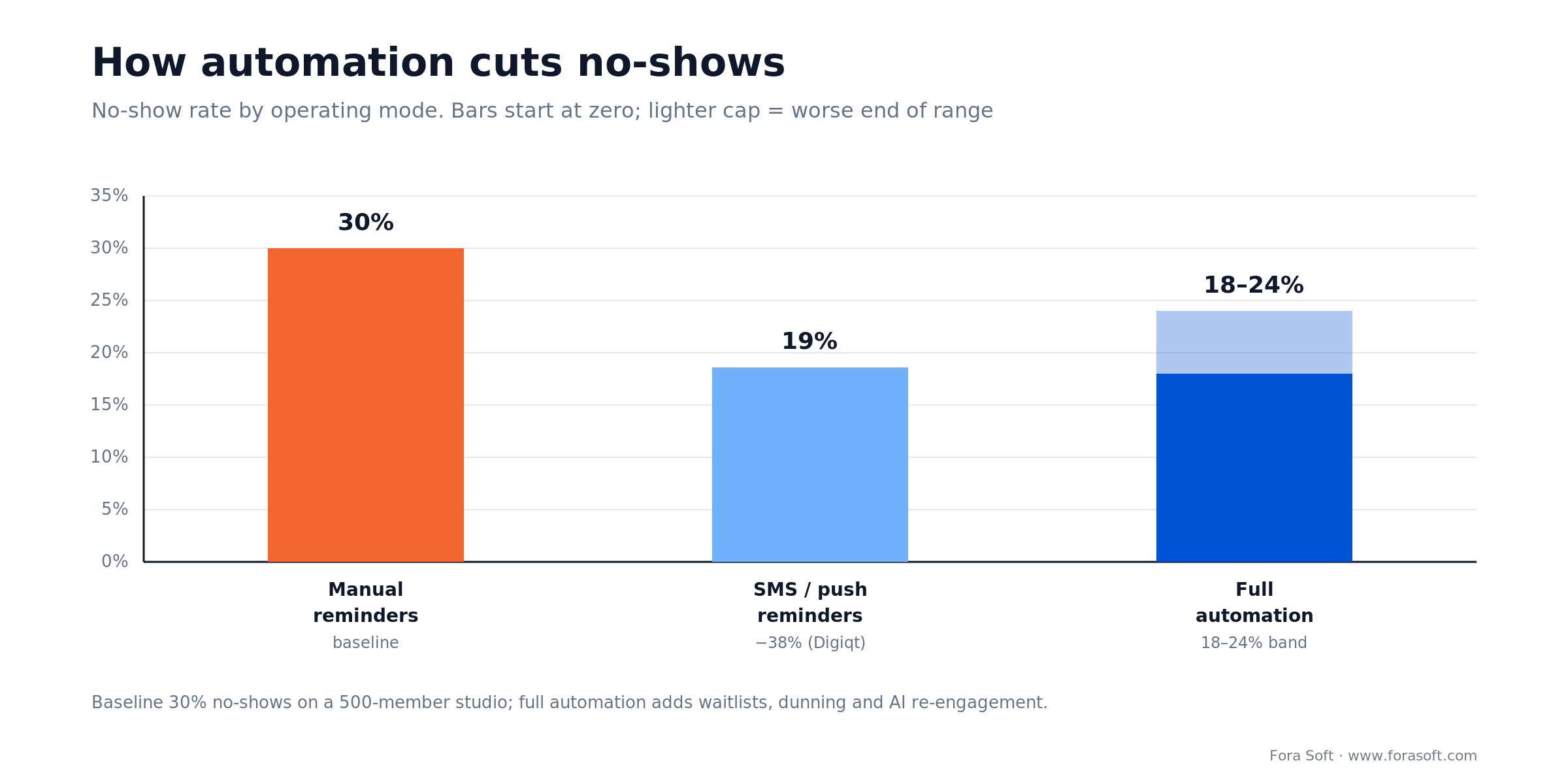
Figure 2. Reminders alone cut no-shows by 38%; full automation holds them in an 18-24% band.
If the wider retention story is your concern, our companion piece on why users leave apps and how to stop the churn walks through the seven-day-window cohort math in detail.
Who actually buys a platform like AppyBee
The buyer profile is narrower than the “all service businesses” tagline implies. Three patterns dominate:
Independent fitness studios with 100–1,500 members
Single owner, 1–3 instructors, often the owner teaches. Cannot afford Mindbody Ultimate; out-grows Calendly. AppyBee’s flat tier hits the sweet spot.
Multi-location boutique chains (2–10 sites)
Yoga, pilates, climbing, CrossFit groups. The pain point is consolidated reporting and a unified branded app. Per-location pricing eats them; this is where the unlimited-member model wins.
Personal trainers and small wellness practitioners
PTs, physios, beauty therapists, hair stylists, massage and tattoo studios. They want recurring billing, embeddable widgets and zero IT.
Table-stakes features for a 2026 booking SaaS
If your spec is missing any of these in the first release, the product will not survive a competitive demo. We have shipped each one in AppyBee, sometimes more than once.
• Real-time class calendar with recurring schedules, holiday/closure overrides, and two-way iCal/Google Calendar sync.
• Multi-location management with branch-level reporting and centralised member records.
• Instructor & staff scheduling with availability, certifications and payroll-friendly exports.
• Recurring billing with automated retries, dunning emails and graceful cancellation flows.
• Member CRM with intake forms, communication history, package balances and contract tracking.
• Attendance tracking across mobile, web and physical kiosk. AppyBee uses QR codes to replace plastic membership cards.
• Branded member apps for iOS and Android with the studio’s name, logo and palette.
• Push notifications for reminders, cancellations, waitlist promotions and re-engagement.
• Automated waitlists with auto-fill the moment a slot opens.
Differentiators that win deals in 2026
The features below are what separates a credible 2026 booking SaaS from a 2019 one. They are not all required at MVP, but if a roadmap does not at least name them, expect demo-loss to a smarter competitor inside two years.
• Offline-capable kiosk check-in: an iPad in the lobby that keeps working when the Wi-Fi drops, then reconciles cleanly. Conflict-resolution logic is harder than it sounds.
• Wearable + POS integration: pull workouts from Apple Health and Fitbit, push class bookings into the studio’s retail POS for personal-training packages and merch.
• AI dynamic pricing: contextual pricing by peak times, coach skill, demand and load. Simulations show 22–25% occupancy lift.
• Churn prediction: visit-frequency drop, payment-failure pattern and app-engagement decay together hit ~85% precision on 30-day churn.
• Marketing automation: drip campaigns, referral programmes, post-class survey nudges, expiring-package reminders.
• Voice booking and AI chatbot: a growing share of members expect to book by voice. The flow has to handle “Sign me up for tomorrow’s 6 a.m. spin” without a form.
Want a feature-by-feature gap analysis?
Send us your current spec or your favourite competitor. In a 30-minute call we will mark exactly which features are table-stakes, which are differentiators, and which to defer past v1.
The AppyBee tech stack — and why each piece is there
AppyBee is a deliberately conservative stack. Booking SaaS does not need exotic tooling — it needs reliability, fast onboarding for new engineers, and components that have been battle-tested for a decade.
Frontend & widget: React
React drives the admin dashboard and the embeddable widget that customers drop into their own marketing sites. We reach for TypeScript on booking front-ends because it catches the regressions these apps are most prone to: date math, currency math and capacity math.
Mobile: React Native
One codebase for iOS and Android, OTA updates for moderation-sensitive screens, and shared business logic with the React.js web client. Cross-platform here is not a cost cut. It is a feature-velocity decision.
Backend: PHP REST API
AppyBee’s server is a PHP REST API split into focused services. That boundary maps cleanly onto PCI-DSS scope: only the payments service touches raw card tokens, so the rest of the platform stays out of audit reach. Class capacity is kept in sync across the member app, the lobby kiosk and the admin dashboard through the same API.
Infrastructure: AWS
EC2 + RDS + S3 + CloudFront. EU region by default for GDPR data residency, with a documented per-tenant pinning option.
Multi-tenant architecture: the decision that costs the most to undo
If your booking SaaS will eventually serve more than ~50 tenants, multi-tenancy stops being a nice-to-have and becomes the spine of the product. The trap is that single-tenant codebases ship faster in month one but become exponentially more expensive every quarter after that.
Three concrete decisions tend to dominate the architecture discussion:
• Data isolation model. Shared schema with tenant_id columns is fastest to build and cheapest to operate, but every query must be guarded. Schema-per-tenant is safer but explodes operational cost. Database-per-tenant is the only model regulated industries trust — and is sometimes the only model that satisfies enterprise procurement.
• Noisy-neighbour control. One large gym running a payroll export at 9 a.m. cannot be allowed to slow down a hundred small ones. Rate limits per tenant, separate worker queues, and tenant-aware connection pools all need to exist before the product hits 100 customers.
• Onboarding/offboarding. GDPR demands a clean export and a verifiable delete. Build that on day one or you will rebuild your data model when the first request lands.
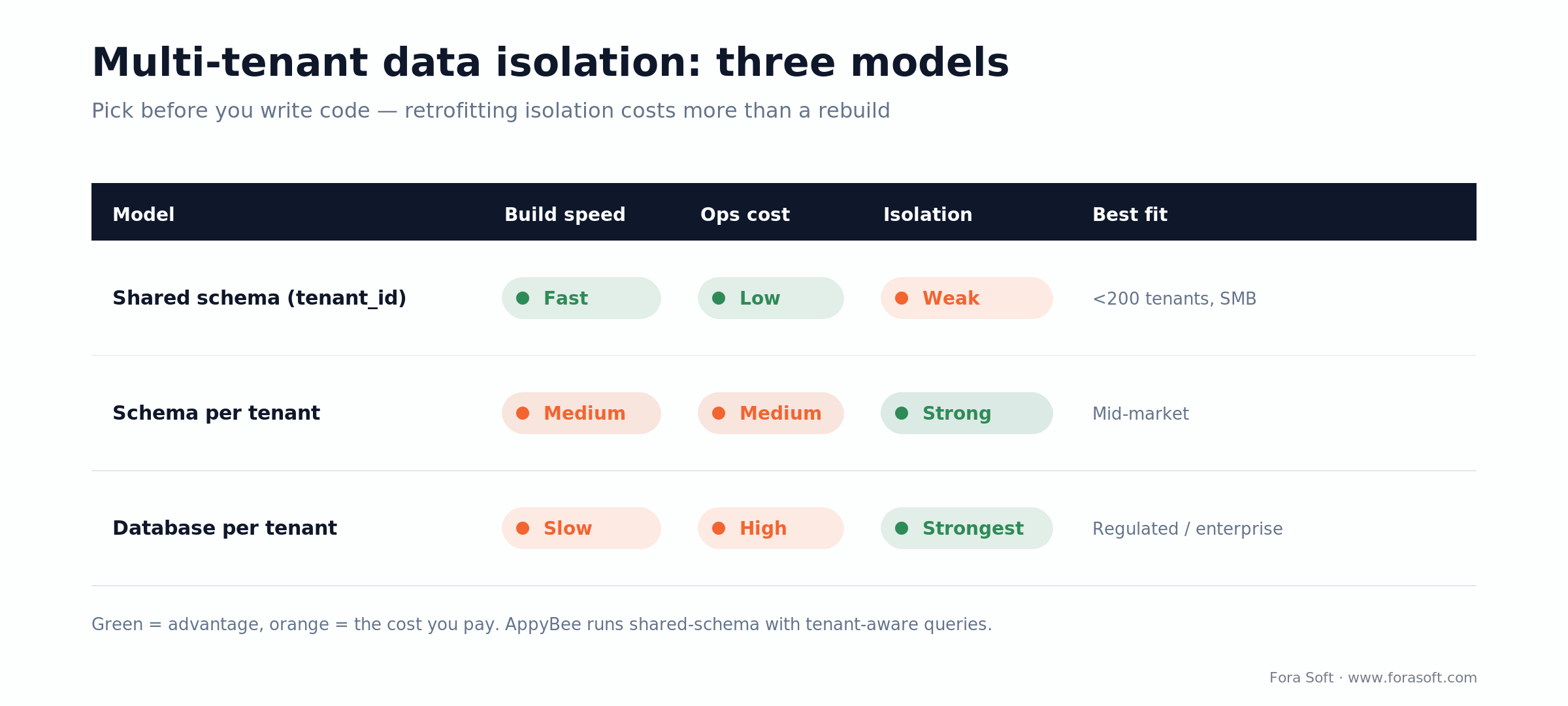
Figure 3. The three tenant-isolation models and the cost each one trades away.
Heuristic. If a SaaS architecture cannot answer “show me everything for tenant X and only tenant X” with a single SQL query, the multi-tenancy model is wrong — and that is more expensive to fix than to redesign now.
Payments & compliance: PCI-DSS, GDPR, local processors
AppyBee is built for the European market, so the payments layer looks different from what a US-first SaaS would ship. Dutch members expect iDEAL and Bancontact at checkout; international cards still go through Stripe-class processors with tokenisation.
Two scoping rules cover most of the audit pain:
• Never let raw card data hit your servers. Use the processor’s hosted fields or SDK tokenisation. The payments microservice exchanges tokens for charges; nothing else in the platform sees a PAN. PCI-DSS scope drops by an order of magnitude.
• Document the GDPR data flow before legal asks. Personal data: member name, contact, attendance, billing history. Special category data (sometimes): health intake forms. Under GDPR, each one needs a stated lawful basis, retention period and a deletion path. Build the export and delete endpoints into the admin dashboard from day one.
Mobile strategy: white-label vs. shared app
There are two viable mobile strategies for a booking SaaS, and they are not interchangeable.
Shared app, theme-per-tenant
One AppyBee app on the store; the studio is a configuration. Cheap, fast, easy to update. Studios complain that they do not appear in their own brand on a member’s home screen.
White-label app, one binary per tenant
Each studio gets its own listing in the App Store and Google Play. Marketing wins, operations weep: per-tenant developer accounts, D-U-N-S registration, separate review cycles (4–6 weeks per tenant), version-control headaches across dozens of binaries.
For most SMB-focused SaaS, AppyBee’s shared-app + branded-widget approach is the right answer. Reserve white-label for the chains that genuinely need it — and price it accordingly.
Booking SaaS compared: AppyBee vs. the field
An honest side-by-side. AppyBee is not the best at every dimension — nothing is — but the trade-offs are the ones boutique studios actually care about.
| Platform | Best for | Pricing | Watch-outs |
|---|---|---|---|
| AppyBee | EU SMB studios, PTs, salons | EUR 89–299/mo, unlimited members | EU-payment focused |
| Mindbody | Multi-location enterprises | USD 99–699/loc + 2.99% + $0.30 | 20% marketplace fee |
| Mariana Tek (ex-Glofox) | Boutique multi-site fitness | ~USD 179–285/loc, custom | Email design limits, kiosk quirks |
| Vagaro | Solo PTs, salons, spas | USD 25–30+/staff | Thin enterprise feature set |
| Wodify | CrossFit, BJJ, niche fitness | Tiered, no-commitment | Smaller integration ecosystem |
| Acuity | Coaches, single-room studios | USD 20–61/calendar | No real CRM or branded app |
| Calendly | 1:1 sessions, intro calls | USD 0–20/user | Not a booking SaaS for studios |
What it costs to build a booking SaaS like AppyBee
We will only quote what we can ship. The figures below are industry-standard ranges from 2025–2026 (SaintNLP, Bytes Brothers, Ptolemay), with our typical envelope marked alongside. Real numbers depend on integrations, white-labelling, payment markets and AI ambitions — we publish a live estimate after the discovery call rather than guessing in a blog post.
MVP (3–4 months)
Single-vertical, single-region, web admin + one mobile platform, one payment processor, basic CRM and reporting. Industry range: USD 28–55 K. Lean, opinionated scope.
Multi-tenant platform (6–12 months)
True multi-tenant, iOS + Android + web, multiple payment processors, full member CRM, marketing automation, kiosk, embeddable widget, GDPR/PCI-DSS compliance. Industry range: USD 55–140 K, plus ops and support.
First-year all-in
Including hosting, monitoring, analytics, content moderation, customer support tooling and at least one minor release per quarter, USD 100–250 K is a fair planning envelope.
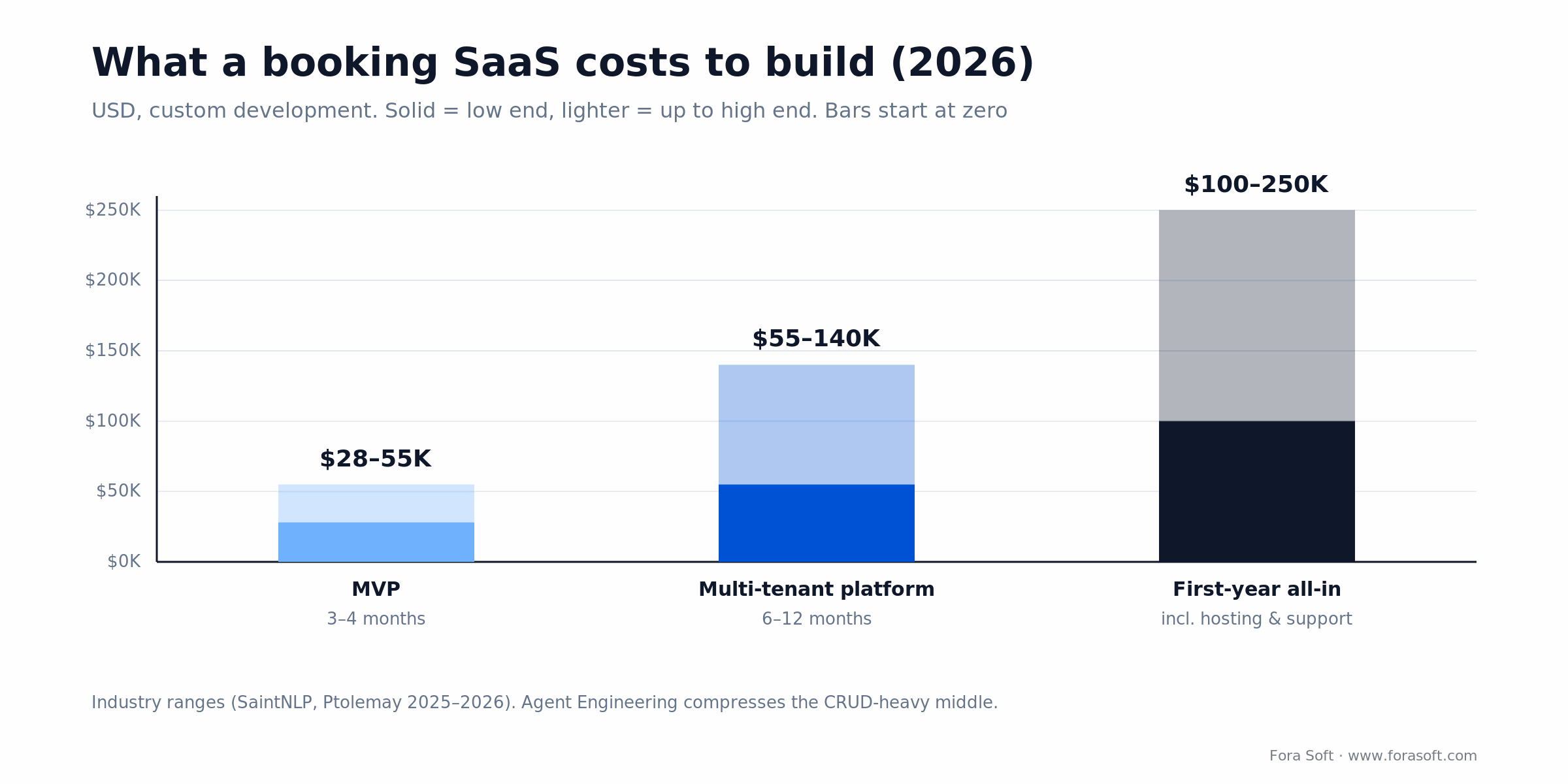
Figure 4. Custom-build cost bands for a booking SaaS, from lean MVP to first-year all-in.
How Agent Engineering moves the envelope. Fora Soft uses an in-house Agent Engineering pipeline (Claude- and GPT-class models orchestrated by senior engineers) to compress the discovery, scaffolding, test-writing and CRUD-heavy parts of a SaaS build. The savings are real but uneven — we apply them where the marginal value is highest, then quote you the actual delivery plan rather than promising a percentage.
A five-question decision framework
Before scoping a booking SaaS, answer these five. The answers decide architecture more than any feature list.
1. How many tenants in 24 months? <20 = single-tenant or shared-schema is fine. 20–200 = shared schema with tenant-aware queries and per-tenant config. 200+ = isolated databases or schemas, with a tenancy router.
2. What are the regulated geographies? EU only = GDPR + local payments. EU + US = data residency design. APAC = add CCPA-class privacy and possibly local hosting.
3. White-label or shared mobile app? If white-label is a v1 commitment, double the mobile budget and add 6 weeks of App Store choreography per tenant.
4. Where do payments fail? Pick processors based on the markets you will actually charge in. iDEAL/Bancontact for NL/BE, SEPA for the EU, Stripe for cards, PayPal for retail muscle memory, local rails for emerging markets.
5. What is the AI roadmap? Even if AI is post-MVP, design event tracking and a feature store now. Bolting churn prediction on a year later is a data-model rewrite.
Five pitfalls that sink booking SaaS projects
Each of these has cost a real client real money — sometimes ours, sometimes a competitor’s.
1. Single-tenant lock-in. “We’ll add multi-tenancy later” is the most expensive sentence in SaaS.
2. Naive recurring billing. Failed cards, partial refunds, mid-cycle upgrades, prorations and tax all need to be in the data model from day one.
3. Missing offline check-in. A studio whose check-in stops working when the cafe’s Wi-Fi crashes will churn off your platform inside a quarter.
4. PCI-DSS scope creep. One PHP utility logging request bodies into S3 can drag the entire platform into PCI scope. Audit the log paths in week one.
5. Push notification spam. >6 push messages per week from a single brand multiplies uninstall risk by 3.4x. Cap aggressively.
Where AI and Agent Engineering shorten the project
Fora Soft maintains an internal Agent Engineering practice that we apply to every SaaS build. The biggest gains come in four places:
• Discovery and spec. Stakeholder interviews are summarised, edge cases generated and acceptance criteria drafted by AI agents under engineer review. Days saved per epic.
• CRUD scaffolding. Tenant-aware repositories, REST controllers, schema migrations and admin tables are generated and reviewed. Multi-tenant boilerplate goes from weeks to days.
• Testing. Unit and integration tests for booking, capacity and payment paths are written by agents and tightened by reviewers. Coverage rises faster than human-only writing can sustain.
• In-product AI. Churn prediction, dynamic pricing and conversational support all build on the same telemetry layer the platform already needs. Designed in, not bolted on, the marginal cost is low.
We keep our AI engineering practice documented in the Learn hub; for how we package it on a project, see our AI integration service.
The KPIs we steer a booking SaaS by
A booking SaaS lives or dies on three KPI families. Track them weekly from week one.
Product KPIs
Booking conversion rate, average bookings per active member per week, no-show rate, waitlist fill rate, push opt-in rate, mobile app crash-free sessions (target ≥99.95%).
Business KPIs
MRR per tenant, gross churn, net revenue retention, payment failure recovery rate, support tickets per 100 members.
Tenant-side KPIs (sold to gym owners)
Member retention curve at day 30/90/180, average revenue per member (ARPM), front-desk hours per 100 members per week, % of payments collected on first attempt.
When NOT to build your own booking SaaS
We build custom platforms for a living. We will still tell you not to do it if any of the following holds:
• You are a single-location studio with <500 members. Mindbody Starter, Wodify or Vagaro will get you 90% of the value at 10% of the cost.
• Your differentiation is content, not workflow. A Calendly + Stripe + ConvertKit stack is fine until you have proven the market wants more.
• You have no in-house product owner. Custom SaaS without a product manager produces an expensive prototype that becomes legacy on day 90.
• You are racing to a fundraising milestone. Off-the-shelf SaaS plus polished landing pages will demonstrate traction faster than custom code.
• The economic question is unresolved. If you do not know your ARPM and CAC to two significant figures, custom development will not save the business.
Mini case: how AppyBee got to 800+ tenants
Setup. AppyBee’s founder Jan came to us in 2017 with a Bootstrap MVP for a single beauty salon. Within nine months we had it servicing fitness studios on a shared-schema multi-tenant model. After the brief detour to a cheaper team, we returned in 2019 to fix mobile and stabilise the back-end.
What we shipped. Unified React Native iOS/Android codebase; embeddable React widget; PHP REST API microservices with a PCI-DSS-scoped payments service; live class-capacity sync; Dutch payment integrations; QR-code member check-in; recurring subscription engine with auto-pause and renewal.
Outcome. 800+ active tenants, 4.6/5 over 57 verified reviews, 10–15 hours of admin saved per gym per week, +20% reported retention lift. Sustained EUR 89/EUR 299 pricing across both tiers with unlimited members.
Quote. Jan singled out our “communication and project delivery quality” as the deciding factor for coming back — not the price. If you want a similar engagement, book a 30-minute call and we will sketch the equivalent for your project.
Companion read. The retention numbers above pair with our deeper playbook on how to stop app abandonment — AppyBee’s +20% number is roughly what the Hooked + B=MAP loops described there will produce when wired into a service product.
The performance floor before any growth work
If your booking SaaS does not clear these numbers, marketing is a tax. Fix the floor first.
| Surface | Floor | Gold standard |
|---|---|---|
| Mobile crash-free sessions | 99.95% | 99.99% |
| App cold-start time | <3s | <1.5s |
| API p95 latency | <500ms | <200ms |
| Booking attempt success rate | ≥99% | 99.95% |
| Push delivery rate (sub-1min) | ≥95% | 99% |
| First-attempt payment success | ≥90% | 95%+ |
Ready to scope a build, or rescue an existing one?
We will look at your current stack — or your wishlist — and give you a 90-day plan with deliverables, dependencies and where Agent Engineering will compress the timeline.
FAQ on building a SaaS booking system
How long does it take to build an AppyBee-class booking SaaS?
A focused single-tenant MVP can ship in 3–4 months. A real multi-tenant platform with iOS, Android, web, kiosk, multiple payment processors and GDPR/PCI-DSS compliance lands at 6–12 months. AppyBee itself was rebuilt in roughly nine months of focused work after we returned to it.
What does it actually cost to build?
Industry ranges for 2025–2026: USD 28–55 K for a lean MVP, USD 55–140 K for a multi-tenant platform, USD 100–250 K all-in for year one. We give project-specific quotes after a discovery call rather than guessing.
Should you use React Native or native iOS/Android?
For booking apps, React Native is almost always the right choice. AppyBee, Sprii and most of our other consumer-facing apps are React Native. The only times we go native are heavy AR (ARKit/ARCore), low-latency video pipelines beyond what React Native bridges support, or strict offline performance requirements.
How do you avoid PCI-DSS scope ballooning?
Use the payment processor’s tokenisation SDK or hosted fields so raw card data never touches your servers. Isolate the payments microservice. Audit log paths for accidental PAN capture. Document the data flow and do a quarterly review.
Should each tenant have a white-label app or share a single app?
Default to a shared, themeable app plus a strong embeddable web widget. Reserve dedicated white-label binaries for chains that pay enough to absorb the operational tax (per-tenant developer accounts, separate App Store reviews, version sprawl).
How do you price the SaaS?
Per-location pricing wins enterprise but loses SMB. AppyBee’s flat tier with unlimited members works because the EU SMB market is price-sensitive and predictable. Test both pricing axes — per-location and per-active-member — on small cohorts before committing.
Can AI predict which members will churn?
Yes, with ~85% precision on 30-day churn when you have at least three months of attendance, payment and app-engagement data. The harder problem is acting on the prediction without making members feel surveilled — nudges should look like helpful reminders, not desperation.
What if your booking SaaS is already breaking?
That is exactly how AppyBee came back to us. Start with a two-week audit of database, CI/CD and the payment path — the cheapest fixes are almost always there. Our troubleshooting and optimisation service is built around that pattern.
Read next
Retention
App abandonment in 2026
25% of apps die after one use. The Day 1/7/30 cohort math and the playbook to fix it.
Engagement
Why active users matter
DAU vs. MAU vs. installs — the metric that actually predicts revenue.
Cost
Mobile app development cost
A line-item teardown of mobile app budgets in 2025–2026.
Case study
Perspire live group fitness
Live-streaming group fitness platform — the next layer up from booking.
Service
Custom software development
How we deliver multi-tenant SaaS, AI features and mobile end-to-end.
So, should you build a booking system?
AppyBee shows that a focused, multi-tenant booking SaaS, built and rebuilt by a single delivery team that understands the operational reality of fitness studios, can compound for almost a decade and serve hundreds of customers from a small footprint. The product moat is not bookings — it is the operational layer (payments, retention, branded mobile, AI nudges) wrapped around them.
Want this kind of outcome?
Tell us your booking-SaaS idea or your stuck project. 30 minutes, no obligation, an actionable plan you can hand to your engineering team on Monday.

