

Key takeaways
• A top software development company is proven by shipped products, not logos. Techreviewer named Fora Soft a top software development company for 2026; this playbook shows what that label should mean to a buyer.
• Domain expertise beats generic engineering where the domain bites. Telemedicine, video streaming, e-learning and surveillance each carry compliance, latency and operational constraints a general team meets only by failing first.
• Production numbers beat slide decks. Sprii (€365M+ in live sales, 72K+ events), BrainCert ($3M ARR, 500M+ classroom minutes), VocalViews (1M+ participants, Google and Netflix as clients).
• AI-augmented delivery only counts with governance. Agent Engineering trims 30–40% off our cycle time, but every change still passes a human PR review and security scan.
• Fora Soft has built software since 2005: 250+ projects, 50+ in-house specialists, 99% Job Success on Upwork. The cluster of proof is the signal, not any one award.
A top software development company in 2026 is not the one with the longest logo wall. It is the team that has shipped your kind of product before, can prove it with production numbers, runs AI-assisted delivery without cutting corners, and hands you a process you can inspect before you sign. Techreviewer named Fora Soft a top software development company for 2026, so treat this as the playbook version of that recognition: what the label should mean, and how to test any vendor against it.
We build video, audio, real-time communication, AI and connected-device platforms, and we lose money when a client picks the wrong partner and comes back a year later to rebuild. So the advice below is the same advice we give founders who never hire us.
What makes a top software development company in 2026
Four things, in order. First, relevant production experience: has this team shipped something with your constraints, and will they put you on a call with that client? Second, proof you can verify: named projects with real metrics, not adjectives. Third, disciplined AI delivery: AI in the workflow, with a governance protocol you can read. Fourth, a process on paper: scope, ownership and exit terms written down before the build starts.
Directories are a useful filter, not the answer. Verified reviews on Techreviewer, Clutch and GoodFirms tell you a vendor cleared a bar; reference calls tell you whether they clear yours. The buyer’s checklist below is how we’d run that comparison.
The buyer’s checklist
| What to verify | Strong signal | Red flag |
|---|---|---|
| Domain track record | A shipped product with your constraints | Only generic dashboards and CRUD apps |
| Reference access | A direct client call, no chaperone | Curated testimonials only |
| Scope discipline | They push back and cut your scope | They say yes to everything |
| AI governance | AI in the workflow with a written review gate | Either no AI, or AI with no controls |
| Code and IP ownership | Yours on day one, no carve-outs | Vendor holds repos or store accounts |
| Security posture | ISO 27001-aligned, named providers, BAAs | Hand-waving about “best practices” |
Domain-focused vs generic: the 2026 split
The gap between a generic outsourced shop and a domain-focused partner widened in 2026. Three reasons.
1. Compliance is an architectural constraint, not an afterthought. HIPAA in healthcare, FERPA in K-12 EdTech, PCI-DSS in payments, and GDPR across regions. Generic teams meet these in month four; domain teams design for them in week one.
2. Latency and scale are domain-shaped. A SaaS dashboard at 1,000 daily users behaves nothing like a live video platform at 1,000 concurrent viewers. Translating one to the other costs months.
3. Vendor and protocol choice is hard-won. WebRTC vs SRT vs HLS, AVFoundation vs ExoPlayer, Tizen vs webOS vs Android TV, multi-DRM, on-device vs edge vs cloud AI. The right call usually needs someone who has shipped each option.
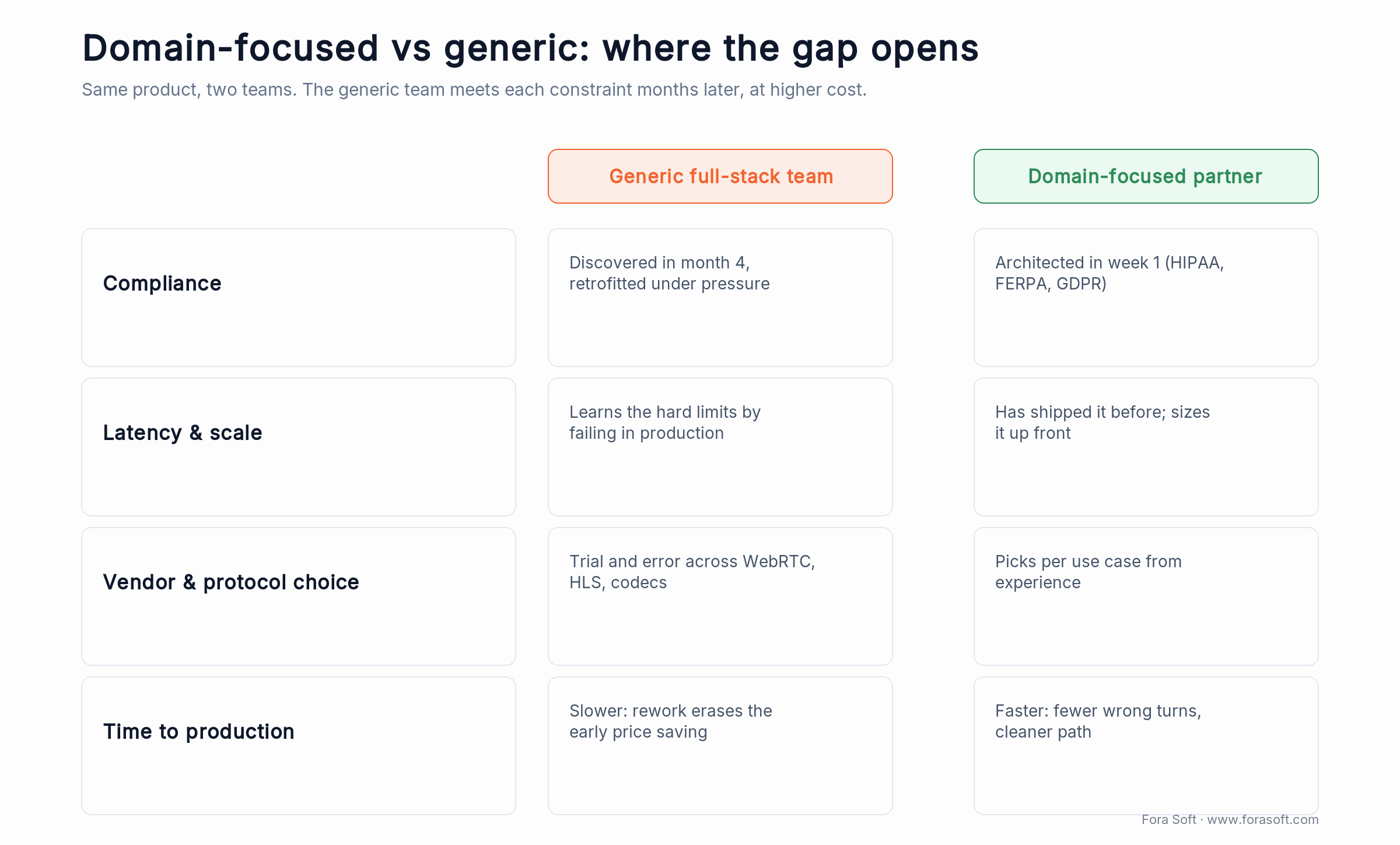
Figure 1. The same product built by a generic team versus a domain-focused partner: the generic team meets each constraint months later.
Reach for a domain-focused partner when: your product touches video, audio, real-time communication, AI or any regulated industry. Otherwise a generalist full-stack agency may serve you fine, with more iteration overhead.
Which type of software development company fits you?
“Top” is relative to your product. Five kinds of partner show up on the shortlists, and each wins in a different place. Match the type to your constraints before you compare individual names.
| Type of partner | Best fit | Watch-out |
|---|---|---|
| Domain-focused specialist | Video, audio, real-time, AI or regulated products with hard constraints | Overkill for a plain CRUD dashboard |
| Generalist full-stack agency | Standard web or SaaS with no latency, AI or compliance load | Learns your domain on your budget and timeline |
| Offshore body shop | Lowest hourly rate on tightly specified, well-understood work | Communication overhead; thin architecture ownership |
| Freelancer or small team | Early prototypes and tight budgets | Bus factor, plus scaling and compliance gaps later |
| Large consultancy | Enterprise procurement and multi-team programs | Premium price; often junior engineers on the ground |
Picking a top software development partner right now?
A 30-minute scoping call: we challenge your scope, validate your stack assumptions, and give you a realistic budget and timeline. No slide decks.
Video streaming: what serious 2026 platforms get right
Streaming is where domain expertise pays back fastest, because the failure modes are expensive and public. Sprii and Rafiky show the pattern at very different scales.
The four decisions that separate platforms
Four decisions separate a platform that holds up from one that buffers. Pick the protocol per use case: WebRTC for sub-500 ms two-way, LL-HLS or LL-DASH for sub-two-second one-to-many at scale, classic HLS for cost-efficient broadcast. Treat multi-CDN as a first-class choice, routed by where viewers actually are. Plan the codec ladder (H.264 for reach, HEVC for efficiency, AV1 for the next 10–25% of bandwidth savings as decoders mature). And instrument viewer-side quality of experience per region, or you are flying without instruments.
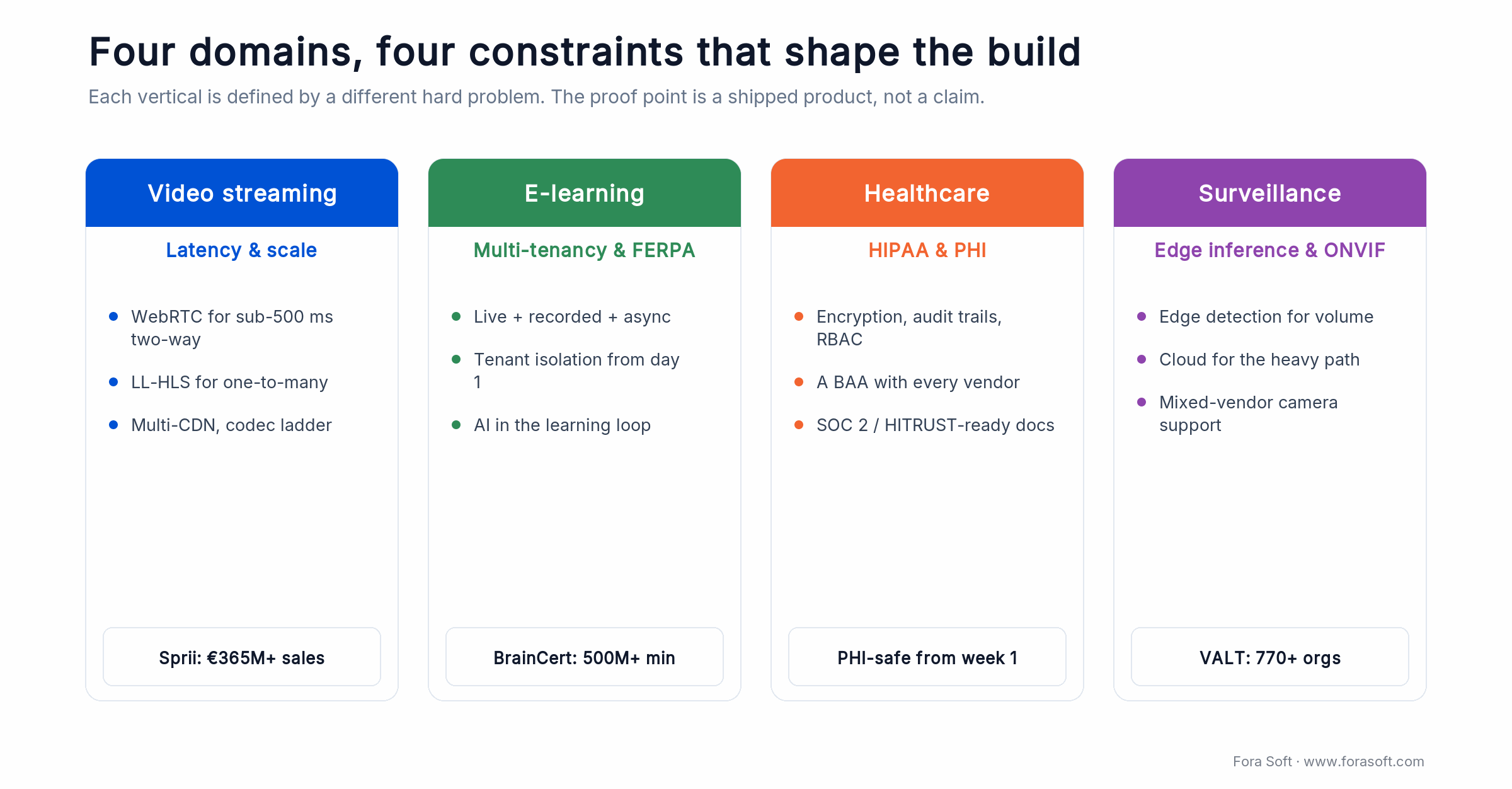
Figure 2. Four verticals, four hard constraints, each anchored to a product we shipped rather than a claim.
For the architecture detail, see our WebRTC architecture guide for business, the video streaming learning hub, and our video and audio streaming services page.
E-learning: the complexity that separates platforms
E-learning looks simple from outside and is one of the most operationally complex domains inside, because each user flow crosses many systems. BrainCert, Scholarly and dozens more taught us four things to plan for.
1. Live, recorded and asynchronous, together. Most serious platforms run all three, sharing authentication, content metadata and progress tracking.
2. Multi-tenancy from day one. B2B EdTech sells to schools, universities and enterprises with very different data-isolation expectations. Retrofitting tenant isolation is painful.
3. Privacy law is not optional. FERPA and GDPR shape K-12 in particular; many platforms quietly breach them for the first 18 months.
4. AI belongs in the learning loop, carefully. Personalisation, assessment generation, plagiarism checks and AI tutors each add value and each need real UX and compliance design.
Healthcare and telemedicine: HIPAA-grade from week one
Healthcare is where shortcuts cost the most. HIPAA, the EU MDR, GDPR and regional device rules are not features you add later; they shape the architecture on day one.
1. PHI handling baked into the architecture. Encryption in transit and at rest, access logs, role-based access, signed URLs for media, retention policies, audit trails on admin actions.
2. A BAA with every vendor that touches PHI. AWS, GCP, Azure, Twilio, Datadog and your AI providers each need a Business Associate Agreement if protected health information flows through them. Keep PHI away from vendors that will not sign one.
3. Telemedicine UX that survives a bad network. Reliable video reconnection, low-bandwidth fallback, async messaging when sync fails, consent flows for recording, prescription handoffs.
4. Documentation that makes the audit boring. SOC 2 or HITRUST later means audit-ready documentation now, written while the code is fresh.
Our telemedicine service page and the healthcare software development challenges guide go deeper.
Reach for a HIPAA-experienced partner when: any of your users could be patients, providers or payers, or anyone whose health data flows through your system. Retrofitting HIPAA later costs far more than building it in.
Video surveillance and computer vision
Surveillance products combine computer vision, real-time video pipelines and edge-or-cloud orchestration. The production-grade pattern in 2026 has four parts.
1. Edge inference for the high-volume path. Person, vehicle and package detection at the camera or a small edge device cuts cloud cost by orders of magnitude.
2. Cloud inference for the heavy path. Activity recognition, multi-camera correlation and forensic search. Send only the relevant clips up.
3. ONVIF and codec compatibility. Real installations run mixed-vendor cameras across years. A single vendor SDK will not cover them.
4. Operator UX decides adoption. The multi-camera grid, search, alerts and evidence export are where a VMS is won or lost.
See our video surveillance services and Android video surveillance AI trends for more.
AI-augmented delivery, done with discipline
Agent Engineering inside our teams cuts cycle time 30–40% on most workstreams. The discipline behind that number matters more than the number.
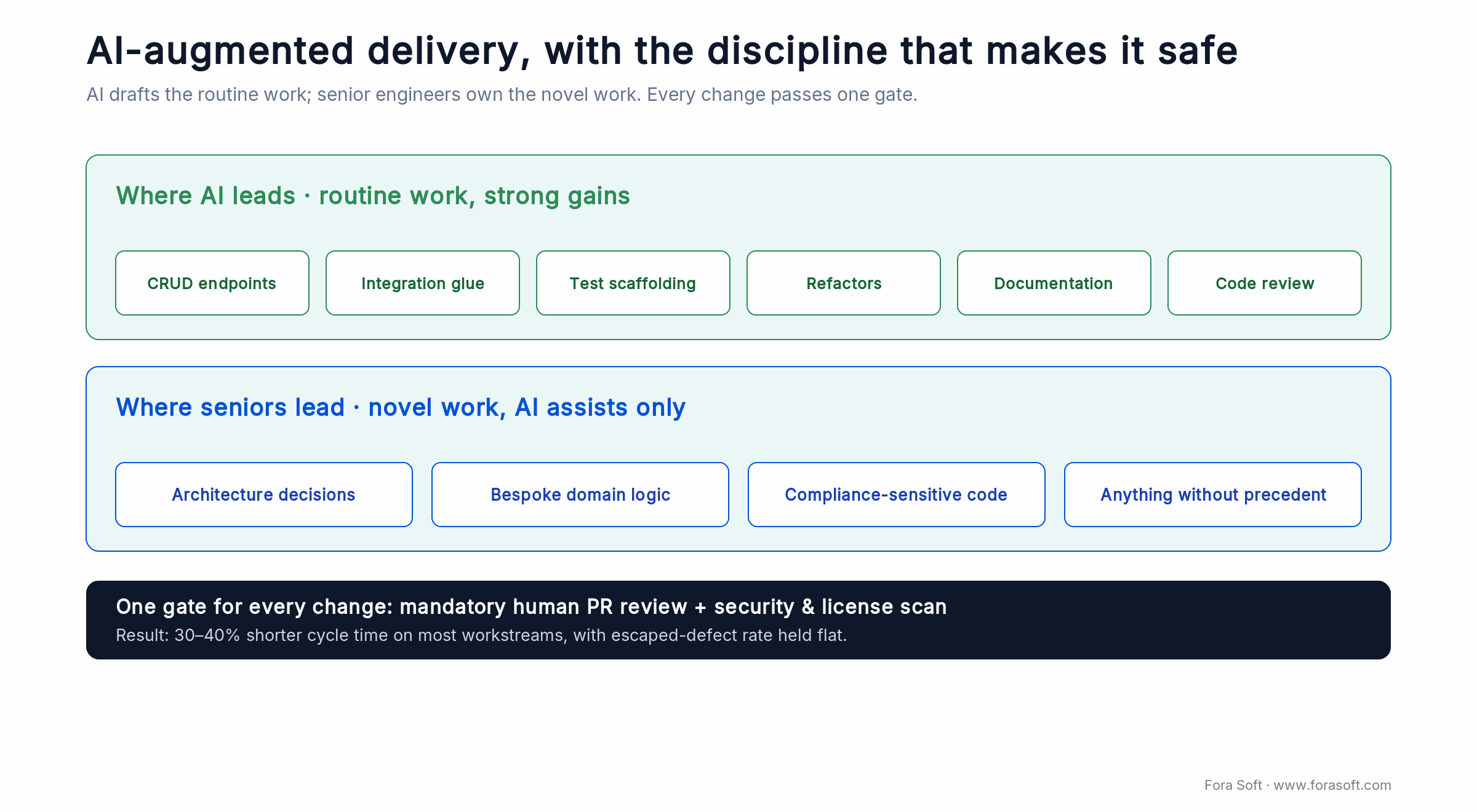
Figure 3. Where AI leads versus where senior engineers lead, and the single review gate every change passes.
1. AI on routine work. CRUD endpoints, integration glue, refactors, test scaffolding, documentation and review assistance. Strong gains, low risk.
2. Senior judgment on novel work. Architecture, bespoke domain logic, compliance-sensitive code and anything without precedent. AI drafts; a person decides.
3. A mandatory human PR review. Every AI-suggested change goes through a reviewer plus security and license scanning. No exceptions.
4. Honest reporting. Cycle time, review time and escaped-defect rate before and after AI, shared so clients can compare.
The methodology and the numbers are in our AI software development case study.
Want Agent Engineering applied to your project?
A 30-minute call: we walk through how we’d structure the AI workflow on your codebase, the governance protocol, and the cycle-time gain to expect.
How we run an engagement: seven phases
A typical engagement runs in seven phases, from a free scoping call to a steady-state team. The build dominates the calendar; the two weeks of discovery in front of it are what keep the build from going sideways.
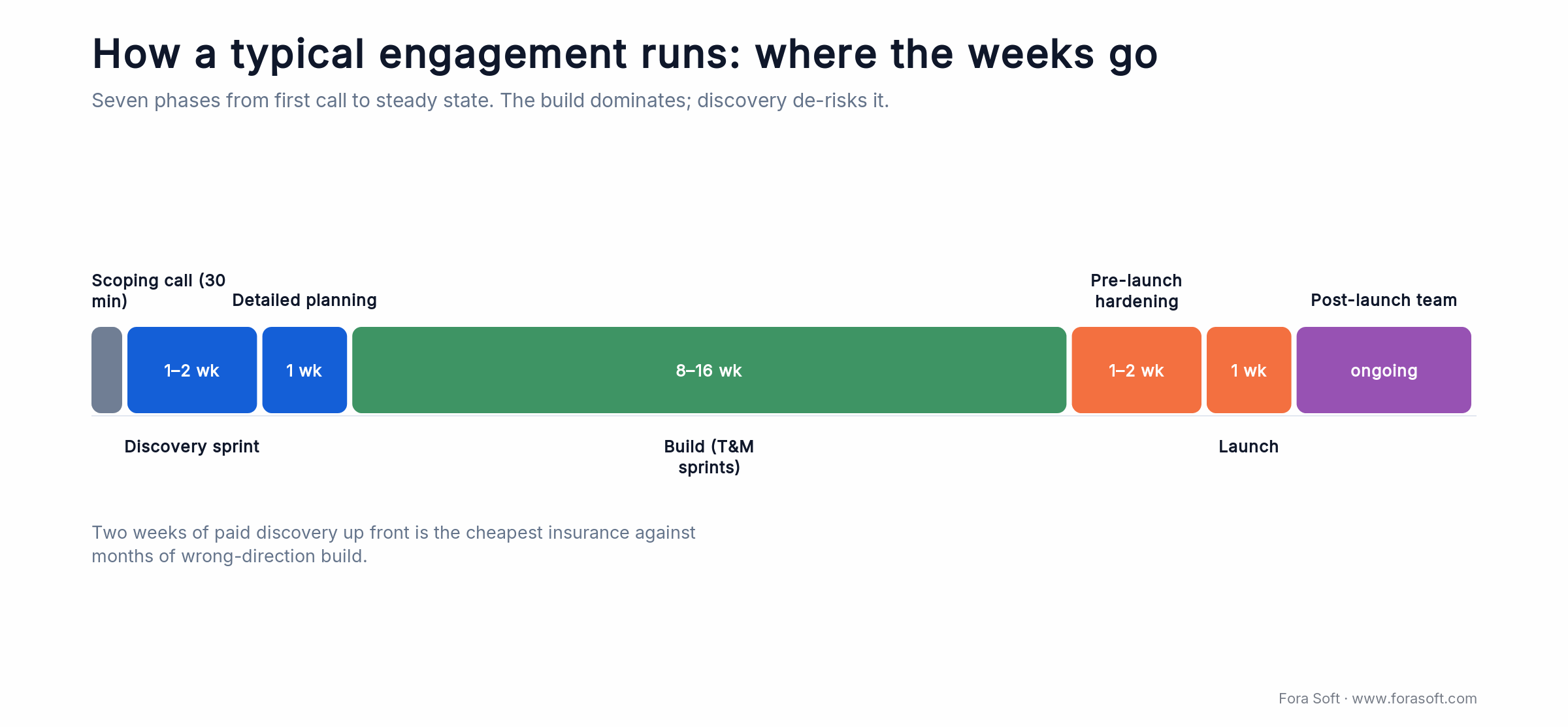
Figure 4. Where the weeks go across a typical engagement. The paid discovery sprint is cheap insurance against a wrong-direction build.
| Phase | Length | Deliverable |
|---|---|---|
| Scoping call (free) | 30 min | Written priority list and ballpark estimate |
| Discovery sprint | 1–2 weeks | Validated scope, prototype, architecture decisions |
| Detailed planning | 1 week | Backlog, milestones, team, written SOW |
| Build (T&M sprints) | 8–16 weeks for an MVP | Working software, weekly demos |
| Pre-launch hardening | 1–2 weeks | Security review, performance, store readiness |
| Launch | 1 week | Phased rollout, monitoring, support handover |
| Post-launch (dedicated team) | Ongoing | Maintenance, scale-up, new features |
Reach for a paid discovery sprint when: the scope is still fuzzy. Two weeks of paid discovery routinely saves months of building the wrong thing, and it is the cheapest way to test how a partner actually thinks.
What a compliant MVP costs in 2026
A credible MVP usually lands between $35K and $80K: web at the lower end, dual-platform mobile or SaaS at the higher end. Compliance work adds 20–30%; AI integration adds 15–30%. Here is the arithmetic, not a quote.
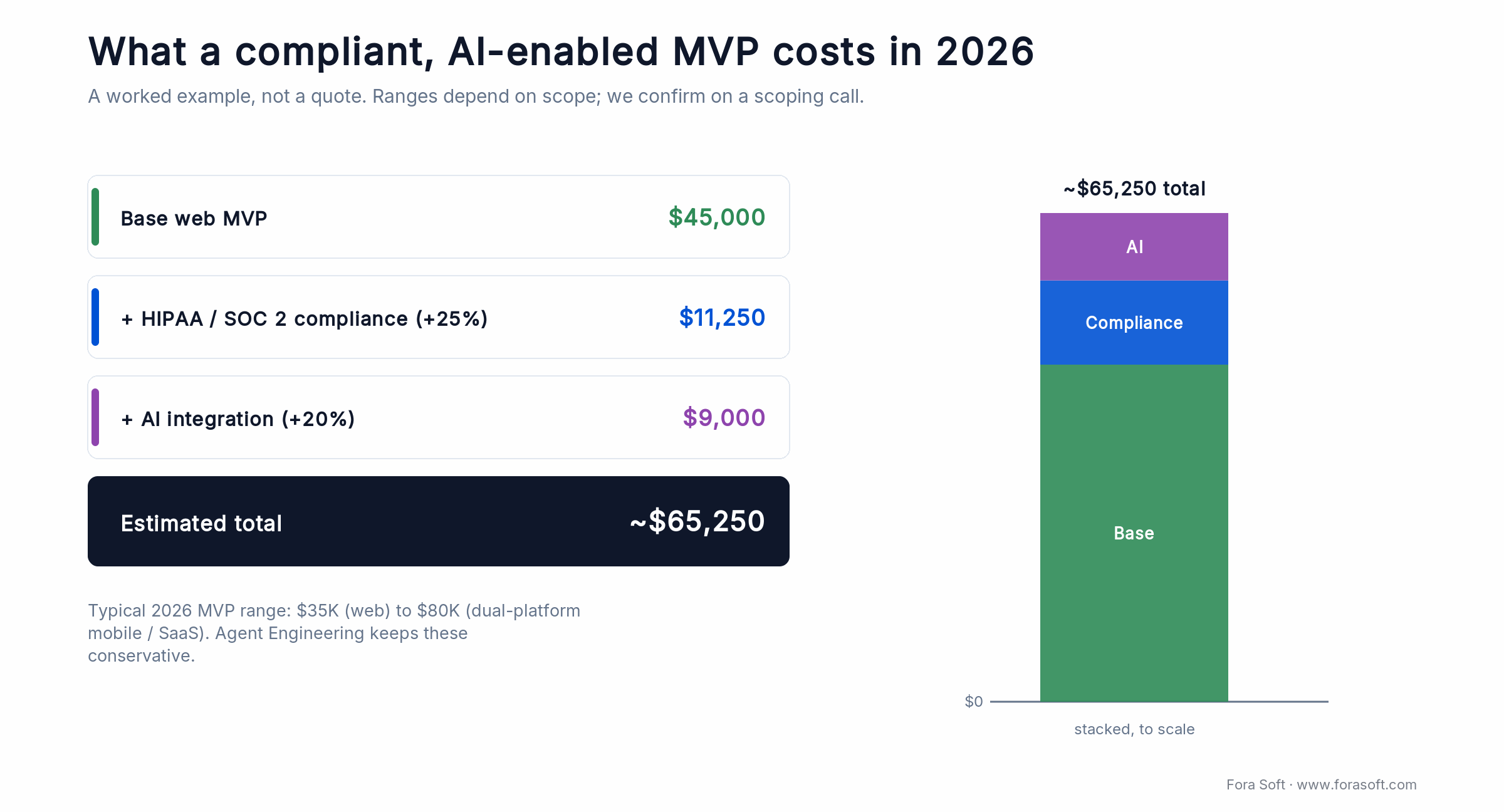
Figure 5. A worked cost example: a base web MVP plus compliance and AI multipliers, with the typical 2026 range.
A worked example
Take a base web MVP at $45,000. Add HIPAA and SOC 2 groundwork at +25% ($11,250). Add AI integration at +20% ($9,000). That lands near $65,250. We keep these figures conservative on purpose: Agent Engineering makes our delivery faster and cheaper than a like-for-like baseline team, so we would rather under-promise. If a number is uncertain, we would rather not print it. For a fuller model, see our mobile app development cost guide and why developer time estimates miss.
Mini case: BrainCert and a $3M-ARR classroom
BrainCert is a WebRTC and HTML5 virtual-classroom LMS that bootstrapped to $3M annual revenue (2024, up 58% year over year) and 100K+ customers, delivering 500M+ real-time classroom minutes at 99.995% uptime. A 12-person business outcompeting venture-backed giants.
We built the product from the technical architecture and WebRTC infrastructure up to the full LMS, and we have kept scaling it across major releases. The load-bearing lesson: production-grade is a property of the whole system, held over years, not a box you tick at launch. As their CEO put it, “Their work is outstanding in every aspect. From designing the technical architecture to programming, they do it all for us.”
Mini case: Sprii and live commerce at scale
Sprii is a Danish live-shopping platform that has driven €365M+ in sales across 72K+ live events, with 21M products sold and 3,000+ brands on board. It is the canonical live-commerce pattern: low-latency broadcast, real-time interaction and checkout in one flow.
The architecture combines RTMP and WebRTC delivery, dynamic product overlays, real-time inventory and multi-channel output to web, iOS and Android. The hard engineering is orchestration: keeping product state, video state and viewer state consistent through peak campaigns. This is exactly where domain experience shows up in revenue, and a pattern we have repeated for interpretation platforms like TransLinguist and research marketplaces like VocalViews (1M+ participants, clients including Google and Netflix).
Want to talk to a current client before you commit?
A 30-minute call: we book a direct reference conversation with a client whose stack matches yours. No chaperone, no script.
Pick a partner: a five-question framework
1. Have they shipped something like your product? Specific domain experience cuts months off discovery; generic experience is a much weaker signal.
2. Can you talk to a real client without a chaperone? Direct reference calls are the highest-signal step in procurement.
3. Will they push back on your scope? A vendor who agrees to everything is selling, not collaborating.
4. How do they use AI, and where do they refuse to? AI in the workflow plus written governance is the 2026 baseline; its absence costs you speed every sprint.
5. Who owns the code? If the answer is anything other than “you, on day one, no exceptions,” walk.
Five pitfalls when hiring a dev company
1. Hiring on price alone. Saving 20% on a $60K build that fails costs more than spending the full $60K on one that ships.
2. Buying process theatre instead of execution. Ceremonies without discipline waste everyone’s time. Ask for retro outcomes, not framework names.
3. Skipping discovery. Two weeks of paid discovery saves months of wrong-direction build.
4. Letting the partner own your accounts. Developer and store credentials stay yours, with vendor access only. Otherwise switching costs explode.
5. Confusing badges with capability. A cluster of verified directories across multiple specialisms is the signal; one award is a starting point.
Contract must-haves: five clauses
1. IP assignment. All work product transfers to you on payment, with no carve-outs unless agreed in advance.
2. Repository ownership. Code lives in your GitHub or GitLab organisation; the vendor gets contributor access.
3. Termination for convenience. Either side, 30 days. Mature partners welcome the clause.
4. Security and compliance reps. A documented baseline, named providers, and 72-hour incident notification.
5. Client-owned accounts. Developer and store credentials stay in your name, vendor access only.
Reach for a 12-week pilot before a 12-month commitment: any partner serious about a long relationship should welcome a small, well-scoped pilot. The ones who refuse usually have something to hide in their delivery model.
KPIs to track once you start
1. Quality. Escaped-defect rate (target under 3% of shipped tickets), pull-request review time (target under 48 hours median), and design validation before build (target 100% for major epics).
2. Delivery. Estimate-vs-actual variance (target within ±15%), lead time from idea to production, and a stakeholder satisfaction score each quarter.
3. Reliability. Sprint commitment completion (target 80–90%), technical-role turnover (under 15% a year), and retrospective actions actually shipped per sprint.
When NOT to hire a domain-focused partner
If your product is a plain SaaS dashboard with no real-time, no AI, no compliance, no streaming and a small audience, a generalist team will do it for less. Domain specialists earn their fee where the domain bites; everywhere else, the extra expertise sits unused.
If you have a strong technical co-founder and a six-to-twelve-week MVP scope, build the first version yourselves. The communication overhead of any partner is real at the earliest stage. And if you cannot yet describe success in three sentences, do user research first: a partner will burn through that in two days and bill you either way.
Where the Techreviewer 2026 award sits
Techreviewer evaluates thousands of providers on verified client reviews, project history, market presence and demonstrated specialism, then publishes its 2026 shortlist. Being on it is a useful signal. It is most useful read as one point in a pattern.
Alongside it, Fora Soft holds Clutch Global awards for Spring and Fall 2024, a Techreviewer Top iOS App Developers listing (2024), and recognition as a Top Software Development Partner for Startups in WebRTC (2025), on top of a Clutch Top-100 Fastest-Growing placement. Streaming, video, AI, mobile, real-time interaction and now software development overall, across independent rating bodies in the same window. That cluster carries more signal for a buyer than any single badge, including this one.
FAQ
What does “top software development company” on Techreviewer mean?
Techreviewer evaluates thousands of IT providers on verified client reviews, project history, legal status and portfolio quality, then publishes a 2026 shortlist of those that clear the bar. It is one signal; cross-check it with Clutch, GoodFirms and a direct reference call.
Why does domain expertise matter for software development?
Compliance, latency, scale and vendor choice are all domain-shaped. Generic teams meet the constraints in month four; domain teams design for them in week one. The cost difference shows up at the first scaling event or the first audit.
What industries does Fora Soft specialise in?
Video and audio streaming, real-time communication, AI feature integration, e-learning, healthcare and telemedicine, video surveillance and live commerce, across iOS, Android, web and desktop, and both managed and self-hosted deployments.
How much does a typical engagement cost?
A credible MVP usually lands between $35K and $80K, with web at the lower end and dual-platform mobile or SaaS at the higher end. Compliance adds 20–30% and AI integration adds 15–30%. We share specific ranges on a free 30-minute scoping call.
How fast can Fora Soft deliver versus a baseline team?
Across most workstreams we see a 30–40% cycle-time reduction thanks to Agent Engineering and disciplined governance, with escaped-defect rate held flat. The methodology and data are in our AI software development case study.
Does Fora Soft work with both startups and enterprises?
Yes. Our project list spans early-stage MVPs to long-term enterprise relationships like BrainCert, Sprii and VocalViews. We adjust process and team composition to the stage.
Who owns the code and the intellectual property?
You do, on day one, with no carve-outs unless agreed in advance. Code lives in your repository; store and developer accounts stay in your name. The vendor gets access, not ownership.
How do we start a conversation about a project?
Book a free 30-minute scoping call, send a one-paragraph scope by email, or reach us on WhatsApp. We reply with the questions we would ask on the discovery call, which is itself a useful comparison signal.
What to read next
Case study
How AI cut 30–40% off our delivery time
Agent Engineering on a 1M+ line video platform, with the numbers and the governance protocol.
WebRTC
WebRTC architecture guide for business
SFU, MCU, P2P, TURN, multi-region placement and managed-service trade-offs for 2026.
Healthcare
Healthcare software development challenges
HIPAA, security, latency and operational complexity in telemedicine and clinical platforms.
Budgeting
Mobile app development costs guide
A defensible breakdown of what a serious iOS or Android app costs to build and maintain.
Decision
Interpreter vs translator vs AI
A 2026 decision tree for real-time language, from one of our interpretation-platform builds.
Ready to work with a top software development company?
Being named a top software development company for 2026 is a useful signal, not the whole answer. The whole answer is 20+ years shipping into demanding industries, production proof you can verify, AI-augmented delivery with discipline, and a process you can inspect before you commit.
If you want a second pair of eyes on a proposal you already have, or a fresh scoping conversation before you go to market, that is exactly what a 30-minute call is for. We bring the case studies, the cycle-time data and our written assumptions about your project. You leave with a prioritised plan whether you hire us or not.



The handbook · 7 volumes
Fora Soft Video Engineering Handbook
If this playbook helped you shortlist partners, the next step is checking how deep their video engineering goes. We wrote a seven-volume handbook on the whole stack, from encoding and delivery to sound and AI; start with Volume 3 on ABR, CDNs, WebRTC and streaming economics, then Volume 1 on codecs and Volume 7 on real-time AI and compliance. Written by Nikolay Sapunov, CEO at Fora Soft.
Browse the handbook on Amazon →7 volumes · 9,000+ pages · Kindle & paperback
Let’s talk about your software project
A free 30-minute call: we challenge your scope, validate your stack, and give you a written priority list whether you hire us or not.

