


Key takeaways
• Fora Soft was named a Clutch Global Leader for Spring 2024 across mobile app publishing, voice and speech recognition, computer vision, smart TV, AI, and machine learning. The recognition reflects a long-running specialism, not a generic dev pitch.
• Voice, vision, smart TV, and AI all share a common challenge in 2026. They are easy to demo and hard to ship at production quality — latency, accuracy, edge cases, and on-device performance separate winners from prototypes.
• On-device AI is now the default for privacy and latency-sensitive features. Apple Intelligence, on-device Android ML, and small open-source models cover most of what cloud-first AI used to require.
• Smart TV development has structural quirks most teams underestimate. Tizen, webOS, Android TV, Roku, and Fire TV each behave differently — and the QA effort is materially more than mobile.
• The right way to read directory recognition is as a pattern, not a single trophy. Look for clusters across multiple specialisms, multiple verified directories, and recent dates — that pattern is what we have built deliberately.
In Spring 2024 Clutch named Fora Soft a Global Leader across mobile app publishing, voice and speech recognition, computer vision, and smart TV development — on top of a strong position in artificial intelligence and machine learning. An award is only useful if it tells a buyer something true about how a team works. So this is the playbook behind the recognition: what voice, computer vision, smart TV, mobile publishing, and AI/ML each actually take to build well in 2026, and how to evaluate any partner — us included — pitching expertise in them.
Below: how to think about voice and speech recognition products, what production-grade computer vision looks like, the structural quirks of smart TV development, the mobile app publishing pipeline, and where AI and ML hype actually translates into shipped value — written for the founders and CTOs who need to make these calls before the next investor meeting.
Why Fora Soft wrote this playbook
Fora Soft has been delivering custom software since 2005 — 250+ projects across video, audio, AI, real-time communication, and connected-device platforms. Recent reference points across the categories Clutch recognised include Blaze Streaming Media’s Volo (software for live-event captions and translation), BrainCert (a virtual classroom platform with multi-region streaming), AppyBee (a fitness booking platform live in 800+ studios across iOS and Android), and Bellicon Smart TV apps (smart TV apps shipped across multiple platforms).
We use Agent Engineering internally, which compresses delivery time on most workstreams by 30–40% versus a baseline team. Methodology and data are documented in our AI software development case study. The recommendations below are what we actually tell founders on real scoping calls — including the parts vendors usually leave out of pitches.
Building a voice, vision, smart TV, or AI product?
A 30-minute scoping call — we map your latency, accuracy, device, and budget needs against real architectures and tell you what to build, buy, or skip.
Voice and speech recognition — what production-grade looks like in 2026
Voice and speech recognition is one of the easiest categories to demo and one of the hardest to ship. The demo runs in a quiet room, on one accent, with one device. Production runs everywhere, with everyone, on whatever microphone the user happens to have.
1. Pick the model based on the job, not the brand. Whisper (OpenAI) for high-quality batch transcription, on-device Apple Speech / Android SpeechRecognizer for low-latency dictation, Deepgram or AssemblyAI for high-volume API calls, custom fine-tuned models for domain-specific vocabulary (medical, legal, finance). Our speech-to-text development team makes that call per feature, not per vendor.
2. Architect for accent, noise, and device variability. Voice activity detection, noise suppression (Krisp, NVIDIA Maxine, in-house), and multi-pass decoding all matter for real-world quality. The lab WER (word error rate) is not the field WER.
3. Latency budgets matter. Real-time conversation needs sub-300 ms end-to-end. Dictation tolerates 500–1,000 ms. Batch transcription can run in seconds. Pick the model placement (on-device, edge, cloud) per latency budget.
4. Privacy and compliance. If audio includes PII, PHI, or commercially sensitive content, on-device or self-hosted is usually the right default. Cloud APIs are convenient and operationally cheap; the data residency question is the deciding factor for many serious products.
Reach for on-device speech recognition when: latency must stay under 300 ms, audio contains PII or PHI, or your users routinely operate offline — otherwise cloud APIs (Whisper, Deepgram, AssemblyAI) usually win on accuracy and operational simplicity.
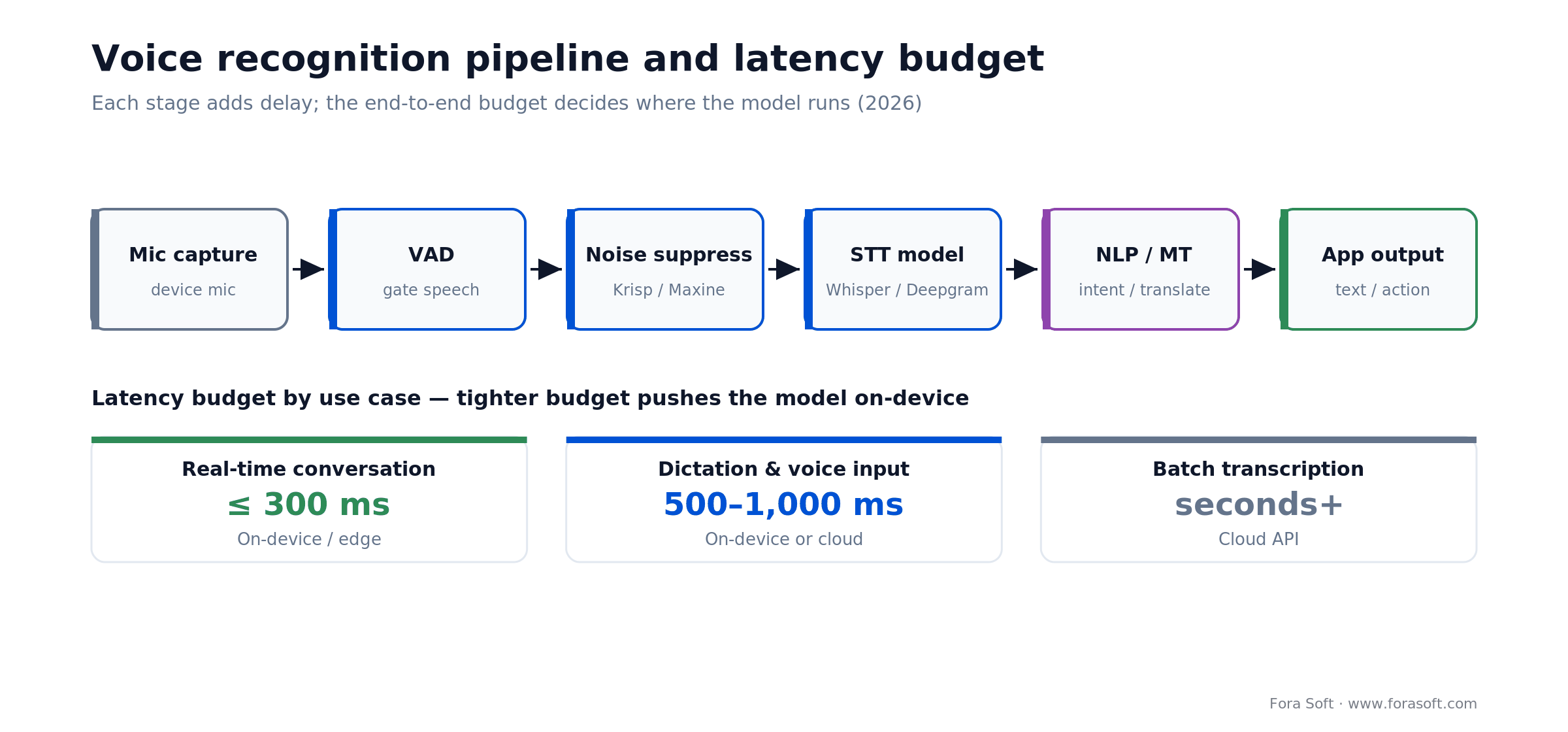
Figure 1. Where each voice stage runs is set by the end-to-end latency budget — real-time conversation under 300 ms belongs on-device.
For a deeper architectural view, our voice recognition in mobile apps playbook is the dedicated build guide, our speech recognition + NLP guide walks through the layers, and our Volo case study covers software we developed for Blaze that runs in production at live events.
Computer vision — from demo notebook to shipped product
Computer vision demos on cherry-picked images, then ships against real lighting, motion, occlusion, odd angles, and devices from 2018. Three honest observations.
1. Pick the model class first, the framework second. Object detection (YOLO11, RT-DETR), segmentation (Segment Anything Model, Mask2Former), pose estimation (MediaPipe Pose, MoveNet), face recognition (ArcFace), OCR (Tesseract for legacy, Surya / TrOCR for modern). The framework choices (PyTorch, LiteRT, Core ML, ONNX) follow.
2. Real-world accuracy lives in the data, not the model. A larger, better-labelled dataset will beat a fancier model architecture nine times out of ten. Plan for data collection, labelling tools (CVAT, Label Studio), and an active-learning loop — not just a one-shot training run.
3. On-device deployment is now the norm. Core ML on iOS, LiteRT (formerly TensorFlow Lite) or ONNX on Android, WebGPU in browsers. Fits most CV workloads with sub-100 ms latency and zero cloud inference cost — if you size the model right.
Our applied work here ranges from video surveillance with AI to AI HDR photo processing, plus the broader AI integration service page.

Figure 2. The gap between a computer-vision demo and a shipped product is closed by the data-and-deploy loop, not a bigger model.
Smart TV development — the structural quirks teams underestimate
Smart TV looks like “mobile but bigger” from the outside. Inside, it is its own discipline.
| Platform | Vendor | Tech stack | Where it shines |
|---|---|---|---|
| Tizen | Samsung | Web (HTML/JS/CSS) + Tizen APIs | Largest single-vendor base (Samsung is the #1 TV brand) |
| webOS | LG | Web + webOS APIs | Strong UX on LG panels |
| Android TV / Google TV | Google + many OEMs | Native Android (Kotlin), Jetpack TV libs | Reuses Android skills, broad OEM reach |
| Roku | Roku | BrightScript + SceneGraph | Dominant in US streaming sticks |
| Fire TV | Amazon | Android-based + Amazon services | Strong with Prime / Alexa users |
Three structural quirks every smart TV build runs into. QA matrix. Same logical app needs to be tested across many TV models — remote behaviour, codec support, screen aspect, and TV-specific UI conventions all vary. Plan for a real-device lab, not just emulators. Codec licensing. Hardware decoders vary by chipset. Some TVs lack AV1 or HEVC; plan a multi-codec ladder. If codecs are new ground for your team, our digital video foundations guide in Learn covers the basics. Submission cycles. Each store has its own review process, branding requirements, and turnaround — from days (Roku) to weeks (Tizen, webOS).
Reach for native Android TV first when: your team already ships Android — the code reuse is genuine. For the widest TV reach (Tizen + webOS + Android TV) plan three codebases or a careful web-based shell architecture; both choices have real trade-offs we walk through on scoping calls.
Our deeper take is in smart TV app development.
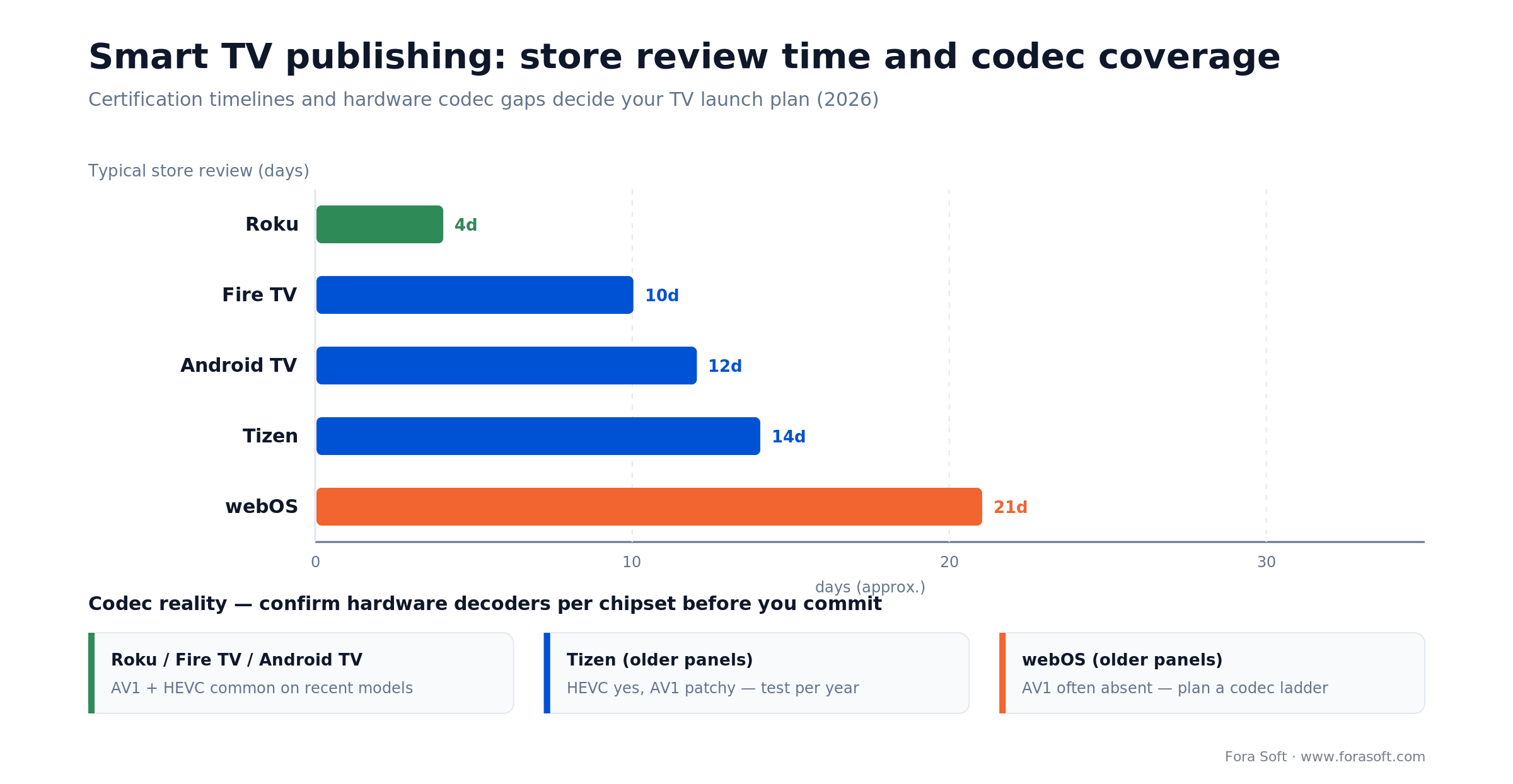
Figure 3. Store review runs from days (Roku) to a few weeks (webOS); confirm AV1/HEVC per chipset before committing.
Mobile app publishing — what App Store Optimisation actually means in 2026
Mobile app publishing is more than “upload the binary”. The Clutch recognition was for end-to-end publishing — from store assets to ASO to ongoing release management. Five things that move the needle.
1. Localised store listings. Title, subtitle, keywords, screenshots translated and adapted per market — not auto-machine-translated. Localised listings routinely lift install conversion more than a new feature does, and it is the highest-ROI ASO work most teams skip.
2. Screenshots that show the value, not the chrome. The first three screenshots above the fold do most of the work. Show the user’s outcome, not the empty home screen.
3. Phased rollouts and A/B testing. Apple’s phased release and Google Play’s staged rollout let you catch regressions before they hit 100% of users. Use them on every meaningful release.
4. App-review-ready architecture. Apple App Review still rejects on subscription wording, account-deletion flows, third-party login policies, and many other policy edges. Build with the policy in mind from the start — reactive fixes burn weeks.
5. Performance reviews tied to release. Crash-free users, p95 cold start, and first-screen render — tracked per release and gated on regression. The ASO bump from a stable, performant app outlasts any single keyword change.
Our deeper coverage is in iOS App Store Optimization, iOS app optimisation, and mobile app development services explained.
AI and ML — where the hype actually translates into shipped value
In 2026 every category is “AI-powered”. The honest filter is whether the AI feature changes a metric the user cares about — conversion, retention, time saved, decisions made — or whether it is decorative. Five places where AI consistently earns its keep right now.
1. Summarisation. Long-form content (notes, calls, threads) compressed to bullets. Cheap, on-device or cloud, very high user value.
2. Semantic search. Vector-based retrieval over user content beats keyword search across nearly every product type.
3. Voice and image input. Lower friction for users who hate typing on phones — especially in emerging markets.
4. Personalisation. Recommendation systems against your user’s history. The classic AI lift; still works, still underestimated.
5. Anomaly detection and content moderation. Real-time classifiers over user-generated content; fraud detection on transactions; safety filters on UGC. Production-ready and high-value.
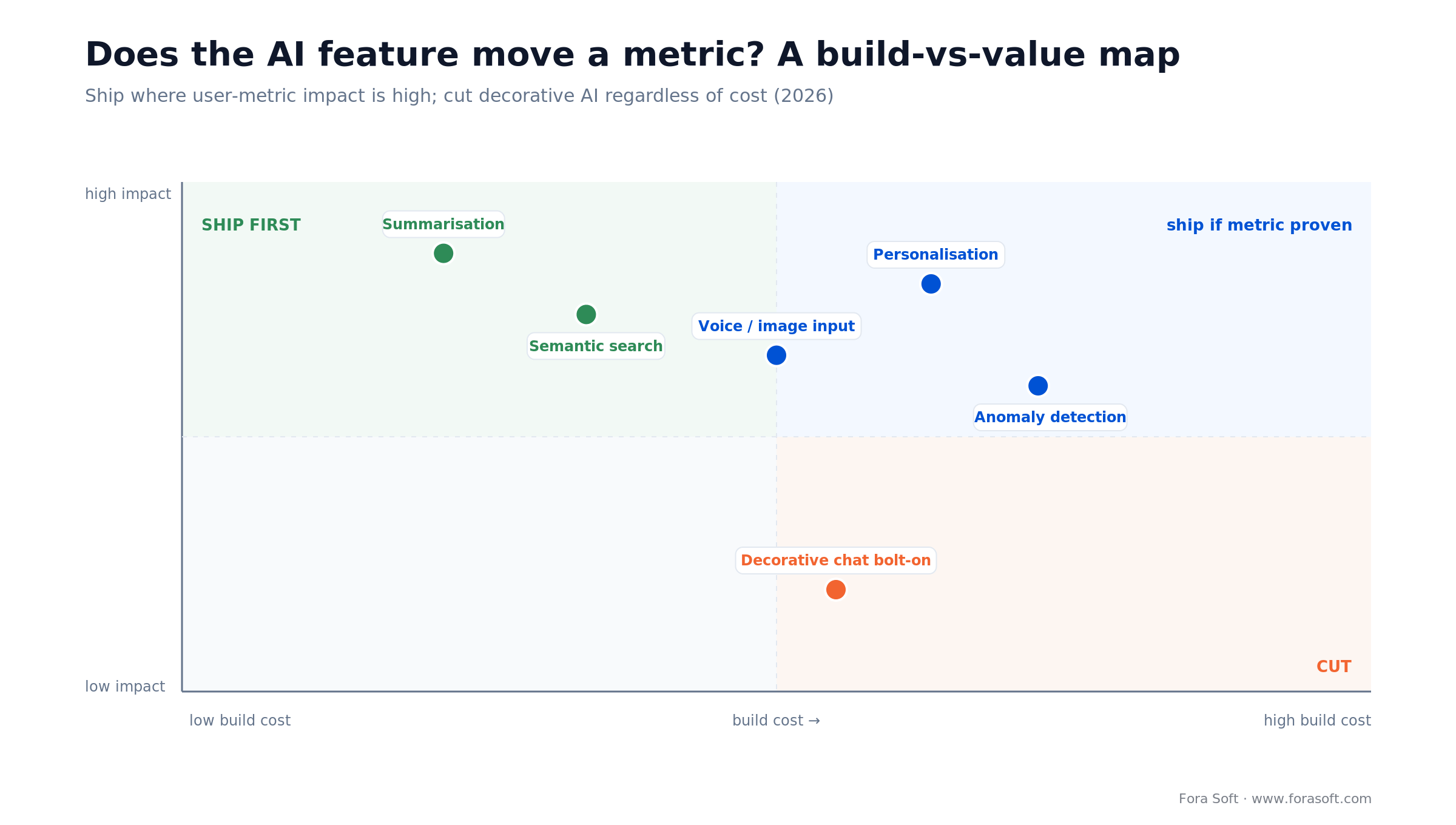
Figure 4. Ship AI where user-metric impact is high; cut decorative features regardless of build cost.
Want to vet an AI feature against the “does it move a metric” test?
A 30-minute call — we look at the AI feature, the metric, the user, and tell you whether it earns its keep or sits in the decorative pile. Free.
Mini case — real-time translation software for Blaze Streaming Media’s Volo
Situation. Blaze Streaming Media wanted live captions and translation for in-person conferences, with nothing for attendees to install.
Plan. We developed a browser app that attendees open from a QR code, a producer console and an admin panel. Speech recognition runs on Speechmatics, translation on Google Translate and voiceover on Google TTS; Vonage carries the speaker’s audio, and captions reach phones over WebSockets.
Outcome. Blaze runs Volo at conferences such as Black Hat USA, GDC and HIMSS.
A decision framework — pick a partner for AI, voice, vision, or smart TV in five questions
1. Have they shipped something like your product before? Specific domain experience cuts months off discovery. Generic “custom software” experience is a much weaker signal in these specialisms.
2. Can they show before/after metrics? Word error rate before/after their tuning, latency before/after their architecture, accuracy on a held-out test set, conversion lift from a personalisation rollout. Numbers, not adjectives.
3. Where do they refuse to use AI? A serious partner has zones — novel architecture, compliance-sensitive code, anything without historical analogue. Vague “AI everywhere” is a sales line.
4. How do they handle data? On-device, self-hosted, cloud-API. Where does training data live? What happens to user audio or images? These answers determine whether you can deploy in HIPAA or EU markets.
5. Who owns the code? If the answer is anything other than “you, on day one, no exceptions” — walk.
Five pitfalls in AI / voice / vision / smart TV product builds
1. Demoing on cherry-picked data. Build the test set from real user audio / images / interactions before celebrating accuracy.
2. Picking the latest model over the right model. The 2024 SOTA paper is rarely the right choice for a product shipping in 2026. Stability and ecosystem maturity beat benchmark wins on real timelines.
3. Cloud-only AI when data residency matters. If your users include EU, healthcare, or finance customers, cloud-only AI is often a non-starter. Plan for on-device or self-hosted from day one.
4. Smart TV testing on emulators only. Real TVs behave differently. Allocate budget for a real-device lab or a third-party device farm.
5. Treating ASO as a one-time exercise. Store algorithms, competitor entrants, and platform policies all change. ASO is a quarterly review, not a launch task.
KPIs to track on AI and connected-device products
Quality KPIs. Word error rate (voice), mean average precision (vision), p95 inference latency, false-positive / false-negative rates against a held-out test set.
Business KPIs. Conversion lift on AI-touched flows, retention delta on personalised cohorts, time-saved per user, and revenue per session on AI-enabled features vs. control.
Reliability KPIs. Crash-free users (≥99.6%), inference success rate (≥99.5%), and on-device fallback rate when cloud APIs are unavailable.
When NOT to ship an AI, voice, or vision feature
If your team cannot articulate a specific user metric the feature should move (conversion, retention, time saved, accuracy of a decision), the feature is decorative. Save the engineering hours.
If the data you would need to evaluate the feature does not exist (no held-out test set, no comparable historical period, no analytics on the existing flow), build the measurement first and the feature second.
If your product is pre-product-market fit, AI features are usually a distraction. Ship the core value, get user love, then layer AI on the specific friction points your users complain about.
Cost and timeline — what these specialisms actually take to ship
A quick orientation for founders who need to size projects before raising or before talking to vendors. Ranges below are deliberately conservative; with our Agent-Engineering process we typically come in faster on comparable scope.
| Workstream | Timeline | Most-common gotcha |
|---|---|---|
| Voice / speech feature inside an existing app | 3–6 weeks | Real-world WER 2–3x lab WER |
| Computer-vision feature on-device | 4–8 weeks | Dataset quality, not model choice |
| Smart TV MVP (Tizen + webOS + Android TV) | 10–16 weeks | Real-device QA matrix and codec gaps |
| ASO + publishing setup for a fresh app | 2–3 weeks | Localisation depth and screenshot quality |
| AI assistant inside an existing product | 3–6 weeks for a single surface | Token cost and recurring inference budget |
Reach for a paid 1–2 week discovery sprint when: any of the workstreams above touch novel architecture or compliance — the sprint cost (~$5K–$10K) is far cheaper than rebuilding the wrong thing in month four.
Vendor vetting in the AI-and-connected-device era
1. Demand a live demo on your data, not theirs. Send 30 minutes of representative audio, 50 representative images, or a real test scenario. Watch the model perform on the data your users will actually generate.
2. Ask for a model card or equivalent. Training data, evaluation methodology, known failure modes, fairness considerations. Vendors who cannot produce this have not thought through the deploy story.
3. Probe the data flow. Where does the audio go? Who trains the model? What is the retention? Get this in writing before signing.
4. Smart TV: ask for a real-device QA report. Real models, real remote behaviour, codec coverage. Emulator-only QA is not enough for a TV product.
5. Check the ASO calendar discipline. A serious mobile partner reviews ASO every quarter, A/B tests creative regularly, and tracks store-side metrics per release. One-shot ASO at launch is not the answer.
Vetting an AI / smart TV / vision vendor right now?
Send us their proposal. We’ll review it for the red flags above and tell you what to push back on. Free, 30 minutes.
Where these categories are heading 2026–2028
1. Voice agents become standard inside apps. Push-to-talk, ambient listening, low-friction commands. Apps without a voice path will feel slow.
2. On-device vision overtakes cloud vision for personal use cases. Privacy, latency, and battery life all favour the on-device path; cloud vision retains its place for heavy enterprise / industrial workloads.
3. Smart TV consolidation around Android TV / Google TV. Tizen and webOS keep their installed base; Android TV grows share among new OEMs. Long-tail platforms (Roku, Fire TV) stay important in their core markets.
4. ASO becomes more about quality signals than keywords. Both stores increasingly weight retention, crash-free rate, and engagement — pure keyword optimisation declines as the dominant ASO lever.
5. Multi-modal AI (voice + vision + text together) becomes the default user input. Especially in mobile, where typing is the slowest of the three.
Where the Spring 2024 Clutch Global Leader recognition sits in our wider pattern
Recognition is most useful as a pattern across multiple specialisms and verified directories. Recent recognitions for Fora Soft include the Clutch 1000 for 2025, Clutch Global Leader for both Spring 2024 and Fall 2024, top iOS app development company on Techreviewer (2024 and 2026), top education software development company on GoodFirms (2025), top custom audio & video software development company in 2025, and 2024 APAC Insider awards for real-time interaction and streaming software innovation.
For a buyer, the right read is the cluster: streaming, video, AI, mobile, education, and now voice / vision / smart TV all in the same window across multiple independent rating bodies. That pattern carries more signal than any single award — including this one.
Contract must-haves for AI and connected-device engagements
A short MSA + per-project SOW beats a long bespoke contract for almost every startup engagement. Five clauses to protect yourself.
1. IP assignment with explicit AI carve-outs. All work product transfers to you on payment. Carve out clearly which third-party models, datasets, or open-source weights are licensed vs. owned.
2. Repository ownership. Code lives in your GitHub / GitLab organisation. Vendor gets contributor access, not ownership.
3. Data handling reps. Where audio / images / user content is processed; named providers; retention windows; whether anything trains a shared model. In writing.
4. Termination for convenience. Either side, 30 days. Mature partners welcome this clause.
5. Smart TV submission ownership. If the engagement involves smart TV publishing, define who owns the developer accounts and store credentials — otherwise vendor lock-in becomes painful.
Reach for a startup-friendly contract template when: the vendor cannot produce a sensible MSA + SOW skeleton in under a week — that delay alone is a procurement-velocity warning at MVP stage.
Post-launch — the phase where AI and connected-device products quietly fail
AI features and connected-device apps both rot in the same way: without dedicated post-launch ownership, model accuracy drifts, codecs break under new OS versions, store policies change, and the product silently degrades.
1. Model drift monitoring. Sample production input regularly, score against the held-out test set, alert when accuracy slips. The drift is real; the alarm is up to you.
2. SDK and OS upgrade calendar. Plan for iOS, Android, Tizen, webOS, and major SDK upgrades each year. Build the regression suite to catch breakage early.
3. Store policy reviews. Apple App Review, Google Play Console, Tizen Seller Office — each changes policy 2–4 times a year. Subscribe to their developer updates and flag breaking changes proactively.
4. Maintenance budget of 15–25%. Of build cost, per year, for steady-state work. Below that, the product silently rots; above that, you are probably building new features and should treat it as new project budget.
Our own approach is documented in the Customer Success Manager playbook.
FAQ
What does the Clutch Global Leader award actually mean?
It is Clutch’s recognition of companies whose verified client reviews, portfolio strength, and category presence put them in the top tier within a specific service line. Spring 2024 saw Fora Soft recognised across Mobile App Publishing, Voice and Speech Recognition, Computer Vision, and Smart TV development — on top of a strong position in AI and ML.
How accurate is real-time speech recognition in 2026?
Word error rates of 5–10% are realistic for clean English speech with a good model and microphone; 15–25% under realistic noise, accent, and device variability. The decisive factor is system design (voice activity detection, noise suppression, device selection), not just model choice.
Can computer vision really run on-device for serious products?
Yes for most workloads in 2026. Apple Neural Engine, Android’s LiteRT (formerly TensorFlow Lite), and ONNX Runtime cover most CV models with sub-100 ms latency on recent phones. The win is privacy, latency, and zero cloud inference cost — the trade-off is model size and battery use.
Should I build for smart TVs as well as mobile?
Only if your audience genuinely watches the product on a TV (streaming, video calls on a TV, fitness, education, smart-home). Smart TV is a real channel for a small set of categories and a distraction for most. If you do build, plan for at least Tizen + webOS + Android TV coverage and a real-device QA budget.
How does ASO actually work in 2026?
A combination of localised store listings, conversion-optimised screenshots, regular A/B testing of icon/title/screenshots, and a stable performant app whose store-side metrics (open rate, retention) signal quality. Single-shot keyword changes are a small lever; the compound work on listings + performance + reviews is the big lever.
When should I pick a managed AI API vs. self-hosting?
Managed APIs (OpenAI, Anthropic, Deepgram, AssemblyAI) win on time-to-market and operational simplicity. Self-hosting wins on data residency, unit economics at scale, and offline capability. The decisive question is usually “does my user’s data have a residency or compliance constraint” — if yes, plan for self-hosted or on-device.
What does “production-grade” mean for an AI feature?
A held-out test set with real user data, monitored accuracy and latency in production, an A/B test that proves user-metric lift, fall-back behaviour when the model fails, clear governance on what data trains the model, and documented compliance posture. Without those, “AI-powered” is a marketing claim.
Can Fora Soft cover voice + vision + smart TV + AI in one engagement?
Yes. We have shipped real production work in each category. The starting point is a free 30-minute scoping call where we challenge your scope, validate your assumptions, and tell you a realistic budget and timeline.
What to read next
Voice + NLP
Speech recognition with NLP — the working guide
A practical walk through speech recognition system design, model placement, and quality trade-offs.
Smart TV
Smart TV app development
The structural quirks of Tizen, webOS, Android TV, Roku, and Fire TV — plus the QA matrix nobody warns you about.
ASO
iOS App Store Optimisation
What actually moves the needle on App Store rankings and conversion in 2026.
Case study
How AI cut 30–40% off our delivery time
A first-person case study of Agent Engineering on a 1M+ line video streaming platform — numbers and methodology.
AI in mobile
How AI can transform your mobile app
Concrete patterns for adding AI features to an existing iOS or Android app without breaking the user experience.
Ready to build voice, vision, smart TV, or AI features that actually ship?
The Spring 2024 Clutch Global Leader recognition reflects a long bet on the categories that are easy to demo and hard to ship. The companies that win in 2026 are the ones who treat AI, voice, vision, and connected-device development as specialisms with their own engineering disciplines — not as features to bolt on at the end.
If you are scoping a voice, vision, smart TV, or AI product — or rethinking one that is hitting an accuracy or latency wall — that is exactly the conversation we run on a 30-minute call. We bring our case studies, our cycle-time data, and our written assumptions about your project. You walk away with a prioritised plan whether you hire us or not.
The handbook · 7 volumes
Fora Soft Video Engineering Handbook
Voice, vision and smart TV share one trait: easy to demo, hard to ship. We wrote a seven-volume handbook on the full video stack: encoding, delivery, audio and AI. Start with Volume 6 on speech recognition, computer vision and on-device models, then Volume 3 on smart TV players and DRM and Volume 7 on serving AI in production. Written by Nikolay Sapunov, CEO at Fora Soft.
Browse the handbook on Amazon →7 volumes · 9,000+ pages · Kindle & paperback
Let’s talk about your AI / voice / vision / smart TV project
A free 30-minute call — we challenge your scope, validate your stack, and give you a written priority list whether you hire us or not.

