


Key takeaways
• Twilio Video is no longer being shut down. In October 2024 Twilio reversed the December 5, 2026 end-of-life and kept Programmable Video as a standalone product, so “forced migration” is off the table.
• Migration still pays off for most teams. AWS Chime SDK, LiveKit and Daily.co cut per-minute cost by 50–90 % versus Twilio’s $0.004/participant-minute, while Vonage and Daily ship the only true drop-in API replacements.
• Pick the platform by use case, not brand. Vonage for closest API parity, Daily for telehealth, LiveKit (self-hosted) for HIPAA and AI agents, Chime SDK for AWS shops, Agora for global broadcast, mediasoup or Janus for full control.
• The real work is not the SDK swap. Recordings, dominant-speaker logic, Network Quality API, bandwidth profiles and JWT signing all need careful porting. Budget 2–6 engineering weeks, not 2 days.
• Fora Soft has shipped production real-time video for 20+ years. If you want a second opinion on the right target platform, book a 30-min scoping call and we will scope it with you.
Why Fora Soft wrote this Twilio Video migration guide
Fora Soft has shipped 250+ real-time video, audio and AI products since 2005. We have written production code against Twilio Programmable Video, Vonage Video API (formerly TokBox), Agora, LiveKit, Daily, Amazon Chime SDK, mediasoup and Janus — and we still operate stacks for telehealth, video courtrooms, dating apps and live shopping that hand off between several of them.
When Twilio first announced the December 2024 end-of-life for Programmable Video, our engineering team scoped migration paths for clients including Mindwibe (a dating platform built on Twilio Video), CirrusMED (HIPAA telehealth) and a Kazakhstan courtroom recording system using V.A.L.T. Even after Twilio walked back the EOL, the questions are the same: what is the closest replacement, what does it actually cost, and what breaks when you swap SDKs?
This playbook is the answer we give clients in scoping calls, distilled. It is opinionated, vendor-neutral, and grounded in the Twilio, Vonage, Daily, LiveKit, Chime and Agora documentation we ship code against every week. We use Agent Engineering internally, which is why our migration estimates are typically 30–50 % faster than what other agencies quote.
Need a second opinion on your Twilio Video migration plan?
We will benchmark Vonage, Daily, LiveKit, Agora and Chime SDK against your real traffic profile and tell you which one is the lowest-risk swap.
Where Twilio Programmable Video stands in 2026
The headline most teams missed: Twilio Programmable Video is no longer being sunset. After announcing an initial EOL of December 5, 2024, then extending it to December 5, 2026, Twilio confirmed in October 2024 that Programmable Video will remain a standalone product with continued investment.
If your team froze on hearing “Twilio Video is shutting down,” you can unfreeze. The platform is supported, accepting new accounts, and the Rooms, Recordings, Compositions and Network Quality APIs are all still on the roadmap. The decision in 2026 is no longer “migrate or break” — it is “migrate or stay.”
That is a much more interesting question, because the EOL window between March and October 2024 forced every competitor to publish migration tooling, free-credit deals and SDK shims. Most of those incentives expired, but the migration paths are still well-trodden. Vonage and Daily.co are the two vendors Twilio formally pointed customers at.
Twilio Video timeline
| Date | Event | What it meant for teams |
|---|---|---|
| Dec 2023 | First EOL announcement — Programmable Video sunset on Dec 5, 2024 | 12-month migration scramble; Vonage and Daily named as preferred partners. |
| Mar 2024 | EOL extended 24 months to Dec 5, 2026 | Pressure relaxed; teams paused mid-migration to evaluate properly. |
| Oct 2024 | Twilio reverses EOL — Video remains standalone product | No forced migration; the question becomes cost, features, vendor risk. |
| 2025–2026 | Vonage, Daily, LiveKit retain migration tooling | Documented migration paths persist even though incentives expired. |
| 2026 baseline | Twilio still $0.004/participant-min | LiveKit and Chime SDK can save 50–90 % on the same workload. |
Should you migrate at all? Five filters before touching code
Migration is engineering debt with real opportunity cost. Run your project through these five filters before you commit to a swap.
1. Are you spending more than $1,500/month on Twilio Video minutes? Below that threshold the savings rarely justify the engineering time. Above it, AWS Chime SDK and LiveKit Cloud start looking obvious.
2. Do you need HIPAA, GDPR-Schrems II, or sovereign-cloud deployment? Twilio is HIPAA-eligible, but if you need data residency in EU/MENA/APAC or on-premise, self-hosted LiveKit, mediasoup or Janus give you more control.
3. Are you adding AI agents, real-time transcription or LLM voice? LiveKit’s Agents framework and Daily’s Pipecat integrations are years ahead of Twilio for multimodal AI workloads. See our LiveKit multimodal agents guide.
4. Are you already deep in AWS, Azure or GCP? AWS Chime SDK is the cheapest managed option ($0.0017/min) and integrates natively with IAM, S3 and CloudWatch. The TCO advantage compounds when half your stack is already there.
5. Is your customer asking for vendor independence? Enterprise procurement increasingly demands “no single point of failure on a third-party SaaS.” Self-hosted mediasoup or Jitsi answers that question. Twilio cannot.
Stay on Twilio when: your monthly bill is under $1,500, you have no compliance pressure, you do not need AI-agent features, and your team has no spare cycles for a 4–6 week SDK port.
The seven Twilio Video alternatives that actually matter
Of the dozen vendors that pitched themselves during the EOL window, seven survive serious technical due diligence in 2026. Each owns a clear use case — do not pick by brand recognition, pick by which row your project sits in. Still weighing whether to move at all? Our Twilio Video alternatives comparison ranks the same shortlist by use case, so you can split the “which vendor” question from the “how to port” one this guide answers.
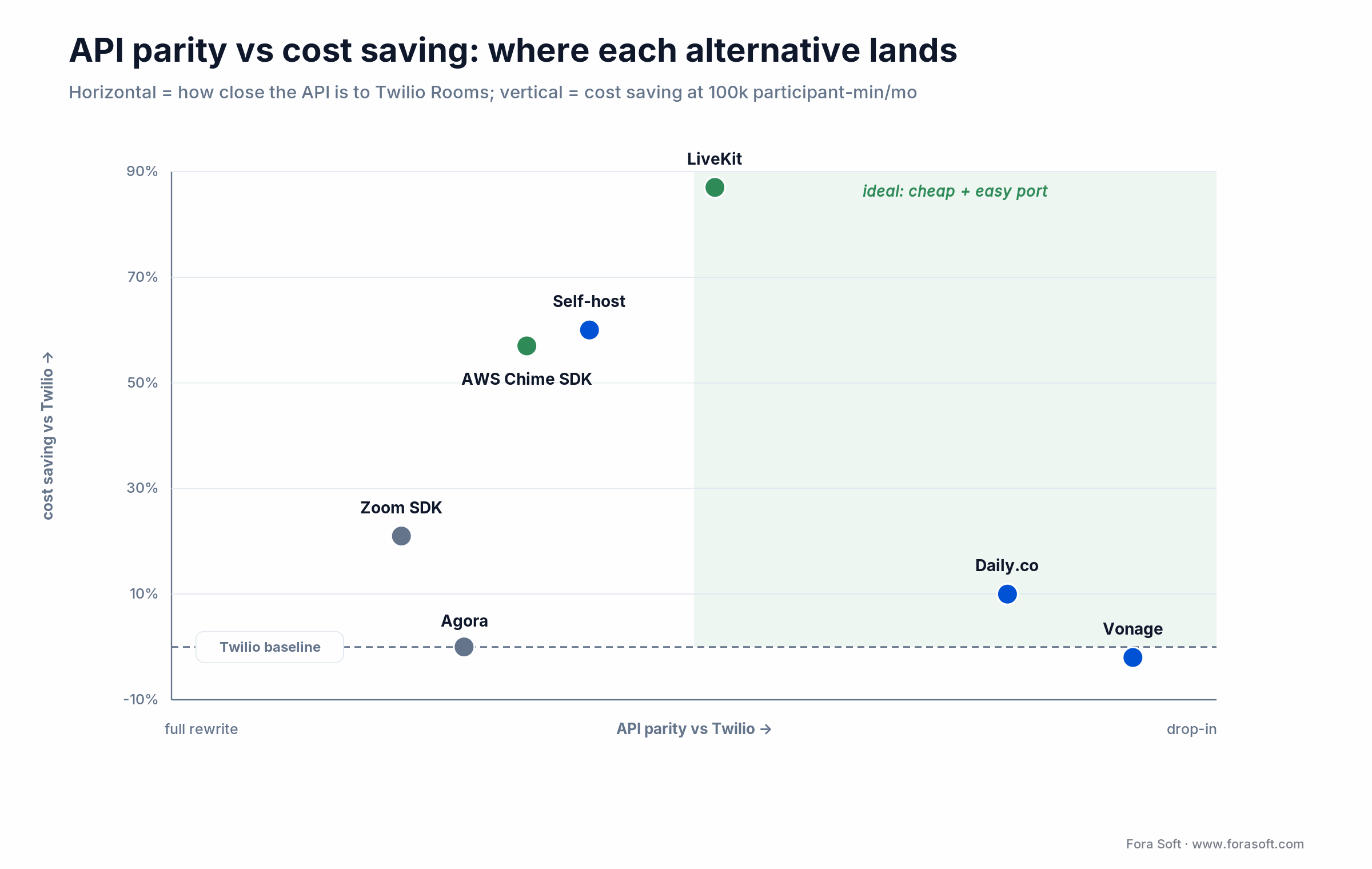
Figure 1. Where each Twilio Video alternative lands on API parity (how close the port is) versus cost saving at 100k participant-minutes a month.
Vonage Video API — the closest drop-in replacement
Why pick it
Vonage Video API (formerly OpenTok / TokBox) is the single platform Twilio explicitly aimed migrants at. It ships first-party migration guides for Web, iOS and Android, the API model is the closest cousin to Twilio Rooms, and the platform has been in production since 2010 under TokBox.
Cost shape
Base $0.0041/participant-minute, essentially the same as Twilio, under the Participant Pricing Model (any number of participants, up to 25 active publishers; an automatic 5% discount kicks in above 100k participant-minutes/month). Recording, transcription and compositions are billed separately — composed archives run $0.025–$0.045/min by resolution. There is no aggressive free tier; this is enterprise pricing.
Limits
Slightly higher per-minute than Twilio. Developer experience feels older than LiveKit or Daily. Documentation is dense and reference-heavy rather than tutorial-driven.
Reach for Vonage when: you want the lowest-risk port, your app already mirrors Twilio’s Rooms / Tracks / dominantSpeaker model, and you need HIPAA / SOC 2 with a name procurement teams recognise.
Daily.co — the telehealth and time-to-ship favourite
Why pick it
Daily was the second platform Twilio formally surfaced. Their porting guide for Twilio telehealth apps was the most-cited piece during the EOL window. Daily’s prebuilt UI, React/iOS/Android SDKs and Pipecat AI agent stack make it the fastest platform to ship on if your team is small.
Cost shape
$0.004/participant-minute (matching Twilio) with 10,000 free minutes/month. Recording $0.01349/min, RTMP live streaming $0.015/min. Volume discounts kick in above ~500k participant-minutes.
Limits
Smaller enterprise feature set than Vonage or Agora. Less mature for very large rooms (1,000+ participants). The prebuilt UI is great until you need a deeply custom layout, then you fall back to the lower-level Daily Call Object API.
Reach for Daily when: you ship telehealth, online tutoring or 1:1 sales-call products, your team is <5 engineers, and you want HIPAA + clean React SDK out of the box.
LiveKit — the cheapest path and the AI-agent home base
Why pick it
LiveKit is the only credible Twilio alternative that runs in two modes: managed cloud and Apache 2.0 self-hosted. The Agents framework has become the default substrate for real-time voice AI — ChatGPT’s Advanced Voice Mode is built on LiveKit — our AI-for-video engineering guide walks that stack end to end. If you are adding LLM voice or computer-vision pipelines on top of video calls, this is the platform.
Cost shape
Cloud is usage-based: about $0.0005 per WebRTC participant-minute plus $0.12/GB of egress on the Ship tier ($50/mo), dropping to $0.0004/min and $0.10/GB on Scale ($500/mo). On the per-minute rate that is roughly 8× cheaper than Twilio, though LiveKit bills bandwidth separately where Twilio bundles it, so model your egress. Self-hosted (Apache 2.0) carries no per-minute fee; you pay infrastructure only.
Limits
API model differs more from Twilio than Vonage or Daily, so the port is heavier. Self-hosting needs a real DevOps owner. HIPAA BAA only on the Scale tier ($500/mo) or via self-hosted deploys.
Reach for LiveKit when: you want the lowest unit cost, you are layering AI voice / vision agents on top of video, or you need full data control via self-hosting.
AWS Chime SDK — the cheapest managed option for AWS shops
Why pick it
Chime SDK is the cheapest fully managed option in the table. It is billed per attendee in 6-second increments, integrated with IAM, KMS and CloudWatch, and recording sinks straight into S3. If your stack is already on AWS, the operational overhead of a second vendor disappears.
Cost shape
$0.0017/attendee-minute for WebRTC sessions. PSTN audio $0.002/min. Streaming to multiple outputs +$0.002/min per output. No commitments, no minimums.
Limits
Vendor lock-in to AWS. Less mature SDKs than Agora or Vonage. Smaller community, fewer Stack Overflow answers. The migration from Twilio is non-trivial. Treat it as a re-architecture rather than a port.
Reach for Chime SDK when: you are already AWS-native, you want the lowest fully-managed unit cost, and you do not need a deeply rich SDK ecosystem.
Agora — global broadcast and Asia-Pacific reach
Why pick it
Agora’s SD-RTN delivers the most consistent sub-200 ms global latency and dominates large-room broadcast (10k+ viewers) and APAC traffic. It is the platform behind the largest live-shopping and social-audio products. Read our Agora.io alternative comparison for the inverse view.
Cost shape
Audio $0.99 per 1,000 minutes ($0.00099/min), HD video $3.99 per 1,000 ($0.00399/min), Full HD $8.99 per 1,000 ($0.00899/min). 10,000 free minutes/month per project. Conversational AI and Real-Time Engagement Cloud are billed separately.
Limits
Pricing tiers are confusing: Full HD nearly triples HD cost. Migration from Twilio is a full rewrite, not a port. Some procurement teams flag concerns over Chinese ownership; check your data-residency contract carefully.
Reach for Agora when: you broadcast to 1k+ concurrent viewers, you need APAC-first latency, or you are building social audio / live shopping at scale.
Zoom Video SDK — brand pull, proprietary protocol
Why pick it
Zoom Video SDK is the embedded-Zoom option: same engine, different SDK, white-label. End-users trust the Zoom brand; clients ask for it by name. Calendar, dial-in and PSTN bridges are first-class.
Cost shape
$0.0035/participant-minute pay-as-you-go, or $0.003/min on the annual ($1,000/yr) plan with 30,000 free minutes/month. Cloud recording $0.015/min PAYG, $0.01/min annual.
Limits
Not WebRTC under the hood — this is Zoom’s proprietary protocol, so a Twilio port is essentially a rewrite. White-label customisation is shallow versus LiveKit / Daily / Agora. HIPAA support is narrower than purpose-built telehealth platforms.
Reach for Zoom Video SDK when: your customer demands the Zoom brand, you need PSTN/dial-in by default, and you do not need deep custom UI.
Self-hosted: mediasoup, Janus and Jitsi for full control
Why pick it
When data residency, sovereign cloud or per-minute pricing politics rule out a SaaS, you self-host. mediasoup is a modular Node.js SFU; Janus is a battle-tested C-based WebRTC gateway in production since 2013; Jitsi Videobridge is the reference open-source SFU. All are free under permissive licences.
Cost shape
Zero per-minute. You pay for compute. A 200-concurrent-participant cluster on Hetzner AX-series bare metal runs roughly $400–$700/month all-in — the same workload on Twilio (200 participants, 8h/day, 30 days) at $0.004/min runs about $11,500/month.
Limits
You own scaling, security patches, TURN, recording, monitoring, on-call. There is no SLA to escalate to. Total cost of ownership only beats SaaS once you cross ~150k participant-minutes/month or have a hard compliance reason. Talk to a real WebRTC team before committing — the wrong stack picks here are expensive.
Reach for self-hosted when: compliance or data residency forces it, your usage is >150k participant-min/month, or you have unique signalling needs no SaaS exposes.
Twilio Video alternatives compared at a glance
| Platform | Per-min (HD) | API parity vs Twilio | HIPAA BAA | Best fit |
|---|---|---|---|---|
| Twilio Video | $0.0040 | Baseline | Yes | Status quo |
| Vonage Video API | $0.0041 | Highest | Yes | Drop-in port |
| Daily.co | $0.0040 | High | Yes | Telehealth, fast ship |
| LiveKit Cloud | ~$0.0005 | Medium | Scale tier / self-host | Lowest cost, AI agents |
| AWS Chime SDK | $0.0017 | Low | Yes | AWS-native stacks |
| Agora | $0.0040 | Low | Yes | Global broadcast, APAC |
| Zoom Video SDK | $0.0030–0.0035 | Low (proprietary) | Limited | Brand-led embed |
| mediasoup / Janus / Jitsi | $0 + infra | N/A | Self-managed | Sovereign cloud, scale |
Cost model: 100k participant-minutes / month, side by side
Most teams we scope sit between 50k and 500k participant-minutes per month. Here is what 100k looks like across the platforms above, before recording or transcription.
| Platform | Per-min | 100k PM cost | vs Twilio |
|---|---|---|---|
| Twilio Video | $0.0040 | $400 | — |
| Vonage Video | $0.0041 | $410 | +2 % |
| Daily.co | $0.0040 | $360 (10k free) | −10 % |
| AWS Chime SDK | $0.0017 | $170 | −57 % |
| LiveKit Cloud | ~$0.0005 | ~$50 | −87 % |
| Zoom Video SDK | $0.0035 | $315 (10k free) | −21 % |
| Self-hosted (Hetzner) | infra-only | ~$400–700 fixed | flat after break-even |
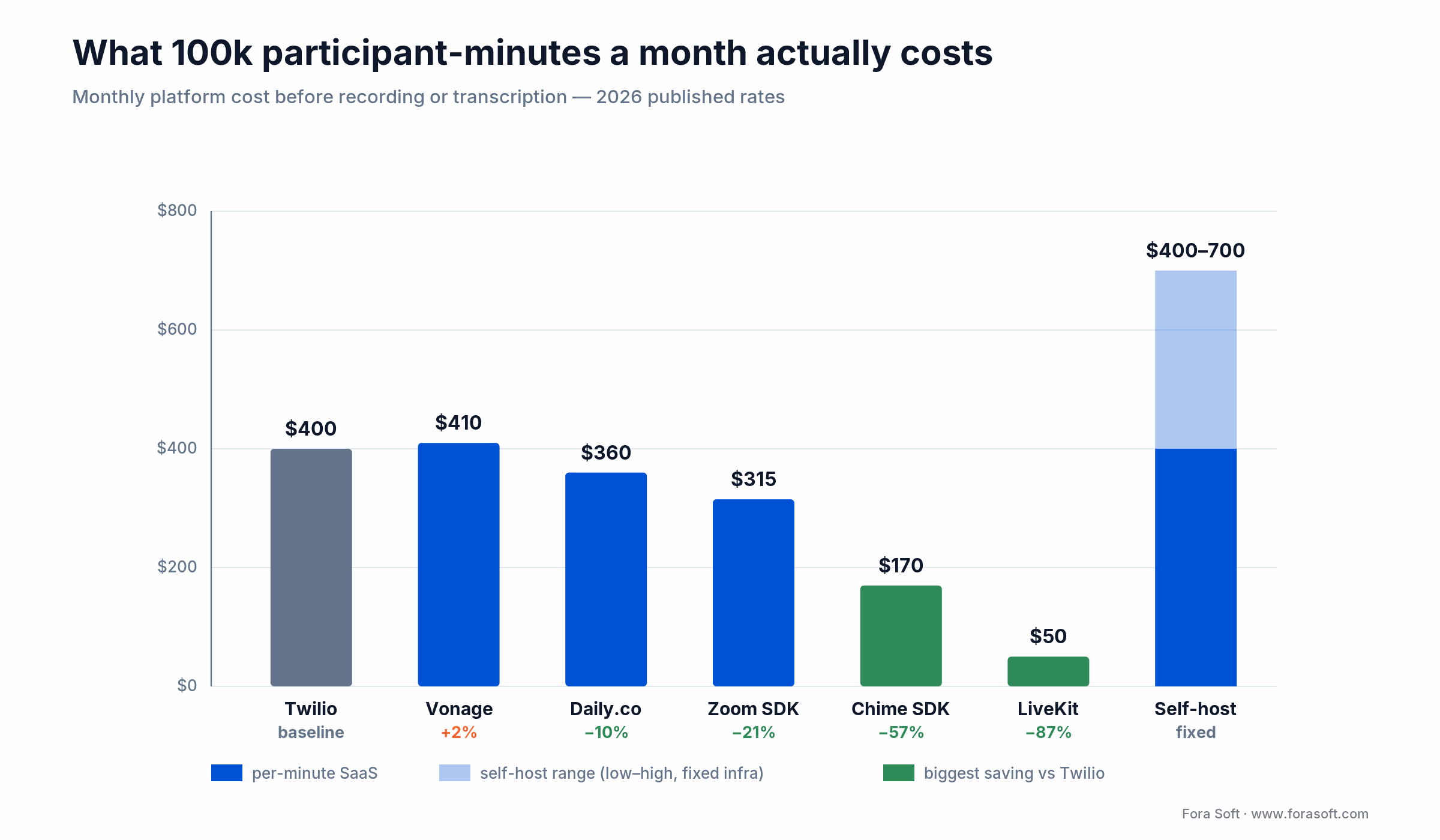
Figure 2. Monthly cost of 100k participant-minutes across Twilio and six alternatives, before recording or transcription (2026 published rates).
A few non-obvious lessons from running this math against real client traffic. First, savings only matter when they cross your engineering opportunity cost: a 4-week migration costs roughly $40–60k of senior engineering time. At 100k PM, swapping Twilio for AWS Chime SDK saves $230/month, which means a 14-year payback, so do not migrate for cost alone at that scale.
Second, LiveKit’s ~$0.0005 number is connection-time only for a standard SD case; Cloud also bills egress at $0.10–$0.12/GB and HD scales the rate, so your real bill lands higher — run the maths on your actual resolution and bandwidth mix. Third, self-hosted is fixed cost, so it gets cheaper as usage grows. The break-even versus Twilio is around 150k PM/month for a single-region cluster, lower if you use Hetzner instead of AWS.
Want a real cost projection on your traffic?
Send us last month’s Twilio invoice and we will model Vonage, Daily, LiveKit, Chime and self-hosted side by side — usually within 48 hours.
What actually has to be ported (and what does not)
A Twilio Video migration is not just “swap the SDK.” The pieces below are the ones that bite, in roughly the order they bite.
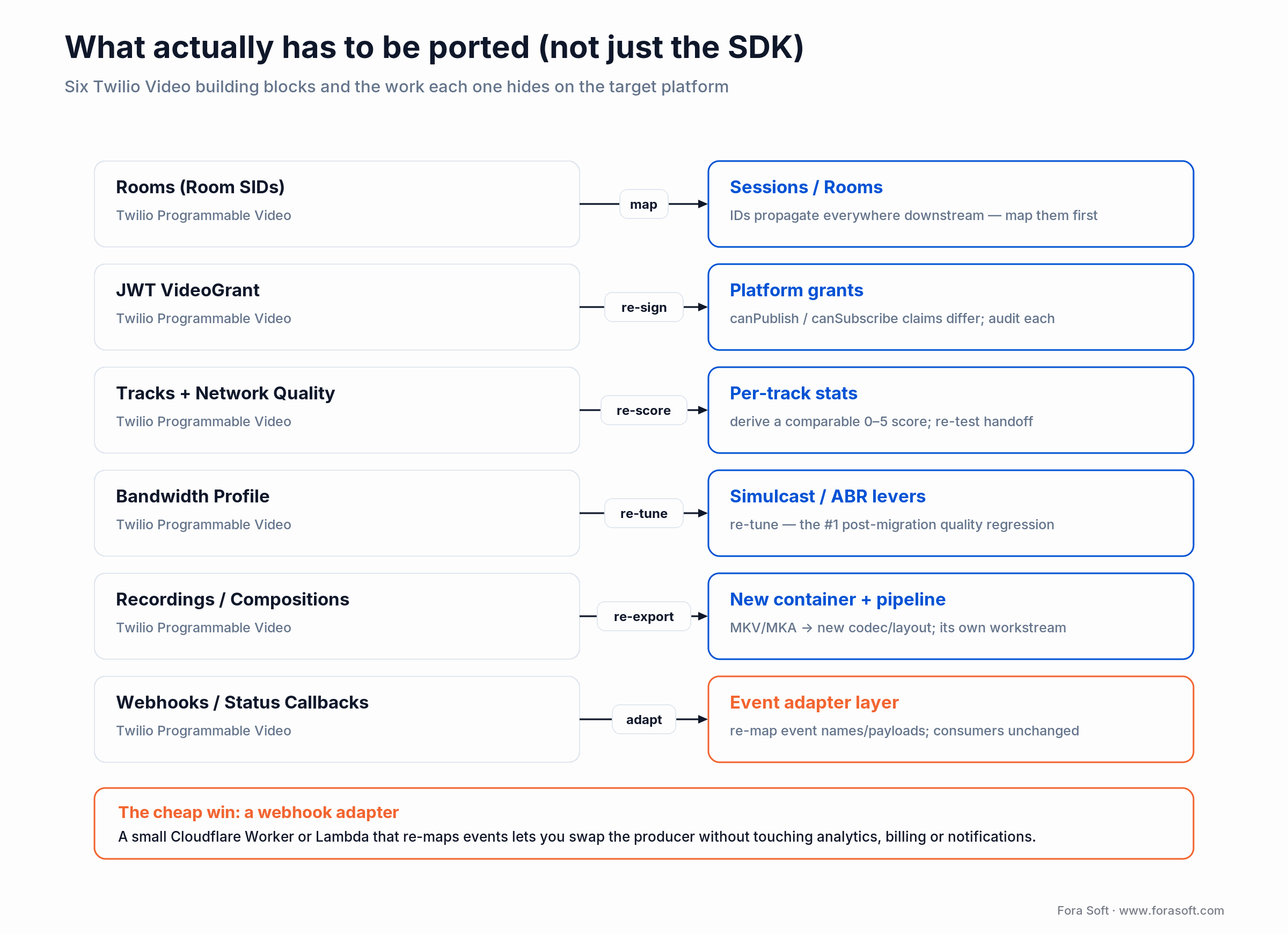
Figure 3. The six Twilio Video building blocks a migration has to port — and the work each one hides on the target platform.
Rooms → Sessions / Conferences
Twilio uses Room SIDs created via the Rooms REST API. Vonage maps to Sessions; Daily to Rooms with a different shape; LiveKit to Rooms with explicit token-encoded permissions. Your room-creation backend is small, but the identifiers propagate everywhere — analytics, recordings, webhook payloads, customer support tooling. Plan a single-source-of-truth identifier mapping table before you write any client-side code.
JWT tokens and grants
Twilio, Vonage and LiveKit all use JWTs but with different claim names and permission models. Twilio’s VideoGrant becomes Vonage’s session token role / publish-subscribe flag, or LiveKit’s VideoGrant with canPublish / canSubscribe / canPublishData granularity. Do not assume the libraries are interchangeable; review claim-by-claim.
Tracks, dominant speaker, network quality
Twilio’s Network Quality API returns a 0–5 score per participant per quality dimension. Vonage has equivalent metrics under different names. LiveKit and Daily expose richer per-track stats but you have to derive a comparable score yourself. Dominant Speaker detection is universally supported but the event names and threshold semantics differ — if you have UI logic that pins the active speaker, port it, then re-tune.
Bandwidth Profile / adaptive bitrate
Twilio’s Bandwidth Profile API lets you set dominantSpeakerPriority and clientTrackSwitchOffControl. Equivalent levers exist on every alternative, but the defaults differ. The single biggest cause of post-migration “quality dropped” tickets is forgetting to re-tune simulcast layers and active-speaker priorities for the new platform.
Recordings and Compositions
Twilio stores recordings as separate MKV/MKA per-track files; Compositions render those into MP4 layouts. The platform you migrate to will use a different container, codec set, and composition pipeline. Three actions to plan: export existing Twilio recordings to your S3 (Twilio supports external buckets natively), re-implement composition in the new platform’s API, and decide whether to re-compose archived recordings or keep them in their original format with a playback shim.
Webhooks and status callbacks
Twilio fires Status Callbacks on room and participant lifecycle events. The new platform will too, but with different event names and payload shapes. Build a webhook adapter layer rather than rewriting every consumer. We typically deliver this as a small Cloudflare Worker or Lambda that translates events into your existing schema, which lets you migrate the producer without touching analytics, billing or notification consumers.
How to migrate existing Twilio recordings
Recordings are the part of a Twilio Video migration teams under-budget the most. Three patterns work, in order of complexity.
1. External S3 from day zero. Twilio supports External S3 Recordings: configure a bucket and Twilio writes recordings directly there. New recordings stop being a migration problem the moment you flip this switch. Do this even if you have no migration plans — vendor-independent storage is hygiene.
2. Bulk export of existing assets. Use the Twilio REST API to enumerate Room and Participant Recordings, then stream each to your S3 with a worker pool. Plan storage, retention and KMS keys before you start; we usually finish a 100k-recording export in 24–72 hours with a small batch script.
3. Composition reformatting. If your product surfaces composed MP4s, you cannot just move the per-track files — you have to either re-compose with Twilio Compositions API before EOL of any specific feature, or build an ffmpeg pipeline that re-renders the per-track MKV/MKA into a layout compatible with the new platform. We usually pick option two for archived content because it removes Twilio from the recording lifecycle entirely.
HIPAA, GDPR and sovereign cloud across the alternatives
Compliance posture is the single feature that most narrows the alternative shortlist. Here is the 2026 reality.
| Platform | HIPAA BAA | GDPR / EU residency | SOC 2 | Sovereign cloud |
|---|---|---|---|---|
| Vonage | Yes | EU regions | Yes | No |
| Daily.co | Yes | EU regions | Yes | No |
| LiveKit Cloud | Scale tier | EU regions | Type II | Self-host yes |
| AWS Chime SDK | Yes | AWS regions | Yes | AWS GovCloud |
| Agora | Yes | Region pinning | Yes | No |
| Zoom Video SDK | Limited | EU regions | Yes | No |
| Self-hosted | You own it | Anywhere | You own it | Yes |
Mini case — integrating Twilio inside a multi-feature dating platform
Situation. Mindwibe is an iOS-first dating product where 1:1 video calls between matches are the core trust-building moment. The team chose Twilio Programmable Video for time-to-market: native iOS SDK, Rooms API, dominant speaker, recordings — everything wired up in a fortnight.
Plan. When the original Dec 2024 EOL hit, our team scoped a 12-week migration to LiveKit self-hosted. Phases: Week 1–2 token-server and Rooms abstraction; Week 3–5 iOS SDK port behind a feature flag; Week 6–8 server recording pipeline replacement; Week 9–10 parallel A/B test with 10 % of matches; Week 11–12 cutover and Twilio decommission.
Outcome (and the twist). By Week 5 Twilio reversed the EOL. We paused the migration, kept Mindwibe on Twilio for production traffic, and shipped the LiveKit self-hosted track as a parallel surface for in-app voice AI matchmaking that Twilio cannot serve. Net result: zero downtime, zero forced migration cost, and a strategic option on running the entire video stack in-house if pricing or compliance ever forces the move. Want a similar dual-track plan? Book a scoping call — we usually need 30 minutes to scope the right phasing.
A decision framework — pick your target in five questions
Q1. Are you already on AWS for the rest of your stack? Yes → Chime SDK is your default; the IAM, S3, KMS, CloudWatch integration and 57 % lower per-minute cost stack up.
Q2. Do you need HIPAA / GDPR with full data residency control? Yes → LiveKit self-hosted, Vonage with EU pinning, or mediasoup/Janus on your own cloud.
Q3. Are you adding voice AI agents, real-time transcription, or LLM video? Yes → LiveKit (Agents framework) or Daily (Pipecat). Twilio, Vonage and Agora trail badly here in 2026.
Q4. Is API parity with Twilio Rooms / Tracks the highest priority? Yes → Vonage Video API. Daily is a close second.
Q5. Does your usage cross 150k participant-minutes/month and is your team comfortable with infrastructure? Yes → self-hosted LiveKit, mediasoup or Jitsi. Costs go flat once you cross the break-even line.
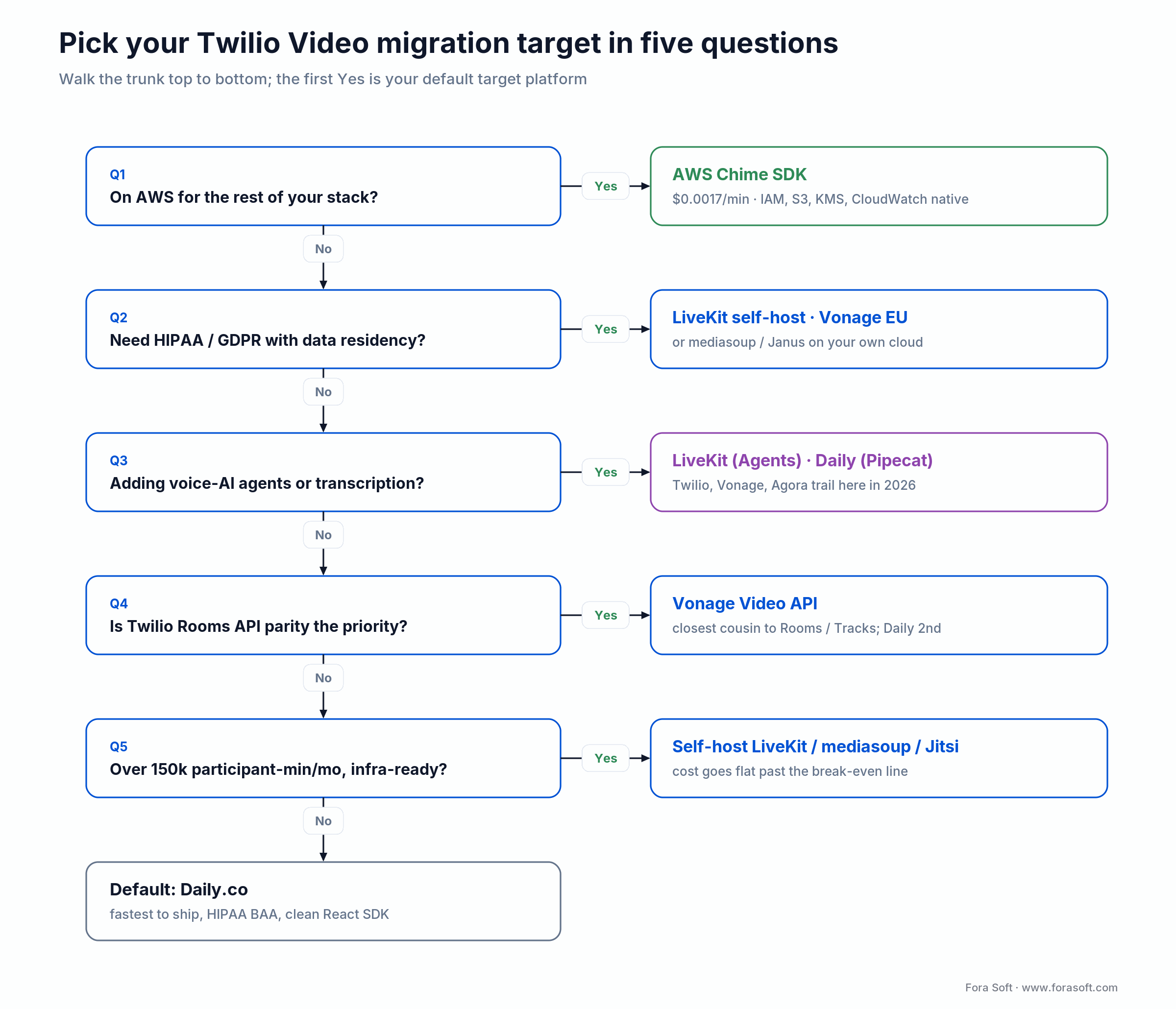
Figure 4. The five-question decision tree we walk in scoping calls to pick a migration target.
Five pitfalls that derail Twilio Video migrations
1. Skipping the bandwidth profile re-tune. Teams ship the new SDK with default simulcast settings, then hit P50 quality regressions in production. Re-tune dominantSpeakerPriority and simulcast layers before A/B test, not after.
2. Treating recordings as “same thing, different vendor.” Container, codec and composition semantics differ between every platform. Plan recording migration as its own workstream with its own owner and timeline.
3. Assuming JWT signing is portable. Twilio, Vonage, LiveKit and Daily all use JWTs but with different claim sets and signing libraries. Audit token generation line by line and test edge cases (expired tokens, role changes mid-call, regional restrictions).
4. Testing only the happy path. Network drop, reconnect, dominant-speaker handoff, simulcast layer switch, server-side recording start failures. Use Chrome DevTools throttling and Network Link Conditioner to break things on purpose. Our network simulation playbook covers the tools.
5. Forgetting webhook consumers. Recording-complete, participant-joined, room-ended — analytics, billing, fraud detection and notifications all consume these. Build an adapter layer instead of rewriting every consumer.
KPIs to track during and after migration
Quality KPIs. P50 / P95 video MOS or Network Quality score, end-to-end latency, simulcast layer switching frequency, dominant-speaker handoff time. Migrate when P95 stays within 5 % of Twilio baseline for two weeks of A/B test traffic.
Business KPIs. Cost per participant-minute (target 30 %+ reduction or do not bother), call drop-off rate (must not regress), call duration distribution (a sudden shift indicates quality regression hidden in averages).
Reliability KPIs. Successful join rate (target >99 %), reconnect success rate, recording start-success rate, webhook delivery completeness. Run synthetic monitors on every region you serve.
Already mid-migration and unsure if your KPIs are on track?
We have shipped this exact migration on telehealth, dating, courtroom and live-shopping products — we will tell you in 30 minutes whether the plan needs adjusting.
When you should not migrate from Twilio Video
A migration is not free, and Twilio is not broken. Stay if any of the following is true.
Your monthly Twilio Video bill is below $1,500 and your team has higher-impact roadmap items. Engineering hours are the most expensive part of any migration; the math rarely beats shipping a feature that grows revenue.
You have no compliance pressure beyond what Twilio already covers, no AI-agent workload, and no data-residency requirement that Twilio cannot satisfy with regional pinning.
You are inside a 6-month launch window. Migrations typically take 4–8 weeks of senior engineering for a non-trivial product, plus 2–4 weeks of A/B test. If your release pressure is higher than your cost pressure, defer.
Frequently asked questions
Is Twilio Programmable Video being shut down in 2026?
No. Twilio announced an EOL in December 2023, extended it in March 2024, and reversed the decision in October 2024. Programmable Video remains a standalone, supported product in 2026.
Which platform is the closest drop-in replacement for Twilio Video?
Vonage Video API (formerly OpenTok / TokBox). Twilio explicitly named Vonage as a migration partner during the EOL window, and Vonage publishes platform-specific migration guides for Web, iOS and Android. The API model maps closer to Twilio Rooms than any other vendor.
How much can we realistically save by migrating from Twilio Video?
At 100k participant-minutes per month: AWS Chime SDK saves ~57 % ($230/mo), LiveKit Cloud saves ~87 % ($350/mo), Daily and Vonage save 0–10 % but ship migration tooling. At 1M participant-minutes the same percentages translate to $2.3k/mo and $3.5k/mo respectively, where engineering payback windows shrink to under a year.
How long does a Twilio Video migration take in practice?
A simple 1:1 video app: 1–2 weeks for one engineer. Group video with dominant-speaker logic: 2–3 weeks. Full feature parity including recordings, compositions, bandwidth profiles and webhook adapters: 4–8 weeks plus 2–4 weeks of A/B testing. Fora Soft typically delivers 30–50 % faster using Agent Engineering on the boilerplate-heavy parts.
Can we keep our existing Twilio Video recordings?
Yes. Twilio supports External S3 Recordings — configure the bucket and Twilio writes recordings directly there. For existing recordings, use Twilio’s REST API to enumerate and stream each one to S3 via a worker pool. If you surface composed MP4s, plan a small ffmpeg pipeline to re-render the per-track MKV/MKA into the new platform’s composition format.
Which Twilio alternative is best for HIPAA-grade telehealth?
For managed cloud: Daily.co or Vonage Video API — both offer BAAs and have shipped real telehealth products at scale. For full data control: LiveKit self-hosted on a HIPAA-eligible AWS account. Avoid Zoom Video SDK and Cloudflare Calls for regulated healthcare; their HIPAA posture lags behind purpose-built telehealth platforms.
Should we go self-hosted instead of picking another SaaS?
Self-host when (a) usage exceeds ~150k participant-minutes/month, (b) compliance or sovereignty requires it, or (c) you have a real DevOps owner already. Below those thresholds the operational cost (on-call, scaling, security patches, TURN ops) outweighs the per-minute savings. mediasoup, Janus and Jitsi are all production-grade choices.
Does Fora Soft offer Twilio Video migration as a service?
Yes. We have shipped production WebRTC migrations across Twilio, Vonage, Agora, LiveKit, Daily, Chime SDK, mediasoup and Janus over the past decade. We typically scope the right target platform in a 30-minute call and deliver a fixed-scope migration plan within 5 working days. Book a call or message us on WhatsApp.
What to read next
WebRTC alternatives
Agora.io alternative in 2026: Custom WebRTC with LiveKit, mediasoup, Jitsi & Janus
When Agora pricing or vendor risk pushes you out, here is the parallel decision tree.
Vendor comparison
Vonage Video API alternatives — the self-hosted and SaaS shortlist
If Vonage looks too enterprise-priced, the same alternatives apply in reverse.
Cost analysis
LiveKit vs Agora: a 2026 cost analysis with real workload numbers
Granular per-minute math when LiveKit and Agora are both on the shortlist.
AI agents
Building multimodal AI agents with LiveKit: voice, vision and production patterns
If your migration is also a leap into voice AI, LiveKit Agents is the substrate.
Ready to scope your Twilio Video migration?
Twilio Programmable Video is staying. The migration question is now about cost, AI roadmap, and compliance — not about a forced shutdown. Vonage and Daily ship the closest API ports; LiveKit and AWS Chime SDK deliver the deepest cost cuts; mediasoup, Janus and Jitsi give you full control if SaaS is no longer an option.
The trap is treating this as “swap the SDK.” Recordings, JWT signing, bandwidth profiles, dominant-speaker logic and webhooks all need real engineering thought. Get the target platform right, build a webhook adapter, plan recordings as their own workstream, and run the new stack in parallel for two weeks before cutover. Our video-conference engineering team does this for a living — we will scope the right path with you.
Get a Twilio Video migration plan tailored to your stack
A 30-minute call, a written migration plan within 5 working days, and a fixed-scope quote. No commitment.

