

Key takeaways
• An OTT platform development company owns 10 modules, not a video player. Ingest, transcode, packaging + DRM, origin, multi-CDN, catalog, recommendation, apps, monetization and analytics. Judge any partner on all ten.
• SVOD, AVOD, TVOD and FAST are business models, not tech choices. Netflix is SVOD; YouTube is AVOD; Apple TV rentals are TVOD; Pluto TV is FAST. Each needs a different billing and ad stack. Pick the model before you architect.
• The build-vs-buy line sits near 1M streaming minutes a month. Below it, Brightcove or Kaltura wins on cost and speed. Above it, a custom stack’s flatter run-rate wins on 3-year TCO. MVP runs $40k–$120k; enterprise OTT $350k–$900k+.
• DRM is never a v2 feature. Studios won’t license content to a platform without Widevine, FairPlay and PlayReady. CMAF-CBCS lets one encrypted ladder serve all three — bake it in on day one.
• We’ve shipped OTT at broadcast scale. For Mangomolo, at over 1B streams a month and 30M+ daily viewers, we built the Wowza SCTE-35 module that powers its server-side ad insertion. We know which modules quietly kill timelines.
Why Fora Soft wrote this guide
Most OTT projects don’t fail on the video player. They fail six months in, when the catalog buckles at 50,000 concurrent viewers, or a studio walks because DRM was scheduled for “phase two.” We’ve been building video products since 2005 (250+ delivered projects, 50 in-house engineers), and we wrote this guide to spare you those specific, expensive surprises.
This is a buyer’s guide. It’s for founders, heads of product and CTOs deciding whether to build, buy, or hire an OTT platform development company. We walk the module architecture, the business models, real 2026 cost ranges, the DRM non-negotiables, and the exact questions that separate a partner who has shipped OTT from one who will learn on your budget. Our streaming work — from BrainCert (500M+ classroom minutes) to Worldcast Live (HD concert streaming) — taught us where the timeline actually goes.
Every failure mode below is one we’ve fixed in production. We name the vendors we run — Wowza, AWS, Cloudflare, Stripe, Cleeng, Mux Data — because honest cost models need real numbers, not a $100k discovery phase that ends in a slide deck.
Sizing your first OTT build?
Bring your content, audience and monetization model. In 30 minutes we’ll sketch the architecture, name the risky modules, and give you a realistic cost and timeline range.
What is an OTT platform
An OTT (over-the-top) platform delivers video over the open internet, bypassing managed cable, satellite and IPTV networks. It’s the full stack: ingest (upload or live), processing (transcode, package, encrypt), distribution (CDN), and playback across phones, browsers and TVs. Netflix, YouTube and Apple TV are all OTT; the difference between them is the business model, not the plumbing.
The word “platform” hides the work. A single video file has to become an adaptive-bitrate ladder, get encrypted once for three DRM systems, land on a CDN that won’t fall over during a finale, and play identically on an iPhone and a five-year-old Tizen TV. That is the job of an OTT platform development company is actually paid to get right.
| Delivery type | Who controls it | Scale | Cost shape | When to choose |
|---|---|---|---|---|
| OTT (your platform) | You own the stack | 1k–100M+ viewers | $40k–$900k+ build; $2k–$50k/mo ops | Differentiated content, own billing, brand control |
| Managed OTT SaaS | Vendor owns infra | 1k–1M viewers | Flat/tiered plan; egress bundled | MVP, no media-ops team, fast launch |
| IPTV (telco) | Telco owns the network | Millions (closed net) | ~$1M+ (enterprise) | Legacy pay-TV bundles; shrinking in 2026 |
| Broadcast / cable | Regulated delivery | Millions (linear) | $10M+ (physical infra) | Licensed linear TV; not a startup path |
What an OTT platform development company actually delivers
A real OTT platform development company delivers a running stack across ten modules plus the ops to keep it up — not a UI kit and a Wowza license. The gap between those two is where budgets disappear. Here’s the map you should hold any vendor to.
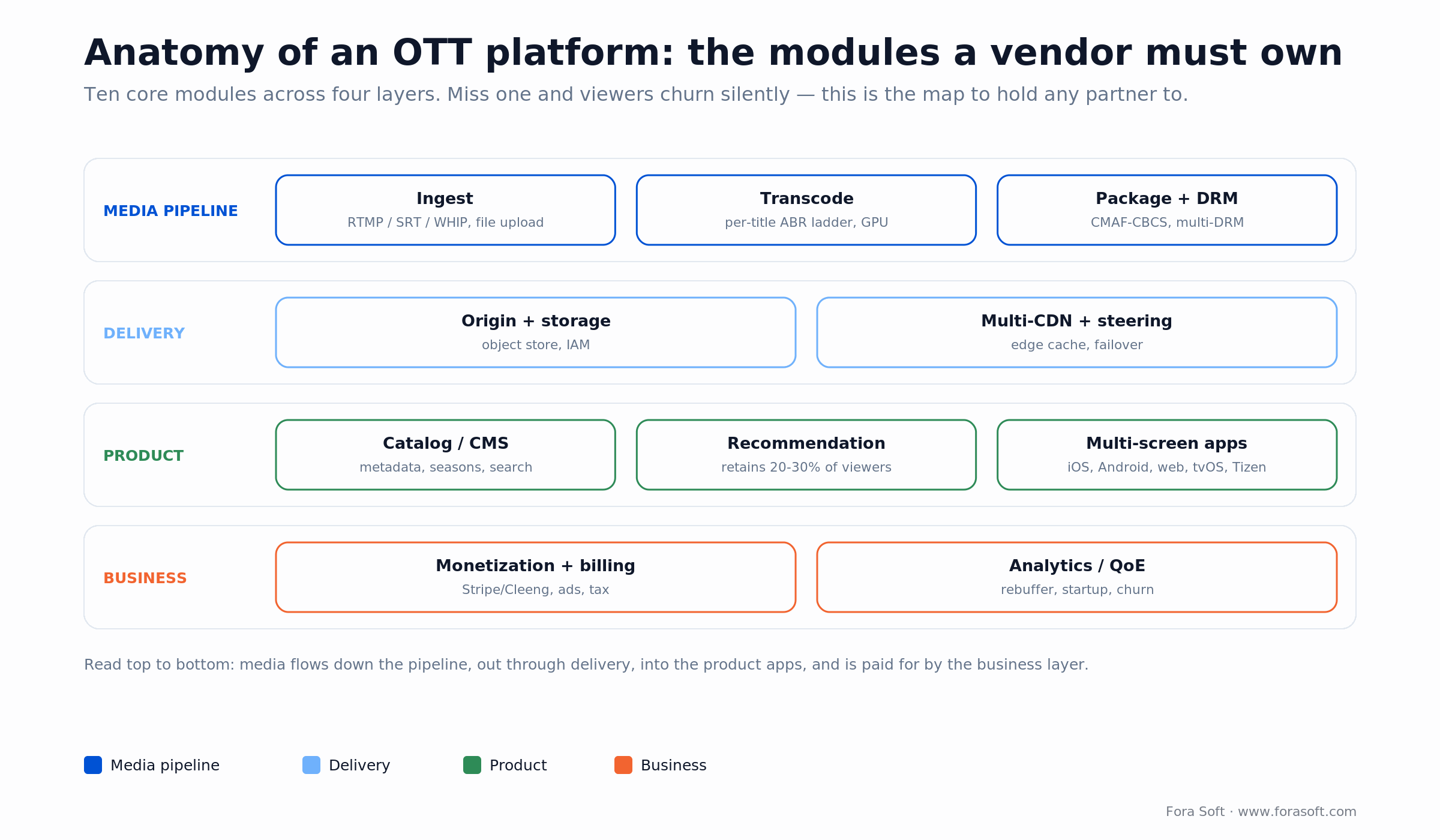
Figure 1. The ten modules a serious OTT platform development company owns, grouped into four layers.
Three of these modules are where inexperienced teams get exposed. Packaging + DRM is treated as orthogonal to transcoding (it isn’t — CMAF-CBCS has to be planned with the ladder). Recommendation gets pushed to “later” (it drives 20–30% of retention). And analytics ships as vanity dashboards instead of segment-level QoE, so nobody can debug a buffering spike. A partner who’s shipped OTT will bring these up before you do.
Reach for a specialist OTT dev company when: your content is licensed (multi-DRM), you need more than one monetization model, or you expect to cross ~1M streaming minutes a month within a year. Below all three, a managed SaaS platform and a generalist agency will do.
OTT business models: SVOD, AVOD, TVOD and FAST
Your monetization model decides half your architecture, so pick it first. SVOD needs retention tooling; AVOD needs an ad stack and scale; TVOD needs clean transactional billing; FAST needs live-linear playout and SCTE-35 ad markers. Most 2026 platforms run two or three at once.
SVOD (subscription). Flat monthly fee, unlimited access, on Netflix’s tiered ad and ad-free plans. Predictable revenue, but churn is the enemy; you live or die on recommendation and retention analytics.
AVOD (ad-supported). Free to the viewer, funded by ads — YouTube. Revenue is CPM × impressions, so you need real scale (roughly 1M+ monthly viewers) before the math works. Ad insertion is the hard part, especially alongside DRM.
TVOD (transactional). Rent or buy per title — Apple TV rentals. Best for events, new releases and premium sport. No recurring revenue; every play is its own conversion funnel.
FAST (free ad-supported streaming TV). Linear, channel-style programming with ad breaks — Pluto TV, Samsung TV Plus. It’s the fastest-growing model of 2024–2026, and it leans on server-side ad insertion and SCTE-35 markers — exactly the custom Wowza work we did for Mangomolo.
Reach for hybrid monetization when: you have both a broad free audience and a premium tier worth paying for. Disney+ runs SVOD with TVOD day-and-date releases; it roughly triples entitlement complexity, so only attempt it with a mature product team.
The 10 core modules of a scalable OTT platform
Here’s what each module does, what it costs to run, and where it bites. Numbers are 2026 planning ranges; your mix of live vs VOD and region will move them.
1. Ingest & transcode. Accept RTMP/SRT/WHIP or file upload, then normalize to a per-title ABR ladder (240p–1080p in H.264, plus H.265/AV1 where devices allow). GPU transcode runs several times faster than CPU, cutting both encode time and per-stream cost. AV1 saves roughly 20–30% bitrate over HEVC and about 50% over H.264 at equal quality, at higher encode cost.
2. Packaging + DRM. Fragment renditions into CMAF segments and encrypt once with CBCS. One encrypted ladder then serves Widevine (Android/Chrome), FairPlay (Apple) and PlayReady (Xbox/many TVs) — with no second encode. See our multi-DRM one-workflow guide. Budget a license server (EZDRM/Axinom/BuyDRM) plus small per-playback fees.
3. Origin + storage. Object storage (S3/R2/B2) behind an origin shield, with IAM so only your CDN can pull segments. Cheap to store, expensive to serve — which is why the next module matters most.
4. Multi-CDN + steering. Distribute segments globally with failover between providers. Egress runs roughly $0.02–$0.12/GB depending on provider and commit; it’s usually your single biggest bill.
5. Catalog / CMS. Metadata, artwork, season/episode hierarchy, genres and search. Custom builds run $30k–$80k; off-the-shelf headless CMS is $200–$1k/mo but limits how far you can customize.
6. Recommendation. Suggest what to watch next. Rule-based trending is free (engineer time); managed ML (AWS Personalize, Recombee) is $500–$5k/mo; Netflix-style custom ML only pays off past ~1M monthly actives. Skipping it costs 20–30% of retention.
7. Search & discovery. Full-text search (Elasticsearch/Algolia) plus faceted filters and trending rows. Often bundled with the CMS; budget $500–$2k/mo.
8. Multi-screen apps. iOS, Android, web, and TV (tvOS, Tizen, Roku). TV viewers watch 3–4× longer than mobile, so TV apps aren’t optional for premium OTT — budget 4–6 weeks per platform.
9. Monetization + billing. Stripe/Recurly/Cleeng for subscriptions and rentals; an ad server for AVOD/FAST. Card processing runs about 2.9% + $0.30 per charge; tax (VAT/GST/sales tax) needs Avalara or TaxJar.
10. Analytics + QoE. Segment-level telemetry — startup time, rebuffering, bitrate by device and CDN pop — via Mux Data, Conviva or Bitmovin. Without it you can’t tell a CDN problem from a transcoder problem.
Reference architecture for a scalable OTT platform
Split the platform into a data plane (ingest → player) and a control plane (catalog, auth, billing, analytics) so each scales on its own. The data plane moves gigabytes; the control plane moves records. Coupling them means a traffic spike takes down your billing API, and a schema migration stalls playback.
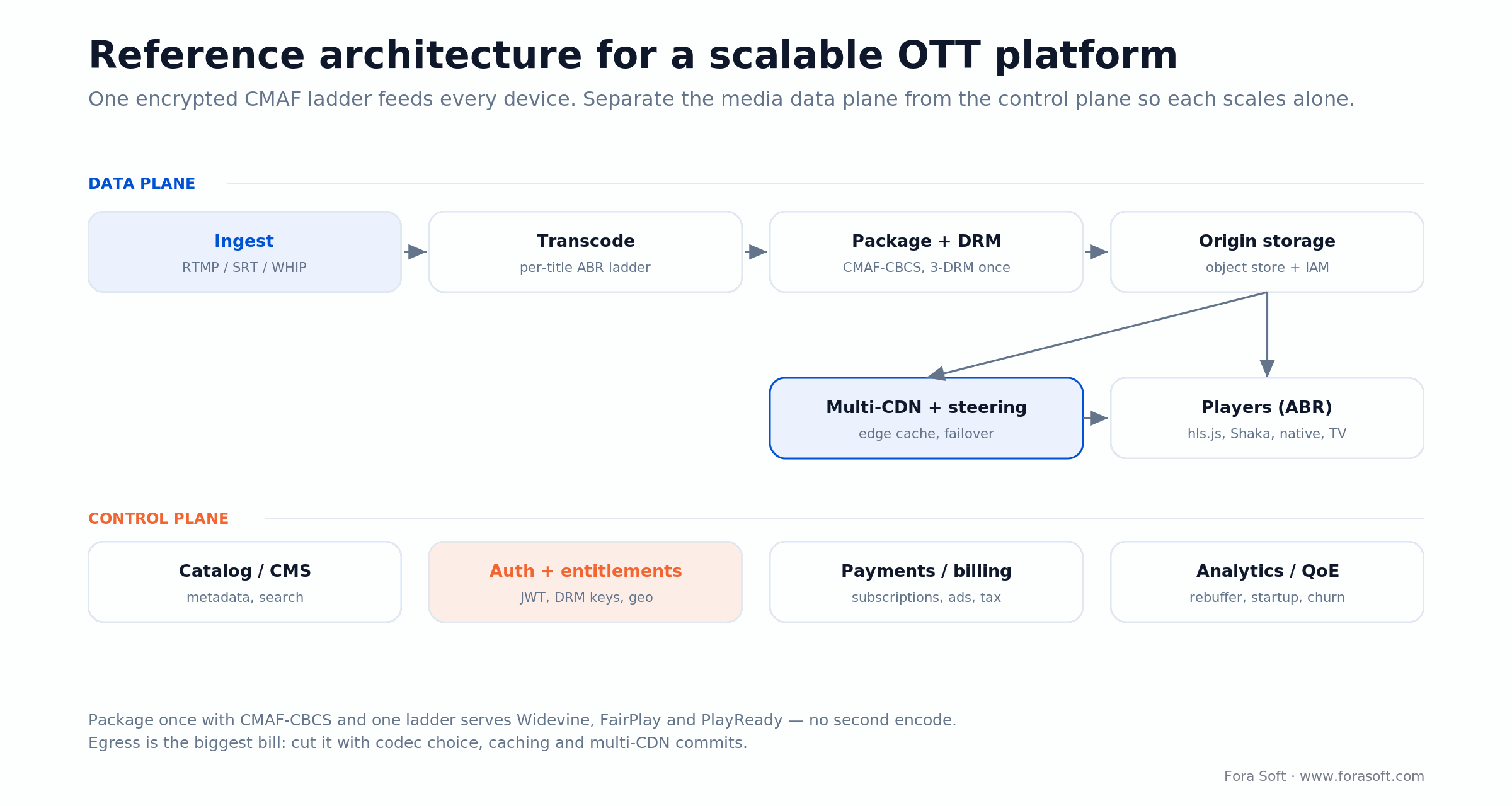
Figure 2. Reference OTT architecture. One CMAF-CBCS ladder feeds every device; data and control planes scale independently.
The single most important decision here is packaging. Encrypt once with CMAF-CBCS and one segment set serves all three DRMs and both HLS and DASH manifests, so storage and encode stay flat instead of tripling. The second is egress: at 50,000 concurrent viewers on a two-hour event, dropping from H.264 to AV1 roughly halves the bandwidth bill, which is why codec and CDN strategy belongs in the architecture phase, not an optimization sprint.
Reach for multi-CDN from day one when: a regional outage would cost you more than ~10% of monthly revenue in an hour. Two providers plus steering adds roughly 10% to egress and removes your single biggest point of failure. Retrofitting it under load is miserable.
DRM and content licensing: non-negotiable for premium content
If your content is licensed, you need Widevine, FairPlay and PlayReady on day one — studios won’t ship keys otherwise. The good news: since PlayReady added CBCS support, a single CMAF master encrypted once in CBCS can be wrapped in all three, so you store and encode one ladder, not three. Widevine plus FairPlay alone covers about 95% of devices, and adding PlayReady pushes past 99%.
Cost and retrofit. A license server runs a monthly subscription plus small per-playback fees; forensic watermarking for pre-release or live sport adds more. Retrofitting DRM into a platform that shipped without it is 4–6 weeks per platform — building the hooks up front is about two. This is the single most common “we’ll do it later” that blows up.
Geo and entitlements. Enforce regional licensing at manifest signing, not the CDN edge — edge blocks fall to VPNs. Use signed JWTs with region and tier claims, validated before the license key is issued. Details in the streaming knowledge base, and the primary specs are worth bookmarking: Apple’s HLS authoring spec and Google’s Widevine DRM overview define what each system expects at the packaging layer.
Recommendation and personalization: the module that retains viewers
Recommendation is a retention feature, not a nice-to-have — algorithmic suggestions drive an estimated 80% of Netflix watch time. Drop it and viewers churn 20–30% faster because they can’t find their next watch. Three tiers, by budget:
Rule-based (free). Trending this week, genre matching, continue-watching. Costs engineer time only; buys ~5–10% retention lift. Ship this in your MVP.
Managed ML ($500–$5k/mo). AWS Personalize or Recombee — collaborative filtering plus content-based fallback for the cold-start problem (a new user with no history). Realistic 15–25% lift. The right choice for most platforms.
Custom ML ($50k–$100k/mo + a data-science team). Trained on your catalog, retrained weekly. Only justified past ~1M monthly actives, where a few points of retention is real money.
The monetization stack: payments, billing, tax and ads
SVOD (subscriptions). Stripe, Recurly or Cleeng handle recurring billing, invoicing and dunning (retrying failed cards). Stripe is about 2.9% + $0.30 per successful charge; automate tax with Avalara or TaxJar. Chargebacks run 0.5–2% of volume — factor them into margin.
TVOD (rentals/purchases). Same processor, plus tokenization to save a card and app-side logic for rental expiry (say 48 hours). Simpler than SVOD because there’s no lifecycle to manage.
AVOD / FAST (ads). An ad server (Google Ad Manager, SpringServe) inserts ads server-side (SSAI, ad-block-proof, DRM-safe) or client-side (cheaper, blockable). Live and FAST channels use SCTE-35 markers to signal breaks. US video CPMs commonly land in the $10–$25 range depending on content and audience.
Hybrid. Running two or three models means entitlements must track subscription tier (ad-free vs ad-supported), active rentals and family sharing at once. It roughly triples billing complexity, so most platforms start with one model and add the second once the first is stable.
Which monetization model fits your catalog?
We’ll map SVOD, AVOD, TVOD and FAST against your content and audience, and cost the billing + ad stack each one needs — before you commit engineering to it.
Security, privacy and compliance: GDPR, CCPA, age gating
GDPR (EU). Data-processing agreements with every vendor (CDN, processor, analytics), no raw IPs or media payloads in logs, a clear retention policy, and real consent at signup. Retrofitting consent is far harder than designing for it.
CCPA (California). Users can access, delete and opt out of data sale, and you must honor export/deletion within 45 days. Use a vetted legal template; homegrown implementations fail audits.
COPPA (under-13). If you target kids, no persistent identifiers, no targeted ads, parental consent required. A separate kids section or app (the Disney+ pattern) is safer than mixing audiences.
Age gating and HIPAA. Enforce content ratings and parental PINs server-side — client-side controls are trivially bypassed. Telemedicine OTT adds HIPAA: you need signed BAAs from infrastructure vendors (AWS and Cloudflare sign; many budget CDNs don’t) and encryption in transit and at rest.
Analytics and QoE: what you measure drives behavior
Startup time (time-to-first-frame). Past 2s, 6–10% of viewers bounce before playback. Target under 1.5s on good networks and track P50/P95/P99 separately by device and network type.
Rebuffering ratio. Time buffering divided by time watching. Under 1% goes unnoticed; over 2% churns viewers. Break it down by device class and CDN pop — a spike on one pop is your signal to debug that route.
Average rendition. If mean bitrate drops 20% week-over-week, something broke — transcoder, cache, or network. It’s a leading indicator of churn, so watch it obsessively.
Tooling. Mux Data ($500–$5k/mo), Conviva (enterprise) and Bitmovin Analytics all capture segment-level telemetry and correlate it with churn. DIY on CloudWatch is possible but needs serious engineering to match them.
Build vs buy vs partner: managed OTT, hybrid, or a custom stack
The decision hinges on volume and differentiation. Below roughly 1M streaming minutes a month, managed SaaS (Brightcove, Kaltura, JW Player, Vimeo OTT) wins on cost and speed. Above it, a custom stack’s flatter run-rate amortizes the build within 18 months and cuts per-viewer cost as you optimize. For the stage-by-stage build-or-buy choices and how each revenue model shapes the build, see our OTT build-vs-buy and monetization playbook.
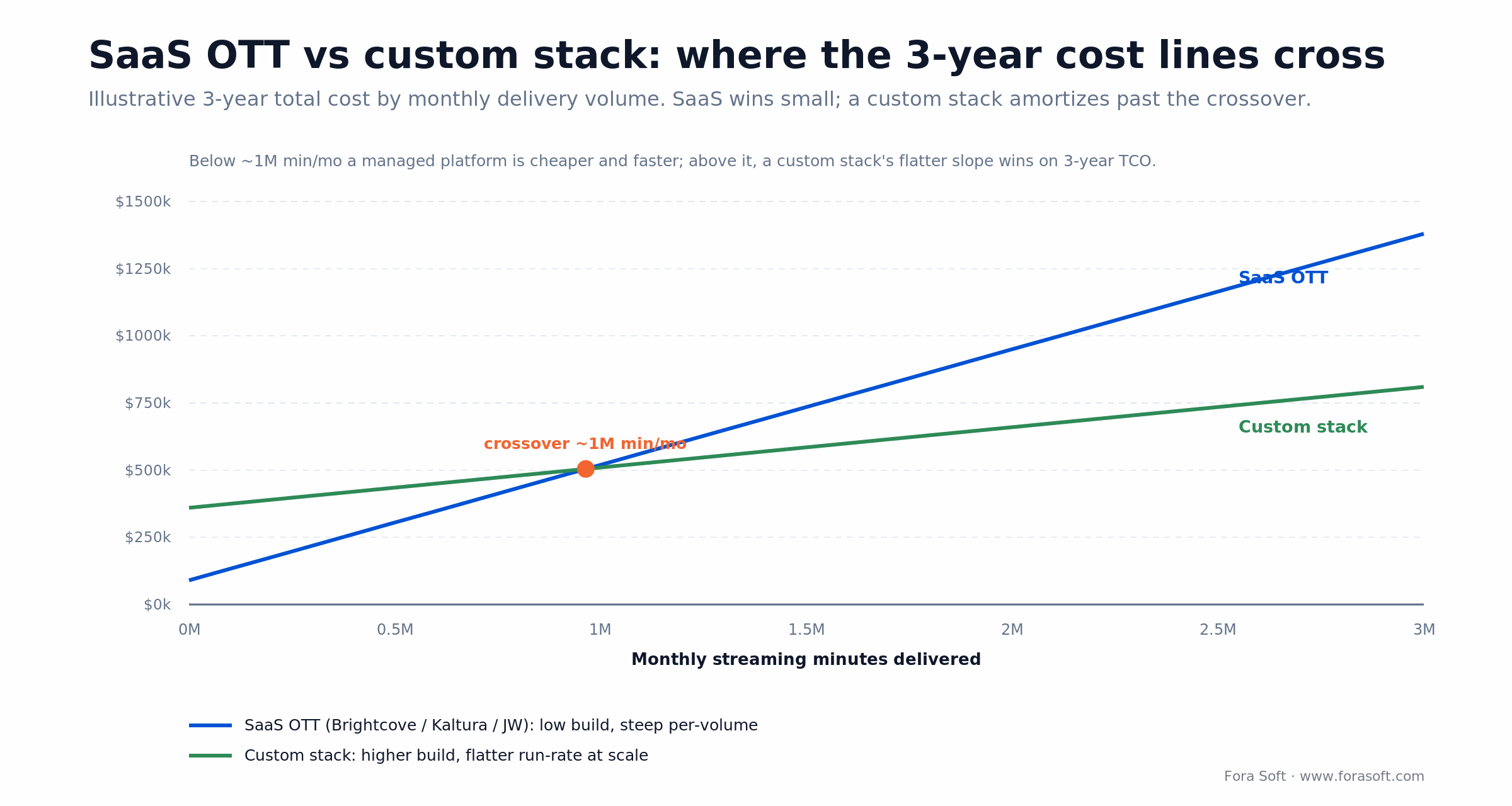
Figure 3. Illustrative 3-year TCO. SaaS wins below ~1M min/mo; a custom stack’s flatter slope wins above it.
| Option | Time to market | First-year cost | Best for |
|---|---|---|---|
| Managed SaaS (Brightcove, Kaltura, JW) | 2–4 weeks | $12k–$50k | MVP, no ops team, fast launch |
| Hybrid (SaaS + custom modules) | 8–12 weeks | $50k–$150k | Custom billing/branding on one platform |
| Custom (Wowza + custom code + partner) | 16–24 weeks | $150k–$500k | 1M+ min/mo, cost control, differentiation |
| Enterprise multi-tenant custom | 24–52 weeks | $400k–$1M+ | B2B OTT, operators, regional players |
See our deeper build-vs-buy framework for the switching case, and the full cost breakdown if budget is your gating question.
Vetting an OTT platform development company: 10 questions
These are the questions that separate a company that has shipped OTT from one that will learn on your budget. Evasive answers are the signal.
1. Have you shipped OTT to production with multi-DRM? If not, DRM will be your first crisis. Ask for the platform and the studio requirements they met.
2. Which CDNs have you run at scale, and what’s the worst outage you’ve survived? Experience with failover and multi-CDN matters more than the brand names.
3. Can you show QoE metrics from a live platform? Startup time, rebuffering ratio, cost per viewer-hour. If they can’t, they’re guessing.
4. Do you own the architecture or white-label a vendor? White-labeling is fine for an MVP, but know which modules are theirs before you sign.
5. What’s your transcode cost at 10k concurrent 1080p viewers? A real answer sounds like a number with assumptions. Silence means they haven’t done the math.
6. How long to retrofit a second DRM or a second CDN? Good teams say 2–4 weeks and can explain how they designed for it.
7. Who owns post-launch ops, and what’s the SLA? A dedicated-team retainer beats a code handoff that leaves you owning ops forever.
8. Does the same architecture scale from 1k to 100k concurrent? The horror story is a rewrite at 10k. Listen for stateless ingest, autoscaling transcode, multi-CDN.
9. What happens when the DRM license server goes down? If viewers can’t play, you need failover to a backup license server. “It won’t happen” is a red flag.
10. Show me the full TCO in writing. Hidden $5k/mo line items (observability, backup, support) are common. Get every recurring cost on paper.
Mini case: the Wowza ad-insertion module behind Mangomolo’s OTT scale
Situation. Mangomolo is an end-to-end OTT platform serving broadcasters across MENA, Europe and Africa (Discovery Networks MENA, Dubai Media’s Awaan, and SABC+) at over 1 billion streams a month and 30M+ daily viewers. FAST and AVOD channels needed to insert the right ad, in real time, into live streams without breaking playback or DRM.
What we built. A custom Wowza module that recognizes SCTE-35 ad markers embedded in live video and drives server-side ad insertion (SSAI) — detecting each break and stitching the correct ad into the stream on the fly, so ads survive ad-blockers and encrypted delivery. After the core module shipped, we kept extending and optimizing the platform alongside their team.
Outcome. Server-side ad insertion at broadcast scale, across 50+ publisher clients and 400,000+ managed videos. The SABC+ partnership, expanded in 2024, helped the platform reach 1.5 million registered users. Want the same kind of assessment for your ad or streaming stack? Book a 30-min architecture review, or read how we approach custom Wowza development.
Cost and timeline: honest ranges from MVP to enterprise OTT
MVP OTT (VOD only, single region, ~1k concurrent). 8–12 weeks with a 3–4 person team. Build $40k–$120k; first-year ops $2k–$5k/mo, mostly CDN egress. Year one all-in: roughly $65k–$180k.
Mid-market OTT (VOD + live, multi-region, ~10k concurrent, multi-DRM). 16–24 weeks with a 5–6 person team. Build $120k–$350k; ops $10k–$30k/mo. Year one: roughly $250k–$700k.
Enterprise OTT (multi-tenant, 100k+ concurrent, global DRM, custom ML, HIPAA where relevant). 36–52 weeks. Build $350k–$900k+; ops $30k–$100k/mo. Scale-dependent and can run higher.
On our estimates. We use Agent Engineering to compress scaffolding, testing and integration, which typically trims timelines versus a hand-coded 2024 baseline. We keep the human QA and architecture review in the budget rather than promising a number we’d have to walk back. If we’re unsure of a figure, we don’t quote it.
Reach for a dedicated-team retainer when: you’ve launched and now need someone owning QoE, security patches and feature work every month. A code handoff with no retainer leaves you owning 24/7 ops the day the build team walks.
A decision framework: five questions to pick your path
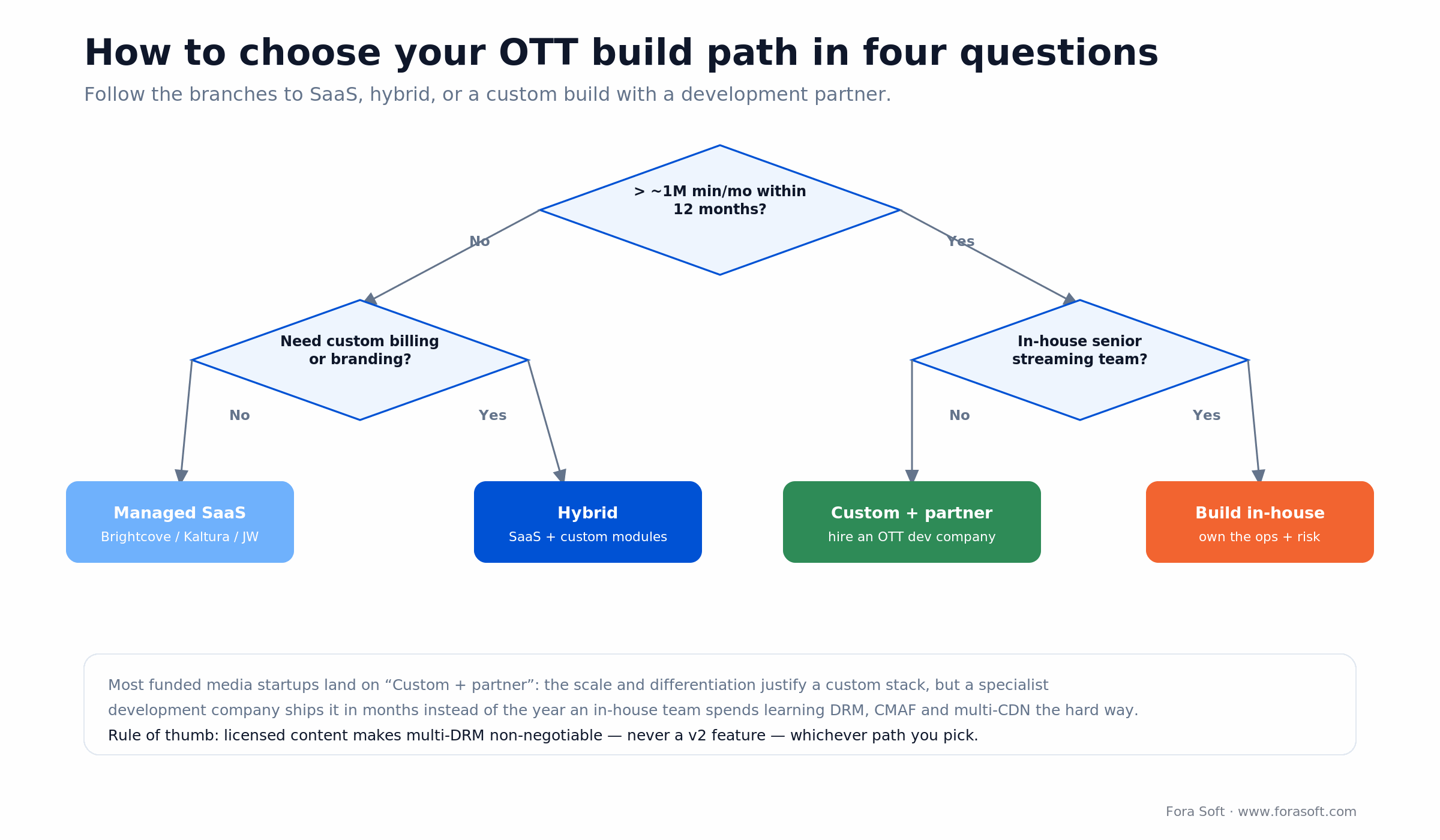
Figure 4. Four questions route you to managed SaaS, hybrid, a custom build with a partner, or building in-house.
Q1. How many streaming minutes a month within 12 months? Under ~1M → managed SaaS. Around 1M and climbing → hybrid or custom. Well past 1M → custom stack with multi-CDN.
Q2. Is your content licensed? Yes → multi-DRM from day one; build-in beats retrofit. No → skip DRM and save the license-server line item.
Q3. What’s your revenue model? SVOD → recommendation + retention analytics first. AVOD/FAST → ad stack + scale. TVOD → clean transactional billing. Hybrid → only with a mature product team.
Q4. Multi-tenant? Reselling to other creators means designing tenant isolation and usage billing up front; retrofitting it is 3–6 months. Proprietary catalog → single-tenant is simpler.
Q5. Do you have senior streaming engineers? Yes → building in-house is viable. No → hire an OTT platform development company rather than learn DRM, CMAF and multi-CDN on a live launch.
Five pitfalls that sink OTT platforms
1. DRM as a v2 feature. Retrofitting multi-DRM is 4–6 weeks per platform and blocks every licensing deal. Build the hooks even before you have content.
2. Single-CDN lock-in. One regional outage takes you down for hours. Multi-CDN adds ~10% cost, kills the single point of failure, and enables geo-pricing. Plan it early.
3. Underestimating tax and compliance. GDPR, CCPA, VAT on digital goods and chargebacks quietly eat 5–10% of revenue when ignored. Budget legal + ops work up front.
4. Treating recommendation as a launch blocker. Ship rule-based trending in the MVP, add ML in month two or three. Teams that over-engineer this slip by months for a feature they could stage.
5. TV apps as an afterthought. Smart-TV viewers watch 3–4× longer than mobile. Deferring tvOS and Tizen leaves that revenue on the table — budget them at launch.
When NOT to build a custom OTT platform
You’ll never cross ~1M streaming minutes a month. Managed SaaS margins beat custom ops at that scale. Brightcove or Kaltura saves you 12–18 months and $200k+.
Video is a feature, not your product. A CRM with calls, or a course tool with lessons, should use Daily or Mux and spend engineering on the actual differentiator. Full OTT complexity isn’t worth it for one feature.
You have no senior streaming engineer and no budget to hire one. Custom OTT isn’t a “learn WebRTC next quarter” project. Hire the specialist or a shop that already has one; learning on the job costs 6–12 months and lasting tech debt.
FAQ
How much does an OTT platform development company charge in 2026?
MVP OTT runs $40k–$120k plus $2k–$5k/mo ops; mid-market $120k–$350k plus $10k–$30k/mo; enterprise $350k–$900k+. Ranges depend on live vs VOD, DRM, regions and concurrency. Get a fixed price for phase one, then move to a retainer for ops.
Do I really need DRM if my content is licensed?
Yes. Studios won’t license movies, series or premium sport without Widevine, FairPlay and PlayReady. No DRM means no licensed catalog. Build the hooks on day one; retrofitting is 4–6 weeks per platform.
What’s the difference between SVOD, AVOD, TVOD and FAST?
SVOD is a flat subscription (Netflix). AVOD is free with ads (YouTube). TVOD is pay-per-title rental or purchase (Apple TV). FAST is free, linear, ad-supported channels (Pluto TV). Most platforms combine two or three.
Can I launch without Apple TV and Smart TV apps?
Technically yes, practically no. TV viewers watch 3–4× longer than mobile and drive 30–50% of revenue. Budget 6–8 weeks for tvOS and one Smart-TV platform at launch rather than treating them as v2.
How much does a recommendation engine cost to run?
Rule-based trending is free (engineer time). Managed ML like Recombee or AWS Personalize is $500–$5k/mo. Netflix-style custom ML is $50k–$100k/mo plus a team and only pays off past ~1M monthly actives.
Should you run one CDN or go multi-CDN?
Single-CDN is cheaper ($2k–$5k/mo) and simpler to start. Multi-CDN adds ~10% but removes regional-outage risk, which at 500k+ viewers can cost $10k+/hour in lost revenue. Plan failover from day one; implementation is 1–2 weeks.
How does CMAF-CBCS reduce DRM cost?
CBCS-mode Common Encryption lets you encrypt one CMAF ladder that Widevine, FairPlay and PlayReady all accept, signalled in both HLS and DASH. You store and encode one set of segments instead of three, so storage and transcode don’t triple.
How do I choose an OTT platform development company?
Ask the ten questions in this guide: production DRM experience, CDN scale and outage history, live QoE metrics, architecture ownership, transcode cost math, retrofit timelines, ops/SLA model, scaling headroom, DRM failover, and a written TCO. Evasive answers are the signal to walk.
What to Read Next
Architecture
Scalable Video Streaming: Challenges & Solutions
SFU topology, transcoding, CDN egress and cost modeling at scale.
Strategy
Build vs Buy: Switching From an SDK to Custom
A five-question framework for when custom beats a managed SDK.
Cost
How Much Does a Video Streaming App Cost?
Full budget breakdown: platform, team, infrastructure, run-rate.
Streaming
Wowza Custom Development in 2026
When custom Wowza work beats off-the-shelf, with the SSAI case.
Ready to choose your OTT platform development company?
An OTT platform is ten modules stacked in the right order — ingest, transcode, packaging + DRM, origin, multi-CDN, catalog, recommendation, apps, monetization and analytics. Get the order wrong and it stalls at 10k concurrent viewers or bleeds money at 100k. Get it right and you own a market.
The build-vs-buy line sits near 1M streaming minutes a month: managed SaaS below it, a custom stack above. We’ve shipped both — SaaS integrations for fast launches, and custom work like the SCTE-35 ad module behind Mangomolo’s billion-plus monthly streams. We can tell you honestly which one fits, and which modules will slip your timeline.
If you’re choosing a partner or sizing your own build, a 30-minute call gets you an architecture sketch, a cost model at three scales, and a realistic go-live date, with the trade-offs named out loud.
The handbook · 7 volumes
Fora Soft Video Engineering Handbook
The ten modules in this guide are where an OTT vendor earns its fee, and every one of them rests on the video stack. We wrote seven volumes covering it end to end: encoding, delivery, audio and AI. To vet a vendor, start with Volume 3 on ABR, CDNs, multi-DRM and QoE, then Volume 2 on ingest and HLS or DASH packaging, and Volume 1 on encoding ladders. Written by Nikolay Sapunov, CEO at Fora Soft.
Browse the handbook on Amazon →7 volumes · 9,000+ pages · Kindle & paperback
Ship a scalable OTT platform without the pitfalls
One call: architecture review, cost model at three scales, the partner-vetting checklist, and an honest go-live date for your platform.

