

Picking AI audio tools in 2026 comes down to two constraints most buyers check last: latency and licensing. Get those right and the rest of the shortlist falls out on its own. Get them wrong and you ship a voice agent that lags half a second behind every reply, or a music feature your lawyer kills the week before launch. We’ve wired all seven tools below into production products, so this is the list we actually reach for, with the 2026 prices, the SDK coverage, and the exact spot where each one breaks.
Key takeaways
• Real-time, streaming, and async are three different products. Pick the latency class before you pick a vendor — a batch engine will never feel live, and you overpay for on-device speed you may not need.
• Licensing kills more deals than accuracy. Music output rights, voice-clone consent, and data-retention clauses are where procurement says no.
• Most stacks need three tools, not one. A real production app pairs an STT engine, a TTS engine, and a denoiser. One vendor rarely wins all three.
• Per-minute price hides the real bill. Concurrency tiers, add-on features, and egress move the number more than the headline rate does.
• On-device is finally practical. whisper.cpp, Moonshine, and the Krisp SDK run on phones and laptops, cutting cloud spend 80–95% when your latency budget allows it.
Why trust this shortlist
Fora Soft has built software since 2005: 250+ shipped projects, 50+ in-house specialists, with a long specialisation in real-time media: WebRTC, streaming, and the audio pipelines that sit underneath them. Audio is not a side quest for us. We run these vendors in live products right now: Deepgram and AssemblyAI for captioning, ElevenLabs and OpenAI for voice agents, Krisp on the mic for call-heavy apps, and Dolby’s media APIs for post-production.
The clearest proof is TransLinguist, an AI interpretation platform we built that transcribes and translates speech across 75+ languages using Deepgram, Google Cloud Speech, and Speechmatics behind one MediaSoup/WebRTC pipeline. It won the UK’s NHS national framework for language services and has been featured twice in Slator. So when we say a tool wins or breaks at a given slot, it’s from wiring it up, not from reading a vendor deck. If you want that read on your own stack, our AI integration team does exactly this.
Shipping a voice, podcast, or music app this quarter?
Book a 30-minute architecture call. We’ll map your latency budget, vendor shortlist, and unit economics to an 8–12-week delivery plan.
How to evaluate an AI audio tool in 2026
Before you compare vendors, pin down six axes. They decide the shortlist. Skip this and you’ll benchmark a real-time engine against a batch one, or pay a premium for on-device inference you don’t need.
1. Latency class. Under 300 ms for conversation, under 2 s for live captioning, 5–60 s for async. Each class has a different winner.
2. Accuracy on your audio. Word error rate on clean English says nothing about a user on a subway platform. Test on your own corpus before you sign.
3. Licensing and output rights. For TTS and music generation: who owns the output, is commercial use allowed, is training-data indemnity included?
4. SDK coverage. Web, iOS, Android, server. Partial coverage means shipping two SDKs or writing your own bridge.
5. Compliance posture. HIPAA for healthcare, SOC 2 Type II for enterprise, a GDPR DPA for EU users, and clear retention terms for everything.
6. Unit economics at scale. The headline per-minute price matters less than concurrency tiers, volume discounts, and egress at your projected usage.
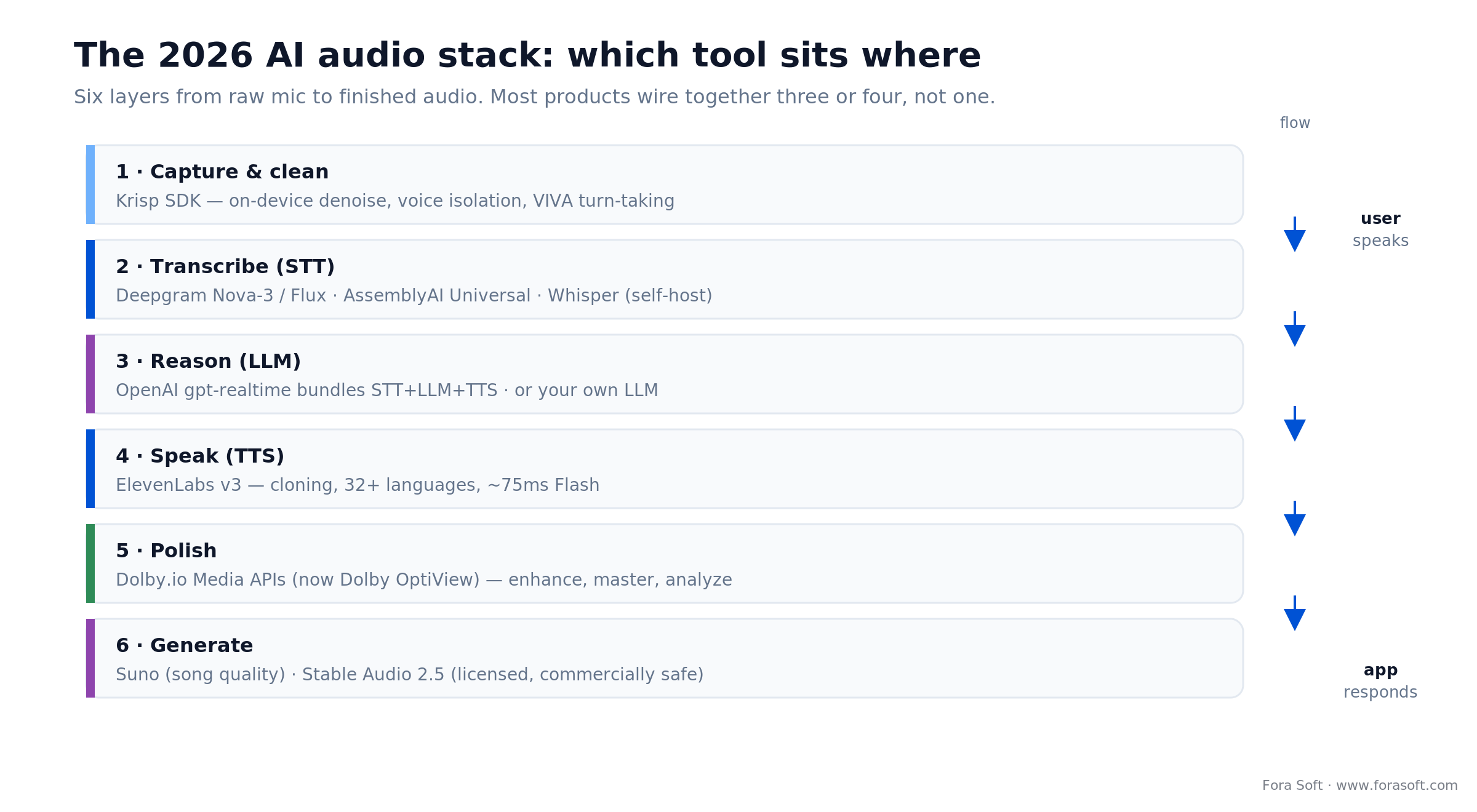
Figure 1. The audio stack in six layers. Each of the seven tools owns a slot; a real product usually wires together three or four of them.
AssemblyAI — transcription plus audio intelligence
What it is. A speech-to-text API with batch and streaming modes, speaker diarization, and a bundle of audio-intelligence features: summarization, sentiment, chapters, topic detection — you’d otherwise build with a second LLM call.
Why it matters in 2026. The Universal model line holds up well on noisy, accented English, and the extras save real engineering time on podcast, meeting, and legal/medical workflows. If your feature is “turn this recording into structured notes,” this is the shortest path there.
2026 pricing. Pre-recorded Universal is $0.15/hour; the newer Universal-3.5 Pro runs $0.21/hour; streaming is $0.15/hour on Universal, $0.45/hour on Universal-3 Pro. Billing is per second, and audio-intelligence add-ons bill separately (sentiment +$0.02/hr, summarization +$0.03/hr, entity +$0.08/hr, topic +$0.15/hr). There’s a $50 free credit. Rates on the AssemblyAI pricing page.
Where it breaks. Turn on three or four add-ons and the “$0.15/hour” headline doubles. And for sub-300 ms turn-taking it isn’t the tightest option — that’s the next tool.
Reach for AssemblyAI when: you need strong English accuracy plus summaries, chapters, or sentiment without a second LLM round-trip: podcasts, meetings, and recorded workflows.
Deepgram — lowest-latency streaming speech-to-text
What it is. A streaming STT platform built for tight loops, with the Nova-3 model family, on-prem and VPC deployment, and in 2025 a dedicated voice-agent model, Flux, plus a Voice Agent API.
Why it matters in 2026. Voice agents and live interpreters live or die on turn-taking latency. Deepgram consistently delivers the tightest streaming loop, and Flux adds turn-awareness so your agent knows when the caller actually stopped talking. The on-prem option is the only viable path for some regulated buyers.
2026 pricing. Nova-3 streaming is about $0.0077/min pay-as-you-go on the standard tier (roughly $0.0048/min for the monolingual model, near $0.29/hour); batch is cheaper at about $0.0043/min. There’s a $200 free credit and committed tiers cut the rate. Details on the Deepgram pricing page.
Where it breaks. The audio-intelligence layer is thinner than AssemblyAI’s, so if you want chapters and summaries out of the box you’ll bolt on your own LLM step.
Reach for Deepgram when: latency is non-negotiable: voice agents, live captioning, interpreting — or you need on-prem/VPC. See our take on speech-to-text for live streaming.
ElevenLabs — premium multilingual text-to-speech
What it is. A text-to-speech and voice-cloning platform with 32+ languages, professional and instant clones, an emotion-control API, and a low-latency Flash model around 75 ms time-to-first-byte.
Why it matters in 2026. ElevenLabs voices are hard to distinguish from human audio in blind tests, and the multilingual v3 model closed the accent gap. For audiobooks, dubbing, and premium voice agents it’s the default. The consent-verification flow also speeds up enterprise procurement.
2026 pricing. The TTS API is about $0.10 per 1,000 characters on Multilingual v2/v3 and $0.05 on Flash/Turbo (Flash bills at 0.5 credit per character). Creator is $22/mo, Pro $99/mo, with Scale/Business tiers adding commercial rights and volume. See the ElevenLabs pricing page. For the wider TTS field, we compared six engines in our synthetic voice libraries guide.
Where it breaks. Cost scales with characters, so a chatty agent that reads long responses gets pricey fast. And voice IDs can be deprecated, which is a real operational risk if you hard-code one.
Reach for ElevenLabs when: voice quality is the product: audiobooks, dubbed video, premium agents, personalised audio.
OpenAI Realtime API and Whisper — conversational agents
What it is. OpenAI’s Realtime API — the GA model is now gpt-realtime — bundles speech-in, reasoning, and speech-out into one WebRTC/WebSocket session. Whisper stays the open-weight workhorse for batch transcription.
Why it matters in 2026. Realtime collapses the STT→LLM→TTS triple-hop into one call, so end-to-end latency lands near 300 ms without you synchronising three vendors. For a greenfield voice agent it’s the fastest route to a working demo.
2026 pricing. gpt-realtime audio is billed at roughly $32 per 1M input tokens and $64 per 1M output tokens — about 20% below the old preview model, and there’s a cheaper gpt-realtime-mini. In practice that’s near $0.06–0.12 per minute of live conversation. Whisper via API is about $0.006/min; the open weights are free to self-host, and whisper.cpp runs on-device.
Where it breaks. Convenience has a price. At scale, one bundled vendor costs multiples of a specialist stack (we do the math below), and you trade away fine-grained control of each stage.
Reach for OpenAI Realtime when: you’re building a conversational agent from scratch and want one session to manage — or you need a free on-device transcription fallback via Whisper.cpp.
Krisp — on-device noise cancellation and turn-taking
What it is. A noise-cancellation, voice-isolation, and accent-conversion SDK that runs entirely on-device, now with VIVA turn-taking models that predict when a speaker is about to finish and whether a mid-response noise is a real interruption.
Why it matters in 2026. The quality of every downstream step (STT, agents, recordings) is capped by how clean the mic signal is. Krisp cleans it before the network hop, which cuts both bandwidth and downstream API cost. On the turn-taking side, Krisp reports roughly 3.5× better accuracy and now processes over a billion minutes a month, which matters because clumsy turn detection is what makes voice agents feel robotic.
2026 pricing. The consumer app is around $8/month; the developer Voice AI SDK is quote-based, typically per active user or per concurrent seat.
Where it breaks. It’s a pre-processor, not a transcriber or a voice — it makes the other tools better, it doesn’t replace them. And SDK pricing is opaque until you talk to sales. For the accuracy math behind denoising, see our guide to speech recognition in noisy environments.
Reach for Krisp when: your users are on imperfect hardware or in noise: call centres, field ops, cars, cafes, transit — or your voice agent needs natural turn-taking.
Dolby.io Media APIs — mastering, enhance, diagnose
What it is. A set of REST APIs for broadcast-grade post-processing: Enhance (denoise plus EQ), Master (loudness normalization), Diagnose, and Analyze. Note the 2025 rebrand — the platform now lives under Dolby OptiView, though the media REST APIs and clients carry over.
Why it matters in 2026. For podcast platforms, UGC apps, and creator tools, one Enhance pass on an amateur recording lifts perceived quality a full tier — the difference between “phone call” and “studio.” It does in one API call what used to need an audio engineer.
2026 pricing. Pay-as-you-go per minute; Enhance sits around $0.06–0.08/min and Master near $0.10/min, with a free tier for small creators. Confirm current rates against the OptiView plans, since the rebrand moved some packaging around.
Where it breaks. It’s async, file-based post-processing, not a real-time filter — don’t reach for it inside a live call. And the brand churn means older tutorials point at dead URLs, so budget a little integration archaeology.
Reach for Dolby’s media APIs when: you run a podcast tool, UGC video app, or creator platform and need studio-grade audio from user uploads without a human in the loop.
Suno and Stable Audio 2.5 — music and sound generation
What they are. Two generative-music options. Suno produces full songs with vocals and leads on quality. Stable Audio 2.5 from Stability AI generates instrumental tracks and sound effects and, importantly, is trained on a fully licensed dataset.
Why they matter in 2026. Music is the newest slot in the audio stack and the riskiest on rights. Suno sounds best but has no official public API — access is the web app or third-party resellers. Stable Audio ships a real API (via Stability, fal, or Replicate), renders a three-minute track in under two seconds, and its licensed-data posture is far easier to defend to a commercial buyer.
2026 pricing. Suno is $10/mo (Pro) or $30/mo (Premier) for commercial rights on the web app; third-party APIs run roughly $0.014–0.111 per song. Stable Audio 2.5 runs about $0.20 per request on fal, with enterprise on-prem licensing available.
Where it breaks. Copyright. The US Copyright Office has said work generated entirely by AI from a prompt generally isn’t protectable — writing the prompt doesn’t make you the author. Read the Copyright Office AI guidance before you build a business on generated tracks. If a song idea is coming from our music-app work, we route product teams to Stable Audio for anything shipping commercially.
Reach for generated music when: your product needs background tracks or SFX: UGC apps, indie games, ad creative, short-form video. Default to Stable Audio 2.5 for commercial ship; use Suno when vocal-song quality is the point and the use is internal.
The seven AI audio tools compared
One view of the whole shortlist. Read the “where it breaks” column as hard as the price column — that’s the one procurement forgets.
| Tool | Slot | Latency | 2026 price | Where it breaks |
|---|---|---|---|---|
| AssemblyAI | STT + audio intel | 0.5–2 s | $0.15/hr | add-ons stack up |
| Deepgram | Streaming STT | <300 ms | ~$0.0077/min | thin audio-intel layer |
| ElevenLabs | Premium TTS | ~75 ms Flash | $0.10/1k chars | cost scales with words |
| OpenAI Realtime | STT+LLM+TTS bundle | <300 ms | ~$0.06–0.12/min | priciest at scale |
| Krisp | Denoise + turn-taking | on-device | quote / seat | pre-processor only |
| Dolby media APIs | Master / enhance | async | $0.06–0.10/min | not real-time |
| Suno / Stable Audio | Music & SFX | async (<5 s) | $10–30/mo · ~$0.20/req | rights & copyright |
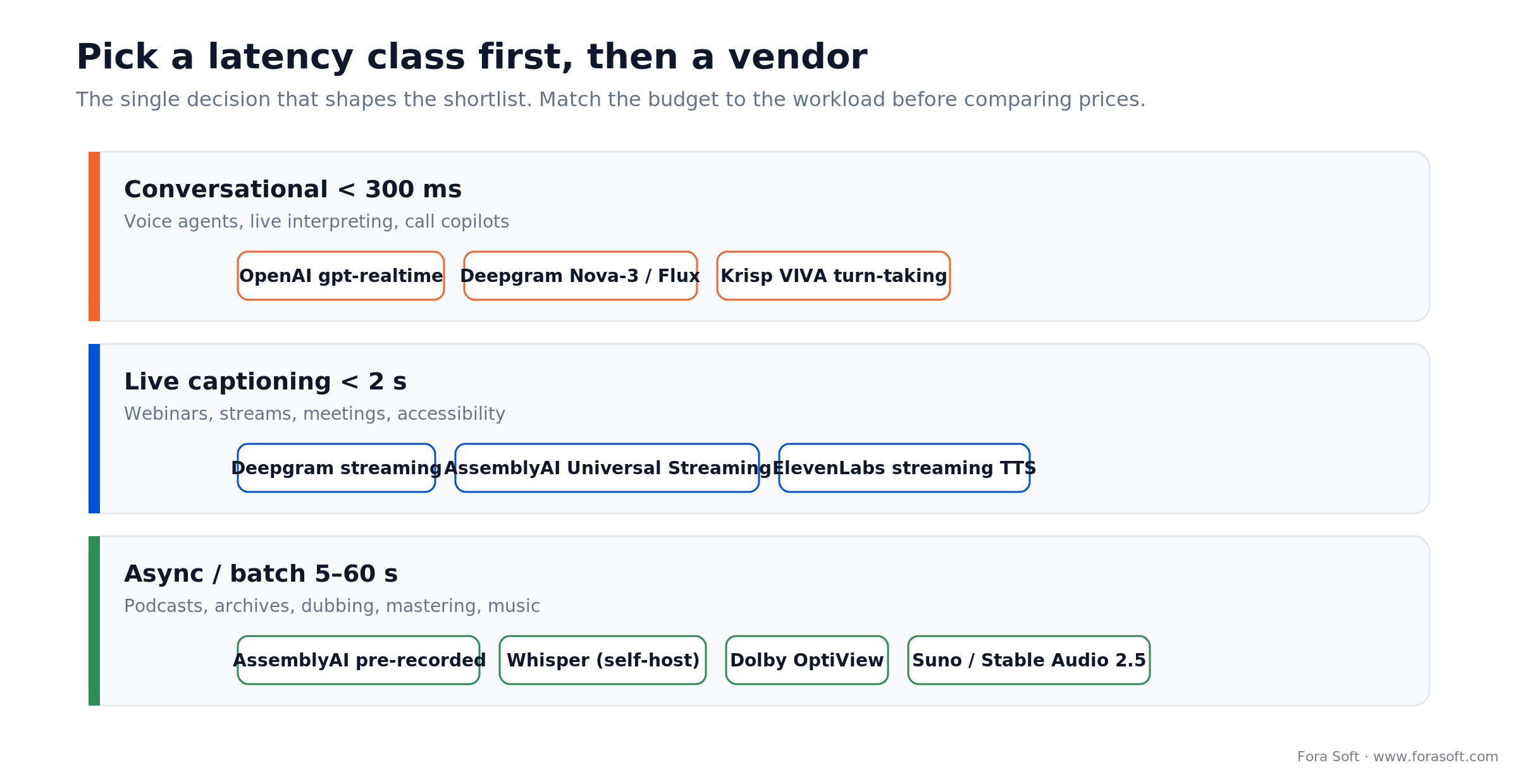
Figure 2. The same seven tools sorted by latency class. Choose the band your workload lives in first; the vendor list narrows itself.
Mini-case: building TransLinguist’s real-time translation stack
The problem. TransLinguist needed live, speech-to-speech interpretation inside video calls — a speaker in one language, listeners hearing another within a couple of seconds, across 75+ languages, reliable enough to win a national healthcare contract. No single vendor covered every language pair at the accuracy bar.
The stack we built. We put the STT layer behind an abstraction and routed each language to its best engine: Deepgram, Google Cloud Speech, or Speechmatics — then fed a translation and text-to-speech step, all riding one MediaSoup/WebRTC pipeline with FFmpeg for recording. The router meant a weak language pair on one engine could fall back to another without touching the app.
The outcome. The platform now offers AI speech-to-speech translation in 16+ languages and captioning in 22, serves a marketplace of 30,000+ interpreters, won the UK NHS national framework for language services, and has been featured twice in Slator. The multi-engine routing is the part we’d reuse on any serious audio product — and it’s the same instinct behind this whole guide: no single tool wins every slot. Want a similar assessment of your stack?
Build vs buy: the MAU threshold
The honest rule we give clients: integrate until roughly 5,000 monthly active users, then reconsider. Below that, hosted vendors are cheaper and safer than anything in-house. Above it, fine-tuned and partly self-hosted pipelines start to pay off — especially if your audio is distinctive: medical jargon, a specific accent, a domain vocabulary the big models fumble.
Four buyer profiles and what we actually recommend:
Pre-seed / MVP. OpenAI Realtime for a voice agent, AssemblyAI for podcast features. One-vendor simplicity beats a 4% cost optimisation you don’t have time for.
Seed to Series A. Split the stack (Deepgram plus ElevenLabs plus Krisp) and lock volume discounts before traffic arrives.
Growth (10k+ MAU, noisy or accented audio). Fine-tune Whisper on your corpus, keep Deepgram as fallback, self-host denoising where the latency budget allows.
Enterprise / regulated. On-prem Deepgram or a custom Whisper deployment, ElevenLabs via private endpoint, and a signed DPA with every vendor.
Not sure whether to integrate or build?
We’ll cost-model both at your projected MAU and run a two-week spike on your own audio before anyone commits to an architecture.
Cost math: a 10,000-MAU voice app
Assume 10,000 MAU, an average of 6 minutes of conversation per user per month, and 60% of caller-side audio needing denoise. Here’s the arithmetic, at 2026 list prices:
Talk volume: 10,000 × 6 min = 60,000 minutes = 1,000 hours/month.
Deepgram STT: 60,000 min × $0.0043/min on a committed streaming tier ≈ $258/mo.
ElevenLabs TTS: the agent speaks about half the talk time: roughly 15.6 million characters on the Flash model at $0.05 per 1,000 ≈ $780/mo.
Krisp denoise: $0.10 per active user (assumed SDK rate) × 6,000 noisy users = $600/mo.
Specialist total ≈ $1,638/mo. The same talk volume on OpenAI gpt-realtime alone lands near $3,900/mo — about 2.4× more. That $2,300 delta is the price of one-vendor simplicity. At 10k MAU it can be worth paying; by 100k it isn’t.
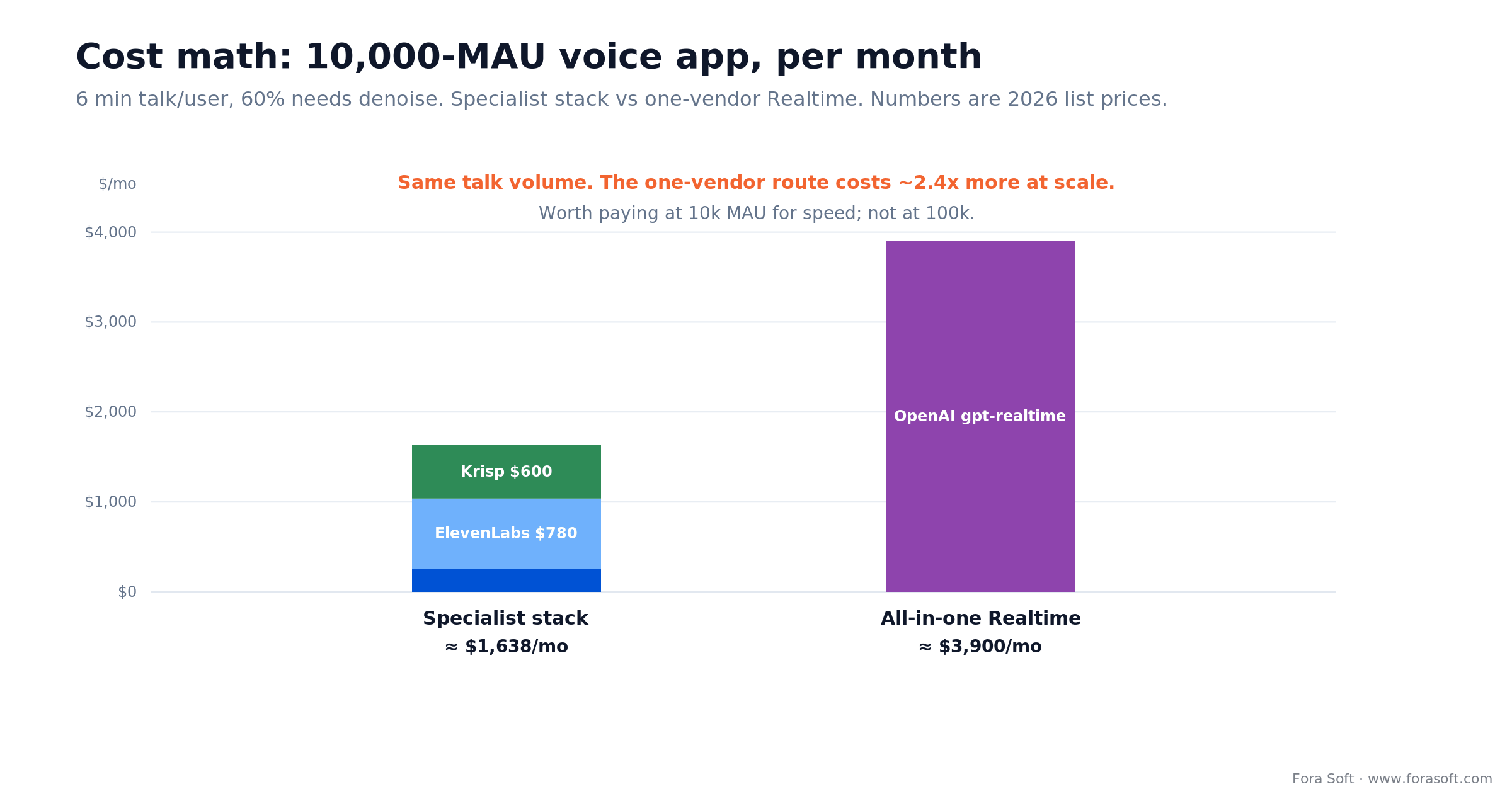
Figure 3. The specialist stack versus one-vendor Realtime at 10,000 MAU. Convenience roughly doubles the monthly bill.
Licensing and rights: the part procurement rejects
Accuracy gets the demo approved. Licensing gets the launch approved. Three clauses trip up more audio products than any benchmark, so check them before you fall for a voice.
Voice-clone consent. If you clone a real person’s voice, you need documented consent from that person. ElevenLabs enforces a verification flow for exactly this reason. Skipping it is a lawsuit, not a shortcut.
Music output rights and copyright. Suno grants commercial rights on paid tiers, but the US Copyright Office position is that fully AI-generated tracks may not be protectable at all — you can use them, but you may not own them. Stable Audio’s licensed-data training is the more defensible base for anything you ship commercially.
Speech-data retention. For healthcare and finance, where the recording goes and how long it lives is the whole conversation. AssemblyAI, Deepgram, and OpenAI offer BAAs on the right tiers; Krisp runs client-side, which moves the question back to your own app. Get every term in writing.
5 integration pitfalls we’ve fixed
1. Denoising after STT instead of before. Cleaning audio after transcription removes audible hiss but can’t recover the accuracy you already lost. Put Krisp, or any denoiser, at the microphone boundary.
2. Billing per attempt, not per result. Most STT vendors bill for the open stream, not the words returned. A user who abandons mid-sentence still costs you. Add client-side voice-activity detection to close idle streams.
3. Hard-coding a single voice ID. Voices get deprecated with short notice. Put a “character → voice-id” map behind the call and keep a fallback so a deprecation is a config change, not an outage.
4. Ignoring codec negotiation. Opus at 48 kHz beats G.711 at 8 kHz by a wide margin on word error rate. If your WebRTC signalling quietly falls back to narrowband, your accuracy drops and no model can fix it.
5. Treating music generation as a feature, not a legal question. Teams ship generated tracks, then discover at the licensing review that they can’t own or clear them. Decide the rights posture before you wire the API.
KPIs: what to actually measure
Quality KPIs. Word error rate on your own audio (not the vendor’s demo set), mean opinion score for TTS naturalness, and signal-to-noise gain from the denoiser in decibels. Track them on real user recordings, sampled weekly.
Business KPIs. Cost per active minute, blended vendor spend per MAU, and the share of sessions that hit a paid feature. If cost-per-minute climbs faster than revenue-per-minute, the stack needs a rebalance.
Reliability KPIs. End-to-end turn latency at the 95th percentile, stream error rate, and failover success rate when a primary engine times out. A voice agent that’s fast on average but janky at p95 still feels broken.
When NOT to add AI audio tools
Honesty sells better than a feature list, so here’s the counter-case. If your audio is a one-off (a handful of files a week), a hosted consumer app beats any API integration on cost and effort. If your users are all on studio hardware in quiet rooms, a denoiser adds latency and spend for no measurable gain. And if you’re pre-product-market-fit, a bundled model like OpenAI Realtime gets you to a testable demo faster than a three-vendor stack you’ll rip out anyway once you learn what users need.
Add the specialist stack when the audio feature is core to the product and the volume justifies the integration — not before. Over-engineering the audio layer of an app nobody uses yet is the most common way we see teams burn a quarter.
A decision framework in five questions
Answer these in order and the shortlist writes itself.
Q1. What’s the latency budget? Under 300 ms means Deepgram or OpenAI Realtime. Seconds are fine? AssemblyAI or Whisper open the field.
Q2. Is voice output part of the product? If yes, ElevenLabs for quality, or OpenAI Realtime if it’s bundled into the agent.
Q3. Are your users in noise? If yes, Krisp at the mic before anything else touches the signal.
Q4. Do you generate or just process audio? Generating music or SFX pulls in Stable Audio or Suno — and a licensing review.
Q5. What’s your MAU and regulatory surface? Under 5k and unregulated, integrate. Above that or regulated, plan for fine-tuning, on-prem, and DPAs. Still unsure after five questions? That’s the conversation we have on a scoping call.
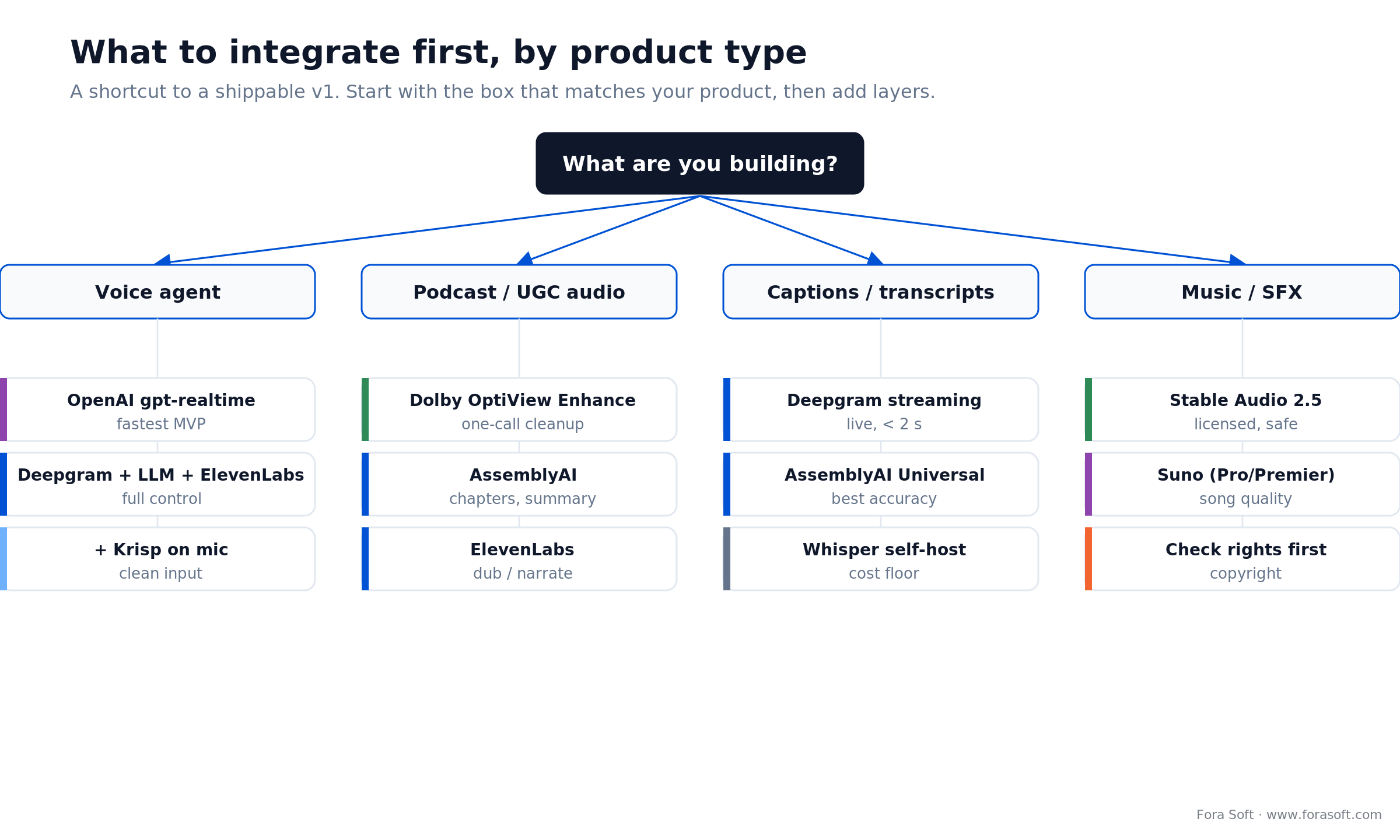
Figure 4. What to integrate first, by product type. Start at the box that matches your product and add layers from there.
Frequently asked questions
What are the best AI audio tools for app development in 2026?
For most product teams the working set is Deepgram or AssemblyAI for speech-to-text, ElevenLabs for text-to-speech, Krisp for on-device denoise and turn-taking, Dolby’s media APIs for post-production, and Suno or Stable Audio 2.5 for music. OpenAI Realtime (gpt-realtime) is the fastest way to a voice-agent MVP but costs more at scale.
Do I really need a denoiser if my STT is good?
Usually yes. Modern STT models handle noise only to a point, but every decibel of signal-to-noise improvement upstream lowers word error rate downstream — and cuts LLM cost if you chain STT into an agent. Put the denoiser before the STT engine, at the microphone, not after.
Can I run AI audio tools on-device in 2026?
STT and denoise, yes: whisper.cpp, Moonshine, and the Krisp SDK run on modern phones and laptops. Premium TTS at ElevenLabs quality is still cloud-only, though smaller on-device voices work for non-premium cases. Music generation is cloud-only for now.
Who owns music generated by Suno or Stable Audio?
It depends on the plan and the platform. Suno grants commercial usage rights on Pro and Premier; the free tier is personal-only. But the US Copyright Office holds that work generated entirely by AI generally isn’t copyrightable, so you may be able to use a track without being able to own it. Stable Audio 2.5’s licensed-data training is the safer base for commercial products. Read both terms in full and keep a lawyer in the loop.
What’s a realistic latency for a voice agent?
End-to-end — user stops speaking to agent starts speaking — of 250–500 ms is achievable with Deepgram plus an LLM plus ElevenLabs and solid WebRTC plumbing. OpenAI Realtime alone lands in the 200–400 ms band. Above one second, users start talking over the agent.
Is HIPAA a blocker for AI audio tools?
Not for this shortlist. AssemblyAI, Deepgram, and OpenAI offer BAAs on appropriate tiers, and ElevenLabs offers one on enterprise plans. Krisp runs client-side, so the HIPAA question shifts to your own app. Always confirm BAA scope in writing before you ship.
What about AWS Transcribe, Google, and Azure Speech?
They’re reasonable defaults if you’re already deep in one cloud and accept slightly lower accuracy and latency. For a dedicated audio product, the specialists win the benchmarks and the developer ergonomics. We use AWS Transcribe on projects like VocalViews where the app already lives on AWS.
How long does a real integration take?
A two-vendor voice agent (STT plus TTS) is 2–4 weeks to a working demo and 8–12 weeks to production with denoise, observability, and fallback paths. Music generation is a fast REST call, but the licensing and moderation review adds weeks. Podcast enhancement via Dolby’s API is the quickest, often under a week to a shipped feature.
Read next
Voice & TTS
6 Best Synthetic Voice Libraries for App Development in 2026
ElevenLabs, OpenAI, Google, Polly, Azure, and Cartesia compared for developers.
Speech recognition
Speech Recognition Accuracy in Noisy Environments
The denoise-plus-STT stack and WER math for real-world audio.
Live streaming
Speech-to-Text for Live Streaming in 2026
API pricing, latency, and integration tactics for live captions.
Video & AI
AI Video Enhancement Tools Compared
The video-side counterpart to this audio stack, for streaming teams.
Which AI audio tools should you actually ship?
There’s no single best tool — there’s a stack. For most teams shipping this year the path is Deepgram or AssemblyAI for speech-to-text, ElevenLabs for text-to-speech, Krisp for denoise and turn-taking, Dolby’s media APIs for post, and Stable Audio 2.5 or Suno if music is part of the product. OpenAI Realtime is the fastest route to a voice-agent MVP, at roughly 2.4× the per-minute cost of the specialist stack once you scale.
The order of decisions never changes: latency class first, licensing posture second, SDK coverage third, unit economics last. Run a two-week spike on your own audio before you sign anything annual — and if you want a second pair of eyes that has shipped this before, that’s us. For the deeper audio engineering behind these choices, our Audio for Video knowledge base goes layer by layer.
The handbook · 7 volumes
Fora Soft Video Engineering Handbook
Picking the AI audio tools is the easy part; wiring them into an app that sounds right is where teams lose months. We wrote seven volumes covering the whole video and audio stack. Start with Volume 6 on ASR, TTS and diarization, then Volume 4 on Opus, loudness, echo cancellation and noise suppression, and Volume 7 on real-time voice agents and cost. Written by Nikolay Sapunov, CEO at Fora Soft.
Browse the handbook on Amazon →7 volumes · 9,000+ pages · Kindle & paperback
Ready to validate your AI audio stack?
In 30 minutes we’ll sketch the vendor shortlist, latency budget, licensing posture, and an 8–12-week delivery plan for your audio product.
Sources & references: AssemblyAI, Deepgram, ElevenLabs, OpenAI, Krisp, Dolby OptiView, Suno, and Stability AI official 2025–2026 pricing and documentation; US Copyright Office AI guidance; IETF RFC 6716 (Opus); Fora Soft TransLinguist and VocalViews client projects.

