

Key takeaways
• A telemedicine software development company de-risks the launch. HIPAA, FHIR, video QoS, DEA prescribing rules and state licensure all collide on day one. An experienced partner has shipped this stack before.
• Custom MVP costs $40K–$70K and takes 3–5 months. A mid-tier build with EHR integration runs $70K–$150K in 5–9 months. Compliance adds 20–30% on top of every tier.
• White-label cuts time-to-market by 80%. $50K–$120K and 4–8 weeks for a clinically usable product, vs. 12–24 months for a fully custom build. The hybrid model wins for most growth-stage operators.
• Video vendor choice is a real decision again, not a default. Twilio reversed its Programmable Video shutdown in October 2024, so it stays on the table next to Daily.co, LiveKit, Agora and AWS Chime SDK. WebRTC, FHIR R4 and SMART on FHIR are the 2026 baseline, not add-ons.
• Compliance gaps are the #1 budget killer. OCR logged 663 large breaches in 2024 exposing ~243M records; Medicare telehealth funding now runs through Dec 31, 2027, while DEA controlled-substance tele-prescribing sits on a temporary extension to Dec 31, 2026.
Why Fora Soft wrote this playbook
We have been building real-time and video-first software since 2005, and 250+ shipped projects later, healthcare is the vertical where the technical choices, the regulation, and the user experience all have to land at the same time. Our telemedicine software development team has shipped HIPAA- and HITECH-compliant telemedicine platforms, integrated WebRTC into electronic medical record (EMR) systems with prescription routing, and connected mobile patient apps to multi-state provider networks — from CirrusMED’s Nevada Direct Primary Care platform to AirDoctor, a travel-telemedicine service connecting 20,000+ doctors to patients abroad. The track record runs deep: 50 in-house engineers, a 5.0/5.0 average across 30 Clutch reviews, and a 100% job-success rate on Upwork.
One flagship telemedicine build, CirrusMED, is a HIPAA-compliant “Netflix for Medicine” platform we built from scratch for a Nevada Direct Primary Care practice: patients subscribe to a doctor and get unlimited browser-based video visits, 24/7 messaging, prescription management and an EMR, no per-visit fees. It now supports 20+ physicians licensed across 48+ US states, all on a WebRTC, React and Node.js stack on AWS. Our adjacent video platform BrainCert, the world’s first WebRTC HTML5 virtual classroom, serves 100,000+ customers, holds HIPAA, GDPR, SOC 2 and ISO certifications, and has delivered 500M+ video minutes. Fifty in-house engineers ship both.
Everything below is what we have learned shipping this category. Where we cite numbers, they come from public 2025–2026 research (HHS Federal Register, Grand View Research, McKinsey, ATA, Accountable HQ, Daily.co engineering, FDA Digital Health Advisory Committee). Where we cite project facts, they come from our own delivery work.
Written by Fora Soft’s healthcare engineering team and reviewed by Polina Sapunova, co-founder and healthcare lead.
Need a second opinion on your telemedicine architecture?
Send us your wireframes, EHR target and target launch date. We’ll come back with a 1-page scoping note in 48 hours — no slide deck, no upsell.
What a telemedicine platform development company actually does
A telemedicine software development company is not a generic web shop. The deliverable is a HIPAA-grade, video-first, EHR-integrated product with auditable provider workflows, and the team has to be fluent in five disciplines that rarely live under the same roof: regulated software engineering, real-time WebRTC, healthcare interoperability, clinical UX and DevSecOps for healthcare cloud.
In a typical 5–9 month engagement, the work breaks down into seven workstreams. They run partly in parallel and they lock at well-defined gates: That is how a competent partner protects the launch date.
1. Regulatory mapping. Decide what regulations apply (HIPAA, HITECH, state laws, GDPR if EU, UK MDR if UK SaMD, DEA if controlled substances), then translate them into product requirements: BAAs signed with every PHI vendor, encryption-by-default, six-year audit log retention, multi-factor authentication, automatic logoff (15 minutes is the common convention), breach notification runbook.
2. Reference architecture. Pick the WebRTC topology (P2P, SFU or MCU), the cloud (AWS, Azure or GCP), the encryption posture (AES-256 at rest, TLS 1.2+ in transit), the EHR adapters (FHIR R4 first, HL7v2 where the legacy system requires it), and the identity provider with SSO and MFA enabled by default. Our deep-dive on P2P, SFU, MCU and hybrid WebRTC architectures spells out the decision rule.
3. Clinical workflow design. Provider intake, patient intake, consent capture, e-signature, visit notes templating, ICD-10 coding, CPT code assignment, e-prescribing routing (SureScripts), DEA-compliant flagging for controlled substances. This is where most generalist agencies fail, they ship Zoom plus a calendar and call it telemedicine.
4. Build and integration. Backend, web app, iOS, Android, video infrastructure (Daily.co, Agora, AWS Chime, LiveKit or self-hosted SFU), payments, insurance eligibility, EHR adapters, push notifications, analytics, observability.
5. Compliance verification. HIPAA Security Risk Assessment, penetration testing, SOC 2 controls mapping, audit log review, BAA execution with every subprocessor, documentation pack ready for OCR audit.
6. Launch and operations. Pilot with 50–200 users in a single state, monitor video drop rate, p95 latency, no-show rate, time-to-first-consult; tune; expand panel; expand states.
7. Post-launch maintenance. Quarterly DEA/CMS rule monitoring, monthly security patches, EHR vendor API change tracking, annual SOC 2 surveillance, app-store updates, compliance audit support. This rarely fits in 20 hours/month — budget 40–80.
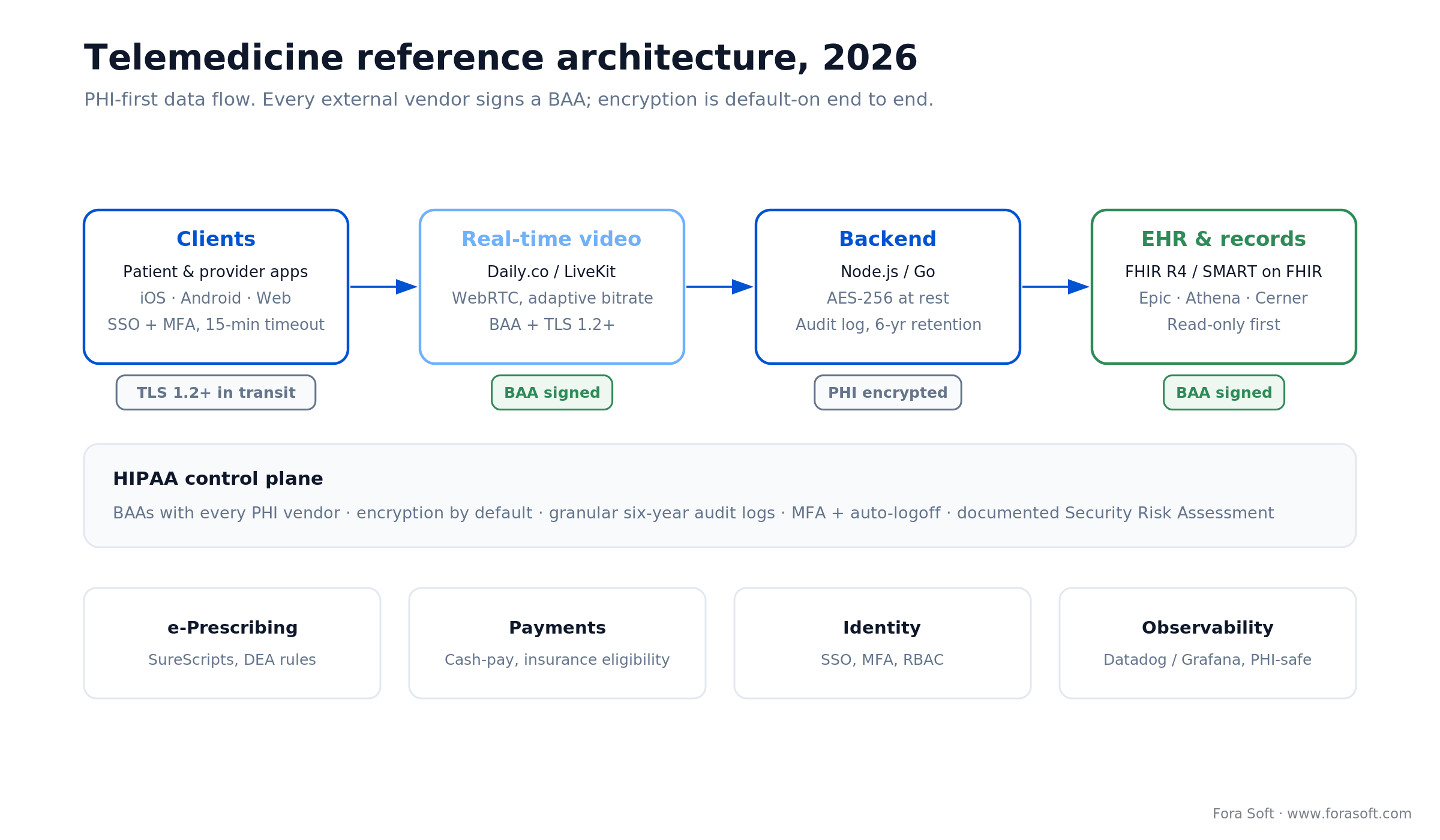
Figure 1. A HIPAA-first telemedicine architecture. PHI stays encrypted end to end and every external vendor signs a BAA.
The 2026 telemedicine market in numbers
Telemedicine is past the pandemic spike and into structural growth. The numbers are unusually consistent across research firms, which is rare for a digital health category, and they tell buyers the same story: the market is large, growing, and consolidating around platforms with EHR depth and clinical workflow specialization rather than feature parity.
| Metric | 2026 figure | CAGR | Source |
|---|---|---|---|
| Global telehealth market | $191B–$219B | ~24.7% | Fortune Business Insights, Towards Healthcare |
| Global telemedicine market | $104B–$189B | 15–20% | Precedence, Fortune BI, Mordor (2026) |
| US digital health | ~$200B by 2030 | ~14% | McKinsey & Company |
| National FHIR guides (exist / widely used) | 79% / ~20% | 2025 survey | HL7 / Firely State of FHIR |
| US adults willing to use telemedicine | ~38% | +22 pp vs 2019 | Industry surveys 2024–2025 |
| Healthcare data breaches (2024) | 663 large | ~243M records | HHS OCR / HIPAA Journal |
Three signals matter for buyers planning a 2026 launch. First, first-mover advantage is gone. Differentiation now comes from specialty depth (psychiatry, dermatology, primary care for seniors), EHR depth, and clinical outcomes, not from being early. Second, the regulatory picture is clearer than a year ago: Congress funded Medicare telehealth through Dec 31, 2027 (signed February 2026), DEA controlled-substance tele-prescribing is extended to Dec 31, 2026 while a permanent rule is written, and the AMA’s telemedicine CPT codes 98000–98016 are live for commercial payers — though Medicare declined most of them. Third, M&A activity from CVS, UnitedHealth and Amazon means consolidation is replacing greenfield funding, pick partners who can move fast.
Build vs buy vs white-label: pick the right path
There are three live paths to a telemedicine product in 2026. They have very different cost shapes, time-to-market, and ceilings. Pick wrong and you lose either money or 18 months: Usually both.
| Factor | Custom build | White-label | Hybrid |
|---|---|---|---|
| Time to market | 12–24 months | 4–8 weeks | 4–8 weeks then 9–15 months |
| Year-1 cost | $100K–$300K+ | $50K–$120K | $60K white-label + $80K–$200K migration |
| SOC 2 / HIPAA prep | $80K–$120K/yr you own | Inherited from vendor | Inherited then owned |
| Customisation ceiling | Unlimited | Vendor API limits | Vendor API then unlimited |
| Team needed | 6–12 engs + DevSecOps | 2–3 integrators | Grows with phase |
| Strategic moat | Highest | Lowest | High after migration |
Industry studies show the “conception to full-scale launch” baseline for custom telemedicine builds is roughly 23 months. White-label deployments hit production in 6–10 weeks. Custom builds also incur 30–50% cost overruns from compliance surprises, EHR friction and video QoS tuning — that is the part most procurement decks under-budget.
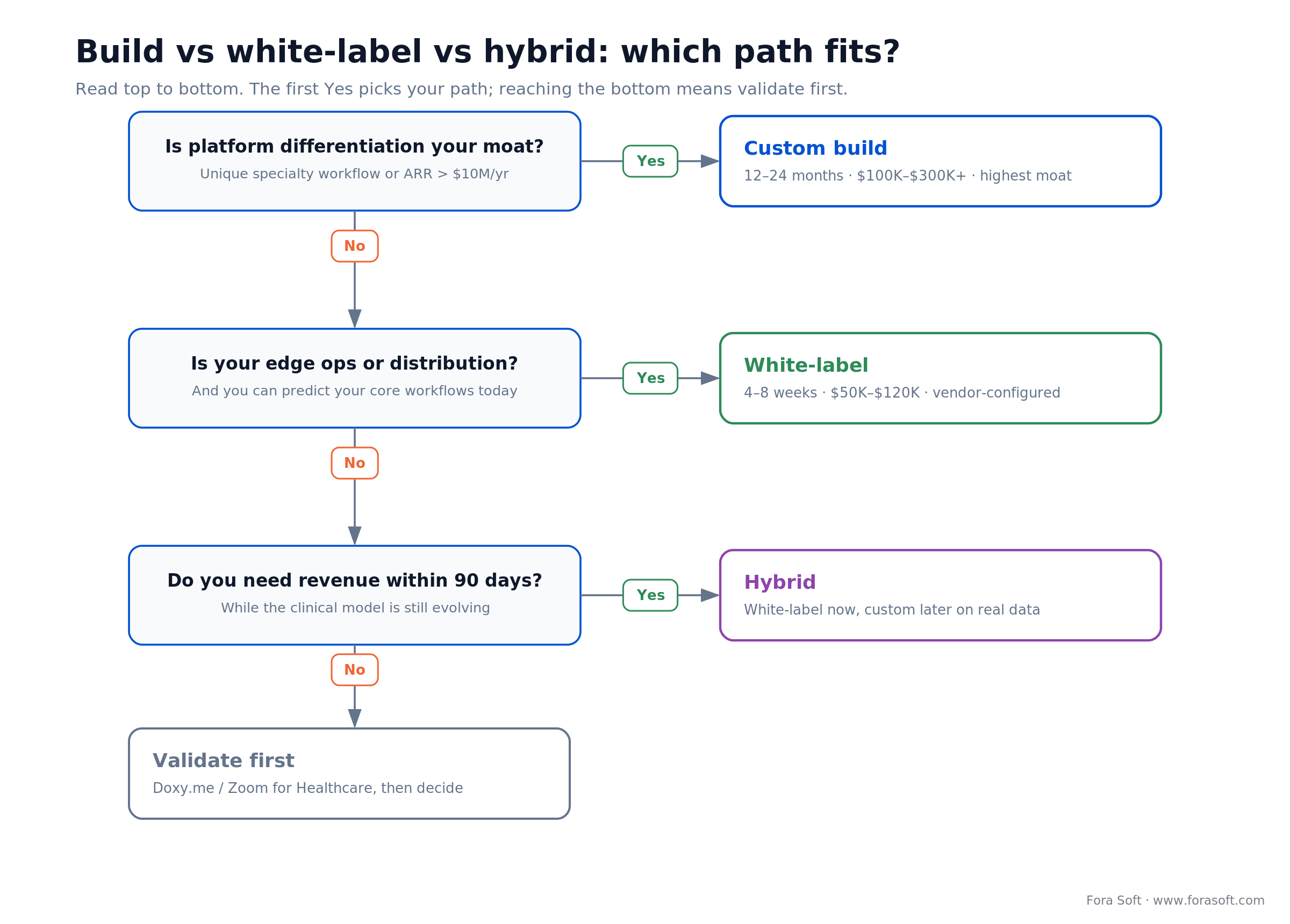
Figure 2. The first Yes decides your path, custom build, white-label, or hybrid.
Custom build path: when it pays off
A custom build is the right answer when the platform itself is the moat. When your specialty workflow, EHR depth, or scale economics cannot be expressed inside a vendor’s API. We see four signatures of a buyer who should custom-build:
1. Specialty workflow differentiation. Orthopedic surgery, psychiatric telehealth, dermatology with image AI, fertility clinics with cycle tracking — clinical UX that no white-label can deliver.
2. Scale economics. Projected ARR above ~$10M per year, where platform differentiation justifies the dev cost and the team to run it.
3. Existing infrastructure. A hospital system already running its own AWS or Azure stack with an in-house DevSecOps team. The marginal cost of telemedicine drops sharply. On this path our AI telehealth video platform development work adds AI scribes and FHIR R4 links to Epic or Oracle Health on a sub-300 ms WebRTC layer the hospital owns.
4. Strategic asset. The platform is a stand-alone product line, an M&A target, or a competitive lockout against a market entrant.
Reach for custom build when: your specialty workflow, EHR integration depth, or projected ARR > $10M makes platform differentiation a strategic lever, and you can absorb a 12–24 month timeline without losing the market window.
White-label path: when it pays off
A white-label telemedicine platform is a vendor-built product that you brand, configure, and resell or operate. Examples include Tellescope, Mend, Doxy.me Enterprise, Updox, eVisit and the white-label tier of Daily.co. They ship with HIPAA controls, BAAs, basic EHR connectors and SOC 2 reports already in place. You configure, you don’t engineer.
The white-label path makes sense for fast proof-of-concept, limited budgets, multi-region rollouts where regional compliance is the heavy lift, and operators whose advantage is clinical operations rather than tech. The trade-off: workflow ceilings, vendor API limits, and a roof on differentiation. You will hit the ceiling around month 12 if you grow fast.
Reach for white-label when: you need a clinically usable product live in 4–8 weeks, your differentiation is clinical operations or distribution rather than software, and your year-1 budget is below $200K.
Hybrid path: white-label now, custom later
For most growth-stage operators, the hybrid path is the rational answer. Deploy white-label in 4–8 weeks, run real clinical workflows for 6–12 months, collect operating data on no-show rate, revenue per visit, churn, NPS and provider occupancy. Then decide whether to custom-build a differentiator on top — or migrate the whole stack: Based on data, not slides.
This sequencing protects three things that pure custom builds tend to lose: cash (you don’t spend $200K on guesses), market timing (you ship before your clinical hypothesis goes stale), and team morale (the team ships product, not a perpetual roadmap).
Reach for hybrid when: your clinical model is novel enough that you cannot fully predict workflows, but your runway demands revenue inside 90 days. Use 6–12 months of operating data to justify the custom build.
The MVP scope you actually need
An MVP that misses any of the items below is not a telemedicine MVP, it is a video calling demo with a stethoscope on the cover slide. The list is opinionated and based on what the OCR audits, payer rules and DEA enforcement actually scope in 2026.
Core MVP (must ship)
- Authentication and authorization. Patient, provider and admin roles; SSO; MFA mandatory; 15-minute idle timeout.
- Appointment scheduling. Calendar sync, SMS/email reminders, no-show flagging, cancellation handling.
- Video and audio. HD video, adaptive bitrate, fallback to audio-only on weak networks, noise cancellation.
- Encrypted chat. Persistent messaging, file sharing for lab images, read receipts.
- Intake forms and consent. HIPAA-compliant form builder, e-signature, pre-visit questionnaires.
- E-prescribing. SureScripts integration, controlled-substance flagging, pharmacy routing.
- Payments and billing. Patient pay, insurance verification, CPT code assignment, receipts.
- Visit documentation. SOAP notes, ICD-10 coding, e-signature, audit trail of changes.
- Audit logging. User, timestamp, PHI accessed, action taken, IP — six-year retention.
MVP+ (ship in months 4–9)
- EHR integration. Read-only first: allergies, medications, lab results via FHIR R4 or HL7v2.
- Patient health record. Patient view of visits, meds, results.
- Insurance eligibility. Real-time check, claims submission, EOB tracking.
- Remote patient monitoring. Wearable ingestion (BP, glucose, HR), out-of-range alerts.
- Provider scheduling. Schedule, breaks, vacation coverage, multi-state coverage rules.
- Operational analytics. No-show, revenue per visit, NPS, provider occupancy, churn.
2026 regulatory must-haves
The AMA’s telemedicine CPT codes 98000–98016 (2025) must be wired into the billing flow for commercial payers. With the caveat that Medicare declined 98000–98015 and still wants standard office/outpatient E/M codes (99202–99215) with a telehealth place-of-service and modifier; only 98016 (virtual check-in) was adopted. Visit notes must capture visit type, chief complaint, assessment, plan, and provider credentials. The prescribing engine must enforce DEA rules for controlled substances, including the telemedicine flexibilities extended through Dec 31, 2026 while a permanent Special Registration for Telemedicine rule is finalized.
Want a 1-page MVP scope tailored to your specialty?
Tell us your clinical model, target states and EHR target. We’ll send back a feature list, an opinionated stack and a realistic timeline. In 48 hours.
Tech stack we recommend in 2026
Two things shifted in 2024–2025 that make every new telemedicine project revisit its stack. First, the Twilio Programmable Video scare: Twilio announced an end-of-life, then reversed it in October 2024, so Twilio is a supported option again — but teams that already moved to Daily.co, LiveKit, Agora or AWS Chime SDK have no reason to move back. Second, FHIR R4 is now the mandated US baseline — the 21st Century Cures Act requires certified health IT to expose a standardized FHIR API — so EHR adapters that still default to HL7v2 are a regression, not a baseline. If video quality is the make-or-break, our Learn track on video streaming covers the delivery fundamentals, and our Twilio Video migration guide compares the alternatives head to head.
| Layer | 2026 default | Strong alternatives | Notes |
|---|---|---|---|
| Video / RTC | Daily.co or LiveKit | Agora, AWS Chime SDK, Vonage | Pick a HIPAA-ready RTC vendor with a BAA; Twilio is viable again after its 2024 reversal. |
| EHR interop | FHIR R4 | HL7v2 (legacy), SMART on FHIR | Default to FHIR; keep HL7v2 only where the EHR demands it. |
| Cloud | AWS (BAA + HealthLake) | Azure for Healthcare, GCP Healthcare API | All three sign BAAs; pick by team skill. |
| Backend | Node.js or Go | Python (FastAPI), .NET, Elixir | Audit-friendly, well-staffed, mature HIPAA libs. |
| Mobile | Native iOS / Android | Flutter, React Native | Native still wins for video QoS; cross-platform OK for chat-heavy apps. |
| Encryption | AES-256 at rest, TLS 1.2+ | FIPS 140-2 HSM for keys | 2025 HHS guidance: encryption-by-default, not optional. |
| Observability | Datadog or Grafana stack | New Relic, Honeycomb | PHI-safe logs; sign BAAs. |
| AI / triage | Rule-based first | LLM (de-identified, human-in-loop) | No LLM is FDA-approved for diagnosis; advisory only. |
If you are evaluating real-time architectures, our briefing on P2P vs MCU vs SFU walks through the routing trade-offs in plain language, and our follow-up on building a scalable video streaming app covers what breaks at scale.
Reach for Daily.co or LiveKit when: you need a HIPAA-ready RTC vendor with adaptive bitrate, sub-150 ms p95 latency on rural 4G, and a BAA template ready to sign, without writing your own SFU.
HIPAA: what compliance really requires
“HIPAA-compliant out of the box” is the single most common red flag in vendor pitches. HIPAA compliance is contextual; it depends on how your specific platform handles protected health information. A HIPAA Security Rule overhaul proposed in the January 2025 Federal Register (still pending in 2026) would tighten all four pillars below, and OCR enforcement already leans this way.
1. BAAs with every PHI vendor. A signed Business Associate Agreement is a contract gate, not a checkbox: Cloud, RTC, observability, analytics, transcription, anywhere PHI travels. Without it, the chain is non-compliant.
2. Encryption by default. TLS 1.2+ in transit, AES-256 at rest, FIPS 140-2 modules for key management. Encryption is still “addressable” under the in-force Security Rule, but the January 2025 proposed rule would make it mandatory and drop the addressable/required split — so build encryption in as default-on now rather than retrofit it later.
3. Audit logs and access controls. Retain access documentation for six years (HIPAA’s documentation-retention rule; teams commonly keep the audit logs themselves that long to match). Log who accessed which PHI, when, from which IP, and what action was taken. Use unique user IDs (no shared logins), a short automatic logoff (15 minutes is the common convention), and MFA — mandatory MFA is part of the 2025 proposed rule and is already best practice. Our deep-dive on HIPAA-compliant video platforms goes through the audit-log schema we use in production.
4. Risk analysis and documentation. A Security Risk Assessment using HHS tools before go-live; documented remediation; annual re-assessment. OCR is now explicitly demanding a risk analysis for complex chains, telemedicine + EHR + AI transcriber + NLP pipeline counts as complex.
The enforcement reality: OCR logged 663 large breaches (500+ individuals) in 2024, exposing roughly 243M records. A single incident, Change Healthcare, accounted for about 192M. Civil penalties run in tiers up to roughly $2.1M per identical-violation category per year. Telemedicine architectures draw OCR scrutiny because PHI crosses multiple subprocessors.
GDPR, MDR and other regional rules
If your patient panel crosses borders, HIPAA is just one of the boxes. The regional regimes have different scopes, different breach windows, and different enforcement appetites. A multi-region launch typically adds 30–50% to development overhead per new jurisdiction — phase regions, do not parallelize.
GDPR (EU/EEA). Health data is “special category” under Article 9; both a lawful basis and an Article 9(2) condition required for every processing activity. 72-hour breach notification to authorities, 30-day notice to affected individuals. Penalties up to EUR 20M or 4% of global revenue.
UK medical devices. New post-market surveillance rules took effect June 16, 2025, tightening incident reporting and traceability. A clinical-decision-support telemedicine app still needs Software as a Medical Device classification; the Great Britain route is UKCA marking, but CE-marked devices stay accepted in GB through June 2028–2030 by type, and MHRA is consulting on recognising them indefinitely. Budget for post-market surveillance either way.
Canada (PHIPA / PIPEDA). “Reasonable steps” standard; less prescriptive than HIPAA but enforceable. Penalties: CAD $200K (individual), CAD $1M (organization).
India (DPDPA 2023). Core obligations effective May 13, 2027. Consent-by-default model; DPO required above thresholds; administrative penalties up to INR 250 crore.
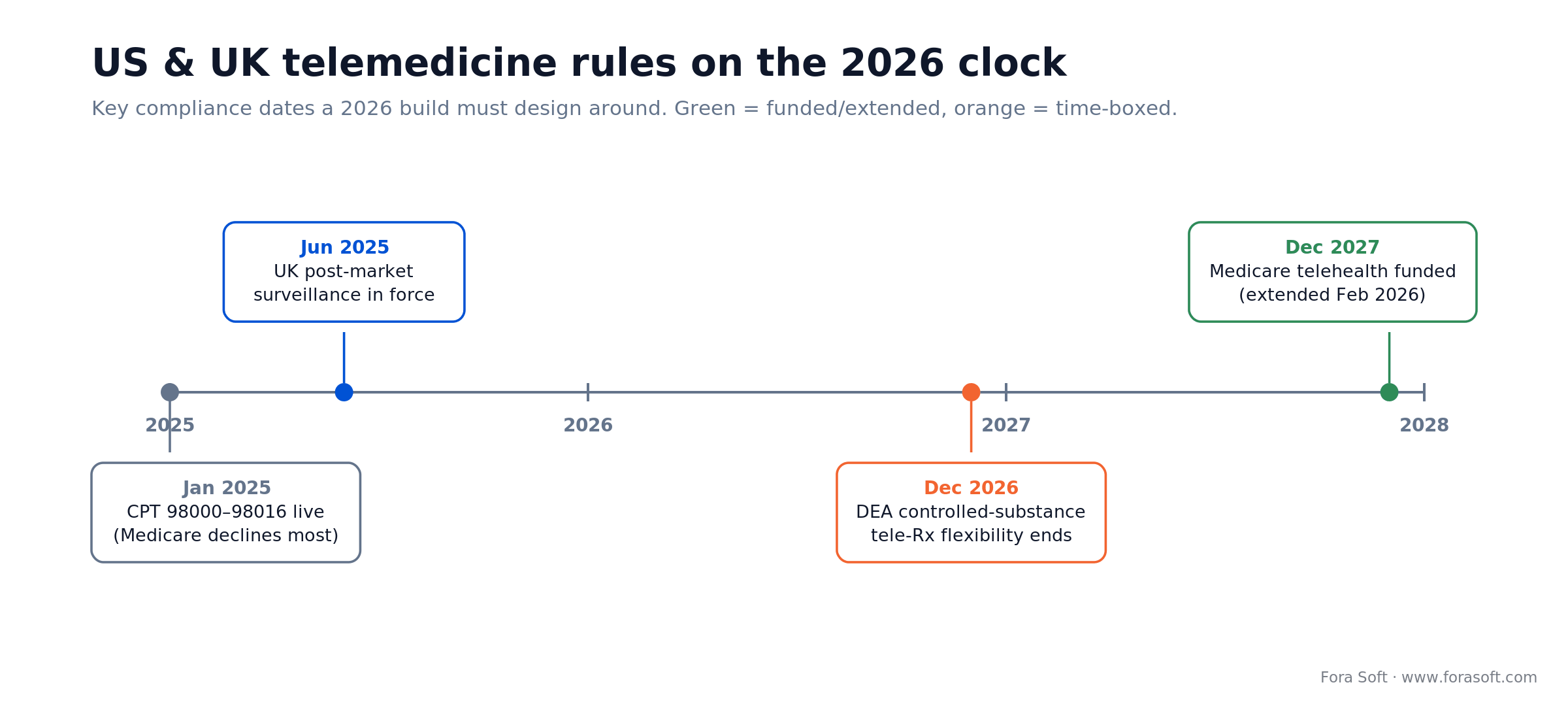
Figure 3. The compliance dates a 2026 telemedicine build has to design around.
EHR integration: FHIR, HL7v2 and SMART on FHIR
EHR integration is the #1 hidden cost in telemedicine builds. Vendors lowball it because the work looks routine on paper, then 6–12 months disappear in mapping schemas, negotiating BAAs and chasing API access. The 21st Century Cures Act made FHIR-based APIs mandatory for certified health IT, with up to $1M per violation for “information blocking”. That part is non-negotiable. Pick the right standard up front.
| Standard | Best for | Time | Cost |
|---|---|---|---|
| FHIR R4 | Cloud-native, mobile, real-time | 4–8 weeks | $15K–$35K |
| HL7v2 | Legacy on-prem EHR transactions | 6–12 weeks | $20K–$40K |
| SMART on FHIR | Patient portals, third-party apps | 4–6 weeks | $10K–$20K |
Our default in 2026 is FHIR R4 first, with a thin HL7v2 layer only where the target EHR (typically older Cerner or eClinicalWorks deployments) cannot serve modern FHIR endpoints. Epic and Athenahealth are FHIR-mature; Cerner/Oracle Health is still mixed. Read-only first, allergies, current meds, latest labs — before attempting bidirectional writes.
A practical scope-control rule we use on every project: write the EHR integration scope as one sentence and refuse to expand it during build. “Read allergies, active medications and last 5 labs from Epic via FHIR” ships in 6 weeks. “Sync everything bidirectionally” rarely ships at all.
What it costs and how long it takes
Public 2025–2026 research clusters cost ranges across four tiers. The numbers below are external benchmarks. Our own baseline for a functional telemedicine product: Paid video consults, scheduling, an EMR and a HIPAA control set, typically lands in the enhanced-MVP band (roughly 3–5 months) rather than the year-plus the public benchmarks assume, because we ship with a pre-built compliance and video toolkit. Where AI-assisted engineering fits a workstream, we usually compress mid-tier and enterprise builds by another 15–25%.
| Tier | Public benchmark cost | Public benchmark time | Includes |
|---|---|---|---|
| Basic MVP | $13K–$50K | 2–3 months | Profiles, scheduling, basic video, chat |
| Enhanced MVP | $40K–$70K | 3–5 months | + e-prescribing, payments, intake |
| Mid-complexity | $70K–$150K | 5–9 months | + EHR integration, advanced workflows |
| Enterprise | $150K–$300K+ | 9–16 months | Full EHR sync, AI triage, RPM, analytics, white-label |

Figure 4. Public 2026 benchmark build ranges by tier; add 20–30% for HIPAA and compliance on every tier.
Three numbers buyers consistently under-budget. Compliance adds 20–30% to every tier — HIPAA controls, BAAs, SOC 2 readiness, audit logging, pen-testing. EHR integration adds $20K–$40K and 4–8 weeks per major EHR even for read-only scope. Post-launch maintenance lands at 40–80 hours per month, not the 20 most procurement decks assume.
For an apples-to-apples view of how RTC-heavy products price out, see our breakdown of WebRTC development costs. Many of the same drivers (concurrency, bandwidth, vendor lock-in) shape telemedicine pricing too.
Mini case: the CirrusMED telemedicine platform
Situation. A Nevada Direct Primary Care physician wanted to turn a subscription care model into software: patients pay a flat monthly fee and get unlimited video visits and messaging instead of per-visit billing. The practice came through the InNEVator accelerator (2021) and needed a HIPAA-compliant, browser-based product. Shipped, not specced.
What we built. CirrusMED, a “Netflix for Medicine” platform on WebRTC, React and Node.js (AWS, MongoDB, Stripe). It ships DPC and one-time subscription plans from $39/mo, peer-to-peer video visits, 24/7 asynchronous messaging, an EMR that tracks allergies, history, vitals and prescriptions, prescription management, lab and imaging referrals, collaborative document sharing, and appointment scheduling with SMS/email reminders. HIPAA controls were baked in from day one — encryption by default, audit logging, and BAAs with every PHI subprocessor.
Outcome. The platform now supports 20+ physicians licensed across 48+ US states, with plans to reach all 50, all on the DPC subscription model rather than per-visit fees. The client’s public review, from Christopher Highley (owner, Preferred Family Medicine): “A detailed wireframing and user stories are done in a fantastic way and timely fashion. All my requirements are taken care of. Highly recommended!” The full write-up is on our CirrusMED project page. Want a similar assessment for your platform?
Vendor selection: how to choose a telemedicine partner
The right partner cuts your timeline, your compliance risk, and your post-launch surprises. The wrong one ships you a Zoom clone wrapped in a custom logo and a $1.5M HIPAA exposure. Six gates separate the two.
1. HIPAA + SOC 2 + ISO 27001 evidence. A signed BAA template you can read; a SOC 2 Type II report (within 18 months) under NDA; ISO 27001 if cross-border. HITRUST is a strong nice-to-have for enterprise buyers.
2. WebRTC fluency. Ask the partner to compare Daily.co, Agora and AWS Chime SDK in concrete terms (BAA availability, pricing model, latency profile, mobile SDK quality). A vague answer is a red flag.
3. FHIR / HL7v2 experience. Ask for the last three EHR integrations they shipped, with the standard used and the calendar duration. Real expertise here is rare; pretenders are common.
4. Healthcare references. At least three referenceable healthcare deployments with real visit volume. Call them. Ask about post-launch SLA and how the team handles compliance change requests.
5. Audit-log design. Have them describe the schema (user, timestamp, PHI element, action, IP, retention). If they cannot answer, walk away.
6. Itemized pricing. Demand a quote that separates development, QA, compliance testing, documentation, and post-launch support. All-in pricing hides surcharges and post-launch shocks.
Five questions to decide before kickoff
If you cannot answer all five before signing the SOW, the project will renegotiate scope inside the first 90 days, that is where most cost overruns are born.
1. Which states and countries do you serve in year one? Drives credentialing, licensure and regulatory scope (HIPAA only vs HIPAA + GDPR + MDR + DEA).
2. Which EHR(s) do you integrate with, and how deep? “Read-only allergies and meds” vs “bidirectional sync” is a 4× cost gap.
3. Will you prescribe controlled substances? Triggers DEA Ryan Haight rules, prescribing engine, audit logs, multi-state credentialing.
4. What is your launch revenue path: Insurance, cash-pay, subscription? Decides billing engine, eligibility checks, CPT code wiring, payer contracts.
5. What is your post-launch operating capacity? 40–80 hours/month maintenance is the floor; if you cannot staff that, structure the contract for a managed-service relationship.
Five pitfalls that derail telemedicine builds
1. Weak audit logs. Logs that capture “user logged in” but not “user accessed this PHI element at 14:32 from this IP.” OCR audits now expect granular, six-year-retained logs. Fix on day one with a structured logging pipeline (e.g., audit events to a write-once store) — retrofitting is twice the cost.
2. EHR scope creep. “We’ll integrate with Epic” balloons into “sync everything” and burns six months. Lock the scope to one sentence in the SOW; refuse expansion during build; extend in a separate phase.
3. No adaptive bitrate or rural testing. The platform passes lab tests on fibre and dies on rural 4G. Telemedicine’s audience is disproportionately rural; pre-launch field testing on 3G/4G is not optional. Use a vendor with proven adaptive bitrate (Daily.co, Agora) and test for 4 weeks with 50–100 real users.
4. Provider credential blind spots. A provider’s license expires mid-quarter, the platform keeps booking visits, and you have unlicensed practice exposure. Wire real-time license verification (NPDB, state boards) and 30-day-out expiration alerts; auto-block on expiry.
5. Treating AI triage as diagnosis. No LLM is FDA-approved for clinical diagnosis. Marketing AI as “diagnosing” is regulatory and liability exposure. Use rule-based triage at MVP; layer in LLM-assisted triage later with an explicit human-in-loop and clear advisory disclaimers.
Worried your stack will fail an OCR audit?
Send us your architecture diagram or current vendor list. We’ll flag the BAA gaps, audit-log holes and EHR risks in a 30-minute review, before they become a $1.5M problem.
KPIs that matter from day one
Pick a small set, instrument them on day one, review weekly. The HFMA benchmarks below are the targets we use on shipped telemedicine products. Three buckets cover 90% of decisions.
Quality KPIs. Patient NPS > 45 (strong advocacy), CSAT > 85%, repeat consultation rate > 60% within 12 months. Provider NPS > 40. Provider churn destroys panel availability faster than patient churn.
Business KPIs. No-show rate < 15% (every 10-point jump cuts revenue by ~5–7%), median wait time < 10 minutes (HFMA), provider occupancy 85–90%, revenue per visit $50–$150 by specialty, LTV:CAC ratio ≥ 3:1, monthly churn < 5%.
Reliability KPIs. Platform uptime > 99.5%, video drop rate < 0.5% of sessions, p95 latency < 150 ms. Track by region; rural performance is always worse than urban and is the most common source of negative reviews.
When NOT to build a telemedicine platform
Honest counter-position. There are three scenarios where a telemedicine platform development partner should tell you not to build — we have walked away from each at least once.
1. You can validate with Doxy.me or Zoom for Healthcare for a quarter. If your clinical model is unproven, validate first with a free or near-free tool, hit 50–200 visits, then decide whether the unit economics justify a platform investment.
2. Your year-1 visit volume is below 1,000. Custom build economics need volume. Below 1,000 visits a year, the math rarely justifies a custom platform; white-label is materially cheaper and faster.
3. You cannot staff post-launch operations. A telemedicine platform is not a website. Quarterly DEA changes, monthly security patches, annual SOC 2 surveillance, EHR vendor API drift. If you cannot staff 40–80 hours/month of operations, structure the engagement as managed service or do not build.
FAQ
How much does a telemedicine platform cost to build in 2026?
Public 2025–2026 benchmarks put a basic MVP at $13K–$50K (2–3 months), an enhanced MVP at $40K–$70K (3–5 months), a mid-tier build with EHR integration at $70K–$150K (5–9 months), and an enterprise platform at $150K–$300K+ (9–16 months). Compliance adds 20–30% on top of every tier. Our own baseline for a functional telemedicine product with paid video consults and an EMR usually lands in the enhanced-MVP band (3–5 months), faster than the public benchmarks because we reuse a pre-built compliance and video toolkit.
What does a telemedicine platform development company actually deliver?
Seven workstreams: regulatory mapping (HIPAA, GDPR, MDR, DEA, state licensure), reference architecture (WebRTC topology, cloud, encryption), clinical workflow design (intake, consent, visit notes, e-prescribing), build and integration (web, iOS, Android, EHR, payments), compliance verification (SRA, pen-test, SOC 2 controls, BAA execution), launch and operations, and post-launch maintenance (40–80 hours/month).
Should I custom-build or use a white-label platform like Tellescope or Mend?
For most growth-stage operators, the hybrid path is right: deploy white-label in 4–8 weeks, run real clinical workflows for 6–12 months, then decide on custom build using operating data. Custom-build only if specialty workflow, projected ARR > $10M, or strategic moat clearly justifies a 12–24 month timeline.
Is Twilio still a good choice for telemedicine video?
It’s viable again. Twilio announced an end-of-life for Programmable Video, then reversed the decision in October 2024, so it remains a supported standalone product in 2026. That said, most new telemedicine builds default to Daily.co or LiveKit, with Agora or AWS Chime SDK as strong alternatives, all sign BAAs and ship adaptive bitrate. Teams that already migrated off Twilio have no reason to move back.
How do I integrate with Epic, Cerner or Athenahealth?
Default to FHIR R4 (4–8 weeks, $15K–$35K per major EHR). Use HL7v2 only for legacy on-prem deployments that cannot serve modern FHIR endpoints. Start read-only (allergies, active meds, last 5 labs); add bidirectional writes in a later phase. Lock the scope to one sentence in the SOW and refuse expansion during build — that is the single best protection against six-month integration overruns.
Can I prescribe controlled substances via telemedicine in 2026?
Yes, in most cases through Dec 31, 2026. In December 2025 the DEA and HHS issued a fourth temporary extension of COVID-era telemedicine flexibilities, letting registered practitioners prescribe controlled substances over audio-video without a prior in-person visit. A permanent Special Registration for Telemedicine rule is still being finalized, so ship a configurable prescribing rules engine, not hard-coded logic, and monitor DEA quarterly.
Is Medicare still paying for telehealth in 2026?
Yes. The Consolidated Appropriations Act signed in February 2026 extended Medicare telehealth flexibilities through Dec 31, 2027, keeping the patient’s home as a valid originating site, preserving audio-only coverage and expanded provider eligibility, and retroactively covering the brief lapse on Jan 30, 2026. For billing, Medicare still uses standard E/M codes (99202–99215) with a telehealth place-of-service and modifier rather than the new 98000–98015 CPT codes.
What does “HIPAA-compliant” really mean for a telemedicine platform?
Four pillars: signed BAAs with every PHI vendor, encryption-by-default (TLS 1.2+ in transit, AES-256 at rest), granular six-year-retained audit logs with MFA and 15-minute idle timeouts, and a documented Security Risk Assessment. A vendor that says “HIPAA-compliant out of the box” without context is a red flag: Compliance depends on how PHI flows through your specific architecture.
How do AI chatbots fit in if no LLM is FDA-approved for diagnosis?
As triage assistants and intake automation, not as diagnostic engines. Symptom-checker bots (Ada, Buoy, Infermedica) and rule-based triage are appropriate at MVP. Add LLM-assisted triage later with an explicit human-in-loop, bias and hallucination monitoring, and clear advisory disclaimers. Marketing AI as “diagnosing” carries regulatory and liability exposure that no telemedicine startup should take on.
What to read next
Compliance
HIPAA-Compliant Video Platform Development
The audit-log schema, BAA list and encryption posture we use on every healthcare video build.
Architecture
P2P, SFU, MCU, Hybrid: Pick the WebRTC Architecture for 2026
Decide your routing topology before you scope a telemedicine MVP, the choice locks cost and scale.
Cost
WebRTC Development Cost: Startup vs Enterprise Pricing
Real-time video pricing math — vendor fees, concurrency, and how compliance shifts the curve.
Scale
Building a Scalable Video Streaming App
What breaks first when telemedicine traffic doubles. And how to size capacity in advance.
Service
Telemedicine & Healthcare Software Development
Our service page. The engagement models, compliance scope and EHR experience we lead with.
Ready to ship a compliant telemedicine platform?
A telemedicine software development company earns its fee by collapsing five disciplines — regulated software, real-time video, EHR interop, clinical UX, and healthcare DevSecOps, into one launch you can ship in months, not years. The 2026 buyer’s job is to pick the right path (custom, white-label or hybrid), the right MVP scope, the right stack (Daily.co or LiveKit, FHIR R4, HIPAA-by-default), and the right partner. Pick well and you launch in 5–9 months with a six-year audit log, a clean BAA chain, and a clinical workflow your providers respect. Pick poorly and you spend 18 months on a Zoom clone with a $1.5M HIPAA exposure.
If you have wireframes, an EHR target and a target launch date, we can give you a 1-page scoping note in 48 hours: Opinionated MVP scope, opinionated stack, realistic timeline, and the specific compliance gaps we would close first. No upsell deck.



The handbook · 7 volumes
Fora Soft Video Engineering Handbook
Once you have picked build, white-label or hybrid, the hard part becomes the video layer a clinician trusts in a live consult. We wrote a seven-volume handbook that covers the whole video stack, from encoding and delivery to sound and AI. For telemedicine, start with volume 3 on WebRTC, DRM and QoE monitoring, then volume 7 on live captions, vertical playbooks and EU AI Act compliance. Written by Nikolay Sapunov, CEO at Fora Soft.
Browse the handbook on Amazon →7 volumes · 9,000+ pages · Kindle & paperback
Let’s scope your telemedicine platform together
30 minutes, no slides. We’ll come back with a 1-page scoping note — MVP scope, stack, timeline, and compliance posture, tailored to your specialty.

