

Key takeaways
• The shortlist that fits most founders is five names: Fora Soft, Oxagile, Contus Tech, Muvi, and Kaltura. Each wins a different slice of the market, and this guide says which.
• Specialist studios beat generalist agencies on this surface. WebRTC, WHIP ingest, LL-HLS, DRM, smart-TV apps, and codec churn reward depth, not a big bench.
• The build-vs-buy math moved. WHIP became a published standard (RFC 9725, March 2025) and the video market is on track from $129B in 2024 to roughly $191B in 2026, so custom is cheaper to reach than the 2023 procurement decks assumed.
• Score partners with five questions, not a portfolio scroll: shipped client URLs, a recent WHIP commit, a DRM story, monetisation breadth, and a written exit clause.
• Don’t hire custom too early. Pre-product-market-fit, a SaaS pilot on Mux, Cloudflare Stream, or Daily is usually the right first move. We say so below, and we build custom.
If you’re scoping an OTT, conferencing, or live-shopping product in 2026, choosing among the custom video streaming software development companies is a bigger decision than choosing a streaming protocol. The right partner cuts months off your launch, a third off your cost of ownership, and half of your post-launch fire-fighting. The wrong one buries you in a lock-in tax that compounds for years. This is the same shortlist briefing we hand new clients on day one.
We’re Fora Soft. Since 2005 we’ve shipped 250+ products, most of them video, audio, and AI, for clients including BrainCert, TradeCaster, and Speed Space. We compete head-on with the studios listed below on real RFPs, so the verdicts here are honest about where competitors win and where we do.
Why Fora Soft wrote this 2026 vendor shortlist
We wrote it because half the buyers who reach us are deciding between us and one of the studios below, and the marketing pages don’t help them choose. Fora Soft is a 50-engineer, in-house team that has run 99% job success on Upwork across two decades of video work. We’ve shipped BrainCert (an LMS that has streamed 500M+ classroom minutes), Speed Space (remote production used by Netflix, EA, and HBO), Worldcast Live (HD concert streaming to roughly 10,000 concurrent viewers), and TradeCaster (sub-500 ms trader streaming). Speed Space is the one we’ve written up in full, and our remote video production workflow playbook shows how the shoot-day pipeline is put together.
We’ve also run production on most of the SaaS video vendors, Mux, Cloudflare Stream, AWS IVS, Wowza, Vimeo OTT, Daily, LiveKit Cloud, Agora, and shipped greenfield SFU plus LL-HLS plus WHIP builds on bare metal, from conferencing products to the OTT and Internet TV platforms our team builds for web, mobile and Smart TV. That’s the vantage point for this list: we know what the platforms do well, and we know where a custom build earns its keep. Companion reads we maintain on the same surface: the SaaS vs custom cost playbook, our LiveKit vs Agora analysis, the WebRTC architecture playbook, and the deeper custom video streaming software guide.
Want a senior streaming partner who’s already shipped on this stack?
Tell us your scope, OTT, conferencing, live shopping, telehealth, classroom, or trader streaming, and we’ll quote a fixed range and an Agent Engineering timeline in 30 minutes.
Market context: why custom builds gained ground in 2026
Custom got cheaper to reach, and SaaS got riskier to bet the company on. The global video streaming market was worth about $129.3B in 2024 and is tracking to roughly $191B in 2026 on its way to $416.8B by 2030, a 21.5% compound rate, according to Grand View Research. As the money grew, two engineering shifts pulled the build-vs-buy line toward custom.
WHIP became a real standard. The WebRTC-HTTP Ingestion Protocol was published as RFC 9725 in March 2025. Sub-second WebRTC ingest into your own media server or CDN used to be bespoke plumbing every shop rebuilt from scratch. Now it’s a documented protocol with interoperable encoders, which trims the riskiest part of a low-latency build.
CPaaS video taught founders a lesson about platform risk. In March 2024 Twilio announced it would end-of-life Programmable Video on 5 December 2026. Teams scrambled to migrate. Then in October 2024 Twilio reversed the decision and kept the product alive. Nobody who lived through that scramble wants their core video experience to hinge on a vendor’s roadmap vote again. Owning the stack stopped being a purist’s preference and became a risk-management line item.

Figure 1. The build-vs-buy split: the signals that should push you toward a SaaS pilot, and the ones that justify hiring a custom development partner.
Reach for a custom build when: latency must be under one second, you need brand-owned mobile and TV apps, your monthly minute volume is above ~500k, or your roadmap needs features the SaaS layer won’t ship in the next 18 months.
What to look for in a custom video streaming development partner
Score every candidate on six capabilities a generalist agency rarely has all of. Each one has a proof you can demand on the first call, so the shortlist survives contact with reality instead of marketing copy.
1. WebRTC and WHIP depth. Sub-500 ms latency is table stakes for any live product now. Proof to demand: a recent WHIP or SFU commit log, not a slide that says “real-time.”
2. Multi-device reach. The modern footprint is web, iOS, Android, Apple TV, Roku, Android TV, Fire TV, plus Samsung Tizen and LG webOS. Half the agencies we audit ship two of those well and the rest poorly. Proof: named apps live in the stores today.
3. DRM and packaging discipline. Full device coverage means three DRM systems, Widevine, FairPlay, and PlayReady, packaged once with CMAF-CENC. Proof: a FairPlay license-server sketch drawn from memory.
4. Monetisation breadth. SVOD, TVOD, AVOD, FAST, hybrid, sponsorships, pay-per-view. A partner who only knows subscriptions quietly limits your future pivots. Proof: a data model that supports all four without a rewrite.
5. Ops and DevOps maturity. CDN volume contracts, Kubernetes, real-time monitoring, and re-encoding pipelines often cost more over three years than the build. Proof: who negotiates your Cloudflare or CloudFront terms, you or them.
6. AI integration depth. Buyers now expect captions, search-by-text, moderation, and recommendations on day one. Proof: a shipped feature, not a “we can add AI” promise. Generalists lag here, and it shows in the demo.
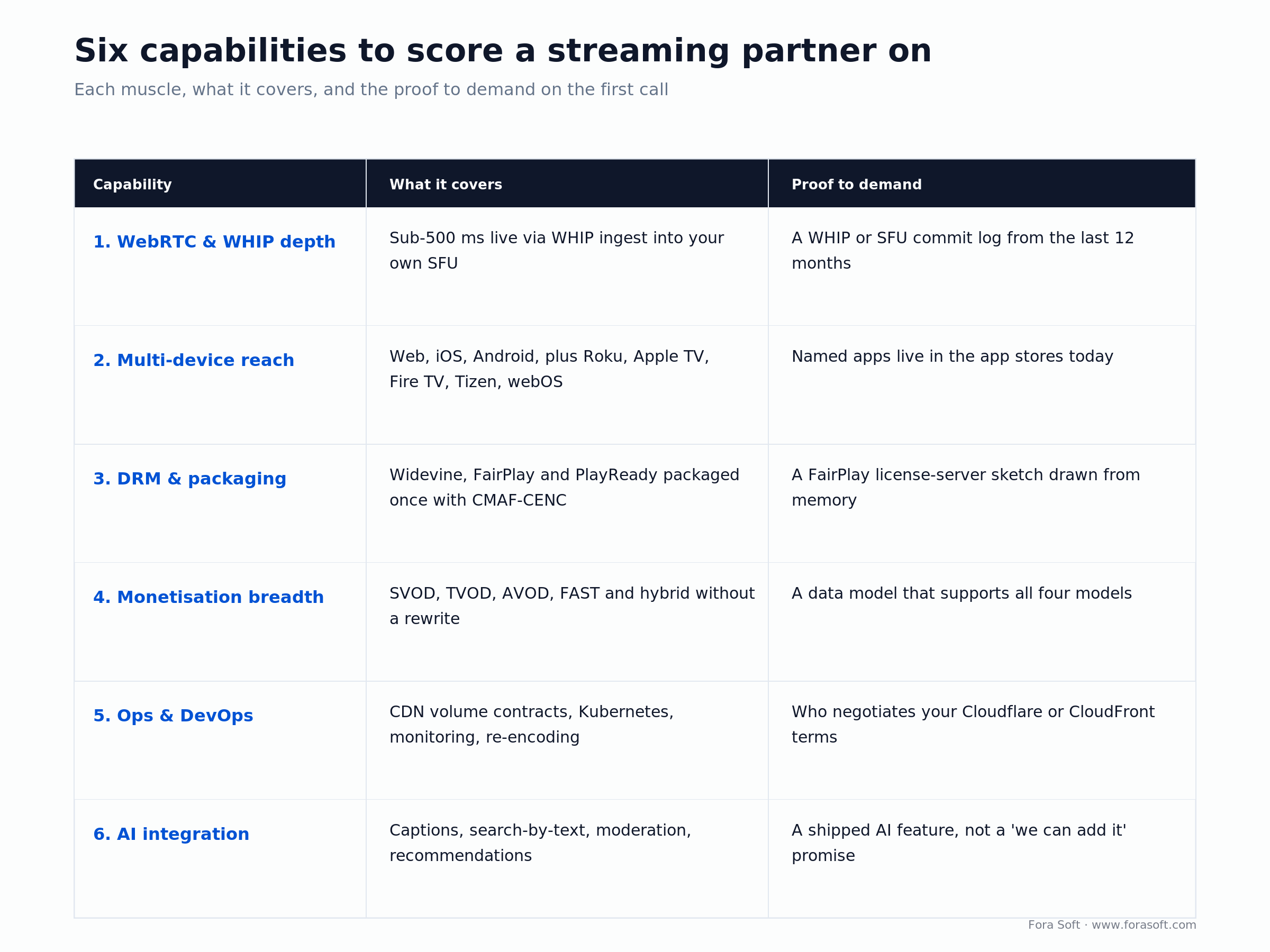
Figure 2. The six-capability scorecard: what each muscle covers and the concrete proof to ask for before you shortlist.
Top custom video streaming development companies in 2026: comparison matrix
Here is the shortlist at a glance: who each shop fits, where it’s strong, what to watch, and a realistic price band. Read it as a map, then read the profiles below for the nuance a table can’t hold.
| Studio | Best for | Strengths | Watch-outs | Typical price band |
|---|---|---|---|---|
| Fora Soft | Multimedia + AI + WebRTC startups | 20 years video-only, AI-native, transparent fixed bids | Smaller bench than a 1,000-seat consultancy | $40k–$250k MVP |
| Oxagile | Enterprise OTT, multi-screen | DRM/SSO/CSAI polish, 10+ years OTT | Six-figure entry; slower for MVPs | $120k–$500k |
| Contus Tech | Media + edtech multi-platform | SVOD/TVOD/AVOD breadth, VPlayed white-label | Timelines stretch on complex integrations | $80k–$300k |
| Muvi | Fast no-code + custom hybrid | Quick deploys; 10+ monetisation models | SLA on high-concurrency events varies | $50k–$180k + monthly |
| Kaltura | Education + corporate streaming | Open SDKs, multi-tenant, public company | Heavier ramp; more platform than agency | $100k–$400k |
| EPAM / GlobalLogic / N-iX | Fortune-500 procurement | Huge bench; cross-domain integration | Video depth varies by project lead; premium rates | $150k–$600k+ |
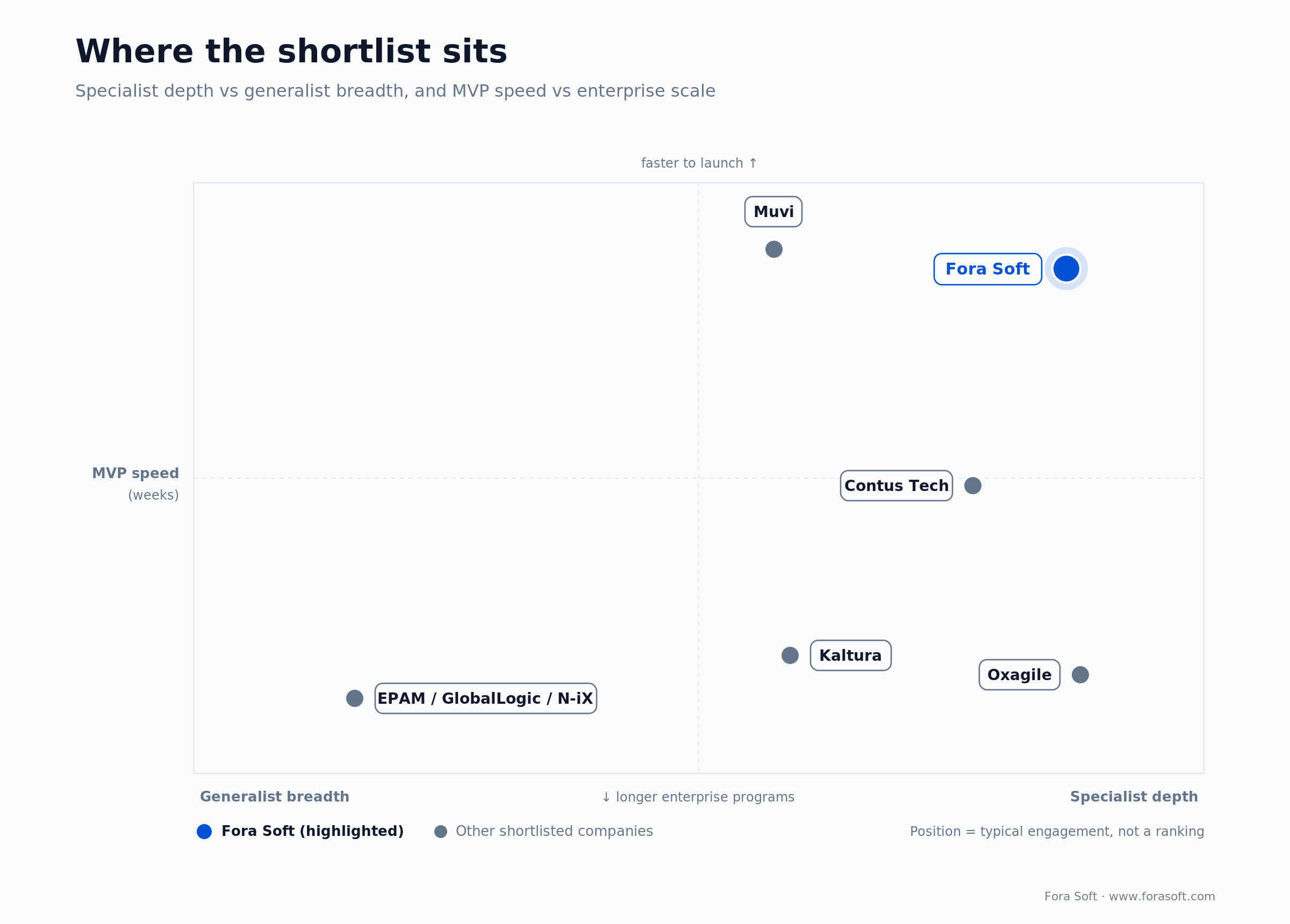
Figure 3. Where the shortlist sits: specialist depth vs generalist breadth on one axis, MVP speed vs enterprise scale on the other.
Reach for a multimedia specialist (Fora Soft, Oxagile) when: the streaming surface is the product. When streaming is one feature inside a bigger app, a generalist with a real video practice is fine, and cheaper to staff.
Fora Soft — multimedia and AI specialist since 2005
Twenty years, 250+ products, and a practice that never left video, audio, and AI. Production work you can open in a browser: BrainCert (an LMS handling thousands of concurrent live classrooms and 500M+ streamed minutes), ProVideoMeeting (all-in-one business conferencing), TradeCaster (sub-500 ms trader streaming, 46k+ users), CirrusMED (HIPAA telehealth), and Scholarly (live classes to 2,000 concurrent).
Stack: WebRTC, WHIP, LL-HLS, HLS, RTSP, LiveKit, mediasoup, Janus, Kurento, Wowza, Pion, plus Mux, Cloudflare Stream, and AWS Elemental. AI: OpenAI Realtime, Whisper, Claude, and custom YOLO or CLIP fine-tunes. How we engage: a free 30-minute scoping call with a senior architect, transparent fixed-bid milestones, weekly demos, and Agent Engineering that compresses MVPs by 25–35% against our 2024 baselines. Best fit: founder-led teams scoping a video, AI, or e-learning MVP in the $40k–$250k range who want the people writing the code on the first call.
Reach for Fora Soft when: you need sub-second latency, brand-owned apps, and AI features shipped by a senior team, and you value a written “you own the IP” clause over a nine-figure logo on the invoice.
Oxagile — enterprise multi-screen OTT polish
A New-York-headquartered shop with more than a decade of OTT work and real strength on Roku, Fire TV, Apple TV, and web players. Genuine depth in DRM, SSO, and CSAI, plus FAST-channel builds for ad-supported streams. Best fit: businesses with $300k+ budgets that need enterprise-grade compliance polish and multi-screen breadth. Watch-outs: minimum engagement size is high, and the pace suits 6-to-12-month enterprise programmes better than a 12-week MVP.
Contus Tech — SVOD/TVOD/AVOD breadth and VPlayed
Operating since 2008 from Chennai and San Jose, Contus offers custom development alongside VPlayed, its AWS-based white-label VoD and OTT product. Strong on offline downloads, server-side ad insertion, and migrating legacy catalogues without downtime. Best fit: media companies moving between VOD and live linear with mature monetisation needs, especially if the white-label starting point saves you months. Watch-outs: complex integrations can stretch to four to six months, so lock milestones tightly.
Comparing Fora Soft against Oxagile or Contus on an RFP?
Send us your spec and we’ll quote a fixed range, share shipped client URLs, and walk through where we win and where competitors win, honestly, in 30 minutes.
Muvi — no-code-plus-custom hybrid
Muvi One is a no-code SaaS layer with custom-development bolt-ons, so you can stand up Roku, Apple TV, web, and mobile apps in days, with 10+ monetisation models built in. Best fit: founders who need to validate a streaming product in weeks, are comfortable on a managed layer, and plan to stay there. Watch-outs: high-concurrency live events stress the SLA, so load-test the platform at your real peak before you sign, and price the monthly platform fee into your year-three model, not just the build.
Kaltura — open SDKs for education and corporate
A public company (around $180M revenue, ~600 staff) with open-source roots and SDKs that shorten dev time for hybrid live-plus-VOD apps. Strong on multi-tenant white-label, useful when you resell streaming to your own clients, and it added AI reach with the November 2025 acquisition of eSelf.ai for real-time avatars. Best fit: education or corporate streaming with analytics-driven optimisation. Watch-outs: it behaves more like a platform and integrator than a full-service agency, so the ramp is heavier and the ecosystem is opinionated.
Build cost ranges in 2026 (with Agent Engineering)
Most MVPs land between $40k and $320k depending on shape. The table and diagram below give a conservative range and a realistic timeline for the six shapes we quote most. These are our own numbers, held down by Agent Engineering, so treat them as a sane anchor for any RFP, not a ceiling for the whole market.
| Build shape | MVP cost | Timeline | Best vendor profile |
|---|---|---|---|
| Niche conferencing MVP | $40–90k | 8–12 weeks | Specialist studio |
| Branded OTT VOD + 1 TV app | $80–180k | 12–16 weeks | Specialist or hybrid SaaS |
| Multi-screen OTT (web + mobile + 3 TV apps) | $150–320k | 16–24 weeks | Enterprise studio (Oxagile-class) |
| Sub-500 ms trader/auction | $60–130k | 10–14 weeks | WHIP/SFU specialist |
| 4K live + DRM + global CDN | $120–250k | 16–20 weeks | Enterprise studio |
| Cloud production studio | $150–250k | 18–24 weeks | Multimedia specialist |

Figure 4. Build cost by project shape: the low-to-high MVP range and typical delivery window for each of the six shapes we quote most.
Other custom video streaming development companies worth knowing
Beyond the top five, a few more shops earn a place on a longer shortlist depending on where your project lands.
1. BairesDev or Toptal-class staff augmentation. Strong when you already have an internal architect and just need senior contractors for a stretch. Avoid them for greenfield architecture, where nobody owns the whole design.
2. EPAM, GlobalLogic, N-iX. Large consultancies with video practices. Best fit for Fortune-500 RFPs where procurement insists on a billion-dollar-revenue vendor. Expect a 40–80% cost premium over a focused specialist, and video depth that swings with your assigned project lead.
3. Sigma Software, Yalantis, SoftServe. Eastern-European generalists with credible video credentials. Good for hybrid products where streaming shares the roadmap with a lot of non-streaming features.
4. Ant Media plus a senior integrator. Ant Media ships a strong media-server engine. Pairing it with a senior integrator, we run it on several builds, gives you the speed of a pre-built server with the flexibility of custom, minus the cost of writing your own SFU from zero.
Reach for an Ant Media plus integrator pairing when: you want low-latency live on a proven engine without paying to build an SFU. We pass our Ant Media partner discount through to clients.
Mini case: how a TradeCaster-class build won against an enterprise studio
A trader-streaming client we won in mid-2025 had three studios on the shortlist: us, an enterprise OTT shop quoting $280k, and a generalist quoting $180k. Our quote was $110k over 12 weeks, fixed-bid, with WHIP ingest into LiveKit OSS on Hetzner AX-class servers behind Cloudflare. What tipped it wasn’t the price alone. It was a 30-minute architecture session with the developer who’d build it, our reference-architecture diagram drawn against their spec, and a recent commit log from a comparable build they could actually read.
The outcome: production latency around 480 ms p95 on regional traffic and roughly 150 ms on the fast path. A SaaS-equivalent bill would have run about $8k a month at launch and near $20k at year-one peak, so the build paid for itself inside 18 months. The exit clause, their right to take the codebase to another partner, was in the contract from day one. Want a similar architecture session against your spec?
A decision framework: pick a custom video streaming partner in five questions
Ask these five on the first call. Each has a right answer a senior shop gives in seconds and a vague answer that turns into a bill later.
1. Show me a recent WHIP commit. If they can’t produce one inside 30 seconds, the sub-second-latency claims are theatre.
2. Walk me through your DRM architecture. Widevine, FairPlay, PlayReady, license server, CMAF packaging. A hand-wave here is a future invoice.
3. Name three smart-TV apps you’ve shipped. Roku, Apple TV, Android TV, Tizen, webOS. It has to be project-level work, not “an engineer once touched one.”
4. What’s your AI integration story? Captions, search-by-text, moderation, recommendations. Buyers expect at least one of these live on day one.
5. What’s the exit clause? A senior partner writes “you own the IP” into the contract from day one. Anything softer is a lock-in tax in disguise.
Want our scoring against those five questions?
30 minutes, real engineering opinions, a sample commit log, a DRM architecture sketch, and a fixed-range estimate at the end.
RFP playbook: how to run a custom video streaming vendor selection
Run three rounds. A one-page brief to four to six candidates, 30-minute technical calls with the top three, and a paid two-week prototype with the final two. The cycle takes six to eight weeks and saves two to four months of post-signature surprises.
Round 1, the brief. Use case, monthly minute-volume target, latency target, monetisation model, smart-TV and mobile platform list, AI feature list, compliance scope, budget band, and target launch date. One page, no more.
Round 2, the call. 30 minutes with a senior architect, not a salesperson, per candidate. Walk the five-question framework. Ask for a recent commit log on a comparable build.
Round 3, the prototype. Pay each finalist for a two-week wireframe plus reference-architecture deliverable, then compare side by side. The studio that charges $5–10k for this round is acting like a senior partner; the one that gives it away free is telling you it’s hungry.
Reach for a paid prototype round when: the project is above $100k. Free wireframes signal a shop that’s desperate on price; a paid prototype signals real engineering and price discipline you’ll want later.
Five pitfalls when picking a custom video streaming partner
1. Anchoring on portfolio gloss. A slick site with stock-photo case studies tells you nothing. Demand shipped client URLs, not screenshots.
2. Skipping the prototype phase. Founders who jump straight from RFP to full build burn 20–30% of budget on rework. A two-week wireframe plus reference architecture saves a month later.
3. Ignoring CDN volume terms. A studio that won’t pre-negotiate Cloudflare, Akamai, or CloudFront on your behalf hands you a 30–50% bill premium once traffic ramps.
4. Lock-in via a private player SDK. If the studio ships a proprietary player only they can maintain, you’ll pay them forever. Insist on standards-based players, hls.js, Shaka, dash.js.
5. Underestimating ops after launch. Custom platforms need DevOps, monitoring, and codec retraining. Budget 15–20% of build cost per year for steady-state ops, or hold the studio to a clear support SLA.
KPIs to measure your custom video streaming partner
Quality KPIs. Glass-to-glass latency p95, join-success rate (target ≥99%), buffer ratio per session (<1.5%), audio MOS (target ≥4.0), and DRM-ready packaging on 100% of premium content.
Business KPIs. Cost per participant-minute, cost per concurrent viewer-hour, time-to-launch (target under 16 weeks for an MVP), and monetisation-model coverage across SVOD, TVOD, AVOD, and FAST as your plan needs.
Reliability KPIs. SFU and CDN uptime (target 99.95%), session error rate (<0.5%), mean time to detect outages (<5 min), and partner SLA on incident response (target under 30 min for a P1).
When NOT to hire a custom video streaming development company
Skip custom while you’re pre-product-market-fit. If your monthly minute volume is unproven, your latency tolerance is above two seconds, and you don’t yet need brand-owned mobile or TV apps, a SaaS pilot on Mux, Cloudflare Stream, Daily, or LiveKit Cloud is almost always the right call for the first six months. Move to a custom shop only once the SaaS bill or a feature ceiling forces it.
Where custom truly pays off: sub-second-latency products, branded OTT subscription businesses, regulated workloads (HIPAA, FERPA, the EU AI Act), and any roadmap that needs features the SaaS layer won’t ship. Our video and audio streaming services page maps the scope, and the Fora Soft Learn: Video Streaming hub explains the protocols in depth if you want to go deeper before you brief anyone.
FAQ
Who are the top custom video streaming software development companies in 2026?
For a streaming-first product, the realistic shortlist is Fora Soft (multimedia and AI specialist, since 2005, 250+ projects), Oxagile (enterprise multi-screen OTT), Contus Tech (SVOD/TVOD/AVOD breadth and the VPlayed white-label), Muvi (no-code plus custom hybrid), and Kaltura (open SDKs for education and corporate). Which one fits depends on whether you want a specialist build, a white-label head start, or enterprise-scale procurement.
How much does custom video streaming app development cost in 2026?
Most MVPs land in the $40–320k range. A niche conferencing MVP runs $40–90k, branded OTT with one TV app $80–180k, multi-screen OTT $150–320k, and 4K live with DRM and a global CDN $120–250k. Our numbers sit 25–35% under 2024 baselines because Agent Engineering compresses the build.
How do I shortlist a custom video streaming software development company?
Apply three filters before the first call: shipped client URLs you can actually visit, a WebRTC or WHIP commit history within the last 12 months, and real DRM plus smart-TV portfolio depth. A shop that fails any one of those three usually fails the build.
Should I pick a specialist or a generalist agency for streaming?
For streaming-as-product, pick a multimedia specialist such as Fora Soft, Oxagile, or Contus. For streaming-as-a-feature inside a broader product, a generalist with a real video practice (EPAM, GlobalLogic, N-iX) works fine. The deciding factor is whether the streaming surface is your differentiation.
Is Twilio Video shutting down, and does that affect my build?
No. Twilio announced an end-of-life for Programmable Video in March 2024, then reversed it in October 2024; Twilio Video remains a standalone product. The episode is still a useful reminder that a managed CPaaS video product can change roadmap under you, which is one reason teams with a long horizon prefer to own the stack.
Should I demand fixed-bid or time-and-materials?
Use fixed-bid milestones for a well-defined MVP and time-and-materials for ongoing maintenance and feature extensions. Avoid pure time-and-materials on greenfield work, since it rewards the wrong things. We default to milestone fixed-bid with a clear change-request process.
How important is sub-500 ms latency in 2026?
It’s essential for trading, auctions, live commerce, and classrooms with live Q&A; nice-to-have for premium sports; and optional for on-demand catalogues. Since WHIP shipped as RFC 9725 in March 2025, the cost gap between “under 500 ms via WebRTC” and “a few seconds via low-latency HLS” narrowed sharply, so ask any partner about it explicitly.
How does Fora Soft compare on price?
Typically 30–40% under enterprise studios such as Oxagile or Kaltura for comparable multimedia scope, at similar quality. The gap comes from Agent Engineering compression and a focused practice without generalist overhead. Book a scoping call and we’ll quote a specific range against your spec.
What to read next
Deep-dive guide
Custom Video Streaming Software Guide
Architecture, protocols, and feature scope for a custom build.
Cost analysis
Streaming Platform Cost: SaaS vs Custom
24- and 60-month TCO math with real vendor pricing.
Architecture
WebRTC Architecture Guide for 2026
P2P, SFU, MCU, and hybrid, mapped to your scope.
OTT build
OTT Platform Development
Feature scope, stack, and monetisation for OTT.
Estimation
Software Estimation in 2026
How to demand a defensible estimate from any vendor.
Ready to shortlist your custom video streaming partner?
The field of custom video streaming software development companies is healthy and competitive, and five names, Fora Soft, Oxagile, Contus, Muvi, and Kaltura, cover the realistic shortlist for most founders. The thing that separates them isn’t the marketing copy. It’s shipped client URLs, WHIP and SFU depth, DRM discipline, and a partner willing to write “you own the IP” into the contract on day one.
If you’re scoping a 2026 streaming product, OTT, telehealth, e-learning, conferencing, trader streaming, or live shopping, we’ll show you what we’ve shipped, say where competitors win, and quote a fixed range against your spec in 30 minutes. That’s the whole conversation our scoping calls are built around.
The handbook · 7 volumes
Fora Soft Video Engineering Handbook
A shortlist only works if you can tell which vendor understands the pipeline behind the demo. We wrote seven volumes on that pipeline; start with the transport volume on RTMP, SRT, WHIP ingest, HLS, DASH and CMAF, then read the encoding volume and the delivery volume on ABR, CDNs, DRM and players before you score a single RFP answer. Written by Nikolay Sapunov, CEO at Fora Soft.
Browse the handbook on Amazon →7 volumes · 9,000+ pages · Kindle & paperback
Scope your 2026 streaming build with a partner who’s already shipped at scale
30 minutes, real engineering opinions, no slides, and a fixed-range estimate at the end.

