.avif)
Key takeaways
• Cascaded pipelines still win for AI interpretation in production. ASR + MT + TTS composed from separate best-in-class vendors outperforms end-to-end models on accuracy, debuggability, and compliance for most video-product use cases.
• First-chunk latency, not total latency, is the UX metric. Below 800 ms feels live; above 2 s, participants start talking over each other. OpenAI’s gpt-realtime and Deepgram Nova-3 deliver sub-500 ms in the field.
• The top 5 engines for product integration in 2026 are Meta Seamless, OpenAI gpt-realtime, Google Cloud, Azure AI Speech, and Deepgram. Everything else is either a wrapper on these or a niche vertical play.
• Voice cloning is production-ready but compliance-heavy. ElevenLabs and Meta’s open model deliver convincing cross-lingual cloning from 30 seconds of audio; the bottleneck is consent capture, not model quality.
• Break-even between cloud APIs and a self-hosted open model sits around 60–150 concurrent streams. Below that, cloud wins on total cost; above it, GPU infrastructure pays back in 6–9 months.
Why Fora Soft wrote this playbook
We have been building real-time video, audio, and AI products since 2005: 250+ video projects across 20+ years of shipping production-grade systems. Real-time AI interpretation has moved from “future feature” to “default expectation” in almost every webinar, e-learning, telemedicine, and streaming build we ship.
Our team has wired up ASR pipelines, multilingual TTS, and WebRTC interpretation bots on top of Agora, LiveKit, 100ms, and custom SFUs. We have also built AI features for Translinguist, a platform that runs multilingual events end-to-end, and integrated interpretation into e-learning products like BrainCert where students join live classes in their own language.
This playbook is the compressed version of what we tell product teams in their first call: the five engines worth shortlisting, how to compare them honestly, where the pricing lands, and which architecture to pick for your specific product. No marketing numbers. Just what we have seen in production. Browse our portfolio for the kind of real-time AI products this applies to, or our real-time speech translation guide for the architecture underneath.
Need a second opinion on your interpretation stack?
30 minutes with a senior engineer who has shipped real-time translation on WebRTC, LiveKit, and custom SFUs. Bring your architecture.
What actually changed in real-time interpretation in 2026
Three shifts matter for anyone building a product this year. First, first-chunk latency dropped below a second for most major engines. OpenAI’s gpt-realtime (GA August 2025), Deepgram Nova-3, and Azure Speech Translation all deliver under 500 ms in practice. Second, streaming got smarter: Deepgram shipped Flux Multilingual in April 2026 with live mid-sentence language switching, and Meta’s Seamless remains the strongest open self-host option for 100+ languages with voice preservation (research-licensed, and no major update since 2023 — plan around that). Third, voice cloning went from novelty to default. Interpreting a speaker in their own voice, in another language, is a one-API call.
What did not change: cascaded architectures (ASR → MT → TTS) still outperform end-to-end models on accuracy, debuggability, and compliance for almost every enterprise video-product use case. End-to-end is winning demos; cascades are winning production.
The four architectures, and when each one fits
Before you shortlist a vendor, pick the architecture. Everything downstream follows this choice: latency budget, cost model, compliance posture.
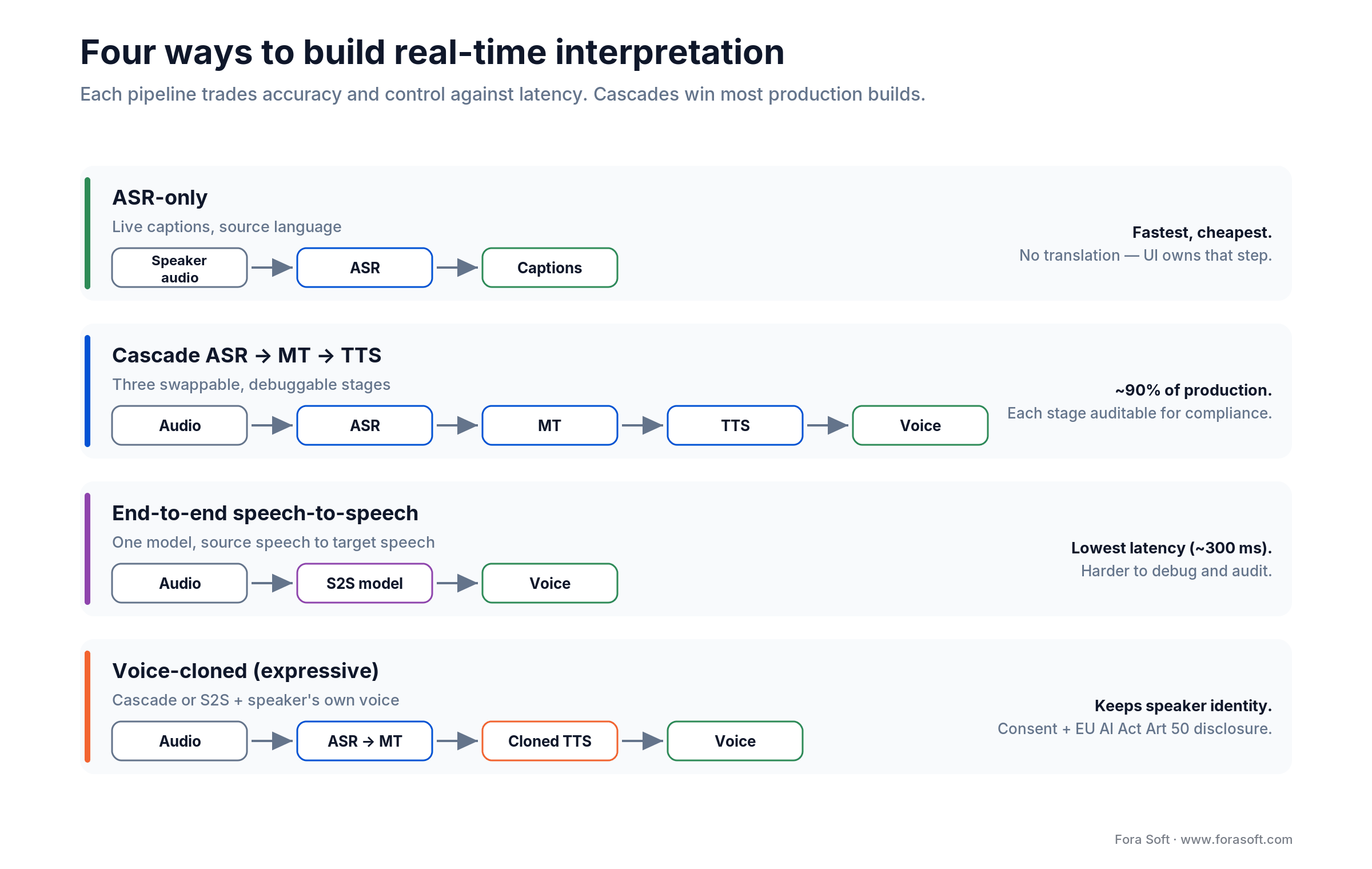
Figure 1. The four ways to build real-time interpretation. Cascades win most production builds; end-to-end wins on raw latency.
1. ASR-only (live captions)
Transcribe the speaker into the source language as text; no translation, no TTS. The cheapest, fastest, and most accurate path when your audience reads captions in their own language via a separate translation call, or when accessibility is the primary driver.
Reach for ASR-only when: you just need accurate live captions and the UI owns the translation step separately.
2. Cascaded speech-to-speech (ASR → MT → TTS)
Three models chained: speech to text, text to translated text, translated text back to speech. Each stage is debuggable, each can be swapped, and each has a mature compliance story. This is what 90% of production interpretation deployments actually use. Interprefy, KUDO, Wordly, and most big-tech products sit there under the hood.
Reach for a cascade when: you need real-time voice output, compliance documentation, and the ability to swap components later.
3. End-to-end speech-to-speech
A single model goes from source speech to target speech. Meta’s open model, Google’s speech-to-speech research line, and OpenAI’s gpt-realtime are the notable examples. Latency is the lowest you can get (~300 ms first chunk), and prosody/intonation can carry across. The price: harder to debug, harder to get specific terminology right, and harder to defend to compliance reviewers who want separate audit trails for ASR and MT.
Reach for end-to-end when: latency is the headline feature (gaming, high-stakes negotiation) and your domain is general-purpose conversation.
4. Voice-cloned translation (expressive)
Same cascade or end-to-end, but the TTS step uses a clone of the original speaker’s voice. ElevenLabs, Microsoft Azure’s Personal Voice, and Google’s Instant Custom Voice all do this well from 30 seconds of enrollment audio. Great for webinars and streaming where brand voice matters; non-negotiable consent capture is required in most jurisdictions.
Reach for voice-cloned translation when: speaker identity carries product value (keynotes, branded content, creator economy).
The top 5 AI tools for real-time language interpretation in 2026
Of the 30-plus engines we have touched, these are the five that consistently come up in production discussions. The ones we recommend shortlisting.
One framing first: buy vs build. If you would rather buy a finished product, managed platforms like Interprefy, KUDO, Wordly, Boostlingo and Palabra sell hosted interpretation you can bolt onto meetings and events. This list is different — these are the engines you integrate when interpretation is a feature inside your own video product, and you want to own latency, cost, data residency and the roadmap. If you are building, keep reading.
1. Meta Seamless (open-source self-host)
The most capable open-source speech-to-speech model family available. Meta’s Seamless covers roughly 100 speech inputs, 35 speech outputs, and over 200 text languages; the Expressive variant preserves prosody and vocal style across languages, and it was the first open model to do that credibly. Self-hostable on a single A100 (80 GB) or a pair of A10G instances for production traffic. Two honest caveats: it ships under a research license (clear commercial use with counsel), and Meta has not shipped a major update since 2023.
Why pick it: data residency, no per-minute fees past the GPU bill, and full control of model weights. Limits: engineering overhead (you own the deployment), research license, and slower new-language support than closed APIs. Typical first-chunk latency: 800–1500 ms self-hosted; tunable.
Reach for a self-hosted open model when: your volume justifies a couple of A100s and you need strict data residency or voice-preservation at scale.
2. OpenAI gpt-realtime + Whisper
OpenAI’s gpt-realtime (GA August 2025) hits roughly 300 ms first-chunk latency for speech-to-speech over WebRTC, WebSocket, or SIP. Whisper (large-v3) and gpt-4o-transcribe still lead the pack on multilingual ASR accuracy, especially on accented English and low-resource languages. Taken together, you get a near-instant voice experience with best-in-class transcription accuracy — and, since the August 2025 price cut to $32/$64 per million audio tokens, a much friendlier per-minute cost than the old GPT-4o Realtime preview.
Why pick it: lowest latency commercially available, strongest general-domain accuracy, and pricing that finally makes sense (~$0.06–0.11 per minute). Limits: US data residency for most enterprise tiers, no on-prem option, voice choices limited to presets. Typical first-chunk latency: 300–500 ms.
Reach for gpt-realtime when: latency is the product (voice assistants, live Q&A, conversational AI) and volume is under ~500 concurrent streams.
3. Google Cloud (Speech-to-Text + Translation + Text-to-Speech)
The most mature cascaded stack on the market. Chirp 3 (Google’s 2026 ASR model, 85+ languages, built-in denoiser and speaker diarization) feeds the Translation API (130+ languages) and Chirp 3 TTS, including Instant Custom Voice for cloning. Chained in a streaming pipeline, you get sub-second first-chunk latency, strong Asian-language coverage, and Google’s compliance umbrella (HIPAA with BAA, GDPR).
Why pick it: language breadth, mature SDKs, strong low-resource language support, Google-scale reliability. Limits: three bills instead of one; glue code for a streaming cascade is your problem. Typical first-chunk latency: 600–1000 ms end-to-end cascaded.
Reach for Google Cloud when: you need 100+ languages, HIPAA-covered infrastructure, and you are willing to own the glue code.
4. Microsoft Azure AI Speech (Speech Translation)
Azure Speech Translation is the only major cloud that exposes a single endpoint doing streaming ASR + MT + neural TTS with voice selection, including Personal Voice for cross-lingual cloning. Tight integration with Teams, strong enterprise compliance (HIPAA, FedRAMP High, EU Data Boundary).
Why pick it: one API, enterprise-grade SLA, EU data boundary, first-class voice cloning. Limits: smaller language roster than Google, pricing opaque for event-scale use. Typical first-chunk latency: 500–900 ms.
Reach for Azure when: your buyer is enterprise IT, your users are in Teams, or EU data residency is mandatory.
5. Deepgram Nova-3 + Aura-2 + Flux
Deepgram is the specialist: streaming ASR with some of the lowest word error rates we have measured on real call-center and medical audio, paired with Aura-2 TTS and, since April 2026, Flux Multilingual — a conversational model that detects and switches languages mid-sentence across 10 languages and handles turn-taking for voice agents. Pricing is materially cheaper than the hyperscalers at volume, and a single WebSocket carries Nova-3, an LLM router, and Aura-2, which is the cleanest thing to integrate into a WebRTC product.
Why pick it: best-in-class ASR on noisy real-world audio, fast WebSocket integration, per-minute cost ~40–60% of hyperscaler equivalents. Limits: live multilingual code-switching covers 10 languages as of 2026 (fewer than the hyperscalers), and translation is newer than the ASR. Typical first-chunk latency: 300–500 ms for ASR, 600–800 ms full cascade.
Reach for Deepgram when: your audio is noisy (call centers, telehealth), English + top 10 languages are enough, and the per-minute cost is squeezing your margin.
The tools compared: a single-view matrix

Figure 2. The five engines at a glance. Green marks a strength, amber a trade-off to plan around.
| Engine | Deployment | Languages | First-chunk latency | Voice cloning | Pricing shape |
|---|---|---|---|---|---|
| Meta SeamlessM4T | Self-host (OSS) | 100+ speech, 200+ text | 800–1500 ms | Yes (Expressive) | GPU hours only |
| OpenAI gpt-realtime | Cloud (US) | ~60 high-quality | 300–500 ms | Limited (voice presets) | Per audio token |
| Google Cloud (cascaded) | Cloud, multi-region | 85+ ASR, 130+ MT | 600–1000 ms | Yes (Instant Custom) | Per-minute, tiered |
| Azure AI Speech | Cloud, EU-boundary | ~70 ASR, 100+ MT | 500–900 ms | Yes (Personal Voice) | Per-hour + TTS chars |
| Deepgram Nova-3 + Flux | Cloud + on-prem | 10 live-switch | 300–500 ms ASR | Aura voices | Per-minute (low) |
A healthy shortlist for most product teams: one hyperscaler (Google or Azure) as the primary cascade, Deepgram as the cost-reducer on your highest-volume language pairs, and an open model spun up in a private cluster for compliance-sensitive customers who insist on data residency.
Latency is a UX metric, not a benchmark
Every vendor quotes total latency. The number that actually predicts user satisfaction is first-chunk latency: how long after the speaker starts talking before your users hear the first translated word. In the field the lowest-latency engines are OpenAI’s gpt-realtime and Deepgram Nova-3, both around 300–500 ms first-chunk; cascaded stacks land at 600–1000 ms. Below 800 ms feels live. Between 800 ms and 1.5 s still works for keynotes and e-learning. Above 2 s, participants start talking over the interpretation and the whole UX collapses.
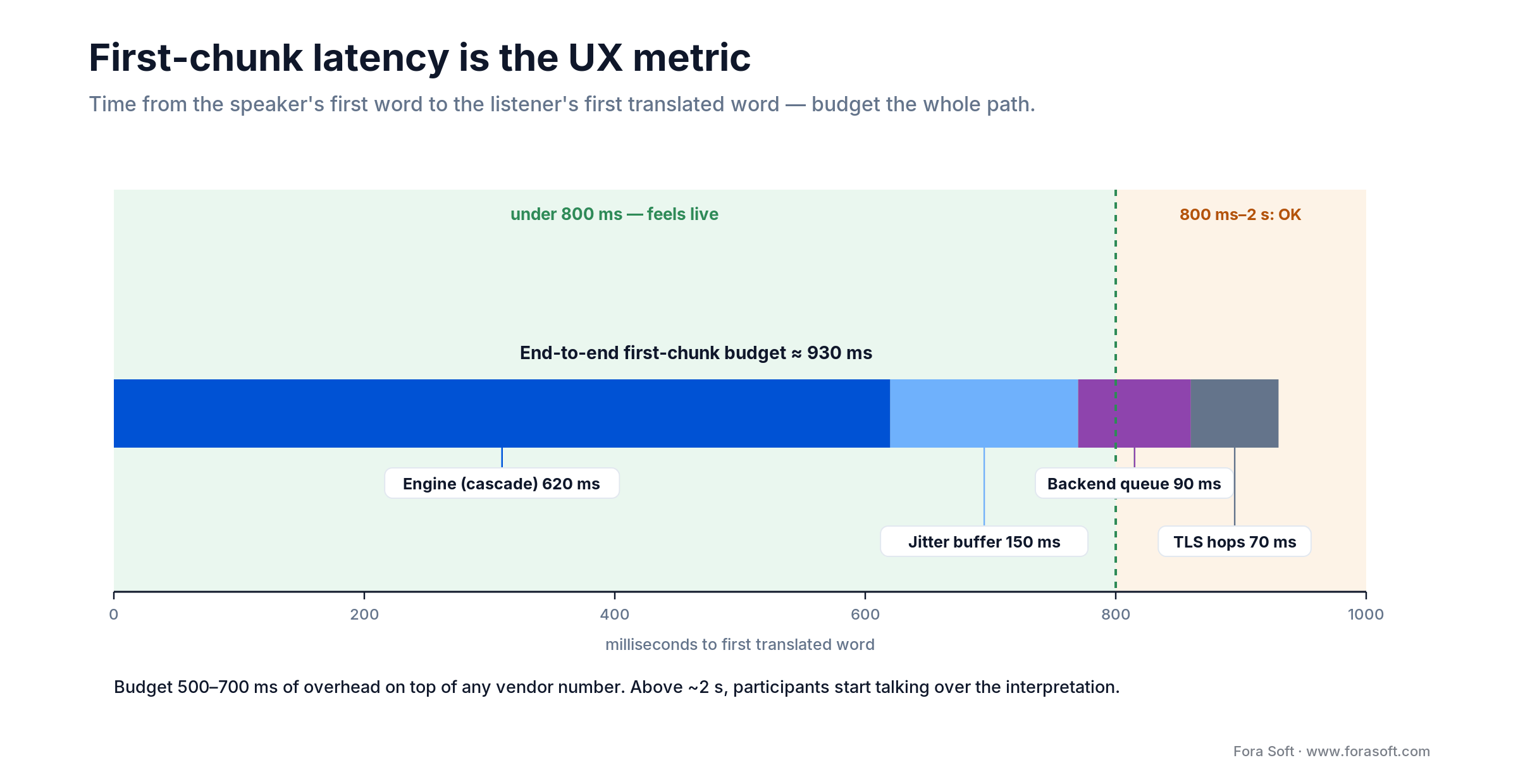
Figure 3. First-chunk latency is the metric users feel. Budget the whole path, not just the vendor's number.
The hidden latency costs are almost always WebRTC jitter buffers (80–200 ms), your own backend queue (50–100 ms), and TLS round trips between services (20–80 ms each). Budget for 500–700 ms of overhead on top of whatever the vendor advertises, and measure end-to-end from real devices in your target regions before you believe any marketing number.
Voice cloning: production-ready, compliance-heavy
Cross-lingual voice cloning is no longer a demo feature. ElevenLabs, Azure Personal Voice, and Google’s Instant Custom Voice all deliver convincing results from as little as 30 seconds of enrollment audio. The output preserves timbre well, and intonation reasonably well for major Indo-European languages.
The engineering is the easy part. The hard part is consent capture: you need a documented opt-in from every speaker whose voice you clone, a clear retention policy, and the ability to revoke and delete voice models on request. The EU AI Act’s Article 50 transparency rules, in force since 2 August 2026, treat a cloned or synthetic voice as AI-generated media: you must disclose it is AI and mark the audio machine-readably (the watermarking piece had a grace period to 2 December 2026). Build the consent and disclosure UI before you build the cloning pipeline.
Embedding interpretation into your video product?
We have wired ASR, translation, and TTS into Agora, LiveKit, 100ms, and custom SFUs. We will tell you what to buy, what to self-host, and what to skip.
Reference architecture for a video product
The pattern that works for 80% of the video and streaming builds we ship:
Capture → separate audio track
Pull the speaker’s raw audio out of your SFU as a dedicated track. On LiveKit or 100ms, use a server-side interpretation bot that subscribes to the publisher’s audio track only; on Agora, use the cloud recording or media-stream API. Keep the translation pipeline on a separate connection from the main video session so a vendor hiccup does not drop the call.
Stream to ASR over WebSocket
All five engines expose a WebSocket endpoint. Send 100–200 ms audio chunks; consume partial transcripts immediately, final transcripts only when the punctuation or endpoint detection fires. Do not wait for finals to translate. The partials drive your first-chunk latency.
Translate partial segments, not words
Translating every word of a partial transcript produces jittery, wrong output. Segment on 1.5–2 second windows or on rolling confidence peaks, translate each window, and stitch using a simple retraction protocol (send a corrected segment if the ASR’s final transcript changes what it earlier emitted).
TTS into the room as a synthetic participant
Mix the translated audio back as a separate participant (“Interpreter, Spanish”), and let users subscribe to whichever language track they want at normal WebRTC quality. Do not overlay the TTS on the speaker’s original audio. Listeners want to hear one voice at a time.
Pricing reality for embedded interpretation
Approximate ranges based on 2026 public pricing and our own billing. Exact per-minute costs depend on language pair, commit tier, and whether you bundle TTS/voice cloning.
| Stack | Cost per minute (translated audio out) | Break-even vs. self-host |
|---|---|---|
| Google Cloud cascade | $0.08–0.14 | ~80 concurrent streams |
| Azure AI Speech | $0.07–0.13 | ~70 concurrent streams |
| AWS Transcribe + Translate + Polly | $0.10–0.18 | ~60 concurrent streams |
| OpenAI gpt-realtime (audio-out) | $0.06–0.11 | ~90 concurrent streams |
| Deepgram Nova-3 + Aura | $0.04–0.08 | ~120 concurrent streams |
| Self-host SeamlessM4T (A100-class GPU) | $0.02–0.05 (amortized) | N/A (baseline) |

Figure 4. Where self-hosting starts to pay off versus cloud APIs, by sustained concurrent streams.
Rule of thumb: under 60 concurrent streams, cloud APIs win on TCO because you avoid GPU ops. Between 60 and 150, it is a judgment call, usually driven by compliance, not dollars. Past 150 concurrent streams sustained, self-hosting an open model (Whisper-class) pays back in 6–9 months, assuming you have the DevOps bandwidth for GPU fleet management.
Our own bias: for most SaaS products we ship a cloud-API-first design with a swap path to self-hosted, so the first dollar of revenue does not require a GPU cluster. Agent Engineering lets us build that swap path in weeks rather than months.
Integration with real-time video platforms
Which platform you build on changes which interpretation stack is easiest.
LiveKit. Has first-class support for server-side agents; writing a “translation agent” that subscribes to a speaker’s track and publishes translated audio back is one of their reference patterns. Our preferred stack for green-field builds in 2026.
Agora. Offers built-in real-time transcription and a Cloud Recording pipeline that you can tap for ASR. For full interpretation, most teams route audio out through a server and publish the translated stream back. Works cleanly, adds one hop.
100ms. Offers a Transcription service out of the box; combine with any of the translation APIs above. Easy path for English-heavy Indian subcontinent traffic.
Zoom, Teams, Meet. Native AI Companion / translated captions are fine if you are building inside the platform via app extensions. If you are building your own video product, you are not in this lane.
Use cases that actually monetize
Global webinars and events. Premium on the price ladder. A 500-attendee multilingual webinar charges $2–5 per attendee-hour, with interpretation as the feature that closes the deal. Typical buyers: Interprefy, KUDO, Wordly.
Telemedicine. High compliance bar (HIPAA, state-level medical interpretation requirements in the US), strong willingness to pay. Cloudbreak and Language Line have long dominated; AI-first newcomers carve out the scheduled-visit segment first.
E-learning. Real-time translation of live classes expands your addressable market by 5–10x overnight. We see this in most of our AI integration briefs from education customers.
Streaming / OTT dubbing. ElevenLabs and HeyGen lead on near-real-time dubbing of pre-recorded content; live sports and news are the next frontier.
Contact centers. AI interpretation on top of existing telephony (Twilio, Genesys, Five9). The easiest ROI story, because each handled call avoids a human interpreter fee of $2–4/minute.
Legal and courts. Compliance-heavy, slow-moving, and usually require certified human interpreters on the record; AI often serves as a draft / parallel channel rather than the primary.
Accuracy benchmarks worth watching
Real numbers to anchor expectations:
- Whisper large-v3 reaches 8–12% word error rate across the FLEURS benchmark for high-resource languages; 20–35% for low-resource ones like Tamil, Swahili, or Kazakh.
- Deepgram Nova-3 reports sub-5% WER on English call-center audio and 6–9% on noisy medical audio, which is where the hyperscalers still drop to 10–15%.
- Meta’s Seamless on the CVSS speech-to-speech benchmark scores within 1–2 BLEU points of the leading cascaded stacks, and wins on prosody preservation.
- Google Translation API + Chirp 3 stays competitive on long-context translation and leads on Asian-language coverage (Vietnamese, Thai, Indonesian).
- GPT-4o-transcribe narrowly beats Whisper on accented English and tops most charts on conversational multilingual code-switching, still the weakest point of open-source ASR.
Compliance and data residency
HIPAA. Google Cloud, Azure, and AWS all offer BAAs on their speech and translation APIs. OpenAI offers a limited BAA on specific enterprise tiers; check before you assume. Deepgram offers HIPAA coverage with a signed BAA.
GDPR. Azure’s EU Data Boundary and Google’s multi-region endpoints are the cleanest paths. Avoid sending raw audio to US-only endpoints for EU users; either use an EU region or self-host an open model in your own VPC.
EU AI Act. Article 50 transparency applies from 2 August 2026: cloned or synthetic voices must be disclosed and watermarked. The heavier high-risk obligations were pushed back under the 2026 Omnibus — 2 December 2027 for stand-alone Annex III systems, 2 August 2028 for AI embedded in regulated products (Annex I) — so build consent capture, audit logging of every translated utterance, and a human-in-the-loop override now, well ahead of those dates.
FERPA and education. Student voice recordings are FERPA-protected in the US; stick to no-retention API modes or self-host. Explicit parental consent for minors is unavoidable.
Five pitfalls that derail interpretation projects
1. Benchmarking on studio audio. Vendors quote WER on clean microphone audio; your users are on phone speakers in coffee shops. Always run your own evaluation on 2–4 hours of representative real-world audio before committing.
2. Translating every partial. Partial transcripts change as the speaker continues; translating each word produces stuttering garbage. Segment on windows, not tokens.
3. Ignoring code-switching. Real multilingual users switch languages mid-sentence (“send me the ¡el invoice por favor”). Most engines still handle this badly; test it explicitly or you will ship a product that fails for exactly the users most likely to need it.
4. No domain glossary. Medical, legal, and technical terminology miss without a custom glossary. Azure, Google, and Deepgram all accept custom vocabularies and domain adaptation. Use them.
5. Shipping without a “raise hand for human” button. AI interpretation is right 90–95% of the time. Users need a fast, visible escape to a human interpreter the other 5–10%. This alone preserves NPS in high-stakes deployments.
A decision framework: pick your engine in five questions
1. Is latency the headline feature or a nice-to-have? If sub-500 ms is the selling point, gpt-realtime or Deepgram. If users can tolerate 1–2 seconds, any of the cascades work.
2. Which languages must you support on day one? More than 80 languages pushes you toward Google Cloud or a self-hosted open model. Top 20 languages is solved by anyone on this list.
3. What is your data residency requirement? EU-only → Azure or a self-hosted open model. US-only → any. Mixed → Google Cloud with per-region endpoints.
4. Does speaker identity carry product value? If yes, a voice-cloning engine: ElevenLabs, Azure Personal Voice, or Google Instant Custom Voice. If no, standard neural TTS is fine.
5. What is your expected concurrent-stream volume 12 months out? Under 60, cloud-first is cheaper. Over 150, plan the self-host migration now so procurement does not bite you later.
Mini case: embedding AI interpretation into an e-learning product
A recent build: an e-learning platform with live cohort classes, primarily English-speaking instructors, needing to reach Spanish-, Portuguese-, and Vietnamese-speaking students without hiring human interpreters.
12-week plan: weeks 1–3 for the interpretation agent architecture on LiveKit, weeks 4–6 for a Google Cloud cascaded pipeline (Chirp 3 ASR + NMT + Chirp 3 HD TTS), weeks 7–9 for a per-student language picker and a “raise hand for human” workflow, weeks 10–12 for glossary tuning on subject-specific vocabulary and low-latency tuning with edge nodes in São Paulo and Singapore.
Outcome: first-chunk latency averaged 780 ms, BLEU on a held-out sample of subject-matter transcripts held above 34 (competitive with a human interpreter on domain terminology after glossary tuning), and enrolment from non-English-native regions grew meaningfully quarter over quarter. The interpreter button was pressed less than 3% of the time. Enough that users trusted the AI, visible enough that they knew they had a safety net.
Want a similar assessment on your own stack? Grab a 30-minute slot and we will walk through where your latency and accuracy budgets should land.
KPIs to measure, and the thresholds that matter
Quality KPIs. Word error rate under 8% on your own evaluation audio. BLEU above 30 on domain-representative text. MOS above 4.0 for synthetic voice output. Comprehension rate above 85% on a listener study with native speakers.
Business KPIs. First-chunk latency p95 under 1.2 s. Cost per translated minute under $0.15 at target volume. “Raise hand for human” rate under 5% after the first month. Active language expansion rate (how fast you can add a new language from request to GA).
Reliability KPIs. Vendor error-rate under 0.5% of streams. Graceful fallback to the secondary engine within 2 s of primary failure. Audit log coverage 100% of translated utterances for compliance-sensitive tenants. Mean time to recover from a vendor outage under 10 minutes.
When NOT to build AI interpretation into your product
Skip it when your user base is overwhelmingly monolingual and you are adding interpretation to chase a demo feature rather than a retention signal. Skip it when your domain is high-stakes certification-required interpretation (court reporting, sworn medical consent) where statutes still require humans in the loop. Skip it when your engineering team is already stretched thin. Interpretation is a multi-quarter investment done right, and a multi-quarter embarrassment done badly.
Build it when multilingual reach is a growth lever, when compliance allows AI as primary with human fallback, and when your team can own the evaluation loop. We have seen cohort expansion, lead velocity, and ARPU all jump meaningfully in the quarters following a well-shipped interpretation launch, but only when it was treated as a product feature, not a vendor integration.
FAQ
What is real-time language interpretation versus real-time translation?
Translation turns text into another language; interpretation does the same with live spoken audio. In practice, “real-time AI interpretation” means a pipeline that takes speech in, transcribes it, translates it, and outputs either text captions or synthesized speech in near real time, typically under 1.5 seconds end to end. The hard parts are the latency target and preserving meaning across cultural nuance.
Which AI interpretation tool is best for video conferencing?
For new product builds, we recommend shortlisting Google Cloud (language breadth), Azure AI Speech (one-API simplicity plus EU data boundary), and Deepgram (cost and noisy-audio accuracy). Pick one primary, keep a second as failover. A self-hosted open model belongs on the shortlist as soon as compliance or volume forces you off pure cloud APIs.
How accurate are AI interpretation tools compared with human interpreters?
On general business conversation between major languages, AI interpretation reaches 90–95% of the quality a human simultaneous interpreter delivers at a fraction of the latency and cost. On domain-heavy content (medical, legal, technical) with custom glossaries, AI closes most of that gap. On emotionally charged or culturally ambiguous content, humans still win. Most successful products treat AI as the default with human backup.
Can AI tools handle multiple speakers and overlapping voices?
Yes, though with caveats. Most streaming ASRs now support speaker diarization, but accuracy on three or more simultaneous speakers drops sharply. The clean solution is to diarize at the video-conferencing layer (you already have one audio track per participant) and run one interpretation pipeline per speaker. That avoids the hardest part of the diarization problem entirely.
How much does adding real-time interpretation cost per minute?
Budget (at 2026 rates) $0.07–0.15 per minute of translated audio output on Google, Azure, or Deepgram at moderate volume; $0.06–0.11 per minute on gpt-realtime; $0.02–0.05 per minute amortized if you self-host an open model on a saturated A100. Add ~20% overhead for bandwidth, voice cloning, and engineering margins.
Is AI interpretation HIPAA-compliant?
The big-three hyperscalers all offer BAAs for their speech and translation services; Deepgram does too. OpenAI offers coverage on specific enterprise tiers only. For maximum safety in telemedicine, a self-hosted open model (Whisper-class) in your own HIPAA-compliant VPC removes the vendor from the trust boundary entirely.
What is voice cloning and do I need consent?
Voice cloning synthesizes speech in a specific person’s voice from a short enrollment sample (typically 30 seconds). Yes, you need documented, revocable consent before cloning anyone’s voice, plus a retention/deletion policy. The EU AI Act and several US states treat voice as biometric-adjacent data; the safe default is opt-in with an explicit consent UI.
Can AI interpretation work without an internet connection?
Locally yes, but with trade-offs. Whisper, Meta’s open model, and smaller community models can run on a reasonable consumer GPU or modern Apple Silicon laptop with acceptable latency for 1-on-1 conversation. Multi-participant real-time events still want server-side GPU inference. Fully offline interpretation in the browser is not practical yet at production quality.
What to Read Next
Guide
The Ultimate Guide to Real-Time Language Translation
The deep reference on real-time translation technology, pipelines, and choices.
Teleconferencing
Live Real-Time Translation for Teleconferencing
How live translation fits inside your conferencing product, practical architecture.
Video calls
Multilingual Translation for Video Calls
Design patterns for embedding multilingual translation into WebRTC calls.
Streaming
AI Language Translation in Live Streaming
How live streaming platforms use AI translation for truly global reach.
Ready to ship real-time interpretation users actually trust?
Real-time language interpretation in 2026 is a five-engine shortlist, a cascaded architecture, a strict latency budget, and a consent story for voice cloning. Teams win when they treat it as a product feature with its own KPIs, not a vendor integration you bolt onto the end of the roadmap.
If you are scoping a build or migrating off a vendor that is not keeping up, our custom AI interpretation team has done this many times on WebRTC, LiveKit, Agora, and 100ms stacks. Bring an architecture diagram or a vendor quote and we will tell you what we would build instead.
Let’s pressure-test your interpretation stack
30 minutes, one senior engineer, zero fluff. Bring your latency number, your vendor shortlist, or just a napkin sketch.