

G.722 is a 1988 ITU wideband speech codec that doubles the audio bandwidth of G.711 — about 7 kHz instead of 3.4 kHz — at the same 64 kbps, and it was the first widely deployed 'HD Voice'. It uses sub-band ADPCM, splitting the signal into two bands and coding each adaptively. The wider bandwidth makes speech noticeably clearer and more natural, with sibilants and intelligibility narrowband can't match, and it became common in SIP desk phones, DECT cordless systems, and conferencing. Newer codecs like Opus and EVS surpass it in efficiency and robustness, but G.722's simplicity and entrenched support keep it in service across enterprise telephony.
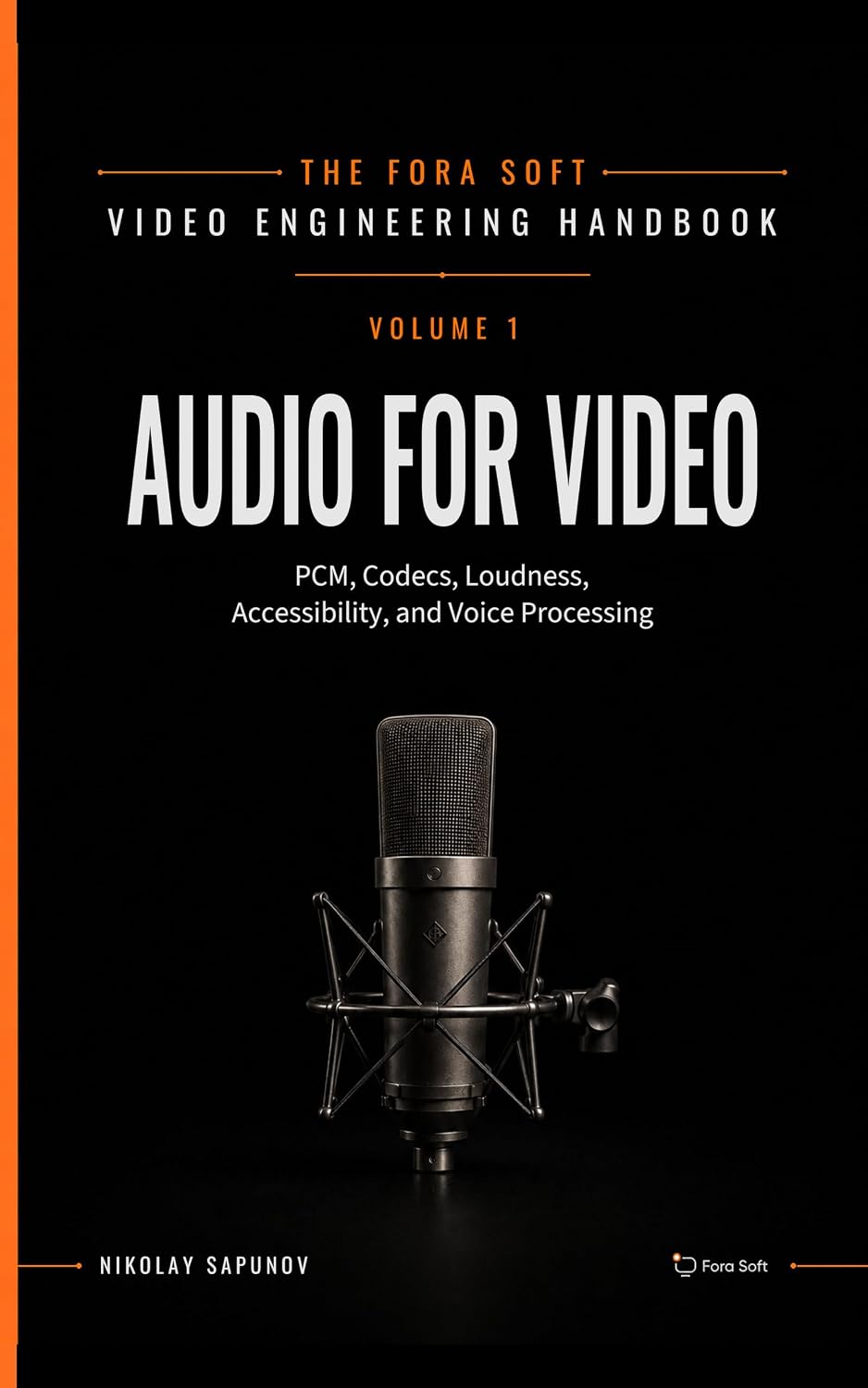
The book · Volume 4 of 7
Audio for Video: A Complete Guide to Sound in Video Products: From PCM and Codecs to Loudness, Accessibility, and Real-Time Voice Processing
G.722 still turns up wherever a video product meets SIP phones and DECT handsets, so it is often the codec at the edge of your call. Volume 4 covers speech codecs in detail alongside Opus and AAC, sampling and bandwidth, and real-time voice processing, so you can plan G.722 interop and transcoding with Opus. Written by Nikolay Sapunov, CEO at Fora Soft.
Bridging WebRTC calls to SIP phones that speak G.722?
We will review your gateway and send an interop plan for G.722 and Opus, including transcoding points and the latency they add. 250+ video products shipped since 2005.
