

Lip-sync is the alignment of audio and video so that the sound a viewer hears lines up with the picture — most visibly, speech with mouth movement. The ear and eye tolerate a small offset, and ITU-R BT.1359 quantifies it: viewers begin to detect errors when audio leads the picture by more than about 45 ms or lags by more than about 125 ms, with production guidelines (EBU R37) tighter still. Maintaining sync means carrying timing through the whole chain — capture, encode, multiplex, deliver, decode, render — and it breaks in characteristic places: separate audio/video pipelines, post-decode buffering, and clock drift over long sessions. It is the failure users notice and complain about first.
The book · Volume 5 of 7
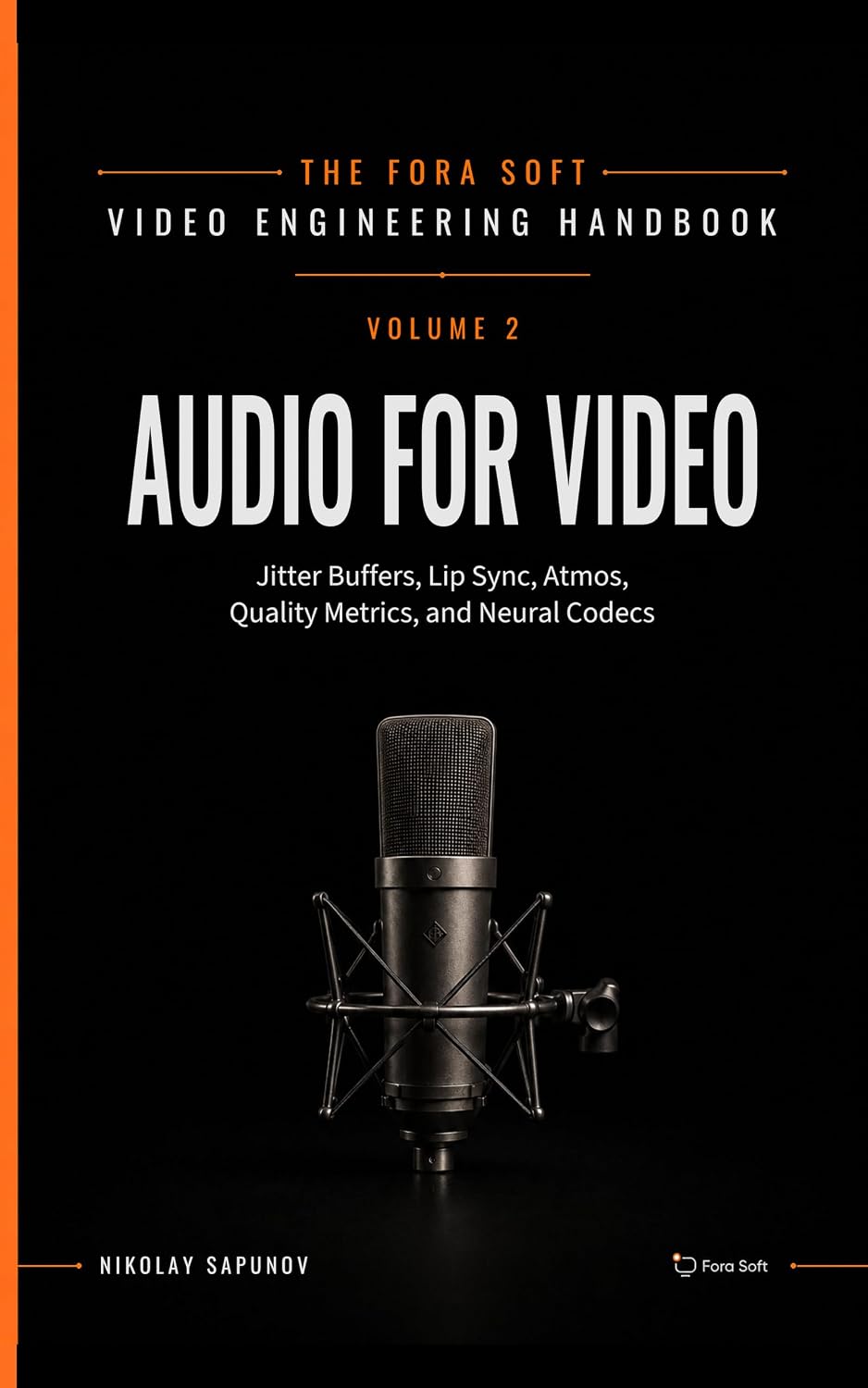
Audio for Video: A Complete Guide to Sound in Video Products: From Jitter Buffers and Lip Sync to Atmos, Quality Metrics, and Neural Codecs
Lip-sync errors are among the first faults viewers notice, and they usually come from timestamps, not from the picture or the sound alone. Volume 5 treats lip-sync in depth: ITU-R BT.1359 windows, timestamps and clock domains, jitter buffer delay, and how to trace drift through capture, encoding and playback. Written by Nikolay Sapunov, CEO at Fora Soft.
Audio drifting away from the picture in your streams or calls?
Send us a sample with the drift and we will trace the lip-sync error to its stage and give you the timestamp or buffer fix. 250+ video products shipped since 2005.
