

MPEG-H 3D Audio is the open ISO immersive standard, the main alternative to Dolby's AC-4, and the audio system of ATSC 3.0 as deployed in South Korea. It unifies all three audio paradigms in one stream — channels, objects, and scene-based Higher-Order Ambisonics — and is built around interactivity: listeners can adjust dialogue, switch language objects, or rebalance elements at playback. The bitstream (MHAS) carries this metadata to the renderer, which adapts to whatever speakers or headphones are present. Because it is standards-based rather than proprietary, MPEG-H is attractive for broadcasters and music (Sony 360 Reality Audio uses it), though Dolby's ecosystem dominates Western streaming.
The book · Volume 5 of 7
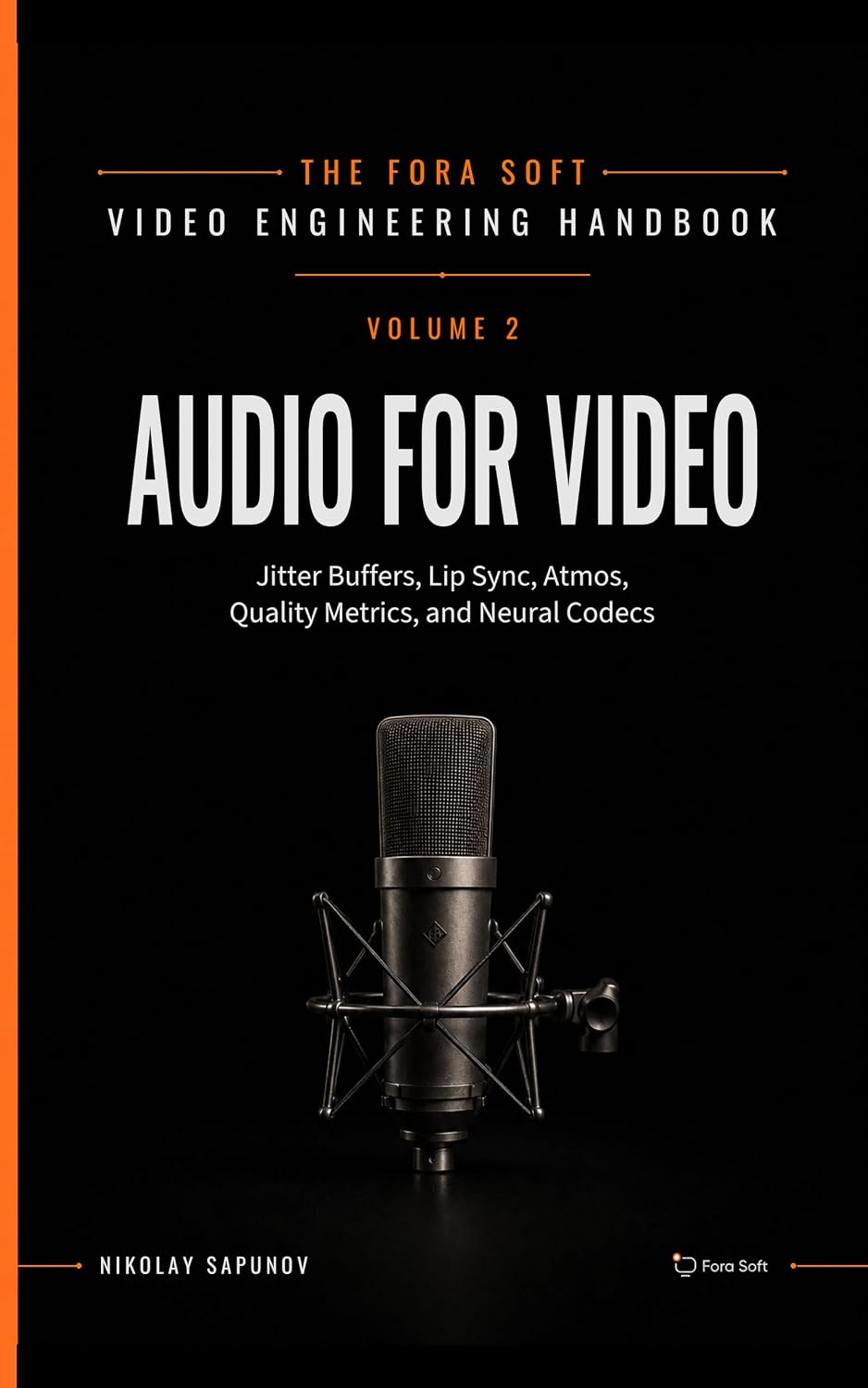
Audio for Video: A Complete Guide to Sound in Video Products: From Jitter Buffers and Lip Sync to Atmos, Quality Metrics, and Neural Codecs
MPEG-H 3D Audio brings personalization, such as user-adjustable dialogue, along with immersive sound, but support varies widely across devices. This volume examines MPEG-H in depth with object-based audio, Ambisonics, Atmos and spatial rendering, so you can weigh it against AC-4 for broadcast and streaming launches. Written by Nikolay Sapunov, CEO at Fora Soft.
Comparing MPEG-H 3D Audio and AC-4 for an immersive broadcast or streaming launch?
Tell us your markets and devices and we will compare MPEG-H with AC-4 for your service, covering support, workflows and rollout cost. 250+ video products shipped since 2005.
