

NVIDIA RTX Voice, now folded into NVIDIA Broadcast and the Maxine SDK, is GPU-accelerated noise and echo removal that leans on the graphics card to run heavier neural models than a CPU comfortably could. By offloading the work to the GPU's tensor cores, it can perform very aggressive cleanup — stripping loud, complex background noise almost entirely — while leaving the CPU free for the application. The cost is that it requires a capable NVIDIA GPU, so it suits desktops and streaming setups more than thin clients or mobile. RTX Voice is the GPU end of the same trend that produced Krisp and RNNoise: deep-learning audio cleanup, scaled to whatever compute is available.
The book · Volume 4 of 7
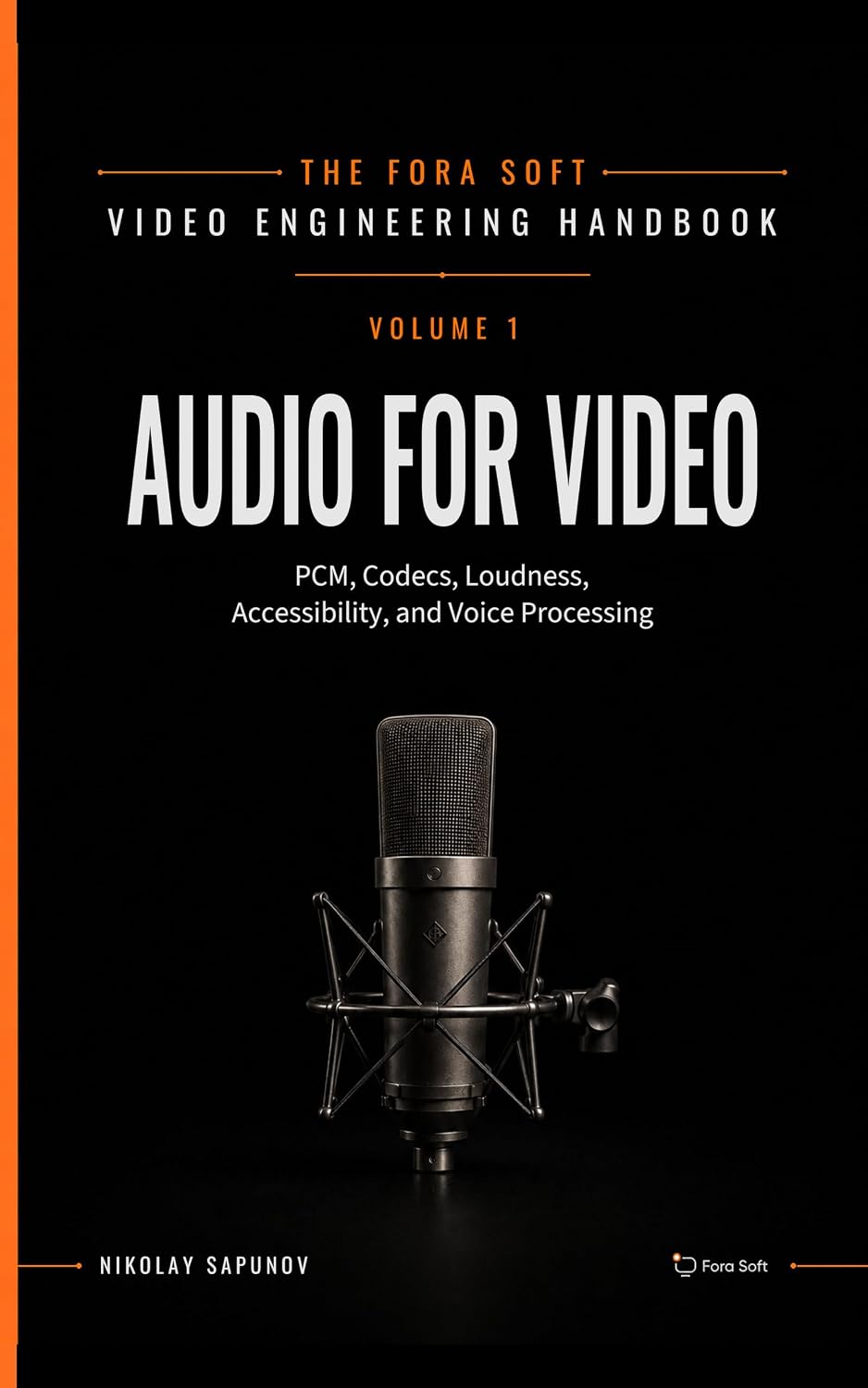
Audio for Video: A Complete Guide to Sound in Video Products: From PCM and Codecs to Loudness, Accessibility, and Real-Time Voice Processing
NVIDIA RTX Voice, now part of Broadcast and Maxine, buys very aggressive cleanup at the price of a GPU on every client. Volume 4 covers real-time voice processing in detail, noise suppression, echo cancellation, AGC and VAD, so you can weigh RTX Voice against CPU options before committing your call stack to it. Written by Nikolay Sapunov, CEO at Fora Soft.
Deciding whether NVIDIA RTX Voice is worth requiring a GPU on every client?
We will compare RTX Voice with CPU-based noise suppression on your own recordings and recommend which one to ship, with the compute cost per call. 250+ video products shipped since 2005.
