

Video delivery covers every step that happens after a frame leaves the encoder and before it appears on a viewer's screen. It is the sum of contribution (getting the signal from the camera to a media server), packaging (chopping the encoded stream into something a player can fetch), distribution (moving those chunks across the public internet via a CDN) and playback (the player's job of fetching, buffering and rendering). When the industry says "streaming" without qualification, it usually means video delivery.
The whole pipeline is graded on three numbers: latency (how far behind real-time the viewer sits), startup time (how long between pressing play and seeing a picture), and rebuffer ratio (what share of viewing time is spent on a spinner). The pipeline has to hold those numbers across a long tail of devices, networks and geographies — a cable modem in São Paulo, a 5G phone on a moving train, a smart TV in a hotel room — using only HTTP, TLS and a handful of standardised manifest formats (HLS, DASH).
In 2026 the dominant pattern is HTTP-based adaptive bitrate delivery: a CMAF segment is fetched from an edge cache, decrypted in the browser via EME, fed into MSE and decoded. WebRTC handles the sub-second use cases (auctions, betting, video conferencing) and Media over QUIC is the rising alternative for both. The choice of delivery protocol is the single biggest architectural decision on a streaming project.
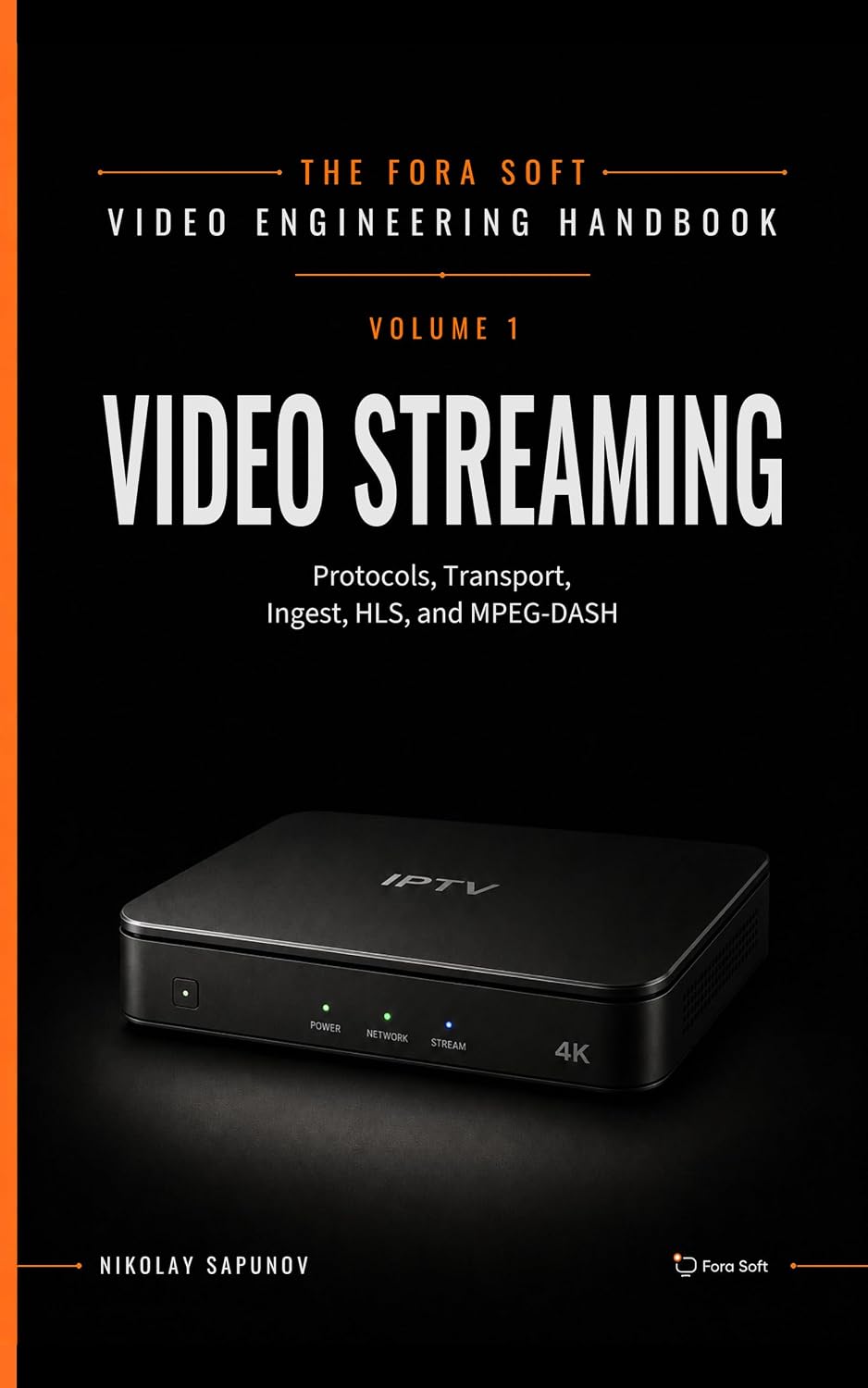
The book · Volume 2 of 7
Video Streaming: A Complete Guide to Video Delivery: From Network Protocols and Transport to Ingest, HLS, and MPEG-DASH
Video delivery is every hop from encoder to screen, and latency, cost and failures add up across ingest, packaging and distribution rather than in one place. This volume covers video delivery in detail from the encoder to the network, with the latency budget, TCP and UDP transport, ingest protocols and HLS, DASH and CMAF packaging. Written by Nikolay Sapunov, CEO at Fora Soft.
Planning video delivery for a new product or a larger audience?
Describe your content and audience and we will deliver a video delivery architecture with protocol choices, CDN approach, latency budget and cost estimate. 250+ video products shipped since 2005.
