

HE-AAC v2 (also eAAC+) adds Parametric Stereo (PS) on top of HE-AAC, squeezing usable stereo into very low bitrates. Instead of coding two channels, the encoder codes a mono core and sends a tiny set of spatial parameters — level and phase differences — from which the decoder reconstructs a stereo image. Combined with the SBR bandwidth extension already in HE-AAC, this gives listenable stereo speech and music down to around 24-32 kbps, the realm of mobile streaming and digital radio on tight links. Quality is clearly a compromise at those rates, but it beats falling back to mono, and decoders are backward compatible with plain HE-AAC and LC.
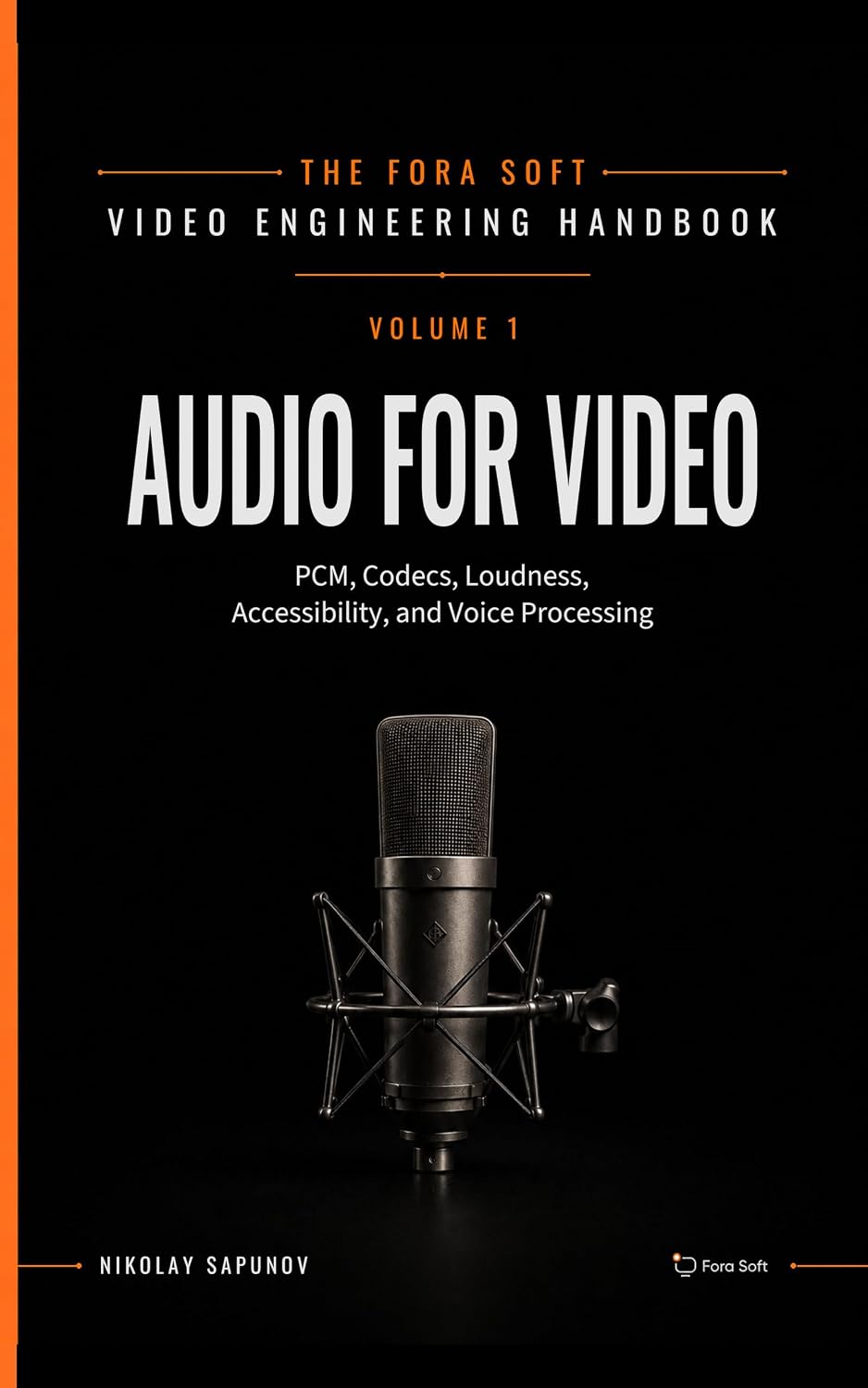
The book · Volume 4 of 7
Audio for Video: A Complete Guide to Sound in Video Products: From PCM and Codecs to Loudness, Accessibility, and Real-Time Voice Processing
HE-AAC v2 keeps stereo audible at around 24 to 32 kbps, which matters for the lowest rungs of a mobile ladder and for radio-style streams. Volume 4 covers audio codecs in detail, with channels and layouts, loudness and LUFS, so you can decide where HE-AAC v2 helps and where AAC-LC or Opus is the better choice. Written by Nikolay Sapunov, CEO at Fora Soft.
Picking audio bitrates for the lowest ladder rungs and considering HE-AAC v2?
We will test HE-AAC v2, AAC-LC and Opus on your content and send an audio ladder with bitrates and device support per rung. 250+ video products shipped since 2005.
