

AAC (Advanced Audio Coding) is the default audio codec for video, the sound in most MP4 files on YouTube, Netflix, Apple, and OTT platforms. Designed as MP3's successor, it delivers better quality at the same bitrate and scales through a family of profiles. AAC-LC (Low Complexity) is the everyday workhorse at 128-256 kbps stereo; HE-AAC adds Spectral Band Replication for efficient low bitrates; HE-AAC v2 adds Parametric Stereo for even lower; xHE-AAC (USAC) unifies speech and music with built-in loudness control. Near-universal hardware decoding makes AAC the safe default for any video service, even where Opus would be more efficient.
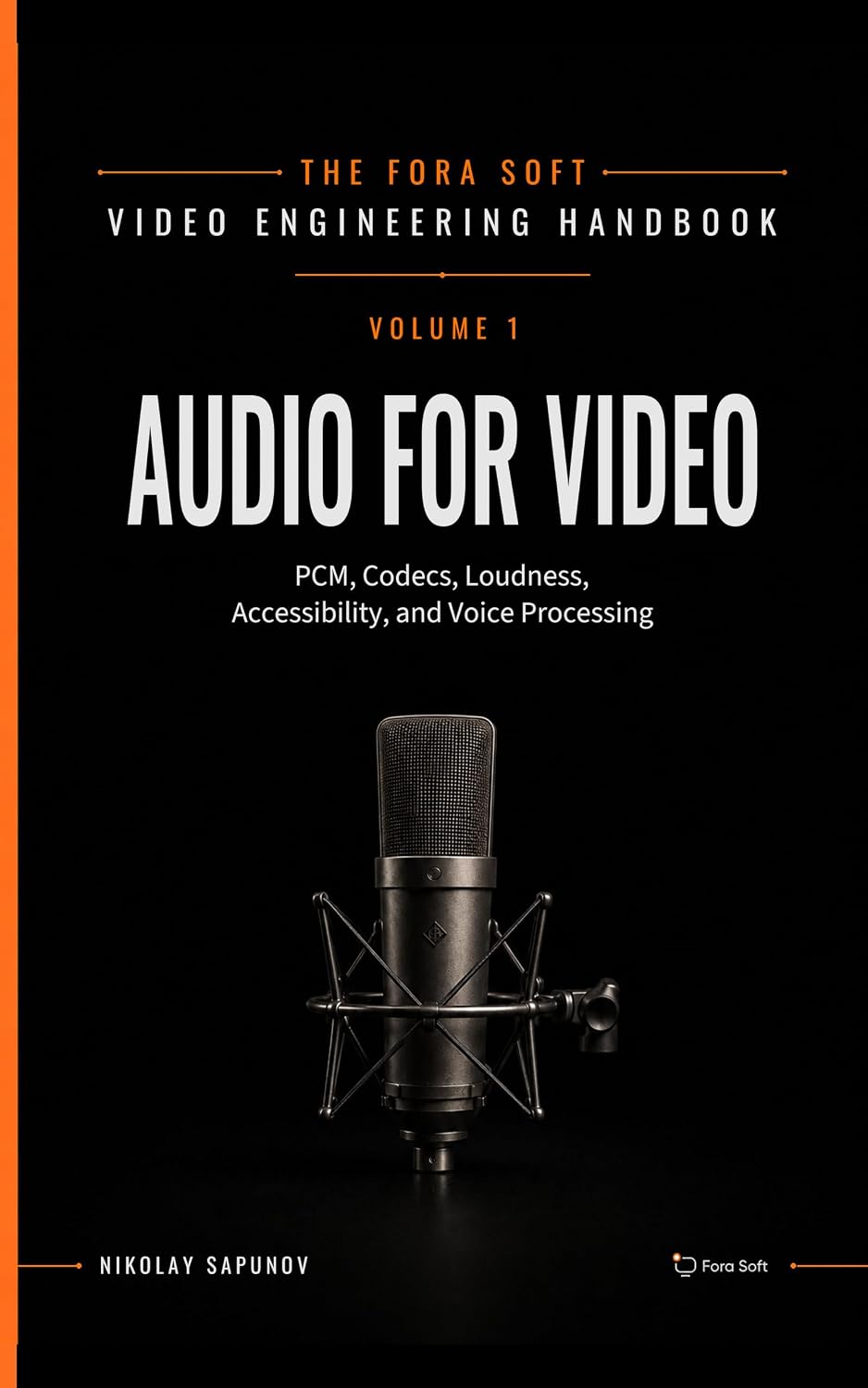
The book · Volume 4 of 7
Audio for Video: A Complete Guide to Sound in Video Products: From PCM and Codecs to Loudness, Accessibility, and Real-Time Voice Processing
AAC is the audio in most MP4 files, yet picking the wrong profile or bitrate is still a common reason streams sound thin on phones. Volume 4 covers AAC in detail within audio codecs: the AAC family and its profiles, Opus and speech codecs, sampling, channels and layouts, and loudness targets for delivery. Written by Nikolay Sapunov, CEO at Fora Soft.
Choosing AAC profiles and bitrates for your video platform?
Tell us your content and target devices, and we will propose an AAC profile and bitrate ladder with a compatibility check across players. 250+ video products shipped since 2005.
