


Key takeaways
• HIPAA is an architecture, not a checkbox. Encryption, de-identification, access controls, audit logs, BAAs, and immutable retention must be in place from day one, retrofitting after a pilot costs 3–5× more and blocks sales.
• DICOM is leaky by default. Patient names, accession numbers, institution, and occasionally burned-in pixel PHI ride inside every study. A strict PS3.15 Annex E de-identification pipeline plus pixel-level OCR redaction, and face/skull defacing for 3D head scans, is non-negotiable.
• HIPAA-eligible cloud is a starting point, not coverage. AWS / Azure / GCP BAAs only cover specific services. Every sub-processor in a PHI path — W&B, Datadog, SendGrid, Segment, needs its own BAA or has to be kept out of that path.
• Realistic compliant-build ranges with Agent Engineering. Compliance-ready imaging MVP: $50K–$110K in 10–16 weeks. Cleared FDA class-II imaging device with HITRUST and clinical validation: $340K–$800K across 12–20 months — 25–35% faster than traditional agency timelines.
• HITRUST + SOC 2 beat HIPAA attestations alone. US hospitals over 250 beds expect one of the two above HIPAA compliance. Run HITRUST i1 and SOC 2 Type II in parallel — 60–70% of controls overlap.
Why Fora Soft wrote this playbook
We’ve spent 20 years shipping video, AI, and healthcare software — 250+ delivered projects with a 99% Upwork success rate. HIPAA-compliant medical imaging software sits right where we live: DICOM pipelines, clinical integrations, encrypted storage, audit logging, and enough regulatory choreography to survive hospital procurement. Our telemedicine services, AI integration practice, and dedicated AI medical imaging team are the day-job behind this guide. Our engineering playbook for AI and video shows how we build these systems in the open.
This playbook reflects patterns we ship. VALT, a HIPAA-compliant video capture and observation platform we have built and run as sole dev team for 10+ years, serves 770+ US healthcare, education, and government organizations and 50,000+ users under the same access-control, encryption, and retention duties an imaging platform carries. Our real-time CV and AI work, see real-time AI on video, is the pattern that powers endoscopy and OR video analysis inside a HIPAA-compliant boundary.
Because we deliver with Agent Engineering, specialist agents on DICOM, security, cloud, app, QA, and compliance in parallel, our HIPAA-ready medical imaging MVPs typically ship 25–35% faster and cheaper than a traditional agency quote for the same scope. That shapes every cost, timeline, and trade-off below.
Scoping a HIPAA-grade imaging build?
30 minutes with our security and compliance architects. We’ll sketch HIPAA posture, cloud BAA map, HITRUST path, and a realistic timeline before anyone quotes you a number.
What HIPAA actually requires for imaging software
HIPAA has three rules that shape medical imaging software: Privacy (how PHI is used and disclosed), Security (how electronic PHI is protected), and Breach Notification (what happens when controls fail). For software builders, the Security Rule is where 80% of engineering effort lands. A January 2025 HIPAA Security Rule proposal (proposed, not final as of 2026; OCR targets roughly 2027) would upgrade encryption at rest and in transit and MFA from ‘addressable’ to mandatory, so the safe move is to build to that bar today.
The Security Rule splits into three safeguard groups. Administrative safeguards cover security management, workforce training, and incident response. Physical safeguards cover facility access and device controls, mostly handled by your cloud provider’s BAA. Technical safeguards (the heart of engineering work) cover access control, audit controls, integrity, transmission security, and authentication.
A few practical definitions. PHI (Protected Health Information) includes the 18 HIPAA identifiers: names, geographic subdivisions below state level, dates more precise than year, phone numbers, emails, MRNs, account numbers, device identifiers, biometric data, photos, and more. ePHI is PHI in electronic form. A Covered Entity is the healthcare provider or health plan. A Business Associate is anyone (including software vendors) that processes PHI on behalf of a Covered Entity, that’s you, and you need a Business Associate Agreement.
Reference architecture for a HIPAA-compliant imaging platform
The stack below is what we deploy for imaging software that must clear hospital procurement security reviews. It’s cloud-agnostic (AWS examples below with direct GCP / Azure analogs), separates the PHI data plane from the non-PHI control plane, and ships with audit and logging that pass HITRUST and SOC 2 audits.
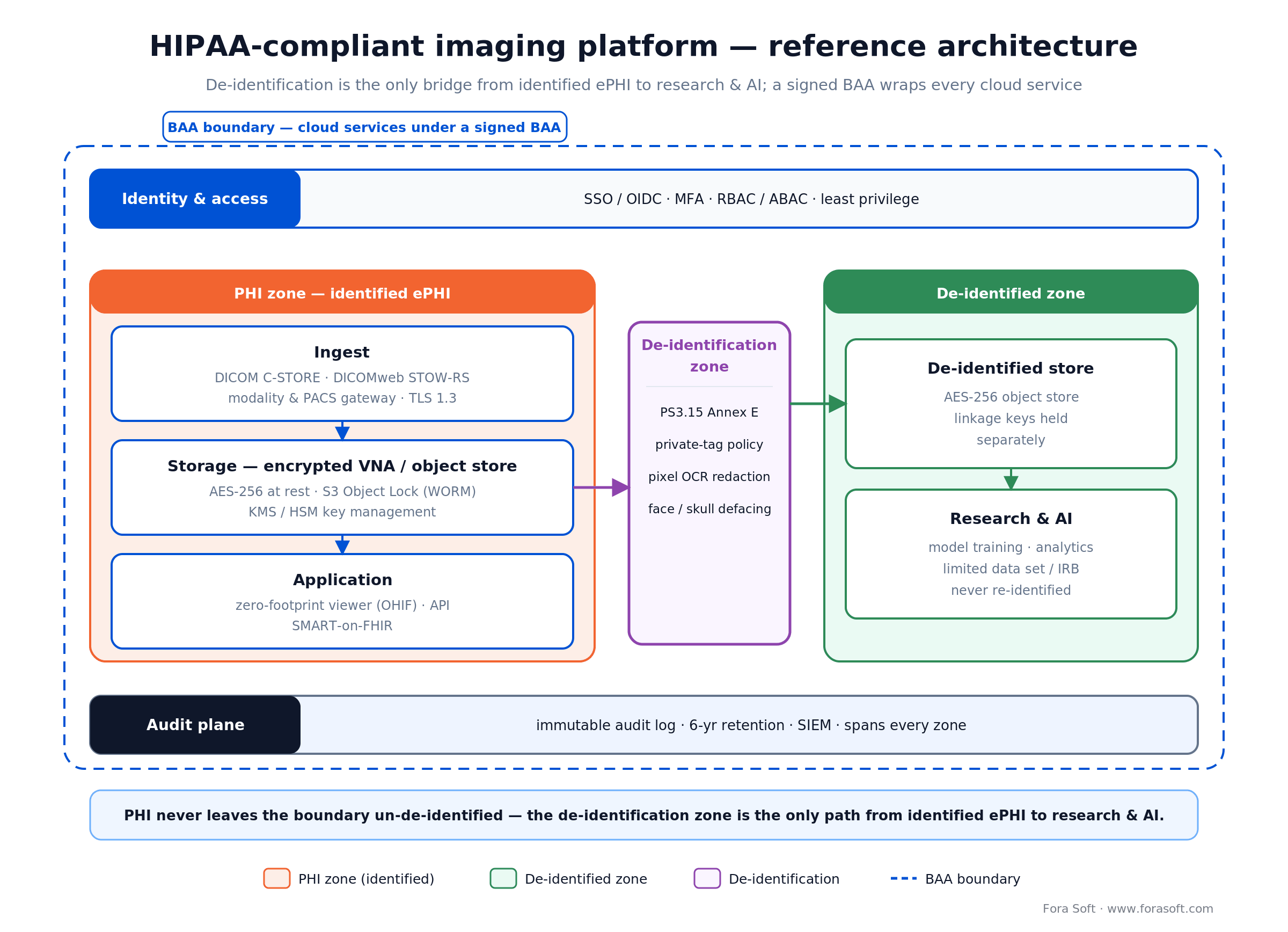
Figure 1. Reference architecture for a HIPAA-compliant imaging platform: identified PHI stays isolated, and the de-identification zone is the only bridge to the research and AI zone, all under a signed BAA and a spanning audit plane.
| Layer | Recommended tech | Why it wins | Alternatives |
|---|---|---|---|
| DICOM ingest | Orthanc + dcm4che | Open-source, IHE-compliant, proven de-identification | AWS HealthImaging, GCP Healthcare API |
| De-identification | CTP + custom pixel OCR | PS3.15 Annex E compliance plus burned-in text scrubbing | Presidio, GCP Healthcare API DLP |
| Storage | S3 with SSE-KMS + Object Lock | AES-256 at rest, immutable retention, 6-year audit trail | Azure Blob with immutable policies, GCS Bucket Lock |
| Database | RDS Postgres encrypted + pgAudit | Relational rigor for clinical data, field-level encryption for PHI | Azure Database for PostgreSQL, Cloud SQL |
| Identity | Cognito / Auth0 + MFA + SCIM | SSO with hospital IdP, enforced MFA, SCIM auto-deprovisioning | Okta, Azure AD B2C, Keycloak |
| Viewer | OHIF + Cornerstone3D | Zero-install, production-grade, strong annotation API | 3D Slicer, Weasis |
| Audit and logging | CloudTrail + CloudWatch + S3 Object Lock | Tamper-evident 6-year retention required by HIPAA | Azure Monitor + Immutable Blob, Loki + S3 |
| Secrets | AWS Secrets Manager + KMS | Automatic rotation, key provenance, audit trail | HashiCorp Vault, Azure Key Vault |
| Integration | HL7 v2 + FHIR R4 + DICOMweb | Speaks the same protocols as Epic, Cerner, Sectra, PACS | Rhapsody, Mirth Connect |
| Network | VPC + private endpoints + WAF | Zero public egress of PHI; TLS 1.3 between every hop | Azure VNet, GCP VPC + Private Service Connect |
De-identification: the most underestimated workload
PHI lives in four places inside a DICOM study. Miss one and you’re out of compliance before the data reaches your model.
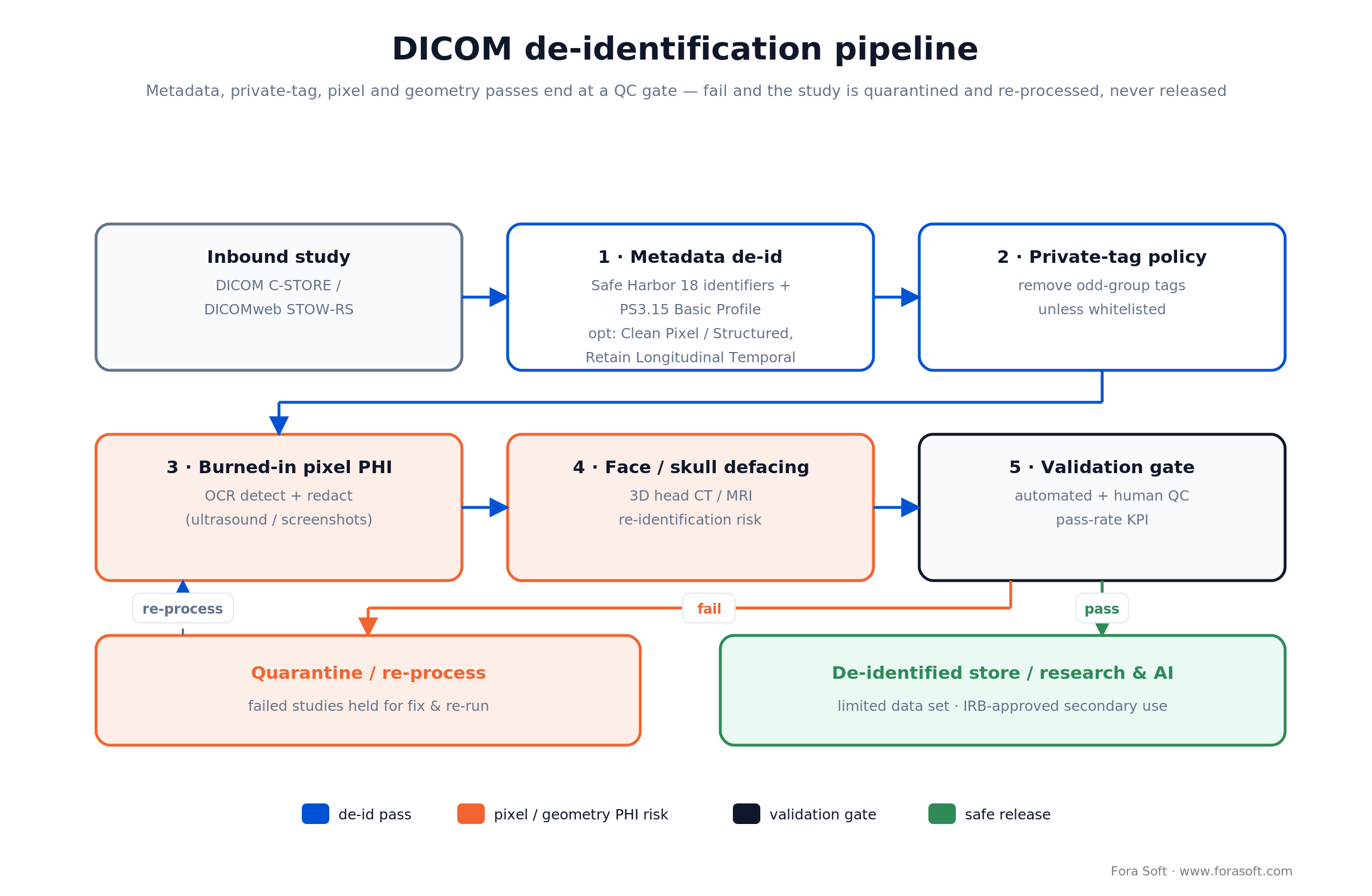
Figure 2. The DICOM de-identification pipeline runs metadata, private-tag, burned-in-pixel and face/skull passes into a validation gate that quarantines and re-processes any study that fails before release.
1. Standard DICOM tags. PatientName, PatientID, PatientBirthDate, AccessionNumber, StudyDate, InstitutionName. DICOM PS3.15 Annex E (the former Supplement 142) defines the Basic Application Level Confidentiality Profile, the minimum. Apply full profile plus the Retain Longitudinal Temporal Information option, the Clean Structured Content option, and shift dates by a consistent per-patient offset to preserve temporal relationships.
2. Private tags. Vendors embed proprietary metadata (sometimes with PHI) in private tag ranges (odd group numbers, e.g. 0009, 0011, 0013). Default policy: remove all private tags. Whitelist only tags you verified don’t carry PHI.
3. Burned-in pixel PHI. Ultrasound, fluoroscopy, and some CT reconstructions burn patient name, date, and institution into the image itself. No tag scrubbing touches pixels. Run OCR across every study (Tesseract, PaddleOCR, or AWS Rekognition Text) and flag or redact any detected text regions. Skip this step and you’ll find yourself retraining models on tainted data.
4. Embedded reports and SR. DICOM Structured Reports can contain free-text PHI (dictated findings). Strip narrative content unless explicitly needed; when needed, run a HIPAA-Safe-Harbor NLP pass (Presidio, AWS Comprehend Medical, GCP Healthcare API DLP).
Safe Harbor vs Expert Determination. HIPAA gives two paths to de-identification. Safe Harbor removes all 18 identifiers. Expert Determination uses a qualified statistician to certify low re-identification risk. Most imaging teams use Safe Harbor for engineering simplicity; Expert Determination lets you keep useful features (fine-grained dates, rare-diagnosis detail) when the use case demands it.
Business Associate Agreements, the sub-processor map
Every vendor that touches PHI needs a BAA. This is where most teams get caught during hospital security review, not for missing HIPAA on their core app, but for leaking PHI into an observability or analytics tool without a BAA.
Cloud providers — AWS, Azure, GCP all offer BAAs covering specific HIPAA-eligible services. Not all services are eligible. Maintain a living sub-processor map and test each data flow at design time. AWS publishes a whitelist of 150+ eligible services; Azure and GCP maintain similar lists.
Observability — Datadog, New Relic, Sentry, Grafana Cloud all offer HIPAA tiers with BAA. Use them. Never send raw PHI to logs, strip or hash identifiers before logging, even on HIPAA tiers.
Analytics and email — Segment, Amplitude, PostHog, SendGrid, Mailgun all have HIPAA-compliant plans (usually enterprise-tier and with explicit opt-in). Free / Growth tiers are not HIPAA-ready.
ML tooling — Weights & Biases, Comet, Neptune all require enterprise contracts with BAAs. For most teams, self-hosted MLflow inside the HIPAA VPC is the easiest path.
LLM APIs — OpenAI, Anthropic, and Azure OpenAI all offer HIPAA-eligible usage with BAAs (zero-data-retention tiers). Off-the-shelf API keys on paid consumer plans do not meet HIPAA.
Reach for a HIPAA-VPC-only deployment when: you can’t get BAAs from a critical sub-processor and self-hosting is cheaper than the BAA-tier contract, this keeps the PHI boundary tight without slowing the stack.
Encryption and key management
At rest. AES-256 on every PHI-touching data store. Use customer-managed KMS keys (AWS KMS CMK, Azure Key Vault customer-managed, GCP Cloud KMS). Rotate keys annually; document rotation in your security policy; retain old keys for the length of data retention.
In transit. TLS 1.3 between every service, including internal microservices. mTLS on the DICOM and HL7 interfaces into hospital networks. Deprecate TLS 1.0 / 1.1 / SSL 3 explicitly; hospital security reviewers scan for these.
Application-level. Envelope-encrypt sensitive columns (diagnoses, genomic data) with per-record data keys. Tokenize identifiers at the API edge. For true end-to-end on a mobile client, pair asymmetric keys per user / per device with server-side key wrapping.
Backups. Encrypt backups with separate keys; ship to a separate account / subscription; test restoration quarterly. A backup that never restores is a compliance finding.
Audit logging and the 6-year retention rule
HIPAA ties audit-log retention to its documentation rule (45 CFR §164.316): keep them at least 6 years (some states require longer), tamper-evident, and able to reconstruct any access to PHI. With the average healthcare data breach at $7.42M in 2025 (IBM Cost of a Data Breach Report), the audit trail you cannot query fast is the breach you cannot bound. Most builders get this mostly right and then lose on three details.
1. Immutable storage. S3 Object Lock (or Azure Immutable Blob, GCS Bucket Lock) in compliance mode. Retention period set to 6 years. This prevents even the root administrator from deleting logs during the retention window, exactly what auditors want to see.
2. Coverage. Every PHI access, read or write, must log user, timestamp, source IP, target resource, and result. That includes database reads (pgAudit), object storage reads (S3 server access logs + CloudTrail data events), API gateway access, and clinician workstation activity.
3. Breach-ready search. If an incident happens, you need to reconstruct “which records were accessed by whom in which time window” in hours, not weeks. HIPAA gives you up to 60 days after discovery to notify, but you cannot scope a breach you cannot query. Index logs into a queryable store (OpenSearch, Loki, Azure Data Explorer) at ingest. Don’t discover at breach time that your logs are an unindexed pile on S3 Glacier.
Access control and identity
1. SSO + MFA everywhere. Hospital IdP via SAML 2.0 or OIDC. MFA mandatory on all user and admin accounts. SCIM 2.0 for automatic provisioning / deprovisioning — a terminated clinician must lose PHI access within minutes, not days.
2. Least privilege RBAC / ABAC. Roles model real workflow (radiologist, technologist, administrator, billing). Attribute-based controls layer in context: time-of-day, requesting IP range, study department. Default-deny, then grant explicit permissions.
3. Session management. 15-minute idle timeout for clinical users, 60-minute hard session length for admin users. Re-authenticate before any destructive operation (delete, export, print).
4. Break-glass workflow. Emergency access to a study by a user who doesn’t normally have permission — must be possible, must require justification, must page the compliance team, and must log extensively. Clinicians will not adopt a platform that blocks emergency access.
HIPAA vs HITRUST vs SOC 2 vs FedRAMP
HIPAA compliance is table stakes. Hospital procurement increasingly asks for more. The matrix below is the shortcut we use when scoping buyer requirements.
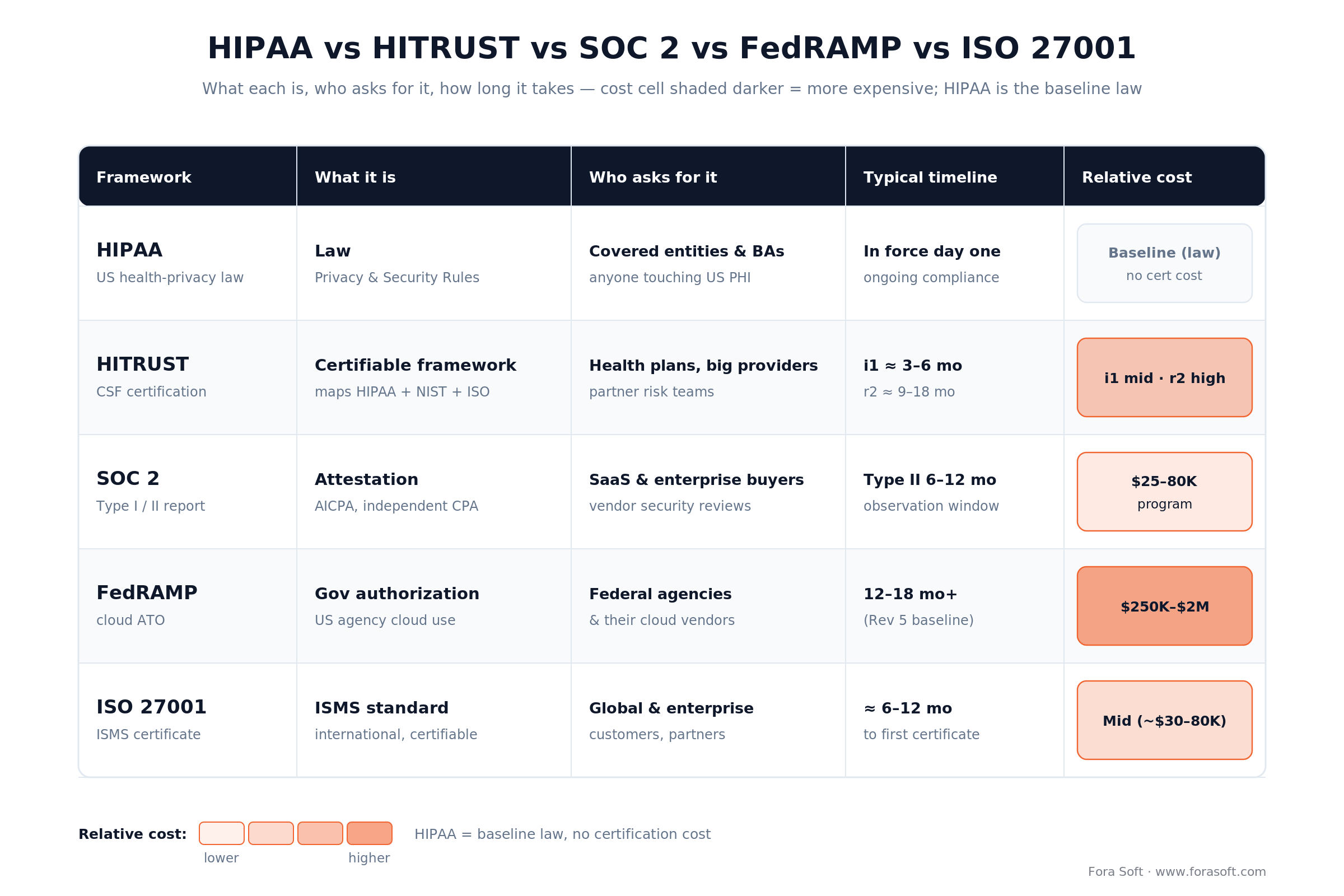
Figure 3. How HIPAA, HITRUST, SOC 2, FedRAMP and ISO 27001 compare on what each is, who asks for it, typical timeline and relative cost.
| Framework | Required by | Typical cost | Timeline |
|---|---|---|---|
| HIPAA | Every US healthcare customer | Internal attestation — no external cert | Continuous |
| SOC 2 Type II | Most US hospitals, B2B SaaS | $25K–$60K audit + platform | 6 months observation + 1–2 month audit |
| HITRUST i1 | Large US hospitals (250+ beds) | $60K–$150K | 6–9 months |
| HITRUST r2 | Enterprise health systems, payers | $150K–$400K | 12–18 months |
| FedRAMP Moderate | VA, DoD, federal health agencies | $500K–$2M | 18–36 months |
| ISO 27001 / 27701 | EU customers, global enterprise | $30K–$120K | 6–12 months |
| GDPR / EU MDR | Any EU deployment | $20K–$80K DPIA + legal | Continuous |
Reach for HITRUST i1 plus SOC 2 Type II when: you’re selling to US hospitals — 60–70% of the controls overlap, so run them in parallel in one 9-month window rather than sequentially.
AI diagnostic hooks inside a HIPAA boundary
Medical imaging software increasingly ships AI inference as a first-class feature. Keeping models compliant while letting them see PHI is a recurring architectural challenge.
1. Inference inside the VPC. Deploy models on Triton / TorchServe / ONNX Runtime in the same VPC as PHI data. No egress to third-party ML APIs unless the provider’s BAA covers the endpoint (AWS Bedrock, Azure OpenAI Service, Vertex AI on HIPAA-eligible projects).
2. Training data provenance. Every training dataset gets a documented provenance record: source site, consent basis, de-identification pipeline version, annotation protocol, split strategy. FDA and HITRUST both audit this.
3. Model registry with version pinning. MLflow or self-hosted SageMaker registry. Every deployed model has a cryptographic hash, training dataset reference, validation metrics, and a rollback plan. A cleared model is a frozen artifact.
4. Audit the inference path. Log which model version processed which study, prediction, and user response. This is both HIPAA audit and FDA post-market surveillance. Our custom AI medical imaging guide covers the model development side in depth.
Integration with PACS, EHR, and hospital networks
PACS. DICOM DIMSE (C-STORE, C-FIND, C-MOVE) or modern DICOMweb (STOW-RS, QIDO-RS, WADO-RS). Authenticate via AE Title + IP allowlist plus TLS. Findings returned as DICOM Structured Reports with proper template IDs so they appear inline in the radiologist’s worklist.
EHR. Epic (via Showroom and Vendor Services) and Oracle Health (Cerner CODE) speak FHIR R4. SMART on FHIR for contextual launch (patient context in, FHIR Observation results back). HL7 v2.x ADT and ORU for enrollment and lab flow. Budget 6–12 weeks per major EHR for production integration.
Interface engines. Mirth Connect and Rhapsody are the interop middleware most hospitals use. Speak their language; ship clean HL7 v2 and FHIR; don’t invent formats.
On-prem vs cloud. Some hospitals still insist on on-prem deployment. Ship a hardened edge appliance: immutable OS image, K3s or Talos Linux, auto-update channel, remote monitoring, offline installer. Reserve cloud for multi-tenant SaaS deployments.
Realistic HIPAA build cost model
Compliance adds real cost but pays back as commercial trust and shorter sales cycles. The table below reflects Fora Soft delivery with Agent Engineering — traditional agencies typically quote 25–50% higher for the same scope.
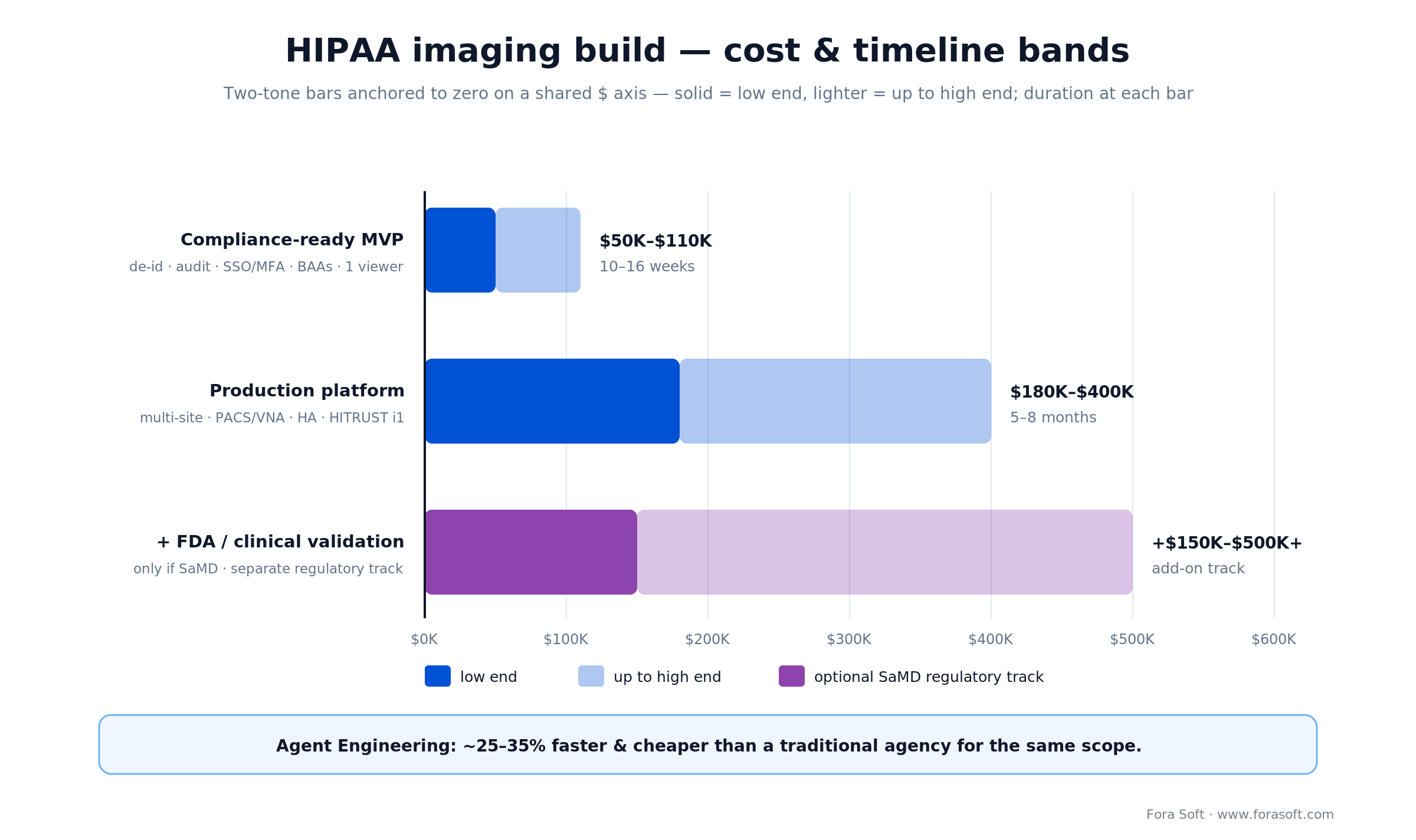
Figure 4. Indicative cost and timeline bands for a HIPAA imaging build — a compliance-ready MVP, a production platform, and an optional FDA/clinical-validation track — shown as two-tone bars anchored to zero.
| Stage | Timeline | Scope | Budget |
|---|---|---|---|
| Compliance-ready MVP | 10–16 weeks | Orthanc + OHIF + encrypted storage + audit + BAAs + SSO | $50K–$110K |
| SOC 2 Type II | 6 months + 1–2 month audit | Policies, controls, evidence, auditor fees | $25K–$60K |
| HITRUST i1 | 6–9 months | 180+ controls, assessor fees, remediation | $60K–$150K |
| FDA 510(k) add-on | 9–15 months | QMS, clinical validation, submission | $150K–$500K+ |
| Year-2 opex | Continuous | HIPAA-tier cloud, pen test, audits, security engineer | $180K–$500K/year |
Expect $6K–$20K/month in HIPAA-tier cloud infrastructure once the platform is live — a HIPAA-tier deployment typically runs ~10–20% above a non-compliant setup once you add logging, encryption, and redundancy. Annual penetration testing runs $12K–$35K depending on scope; cyber insurance premiums for healthcare software add $15K–$60K. Stacked end to end (compliance-ready MVP, security hardening, multi-site scale, and a HITRUST i1 assessment), a production platform typically lands in the $180K–$400K range over 5–8 months.
Mini case: HIPAA-ready imaging platform in 18 weeks
Situation. A startup building orthopedic measurement AI needed to ship a compliant platform to a pilot hospital within 5 months. No prior security engineer, no policies, a research prototype in a GitHub repo, and a signed BAA with AWS and nothing else.
18-week plan. Specialist agents in parallel: security team stood up a HIPAA-eligible AWS account structure (separate PHI and non-PHI accounts, SCPs, Control Tower, KMS CMKs), de-identification team deployed a PS3.15 Annex E pipeline plus pixel OCR, app team shipped OHIF + Cornerstone3D on the encrypted backend, compliance team wrote and shipped the 23 policies required for SOC 2 Type II observation.
Outcome. Week 18: HIPAA-ready platform live at pilot site with DICOM integration and audit trail; SOC 2 Type II observation window open; pen test clean. 6 months later: SOC 2 Type II report issued; HITRUST i1 started. The platform closed two additional hospital pilots on the back of the reports. Want a similar 18-week plan for your product? Book a 30-minute architecture call and we’ll sketch your HIPAA path live.
Pitfalls we see kill HIPAA compliance
1. Logging PHI. Raw PHI ends up in error logs, stack traces, crash reports. Strip or hash identifiers at the serialization layer; Pydantic validators and Zod schemas help enforce this at runtime.
2. Uncovered sub-processors. The app is HIPAA-ready, but Sentry, Intercom, Mixpanel, or SendGrid are on the non-HIPAA tier. Every sub-processor touching PHI needs a BAA — audit at design time.
3. Shared developer access to prod PHI. Engineers SSH into the production database to debug. Instead, ship debugging data products (de-identified samples, synthetic fixtures) and build break-glass workflows with justification + audit.
4. Skipping pen tests. An attacker finds the S3 bucket with accidental public access before the HIPAA auditor does. Annual penetration tests plus ongoing vulnerability scanning (Snyk, Trivy, AWS Inspector) are table stakes.
5. Burned-in PHI in training data. A pixel-OCR redaction slip lets patient names train into the model. FDA reviewers catch this in validation; hospital customers catch it first time they see a finding with a PHI fragment.
Decision framework — choose your compliance posture
1. Who is the buyer? For an SMB clinic or imaging center, HIPAA plus SOC 2 Type II is usually enough. A large health system (250+ beds) will also expect HITRUST i1. Federal buyers (VA, DoD) mean the 18–36 month FedRAMP path.
2. Does the product ever see PHI? If it never touches PHI, skip HIPAA and focus on SOC 2 for B2B trust. If it does, HIPAA is mandatory and the architecture has to reflect it from day one.
3. Is the product a Medical Device? If yes (software that diagnoses or treats), add FDA 510(k) or De Novo clearance. The compliance posture doubles but so does defensibility.
4. US-only or EU too? EU deployments add GDPR, EU MDR (if device), and likely ISO 27001/27701. Budget 3–6 additional months.
5. Cloud or on-prem? Cloud is faster and cheaper if hospitals accept it. Enterprise health systems increasingly do. Budget an edge-appliance option (K3s / Talos) for the ~10% of customers who still insist.
Want a HIPAA gap-analysis of your current build?
Share your architecture. Within 5 business days we’ll return a gap report: control-by-control coverage, sub-processor map, the 5 fixes that move the needle most, and a realistic cost to HIPAA-ready state.
Reach for a compliance-as-a-service platform (Vanta, Drata, Secureframe) when: you need to ship policies, evidence collection, and auditor coordination in weeks instead of months — these platforms cut SOC 2 observation overhead by 60%+.
KPIs and metrics that matter for compliance ops
Security KPIs. Mean-time-to-detect < 24 hours on high-severity vulnerabilities, mean-time-to-remediate < 30 days for critical CVEs, 100% encryption coverage on PHI data stores, 100% MFA enrollment for users accessing PHI.
Audit KPIs. 100% of PHI access events logged, log ingest-to-query latency < 5 minutes, breach-scope reconstruction possible within 72 hours. Zero gaps in 6-year retention verified quarterly.
Integration KPIs. DICOM ingest success rate > 99.5%, HL7 message round-trip < 60 seconds, PACS connection uptime > 99.9%, zero PHI leak events in logs or analytics.
When NOT to build HIPAA compliance in-house
Three signals we respect. First, if the product never touches PHI — say, a training portal for radiologists that deals only with de-identified teaching cases — HIPAA is not required. Don’t over-build; SOC 2 alone is enough for B2B trust.
Second, if the team has zero security or compliance experience and runway is under 12 months, partner with a compliance-as-a-service platform (Vanta, Drata, Secureframe) and an MSP. Building from scratch absorbs a quarter of your engineering capacity.
Third, if you’re a pure research tool for retrospective de-identified data, skip the whole consumer-facing HIPAA posture and focus on IRB approvals and data-use agreements. Don’t try to become a device company by accident.
An 18-week HIPAA-ready delivery roadmap
The plan below reflects Agent Engineering delivery with specialist agents on security, de-identification, app, integration, and compliance in parallel. Traditional teams typically run 24–30 weeks for the same scope.
| Weeks | Milestone | Deliverables |
|---|---|---|
| 1–3 | Discovery + security design | Threat model, data-flow diagrams, sub-processor map, BAA list, policies outlined |
| 2–5 | HIPAA cloud foundation | AWS Control Tower, KMS CMKs, VPC with private endpoints, IAM baseline, CloudTrail |
| 3–7 | DICOM + de-identification | Orthanc router, PS3.15 Annex E profile, pixel OCR pipeline, private-tag policy |
| 5–10 | App + viewer | OHIF viewer, auth (SSO + MFA), RBAC, audit logging, break-glass workflow |
| 8–13 | Integration | HL7 v2 ADT/ORU, FHIR R4, DICOMweb, optional EHR SMART launch |
| 10–15 | Compliance program | 23 policies, risk assessment, training records, vendor BAAs signed |
| 15–18 | Pen test + pilot | External pen test, remediation, SOC 2 observation start, pilot go-live |
Reach for Agent Engineering when: you want a HIPAA-ready imaging platform in 18 weeks — with specialist agents on security, de-ID, app, integration, and compliance in parallel rather than one sequential sprint after another.
FAQ
Is “HIPAA certified” a real thing?
No. HIPAA compliance is attestation-based — there’s no government-issued certification. What buyers actually want is a SOC 2 Type II report, HITRUST certification, or a detailed security questionnaire plus signed BAAs. Treat any vendor claiming to be “HIPAA certified” with caution.
Do we need a BAA with AWS / Azure / GCP?
Yes, and only after signing do HIPAA-eligible services become HIPAA-covered in your account. BAAs are free from all three major clouds but must be signed through the provider’s program (AWS Artifact, Azure Trust Center, GCP HIPAA program). Coverage applies only to whitelisted services — maintain an ongoing map of which service is in or out of the BAA.
How long does a HIPAA-ready MVP actually take?
Under Agent Engineering, 4–6 months to pilot-ready state covering DICOM ingest, encrypted storage, de-identification, OHIF viewer, SSO + MFA, audit logging, and signed BAAs with sub-processors. SOC 2 Type II adds a 6-month observation window that runs in parallel.
What’s the difference between HIPAA and HITRUST?
HIPAA is the US law setting minimum PHI safeguards. HITRUST is a private certification (HITRUST CSF) that maps HIPAA plus other frameworks (NIST, ISO 27001, COBIT) into one auditable control set. Hospitals increasingly request HITRUST as shorthand for “this vendor did more than the legal minimum.”
Can we use ChatGPT / Claude / Gemini for processing PHI?
Only via providers that offer a signed BAA and zero-data-retention contract — Azure OpenAI Service, AWS Bedrock (Anthropic, Meta, Cohere models), Google Vertex AI with HIPAA-eligible projects. Consumer-tier OpenAI, Anthropic, or Google AI API keys do not cover PHI processing. Check before a developer pastes a prompt.
How do we handle right-to-delete requests under HIPAA / GDPR?
HIPAA does not mandate right-to-delete, but GDPR does for EU subjects. Build automated deletion workflows that purge PHI across primary storage, backups, logs (with legal-hold exceptions), and derived analytics. Document retention schedules per data category so you can respond to requests within statutory deadlines (30 days for GDPR).
Do we need pen testing even if AWS handles physical security?
Yes. AWS handles security OF the cloud (physical, network, hypervisor); you handle security IN the cloud (your app, configuration, IAM, data). HIPAA’s evaluation requirement (45 CFR §164.308(a)(8)) and most procurement processes drive annual external penetration testing of your application stack. Budget $12K–$35K.
How does Fora Soft accelerate HIPAA delivery?
Agent Engineering runs security, de-identification, app, integration, and compliance streams in parallel rather than sequentially. Combined with infrastructure-as-code templates we’ve hardened across 250+ projects, a typical HIPAA-ready MVP lands in 18 weeks instead of 24–30. We also provide a gap-analysis of any existing build as a standalone engagement.
What to Read Next
Medical AI
Custom AI for Medical Imaging: The Playbook
Dataset strategy, FDA 510(k) pathway, PACS integration, and 14-week PoC-to-pilot delivery.
Real-time AI
Real-Time AI on Video: Architecture Patterns
Computer-vision on live video at clinical latency — same patterns used for endoscopy and OR analysis.
AI + imaging
AI Video Quality Enhancement: The Real Stack
Super-resolution and denoising maps directly onto low-dose CT and MRI acceleration workflows.
Medical imaging
Medical Imaging Software Development: 2026 Playbook
The build-side companion to this compliance guide: DICOM, PACS, OHIF/Orthanc, cloud and cost.
Ready to ship HIPAA-compliant medical imaging software?
HIPAA-compliant medical imaging ships when encryption, de-identification, access control, audit logging, and BAA coverage are engineering decisions made in week one — not an afterthought. Layer SOC 2 Type II and HITRUST i1 on top and you clear hospital procurement without months of security questionnaires.
If you’re scoping a new build or auditing an existing stack, our 18-week plan has shipped across multiple imaging and telemedicine products. We’ll tell you (honestly, in 30 minutes) which controls to prioritize, which sub-processors to replace, and which frameworks you actually need.



The handbook · 7 volumes
Fora Soft Video Engineering Handbook
A HIPAA-ready imaging platform is compliance wrapped around a video and AI stack, and this guide covers the compliance half. We wrote seven volumes on that stack, from encoding and delivery to audio and AI. Imaging teams can start with Volume 7 on regulation and vertical playbooks, then Volume 6 on computer vision and model deployment, and Volume 1 on compression and quality metrics. Written by Nikolay Sapunov, CEO at Fora Soft.
Browse the handbook on Amazon →7 volumes · 9,000+ pages · Kindle & paperback
Let’s scope your HIPAA-ready imaging build together
30 minutes with our security, cloud, and compliance architects. We’ll sketch your HIPAA posture, sub-processor map, and realistic path to SOC 2 / HITRUST — tailored to your runway and buyer mix.

