Key takeaways
• A FAST channel is linear TV rebuilt on the internet. Free Ad-supported Streaming TV runs a fixed 24/7 schedule, discovered through a program guide, and pays for itself with ads instead of a subscription. It is not on-demand — that distinction drives every technical choice below.
• The launch is the easy part. Managed playout starts around $250–$499 per channel per month (vendor list prices, July 2026). The hard part is filling a 24/7 schedule with rights-cleared content and wiring an ad engine that actually earns.
• SSAI is the money layer. Server-side ad insertion stitches ads into the video manifest so they play like broadcast TV and survive ad-blockers. Without it, a FAST channel is just a free stream that costs you money.
• Reach lives on the platforms; margin and data live in your app. Roku, Samsung TV Plus, and Pluto TV together reach 200M+ US viewers, but distribution is usually a revenue share (plan for roughly 50%). Your own app keeps the audience data and most of the revenue.
• Buy playout when you have one channel; build when FAST is your product. A single channel rents a SaaS playout tool. A platform operator running many channels, or one whose economics or control needs outgrow SaaS, builds a custom stack.
The pitch for a FAST channel sounds like free money: you already own a video library, connected TVs are hungry for content, and advertisers are following the audience. So you spin up a channel, list it on a few platforms, and collect ad revenue. Most of that is true — the FAST market is projected to grow from about $12.3 billion in 2025 to roughly $14.9 billion in 2026, and US FAST users are expected to hit 131.4 million, more than half of all connected-TV users (eMarketer, 2026).
What the pitch skips is that a FAST channel is a small broadcast operation. You need a 24/7 schedule that never goes dark, an ad system that fills breaks without ruining playback, a program guide clean enough to pass platform review, and distribution deals where someone else usually takes half the ad revenue. This guide is the engineering and economics version of that story: what a FAST channel actually is, how the pipeline fits together, what it costs, whether it makes money, and when to buy the plumbing versus build it.
Thinking about launching a FAST channel?
Tell us what content you own and where you want it seen, and we’ll give you a straight read on whether to rent a playout tool or build a custom stack — with the ad-tech and distribution tradeoffs behind the call.
Why Fora Soft wrote this guide
We build video and streaming software, and have since 2005 — 250+ projects with a team of 50+ in-house specialists. A large share of that is the exact plumbing a FAST channel needs: ingesting and transcoding video, running 24/7 video streaming platforms, and wiring ad insertion into live pipelines. When someone asks us to keep a channel on the air and monetized around the clock, we’ve usually built the pieces before.
One project is worth naming up front, because it is exactly the hard part of FAST. For Mangomolo, an end-to-end OTT platform serving Discovery Networks MENA, Dubai Media, and SABC+, we built a custom module that recognizes SCTE-35 ad markers in live streams and performs server-side ad insertion — detecting the cue in the video and stitching the right ad in real time. That platform runs over a billion streams a month. The ad engine we built there is the same engine every FAST channel lives or dies on.
We don’t sell a boxed FAST product, and we’re not reselling a playout vendor here. For a lot of content owners, renting a managed playout tool is the right answer, and we’ll say so plainly. What we build is the custom version — which means we’ve earned the right to tell you when you don’t need one. When you do, our OTT and IPTV platform development team builds the playout, SSAI and app layer as one system. You can also see a live streaming build of ours in TradeCaster, a real-time streaming platform with 46,000+ users.
What a FAST channel is (and how it differs from AVOD)
A FAST channel is a free, ad-supported linear TV channel delivered over the internet. Content plays on a fixed schedule you set in advance, viewers find it through an on-screen program guide, and the whole thing is paid for by ads inserted into breaks — no login, no subscription, no paywall. It recreates the lean-back experience of cable TV: you turn it on and something is already playing.
The distinction that trips people up is FAST versus AVOD. Both are ad-supported and free, but they behave differently. AVOD (ad-supported video on demand) is a library you browse and pick from — a lean-forward, on-demand experience. FAST is a channel that plays whether or not you are watching — a lean-back, scheduled experience with a guide. That single difference — scheduled versus on-demand — is why FAST needs a playout system, an EPG, and linear ad insertion, none of which a pure AVOD library requires. If you want the on-demand side of the house, our OTT platform development guide covers it; for the vocabulary, the OTT video platform glossary defines the terms.
FAST is also not the same as SVOD (subscription video like Netflix). SVOD sells access; FAST sells attention. That changes the whole business: instead of optimizing for sign-ups and churn, you optimize for hours viewed and ad fill, because your revenue is impressions multiplied by what advertisers pay for them. The growth backs the model — the leading measurement firm ranks Tubi, The Roku Channel, and Pluto TV as the top three US FAST services, and Tubi alone reports roughly 97 million monthly active users (Parks Associates, 2026).
The short answer: rent playout, use an aggregator, or build
Rent a managed playout SaaS (Amagi, Wurl, Veset, and peers) when you want one or a few channels on the air fast and you’d rather not run infrastructure. You get scheduling, branding, ad signalling, and delivery for a monthly fee — roughly $250 to $500 per channel to start — and you can go live in weeks. For most single-channel content owners, this is the right call.
Go through a FAST aggregator or platform program when your priority is reach and you want someone else to handle both playout and distribution deals. Aggregators place your channel on the big platforms and split the ad revenue with you. It’s the least hands-on path, and also the one where you keep the least control and the smallest share.
Build a custom FAST stack when running channels is your business rather than a side experiment — when you operate many channels, need ad-tech and data you fully control, have unusual delivery or rights constraints, or the per-channel SaaS fees across a large lineup have outgrown a one-time build. The rest of this guide is the evidence behind those three paragraphs.
Anatomy of a FAST channel: from library to living room
A FAST channel is a chain of seven stages, and the money leaks out wherever one of them is weak. Content flows from your library, through a playout system that builds the linear feed, into an encoder that packages and marks it for ads, through an ad-insertion server, out over a CDN, and finally onto viewers’ screens — on your own app and on the FAST platforms — each guided by an electronic program guide.
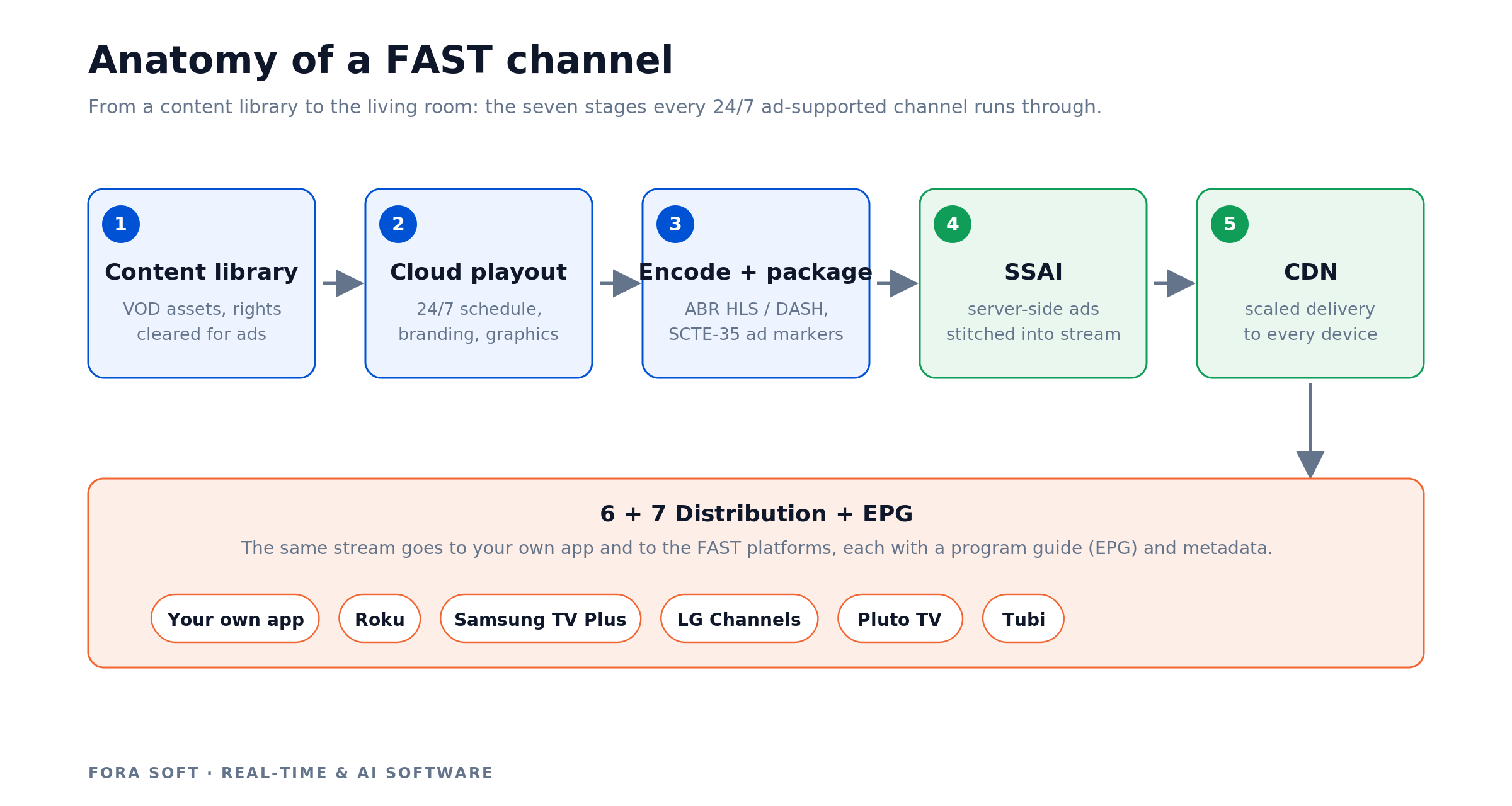
Figure 1. The seven stages of a FAST channel. The first three build and package the linear feed; the green stages monetize and deliver it; the last two get it discovered.
Content and rights. It starts with a library deep enough to program 24 hours a day without feeling repetitive, and — this is the part people skip — with rights that explicitly allow ad-supported linear distribution. A movie you can stream on demand is not automatically a movie you can run on a FAST channel with ads on connected TVs. Getting this wrong is how channels get pulled.
Playout, packaging, and the ad engine. The playout system turns your library into a scheduled feed with bumpers, graphics, and ad breaks. An encoder packages that feed into adaptive HLS or DASH and writes SCTE-35 markers where the ad breaks go. Server-side ad insertion reads those markers and stitches real ads into the stream. We’ll take each of these apart in its own section.
Delivery, distribution, and discovery. A CDN carries the stream to scale, distribution puts the channel in front of viewers on your app and on the FAST platforms, and the EPG tells every device what is playing now and next. A channel that nails the first five stages and neglects the last two is a great stream nobody can find.
The playout layer: scheduling, branding, and 24/7 automation
Playout is the system that turns a pile of video files into a channel. It holds the schedule, plays each asset in order, drops in bumpers and lower-thirds, fires ad breaks at the marked points, and does all of it automatically, around the clock, without a person babysitting it. In broadcast terms it is the master control room — only now it runs in the cloud.
Modern FAST playout is cloud-native and priced per channel. Veset, for example, lists its cloud FAST playout from $499 per channel per month, with SCTE-35 signalling and third-party ad insertion built in (Veset, captured July 2026). The reason cloud won here is simple: a FAST channel has bursty economics, and paying for a channel by the month beats buying and racking playout hardware for a channel that might not survive its first quarter.
Two operating modes matter. A scheduled channel plays pre-arranged VOD assets on a timeline — the common case, and the one that automates cleanly. A live or hybrid channel mixes in live events, which raises the engineering bar because you now need live ingest, failover, and the ability to return cleanly to the schedule when the game ends. Most content owners start scheduled and add live later.
The unglamorous truth about playout: the software is the cheap part. Programming a channel that people keep watching — building schedules, rotating content so it doesn’t feel like a six-hour loop, and reacting to what performs — is ongoing human work. Budget for a scheduler, not just a subscription.
The ad engine: SSAI and dynamic ad insertion
This is where a FAST channel earns. Server-side ad insertion (SSAI) is the technique of stitching ads directly into the video stream on the server, so the viewer receives one continuous manifest with programming and ads already spliced together. Because the ad and the show arrive as the same stream, ads play smoothly on a TV and can’t be stripped out by client-side ad-blockers — the two properties that make FAST inventory worth buying.
The mechanism has two named parts. SCTE-35 is the marker: a cue written into the stream that says “an ad break starts here and lasts this long.” SSAI is the server that acts on the marker: at the break, it calls an ad-decisioning server, gets back the right ad for that viewer, and stitches it into the manifest. Get the timing or the alignment wrong and viewers see a frozen frame or a hard cut — the fastest way to lose both audience and advertiser trust.
We’re deliberately keeping this section at the level a decision-maker needs. The full mechanics — VAST tags, ad stitching, beaconing, how to keep fill high without hurting playback — are their own deep topic, which we cover in the server-side ad insertion implementation guide. What you need to hold onto here: SSAI is not optional for a serious FAST channel, and it is the single component most worth getting right.
Why we keep coming back to SSAI: the module we built for Mangomolo did exactly this — recognize the SCTE-35 marker in a live stream and insert the correct ad in real time — across a platform running more than a billion streams a month. When the ad engine is solid, everything downstream is monetizable. When it isn’t, you’re paying to give video away.
EPG and metadata: the part that gets channels rejected
The electronic program guide (EPG) is the on-screen schedule that tells a viewer what is playing now and what’s next. On a FAST platform, the EPG is not a nice-to-have — it is how your channel is discovered, and a clean feed is a hard requirement to get onboarded. Wurl, a major distributor, spells out the deliverables plainly: a reliable HLS or DASH stream, correct SCTE-35 markers, and a clean EPG with accurate metadata (industry launch guidance, 2024–2026).
Metadata is the quiet reason channels get bounced in platform review. Every asset needs accurate titles, descriptions, genres, ratings, artwork at the right dimensions, and closed captions. Miss captions or ship mismatched run-times and the guide drifts out of sync with the stream — the viewer sees one thing while the guide promises another. Platforms treat that as a failed submission, and fixing it after the fact is slower than doing it right the first time.
The engineering implication: your schedule, your stream, and your EPG feed all have to agree, continuously, as the schedule rolls forward. That synchronization — keeping “what the guide says” and “what is actually playing” in lockstep 24/7 — is a real system, not a spreadsheet export. It’s one of the first things a custom build has to get right, and one of the first things to check when evaluating a SaaS tool.
Distribution: your own app versus the FAST platforms
Once your channel exists, you have to get it watched, and there are two routes that most operators run at once. You can distribute on the big FAST platforms — Roku, Samsung TV Plus, LG Channels, Pluto TV, Tubi — where the audience already is, or you can put the channel in your own app, where you own the relationship. They optimize for opposite things.
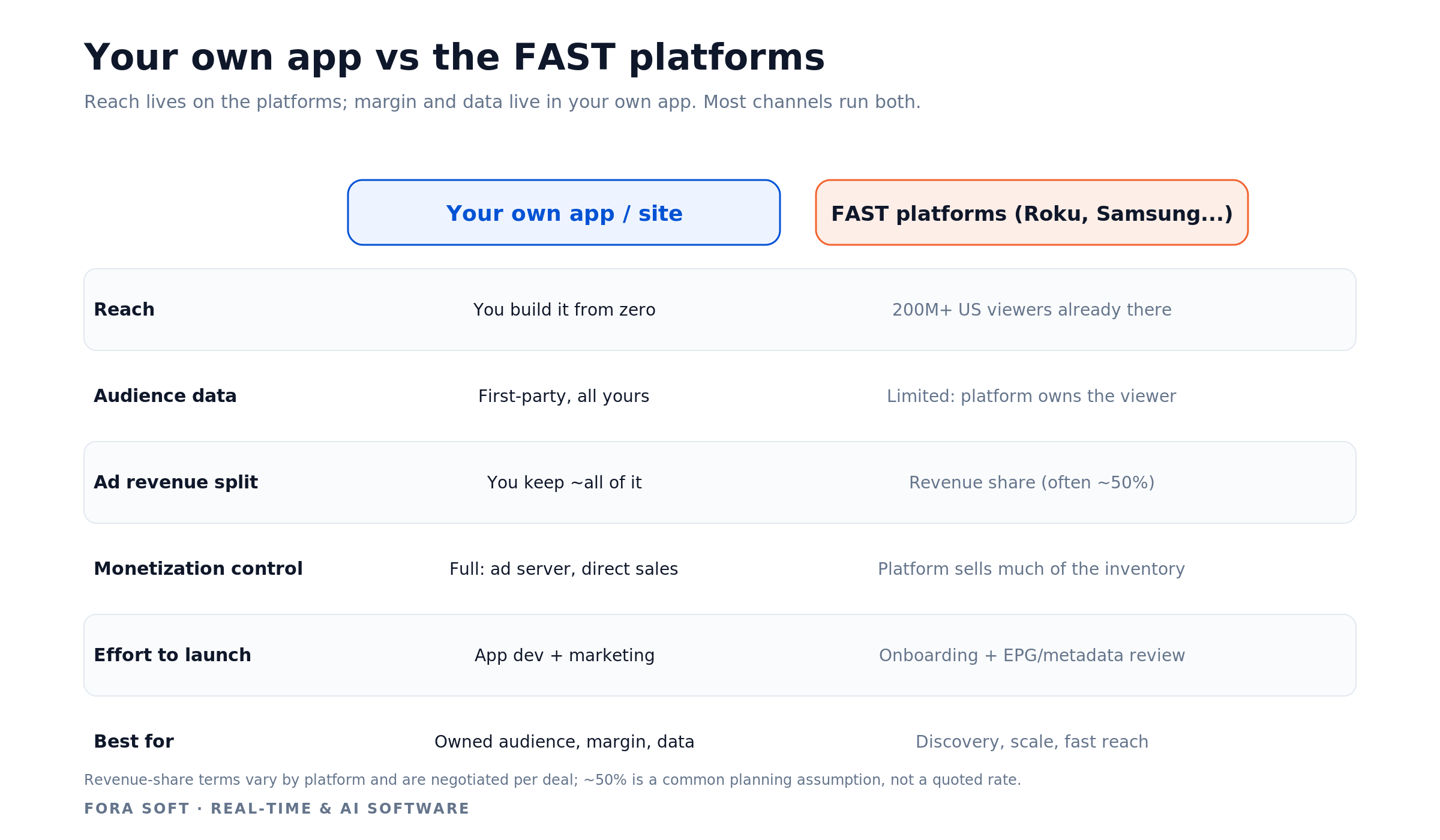
Figure 2. The distribution trade. Platforms bring reach you can’t buy quickly; your own app keeps the data and the margin. Most channels run both and accept the split.
The platforms give you reach and take a cut. Combined, the major FAST services reach more than 200 million US viewers — distribution at a scale you can’t replicate by marketing your own app. The cost is a revenue share: the platform sells much of the ad inventory and keeps a portion, commonly modeled at around 50%, though the exact split is negotiated per deal and varies by platform. You also inherit their reporting cadence — some report monthly, some quarterly, some with a 60-to-90-day lag.
Your own app keeps the data and the margin. In your app you keep first-party audience data, control the ad stack, and keep most of the revenue — but you have to earn every viewer yourself. The realistic strategy for most operators is both: use the platforms for discovery and scale, use your own app for the high-value, high-margin relationship, and treat the platform revenue share as the cost of reach.
Read every distribution deal for two numbers: the revenue split, and who controls the ad inventory. A generous-sounding split still hurts if the platform sells most of the ads at rates you don’t set. Where you keep the right to sell your own inventory, your effective revenue can be far higher than the headline percentage suggests.
Not sure how the ad engine should fit together?
SSAI, SCTE-35, EPG sync, and distribution splits are where FAST channels quietly lose money. We’ve built the ad-insertion layer behind a platform doing a billion streams a month — let’s map yours.
The reference pipeline: manifest, ad markers, and delivery
Here is the same channel viewed as a data pipeline, because that’s how you’ll actually build or evaluate it. A scheduler builds the 24/7 playlist and marks the ad breaks. A playout origin renders the linear feed with graphics. A packager segments it into HLS or DASH and writes the SCTE-35 cues. An SSAI stitcher fills those cues with ads. A CDN scales the segments. And a player receives one clean stream.
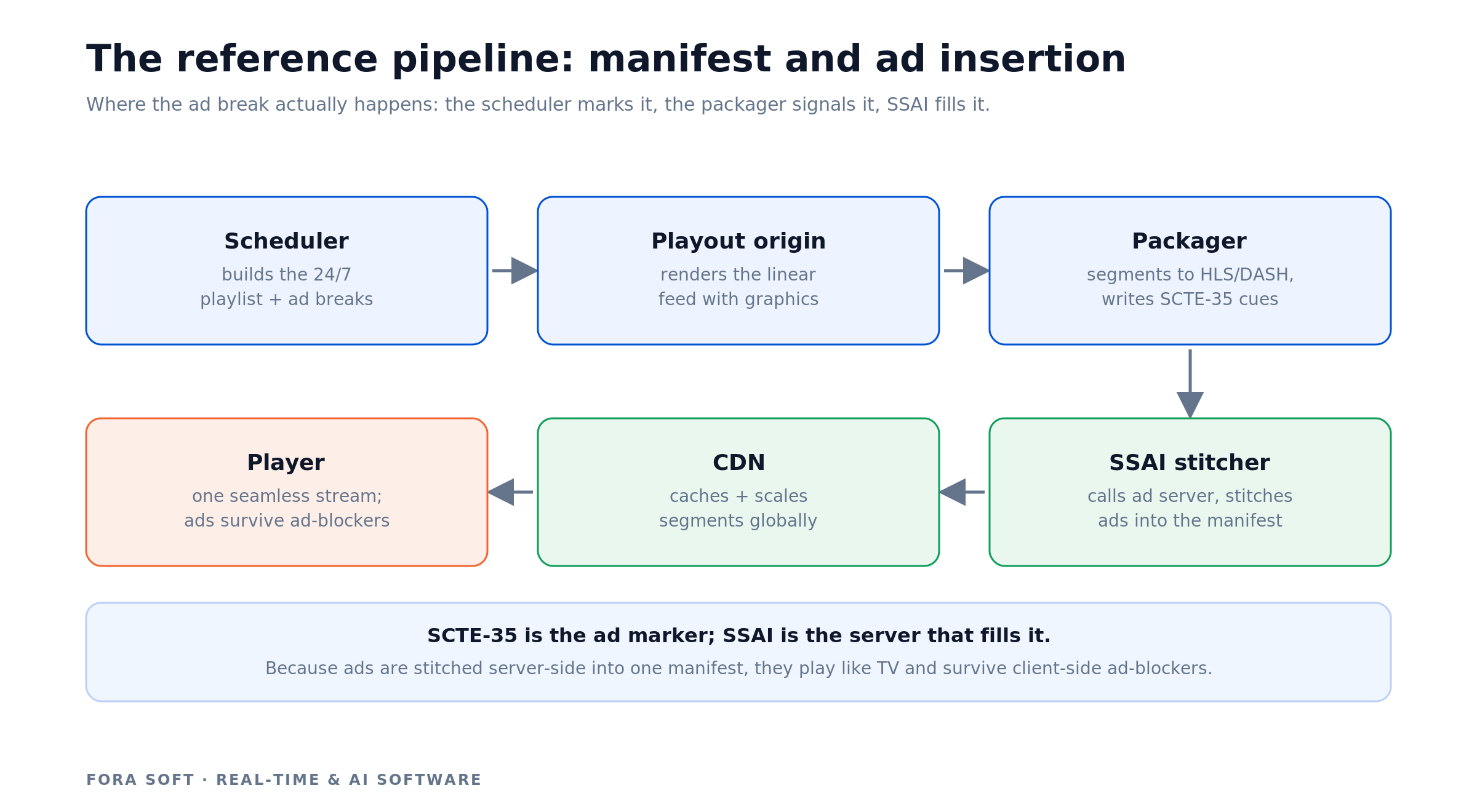
Figure 3. Where the ad break happens. The scheduler marks it, the packager signals it with SCTE-35, and SSAI fills it — so the player gets programming and ads as one stream.
Adaptive bitrate is the baseline. The packager produces multiple renditions so a phone on cellular and a 4K TV on fiber each get a stream they can play. On connected TVs, playback quality and fast start-up matter more than raw resolution — a channel that buffers at the join is a channel viewers flip away from before your first ad ever runs.
The CDN is your scaling and your egress bill. Delivery cost scales with hours watched, so success has a cost: a channel that finds an audience spends more on CDN egress. That is a good problem, but it belongs in the model from day one. It’s also why the build-versus-buy math shifts as you grow — at low volume the SaaS fee dominates; at high volume, delivery and ad-tech control start to.
What it costs to launch a FAST channel
Four line items decide the number: playout, ad tech, CDN, and the people who run it. Content and rights sit on top and vary too much to model here. Below are two realistic monthly stacks — a lean single channel on managed SaaS, and a multi-channel or custom operation — using vendor list prices captured in July 2026.
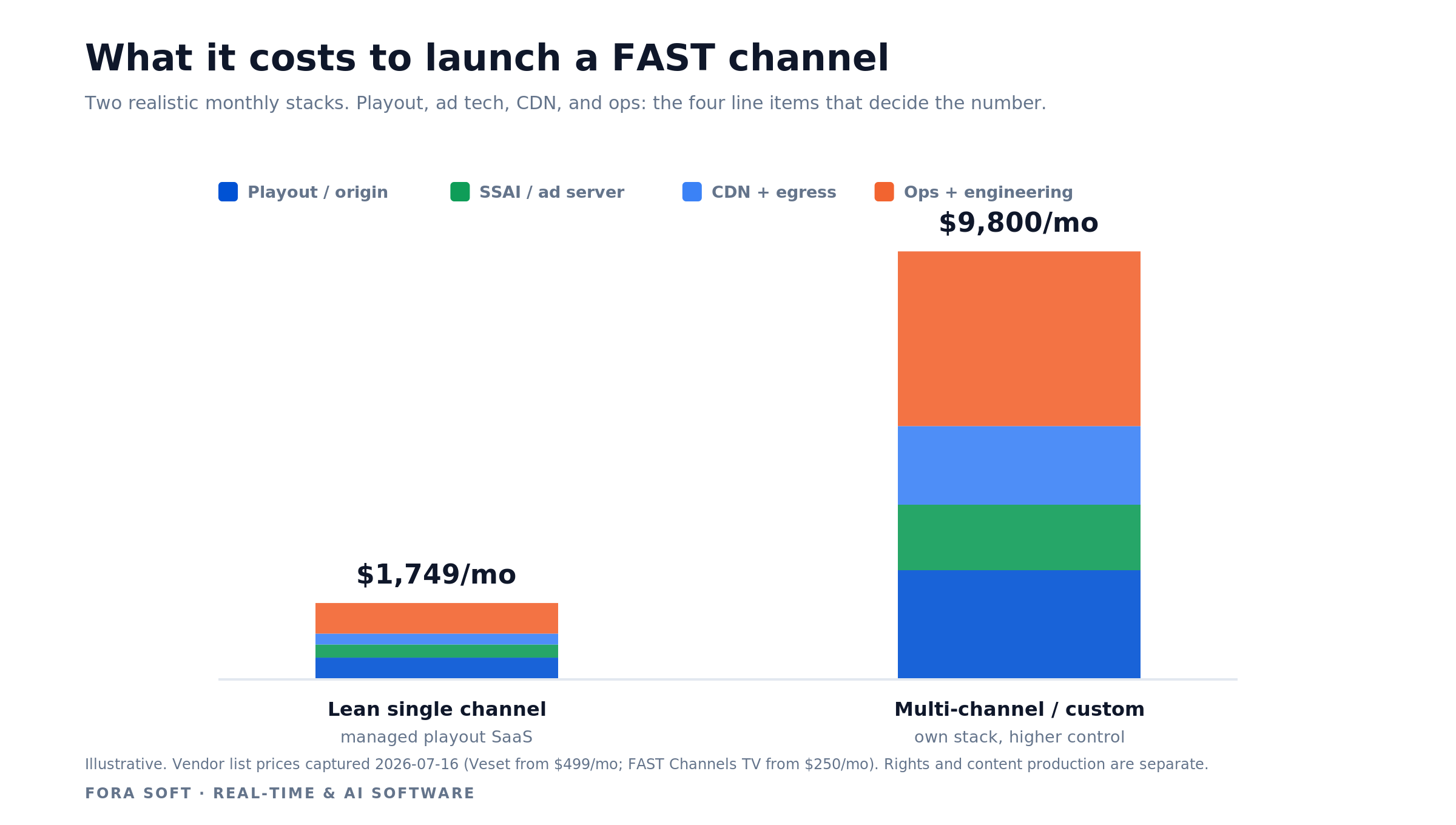
Figure 4. Two monthly cost stacks. The lean channel is dominated by ops, not software; the custom stack trades higher fixed cost for control and per-channel economics that improve with scale.
The lean single channel. Managed playout runs from about $250 to $499 per month (FAST Channels TV lists entry playout from $250; Veset from $499). Add a few hundred for SSAI and ad-server access, a few hundred for CDN and egress at modest volume, and the biggest real line — a person to schedule and run the channel. All in, a serious single channel lands near $1,500 to $2,000 per month before content costs. The software is the small part.
The multi-channel or custom operation. Running your own playout and origin, your own SSAI and ad server, and CDN at real volume pushes fixed monthly cost into the several-thousand-to-ten-thousand range, plus the engineering to build and maintain it. The trade is control and marginal economics: once the stack exists, each additional channel is cheap, whereas SaaS charges you per channel every month forever.
Treat these as planning ranges, not quotes — every vendor prices ad tech and CDN differently, and content licensing can dwarf all of it. The point of the picture is the shape: at one channel, rent; as the lineup and the audience grow, the custom stack’s fixed cost gets amortized across more channels and more hours, and the math flips.
Can a FAST channel make money? The revenue math
FAST revenue is one formula: ad impressions times CPM times fill rate, minus the platform’s revenue share. Everything else is an input to those four numbers. FAST and broad AVOD inventory typically clears somewhere between $15 and $25 CPM on premium programmatic, and can run lower — $6 to $18 — on the big free tiers (2026 CTV benchmarks).
A worked example. Say your channel averages 5,000 concurrent viewers over a month — a modest but real audience. At roughly 8 minutes of ads per hour, that’s about 8 ad impressions per viewer-hour. Five thousand viewers watching around the clock is on the order of 3.6 million viewer-hours a month, so call it ~29 million potential ad impressions. At a $15 CPM and a realistic 60% fill rate, that’s about $261,000 in gross ad revenue. After a 50% platform revenue share, you keep roughly $130,000 — before content and operating costs.
Those numbers are illustrative, and every input is a lever: CPM depends on your content and audience, fill rate depends on your ad demand, and concurrency is the number most people overestimate. The honest version is that a channel with a small, loyal, well-defined audience — the kind advertisers pay a premium to reach — can beat a bigger channel with generic content and weak fill. Niche and measurable wins.
The strategic read: revenue scales with hours watched and fill, not with how many platforms you’re on. One well-programmed channel with strong fill beats five thin channels nobody finishes. If you want the full menu of monetization beyond linear ads, our guide to streaming monetization strategies covers the hybrid models.
Mini-case: the ad engine behind a billion streams a month
Mangomolo is an end-to-end OTT platform, founded in 2013, that powers streaming for Discovery Networks MENA, Dubai Media’s Awaan platform, and South Africa’s SABC+. It supports every monetization model — subscription, transactional, ad-supported on-demand, and FAST — and runs broadcast-grade delivery up to 4K. At its scale, the platform handles more than a billion streams a month and 30 million-plus daily viewers, and the SABC+ partnership alone helped reach 1.5 million registered users.
The piece we owned is the piece this whole article circles back to: ad insertion. We built a custom module that recognizes SCTE-35 ad markers embedded in live video streams and performs server-side ad insertion — detecting the cue in real time and stitching the correct ad into the stream as it plays. It is the exact mechanism a FAST channel needs to turn a break in the schedule into revenue, running here at a scale where mistakes are expensive and visible.
The lesson we carry from it into FAST work: the ad engine is where reliability and money meet. Detection has to be exact, insertion has to be frame-accurate, and it all has to hold up under real traffic. Once that layer is solid, adding channels and distribution is comparatively routine. Want a similar assessment of your own pipeline? You can book a 30-minute call and we’ll walk your stack with you.
Build vs buy: playout SaaS, aggregator, or custom
There is no universally right answer here — there’s the answer for your channel count, your control needs, and your economics. The three paths trade speed and simplicity against control and margin, and the crossover point moves as you scale. Here they are side by side.
| Dimension | Managed playout SaaS | FAST aggregator | Custom build |
|---|---|---|---|
| Time to launch | Weeks | Weeks (they do the work) | Months |
| Upfront cost | Low ($250–$499/mo per channel) | Near zero | High (engineering) |
| Control over ad stack | Partial | Minimal | Full |
| Revenue you keep | Most, minus platform split | Smallest share | Highest at scale |
| Economics at many channels | Cost grows per channel | Cost grows per channel | Marginal cost drops |
| Best for | One or a few channels | Reach with least effort | FAST as your business |
Reach for a custom build when: you’re running enough channels that per-channel SaaS fees exceed a one-time build, you need ad-tech and audience data you fully control, or your rights, delivery, or platform requirements fall outside what an off-the-shelf tool supports. Below that line, rent. Compare vendor options the same way you would any streaming stack — our streaming platform comparison shows the method.
Build or buy — want a second opinion?
If your channel count or economics are near the crossover point, an hour with engineers who’ve shipped both saves months. We’ll tell you honestly which side of the line you’re on.
A decision framework: build a FAST platform in five questions
If you answer these five honestly, the build-versus-buy call usually makes itself.
1. How many channels will you run? One or two channels almost always favors renting managed playout. Ten or more, and the per-channel monthly fees start to look like a custom build’s amortized cost. Channel count is the single biggest input.
2. How much do you need to control the ad stack? If direct ad sales, first-party data, and your own yield optimization are core to the plan, that pushes toward a build. If you’re happy letting a platform or aggregator sell most of the inventory, SaaS is fine.
3. Do you have unusual rights, delivery, or data constraints? Content licensing that limits where and how you can run ads, data-residency rules, or a need to run on infrastructure a vendor doesn’t support are all reasons the off-the-shelf tool won’t fit — and reasons to build.
4. Is FAST a product or an experiment? If launching and operating channels is the business you’re in — you’re a platform, an aggregator, or a large content owner going all-in — owning the stack is strategic. If you’re testing whether your library has a FAST audience at all, rent and find out cheaply first.
5. What’s your realistic in-house capacity? A custom FAST stack is a real system to build and keep running 24/7. If you don’t have — or won’t hire — the engineering to own it, buy, or bring in a partner who will build and hand off something maintainable. Building what you can’t operate is the worst outcome.
Five pitfalls that sink FAST channels
1. Treating rights as an afterthought. The single most common way a channel gets pulled is running content whose license doesn’t cover ad-supported linear distribution. Clear the rights for FAST specifically, in writing, before you schedule a single asset. On-demand rights are not FAST rights.
2. Under-programming the schedule. A shallow library becomes a short loop, and viewers notice a six-hour repeat fast. Thin programming drops watch time, which drops impressions, which drops revenue. Depth of catalog and thoughtful scheduling are not optional polish — they’re the audience.
3. Neglecting the ad engine. A channel with poor SSAI — low fill, mistimed breaks, frozen frames at the splice — gives video away and annoys viewers while doing it. The ad layer is the business model; it deserves the most engineering attention, not the least.
4. Shipping a dirty EPG. Wrong run-times, missing captions, mismatched metadata — these fail platform onboarding and, once live, desync the guide from the stream. A guide that lies about what’s on erodes trust and gets flagged. Clean metadata is a launch requirement, not a later cleanup.
5. Chasing platform count over watch time. Being on ten platforms with a channel nobody finishes earns less than being on three with a channel people watch. Revenue follows hours viewed and fill rate, not the number of logos on your distribution slide. Depth beats breadth.
KPIs: what to actually measure
Audience KPIs. Track average concurrent viewers, total hours viewed, and average view duration per session. Hours viewed is the revenue engine — it’s what impressions are made of — and view duration tells you whether your programming holds people or leaks them. Watch these by daypart, not just as monthly totals.
Monetization KPIs. Track ad fill rate, effective CPM, and revenue per thousand hours viewed. Fill rate times CPM is where money is won or lost: a channel with great audience and 40% fill is leaving half its revenue on the table. Revenue per thousand hours is the clean number for comparing channels and platforms on the same footing.
Quality and reliability KPIs. Track uptime, rebuffering rate, stream start-up time, and ad-error rate. A FAST channel is a 24/7 broadcast — every minute of downtime or every frozen ad splice is lost revenue and lost trust. On connected TVs, start-up time and smooth playback matter more to retention than resolution does.
When NOT to launch a FAST channel
A FAST channel is the wrong move more often than the vendors admit, and knowing when to skip it is worth as much as knowing how to build it. Skip it if your catalog is too thin to program 24/7 without an obvious loop — a channel that repeats every few hours reads as low-effort and won’t hold an audience long enough to matter.
Skip it, or at least pause, if your content is genuinely on-demand by nature — short tutorials, a searchable reference library, anything people want to pick rather than have served to them. That audience wants AVOD, and forcing it into a linear schedule fights how people actually watch it. And skip it if you can’t clear ad-supported linear rights, because no amount of engineering fixes a licensing problem.
Finally, be honest about audience scale and appetite. If your realistic concurrent audience is a few dozen viewers, the ad revenue won’t cover the operating cost, and your effort is better spent elsewhere. FAST rewards either a large audience or a small, sharply defined one advertisers pay a premium to reach — the mushy middle rarely pays for itself.
FAQ
What is a FAST channel?
A FAST channel is a free, ad-supported streaming TV channel delivered over the internet. It plays a fixed 24/7 schedule that viewers find through an on-screen program guide, and it’s paid for by ads instead of a subscription. It recreates the lean-back experience of cable TV — you turn it on and something is already playing — on connected TVs and streaming apps.
How do you launch a FAST channel?
In five steps: secure a content library with ad-supported linear rights, build a 24/7 schedule, choose a playout system that packages the stream and marks ad breaks with SCTE-35, wire server-side ad insertion for monetization, and distribute to your own app and the FAST platforms with a clean EPG. Managed playout tools let you go live in weeks; a custom build takes months but gives you full control.
How much does it cost to launch a FAST channel?
Managed playout lists from about $250 to $499 per channel per month (FAST Channels TV and Veset, July 2026). Add ad tech, CDN, and — the biggest real line — a person to program the channel, and a serious single channel lands near $1,500 to $2,000 per month before content. A multi-channel custom stack runs several thousand to ten thousand per month plus engineering, but its per-channel cost drops as you add channels.
Do FAST channels make money?
They can. Revenue is ad impressions times CPM times fill rate, minus the platform’s revenue share. FAST inventory typically clears $15–$25 CPM on premium programmatic and less on the big free tiers. A channel with 5,000 average concurrent viewers, a $15 CPM, and 60% fill can gross on the order of $260,000 a month before a roughly 50% platform split — but concurrency is the number most operators overestimate.
What is the difference between FAST and AVOD?
Both are free and ad-supported, but FAST is linear and AVOD is on-demand. FAST plays a scheduled channel you discover through a program guide — a lean-back experience. AVOD is a library you browse and pick from — a lean-forward experience. That difference is why FAST needs a playout system, an EPG, and linear ad insertion, none of which a pure AVOD library requires.
How do you distribute a FAST channel to Roku and Samsung TV Plus?
You submit your channel — a reliable HLS or DASH stream, correct SCTE-35 ad markers, and a clean EPG with accurate metadata — through each platform’s onboarding process, often via a distributor or aggregator. Distribution is typically a revenue-share deal (commonly modeled around 50%, negotiated per platform). Combined, the major FAST platforms reach more than 200 million US viewers, which is why most channels accept the split for the reach.
What is SSAI and why does a FAST channel need it?
Server-side ad insertion (SSAI) stitches ads directly into the video stream on the server, so the viewer receives programming and ads as one continuous manifest. That makes ads play smoothly on a TV and survive client-side ad-blockers — the two properties that make FAST inventory worth buying. SCTE-35 markers signal where the ad breaks go; SSAI fills them. Without solid SSAI, a FAST channel gives video away instead of earning from it.
Should we build our own FAST platform or use a SaaS?
Use managed playout SaaS for one or a few channels — it’s cheaper and faster, and that’s most content owners. Build a custom stack when running channels is your business: many channels where per-channel fees exceed a build, a need to control ad tech and first-party data, or rights and delivery constraints an off-the-shelf tool can’t meet. The crossover is mostly about channel count and how much control you need.
What to read next
Ad tech
Server-Side Ad Insertion Guide
The ad engine of a FAST channel, taken apart — SCTE-35, stitching, and keeping fill high.
Streaming
OTT Platform Development Guide
The on-demand side of the house — architecture for a full OTT streaming platform.
Monetization
Streaming Monetization Strategies
Beyond linear ads — the hybrid SVOD, AVOD, and TVOD models that stack on top of FAST.
Compare
Uscreen vs Vimeo OTT vs Dacast
How to compare streaming platforms and vendors — the same method applies to FAST tooling.
Ready to launch your FAST channel?
A FAST channel is a small broadcast operation, and it succeeds or fails on the same things broadcast always did: enough good content to program around the clock, an ad system that fills breaks cleanly, a guide that tells the truth, and distribution that reaches people without giving away all the margin. The launch is quick. The business is in the schedule and the ad engine.
Rent managed playout when you have one channel and want to test the waters; go through an aggregator when reach with minimum effort is the goal; build a custom stack when FAST is your business and the economics and control justify it. If you’re not sure which side of that line you’re on, we’ll help you decide before you commit — you can book a 30-minute call or explore our video and audio streaming development services to see where we’d start.
The handbook · 7 volumes
Fora Soft Video Engineering Handbook
A FAST channel is a 24/7 pipeline: library in, encoded, packaged with ad markers, delivered to every screen. We wrote a seven-volume handbook on the full video stack: encoding, delivery, audio and AI. Start with Volume 2 on HLS, DASH and CMAF packaging, then Volume 1 on transcoding the library and Volume 3 on CDN and the economics of delivery. Written by Nikolay Sapunov, CEO at Fora Soft.
Browse the handbook on Amazon →7 volumes · 9,000+ pages · Kindle & paperback
Let’s scope your FAST channel
Whether you’re renting playout or building a custom stack, we’ll give you an honest read in 30 minutes — the pipeline, the ad engine, the distribution split, and the build-versus-buy call for your library.