

ASR (Automatic Speech Recognition), or speech-to-text, turns the audio of a call or recording into written text for live captions, searchable transcripts, summaries, and voice commands. In a conferencing pipeline it sits downstream of the media: audio is branched off the mix or per-speaker streams, cleaned and segmented (usually using VAD to find utterance boundaries), then fed to a recognition model that may run in the cloud or on-device. Modern ASR uses deep neural networks and large speech models, and its accuracy depends heavily on the audio quality it receives — which is why noise suppression, echo cancellation, and good capture upstream directly improve the transcript downstream.
The book · Volume 5 of 7
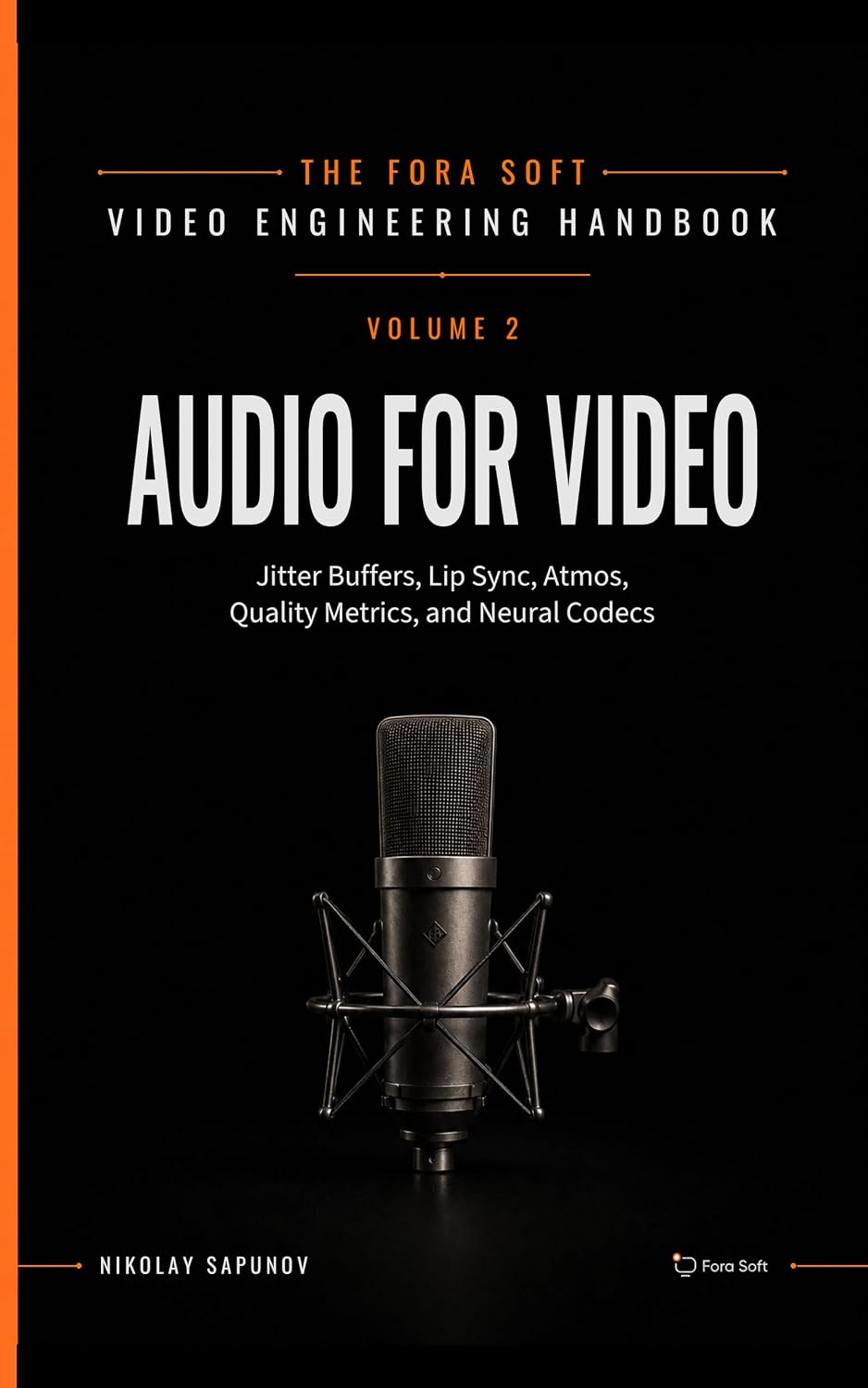
Audio for Video: A Complete Guide to Sound in Video Products: From Jitter Buffers and Lip Sync to Atmos, Quality Metrics, and Neural Codecs
ASR quality in calls depends as much on where audio is tapped and how it is recorded as on the model itself. Volume 5 covers ASR in detail within recording and transcription: where audio leaves the call, per-speaker versus mixed streams, timestamps, transcription pipelines and diagnosing quality problems by symptom. Written by Nikolay Sapunov, CEO at Fora Soft.
Adding ASR transcription to your calls or recordings?
Tell us your call platform and use case, and we will design the ASR pipeline, choose where to tap audio and estimate cost per hour. 250+ video products shipped since 2005.
