

EnCodec is Meta's open neural audio codec, an encoder-quantizer-decoder trained end to end to compress speech and music across a wide range of very low bitrates (roughly 1.5 to 24 kbps). It uses residual vector quantization to turn audio into a compact stream of discrete tokens and a neural decoder, trained with adversarial and reconstruction objectives, to rebuild a natural-sounding waveform. Beyond compression, those tokens have become a standard representation that generative audio and text-to-speech models build on, which is a big part of why neural codecs matter now. EnCodec, alongside Google's SoundStream and Lyra, exemplifies how learned codecs push quality at bitrates traditional codecs can't reach, at the cost of greater computation.
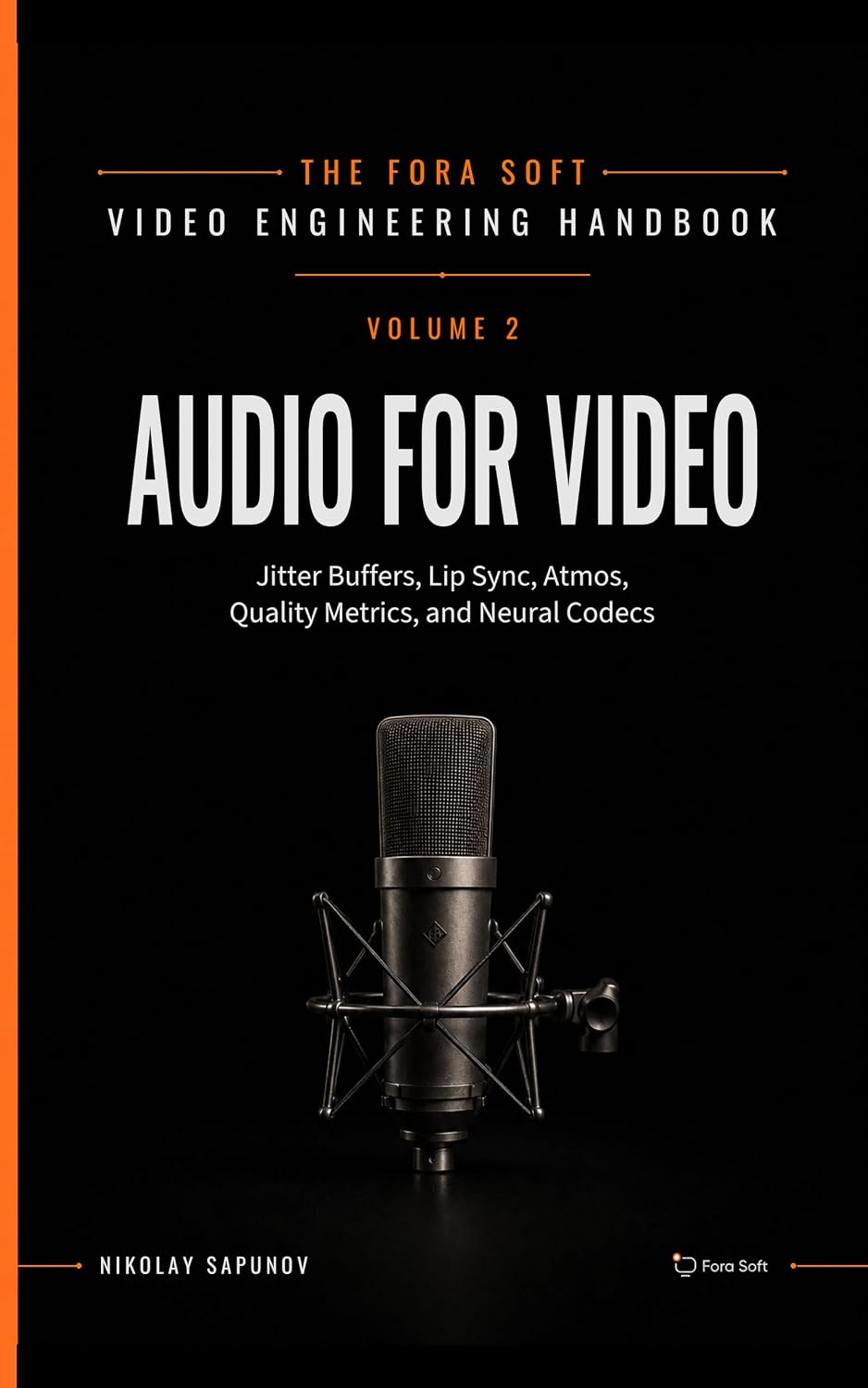
The book · Volume 5 of 7
Audio for Video: A Complete Guide to Sound in Video Products: From Jitter Buffers and Lip Sync to Atmos, Quality Metrics, and Neural Codecs
EnCodec shows how neural codecs can carry speech and music at a few kilobits per second, but compute cost and artifacts decide whether it fits your product. This volume examines EnCodec in detail among neural audio codecs, next to packet loss concealment, FEC and quality metrics like ViSQOL and MUSHRA, so you can judge it with evidence. Written by Nikolay Sapunov, CEO at Fora Soft.
Evaluating EnCodec or another neural codec for very low-bitrate audio in your app?
Share your bitrate and device constraints and we will run a comparison of EnCodec against Opus with listening tests and compute cost estimates. 250+ video products shipped since 2005.
