

A jitter buffer is a short queue at the receiver that holds arriving audio packets just long enough to smooth out their irregular network timing, so playback can run on a steady clock. Packets sent every 20 ms don't arrive every 20 ms — they bunch up and spread out — and without a buffer that variance becomes gaps and glitches. The buffer trades latency for smoothness: deeper means more packets survive late arrival but more delay is added, shallower means lower delay but more dropouts. Modern buffers are adaptive, growing and shrinking with measured network conditions, and in WebRTC the jitter buffer and concealment are fused into NetEQ.
The book · Volume 5 of 7
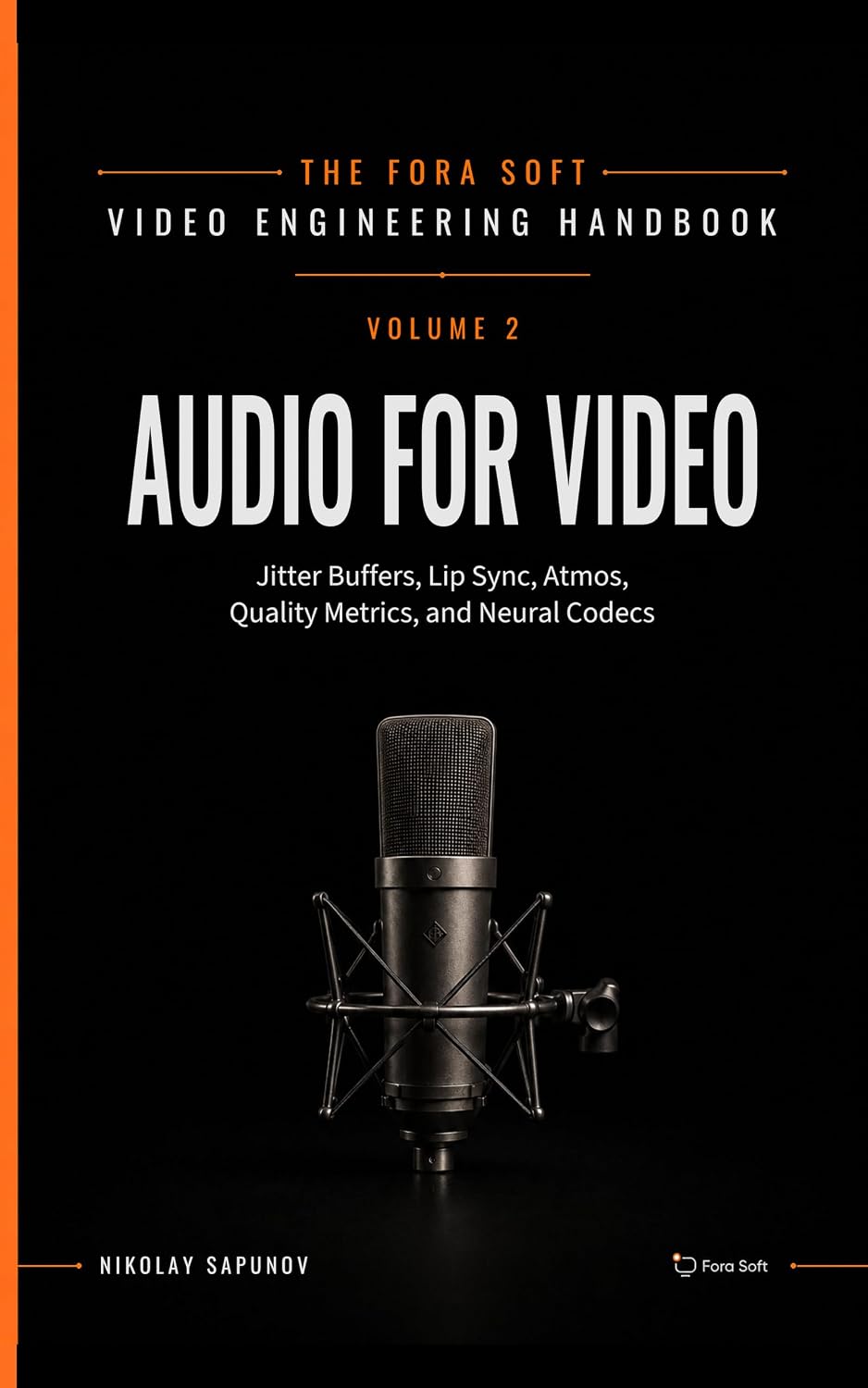
Audio for Video: A Complete Guide to Sound in Video Products: From Jitter Buffers and Lip Sync to Atmos, Quality Metrics, and Neural Codecs
The jitter buffer decides whether a call sounds smooth or robotic, and sizing it is a constant trade between delay and dropouts. This volume covers the jitter buffer in depth with NetEq, packet loss concealment, FEC and RED, and symptom-based incident analysis, so you can tune audio for real networks rather than lab ones. Written by Nikolay Sapunov, CEO at Fora Soft.
Calls sounding choppy or delayed because your jitter buffer is tuned for the wrong network?
Share call stats or recordings from bad sessions and we will tune your jitter buffer and loss recovery settings with before-and-after measurements. 250+ video products shipped since 2005.
