

POLQA (Perceptual Objective Listening Quality Analysis, ITU-T P.863) is the successor to PESQ and the current reference for objectively scoring voice quality. Like PESQ it is full-reference — it compares degraded speech against a clean original and predicts a MOS — but it extends coverage to super-wideband and fullband speech and handles modern codecs, higher bandwidths, and processing that PESQ couldn't. It is widely used to benchmark codecs, validate VoLTE and VoIP networks, and tune enhancement algorithms without convening human listening panels for every test. POLQA's predictions are calibrated against large sets of real subjective scores, so it serves as a fast, repeatable proxy for the human MOS it is designed to estimate.
The book · Volume 5 of 7
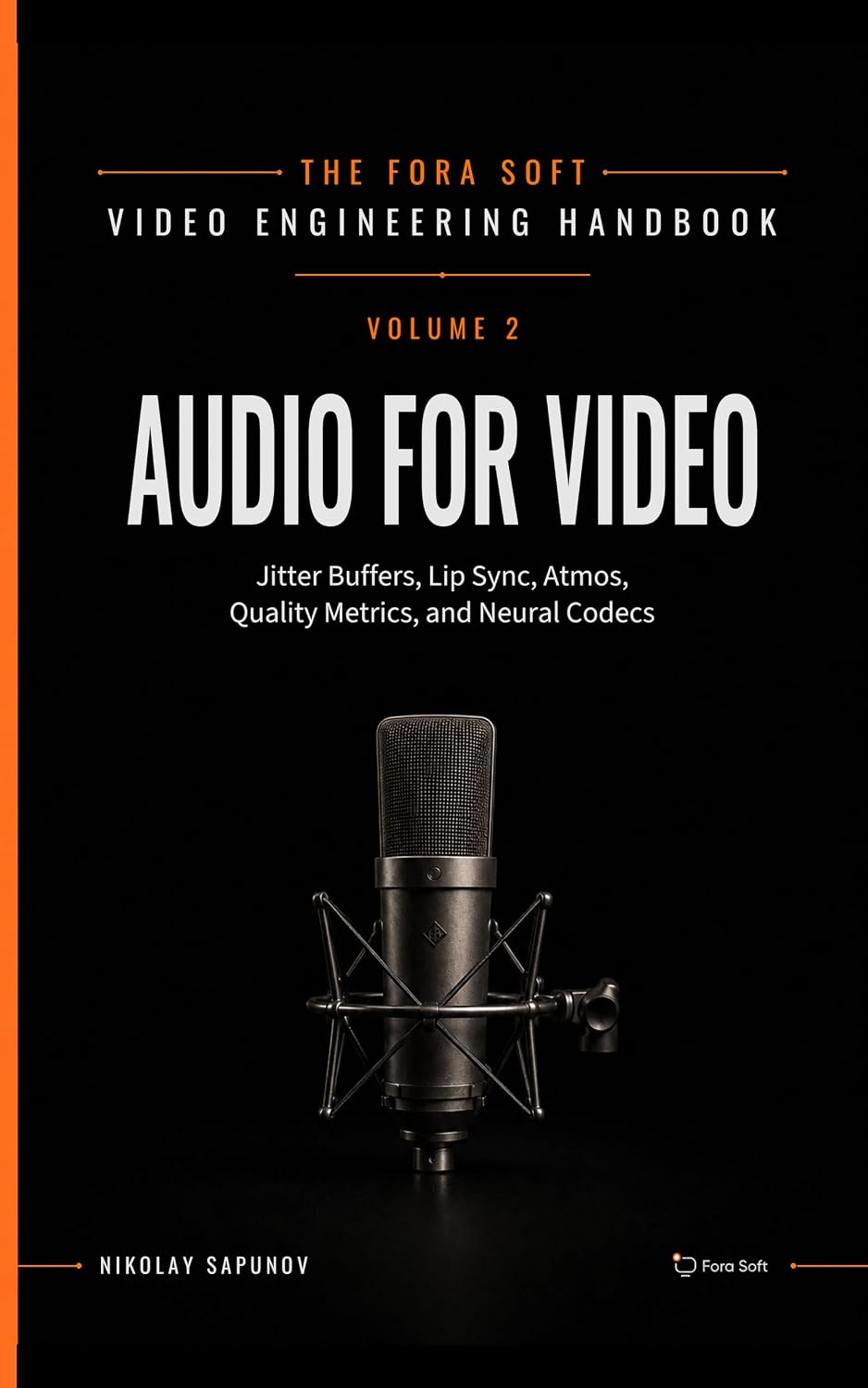
Audio for Video: A Complete Guide to Sound in Video Products: From Jitter Buffers and Lip Sync to Atmos, Quality Metrics, and Neural Codecs
POLQA is the current reference metric for voice quality across wideband and super-wideband codecs, yet licensing and test setup decide its value. This volume covers POLQA in depth with PESQ, ViSQOL, MOS and MUSHRA, so you can build objective voice testing that tracks what real listeners hear. Written by Nikolay Sapunov, CEO at Fora Soft.
Need POLQA scores to benchmark voice quality across codecs and networks?
Tell us your codecs and network profiles and we will run a POLQA benchmark and deliver scores with recommendations per scenario. 250+ video products shipped since 2005.
