

Resampling (sample-rate conversion) is the DSP process of computing what a signal sampled at one rate would look like at another — 44.1 kHz to 48 kHz for delivery, or microscopic ratio adjustments to cancel clock drift in real time. It works by reconstructing the band-limited waveform and re-sampling it on the new grid, so the maths is essentially interpolation with a carefully designed filter. Quality is everything: a cheap converter introduces aliasing, passband ripple, or audible artefacts, while a good one is transparent. Resampling is everywhere audio crosses a rate boundary — between 44.1 and 48 kHz worlds, inside adaptive jitter buffers, and whenever a device's clock must be matched to the network.
The book · Volume 5 of 7
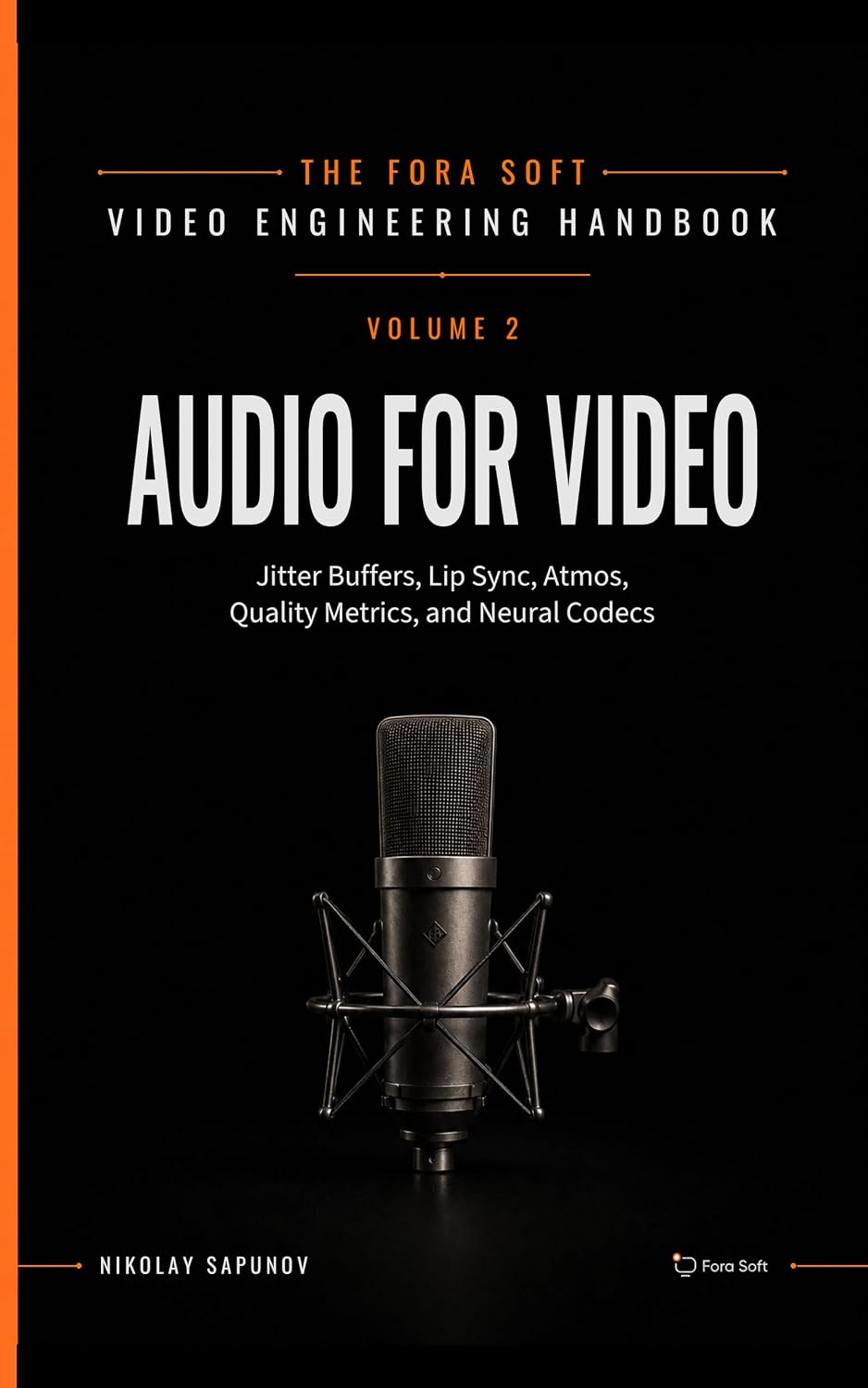
Audio for Video: A Complete Guide to Sound in Video Products: From Jitter Buffers and Lip Sync to Atmos, Quality Metrics, and Neural Codecs
Resampling quietly fixes clock drift and rate mismatches, and a cheap resampler quietly adds aliasing or latency. This volume covers resampling in depth as a drift correction tool, alongside frame drop and insert, clock domains and lip sync, so long sessions stay in sync without audible artifacts. Written by Nikolay Sapunov, CEO at Fora Soft.
Fighting drift and aliasing because of poor resampling in your audio pipeline?
Tell us your devices and sample rates and we will choose a resampling strategy, set drift correction thresholds and verify sync over long sessions. 250+ video products shipped since 2005.
