


Why this matters
If you are a media founder, product manager, or first-time streaming CTO, "build vs buy" is the first big decision you make, and it constrains every decision after it — your cost structure, your margin, your speed to market, and whether you can ever differentiate. Get it wrong in the cheap direction and you launch fast but hit a ceiling on control and unit economics you cannot break through without a rebuild. Get it wrong in the expensive direction and you spend a year building infrastructure a $399-a-month product would have given you on Friday. This article gives you a vendor-neutral way to choose: the three real options, what each costs in money, time, control, and margin, the standards that decide whether you are locked in, and a worked total-cost example that shows where the lines cross. The companion worksheet lets you place your specific project on the spectrum and score it.
Three paths, not two: buy, assemble, build
"Build vs buy" is the wrong framing because it hides the option most serious platforms actually pick. There are three.
Buy means a turnkey or white-label OTT product — a finished platform you configure and brand. You upload content, set a price, pick which apps to publish, and the vendor runs everything underneath: encoding, storage, delivery, content protection, and the player. Think of it as renting a furnished shop: you move your stock in and open tomorrow, but the walls, the till, and the loading dock belong to the landlord, and you pay rent forever.
Assemble means wiring a platform together from cloud building blocks — a managed encoder, object storage, a content delivery network, a multi-vendor content-protection service, and your own back end and apps on top. You own the architecture and the code; you rent the heavy infrastructure from cloud providers at their list prices. This is the shop you fit out yourself inside a rented building: you choose the layout, the till, and the suppliers, and you can renegotiate any of them.
Build means going fully custom — bespoke back-end services and, at the extreme, your own encoding farm or self-hosted content-protection servers instead of managed ones. You own everything down to the metal. This is buying the building and constructing the shop: the largest upfront cost, the longest timeline, and the lowest running cost once you operate at a scale where shaving every byte repays the engineering.
Most real custom platforms land on assemble, not pure build, because the cloud building blocks are excellent and re-creating them earns nothing. Throughout this article, "build a custom platform" almost always means "assemble from cloud primitives with your own product on top" — and we will keep the fully-custom extreme separate where it matters.
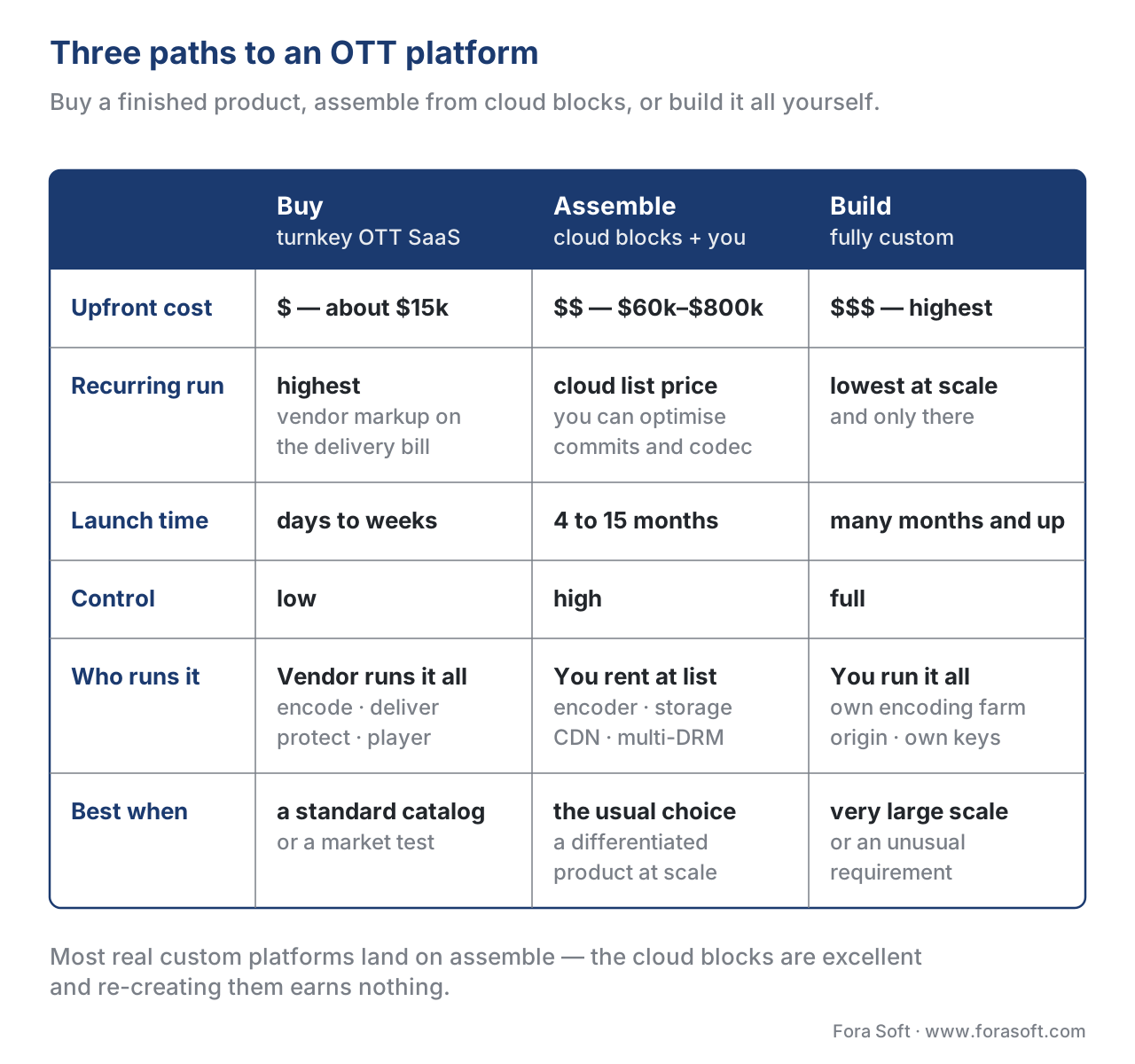 Figure 1. The three paths. Moving left to right, you trade lower upfront cost and faster launch for more control of the architecture and the recurring bill that sets your margin.
What each path costs in 2026
Money is where the decision usually starts, so let us price all three with current numbers. Keep one distinction front of mind, because it is the whole game: a one-time build cost is paid once to reach launch, while a recurring run cost arrives every month for the life of the platform. Buying minimises the first and maximises the second; building does the reverse.
Buying: low upfront, a subscription that never ends
Off-the-shelf OTT platforms charge a monthly or annual subscription that scales with usage. Representative 2026 pricing, dated and vendor-specific because these plans change:
- Muvi One lists a Standard plan at $399/month, Professional at $1,499/month, and Enterprise at $3,900/month, with each published app adding roughly $299–$499/month plus infrastructure fees; Muvi notably does not take a cut of your subscription or transaction revenue (Muvi pricing, 2026).
- JW Player prices its professional streaming plans from about $99 to $999/month, with full OTT-grade features (1080p, apps) gated behind a custom Enterprise plan (JW Player, 2026).
- Brightcove publishes no list price; reported deals run $20,000–$250,000+ per year, with corporate use at the low end and media/OTT deployments reaching six figures (market reporting, 2026).
- Vimeo OTT and Dacast sit in between with per-subscriber fees or pay-as-you-go bandwidth pricing.
The pattern across all of them: a modest entry price, then a bill that climbs with your catalog, your audience, your app count, and — crucially — your delivery, because the vendor's content delivery network and content-protection costs are wrapped into your fees with their margin on top. You are paying retail for the most expensive line in streaming.
Assembling: medium upfront, cloud list prices you control
Assembling means a real engineering build plus cloud infrastructure at list price. The build — viewer apps for web, mobile, and TV, the catalog and account back end, the entitlement service that decides who may watch what, billing, and content-operations tooling — runs, in the 2026 market, from about $60,000 for a two-platform on-demand minimum viable product to $150,000–$350,000 for a standard custom entertainment platform, and toward $600,000–$800,000+ for an enterprise multi-platform product with live streaming and full content protection (OTT-development market surveys, 2026). The biggest swing factor is the device matrix: each living-room and mobile target is a separate codebase, and native apps across web, iOS, Android, Apple TV, Roku, Samsung Tizen, LG webOS, and Fire TV cost roughly $50,000–$150,000 per platform to build.
On top of the build, the recurring run is cloud list price. The dominant line is egress — the per-gigabyte fee a content delivery network charges to send video to viewers. Amazon CloudFront's US rates (AWS, 2026-06-08) are tiered: the first 1 TB per month free, the next 9 TB at $0.085/GB, falling to $0.040/GB and below in higher tiers, with a one-year commitment saving up to 30%. Encoding via a managed cloud transcoder such as AWS Elemental MediaConvert is about $0.015 per output minute for HD, billed once per title. Object storage on Amazon S3 is about $0.023 per gigabyte per month. We model the full monthly bill in the OTT cost model; the point here is that you pay these directly, with no reseller margin, and you can renegotiate every one as you grow.
Building fully custom: highest upfront, lowest run at scale
Going fully custom adds the cost of operating infrastructure other people would rent you: your own encoding farm, your own packaging and origin, possibly self-hosted content-protection key servers. A self-hosted multi-vendor content-protection stack alone runs $10,000–$50,000+ to set up and $500–$5,000/month to operate. The justification is never "to save money in year one" — it is that at very large scale, shaving the recurring bill repays a large engineering investment, or that an unusual requirement (a specialised codec pipeline, a data-residency rule, a latency target) leaves no off-the-shelf option. There is also an ongoing tax everyone underestimates: a streaming engineering team of eight to ten people costs on the order of $60,000–$150,000 per month fully loaded, which is $720,000–$1.8M a year just to keep a large custom platform running and current.
The number that actually decides: total cost over time
A single month's price is the wrong lens. Buying looks cheap because you compare its first invoice to a build quote, but the build is paid once and the subscription is paid forever. The right lens is total cost of ownership over time — add up build plus every monthly run cost across the period you will actually operate, typically three years.
Let us work a concrete crossover. Take a subscription platform growing toward 50,000 monthly viewers with a mid-size catalog.
The buy path. Assume an off-the-shelf platform at a blended $4,000/month for the plan and apps at small scale, rising as usage grows; for an audience this size with the vendor's delivery and protection markups folded in, call it an effective $12,000/month once you are at 50,000 viewers. Over three years, with growth, that is roughly:
buy, 3-year total ≈ $12,000/mo × 36 months   ≈ $432,000
upfront build                                 ≈ $15,000 (config, branding, content load)
-------------------------------------------------------
buy TCO (3 yr)                                ≈ $447,000
The assemble path. A standard custom build, then cloud list-price run.
one-time build                                ≈ $250,000
recurring run at scale (egress-dominated)     ≈ $35,000/mo   (see the cost model)
   with a CDN commit discount                 ≈ $26,000/mo
assemble run, 3-year (using committed)        ≈ $26,000 × 36 ≈ $936,000
-------------------------------------------------------
assemble TCO (3 yr)                           ≈ $1,186,000
At first glance buying wins by a mile — and at 50,000 viewers, for a standard product, it often does. The crossover is not about this snapshot; it is about the slope. The assembled platform's run cost is mostly raw cloud delivery you can drive down with codec efficiency, cache-hit ratio, commit pricing, and per-title encoding. The bought platform's bill includes someone else's margin on those same bytes, and you cannot touch it. As audience and watch-time climb, the bought bill climbs faster, because the most expensive line — delivery — carries a reseller markup that compounds with every viewer. Somewhere between roughly 100,000 and a few hundred thousand engaged viewers, depending on bitrate and the vendor's markup, the two lines cross, and past that point owning the pipeline is both cheaper and more controllable. Below it, buying is the rational choice.
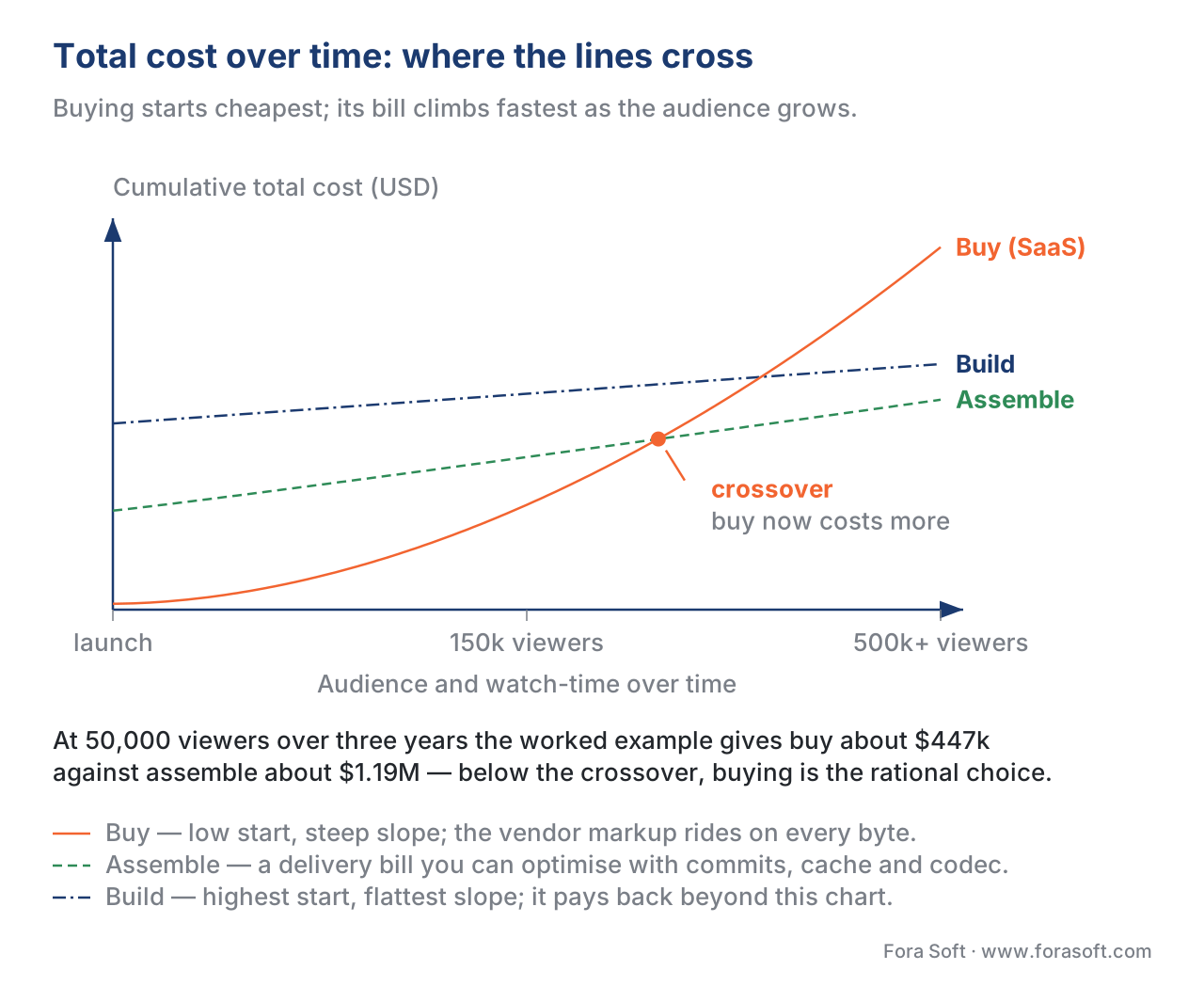 Figure 2. Total cost over time. Buying starts lowest; assembling starts higher but its delivery-dominated bill is yours to optimise. The lines cross as audience grows — the crossover, not today's invoice, is the real decision.
Beyond money: control, speed, and the margin you keep
Cost is only one of four axes. The other three often decide the call before the money does.
Speed to launch. Buying is measured in days to weeks: configure, brand, publish, sell. Assembling a standard custom platform is nine to fifteen months; a focused minimum viable product is four to six months. Fully custom is longer still. If a market window or a content deal demands you launch this quarter, that constraint can settle the decision on its own — and buying first, then rebuilding once the business is proven, is a legitimate strategy rather than a failure.
Control of the product. The question to ask is blunt: can the off-the-shelf platform do the one thing your product exists to do? If your differentiator is a standard subscription catalog, a turnkey product already does it and building earns you nothing. If your differentiator is an unusual content type, a bespoke discovery experience, a particular monetization mix, an interactive or live format, or a deep integration with your own systems, a rented platform will fight you — you will spend the saved build budget on workarounds and never quite ship the thing that was the point. Control is not a luxury; it is whether you can build your actual product.
Control of margin. This is the streaming-specific one. Because delivery is the dominant recurring cost, the platform that owns its delivery owns its margin. On an assembled platform you negotiate your own CDN commit, raise your cache-hit ratio, and switch popular content to a more efficient codec — and every one of those flows straight to the bottom line. On a bought platform, delivery is a line you cannot see or change, sold to you with a markup. At small scale the markup is affordable; at large scale it is the difference between a healthy business and a thin one.
Lock-in and portability. The hidden cost of buying is the cost of leaving. The good news is that the streaming industry runs on open standards, and using them is how you stay portable. The modern pattern is encrypt once, license many: you package content as Common Media Application Format (CMAF, ISO/IEC 23000-19) segments, encrypt them a single time with the cbcs scheme of Common Encryption (ISO/IEC 23001-7), and serve the same files as HLS (IETF RFC 8216) and MPEG-DASH (ISO/IEC 23009-1) while issuing Widevine, PlayReady, and FairPlay licenses from those same segments. A platform assembled on these standards is portable — you can change CDN, change encoder, change protection vendor — because the artifacts are standard. A bought platform hides these behind proprietary configuration, so the bytes may be standard but your operational knowledge, integrations, and content pipeline are tied to the vendor. We explain the encrypt-once mechanics in multi-DRM, one workflow.
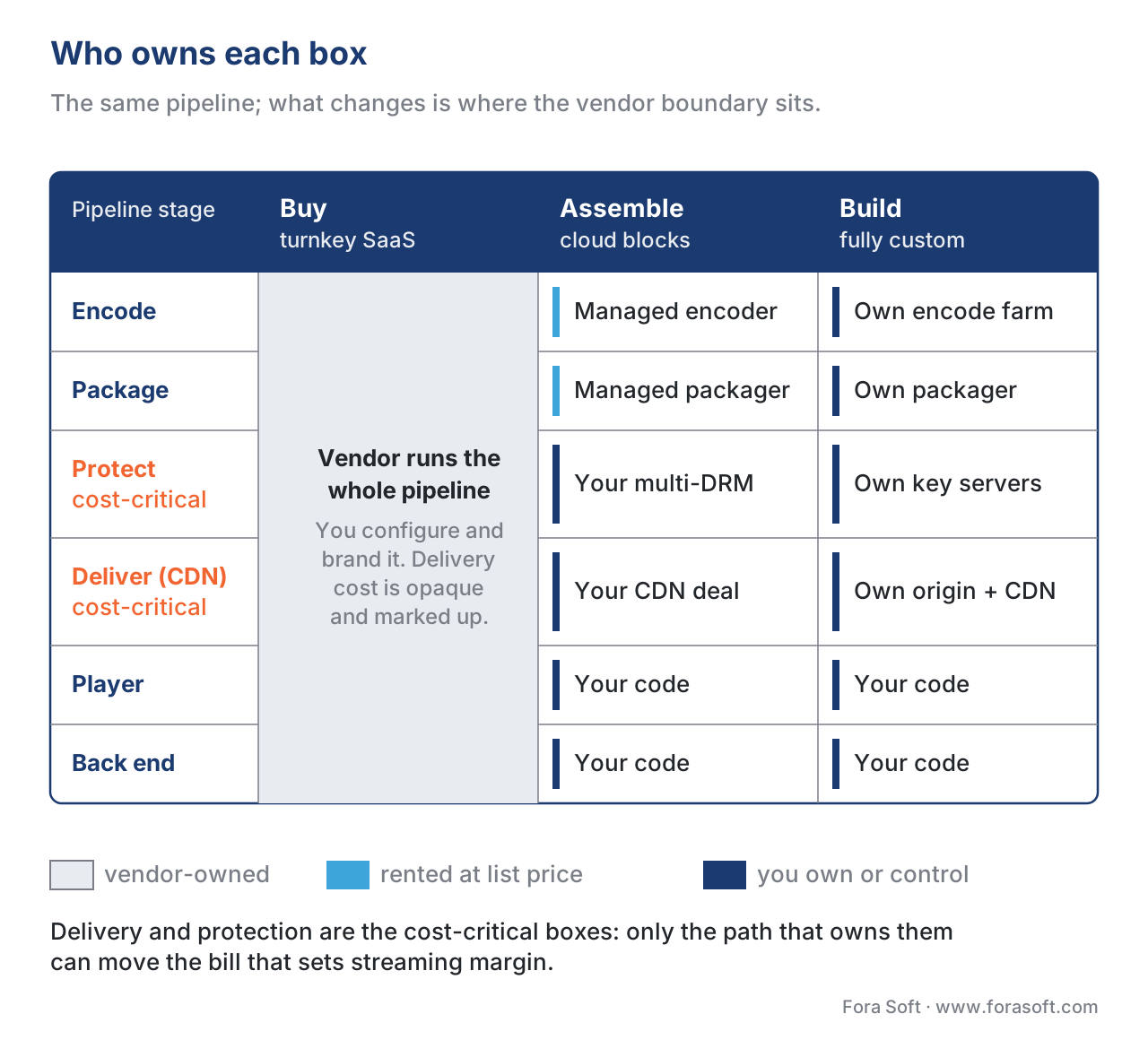 Figure 3. Who owns each box. Buying puts the whole pipeline behind the vendor boundary; assembling pulls the cost-critical stages — delivery and protection — onto standards you control; building owns it all.
A worked comparison of the three paths
Putting the axes side by side makes the trade visible. The column that decides a streaming business is not "one-time build" — it is the recurring run and who controls it.
| Criterion | Buy (OTT SaaS) | Assemble (cloud primitives) | Build (fully custom) |
|---|---|---|---|
| Upfront cost | Lowest ($) | Medium ($$) | Highest ($$$) |
| Recurring run | Highest — vendor markup on egress & protection | Cloud list price, commit-discountable | Lowest at large scale |
| Time to launch | Days–weeks | 4–15 months | Many months+ |
| Control of product | Low — vendor's feature set | High | Full |
| Control of margin (delivery) | None — opaque, marked up | High — you optimise it | Full |
| Portability / lock-in | Locked to vendor ops | Portable (open standards) | Fully portable |
| Standards you can reach | Hidden behind config | HLS, DASH, CMAF, cbcs directly |
All, down to the metal |
| Best when | Validating a market; standard catalog | Differentiated product at real scale | Very large scale or unusual requirement |
Table 1. The three paths across the axes that matter. "Supported" control of margin and product is the column that separates a platform you can grow from one you will outgrow.
A common mistake: comparing the wrong two numbers
The error we see most is comparing a build quote to a SaaS monthly invoice and concluding the SaaS is cheaper. It compares a one-time number to a recurring one. The build is paid once; the subscription is paid every month for years, and it grows with your audience. Always compare total cost over the same multi-year window, and put both delivery bills on the table — the bought one with its markup, the assembled one at cloud list with a commit.
A second mistake is buying to save money when the real constraint is control. If your product needs something the off-the-shelf platform cannot do, the money you "saved" by buying is spent twice over on workarounds, and you still do not have the product. Decide control first: can the bought platform do your actual job? Only if yes does the cost comparison even apply.
A third is assuming buy means no lock-in because "it's all standard formats". The bytes are standard; your pipeline, integrations, and operational knowledge are not. If portability matters, the assemble path on open standards (CMAF, cbcs Common Encryption, HLS, DASH) is what keeps you free to move — not the vendor's promise.
Where Fora Soft fits in
The build-vs-buy decision turns on one streaming-specific fact: delivery is the cost that decides margin, and only the team that owns the pipeline can control it. Fora Soft has built video streaming, OTT/Internet TV, e-learning, telemedicine, and surveillance software since 2005, across 625+ shipped projects for 400+ clients, and that work is precisely the assemble-and-scale problem — wiring managed encoding, multi-CDN delivery, and standards-based multi-DRM into a custom product whose unit economics hold as the audience grows from a thousand viewers to a million. When a media company has outgrown a rented platform, or knows from the start that its product needs control a turnkey tool cannot give, that standards-first, cost-aware engineering is the capability we bring. We also help teams decide honestly when buying is the right first move — building the thing you do not yet need is its own expensive mistake.
The handbook
Fora Soft Video Engineering Handbook
We wrote a seven-volume handbook that takes the whole video stack apart, from the pixel to the delivery invoice, and an engineer who works through it can design and assemble the platform this article has just priced. Volume 3 sits closest to the decision here: CDNs, caching, players, DRM and the economics of delivery — the recurring bill that decides whether owning the pipeline pays. Volume 2 covers the ingest, HLS, DASH and CMAF packaging that keeps an assembled platform portable, and volume 1 explains the encoding choices that set how many bytes you ship in the first place. Written by Nikolay Sapunov, CEO at Fora Soft.
Buy, assemble, or build — which one is your platform?
Tell us what your product has to do and the audience you are planning for, and we will walk the three paths with your numbers: what each costs to launch, what the delivery bill looks like in year three, and where your crossover actually sits. 250+ video products shipped since 2005.
See our case studies
Case study
Worldcast Live
Concert streaming at 0.4–0.5 s latency and 1.5 Gb/s for 10,000 simultaneous viewers, on a custom WebRTC and Kurento pipeline — the target no turnkey OTT product sells you.
Case study
Speed.Space
Remote production recording at 1080p and 8 Mbps, more than five times conferencing quality, used on Netflix, Electronic Arts and HBO productions — control of the product, which is the axis that decides the call before cost does.
Case study
Mindbox
A pipeline assembled from standard parts — RTSP into FFmpeg into HLS — that carried across 50+ deployments in transport, pharma and gated communities without a rebuild.
What to read next
Economics
The OTT platform cost model: build and run costs
The monthly bill behind the assemble column, modelled line by line.
Delivery cost
CDN cost engineering: egress, commits and the 95th percentile
How the delivery bill you own actually comes down once you own it.
Protection
Multi-DRM: one workflow for every device
Encrypt once, license many — the pattern that keeps an assembled platform portable.
Clients
The OTT client matrix: web, mobile, smart TV, devices
The device matrix is the biggest swing factor in any build quote.
References
- Muvi One pricing plans and configurations — Muvi. Standard $399/mo, Professional $1,499/mo, Enterprise $3,900/mo; per-app add-on fees; no revenue share. Tier 4 (first-party vendor). https://www.muvi.com/one/pricing/ (accessed 2026-06-15)
- JW Player pricing — JW Player. Professional streaming plans ~$99–$999/mo; OTT-grade features on custom Enterprise plan. Tier 4. https://www.jwplayer.com/pricing/ (accessed 2026-06-15)
- Brightcove software pricing & plans 2026 — Vendr marketplace. Reported deals $20,000–$250,000+/yr; OTT deployments reach six figures. Tier 5 (market/analyst reporting). https://www.vendr.com/marketplace/brightcove (accessed 2026-06-15)
- Amazon CloudFront pay-as-you-go pricing — Amazon Web Services. US/Canada egress tiers (first 1 TB free, $0.085/GB next 9 TB, falling to $0.040 and below); Savings Bundle up to 30%. Page updated 2026-06-08. Tier 4. https://aws.amazon.com/cloudfront/pricing/pay-as-you-go/ (accessed 2026-06-15)
- AWS Elemental MediaConvert pricing — Amazon Web Services. Per-output-minute transcode (~$0.015/min HD Basic AVC), codec multipliers. Tier 4. https://aws.amazon.com/mediaconvert/pricing/ (accessed 2026-06-15)
- Amazon S3 pricing — S3 Standard — Amazon Web Services. ~$0.023/GB-month first 50 TB (us-east-1). Tier 4. https://aws.amazon.com/s3/pricing/ (accessed 2026-06-15)
- RFC 8216 — HTTP Live Streaming (HLS) — IETF. The HLS manifest/segment format an assembled platform serves; a delivery standard that keeps the pipeline portable. Tier 1 (official standard). https://www.rfc-editor.org/rfc/rfc8216 (accessed 2026-06-15)
- ISO/IEC 23009-1 — Dynamic Adaptive Streaming over HTTP (MPEG-DASH) — ISO/IEC. The DASH delivery standard served from the same CMAF segments. Tier 1. https://www.iso.org/standard/83314.html (accessed 2026-06-15)
- ISO/IEC 23000-19 — Common Media Application Format (CMAF) — ISO/IEC. One set of fragmented-MP4 segments serving both HLS and DASH — the "package once" foundation of a portable, non-locked-in pipeline. Tier 1. https://www.iso.org/standard/85623.html (accessed 2026-06-15)
- ISO/IEC 23001-7 — Common Encryption (CENC) — ISO/IEC. The
cenc/cbcsschemes;cbcsenables encrypt-once across Widevine/PlayReady/FairPlay, the key to portability. Tier 1. https://www.iso.org/standard/84637.html (accessed 2026-06-15) - Custom OTT app development cost (2026 market survey) — Appinventiv. Build-cost ranges by scope ($60k MVP to $600k–$800k+ enterprise); per-platform native-app costs; maintenance 15–20%/yr; team run-rate. Tier 7 (SEO/market content) — orientation only; flagged as non-authoritative. https://appinventiv.com/blog/ott-app-development-cost/ (accessed 2026-06-15)
Source note (per §4.3.2): all cost figures are dated 2026 and split by tier — vendor list prices (refs 1–6, tier 4) and market-survey build ranges (ref 11, tier 7, flagged in-text as ranges, not quotes). Every portability/lock-in claim about the delivery and protection layer traces to tier-1 standards (refs 7–10): the encrypt-once-and-license-many pattern follows ISO/IEC 23001-7 cbcs Common Encryption over ISO/IEC 23000-19 CMAF, served as RFC 8216 HLS and ISO/IEC 23009-1 DASH. No lower-tier source overrode a standard.
