


This is engineering guidance, not legal advice. Confirm specifics with qualified counsel.
Why this matters
Triage is the first decision in almost every care journey, and it is the one with the least slack: send a heart-attack symptom to a "book a routine visit" queue and the software has caused harm before a clinician ever sees the patient. AI promises to make that first step faster and available at 2 a.m., which is genuinely valuable — but a triage tool that crosses from "here is what this might be, talk to your clinician" into "you have X, do Y" can become a regulated medical device, a civil-rights problem, or a malpractice exposure, often all three. This article is for the founder, product manager, or engineer deciding what their app's intake chatbot is actually allowed to say, which model sits behind it, and where a human must stay in the loop. It draws the regulatory lines in plain language and gives you a design that stays on the safe side of all of them.
What "triage" actually means
The word "triage" gets stretched to cover three different jobs, and a product team has to keep them apart because each carries different risk.
Symptom intake is data collection. The patient answers questions — what hurts, for how long, how badly — and the system records structured information for the clinician. This is the lowest-risk job: gathering facts is not the same as judging them.
Triage is the assessment of urgency: given those symptoms, how soon does this person need care, and what kind? The classic output is a level — emergency now, urgent within a day, routine, or self-care. This is where risk concentrates, because the answer changes what the patient does next.
Routing is the action: sending the patient to the right destination — the emergency department, an on-call clinician, a specialty queue, or a self-care article. Routing executes the triage decision, so any bias or error in triage becomes a bias or error in where real people end up.
One term runs through the whole article: a symptom checker is patient-facing triage software — the chatbot or questionnaire a patient uses themselves, with no clinician reading along in real time. Hold onto that "patient-facing" detail. As we will see, who receives the software's output is the single fact that most changes how the law treats it.
 Figure 1. The three jobs that get called "triage." Intake collects facts, triage judges urgency, and routing acts on that judgment — each carries more risk than the one before it.
The line that governs everything: decision support vs diagnosis
Here is the rule a triage feature lives or dies by. United States law separates software that supports a professional's judgment from software that effectively makes the medical decision. The first can be exempt from medical-device regulation; the second is a regulated medical device that needs FDA clearance before it ships. Getting on the right side of that line is the most important design decision in the whole feature.
The exemption comes from the 21st Century Cures Act, which amended the federal device law (the Federal Food, Drug, and Cosmetic Act) to carve certain Clinical Decision Support, or CDS, software out of the definition of a "device." The carve-out, at section 520(o)(1)(E), only applies if the software meets all four of these conditions, which the FDA spelled out in its Clinical Decision Support Software guidance, issued in final form in January 2026:¹
- It does not analyze a medical image or a signal from a monitor or diagnostic device (so reading an ECG tracing is out).
- It displays or analyzes medical information about the patient or other medical information.
- It provides recommendations to a health care professional about preventing, diagnosing, or treating a condition.
- It lets that professional independently review the basis for the recommendation, so the professional is not meant to rely primarily on the software to make the call.
Read conditions 3 and 4 together and the design intent is obvious: the carve-out is built for a tool that whispers a suggestion to a clinician who can see the reasoning and overrule it. The 2026 guidance even relaxed an old sticking point — software may now present a single recommendation when only one is clinically appropriate, rather than always offering a menu, and the FDA will use enforcement discretion for that case.¹
Now apply this to a patient-facing symptom checker, and the problem appears. Condition 3 requires the recommendation to go to a health care professional. A symptom checker talks to the patient. The FDA's January 2026 guidance is explicit on this point: it "clarifies that FDA's existing digital health policies continue to apply to software functions that meet the definition of a device, including those that are intended for use by patients or caregivers."¹ In plain terms: the CDS carve-out is for clinician-facing tools. A consumer-facing symptom checker does not get the carve-out, and whether it is a regulated device turns on what it actually does — gather and relay information (lower risk) versus deliver a specific diagnosis or directive the patient acts on (the device end of the spectrum). The FDA has signaled it will revisit the boundary for consumer-facing tools and symptom checkers in a future update, so this is an area to watch.¹
The practical translation for your copy deck is a single sentence. A triage tool may say "these symptoms can be a sign of strep throat — here is how to reach a clinician now" (information and routing). It must not say "you have strep throat, take amoxicillin" (a diagnosis and a treatment directive). The first describes and connects; the second decides — and deciding is what turns software into a device or a malpractice claim.
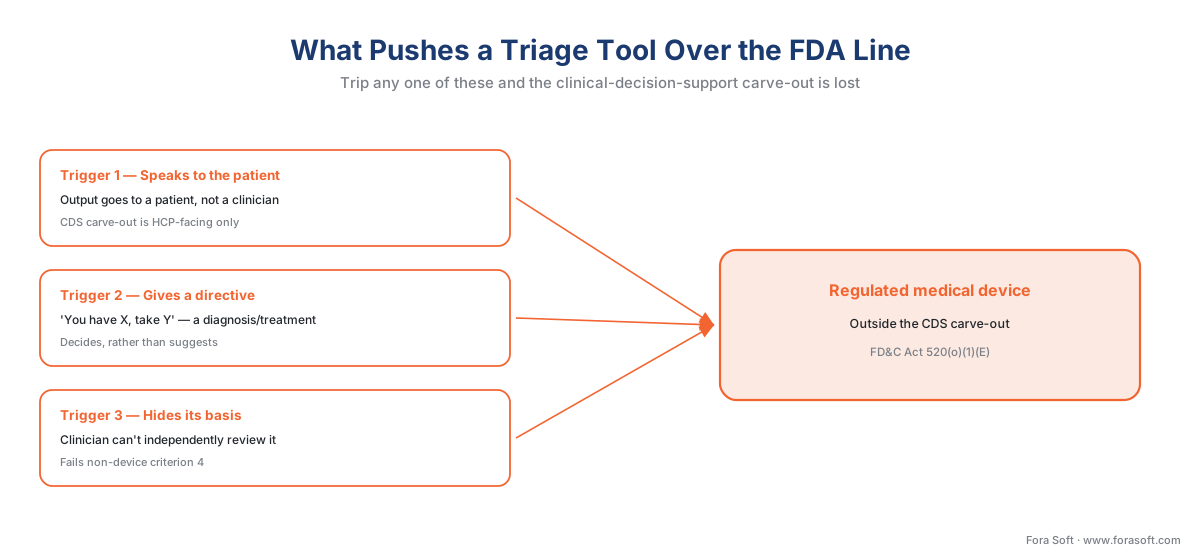 Figure 2. What pushes a triage tool over the FDA line. Speaking directly to the patient, issuing a diagnosis or directive, or hiding the basis of its recommendation each move it out of the decision-support carve-out and toward regulation as a device.
The error that matters most: under-triage
Triage accuracy is not one number, and treating it as one is how teams talk themselves into a dangerous tool. What matters is which way the errors go.
Recent evaluations of AI symptom checkers are encouraging at the headline level — studies in 2024–2026 found large-language-model triage matching expert urgency classifications on the order of 90% of cases and correctly flagging most emergencies.²⁴ But the same research is consistent that AI tools should complement, not replace clinician triage, because they remain prone to bias, to confidently wrong answers, and to sensitivity to how a question is phrased.²³ Both directions of error carry harm, and they are not symmetric.
Walk the two failure modes through. Over-triage sends a low-acuity patient to the emergency department: it wastes money and clinician time and frightens the patient, but it rarely kills anyone. Under-triage tells someone with an emerging emergency to "rest and book a routine appointment": that is the failure that ends in a missed heart attack or sepsis. A safe triage system is deliberately tuned to over-triage at the margin — when unsure, escalate.
Do the arithmetic a product owner should do. Suppose your tool is "95% accurate" and handles 2,000 intakes a month. That sounds excellent until you ask where the 5% — about 100 cases — land. If even a fifth of those errors are under-triage, that is roughly 20 patients a month told they are less sick than they are. The headline accuracy is reassuring; the distribution of the errors is the safety story. This is exactly why the law and good design both insist a human or a conservative rule sits between the model and the patient's next step.
Every typed symptom is PHI — so the model is a business associate
A patient describing chest pain to your chatbot has just handed you Protected Health Information, or PHI — any health information tied to an identifiable person. The moment that text leaves your servers for a model — a cloud large-language-model API, a third-party triage engine — that vendor is handling PHI on your behalf, which under HIPAA makes it a business associate. And a business associate may not touch PHI until you have a signed Business Associate Agreement, or BAA: the contract in which the vendor promises to guard the data and accept HIPAA liability (45 CFR §160.103 and §164.502(e)).⁵
Think of the BAA as the signed promise every contractor makes before getting a key to the building. No signature, no key — no matter how good the contractor is, and no matter how clever the model.
This rule disqualifies the tool many teams reach for first. The free, consumer versions of popular chatbots do not come with a BAA and are not built for PHI; piping a patient's symptoms into a consumer LLM endpoint is a HIPAA breach regardless of how good the triage looks. The enterprise tiers are different — the major cloud providers offer their model APIs under a BAA — but you must use the covered enterprise service, confirm the BAA names it, and pin down one more thing that matters specifically for AI: a no-training clause, so your patients' symptoms are not absorbed into the vendor's future models. The pattern is identical to the one in our ambient clinical documentation (AI scribe) and transcription articles: the model is a commodity you can buy under a BAA; placing it correctly relative to the PHI boundary is the work. The full treatment of PHI handling, BAAs with model providers, and the device line for every AI feature lives in our compliance and safety layer for clinical AI.
Bias is a civil-rights problem, not just a quality problem
A triage algorithm decides who gets seen sooner. If it systematically routes one group to lower-acuity queues, it has discriminated — and since 2024, that is explicitly a federal civil-rights matter, not merely a model-quality concern.
The controlling rule is Section 1557 of the Affordable Care Act, the healthcare anti-discrimination law, whose 2024 regulation added a section squarely about exactly this kind of software. Under 45 CFR §92.210, a covered health entity must not discriminate through the use of "patient care decision support tools," and it carries two ongoing duties: a duty to make reasonable efforts to identify tools that use race, color, national origin, sex, age, or disability as an input, and a duty to make reasonable efforts to mitigate the risk of discrimination from those tools.⁶ A triage or routing model is precisely a patient care decision support tool. If yours uses any of those protected characteristics — directly, or through a proxy like ZIP code standing in for race — §92.210 puts you on the hook to find it and fix it.
There is a transparency layer too. The Office of the National Coordinator's HTI-1 rule defines a Predictive Decision Support Intervention — software that uses a trained model to produce a prediction, classification, or recommendation, which is what a triage model does — and requires certified health-IT products to surface a long list of "source attributes" describing how the model was trained and validated (45 CFR §170.315(b)(11)).⁷ Even if your product is not itself certified health IT, treat that list as the disclosure bar buyers and auditors will expect: what data trained it, on what population, how it performs across groups, and how it is kept current.
The build implication is concrete. You need a documented bias check before launch and on a schedule after — measure triage and routing outcomes across demographic groups, look for a protected characteristic acting as an input or a proxy, and keep the record. "We didn't put race in the model" is not a defense if ZIP code or language is doing the same work invisibly.
The safe-default, human-in-the-loop design pattern
Put the rules together and a single architecture satisfies all of them. The triage AI suggests; a clinician or a conservative rule decides; and the system always errs toward more care.
Concretely: the model proposes an urgency level and a destination, with the reasoning visible. For anything above the lowest acuity, a human clinician confirms the routing before the patient is sent — keeping the tool on the supportive side of the FDA line and a person accountable for the decision. Where a human cannot be in the loop in real time, a safe default stands in: hard-coded red-flag rules that escalate immediately and never down-route. Chest pain, difficulty breathing, stroke symptoms, suicidal ideation, and similar danger signals bypass the model entirely and go straight to "call emergency services / connect to a clinician now." The model is allowed to escalate the safe default; it is never allowed to overrule it downward.
Three more guardrails make this real. First, the patient-facing language stays in the information-and-routing register — "these symptoms may need urgent attention; here is how to get it" — never a diagnosis or a treatment directive. Second, every symptom flows through the BAA-covered boundary, with the consumer chatbot kept strictly outside it. Third, the whole thing is logged and reviewed: triage suggestions, human overrides, and routing outcomes, so you can audit accuracy and bias over time. A tool built this way is support, not a substitute — which is what keeps it clear of the device line, the civil-rights rule, and the malpractice exposure at once.
 Figure 3. The safe AI-triage pattern. Symptom intake (PHI) enters the HIPAA boundary; a BAA-covered model suggests urgency, hard-coded red-flag rules guarantee a safe default, and a clinician confirms routing. The consumer chatbot stays outside the boundary and never sees patient data.
A reference design for AI triage and routing
Make it concrete with a flow you could build. A patient opens the app at night with abdominal pain.
At intake, the app asks structured questions and records the answers as PHI inside the compliance boundary. A safe-default rule engine screens the answers first: if any red flag is present (for abdominal pain, signs like rigid abdomen or fainting), it routes straight to emergency care and the model never gets a vote on down-routing. If no red flag fires, the symptom data goes to a BAA-covered triage model — under a contract with a no-training clause — which returns a suggested urgency level and destination with its reasoning attached. For anything above self-care, an on-call clinician sees the suggestion and the structured intake and confirms or changes the routing; the patient-facing message describes and connects ("this may need to be seen today — here is the soonest visit") without diagnosing. Every step — intake, the safe-default decision, the model suggestion, the human override, the final route — is logged for audit and periodic bias review across demographic groups.
That design uses AI where it genuinely helps — fast, 24/7 structured intake and a first-pass urgency suggestion — while a human and a conservative rule own the decision that affects the patient. It keeps every symptom inside a contracted boundary, keeps the language on the safe side of the FDA's decision-support line, and produces the audit trail §92.210 effectively requires. It is the shape of a system that passes a clinical review, a HIPAA review, and an Office for Civil Rights inquiry.
A common, expensive mistake
The signature failure in AI-triage builds is shipping a patient-facing chatbot that answers instead of routes. Under deadline, a team wires the app to a consumer LLM, lets it tell patients what they "have" and what to do, and demos it to applause. In one move they have done three things wrong: sent PHI to a vendor with no BAA (a HIPAA breach), let unreviewed software issue diagnoses and directives to patients (the device and malpractice end of the spectrum), and shipped a model whose triage bias nobody measured (a §92.210 problem). The feature looks magical in the demo and is a triple liability the first time a real patient under-triages a real emergency.
The quieter cousin is the silent down-route: a tool tuned for "efficiency" that nudges borderline cases toward routine queues to relieve the emergency department. It improves the metrics that are easy to see and hides the harm that is hard to see, until an under-triaged patient is the case review. Build the safe default so escalation is the easy path and down-routing requires a human, and neither mistake stays tempting.
Where Fora Soft fits in
The requirement comes first: a triage feature must stay on the supportive side of the FDA's decision-support line, keep a clinician or a safe default in the loop, hold every symptom inside a BAA-covered boundary, and be checkable for bias under Section 1557. Fora Soft has built real-time video, conferencing, and clinical-workflow software since 2005, including telemedicine platforms where intake, routing, and provider queues feed a live consult. We wire AI triage in as augmentation — fast structured intake and a first-pass urgency suggestion — with hard-coded red-flag escalation and human confirmation around it, never as a chatbot that quietly diagnoses the patient.
What to read next
- Where AI fits in a telemedicine product — the map
- The compliance and safety layer for clinical AI
- The telemedicine waiting room: queueing, triage, and provider readiness
Download the AI Triage Safety & Compliance Checklist (PDF)
Call to action
- Talk to a telemedicine engineer — book a 30-minute scoping call to talk through your ai triage telehealth plan.
- See our case studies — 250+ shipped projects across video streaming, WebRTC, OTT, telemedicine, e-learning, surveillance, and AR/VR.
- Download the AI Triage Safety & Compliance Checklist — One page: run a telehealth AI-triage feature through four gates — the decision-support-vs-diagnosis line, the PHI boundary and BAA, the bias duty under 45 CFR 92.210, and the safe-default human-in-the-loop pattern — before you build.
References
- Clinical Decision Support Software — Guidance for Industry and FDA Staff (Final, January 2026) — U.S. Food and Drug Administration, docket FDA-2017-D-6569, content current 2026-01-29. Tier 1. The four non-device CDS criteria under FD&C Act §520(o)(1)(E); the clarification that device policies "continue to apply to software functions that meet the definition of a device, including those that are intended for use by patients or caregivers"; the single-recommendation enforcement discretion. Time-sensitive.
- Evaluation of Artificial Intelligence for Patient Self-Triage vs the NHS 111 Online Symptom Checker — Cureus (2025). Tier 5. AI platforms matched gold-standard urgency classification in ~90% of cases and identified most emergencies, but performance varied by platform and scenario.
- Does an App a Day Keep the Doctor Away? AI Symptom Checker Applications, Entrenched Bias, and Professional Responsibility — PMC (2024). Tier 5. Symptom-checker bias, the need for human oversight, and the case for AI as decision support rather than replacement.
- Enhancing diagnostic accuracy in symptom-based health checkers: a comprehensive machine learning approach with clinical vignettes and benchmarking — Frontiers in Artificial Intelligence (2024). Tier 5. Benchmarking of symptom-checker accuracy on clinical vignettes; over- and under-triage as distinct patient-safety risks.
- HIPAA Privacy Rule — Business Associates (45 CFR §160.103, §164.502(e)) — HHS. Tier 1. Any model provider that receives PHI is a business associate and needs a signed BAA before any data reaches it.
- 45 CFR §92.210 — Nondiscrimination in the use of patient care decision support tools (Section 1557 Final Rule) — HHS (eCFR), source 89 FR 37692, May 6, 2024, effective July 5, 2024. Tier 1. The duty to identify and mitigate discrimination in patient care decision support tools that use race, color, national origin, sex, age, or disability as input variables.
- ONC HTI-1 Final Rule — Decision Support Interventions certification criterion (45 CFR §170.315(b)(11)) — HHS Assistant Secretary for Technology Policy / ONC. Tier 1. The Predictive DSI definition and the 31 source attributes that disclose how a predictive model was trained and validated. Time-sensitive.
- Section 1557 — Meaningful Access for Individuals with Limited English Proficiency (45 CFR §92.201) — HHS (eCFR), source 89 FR 37692, May 6, 2024. Tier 1. Language-access duties that a triage front door must honor — qualified interpreters, free and timely, with the limit on machine translation of critical text.
