


This is engineering guidance, not legal advice. Confirm specifics with qualified counsel.
Why this matters
Founders usually start a telemedicine project from the feature they imagine — a video call, a nice waiting room, a tidy dashboard — and discover the real work only after they have picked a clinical area, when the rules and integrations specific to that area land on the roadmap. By then the scope is set and the budget is wrong. This article is for the founder, product manager, or health-system lead who has not yet locked a vertical, or who wants to sanity-check the one they have chosen. Choosing a telehealth vertical well means matching the build to the compliance burden you can carry, the integrations you can fund, and the clinical bar you must meet — before you write a line of code. Choose it badly and you will rebuild the product once you learn what the vertical actually demanded.
The one idea: the vertical is the spec
Every article in this section's Block 7 describes one vertical in depth. Read together, they make a single point: the clinical use case is the specification. A consumer video app connects two strangers for a chat; a telemedicine product connects a patient and a clinician under a body of rules that exists because someone's health is on the line. Which rules, which systems, and which performance bar all depend on the vertical.
So before comparing features or vendors, a founder should compare verticals along the four dimensions that actually drive the work. We call them dials because each vertical turns each one to a different setting, and the combined setting is your product's true difficulty. The four dials are compliance burden, integration depth, the latency-and-reliability bar, and cost-and-time. Everything else — the video layer, the UI, the choice of cloud — is downstream of these four.
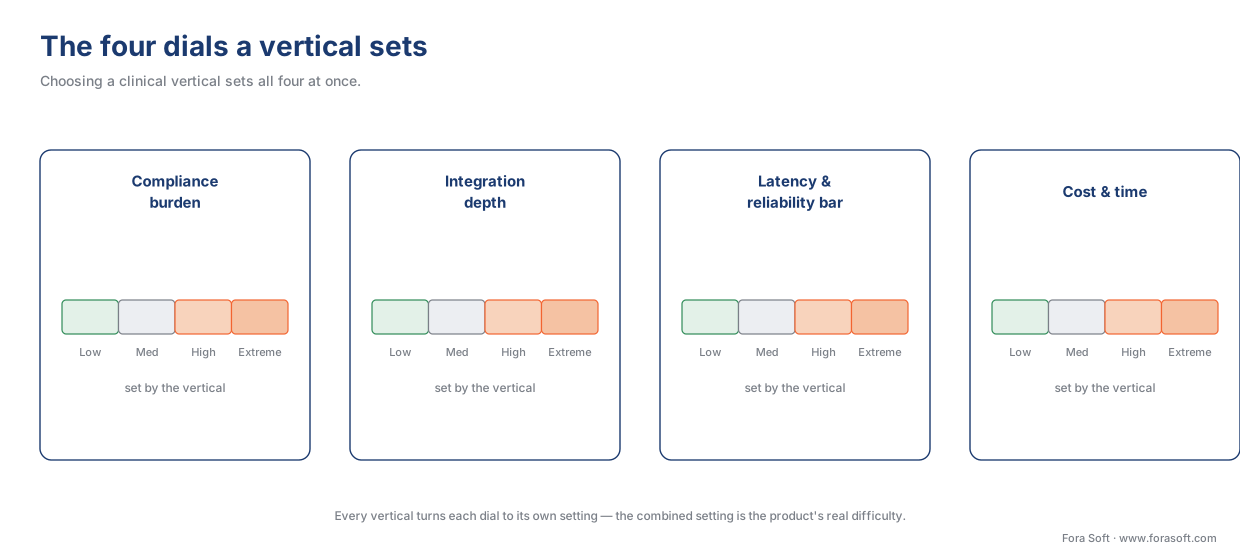 Figure 1. The four dials. Picking a clinical vertical sets all four at once — each vertical turns each dial to its own level, and the combined setting is the product's real difficulty.
Dial 1 — Compliance burden
Every telemedicine product in the United States sits on the same floor: the Health Insurance Portability and Accountability Act (HIPAA), the federal law that governs protected health information (PHI) — any health data tied to an identifiable person. That floor is covered once in the HIPAA guide for product teams and applies to all verticals. What differs is how many extra layers stack on top.
Behavioral health carries the heaviest stack. On top of HIPAA, psychotherapy notes are locked away under their own rule (45 CFR §164.508(a)(2)), substance-use-disorder records get a second federal privacy law (42 CFR Part 2), and the product has to carry a crisis-escalation path before it ever places a call. The reasoning is laid out in the mental-health telemedicine playbook. Anything that prescribes controlled medications inherits the federal remote-prescribing rules under the Ryan Haight Act, whose current telemedicine flexibility the Drug Enforcement Administration extended only through December 31, 2026 (the Fourth Temporary Extension, Federal Register 2025-24123) — a date a builder must design around, not assume.
Verticals that capture or interpret clinical images and movement add a different layer: the line between software that is a regulated medical device and software that is not. Showing a dermatology photo or a range-of-motion video is generally a non-device function; software that interprets the image to output a diagnosis can become regulated Software as a Medical Device (SaMD) under the U.S. Food and Drug Administration (FDA). That line is the load-bearing decision in the specialty visual-consults playbook and the tele-rehabilitation playbook. Hospital-at-home adds the rules of a federal Medicare waiver. The point is not to memorize the rules here, but to see that compliance burden is a dial, and it is set by the vertical.
Dial 2 — Integration depth
The second dial is how many of a hospital's systems your product must connect to. Most consumer-facing telehealth tools talk to one or two systems. Clinical products embedded in a health system talk to many: the electronic health record (EHR) over the modern Fast Healthcare Interoperability Resources standard (FHIR), the pharmacy for prescriptions, the lab for results, scheduling, identity, billing, and sometimes a device fleet. The whole map is drawn in the telemedicine integration map; each connection on it is a project, not a checkbox.
Integration depth climbs steadily across the verticals. A direct-to-consumer urgent-care app may run mostly standalone, writing a visit summary out and little else. A chronic-care and remote-monitoring product, covered in the chronic-care and RPM playbook, has to ingest data from a fleet of connected devices and reconcile it with the record. Hospital-at-home, the subject of the hospital-at-home playbook, integrates with almost everything a hospital has because it is standing in for the hospital. Integration depth is the dial that most often blows up a timeline, because every connected system is also another party that needs a Business Associate Agreement (BAA) — the contract that lets a vendor handle PHI under HIPAA (45 CFR §164.502(e)) — and another data path you must encrypt and audit. Scope the integrations first; the feature list second.
Dial 3 — The latency and reliability bar
The third dial is how fast and how reliably the product must perform, and it is set by what the clinician is doing during the encounter. Not all clinical video needs the same quality, and over-engineering the wrong vertical wastes money as surely as under-engineering the right one.
At the low end sit the asynchronous verticals. Store-and-forward dermatology and most remote-monitoring flows do not need a real-time call at all — a photo or a reading is captured now and reviewed later, so "latency" is measured in hours and the engineering problem is data integrity, not milliseconds. A talk-therapy session needs a stable, natural conversation but tolerates ordinary video quality. Movement-based tele-rehab raises the bar because the camera is feeding pose feedback. The high end is acute care: a tele-stroke consult, described in the tele-stroke and tele-ICU playbook, runs against a clinical clock measured in minutes and needs conversational latency at or below 150 milliseconds (the long-standing ITU-T G.114 guidance for one-way delay), plus redundancy at every layer. In acute care, HIPAA itself treats availability of the system as a security requirement, with a required contingency plan (45 CFR §164.308(a)(7)) and emergency-access procedure (45 CFR §164.312(a)(2)(ii)) — downtime is both a safety event and a compliance failure. The deep mechanics of latency and reliability live in the Block 3 articles; the vertical decides where on that scale you must operate.
Dial 4 — Cost and time
The fourth dial is the consequence of the first three. Cost and timeline are not a separate choice; they are what the other three dials add up to. The detailed model is in the telemedicine cost model, but the scoping-level intuition is simple: a heavier compliance stack means more legal review and more controls to build, deeper integration means more engineering and more BAAs, and a stricter latency-and-reliability bar means more infrastructure and more testing. A vertical that turns all three dials high is not incrementally more expensive — it is a different scale of project.
Here is the arithmetic made concrete, in round planning numbers rather than a quote. Imagine the engineering effort to ship a usable first version. A largely standalone vertical with a moderate compliance stack and no real-time extreme — say a focused behavioral-health app — might be one baseline unit of effort. Add a connected-device fleet and the device-and-EHR integration that chronic care needs, and you are plausibly at two to three times that baseline. Take hospital-at-home, which stacks a heavy waiver-driven compliance burden, the deepest integration in the field, and a 24/7 command center, and you are at several times the baseline again. The numbers you plug in will be your own; the shape — that vertical choice multiplies cost rather than adding to it — is the lesson. Decide what scale of project you can fund before you fall in love with a vertical that needs a bigger one.
The comparison at a glance
The table below places the seven verticals against the four dials. The ratings are deliberately coarse — Low, Medium, High, Extreme — because the goal is a scan that tells you which projects are in the same weight class, not a false-precision score. Each row links to the full playbook for that vertical.
| Vertical | Compliance burden | Integration depth | Latency / reliability bar | Cost & time |
|---|---|---|---|---|
| Mental & behavioral health | High (42 CFR Part 2, psych notes, crisis path) | Low–Medium | Low | Medium |
| Primary & urgent care | Medium (prescribing, licensing, triage safety) | Medium | Low–Medium | Medium |
| Chronic care & RPM | High (FDA device line, billing codes) | High (device fleet + EHR) | Low (asynchronous) | High |
| Visual consults (derm, wound, eye) | Medium–High (FDA device line, image de-identification) | Medium | Low (store-and-forward) | Medium |
| Tele-rehab & physical therapy | Medium (FDA coach-vs-assess, RTM billing) | Medium | Medium (pose feedback) | Medium |
| Tele-stroke / tele-ICU / acute | High (HIPAA availability as a duty) | High (imaging, EHR) | Extreme (clinical clock, ≤150 ms) | High |
| Hospital-at-home | High (Medicare waiver rules, FDA devices) | Extreme (nearly every hospital system) | Medium | Extreme |
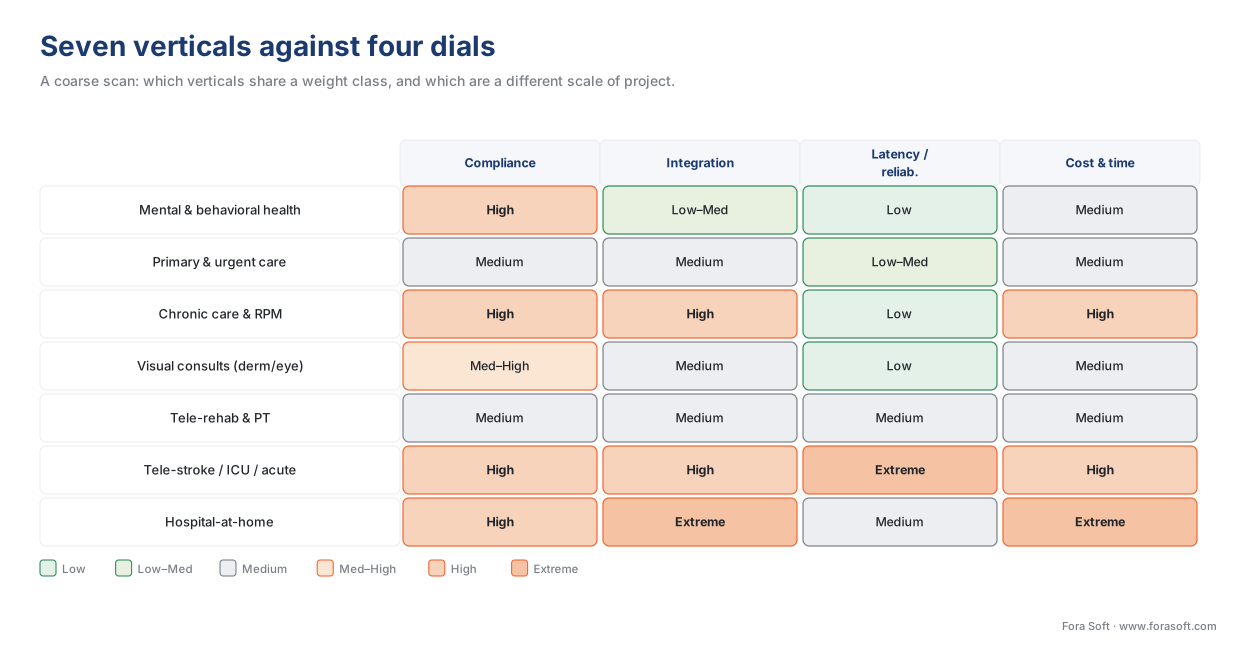 Figure 2. The same comparison as a heat matrix. Read down a column to see which verticals share a weight class on one dial; read across a row to see a vertical's overall difficulty profile.
Two patterns are worth naming. First, no vertical is easy on every dial — even the "lightest" carries a High somewhere, because this is healthcare. Second, the cost dial tracks the others: the verticals that turn integration and compliance high (chronic care, acute care, hospital-at-home) are the expensive ones, and the cheaper ones (behavioral health, visual consults) keep at least one dial Low. There is no vertical that is simultaneously light on compliance, light on integration, demanding on latency, and cheap — that product does not exist in clinical care.
The scoping framework: four questions
A comparison table tells you the terrain; it does not tell you where to walk. To turn the four dials into a decision, ask four questions in order. Each one narrows the field, and the order matters because an early "no" saves you from scoping a vertical you cannot serve.
The first question is about access, not technology: do you have a clinical partner or domain in this vertical? Telemedicine products are sold to or run by clinicians, and a founder with a relationship in cardiology, behavioral health, or a hospital system has a decisive advantage there and nowhere else. Pick the vertical where you can get a real clinician to tell you the truth about the workflow.
The second question is about appetite for rules: how much compliance burden can you carry in version one? If you do not have access to healthcare counsel and a compliance lead, a vertical that stacks 42 CFR Part 2, controlled-substance prescribing, or a Medicare waiver on top of HIPAA will out-run your team. A vertical with HIPAA plus one extra layer is a more honest starting point.
The third question is about systems: how deep an integration can you fund and maintain? Each EHR, pharmacy, lab, or device connection is ongoing engineering and another BAA. If you can fund one or two integrations, scope a vertical that needs one or two. If you cannot stand up a device-logistics operation, do not pick a vertical whose product is a device fleet.
The fourth question is about the clinical bar: does the encounter need real-time, low-latency, high-reliability video, or not? If the clinical task tolerates store-and-forward or ordinary video — much of dermatology, monitoring, and talk therapy — you avoid the most expensive engineering in the field. If it is acute care, the latency and reliability bar is non-negotiable and your budget must reflect it from day one.
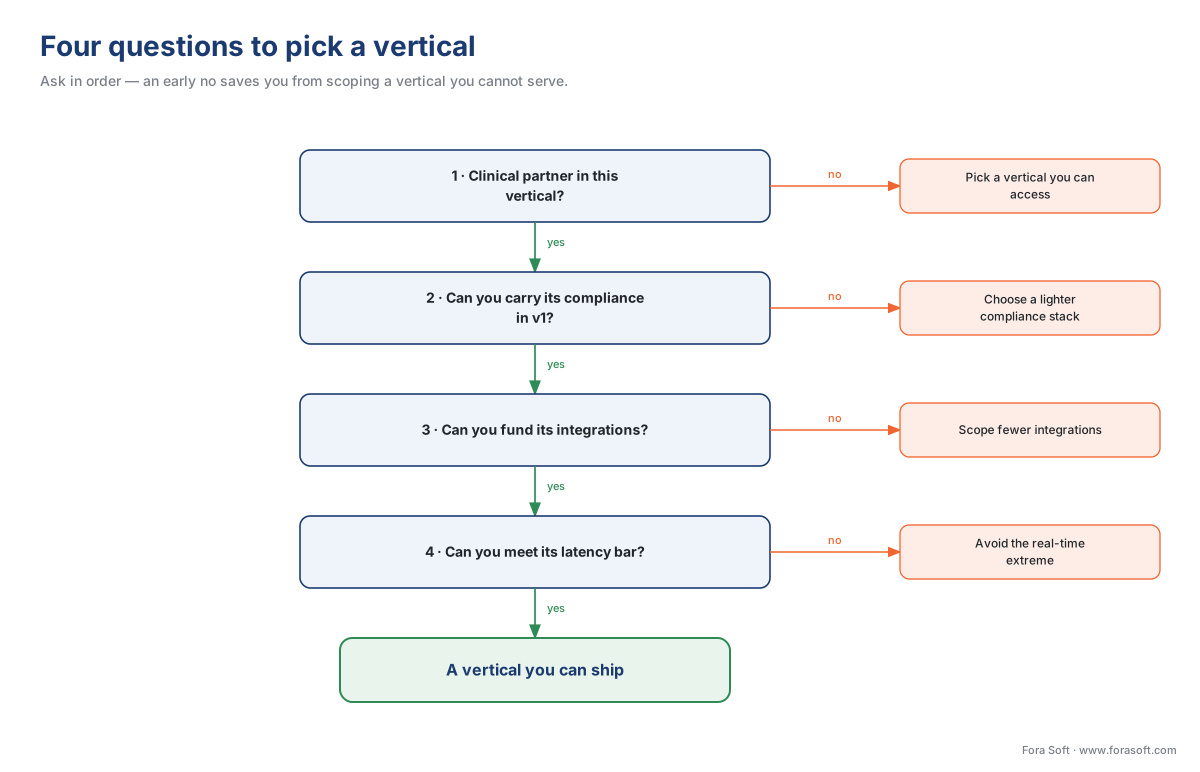 Figure 3. Four questions, in order. Clinical access first, then the three dials you can afford to turn — the path ends at a vertical you can actually ship, not the one that looked most exciting.
A common, expensive mistake
The most frequent scoping error is choosing a vertical by market size and treating compliance and integration as details to handle later. A founder reads that the chronic-care market is enormous, builds a polished monitoring app, and only then learns that remote-monitoring reimbursement is governed by specific billing codes with hard rules — the 16-day device-data requirement, the monthly live-interaction requirement, the separation between remote physiologic monitoring and remote therapeutic monitoring (CPT families 99453–99458 and 98975–98981) — and that those codes are effectively the product specification. The same trap waits in every vertical: the rule you skipped in scoping becomes the rebuild in month nine. Scope the dials first, and let market size break ties between verticals you can actually build — not choose one you cannot.
Where Fora Soft fits in
Choosing a vertical is the point where a real-time-video plan meets a body of healthcare rules and a stack of integrations, and that intersection is the work Fora Soft has done since 2005 across video conferencing, streaming, surveillance, and telemedicine. The requirement at this stage is an honest scope — matching the build to the compliance burden, integration depth, and clinical bar a specific vertical demands — and the capability is having built the horizontal pieces (compliant WebRTC video, FHIR integration, monitoring) often enough to estimate them realistically per vertical. We help teams set the scope before the budget, so the product they fund is the product the vertical actually needs.
What to read next
- The telemedicine cost model: what a platform actually costs
- Build vs buy vs hybrid for telemedicine
- The telemedicine integration map: what connects to what
Call to action
- Talk to a telemedicine engineer — book a 30-minute scoping call to talk through your choosing a telehealth vertical plan.
- See our case studies — 250+ shipped projects across video streaming, WebRTC, OTT, telemedicine, e-learning, surveillance, and AR/VR.
- Download the Telehealth Vertical Scoping Worksheet — One page: score a telehealth idea on the four dials (compliance burden, integration depth, latency/reliability bar, cost & time), work the four ordered scoping questions (clinical access, compliance appetite, integration budget, latency….
References
- 45 CFR Part 164 — HIPAA Privacy and Security Rules (the federal floor for protected health information; §164.502(e) Business Associate Agreement requirement; §164.508(a)(2) psychotherapy-notes authorization; §164.514 de-identification; §164.308(a)(7) contingency plan; §164.312(a)(2)(ii) emergency access). Electronic Code of Federal Regulations.
https://www.ecfr.gov/current/title-45/subtitle-A/subchapter-C/part-164(accessed 2026-06-15). Tier 1 — federal regulation. - 42 CFR Part 2 — Confidentiality of Substance Use Disorder Patient Records (SAMHSA); the second federal privacy layer above HIPAA for behavioral-health verticals.
https://www.ecfr.gov/current/title-42/chapter-I/subchapter-A/part-2(accessed 2026-06-15). Tier 1 — federal regulation. - Food, Drug, and Cosmetic Act §201(h) and FDA Software as a Medical Device (SaMD) / Clinical Decision Support guidance — the display-vs-interpret line that separates a non-device from a regulated device. U.S. Food and Drug Administration.
https://www.fda.gov/medical-devices/digital-health-center-excellence/software-medical-device-samd(accessed 2026-06-15). Tier 1 — statute / FDA guidance. - DEA & HHS — Fourth Temporary Extension of COVID-19 Telemedicine Flexibilities for Prescription of Controlled Medications (telemedicine controlled-substance prescribing flexibility extended through December 31, 2026). Federal Register, doc. 2025-24123, Dec 31, 2025.
https://www.federalregister.gov/documents/2025/12/31/2025-24123/Tier 1 — issuing agency. (Re-verify the permanent-rule status and expiry before publish.) - CMS — Medicare Telehealth Services; the Consolidated Appropriations Act, 2026 extended Medicare telehealth flexibilities through December 31, 2027 (signed Feb 3, 2026). U.S. Centers for Medicare & Medicaid Services.
https://www.cms.gov/medicare/coverage/telehealth(accessed 2026-06-15). Tier 1 — issuing agency. (Reimbursement rules change yearly; cite the year.) - CMS — Acute Hospital Care at Home program; waiver authorities extended through September 30, 2030 under the Consolidated Appropriations Act, 2026 (H.R. 7148 lineage). U.S. Centers for Medicare & Medicaid Services (QualityNet).
https://qualitynet.cms.gov/acute-hospital-care-at-home(accessed 2026-06-15). Tier 1 — issuing agency. (Confirm exact public-law number and the 2030 date against the statute.) - CMS — CY2026 Physician Fee Schedule and remote-monitoring code families: Remote Physiologic Monitoring (CPT 99453–99458) and Remote Therapeutic Monitoring (CPT 98975–98981, plus 2026 short-duration additions). U.S. Centers for Medicare & Medicaid Services.
https://www.cms.gov/medicare/payment/fee-schedules/physician(accessed 2026-06-15). Tier 1 — issuing agency. (Codes and rates change yearly; re-pull at publish.) - ITU-T Recommendation G.114 — One-way transmission time (the ≤150 ms guidance for conversational interactivity, applied to the acute-care latency bar). International Telecommunication Union.
https://www.itu.int/rec/T-REC-G.114Tier 3 — standards body. - HL7 FHIR R4 — Fast Healthcare Interoperability Resources, the modern EHR data-exchange standard underlying the integration dial. HL7 International.
https://hl7.org/fhir/R4/Tier 1 — standard.
