


This is engineering guidance, not legal advice. Confirm specifics with qualified counsel.
Why this matters
Scheduling looks like the easy part of a telemedicine build — a calendar widget, how hard can it be? — and that assumption is why it is one of the most common sources of overrun and embarrassment. This article is for the founder, product manager, or hospital IT lead who needs to scope booking honestly: where the standards live, what the reminder rules actually permit, and which two design mistakes (time zones and a leaky calendar) reliably surface in production after launch. Get it right and the schedule quietly does its job: the right patient meets the right licensed provider at a time both understand, and the no-show rate drops. Get it wrong and you book patients into the wrong hour, double-book a slot, or leak patient names onto a personal calendar — each a separate way to lose trust. This is the deep dive behind the scheduling node on the telemedicine integration map.
The four jobs scheduling actually does
Before any standard or API, get the shape of the problem. A telemedicine schedule has to do four distinct things, and most teams underestimate at least two of them.
The first is publishing availability — turning a provider's working hours, appointment types, and existing commitments into bookable openings. The second is booking — letting a patient claim one of those openings without a second patient claiming the same one a half-second later. The third is reminding — nudging the patient before the visit so the slot is not wasted. The fourth is synchronizing — pushing every booking, change, and cancellation out to the systems that also need to know: the electronic health record (the clinical system of record, abbreviated EHR), the provider's personal calendar, and the billing system.
Each job has its own failure mode, and the rest of this article walks them in order. Hold the four in mind, because the standards below map onto them directly.
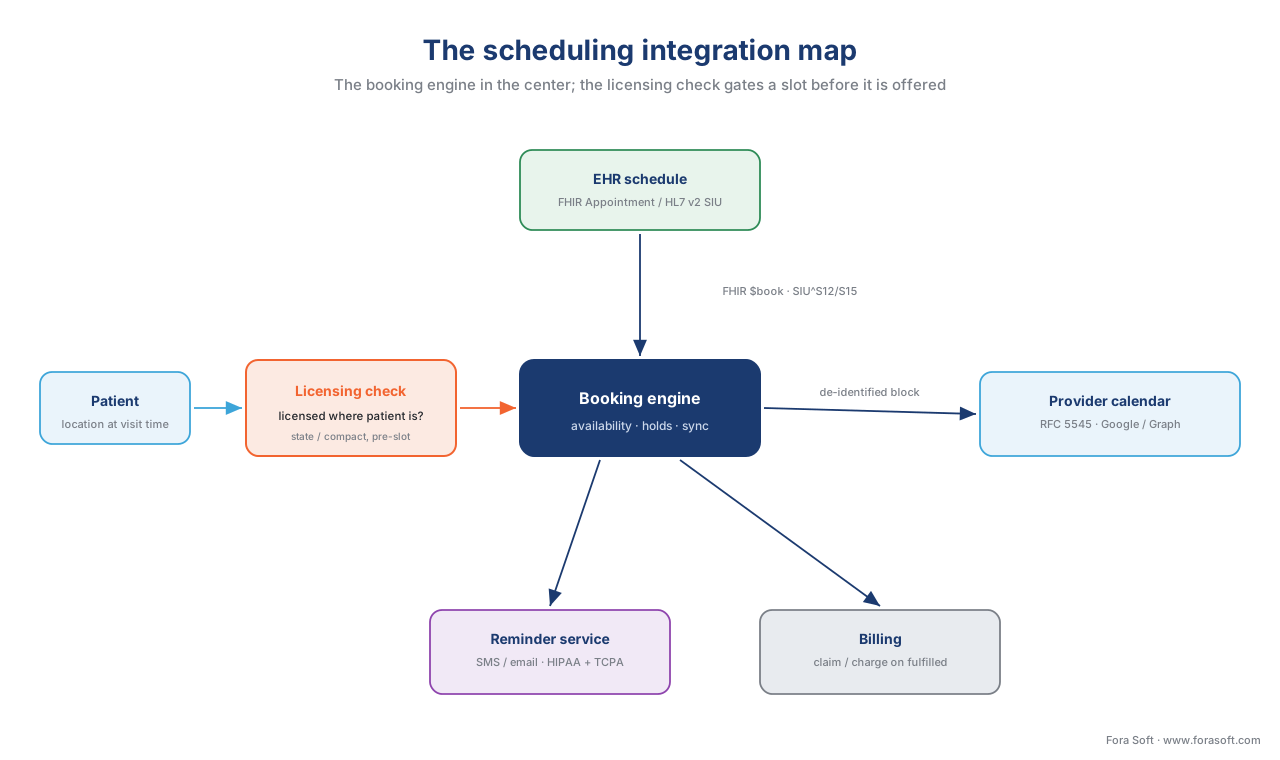 Figure 1. The scheduling integration map. The platform's booking engine sits in the center; each spoke carries a different standard, and the licensing check gates a slot before it is ever offered.
The data model: FHIR's four scheduling resources
Start with the good news, because there is a real standard for this. The interoperability body HL7 publishes FHIR (Fast Healthcare Interoperability Resources), a web API where every clinical concept is a "resource" with a defined shape. Scheduling uses four of them, and they fit together like nesting dolls [1].
A Schedule is the container — it says "this provider, for this kind of visit, offers time within this window." Inside a Schedule sit Slot resources, each one a specific block of time with a status: free, busy, busy-unavailable, busy-tentative, or entered-in-error [2]. A free Slot is an opening a patient can take. When a patient takes one, you create an Appointment — the booking itself, which moves through its own lifecycle of statuses: proposed, pending, booked, arrived, fulfilled, cancelled, and the one every clinic dreads, noshow [1]. Finally, when a booking needs each participant to confirm — the patient, the provider, maybe an interpreter — an AppointmentResponse records each party's accept or decline [1].
That is the whole model: a Schedule holds Slots; a free Slot becomes an Appointment; participants confirm with AppointmentResponses. If you have read the FHIR and EHR integration reality, this is the same R4 data shape applied to time instead of clinical data.
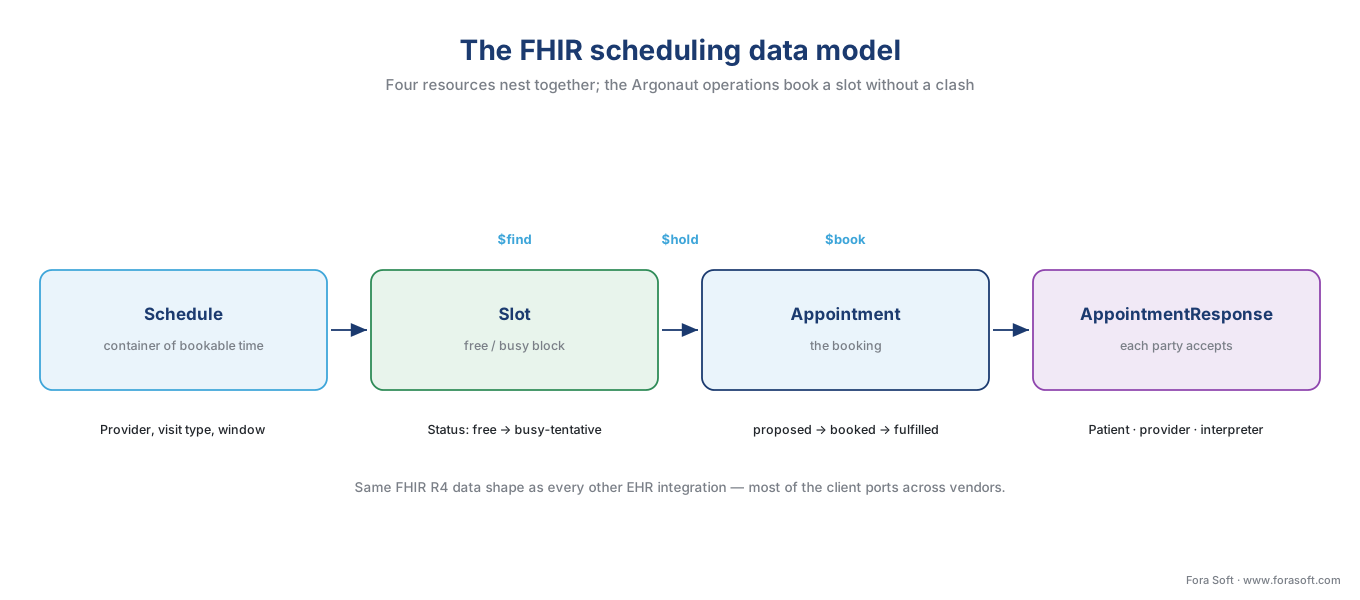 Figure 2. The FHIR scheduling data model. Four resources nest together; the Argonaut
 $find, $hold, and $book operations book a slot without a clash — the same R4 shape that ports across EHR vendors.
The booking workflow on top of these resources is standardized too, by the Argonaut Scheduling implementation guide — a vendor-neutral FHIR specification for patient and provider appointment access [3]. It defines three operations that solve the booking race directly: $find returns open appointment slots matching a patient's need; $hold reserves one temporarily so no one else can grab it while the patient finishes booking; and $book confirms it [3]. Epic exposes scheduling services along these lines through its developer program, and other major EHRs follow the same Argonaut pattern [4]. If you wrote a generic FHIR scheduling client, much of it ports across vendors — the same lesson as every other EHR integration.
The legacy that is still everywhere: HL7 v2 SIU
FHIR is the future, but a large share of real hospital scheduling still moves over the previous standard, HL7 version 2, in pipe-delimited messages called SIU (Scheduling Information Unsolicited). When a hospital scheduling system books, reschedules, or cancels, it emits an SIU message: SIU^S12 for a new booking, S13 for a reschedule, S14 for a modification, S15 for a cancel, and S26 for a no-show, each acknowledged with an ACK [5]. These feeds are one-directional notifications more than interactive booking — the hospital's system schedules, and your platform listens.
The practical lesson: do not assume "FHIR" everywhere. When you scope an EHR scheduling integration, ask which path the customer actually exposes. A modern Epic or Oracle Health site may give you FHIR Appointment and the Argonaut operations; an older site may only emit SIU v2 messages you have to consume. Budget for both, because the standard a hospital publishes and the standard it runs in production are not always the same.
The two clocks that break everything: time and time zones
Now the part that humbles every team, and it has nothing to do with healthcare standards. Telemedicine is the one kind of appointment where the patient and the provider are routinely in different time zones, and the booking system has to be right for both.
The rule that saves you is boring and absolute: store every time in UTC (Coordinated Universal Time, the single global clock with no daylight-saving shifts), and render it into each person's local zone only at display time, using the IANA time-zone database — the canonical list of zones like America/New_York that encodes every region's daylight-saving rules and their history [6]. Never store "3:00 PM" without a zone; never store a fixed offset like "UTC-5" for a US Eastern appointment, because Eastern is UTC-5 in winter and UTC-4 in summer.
That last point is the specific killer: daylight-saving time. Twice a year a region's offset changes, and any appointment stored as a naked offset silently drifts by an hour. A visit booked in March for an April date, stored as "UTC-5," shows up an hour wrong after the spring clock change. The patient logs in at what their phone says is 3:00 PM; the provider's system says 2:00 PM; someone is staring at an empty waiting room. Store the zone identifier (America/New_York), not the offset, and let the IANA database do the conversion at render time.
When you exchange appointment data with calendars and other systems, the interchange format is iCalendar, defined in IETF RFC 5545 — the .ics standard behind Google, Apple, and Outlook calendars [7]. It carries the time zone as a TZID property and recurring appointments as an RRULE recurrence rule, so a "every other Tuesday" therapy series is one rule, not fifty rows [7]. Honor RFC 5545's time-zone handling and you inherit decades of cross-platform correctness instead of reinventing it.
The booking race: holds and double-booking
The second design trap is concurrency. Two patients load the same provider's openings, both see the 3:00 PM Tuesday slot, both tap "book." Without protection, you have either booked two patients into one slot or thrown a confusing error at one of them.
This is exactly what the Argonaut $hold operation is for: the moment a patient selects a slot, you place a short-lived hold that marks the Slot busy-tentative, give the patient a couple of minutes to confirm, then either $book it or release it back to free [2][3]. If you are building your own scheduling engine rather than calling an EHR's, implement the same idea with a database-level lock or an atomic "claim if still free" update — the booking write must be a single transaction that fails cleanly for the second patient. The user experience is then honest: "That time was just taken — here are the next openings," instead of a double-booked provider discovering the clash at visit time.
Reminders that cut no-shows — with the math
A booked slot the patient forgets is worse than an empty one: the provider held the time and earned nothing. Reminders are the highest-return feature in the whole scheduling stack, and the effect is measurable. A systematic review in the Journal of Telemedicine and Telecare found SMS reminders reduced non-attendance by about 38% on average, more than any other single intervention [8]. A randomized study in The Permanente Journal found targeted text reminders cut missed visits significantly against no reminder [9].
Walk the arithmetic, because it is what justifies the build. Suppose a provider runs 40 telemedicine visits a week at an average reimbursed value of \$120, with a typical 23% no-show rate:
40 visits × 23% no-show = ~9 missed visits/week
9 missed × $120 = $1,080/week of held-but-unpaid time
Now apply a reminder system that cuts no-shows by the reviewed ~38%:
9 missed × 38% recovered = ~3.4 visits recovered/week
3.4 × $120 = ~$410/week, or ~$21,000/year per provider
For one provider, a reminder feature pays for itself many times over; across a panel of providers it is one of the clearest ROI cases in the product. The numbers are illustrative — plug in your own visit value and baseline no-show rate — but the shape holds: reminders are cheap and the recovered revenue is large.
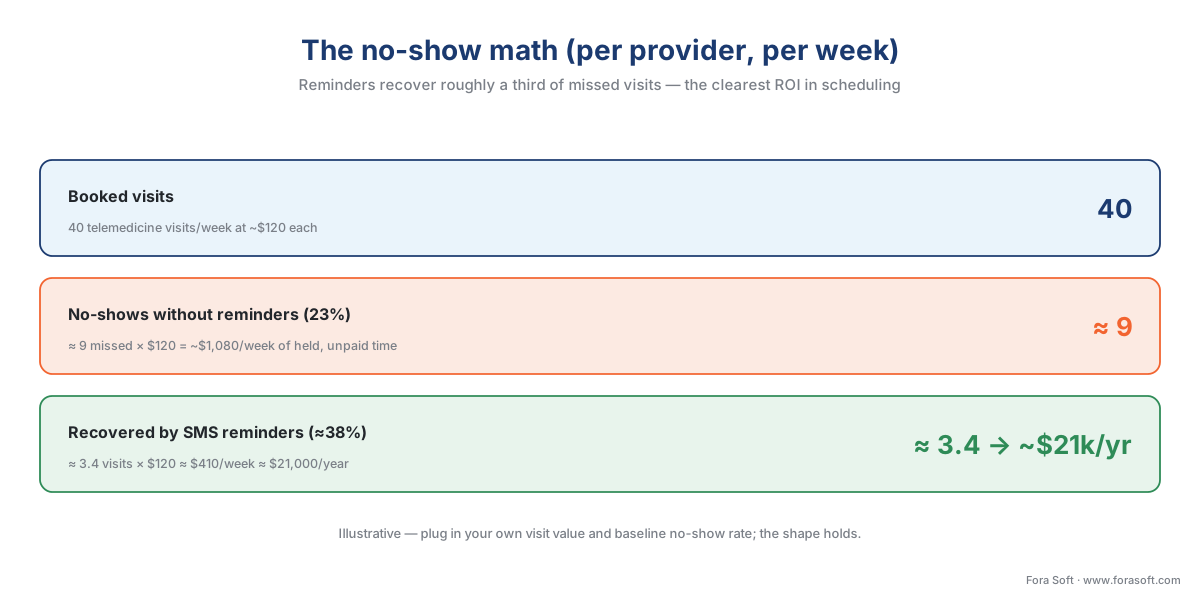 Figure 3. The no-show math. A reminder system that recovers roughly a third of missed visits turns held-but-unpaid time back into care delivered — the clearest ROI case in the scheduling stack.
What HIPAA and TCPA actually allow
Two laws govern those reminders, and the good news is that both permit them — within limits. Under the HIPAA Privacy Rule, an appointment reminder is part of treatment and health care operations as defined at 45 CFR § 164.501, so a covered entity may send it without separate patient authorization [10]. You do not need a signed consent form to remind someone of their own appointment. But two limits bite: the minimum-necessary principle means the reminder must not spill clinical detail — "You have an appointment Tuesday at 3:00 PM" is fine; "Your HIV follow-up is Tuesday" is a disclosure you just made to whoever glanced at the lock screen. And the channel itself must be appropriate: a plain SMS or email is not encrypted, so keep the content to time, place, and a generic visit label.
The second law is the Telephone Consumer Protection Act (TCPA), which governs automated calls and texts. Appointment reminders are treated as informational healthcare messages rather than marketing, so they sit under a far lighter consent bar than promotional texts — generally satisfied when the patient provides their number for care — but you must still honor opt-outs promptly and never let a reminder drift into marketing [11]. One caveat to watch: a 2025 U.S. Supreme Court decision (McLaughlin) unsettled how courts read the TCPA's text-message rules, so treat the consent and opt-out design as a point to confirm with counsel, not a settled checkbox [11].
The compliance trap: a provider's calendar is PHI
Here is the mistake that surprises teams most, because it feels like a convenience feature. You let providers sync their telemedicine appointments to their personal Google Calendar or Outlook, so the visit shows up next to their lunch and their kid's recital. The integration is easy — both expose clean APIs with webhook change-notifications and sync tokens so you do not have to poll [12]. The compliance problem is severe.
The instant an appointment carrying a patient's name and reason for visit lands on an external consumer calendar, that calendar is holding Protected Health Information (PHI) — any health data tied to an identifiable person. That makes the calendar provider a handler of patient data, which under HIPAA requires a signed Business Associate Agreement (BAA) — the contract that makes it lawful for an outside vendor to process PHI on your behalf. A provider's personal Google account has no BAA. So a calendar entry reading "3:00 PM — Jane Doe, anxiety follow-up" on a personal calendar is a quiet HIPAA violation, no matter how well the connection is encrypted. Encryption is necessary, not sufficient — "encrypted" and "compliant" are different claims.
There are two clean ways out. Either the sync runs through a BAA-covered workspace (Google Workspace and Microsoft 365 will sign a BAA for their healthcare customers, covering the organization's managed accounts), or — better and simpler — you de-identify the calendar entry: push only a generic block like "Telehealth visit" with an opaque appointment ID, and keep the patient's identity inside your HIPAA-covered platform where the provider clicks through to see who it is. The provider gets the convenience of a blocked calendar; no patient name ever touches an uncovered system. The contract behind all of this is covered in Business Associate Agreements.
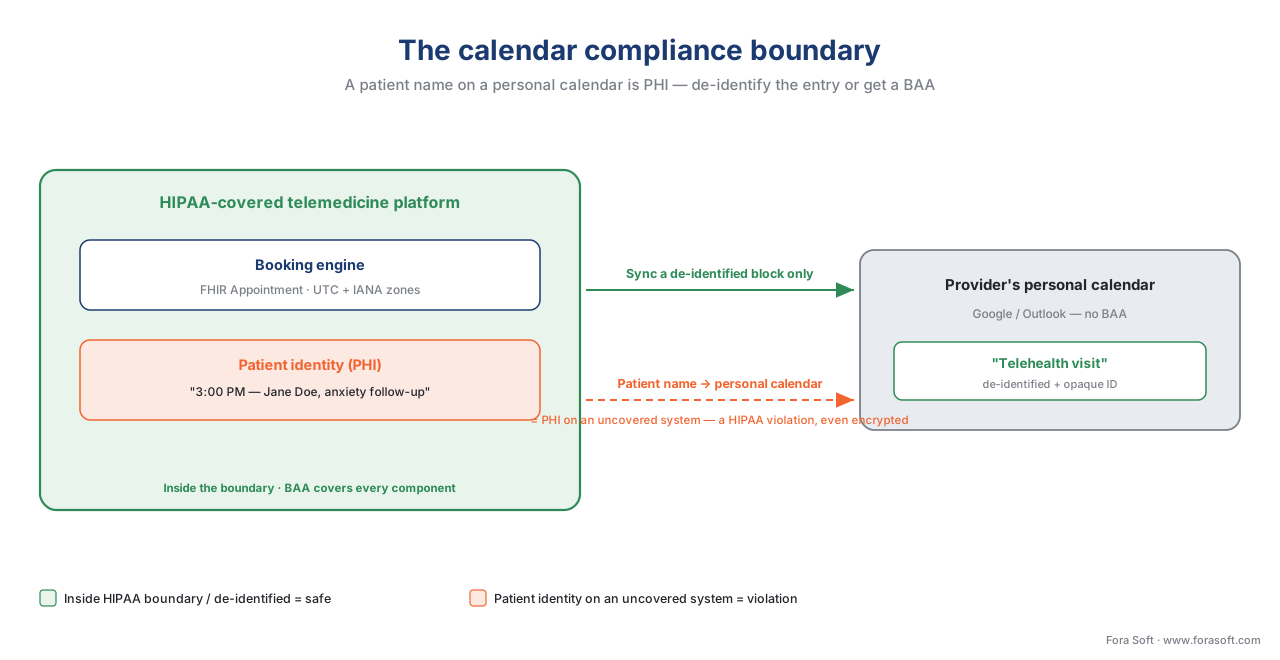 Figure 4. The calendar boundary. Patient identity stays inside the HIPAA-covered platform; the external calendar receives only a de-identified "Telehealth visit" block — or sits inside a BAA-covered workspace. A patient name on a personal calendar is a violation.
The licensing check the schedule must enforce
One rule sits upstream of everything else and is easy to miss because it is a legal constraint wearing a scheduling costume. A clinician must generally be licensed in the state where the patient is physically located at the time of the visit — not where the clinician is, and not where the patient lives [13]. If the patient logs in from a relative's house across a state line, the provider needs a license for that state.
For the schedule, this means the booking flow must capture the patient's location at the time of the planned visit and only offer providers licensed there — or providers covered by an interstate compact such as the Interstate Medical Licensure Compact, PSYPACT for psychologists, or the Counseling Compact [13]. The check belongs before slots are shown, not as a warning at checkout, because offering a slot a provider cannot legally fill is a promise you have to break. The licensing and compact landscape is jurisdictional and changes yearly; the depth is in state and specialty rules: licensing and prescribing.
Reschedule and cancel: the flows that actually matter
Booking is the demo; rescheduling and cancelling are the product. Patients change plans, providers get pulled into emergencies, and a schedule that handles the happy path but fumbles changes generates support tickets and double-bookings. Three rules keep it clean. First, a reschedule is an atomic move, not a cancel-then-rebook that briefly frees the old slot for a stranger to grab — hold the new slot before releasing the old. Second, every change must propagate to all four synchronized systems — EHR, calendar, reminders, billing — or they drift out of agreement; the FHIR Appointment status (cancelled, noshow) and the v2 SIU^S15 cancel exist precisely so downstream systems learn of the change [1][5]. Third, cancellations must cancel pending reminders, or you text a patient about a visit that no longer exists — a small bug that reads as carelessness to the person on the other end.
Where Fora Soft fits in
Fora Soft has built real-time video and clinical software since 2005, and in telemedicine the schedule is where two invisible risks concentrate: the time-zone math that silently shifts a visit by an hour, and the calendar sync that quietly carries a patient's name onto an uncovered system. We design booking the compliance-first way — the licensing check runs before a slot is ever offered, appointment times are stored in UTC against IANA zones, and external calendars receive a de-identified block, never a patient name, unless a Business Associate Agreement covers them. On the standards side we map to FHIR Schedule/Slot/Appointment with Argonaut $hold/$book where the EHR supports it, and consume HL7 v2 SIU feeds where it does not, so the booking the patient makes is the booking every connected system sees.
What to read next
- HL7 v2, FHIR, and the EHR integration reality
- The telemedicine integration map: what connects to what
- The waiting room: queueing, triage, and provider readiness
Download the Telemedicine Scheduling Integration Checklist (PDF)
Call to action
- Talk to a telemedicine engineer — book a 30-minute scoping call to talk through your telemedicine appointment scheduling plan.
- See our case studies — 250+ shipped projects across video streaming, WebRTC, OTT, telemedicine, e-learning, surveillance, and AR/VR.
- Download the Telemedicine Scheduling Integration Checklist — One page to scope the scheduling layer of a telemedicine product: the availability and booking model (FHIR Schedule/Slot/Appointment, HL7 v2 SIU), the time-zone rules that prevent silent hour-shifts, the reminder rules that stay HIPAA-….
References
- FHIR R4 Appointment & AppointmentResponse resources — HL7 International. Defines the
Appointmentresource and its status lifecycle (proposed,pending,booked,arrived,fulfilled,cancelled,noshow) and the request/response booking pattern viaAppointmentResponse. The booking data model. Tier 1. https://hl7.org/fhir/R4/appointment.html - FHIR R4 Schedule & Slot resources — HL7 International.
Scheduleis the container of bookable time;Slotis a specific block with statusfree/busy/busy-unavailable/busy-tentative/entered-in-error. The availability model and the basis for the temporary-hold pattern. Tier 1. https://hl7.org/fhir/R4/slot.html - Argonaut Scheduling Implementation Guide (Release 1.0.0) — Argonaut Project / HL7. Vendor-agnostic FHIR profiles and operations for appointment access:
$find(open slots),$hold(temporary reservation), and$book(confirm). The standardized booking workflow that prevents double-booking. Tier 3 (standards-author specification). https://fhir.org/guides/argonaut/scheduling/ - open.epic — Scheduling (FHIR) — Epic Systems. Epic's developer documentation for FHIR-based appointment scheduling services, following the Argonaut pattern. Vendor documentation, used to describe process, not as a regulatory source; re-verify before publish. Tier 4. https://open.epic.com/Scheduling/FHIR
- HL7 v2 SIU (Scheduling Information Unsolicited) messages — HL7 International / Caristix HL7 definition reference.
SIU^S12new booking,S13reschedule,S14modification,S15cancel,S26no-show, each withACK. The legacy scheduling interface still common in production EHR feeds. Tier 2 (standard, via definition reference). https://hl7-definition.caristix.com/v2/HL7v2.7/TriggerEvents/SIU_S12 - IANA Time Zone Database (tz database) — Internet Assigned Numbers Authority. The canonical source of time-zone identifiers (e.g.,
America/New_York) and their daylight-saving rules and history; the reference data behind correct UTC-to-local conversion. Tier 1. https://www.iana.org/time-zones - RFC 5545 — Internet Calendaring and Scheduling Core Object Specification (iCalendar) — IETF. The
.icsinterchange standard behind Google/Apple/Outlook calendars; definesTZIDtime-zone handling andRRULErecurrence. The cross-platform calendar exchange format. Tier 1. https://datatracker.ietf.org/doc/html/rfc5545 - The effectiveness of SMS reminders on non-attendance — systematic review/meta-analysis (Journal of Telemedicine and Telecare) — peer-reviewed. SMS reminders reduced non-attendance by ~38% on average, the largest effect among single interventions. Tier 5 (peer-reviewed, used for the no-show effect size). https://journals.sagepub.com/home/jtt
- Pragmatic Randomized Study of Targeted Text Message Reminders to Reduce Missed Clinic Visits (The Permanente Journal, 2021) — peer-reviewed RCT. Targeted SMS reminders significantly reduced missed visits versus no reminder. Tier 5 (peer-reviewed). https://www.thepermanentejournal.org/doi/10.7812/TPP/21.078
- 45 CFR § 164.501 (Definitions: treatment, health care operations) and § 164.506 (uses/disclosures for TPO) — HHS / Code of Federal Regulations. Appointment reminders fall under treatment and health care operations and may be made without separate patient authorization, subject to the minimum-necessary rule. Tier 1. https://www.ecfr.gov/current/title-45/subtitle-A/subchapter-C/part-164/subpart-E/section-164.506
- Telephone Consumer Protection Act (TCPA), 47 U.S.C. § 227, and FCC healthcare-message treatment — FCC / U.S. Code. Informational healthcare messages such as appointment reminders sit under a lighter consent bar than marketing, with opt-out honored; the 2025 McLaughlin v. McKesson Supreme Court decision adds interpretive uncertainty to text-message rules. Tier 1 (statute) / Tier 5 (case commentary). https://www.fcc.gov/general/telemarketing-and-robocalls
- Google Calendar API push notifications & Microsoft Graph change notifications — Google / Microsoft. Webhook-based change delivery and sync tokens/deltas for calendar synchronization without polling. Vendor documentation, used for integration mechanics; re-verify before publish. Tier 4. https://developers.google.com/calendar/api/guides/push
- State Telehealth Policies — Cross-State Licensing (Center for Connected Health Policy) — CCHP. A provider must generally be licensed where the patient is physically located at the time of the visit; interstate compacts (IMLC, PSYPACT, Counseling Compact) expand cross-state practice. Jurisdictional and changes yearly. Tier 5 (policy tracker; underlying rule is state law). https://www.cchpca.org/topic/cross-state-licensing-professional-requirements/
Per the source hierarchy, the booking data model and time/calendar standards are cited to HL7 FHIR, IANA, and IETF (refs 1–3, 6–7, tier 1–3); the HIPAA reminder permission and TCPA framing to the CFR and statute (refs 10–11, tier 1); the legacy scheduling interface to the HL7 v2 standard (ref 5); vendor integration mechanics to each provider's developer docs (refs 4, 12, tier 4); and the no-show effect size and licensing rule to peer-reviewed and policy-tracker sources (refs 8–9, 13). Of 13 sources, 6 are tier-1 primary regulatory/standards documents (46%), and every compliance claim — the reminder permission, the minimum-necessary limit, the PHI/BAA calendar rule, and the licensing rule — traces to a primary regulatory or standards source.
