

SRT was originally developed by Haivision and open-sourced in 2017 (Internet-Draft draft-sharabayko-srt, latest version 2024). It runs on UDP, adds a sequence-numbered framing layer, retransmits lost packets within a configurable latency window (typically 80–500 ms), and encrypts payload with AES-128 or AES-256. The result is broadcast-grade contribution over the public internet with bounded latency and bounded loss tolerance.
The killer feature is the latency knob. An operator sets the target window — say 250 ms — and SRT recovers losses within that window using ARQ, dropping packets only when retransmission would exceed it. That makes SRT predictable: a 250 ms SRT path with 1 % loss behaves measurably better than RTMP over TCP with the same loss profile, because TCP retransmission has no upper bound on latency.
SRT is built into FFmpeg, OBS (since 2021), GStreamer, Wowza, Nimble Streamer, AWS MediaLive and Microsoft Azure Media Services. The pattern is to run SRT for the contribution leg of a live workflow (encoder to cloud or encoder to teleport) and then convert to whatever the distribution stack speaks — HLS for OTT, WebRTC for low-latency, SRT-on-output for B2B handoff. SRT is also commonly bonded: multiple parallel SRT sessions over different links, recombined at the receiver, used in field production over bonded cellular.
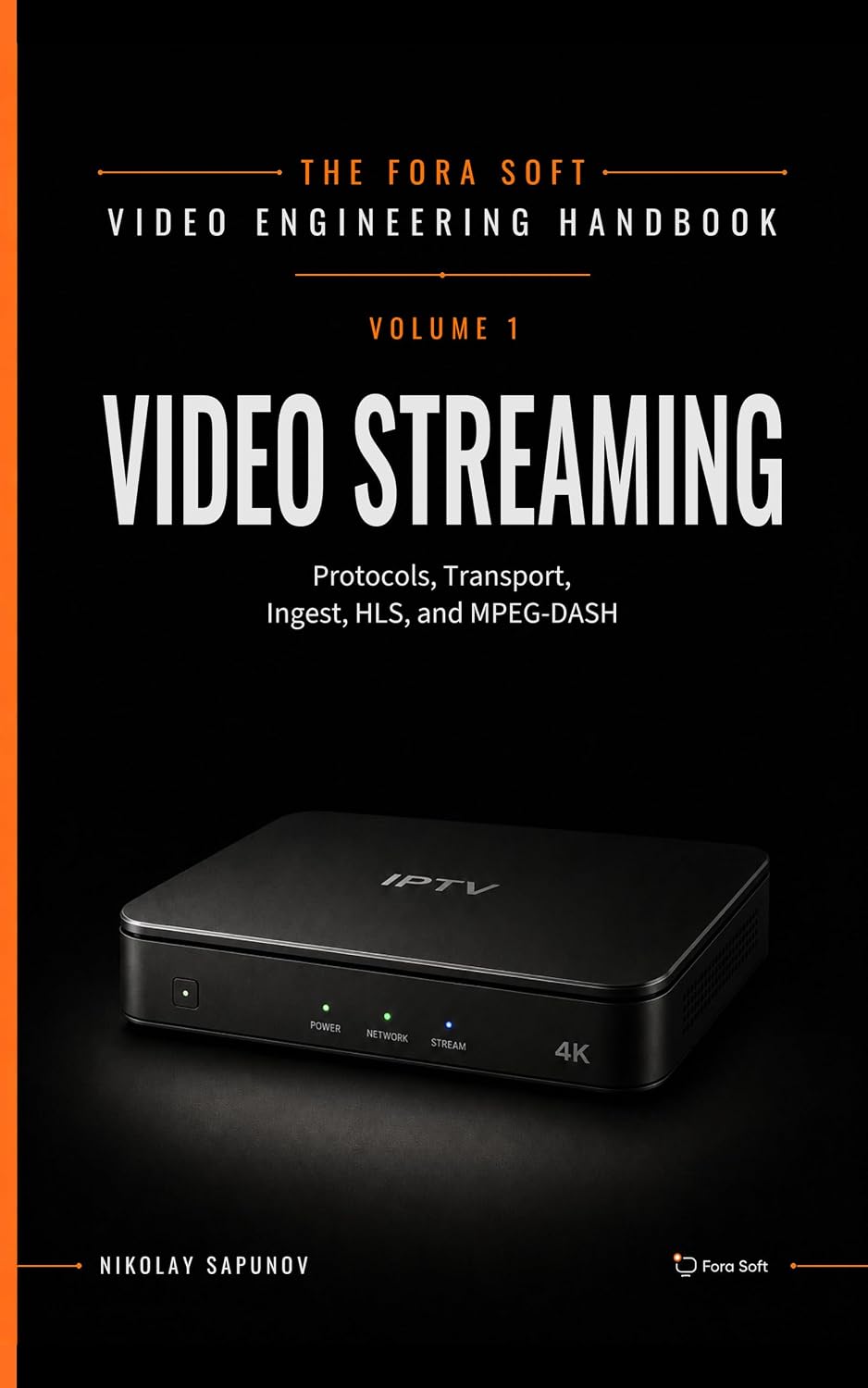
The book · Volume 2 of 7
Video Streaming: A Complete Guide to Video Delivery: From Network Protocols and Transport to Ingest, HLS, and MPEG-DASH
SRT recovers lost packets inside a fixed latency window, so choosing that window against the link RTT is what makes contribution stable. This volume covers SRT in detail, with RIST and RTMP as alternatives, packet loss recovery, caller and listener modes behind NAT and the contribution share of the latency budget. Written by Nikolay Sapunov, CEO at Fora Soft.
Running SRT contribution over unreliable internet links?
Send us your link measurements and we will deliver an SRT configuration with latency window, bandwidth overhead and failover setup for each contribution path. 250+ video products shipped since 2005.
