

RIST is the broadcast industry's answer to "we want SRT but with a vendor-neutral spec and full broadcast pedigree". Where SRT grew from a single vendor's product and was later open-sourced, RIST was designed by a working group of broadcasters and encoder vendors from day one. The Simple Profile covers basic UDP with ARQ; the Main Profile adds GRE encapsulation, encryption, FEC, multiplexing and tunnelling; the Advanced Profile (2024) adds multilink bonding and richer signalling.
RIST's design points emphasise broadcast-style operations: support for multicast distribution inside broadcaster networks, clean handling of SMPTE 2022 FEC, native tunnelling through corporate firewalls, and explicit support for null packets and PCR retiming on MPEG-TS. Most pro broadcast contribution encoders (Net Insight, Nevion, Appear, Cobalt) support both SRT and RIST and the choice often comes down to existing operational practice.
Adoption is concentrated in tier-1 broadcasters and contribution backbones rather than in OTT or social. Open-source implementation librist powers FFmpeg, GStreamer and most software-encoder support. The trend through 2026 is that SRT dominates internet contribution for OTT and live streaming, while RIST dominates closed-network broadcast contribution and IP-to-IP gateway products.
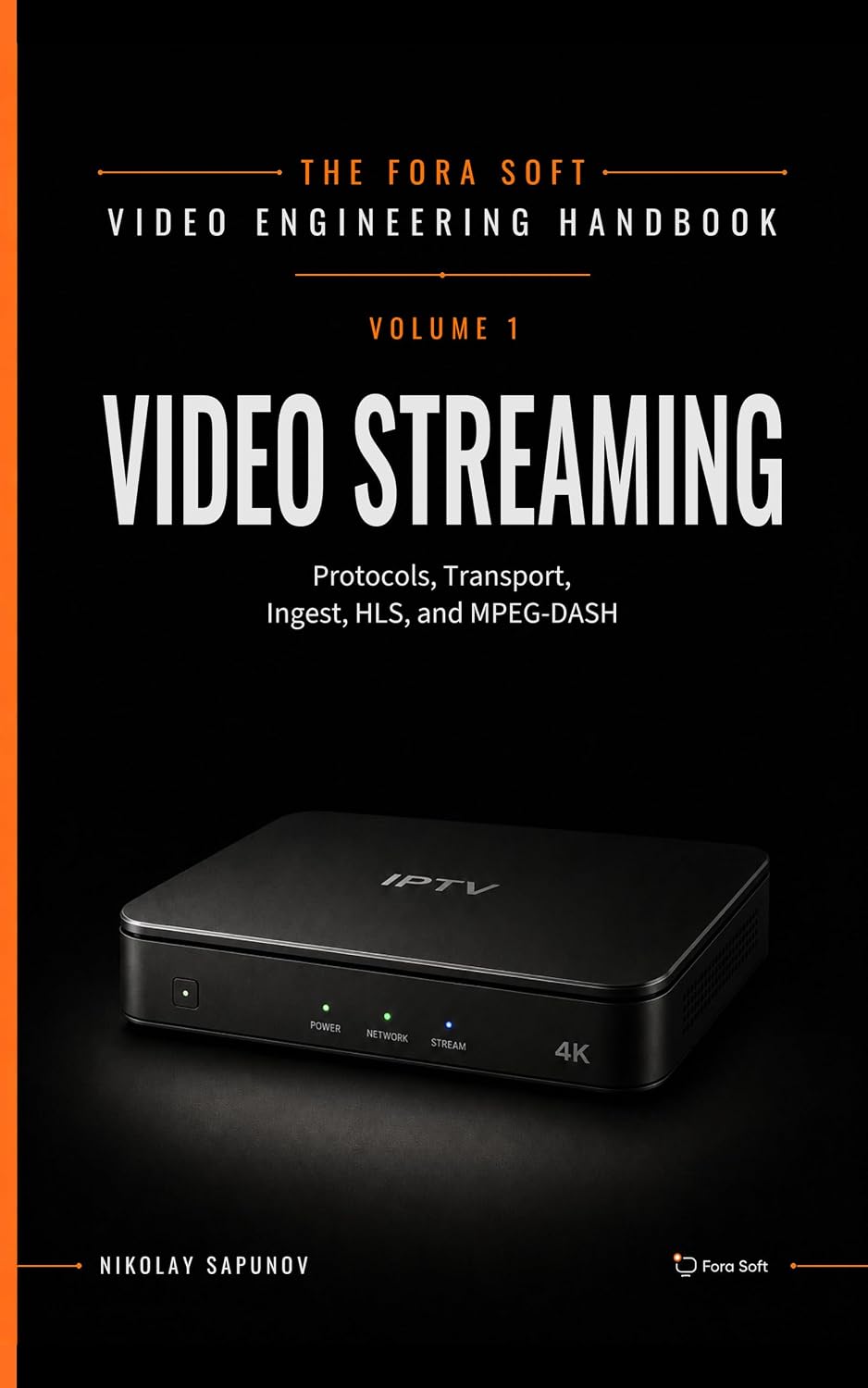
The book · Volume 2 of 7
Video Streaming: A Complete Guide to Video Delivery: From Network Protocols and Transport to Ingest, HLS, and MPEG-DASH
RIST gives broadcasters a vendor-neutral way to move live feeds over the public internet with retransmission, but profile choice and buffer sizing decide whether it holds up. This volume covers RIST in detail, with SRT and RTMP as alternatives, packet loss recovery, contribution workflows and the latency budget of live ingest. Written by Nikolay Sapunov, CEO at Fora Soft.
Choosing between RIST and SRT for broadcast contribution?
We will review your links and receivers and give you a contribution plan with RIST profile, buffer size, bandwidth overhead and a comparison against SRT. 250+ video products shipped since 2005.
