

WebTransport gives JavaScript what WebSockets only partially gave it: a bidirectional connection to a server, but with QUIC's full feature set — multiplexed streams without head-of-line blocking, unreliable datagrams for real-time data, 0-RTT resumption, and TLS 1.3 built in. The API was Candidate Recommendation in 2024 with shipping support in Chromium-based browsers since 2022 and Safari since 2024. Firefox is the slowest to adopt.
For streaming, WebTransport opens designs that neither WebSocket nor WebRTC quite reach. Media over QUIC uses WebTransport as its browser-facing API. A pub/sub live system can push subscriber-specific data on its own stream without blocking the video. A real-time AR overlay can send sensor data on a datagram channel parallel to the video stream. None of these were impossible before, but each previously required a stack of workarounds — WebSocket over TCP with custom multiplexing, or full WebRTC with all its STUN/TURN/SDP overhead.
WebTransport does not replace WebRTC or HLS. WebRTC remains the right answer for peer-to-peer media; HLS and DASH remain right for large-scale CDN distribution. WebTransport occupies the middle — client-server low-latency data and media, where you want QUIC's transport features but not WebRTC's peer-to-peer semantics. By 2026 the most visible use is Media over QUIC implementations and a growing list of low-latency game telemetry and live-event side-channel apps.
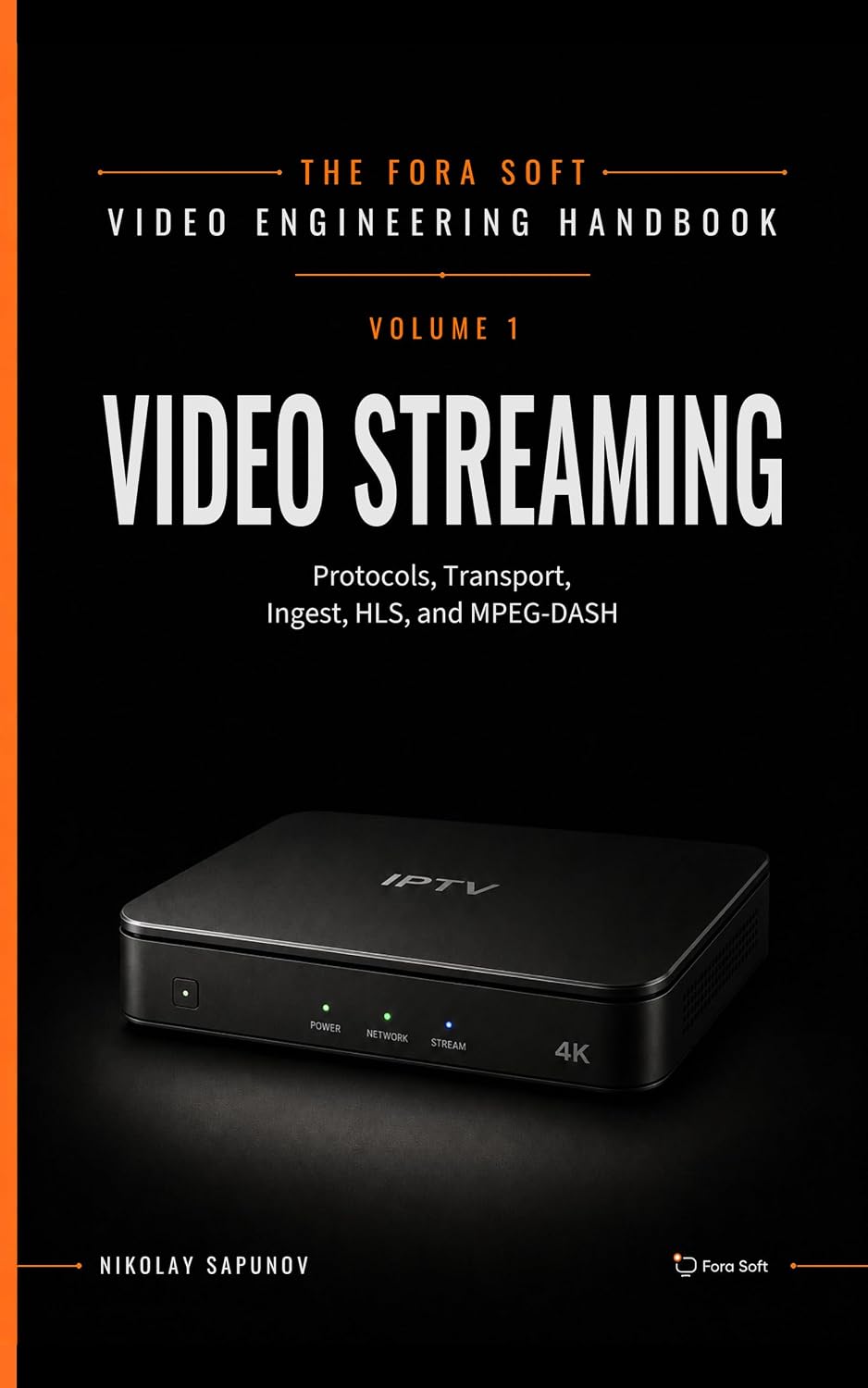
The book · Volume 2 of 7
Video Streaming: A Complete Guide to Video Delivery: From Network Protocols and Transport to Ingest, HLS, and MPEG-DASH
WebTransport exposes QUIC streams and datagrams to the browser, which opens low-latency media designs that WebSockets and HLS cannot reach. This volume covers the transport layer under WebTransport in detail, with QUIC and HTTP/3, congestion control, reliable versus unreliable delivery and Media over QUIC. Written by Nikolay Sapunov, CEO at Fora Soft.
Considering WebTransport for low-latency media in the browser?
We will assess your latency targets and browser mix and return a WebTransport feasibility review with a prototype plan and fallbacks for unsupported clients. 250+ video products shipped since 2005.
