


Key takeaways
• A gun detection system watches your existing cameras for a visible firearm. AI visual weapon detection runs a computer-vision model over live video, spots a drawn handgun, rifle, or shotgun, and pushes an alert — usually after a human confirms it. It is not a metal detector and it cannot see a concealed gun.
• “99% accurate” is marketing. A peer-reviewed 2025 survey of AI weapon detection put real reported precision at 78–99.5% and recall at 83–97% (MDPI Electronics, 2025). At the scale of a school’s camera feeds, even a great precision number produces false alerts — which is exactly why a person verifies every one.
• The failures are documented, and they teach the limits. At Antioch High School in January 2025, the Omnilert system did not detect the shooter’s gun because it was not visibly brandished (CNN, 2025). In 2024 the FTC acted against Evolv for overstated detection claims (FTC, 2024). Honest scoping starts here.
• For a single school, you almost always buy, not build. Managed services run roughly $20–$50 per camera stream per month with monitoring included (reported, 2026), and they bundle the two hardest things to replicate: 24/7 human verification and DHS SAFETY Act liability protection.
• Building makes sense when detection is a feature of your product. Fora Soft has built computer-vision camera systems since 2005 across 250+ projects. Below is the honest engineering guide: how it works, what it really catches, what it costs, and where a person — not the model — carries the risk.
Why Fora Soft wrote this guide
We build computer-vision products for a living. Since 2005 we’ve shipped 250+ projects, and a fair number are the exact pieces a gun detection system is made of: camera capture, object detection, tracking, and wiring a detection into an alerting workflow someone can actually act on. So when a school district or a venue asks us about “AI weapon detection,” we don’t start from a sales deck — we start from what the technology can and can’t do.
We wrote this because almost everything ranking for “gun detection system” is a vendor product page. There’s little that treats it as an engineering and procurement decision: how the pipeline works, what the honest accuracy numbers are, why a human still sits in the loop, what it costs, and when it’s the wrong tool. This is a serious subject — it’s tied to school shootings and to armed responses triggered by software — so we’ve kept every claim sourced and dated, and we flag the failures as plainly as the wins. Our video surveillance team and our computer vision for surveillance group both weighed in.
One thing up front, because it shapes the whole guide: for most schools and campuses, the right answer is to buy a proven managed service, not to build one. We’ll explain exactly why, and we’ll be just as clear about the narrower cases where a custom build is the right call — which is the work we actually do.
Scoping weapon detection for a campus or product?
Tell us your cameras, your coverage, and who responds to an alert. In 30 minutes we’ll give you an honest buy-vs-build answer — and we’ll say “buy” when that’s the right call.
What a gun detection system actually is
A gun detection system is software that watches video for a firearm and raises an alarm when it sees one. In the surveillance world the term almost always means AI visual gun detection: a computer-vision model runs on the feeds from your security cameras, and when it recognizes the shape of a drawn weapon — a handgun, rifle, or shotgun — it flags the frame, a person confirms it, and an alert goes to staff and often to police, with an image and a location attached.
The mental model that matters: this is a detector bolted onto cameras you already have, not a scanner people walk through. The camera-agnostic vendors — ZeroEyes, Omnilert, Scylla — layer their model on top of existing IP cameras, so the value is turning passive footage into an active alert the instant a gun appears on screen. Everything a school cares about — lock down, call police, push the shooter’s image and location to responders — happens after that detection exists.
And here is the single most important limit, stated first because so much marketing hides it: visual detection only works on a gun the camera can see. A firearm in a bag, under a coat, or in a waistband is invisible to it. That’s not a bug to be patched — it’s the physics of a camera. It’s also why people confuse this technology with two others that solve different problems, which we’ll separate next.
Visual, acoustic, concealed: three different systems
Buyers routinely ask for a “gun detection system” and mean one of three unrelated technologies. They sense different things, at different moments, in different places, and each has a blind spot the others cover. Getting this straight is the first real decision — picking the wrong category is the most expensive mistake in the whole process.

Figure 1. Three technologies people call “gun detection.” They sense different signals at different moments — and each is blind to what the others catch.
Visual AI detection (this guide). Computer vision on camera feeds, detecting a visible, brandished firearm anywhere a camera looks. It’s preventive — it can fire before a shot — and it scales across a building on existing cameras. Its blind spot is concealment: no camera sees a gun in a backpack.
Acoustic gunshot detection. Microphone arrays that hear and localize a shot after it’s fired. The best-known is ShotSpotter, now SoundThinking, and the U.S. Department of Homeland Security has published on the category. It works when nothing is visible, but by definition it’s reactive: the trigger has already been pulled.
Concealed-weapons screening. Walk-through sensors at a controlled entry — Evolv, CEIA, Xtract One — using millimeter-wave or sensor fusion to flag concealed metal. This is the one that can see a hidden gun, but only at a chokepoint people funnel through, and it comes with a false-alarm burden we’ll return to. A serious program often layers all three; this guide is about the visual layer that turns your cameras into a preventive tripwire.
How AI visual gun detection works
A detection is a short pipeline, and knowing the stages tells you where it succeeds and where it leaks. A frame arrives from a camera. A computer-vision model — typically a YOLO- or R-CNN-family object detector trained on firearms — scans it for the visual signature of a gun, judging shape, size, orientation, and context. Because a single frame is easy to fool, the system does multi-frame validation: it wants the same weapon signature across several consecutive frames before it will trust it. Only then does it flag the event.

Figure 2. The detection pipeline. The model and multi-frame validation cut noise; the human verification step is what makes an alert trustworthy enough to send armed responders.
The detector itself is the same object-detection-and-tracking technology we cover in our YOLO and DeepSORT surveillance guide — a firearm is just a hard, high-stakes object class. What separates a gun detection system from generic object detection is everything wrapped around the model: the multi-frame gate, the human check, and the response workflow. The model is maybe 30% of the product; the rest is what keeps it from crying wolf and what turns a flag into a coordinated response.
After validation, the flagged image goes to a human verifier (next section), and once confirmed, the system dispatches: it pushes the annotated image, camera location, and often a map to on-site staff and to law enforcement, and can trigger locks, mass notification, and 911 workflows. The read is the easy part; the choreography after it is where a deployment is won or lost.
Why a human still verifies every alert
The best vendors don’t let the model send an alert on its own. When the AI flags a possible gun, the image lands in a monitoring center where a trained analyst confirms in seconds whether it’s a real firearm before anything reaches the school or the police. ZeroEyes runs a 24/7 operations center staffed by military veterans and former law-enforcement officers; every flagged image is human-verified before dispatch, and the company reports actionable intelligence reaching responders in as little as 3–5 seconds (ZeroEyes, 2025).
Why bother, if the model is good? Because the cost of the two mistakes is wildly asymmetric. A missed gun is a catastrophe. But a false gun alert isn’t harmless either — it can send armed police running toward a child holding a phone, a tool, or a musical instrument. A human verifier collapses the false-alarm rate that actually reaches responders, turning a noisy model into a signal people will trust and act on. It is the difference between a demo and a system a school will keep after the first embarrassing false alarm.
A human-in-the-loop is non-negotiable when: an alert can trigger an armed response. If a vendor offers a model that dispatches to police entirely on its own, treat that as a red flag, not a feature — someone must own the decision to escalate.
What “accurate” really means (and doesn’t)
Vendors love a single big number. The honest picture is a range, and it comes from research, not marketing. A 2025 peer-reviewed survey of AI weapon detection work from 2016–2025 found reported precision of 78–99.5%, recall of 83–97%, and mean average precision of roughly 70–99% across published models (peer-reviewed survey, MDPI Electronics, 2025). Those are lab benchmarks on curated datasets — real hallways, real lighting, and real angles are harder.
The trap is that precision and recall pull against each other, and at camera scale even excellent numbers generate work. Tune the model to catch every gun (high recall) and you raise false positives; tune it to never cry wolf (high precision) and you risk missing a real one. Now multiply by volume: a campus with dozens of cameras processes an enormous number of frames a day, so a tiny per-frame error rate still surfaces alerts that aren’t guns.

Figure 3. Illustrative false-positive math. Even a high precision rate becomes a stream of false alerts once you multiply by the detections a campus generates — which is the whole argument for human verification.
Work a simple example. Say a model flags 200 candidate weapons a day across a district and runs at 95% precision — a strong number. That’s still about 10 false flags every day. Without a human filter, that’s 10 chances a day to scramble police over nothing; with one, it’s 10 images a trained analyst clears in seconds and zero false dispatches. This is why the vendor claims you’ll see — “0.005% false positives” and the like — most likely describe the rate after human verification, which is exactly why you should ask which number a vendor is quoting. The false positives themselves are real and documented: reported cases include a system mistaking a clarinet and a bag of chips for a gun (Undark, 2026).
The response timeline: detection to dispatch
The entire value proposition is time. In a shooting, the gap between the first sighting of a gun and the first call to police is often minutes — time spent realizing what’s happening, finding a phone, and describing a location. A gun detection system aims to compress that gap to seconds and hand responders something a panicked witness can’t: a clear image, a precise camera location, and a head start.

Figure 4. The timeline the technology is selling: seconds instead of minutes between a visible gun and a located, verified alert to responders. Vendor figures; independent field data is thin.
Vendors publish tight numbers. Omnilert describes a firearm identified on camera within about a second, an alert to security within one to three seconds, and monitoring staff verifying and initiating protocols within three to ten seconds (Omnilert, 2025). Take these as vendor claims measured in favorable conditions, not independently audited field results — but the shape is right, and the seconds-versus-minutes difference is the honest reason the category exists.
The catch, and it’s a big one: the clock only starts if the gun is on camera. If a shooter draws inside a blind spot, or never brandishes until the moment of firing, the timeline never begins — which brings us to where this technology fails.
Where visual detection fails — honestly
A vendor won’t lead with this, but you should scope around it. The failures are specific and knowable.
Concealment defeats it entirely. The clearest lesson is Antioch High School in Nashville in January 2025, where a school running Omnilert’s system saw no alert during the shooting. District officials said the shooter was too far from the cameras; the vendor said the gun was not visible — not brandished long enough to trigger a detection (CNN, 2025; a survivor later sued the vendor). Both explanations point to the same truth: no visible gun, no detection.
Coverage sets the ceiling. A detection can only happen where a camera looks, with enough pixels on the weapon, at a workable angle. Blind spots, low light, distance, and bad framing all cost detections — the same lesson we hammer for any vision analytic in our AI-powered IP camera guide: capture quality caps everything downstream.
The evidence base is thin. Independent researchers caution that there’s little hard evidence these tools meaningfully reduce harm in school shootings (The Conversation, 2026). That doesn’t make them worthless — seconds matter — but it means you should treat gun detection as one layer of a school safety technology stack with clear limits, not as a solution, and never let a purchase substitute for drills, mental-health support, and physical security.
Reach for visual detection when: you have decent camera coverage of the spaces where a gun would first appear — entrances, corridors, parking lots — and you want a preventive tripwire that buys responders seconds. Pair it with concealed screening at entries if you need to catch hidden weapons.
The main providers: who does what
The visual-detection field clusters around a few players, and the differences that matter for a buyer are camera compatibility, whether the vendor provides 24/7 human verification, and whether they hold DHS SAFETY Act designation (more on that below). Details and terms below are from vendor and public sources, captured July 15, 2026 — verify before you commit, because status and pricing move.
| Provider | Uses your cameras? | 24/7 human verify | SAFETY Act | Best for |
|---|---|---|---|---|
| ZeroEyes | Yes (camera-agnostic) | Yes (veteran/LE-staffed) | Full (first, 2024) | Schools/campuses wanting managed monitoring |
| Omnilert | Yes (camera-agnostic) | Yes | Full (2025) | Focused gun detection + response automation |
| Scylla | Yes | Optional / integration | No | Broader threat + behavior analytics suite |
| Actuate | Yes (VMS add-on) | No (your SOC) | No | Orgs with a VMS + their own monitoring |
| Verkada | No (proprietary cameras) | Platform-dependent | No | Teams standardizing on one camera platform |
| Custom build | Your choice | Your design | You’d pursue | Detection as a feature of your product |
The pattern worth noticing: the two market leaders for schools, ZeroEyes and Omnilert, both pair a camera-agnostic model with a staffed 24/7 verification center and hold full SAFETY Act designation. That combination — not the model alone — is what you’re really buying, and it’s what makes building from scratch a poor trade for a single institution.
Buy or build: the honest answer for schools
We build custom software, and we’ll still tell most schools to buy. Here’s the reasoning, because it’s the crux of the whole decision. A gun detection system isn’t really a model — it’s three things stacked together, and two of them are brutal to replicate for one campus.
First, a large, curated firearm dataset. A model that reliably tells a gun from a phone, a drill, or a stapler at odd angles and distances takes a training set most organizations can’t assemble. Second, 24/7 human verification. Even a great model needs people watching around the clock to clear false flags before they reach police — that’s a staffed operations center, not a feature. Third, liability protection: the SAFETY Act designation the leaders carry limits customers’ third-party liability after a terrorism-related incident, and you can’t buy that for a home-grown build. For a single school, buying gives you all three for tens of dollars per camera a month.
Buy a managed service when: you’re a school, campus, or venue protecting people and you need proven detection, round-the-clock verification, and liability cover today. This is the right answer for the large majority of buyers — and we’ll say so.
So when does building win? When detection is a feature of a product you’re building, not a service you’re buying. If you’re a VMS or security-platform company adding gun detection to your own offering, if you already run a monitoring center and want a detection model wired into it (the add-on pattern Actuate follows), or if data-residency rules forbid sending video to a third party, a custom computer-vision build is the right call. That is exactly the work we do — the detection, tracking, integration, and alerting pipeline — and it’s a different job from running a school-facing monitoring service.
Build custom when: gun or weapon detection is part of a product or platform you own, you have (or will run) your own monitoring, or video can’t leave your infrastructure. Then the model, the pipeline, and the integrations are yours to control — and worth building well.
What a gun detection system costs
Managed visual gun detection is priced per camera stream, per month, and quotes are shaped by how many streams you monitor and how long the contract runs. Publicly reported figures put it in the range of roughly $20–$50 per camera stream per month, with installation and monitoring bundled in (reported, 2026). That price includes the parts you’d otherwise have to build: the model, the 24/7 verification staff, and the liability coverage.
Translated to a district, the numbers are concrete. Volusia County Schools’ ZeroEyes deployment was reported at roughly $50,000 a year (2025); Metro Nashville approved about a $1M contract with Omnilert across its schools (2025). Your bill scales with camera count, so the real cost lever is deciding which cameras — entrances, corridors, lots — genuinely need weapon detection versus general surveillance.
A custom build inverts the shape: higher one-time engineering (the detector or a licensed model, the validation and alerting pipeline, VMS integration, and — critically — whatever verification and monitoring you’ll operate), then lower marginal cost as you scale streams. We keep these estimates conservative and scope them to your exact deployment; the honest version depends on how much of the verification burden you intend to carry yourself. Building to save money on one campus rarely pencils out — build for control and product fit, not to shave a subscription.
Want a straight buy-vs-build number?
Bring your camera count, coverage, and who monitors alerts. We’ll map it to a managed-service estimate or a build scope — conservatively — and tell you which one we’d pick in your shoes.
SAFETY Act, FERPA, and the transparency lesson
Three governance facts shape any responsible purchase. The first is the SAFETY Act. Under this U.S. program, DHS tests anti-terrorism technologies and grants designations that limit sellers’ and customers’ liability for claims arising from an act of terrorism when the technology is in use. ZeroEyes was the first AI-based gun detection technology to earn full designation (2024); Omnilert followed with full designation (2025), per public reporting. If you’re protecting people, prefer a designated technology — it’s both a vetting signal and a liability shield.
The second is data governance. School video is regulated: in the U.S., footage that constitutes an education record falls under FERPA, and biometric or personal data more broadly is covered by state privacy laws and, in Europe, by GDPR. Retention limits, access controls, an audit trail, and a clear policy for who sees alerts and stored clips are build-and-procurement requirements, not afterthoughts — the same stance we take across our video surveillance work. This is design input, not legal advice; involve counsel.
The third is a hard-won transparency lesson. In 2024 the FTC acted against Evolv — a concealed-screening vendor, not a visual one — over claims that its AI could detect “all weapons” and outperform metal detectors, alleging the company even circulated a shortened version of an independent report that omitted negative findings (FTC action, 2024, as covered by EFF). The takeaway for buyers: demand independent test data, ask which numbers are measured versus modeled, and be wary of any vendor promising to catch everything. Skepticism here protects both budgets and people.
The ethics you cannot skip
This technology points cameras and, potentially, armed responders at children and the public. That raises questions a purchase order shouldn’t paper over, and we think building or buying responsibly means facing them directly.
A false alert has a cost. When software can summon police, a wrong call can put a student holding a phone or a prop at the wrong end of an armed response. Human verification exists precisely to prevent this, which is why we treat it as mandatory rather than optional — and why a system’s false-positive handling matters as much as its detection rate.
It is a layer, not a savior. With independent evidence still thin on whether these tools reduce harm, they should complement — never replace — drills, threat assessment, mental-health support, and sound physical security. Selling or buying it as a complete answer misleads a community and can crowd out measures that help more.
Surveillance of minors demands restraint. Constant AI monitoring of students carries real privacy weight. Scope cameras to weapon-relevant spaces, minimize and time-limit retention, restrict who can view feeds and alerts, and be transparent with the community about what’s deployed and why. If you’re building custom, bake these constraints in from day one; if you’re buying, make them contract terms.
Mini-case: the vision pieces we’ve shipped
We’ll be straight about our lane. Fora Soft doesn’t run a school-facing 24/7 gun-detection monitoring service — that’s what the managed vendors do well, and we’ll point you to them when that’s the fit. What we’ve built, repeatedly, are the computer-vision pieces a detection system is made of. On an object-detection and tracking build, the model was the easy part; the work was clean capture in real conditions and turning raw detections into events a client’s system could act on without drowning operators in noise.
Our surveillance experience runs deep in education too. VALT, the video capture and management platform we’ve developed, is used by 770+ organizations and 50,000+ users, a good share of them in schools and universities recording and reviewing observation footage. That taught us the parts of a school video system that never make the sales page: role-based access, retention policy, audit trails, and integration with the systems staff already use — exactly the governance layer a weapon-detection deployment lives or dies on.
So if your need is a product that embeds gun or weapon detection — a VMS feature, a campus platform, an analytics layer over an existing SOC — that’s our work, and we move fast because we’ve built the hard parts before. If your need is monitoring for one campus, we’ll tell you to buy, and help you evaluate. Grab 30 minutes and we’ll tell you which one you are.
A decision framework in five questions
Five questions, answered honestly, will tell you what to procure or build.
1. Visible or concealed threat? If you need to catch hidden weapons at a door, you need concealed screening, not (or in addition to) visual detection. Visual detection only catches a gun in view.
2. Do you have camera coverage where a gun would first appear? Entrances, corridors, parking lots. If the spaces that matter are dark, distant, or uncovered, fix cameras before buying detection — capture is the ceiling.
3. Who verifies and who responds? If you can’t staff 24/7 verification yourself, you need a vendor who does — and a rehearsed response plan on your side. An alert nobody acts on is worthless.
4. Are you protecting a place or building a product? Protecting a campus points to buying a managed, SAFETY-Act-designated service. Building a product with detection inside points to a custom computer-vision build.
5. Can your video leave your walls? If data-residency or policy forbids sending footage to a third party, that pushes you toward on-prem or custom — and reshapes both cost and vendor shortlist.
Five pitfalls that wreck these projects
1. Believing “99% accurate.” Ask which metric, measured how, and after human verification or before. Treat an unaudited single number as marketing until proven otherwise.
2. Skipping human verification. A model dispatching police on its own will eventually send them to a child with a phone. The verifier isn’t overhead; it’s the safety mechanism.
3. Ignoring camera coverage. Buying detection for blind, dark, or distant cameras funds alerts that can’t fire. Audit and fix capture first.
4. Treating it as the whole plan. Detection is one layer. Without drills, threat assessment, and a response plan, the seconds it buys go unused.
5. Neglecting governance. No retention limits, access controls, or community transparency turns a safety tool into a privacy liability — and, as the FTC case showed, a legal one.
When a camera system is the wrong tool
Sometimes the honest recommendation is not to buy visual detection at all. If your primary risk is a concealed weapon carried through a single controlled entrance, screening at that door does more than cameras watching open space. If your camera coverage is poor and you have no budget to improve it, spend on capture first — detection on bad cameras is money lit on fire.
And if you have no plan and no people to act on an alert — no verification, no rehearsed response, no one to make the call to lock down — then an alerting system will produce notifications into a void. The technology compresses the timeline to responders; it doesn’t create the responders. Build that capacity first, then let detection make it faster.
FAQ
What is a gun detection system?
In video surveillance, it’s software that runs a computer-vision model over your security camera feeds and raises an alarm when it recognizes a visible firearm — a drawn handgun, rifle, or shotgun. A human typically verifies the flag, then an alert with an image and location goes to staff and police. It works on existing IP cameras and detects only guns the camera can actually see.
Can AI gun detection see a concealed weapon?
No. Visual detection only catches a firearm that is visible in the camera frame. A gun in a bag, under a coat, or in a waistband is invisible to it — that’s the physics of a camera. To catch concealed weapons you need entry screening (millimeter-wave or sensor-fusion walk-throughs like Evolv, CEIA, or Xtract One), which is a different technology from camera-based detection.
How accurate is AI weapon detection?
A 2025 peer-reviewed survey reported precision of 78–99.5% and recall of 83–97% across published models (MDPI Electronics, 2025) — lab numbers on curated data, so real deployments run lower. Because cameras generate huge frame volumes, even high precision produces some false alerts, which is why the leading systems route every flag through a human before dispatching. Ask any vendor whether a quoted figure is before or after human verification.
Does a gun detection system work with our existing cameras?
Usually yes, if you choose a camera-agnostic vendor. ZeroEyes, Omnilert, and Scylla layer their models onto existing IP cameras, so you don’t replace hardware. Verkada is the exception — its detection runs on its own proprietary cameras. Either way, coverage and image quality set the ceiling: a camera that can’t clearly see the space where a gun would appear can’t detect one there.
How much does a gun detection system cost?
Managed visual detection is priced per camera stream per month — publicly reported around $20–$50 per stream with monitoring included (2026). At district scale that’s real money: Volusia County Schools’ ZeroEyes was reported near $50,000/year, and Metro Nashville approved roughly a $1M Omnilert contract (2025). The price bundles the model, 24/7 human verification, and liability coverage — the parts that are hardest to build yourself.
Should we buy a service or build our own?
If you’re protecting a school, campus, or venue, buy a proven managed service — you get detection, round-the-clock verification, and SAFETY Act liability protection that’s impractical to replicate for one site. Build custom only when weapon detection is a feature of a product you own, when you run your own monitoring center, or when video can’t leave your infrastructure. Building to save on a subscription for one campus rarely makes sense.
What is the DHS SAFETY Act, and does it matter?
The SAFETY Act is a U.S. program under which DHS tests anti-terrorism technologies and grants designations that limit liability for sellers and customers over claims arising from a terrorism-related incident when the technology is in use. ZeroEyes (2024) and Omnilert (2025) hold full designation. For a public institution it matters twice over: as an independent vetting signal and as a liability shield you can’t obtain for a home-built system.
Do these systems actually stop school shootings?
The honest answer is that evidence is thin, and there are documented failures — at Antioch High School in January 2025, the visual system didn’t detect the gun because it wasn’t visibly brandished (CNN, 2025). What these systems can do is shave minutes off the time between a visible gun and a located, verified alert to responders. Treat that as one layer alongside drills, threat assessment, mental-health support, and physical security — not a standalone solution.
What to read next
Development
YOLO + DeepSORT Surveillance Guide
The detection-and-tracking stack a gun detector is built on.
Technologies
Anomaly Detection in Surveillance
Catching threats beyond weapons: behavior and event detection.
Development
Edge AI Surveillance Architecture
Where detection runs when video can’t leave the building.
Technologies
AI-Powered IP Cameras
Why the capture layer sets the ceiling for any vision analytic.
Ready to scope weapon detection responsibly?
The short version: a gun detection system turns your cameras into a preventive tripwire for a visible firearm, verified by a human, dispatched in seconds. It can’t see a concealed gun, its real-world accuracy is a range not a single number, and it’s one layer of a safety plan rather than the plan itself. For most schools and campuses, buying a proven, SAFETY-Act-designated managed service beats building — and we’ll tell you so.
Building is the right move when detection is a feature of a product you own, when you run your own monitoring, or when video must stay in-house. That’s our work: the computer-vision pipeline, the integration, and the governance layer, built honestly and scoped conservatively. Whichever side you’re on, we’ll give you a straight answer.
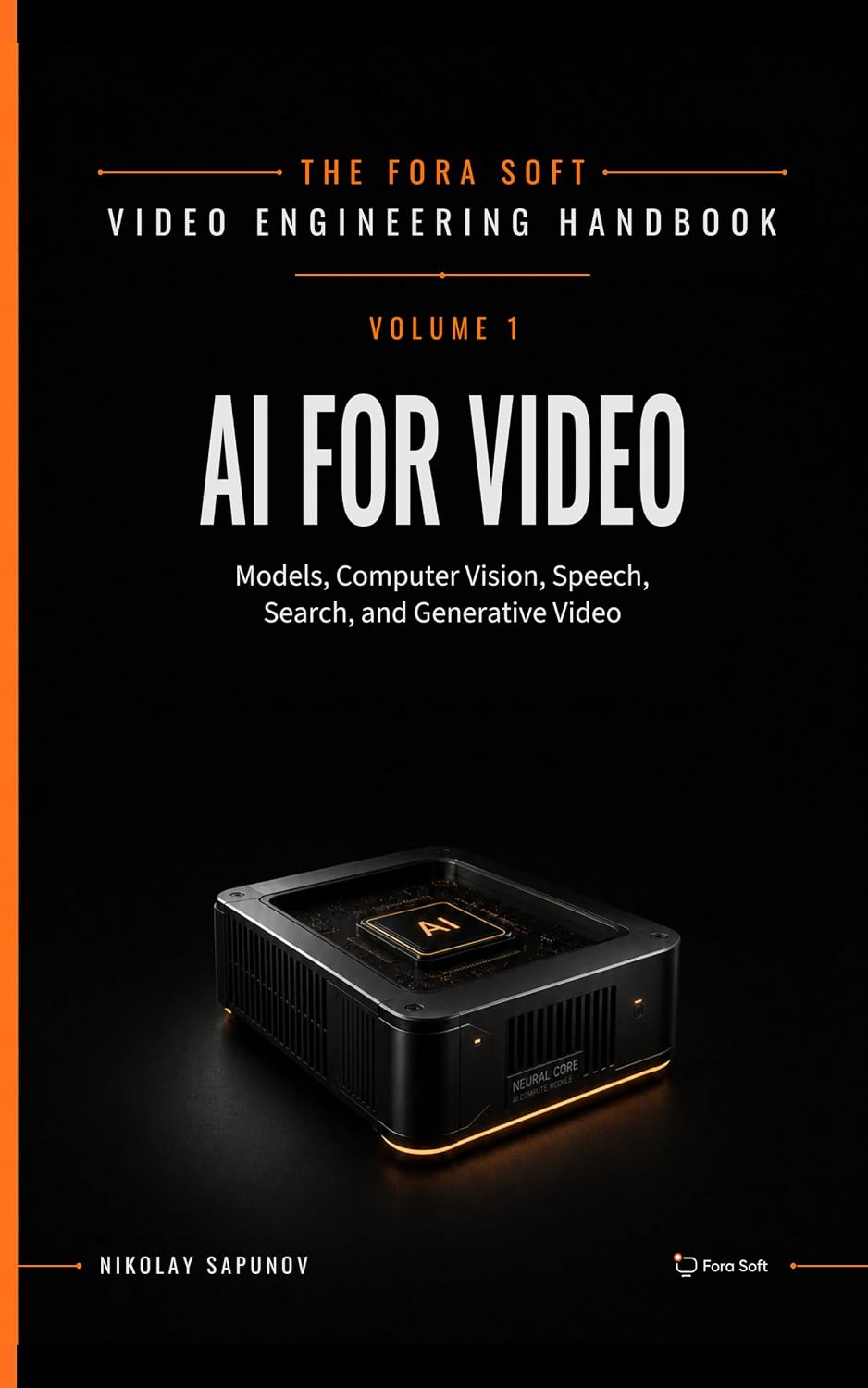
The book · Volume 6 of 7
AI for Video: A Complete Guide to Intelligence in Video Products: From Models and Inference to Computer Vision, Speech, Search, and Generative Video
Every visual gun detection system in this guide is a detection and tracking model with a human reviewer at the end of it. Volume 6 of our handbook explains how those models work in practice: object detection and tracking, model artifacts, edge versus cloud deployment, and the lifecycle of an AI feature, so you can read a vendor's accuracy claim with the right questions. Written by Nikolay Sapunov, CEO at Fora Soft.
Read it on Amazon →Kindle & paperback · Fora Soft Video Engineering Handbook
Let’s scope your weapon detection project
Bring your cameras, your coverage, and who responds to an alert. You’ll leave with an honest buy-vs-build answer and a conservative number.