

Key takeaways
• Live auction software is two hard systems in a trenchcoat. A low-latency video pipeline and a real-time bid engine. Most tools that call themselves “live auction software” are mobile silent-auction apps for fundraisers; a real-time video auction house is a different, harder build.
• Latency decides fairness. WebRTC delivers 0.2–0.5s glass-to-glass; LL-HLS is 2–5s; standard HLS is 15–40s. No HTTP-based protocol reaches sub-1s (2026). If your close is measured in seconds, the lag is the product.
• The bid engine has to be correct, not just fast. Two people bidding the same amount at the same instant is a race condition. Optimistic locking plus effectively-once settlement is what stops wrong winners and double charges.
• Soft close beats sniping. Extend the clock when a late bid lands (eBay Live adds 5 seconds) so the highest willing bidder wins, not the one with the fastest connection.
• Buy for one event; build when auctions are your product. An off-the-shelf platform runs a fundraiser fast. A custom build wins when you need real-time video, your own bid engine, white-label control, or you’d otherwise pay a take-rate on every sale you grow.
Picture the last ten seconds of a live auction. The price is $4,200, two bidders are still in, and the auctioneer is counting down. One bidder taps “$4,300” with two seconds left — but their video feed is running eight seconds behind the room, so by the time they see the number they’re bidding on, the lot is already sold. They didn’t lose because someone wanted it more. They lost because of buffering. That’s the problem live auction software exists to solve, and it’s why building one is less about a catalog and a “Bid” button than about milliseconds and correctness under load.
We’ve built real-time video and streaming platforms since 2005, including systems that push live video and live data to tens of thousands of concurrent users. This is the honest engineering guide to live auction software: what it actually is, the two subsystems that make or break it, what it costs, and when you should buy an off-the-shelf tool instead of building your own.
Scoping a live auction platform?
Tell us your format, your concurrency, and your latency target. We’ll tell you honestly whether to buy a tool or build — with the video-pipeline and bid-engine math behind the call.
Why Fora Soft wrote this guide
We’re a video and AI software company: 250+ projects since 2005, a team of 50+ in-house specialists, and a 99% job-success record on Upwork. Most of that work is the exact plumbing a live auction needs — low-latency streaming, real-time state sync across many clients, and the payment and identity layers around them. When a founder asks us how to run a video auction where a late bid is treated fairly, we’ve usually built each of the pieces already, just not bolted together for this use case. The sub-second video half is daily work for our WebRTC development team on mediasoup, LiveKit and Janus.
One example that’s close to the shape of an auction is TradeCaster, a real-time platform for stock traders with 46,000+ users. It streams a trader’s live desktop while pushing live trade data to every viewer, and it auto-scales through the load spikes when markets open. That’s the same trio a live auction needs: sub-second video, a shared real-time state everyone has to agree on, and a spike-tolerant backend. We’ll come back to it as a mini-case later.
We don’t sell a shrink-wrapped auction product, so we’ve nothing to push here. We’ll happily tell you when an off-the-shelf tool like Handbid or ClickBid is the right call — for a one-off charity gala, it usually is — and when owning the stack is the only thing that makes sense. What we build is the custom version, and that’s earned us the right to be honest about when you don’t need one.
What live auction software actually is
Live auction software is a platform that runs an auction in real time: it streams the auctioneer or the lot to remote bidders, accepts their bids as the event happens, keeps everyone looking at the same current price, and closes each lot to a single winner who then pays. The defining word is live — bids and the video have to move fast enough that a remote bidder competes on equal footing with someone in the room. Strip that away and you have a timed listing site, which is a much easier thing to build.
It helps to separate the term from the tools that claim it. Search “live auction software” and most results are mobile bidding apps built for nonprofit galas — guests bid from their phones on a silent-auction catalog, and “live” means the fundraiser is happening tonight, not that video is flowing in real time. Those are good products for what they do. They are not the same as a simulcast auction-house platform where a real-time video feed and an in-room auctioneer drive a fast, competitive close. This guide is about the harder one.
The reason it’s a category at all is that live, competitive bidding puts two unforgiving requirements next to each other: video that’s fast enough to be fair, and a bid engine that’s correct even when hundreds of people act in the same second. Get either wrong and the auction isn’t just clunky — it’s unfair, and unfairness is what gets a platform abandoned or sued.
The short answer: build, buy, or extend
Buy an off-the-shelf tool (Handbid, ClickBid, MaestroSoft, AuctionMethod, and similar) if you’re running fundraisers or standard timed and simulcast events and you can live inside a vendor’s features, branding limits, and fees. For a one-off gala or a small auction house, it’s the fastest way to a working event, and it’s usually the right answer.
Extend a platform when a vendor covers most of the job but you need a specific integration, a custom bidding format, or a workflow the product won’t bend to. Some auction platforms expose APIs; you build the missing slice around them rather than from scratch.
Build a custom platform when auctions are the product you sell, when you need genuine sub-second video, when white-label control and owning the bid engine matter, or when a per-event or percentage-of-sales fee at your volume would dwarf a one-time build. The rest of this guide is the evidence behind those three sentences — and it starts with the formats, because the format you run changes the whole architecture.
Live, timed, and simulcast: the formats that shape the build
Before any architecture, decide which auction you’re actually running, because the format sets your latency budget. A timed online auction has no live video and a fixed end time — think eBay. Bids trickle in over days, so latency barely matters and you don’t need a media server at all. A live (real-time) auction has an auctioneer or a fast countdown, and bids resolve in seconds — here latency is everything. A simulcast auction is the auction-house standard: a live, in-room event with online bidders competing alongside the floor in real time, which is the hardest version because you’re synchronizing a physical room with the internet.
The bidding mechanic matters too. Most online auctions are English (ascending) — open, rising bids until no one goes higher. Dutch auctions descend from a high price until someone accepts. Sealed-bid takes one hidden bid per participant. And every format is either reserve (a hidden minimum the price must clear) or absolute (no reserve — it sells to the highest bidder, full stop). These aren’t just business rules; a reserve, a proxy/max-bid feature, and a soft close each add real logic to the bid engine.
The practical takeaway: if you only need a timed listing site, don’t pay for real-time video architecture you’ll never use. If you need a live or simulcast close, accept early that you’re building a low-latency streaming system with a real-time bid engine attached — the two sections that follow.
Decide this first: “Do we need live video, or just a live-feeling deadline?” is the single most expensive question in the project. A timed auction with a countdown is a fraction of the cost of a real-time simulcast platform, and teams that answer it late build the wrong architecture and pay to redo it.
Anatomy of a live auction platform
A real-time auction platform is six layers, and two of them — delivery and the bid engine — are where the engineering actually lives. The other four are well-trodden; the hard parts are keeping video fast and keeping bids correct.
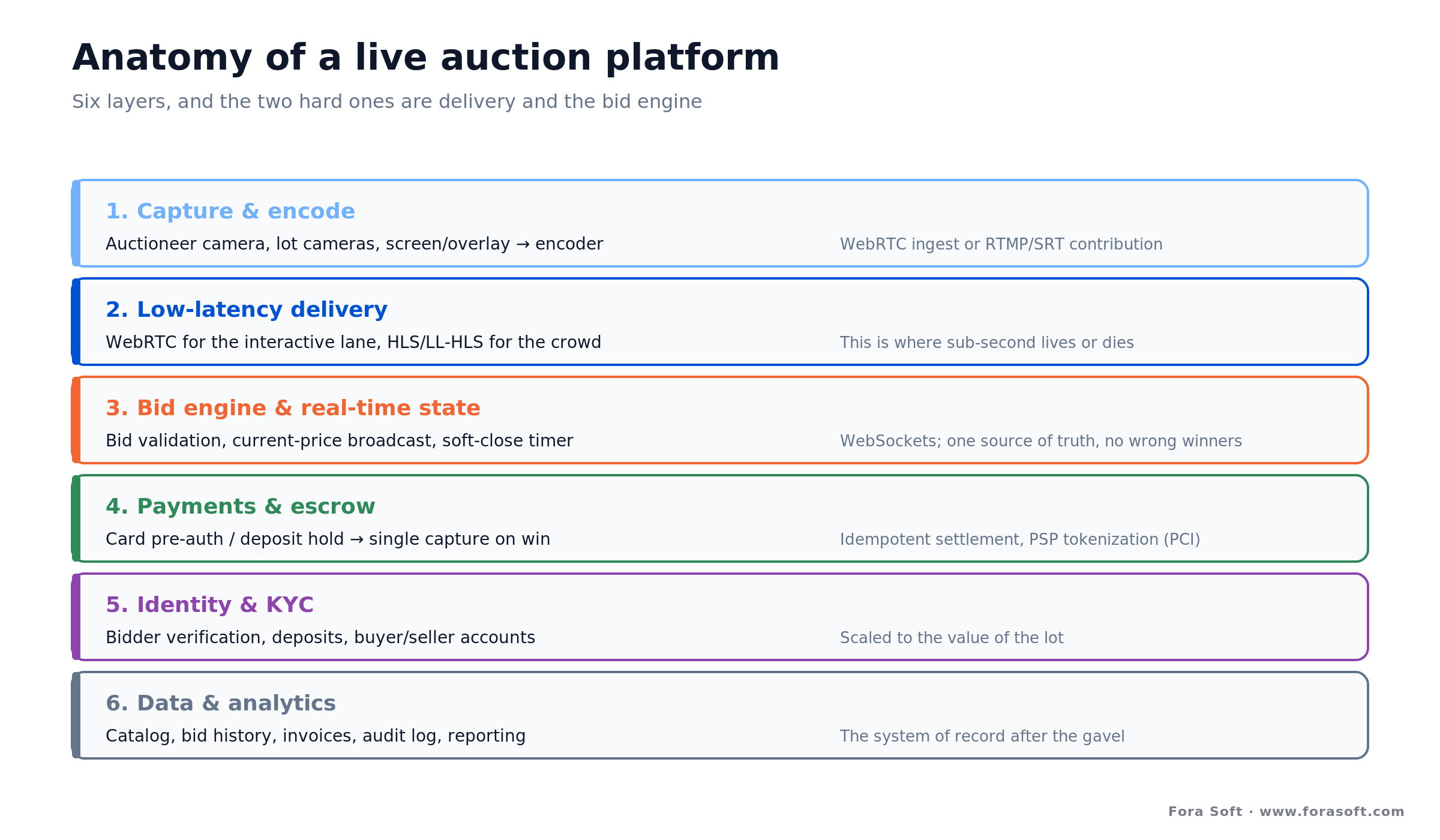
Figure 1. The six layers of a live auction platform. Delivery and the bid engine are the two that decide whether it’s fair.
Capture and encode takes the auctioneer camera, lot cameras, and any graphics overlay and turns them into a stream, either ingested straight over WebRTC or contributed via RTMP/SRT. Low-latency delivery gets that stream to bidders fast enough to be fair — the WebRTC-versus-HLS decision that gets its own section next. The bid engine and real-time state validate each bid, broadcast the new current price to every client at once, and run the closing timer; it’s the source of truth, and it can’t ever have two.
Payments and escrow pre-authorize or hold funds before bidding and capture exactly one charge on a win. Identity and KYC verify bidders and take deposits, scaled to how much the lot is worth — a $50 charity item and a $500,000 car need very different checks. Data and analytics is the catalog, bid history, invoices, and audit log — the system of record once the gavel falls. Miss that last layer and you can’t resolve the dispute that will, eventually, arrive.
Latency is the whole game: WebRTC vs LL-HLS
For a live auction, the honest answer is: use WebRTC for anyone who bids, and HLS only for a large passive crowd that’s just watching. WebRTC delivers 0.2–0.5 seconds of glass-to-glass latency because it sends media in small packets over UDP with no segment buffering. Low-Latency HLS lands around 2–5 seconds, and standard HLS or DASH sits at 15–40 seconds (protocol guides, 2026). Crucially, no HTTP-based protocol — not LL-HLS, not Low-Latency CMAF — reaches sub-one-second delivery. That gap isn’t academic: at eight seconds of lag, a remote bidder is bidding on a price that’s already gone.
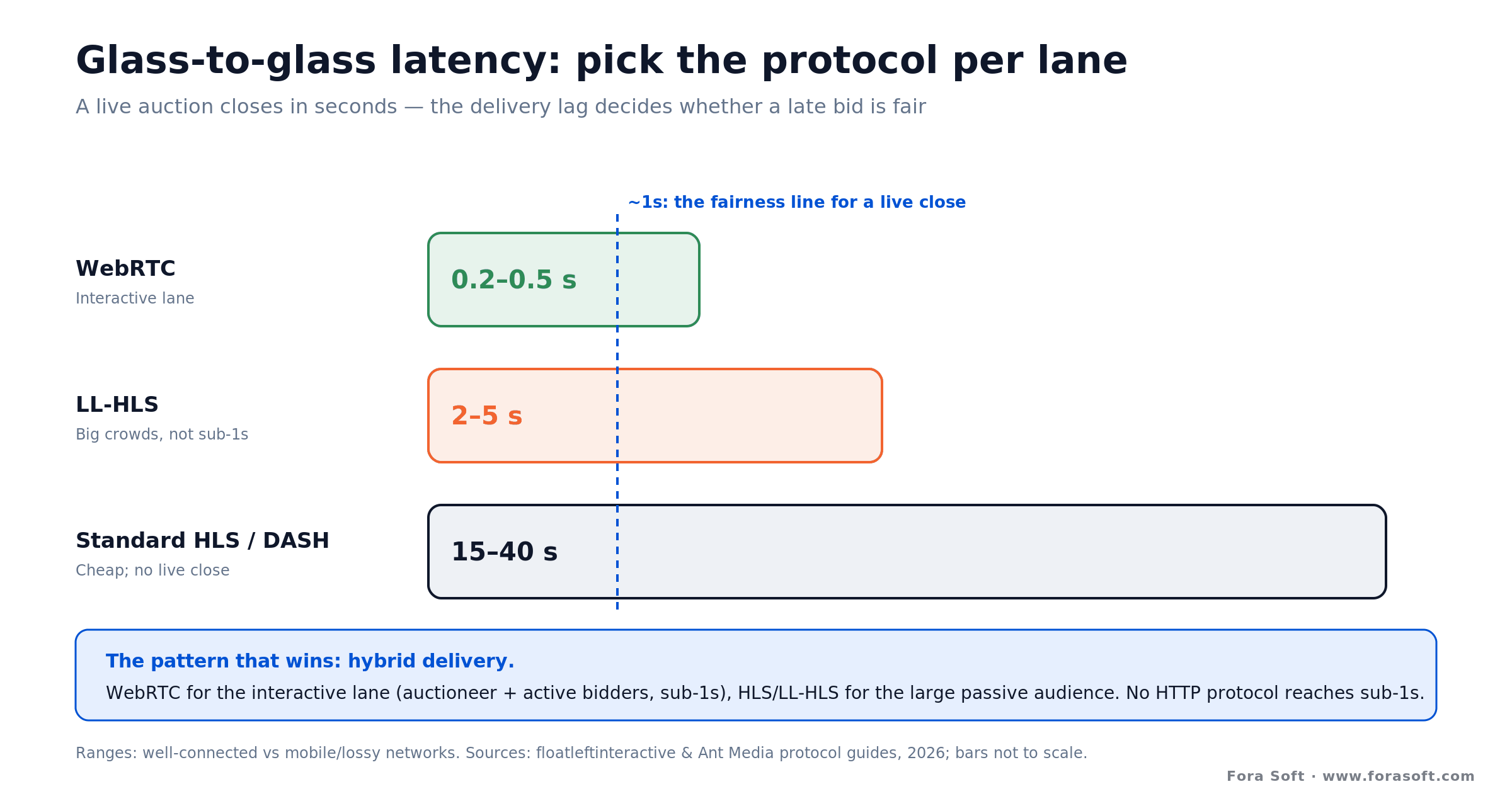
Figure 2. Where each protocol lands. Only WebRTC clears the ~1-second line that keeps a live close fair.
The catch is that WebRTC is harder and pricier to scale to huge audiences than HLS, which rides ordinary CDNs. So the pattern that actually wins is hybrid: put the auctioneer and the active bidders on a WebRTC lane where everyone’s within a second of each other, and fan the same event out over LL-HLS to the thousands who are only spectating. Your bidders stay fair; your spectators stay cheap. We go deeper on the trade-offs in our comparison of WebRTC vs HLS, and on holding sub-second delivery at scale in our guide to minimizing latency for mass streams.
One more subtlety that trips teams up: it’s not enough for video to be fast — the bid state and the video have to stay roughly in sync. If the price ticker updates a second before the video shows the auctioneer taking that bid, bidders get confused and distrust the system. In practice the real-time data channel (the bids) runs even faster than the video, so you often deliberately pace the ticker to match the interactive video lane. For a primer on what these numbers mean, our video streaming glossary unpacks glass-to-glass latency in plain terms.
Reach for the hybrid pattern when: you have both bidders and spectators. Put everyone who can bid on the WebRTC lane so they’re within a second of the gavel, and fan the same feed out over LL-HLS to the passive crowd. Trying to put 10,000 spectators on WebRTC is how streaming bills explode; trying to let anyone bid over 8-second HLS is how auctions become unfair.
Need a sub-second bidding lane?
We’ll design the WebRTC-plus-HLS hybrid for your concurrency and budget — and tell you where the scaling costs actually land before you commit.
The bid engine: concurrency without wrong winners
The bid engine’s job sounds trivial — accept the highest bid — and it’s where naive builds quietly break. The failure mode is a race condition: the price is $100, two bidders both tap “Bid $105” in the same instant, and without concurrency control both requests pass the “$105 > $100” check and both get accepted. Now the system has two winners at the same price and no principled way to choose. In a fundraiser that’s awkward; in a high-value auction it’s a lawsuit.
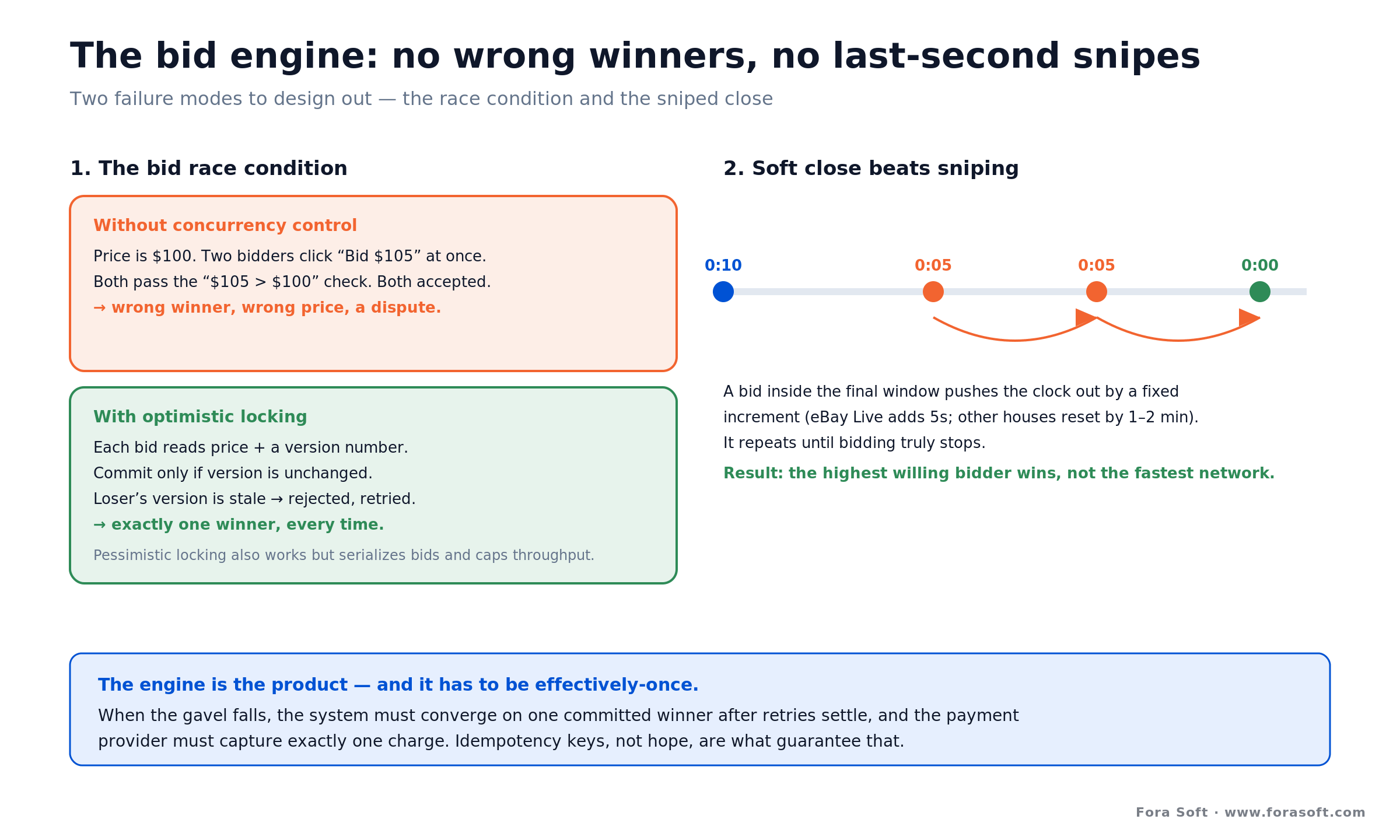
Figure 3. The two things the bid engine must get right: one winner per bid (concurrency control) and a fair finish (soft close).
The standard fix is optimistic locking. Each bid reads the current price and a version number, then commits only if the version hasn’t changed in the meantime. When the two $105 bids collide, the first commit bumps the version; the second finds a stale version, gets rejected, and is retried against the new price of $105 — so it either becomes $110 or bows out. You get exactly one winner, every time, without locking the record for every reader. Pessimistic locking — taking an exclusive lock on the auction before each bid — also guarantees correctness, but it serializes every bid and caps throughput, which hurts on a hot lot with hundreds of bidders. Most high-concurrency auctions lean optimistic and reserve pessimistic locking for the final settlement step.
And the current price has to reach everyone at once. That’s a WebSocket (or similar) fan-out from a single authoritative state: one server owns the truth for a lot, and every client is a subscriber. When a bid is accepted, the new price is pushed to all of them in the same beat. If two clients can each believe they hold the high bid, you’ve already lost — the whole design goal is that there is one price, and everyone sees it move together.
Reach for optimistic locking when: reads vastly outnumber real conflicts — which is every auction, since most viewers are watching, not bidding at the same millisecond. Reserve pessimistic locking for the final settlement, where you want to serialize the one transition that turns an open lot into a sold one.
Anti-sniping and soft close: a fair finish
Sniping is the practice of firing a bid in the auction’s final second to win before anyone can respond. On a hard deadline it rewards fast connections and bidding bots over people who’d actually pay more — the opposite of what a seller wants. The fix is a soft close (also called dynamic closing or extended bidding): if a bid lands inside the final window, the closing time extends by a fixed increment, and it keeps extending until a window passes with no new bids. The lot only sells once bidding genuinely dies down.
The increments are small and well established. eBay’s eBay Live lets sellers enable extended bidding that adds 5 seconds when a late bid comes in; its trading-card pilot resets the clock by two minutes on a last-minute bid (eBay, 2026). Auction houses commonly use one-to-two-minute extensions. The National Auction Association describes the same mechanism under “dynamic” or “soft” close. Whatever the number, the effect is identical: the highest willing bidder wins, not the one with the lowest ping.
Soft close interacts with the bid engine, which is why we treat them together. The closing timer is part of the authoritative state, and a bid that arrives has to be evaluated against — and able to extend — that timer atomically. Bolt soft close on afterward and you’ll find edge cases where a bid is accepted but the extension didn’t fire, or the lot closes a beat before a valid bid lands. Design it into the state machine from the start.
Payments, escrow, and bidder verification
Winning a bid and paying for it are two events, and the gap between them is where auctions leak money. The defensive pattern is to authorize before bidding: put a hold or pre-authorization on the winner’s card (or take a refundable deposit for high-value lots) so that when the gavel falls you capture a charge you already know will clear. Skip that and you get the classic auction problem — the winning bidder who never pays — which is exactly why eBay added phone verification to its bidding process, aimed at reducing sniping, shill bidding, and unpaid items (eBay, 2026).
Settlement has to be effectively-once. When time expires, the system converges on a single committed winner after any retries settle, and the payment provider must end up with exactly one captured charge. In practice that means idempotency keys on the capture call so a network retry can’t double-charge, and a clean state transition from “auction open” to “sold to bidder X at price Y” that can’t be entered twice. This is the same discipline the bid engine needs, extended to money.
Keep card data out of your own scope. Tokenize through a payment processor — Stripe, Adyen, Braintree, whoever fits your geography — so raw card numbers never touch your servers, which keeps your PCI DSS obligations manageable. Verification effort should scale with stakes: a $25 fundraiser item needs almost nothing, while a five- or six-figure lot warrants real KYC (identity documents, deposits, sometimes proof of funds). Over-verify a charity gala and bidders bounce; under-verify a fine-art sale and you invite fraud.
Reach for pre-authorization holds when: a winning bid should be a guaranteed sale, not an invoice you hope clears. Authorize the card (or take a deposit) before the bidder can bid, then capture on the win with an idempotency key. It’s the cheapest insurance against the oldest problem in auctions: the winner who never pays.
Fraud, shill bidding, and consumer-protection basics
Auctions attract specific abuse, and a credible platform designs against it. Shill bidding — a seller or their accomplice bidding to inflate the price — is illegal in many jurisdictions and corrosive to trust; you fight it by tying bids to verified identities, flagging seller-linked accounts, and keeping an audit trail that makes patterns visible after the fact. Bid retraction and non-payment need clear, enforced rules baked into the workflow, not handled ad hoc over email.
The consumer-protection surface varies by where you operate, so treat this as a checklist to raise with counsel, not legal advice: clear terms on buyer’s premiums and fees, honest lot descriptions, a defined dispute process, and data-privacy compliance (GDPR in the EU, plus state laws in the US) since you’re handling identity and payment data. None of this is exotic, but it’s the difference between a platform an auction house will actually adopt and one their compliance team vetoes. Build the audit log early — it’s what lets you answer “what happened on that lot?” six months later.
The tools compared: Handbid, ClickBid, MaestroSoft, custom
Most of the market you’ll find under “live auction software” is fundraising-oriented mobile bidding, priced on annual plans. Here’s an honest read of the common options and where a custom build sits, with prices snapped from public pages on 2026-07-15 (annual plans, shown per-month for comparison; auction-house and enterprise platforms are quote-only).
| Tool | Best for | Real-time video? | Indicative price (2026-07-15) |
|---|---|---|---|
| Handbid | Nonprofit galas, silent auctions | Limited / event livestream | Custom; entry ~$792/yr, demo-gated |
| ClickBid | Fundraising, mobile bidding | Event livestream add-on | $895–$1,495/yr (~$75–$125/mo) |
| MaestroSoft | Fundraising auctions, benefit events | Limited | From ~$999/yr (~$83/mo) |
| AuctionMethod / simulcast tools | Auction houses, simulcast events | Yes, platform-controlled | Quote-based; often % of sales |
| Custom build | Auctions as your product; white-label | Yes — you own the pipeline | One-time build + hosting (see cost math) |
Prices from vendor and directory pages (Capterra, vendor pricing pages), retrieved 2026-07-15; annual plans converted to monthly for comparison. Confirm current pricing before you decide — auction vendors change plans and gate specifics behind demos.
The pattern to notice: the affordable tools are built for fundraising, where “live” means the event is tonight, not that video is sub-second. If your use case is a real-time video auction house or auctions embedded in your own product, you’re either paying an enterprise platform a percentage of every sale or building. That’s the fork the next two sections walk through. If your model is closer to shopping than bidding, our guide to live commerce platform development covers the creator-and-checkout side of real-time selling.
Build vs buy: when a custom platform wins
Buy when you’re a consumer of auctions — running events, raising money, selling occasional lots — and a vendor’s feature set and branding are good enough. The math is simple: a few thousand dollars a year beats a build you’d use a handful of times. Most organizations running fundraisers should stop here.
Build when auctions are your product, not your event. Four signals point to custom: you need genuine sub-second video that off-the-shelf tools don’t deliver; you need to own and evolve the bid engine (custom formats, proxy bidding, your own soft-close rules); you need a white-label experience under your brand and inside your app; or a percentage-of-sales fee at your projected volume would quietly cost more than a one-time build ever would. That last one flips fast — a 1–3% take-rate on a growing marketplace compounds into real money.
The honest middle path is extend, not build-from-zero. If a platform gets you 80% there and exposes an API, wrap the missing 20% rather than reinventing video and payments. We recommend that more often than founders expect — the interesting custom work is usually the bid engine and the real-time experience, not rebuilding a catalog and a checkout that already exist.
What a custom live auction build costs
A custom real-time auction platform is typically a low-six-figure build for a solid MVP, plus modest monthly infrastructure. The numbers below are illustrative planning ranges at roughly 1,000 concurrent bidders — not a quote, because scope (formats, integrations, compliance, design polish) is what actually sets the price. But they show the shape of the decision against a SaaS platform that charges recurring or percentage fees.
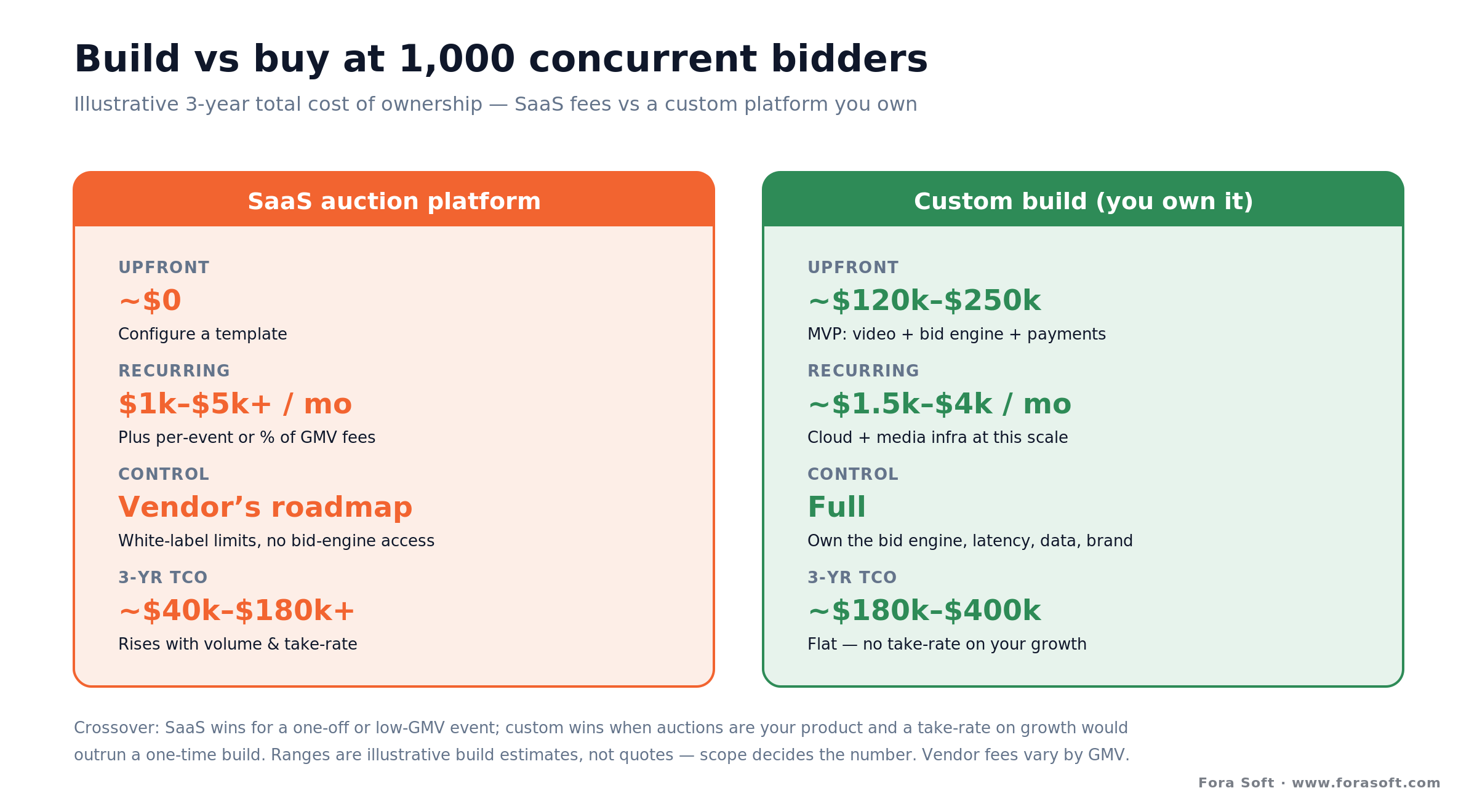
Figure 4. Illustrative 3-year TCO. SaaS is cheap to start and scales with your take-rate; a custom build is a bigger upfront cost that stays flat as you grow.
On the SaaS side, upfront cost is near zero and you’re live in days, but you pay $1,000–$5,000+ a month plus per-event or percentage-of-sales fees, and you live inside the vendor’s roadmap and branding. Over three years that’s roughly $40,000–$180,000+, and the number climbs with your volume — the more you sell, the more the take-rate takes.
On the custom side, expect roughly $120,000–$250,000 for an MVP that includes the video pipeline, the bid engine, and payments, then about $1,500–$4,000 a month for cloud and media infrastructure at this scale. Three-year total lands around $180,000–$400,000 — higher upfront, but flat: no one takes a cut of your growth. The crossover is the whole decision. For a one-off or low-volume event, SaaS wins easily. When auctions are a growing part of your business, the build pays for itself by the time a percentage fee would have eclipsed it — and you own the bid engine, the latency, the data, and the brand.
Not sure whether to buy or build?
Send us your projected volume and take-rate, and we’ll model the crossover with you — a straight buy-versus-build answer, not a sales pitch.
Mini-case: real-time video and data at TradeCaster scale
We’ll be straight: TradeCaster isn’t an auction. It’s a real-time platform for stock traders — 46,000+ users — where viewers watch a trader’s live desktop and trades as they happen. We include it because it’s built from the exact three parts a live auction needs, and it proves we’ve run them together at scale, not just in theory.
First, low-latency video: TradeCaster streams live desktops in real time over a WebRTC-based pipeline, because a trade signal that arrives late is worthless — the same reason a late bid is unfair. Second, shared real-time state: every viewer sees the same live trade data and charts, synchronized, which is the auction’s “one price, everyone sees it move together.” Third, spike tolerance: it auto-scales through the load surges when markets open, the direct analog of a hot lot where hundreds of bidders pile in at once.
The stack — React, Node.js, WebRTC, Redis, MongoDB on AWS — is the same toolkit we’d reach for on an auction build, with Redis carrying the real-time state and the fan-out. The lesson we carry over: the hard part was never the UI or the catalog. It was keeping the real-time state correct and synchronized while the concurrency spiked. That’s the auction problem too, which is why we’re confident quoting the architecture above.
A build-vs-buy decision framework in five questions
Run your project through these five questions in order. The first “yes, and it matters” usually tells you which side of the line you’re on.
1. Do you need real-time video, or just a live-feeling deadline? No video → a timed platform or an off-the-shelf tool is plenty. Genuine sub-second video → lean toward custom.
2. Are auctions your product or your event? An event a few times a year → buy. A platform you sell or embed → build or extend.
3. Would a percentage-of-sales fee outgrow a one-time build? Do the math at your projected volume. If a take-rate compounds past a build in 2–3 years → build.
4. Do you need to own the bid engine and the brand? Custom formats, proxy bidding, your own soft-close rules, full white-label → build. Vendor defaults are fine → buy.
5. How high are the stakes per lot? Five- and six-figure lots need real KYC, deposits, and audit trails that generic tools rarely do well → build or heavily extend.
Five pitfalls when building a live auction platform
1. Treating video as an afterthought. Teams build the catalog and bidding first, then discover the “live” feed is eight seconds behind and the whole premise is broken. Decide the latency budget on day one.
2. No concurrency control on bids. It works in the demo with three users and falls apart on a hot lot. Optimistic locking isn’t optional; it’s the core of the engine.
3. Hard close with no anti-snipe. Ship a fixed deadline and you’ve built a reflex-and-bandwidth contest, not an auction. Add soft close before launch, not after the complaints.
4. Capturing payment after the win with no hold. The unpaid-winner problem is as old as auctions. Authorize or deposit before bidding, and make settlement idempotent.
5. No audit log. When a bidder disputes a result — and they will — “the system said so” isn’t an answer. A complete, timestamped bid and access log is what resolves it and what an auction house will require.
When NOT to build custom
Don’t build if you’re running fundraisers or a handful of events a year — Handbid, ClickBid, or MaestroSoft will have you live this week for a fraction of a build’s cost, and the mobile-bidding experience is already good. Don’t build if you don’t actually need real-time video; a timed-auction model removes the single hardest requirement and opens up far cheaper options.
And don’t build the whole thing when you only need a slice. If an existing platform covers catalog, payments, and streaming but not your one custom bidding rule, extend it through its API. The reason to own an auction platform is control over the parts that differentiate you — the bid engine, the latency, the brand — not the satisfaction of having written a checkout from scratch. If none of the build signals in the framework above are a firm “yes,” buying or extending is the cheaper, faster, and honestly better call.
FAQ
How much does it cost to build live auction software?
A custom real-time auction MVP — video pipeline, bid engine, and payments — is typically a low-six-figure build, roughly $120,000–$250,000 depending on scope, plus about $1,500–$4,000 a month in cloud and media infrastructure at around 1,000 concurrent bidders. Off-the-shelf fundraising tools start near $895–$1,495 a year (2026). The build makes sense when auctions are your product and a percentage-of-sales fee would eventually cost more.
WebRTC or HLS for a live auction?
WebRTC for anyone who bids — it delivers 0.2–0.5 seconds of latency, low enough to keep a live close fair. HLS and LL-HLS run 2–40 seconds and can’t reach sub-one-second, so use them only for a large passive audience that’s just watching. The winning pattern is hybrid: WebRTC for the bidding lane, HLS for spectators at scale.
How do you stop last-second bid sniping?
Use a soft close (dynamic closing). If a bid lands inside the final window, extend the closing time by a fixed increment — eBay Live adds 5 seconds; auction houses often use one to two minutes — and keep extending until a window passes with no new bids. The highest willing bidder wins instead of the fastest connection. Build the timer into the bid engine’s state machine so extensions fire atomically with each bid.
How do you prevent two bidders winning the same lot?
With concurrency control. Optimistic locking is the usual choice: each bid reads the current price and a version number and commits only if the version hasn’t changed, so simultaneous equal bids can’t both win — the second is rejected and retried against the new price. Pair it with effectively-once settlement (idempotency keys on the payment capture) so a network retry can’t create a second winner or a double charge.
How long does it take to build an auction platform?
A focused MVP with real-time video, a correct bid engine, soft close, and payments is usually a few months of work for a small senior team, depending on how many auction formats and integrations you need. A timed-auction site with no live video is considerably faster. The bid engine and the real-time video sync take the most engineering; the catalog and checkout are the quick parts.
Can I white-label an existing auction platform instead of building?
Sometimes, and it’s worth checking first. Some platforms offer white-label or API access that lets you wrap their catalog, payments, and streaming under your brand and add only your custom logic. That’s the “extend” path, and it’s cheaper than a full build. The limits are usually how much you can customize the bidding experience and whether their video latency is good enough for a truly live close.
Do I need blockchain for an online auction?
Almost never. A conventional database with proper concurrency control and an immutable audit log gives you the correctness and transparency an auction needs, at a fraction of the complexity and latency of a blockchain. Blockchain is only worth considering for specific cases like tokenized assets or NFT sales where on-chain settlement is the actual product — and even then, the live bidding usually runs off-chain for speed.
What to read next
Protocols
WebRTC vs HLS in 2026
The latency, cost, and scale trade-offs behind the bidding-lane decision in this guide.
Scale
Sub-1s Latency for Mass Streams
How to hold sub-second delivery when thousands of bidders and spectators join at once.
Adjacent
Live Commerce Platform Development
The shopping-and-checkout cousin of live auctions: real-time selling without a bid engine.
Services
Video & Audio Streaming Development
The team and stack we’d put on a real-time auction build.
Ready to build an auction that’s fair by design?
Live auction software lives or dies on two things: video fast enough that a remote bidder competes fairly, and a bid engine correct enough that there’s exactly one winner and exactly one charge. Get the latency right with a WebRTC-plus-HLS hybrid, get correctness right with optimistic locking and a soft close, authorize payment before the gavel, and keep an audit log for the dispute that eventually comes. Everything else — the catalog, the checkout, the pretty front end — is the easy part.
Buy an off-the-shelf tool if you’re running fundraisers or occasional events; it’s the fast, sensible call. Build when auctions are your product, when you need real sub-second video and your own bid engine, or when a take-rate on your growth would outrun a one-time build. If you want a straight answer on which side of that line you’re on, we’ll run the numbers with you. See how we’d approach it on our video and audio streaming development page.
The book · Volume 2 of 7
Video Streaming: A Complete Guide to Video Delivery: From Network Protocols and Transport to Ingest, HLS, and MPEG-DASH
In a live auction the video delay is part of the fairness rules, so the latency budget has to be designed before the bid engine. Volume 2 of our handbook covers that budget glass to glass: what the network does to the stream, TCP versus UDP, ingest over RTMP and SRT, and low-latency HLS and CMAF. Written by Nikolay Sapunov, CEO at Fora Soft.
Read it on Amazon →Kindle & paperback · Fora Soft Video Engineering Handbook
Let’s scope your live auction platform
Whether you need help choosing a tool or building a real-time video auction from scratch, we’ll give you an honest read in 30 minutes — buy, extend, or build, with the latency and bid-engine math to back it.