

Key takeaways
• Licensing, not code, is what kills music apps. Every track carries two copyrights — the composition and the recording — and on-demand play of the recording has no compulsory license, so you deal with labels directly or through an aggregator.
• Royalties dwarf infrastructure. Rights holders take roughly 70% of revenue; the US mechanical rate climbs to 15.3% of service revenue in 2026. Your CDN bill is a rounding error next to that.
• The architecture is well-trodden. Ingest, a transcode ladder, adaptive HLS/DASH delivery, a metadata catalog, offline caching, and a recommendation layer. None of it is exotic in 2026.
• Build vs white-label vs aggregate is the real decision. Your catalog source and how interactive the product is decide the answer, not your engineering taste.
• We have shipped this. Franchise Record Pool runs 720,000 tracks, AI playlist building, and Shazam-style audio recognition for 12,000 DJs on a stack we built.
Why Fora Soft wrote this guide
Most founders come to music streaming app development with a feature list and leave with a licensing problem they never priced. The audio player is a weekend. The right to legally play someone else’s song to a paying stranger is a negotiation with a record label, and it’s the reason nine out of ten Spotify clones never launch. We’ve watched teams burn a year building playback before anyone read a rate schedule.
Fora Soft has built video, audio, and real-time media products since 2005, with 250+ projects and a 50+ person in-house team and a 99% job success score on Upwork. We built Franchise Record Pool, a music platform serving 12,000 DJs with a 720,000-track catalog, AI voice-driven playlists, and audio-fingerprint recognition; the ingest, transcoding and adaptive HLS delivery behind it came from our audio and video streaming development team. This guide is what we wish every client knew before the first call: how the rights actually work, what the stack looks like, and where the money really goes.
We’ll be blunt about trade-offs, name real 2026 rates, and show the arithmetic. If you leave convinced you should white-label instead of building, we did our job.
Scoping a music or audio streaming product?
We’ll map your catalog source, licensing path, and a realistic budget in one call — no slide deck, just engineers who have shipped this.
What music streaming app development actually involves
Music streaming app development is the work of licensing a catalog, encoding it into adaptive audio streams, storing the tracks and their metadata, delivering them worldwide over a CDN, and wrapping it all in apps that let people search, play, save, and pay. Roughly a third of the effort is engineering. The rest is rights and business rules.
Here’s the honest split. The playback engine, the catalog database, the search, the payments — that’s solved-problem territory in 2026, and a competent team ships it predictably. What varies wildly is how you get music you’re allowed to stream, and how much of every dollar you keep after the rights holders are paid. Get those two right and the app is a project. Get them wrong and it’s a lawsuit.
This guide walks the licensing maze first because it decides everything downstream, then the reference architecture, then a worked cost model, and finally a decision framework so you can pick the right path for your case.
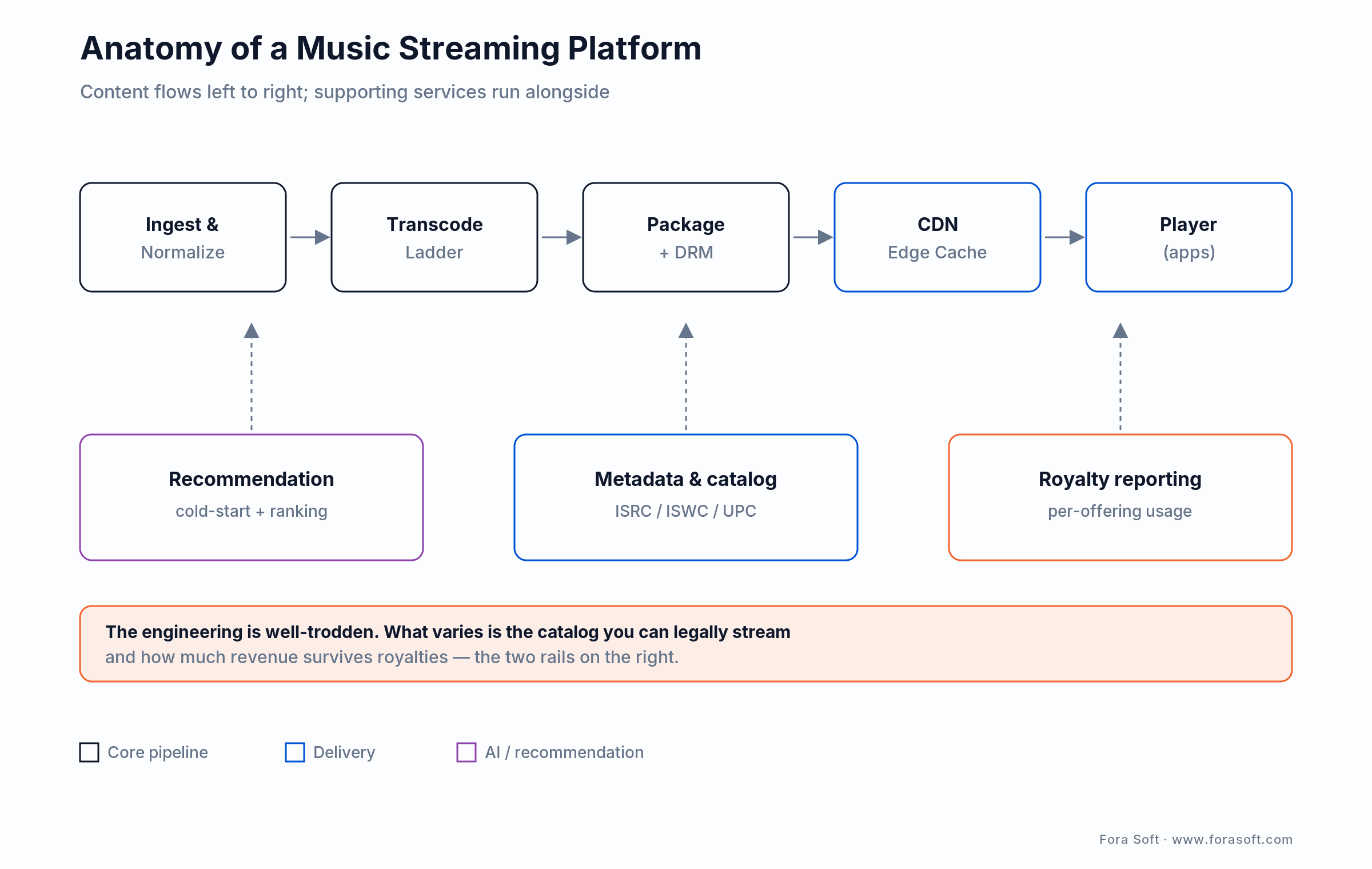
Figure 1. The anatomy of a music streaming platform: content flows left to right from ingest to the player, with recommendation, metadata, and royalty reporting running alongside.
The licensing maze: two copyrights, four rights
Every song you stream involves two separate copyrights, and playing it triggers up to four distinct rights you must clear. That single fact is what most build guides gloss over, and it’s where budgets explode.
The first copyright is the musical work — the composition, owned by songwriters and their publishers. The second is the sound recording, or master — the specific recorded performance, owned by the artist or, far more often, their label. When a user presses play on an interactive service, you owe a mechanical royalty (reproduction of the composition) and a performance royalty (public performance of the composition) on the work side, plus a license to stream the master on the recording side. Add a sync license if music ever pairs with video.
The legal foundation is US Copyright law, 17 U.S.C. §§106, 114 and 115, the sections that define reproduction, public performance, and the statutory mechanical license. Read them once; they explain why the recording side has no shortcut.
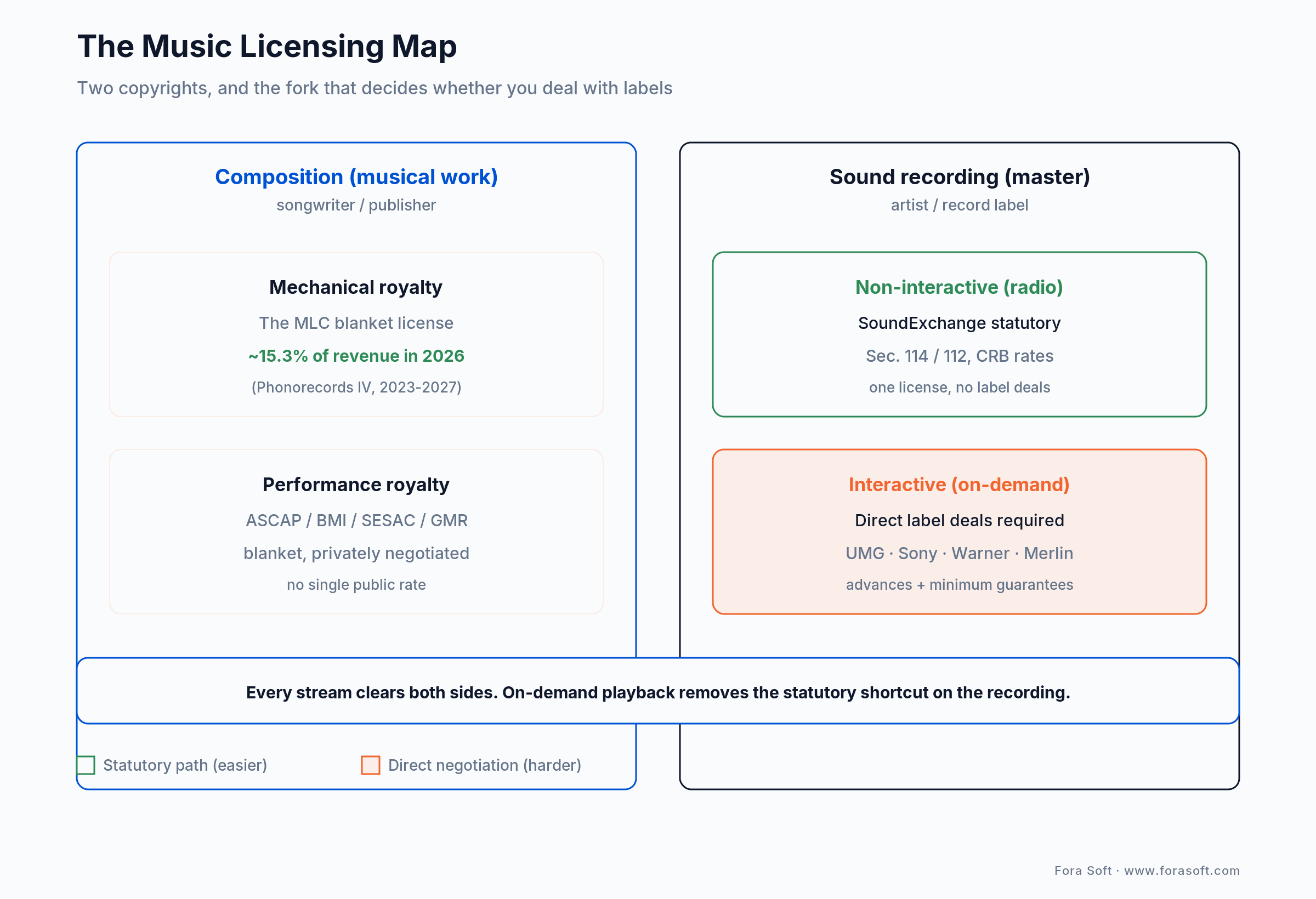
Figure 2. The rights map. The composition splits into mechanical and performance royalties; the recording splits along the interactive vs non-interactive fork that decides whether you can skip label deals.
Reach for a lawyer early when: your product is on-demand (users pick the exact track), because that one design choice removes every statutory shortcut and forces direct deals with labels.
Mechanical and performance royalties: what the MLC and PROs cost
On the composition side, you pay mechanical royalties through one blanket license from The MLC and performance royalties through the four US PROs. The mechanical rate is public and rising; the performance rates are privately negotiated.
The Mechanical Licensing Collective (MLC) was created by the Music Modernization Act of 2018 and has issued a single blanket mechanical license for interactive streaming since January 1, 2021. Instead of clearing songs one by one, you report usage and pay The MLC monthly. The current rates come from the Copyright Royalty Board’s Phonorecords IV determination, which covers January 1, 2023 through December 31, 2027.
The headline “all-in” royalty is a percentage of service revenue that steps up every year: 15.1% in 2023, rising through 15.3% in 2026 and 15.35% in 2027 (as reported by NMPA and Music Business Worldwide from the CRB settlement). “All-in” means the performance royalties you already paid to PROs are subtracted, and the collective compares that revenue percentage against a total-content-cost prong and per-subscriber floors, calculated separately for each offering. Per The MLC’s Phono 4 guidance (captured July 2026), family plans count subscribers at a 1.75× multiplier and student plans at 0.5×.
Performance royalties go to ASCAP, BMI, SESAC, and GMR. Because an interactive stream is a public performance, you need blanket licenses from all four to cover the full repertory. ASCAP and BMI operate under Department of Justice consent decrees, so their rates can be set by a federal rate court when negotiation stalls; SESAC and GMR negotiate privately. None publishes a single streaming percentage, so budget a negotiated fee and don’t trust any guide that quotes you an exact PRO rate.
Budget the composition side as: ~15.3% of revenue to The MLC in 2026 (less what PROs already took), plus separately negotiated PRO blanket fees. It’s the predictable part of the bill.
Master rights: why interactive streaming has no shortcut
There is no compulsory license for streaming a sound recording on demand. If users pick the exact track, you must sign direct licenses with whoever owns the masters — and the majors own most of them. This is the single biggest barrier to launching a Spotify-style app.
The statutory license in 17 U.S.C. §114 only covers non-interactive transmissions, like internet radio. The moment your product becomes on-demand, that door closes. You negotiate with Universal Music Group, Sony Music, and Warner Music, plus independents (often bundled through Merlin) or a distributor. Those deals routinely demand advances, minimum guarantees, sometimes equity, and enforced DRM on premium and lossless tiers.
Non-interactive is the escape hatch. Build internet-radio-style stations where users can’t choose the next track, and you qualify for the SoundExchange statutory license under §§112 and 114 — one license, CRB-set rates, no label negotiations. Many products that don’t strictly need on-demand playback start here to reach the market, then add interactivity once revenue justifies label deals.
Reach for non-interactive radio when: you want the mainstream catalog without label negotiations. You trade the “play any song now” feature for a single statutory license — often the difference between launching this year and never.
Three licensing paths: majors, aggregator, or royalty-free
There are three practical ways to fill a catalog, and your budget and differentiation decide which. Direct label deals give you the hits at the highest cost and effort; an aggregator API rents you a catalog fast; royalty-free libraries sidestep the majors entirely.
1. Direct label deals. You license masters straight from UMG, Sony, Warner, and indies. This is the only path to the full mainstream catalog, and it’s the hardest — advances, minimum guarantees, reporting obligations, and DRM. Right for funded teams targeting a mass-market on-demand product.
2. Aggregator / catalog-as-a-service. Providers like 7digital offer a B2B licensed-music API with catalog, delivery, and reporting handled for you; recognition services like ACRCloud add Shazam-style audio fingerprinting over a 150-million-track reference database. You launch far faster and pay per usage, at the cost of thinner margins and less control. Right for MVPs and vertical apps.
3. Royalty-free and creator catalogs. Libraries such as Epidemic Sound or Musicbed clear the rights up front, so no PRO or label deals are needed. You lose the household-name tracks but keep almost all your revenue. Right for fitness, wellness, gaming, and background-music products where brand-name songs don’t drive retention.
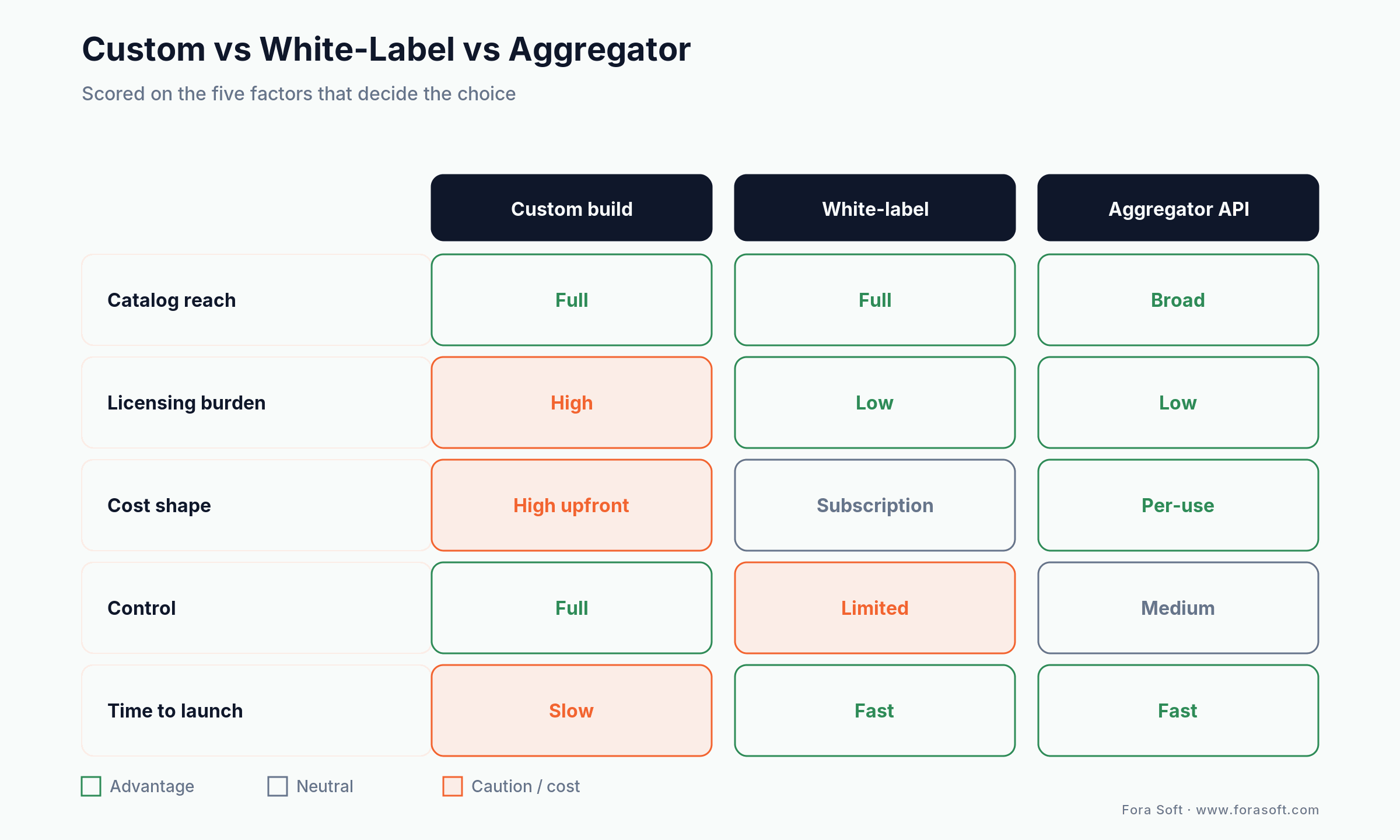
Figure 3. Build vs white-label vs aggregate, scored on the five factors that actually decide the choice.
Reach for an aggregator when: you need a real catalog live in months, not a year, and you’d rather validate the product than negotiate with three record labels first.
Reference architecture: from ingest to playback
The technical backbone of a music streaming app is a content pipeline plus a delivery path. Tracks are ingested and normalized, transcoded into a ladder of bitrates, packaged and optionally DRM-protected, pushed to object storage and a CDN, and served to players that adapt to the listener’s connection.
Ingest is where masters arrive from labels or an aggregator. Each file is validated, loudness-normalized so tracks don’t jump in volume, and stamped with metadata and identifiers — an ISRC for the recording, an ISWC for the composition, a UPC for the release. Those codes are how royalties later route to the right owner, so bad metadata is not a cosmetic problem; it’s an unpaid-royalty problem.
From there the catalog service holds all metadata and relationships (artist, album, playlist, rights), the transcode step produces the streaming ladder, and the delivery layer caches immutable audio segments at the edge while keeping manifests short-lived. Alongside the main path run three quieter systems that make or break the product: recommendations, search, and royalty reporting.
The audio pipeline: codecs, bitrates, adaptive streaming
You encode each track into several bitrates and let the player pick the best one it can sustain. That’s adaptive streaming, and it’s the same HLS or DASH machinery video uses, applied to audio-only segments.
On codecs, AAC (standardized as MPEG-4 Audio) is the safe default for compatibility; Opus (defined in RFC 6716) gives better quality per bit at low bitrates and shines for mobile; MP3 remains a universal fallback. For premium tiers you add lossless FLAC or ALAC. Spotify’s public tiers run about 24, 96, 160, and 320 kbit/s, with a lossless option up to 24-bit FLAC; Apple Music offers ALAC up to 24-bit/192 kHz. Match that shape and no listener will complain.
Delivery uses HLS (RFC 8216) or MPEG-DASH (ISO/IEC 23009-1). Both cut each rendition into short segments over plain HTTP; the client watches its buffer and throughput and switches renditions between segments. Because segments are immutable, a CDN caches them aggressively and origin load stays low. One detail people forget: gapless playback needs the encoder’s delay and padding trimmed at decode, or live albums and DJ mixes get a click between tracks.
Want the audio pipeline designed properly the first time?
We’ve built encoding ladders, multi-DRM, and offline caching for real catalogs. Bring your requirements and we’ll sketch the architecture with you.
Recommendations and search: solving cold-start
Recommendations are what turn a catalog into a habit, and the hard part is the cold-start problem: how do you suggest a brand-new track with no play history? The answer that works in production combines three techniques rather than betting on one.
Collaborative filtering learns from behavior — people who liked what you liked point you at what’s next. It’s powerful but blind to fresh songs no one has played yet. Content-based models fix that by analyzing the audio itself; a landmark 2013 study showed a convolutional network can predict a track’s latent profile straight from the waveform, so a new upload is recommendable on day one. Real systems then rank the blended candidates with contextual bandits that keep learning from clicks and skips.
Search deserves the same care. Text search over metadata is table stakes; audio search — identify a track from a hummed melody or a clip in a noisy room — is a differentiator. We go deep on the recommendation side in our guide to AI content recommendation systems, and on the fingerprinting side in how we built the Franchise Record Pool track library.
Offline playback and DRM
Offline downloads and premium catalogs both require DRM, because labels won’t license lossless masters to a player that stores plaintext files. You download encrypted segments plus a license, and the device decrypts them in a protected path only while the license is valid.
No single DRM covers every platform, so you package once and attach multiple key systems: Widevine for Android and Chrome, FairPlay for Apple devices, and PlayReady for Windows and many smart TVs. Package with CMAF and common encryption so one set of files serves all three. Offline is the same mechanism with a persistent license that carries an expiry, which is how a subscription that lapses stops playing your downloads.
If your catalog is royalty-free or you only stream your own recordings, you can often skip DRM entirely and save real complexity. Honest trade-off: DRM adds device edge cases and support tickets, so add it only where a license demands it.
The tech stack we reach for
There’s no single right stack, but the shape is consistent across the music products we’ve shipped. Below is what we default to and why — treat it as a starting point, not gospel.
| Layer | Default choice | Why |
|---|---|---|
| Mobile apps | React Native (or native for deep audio) | One codebase; drop to native modules for background audio and DRM. |
| Backend | Node.js or Python, service-oriented | Fast to build; separate catalog, playback, and billing services. |
| Catalog / search | PostgreSQL + Elasticsearch | Relational rights data, fast text search over metadata. |
| Storage | S3-compatible object storage | Cheap, durable, tiered for hot vs cold tracks. |
| Encoding | FFmpeg pipeline or managed transcoder | Build the AAC/Opus/FLAC ladder; managed if volume is spiky. |
| Delivery | CDN with HLS/DASH | Edge-cache immutable segments worldwide. |
This is the same media backbone behind general media streaming software development. The difference for music is the licensing and catalog layer on top — that general guide covers video and mixed media, while everything here is tuned to the music vertical and its royalties.
What it costs to build and run
Build cost depends on scope, but the running cost is dominated by royalties, not servers. We’ll give conservative build numbers and then show why the CDN bill everyone frets about is the smallest line on the page.
On the build: a licensed MVP — aggregator catalog, adaptive audio, search, playlists, offline, payments — lands around $50,000 to $90,000 with us, because we lean on our Agent Engineering approach to move faster than a typical shop. A full custom platform with a recommendation engine, multi-DRM, and native apps runs $150,000 to $300,000+. Treat these as scoping anchors; the honest number comes from a requirements call, and we’ll give you a fixed one there. Publicly floating agency estimates cluster from $40,000 MVPs to $500,000 flagship builds, wide because scope is undefined, so pin scope before you trust any figure.
Now the running cost, with the arithmetic in the open. Audio bandwidth is small: at 128 kbps, one hour of listening is 128 ÷ 8 × 3600 ÷ 1000 ≈ 57.6 MB. Take 50,000 monthly active users listening 20 hours each: 20 × 57.6 MB ≈ 1.15 GB per user, times 50,000 ≈ 57.6 TB per month. On a value CDN at roughly $0.01 per GB (bunny.net standard Europe/North America rate, captured July 2026), that’s about $576 a month; on the volume tier near $0.005 per GB it halves. AWS CloudFront’s 2026 flat-rate Premium plan at $1,000 a month (aws.amazon.com/cloudfront pricing, captured July 2026) covers 50 TB and is configurable higher.
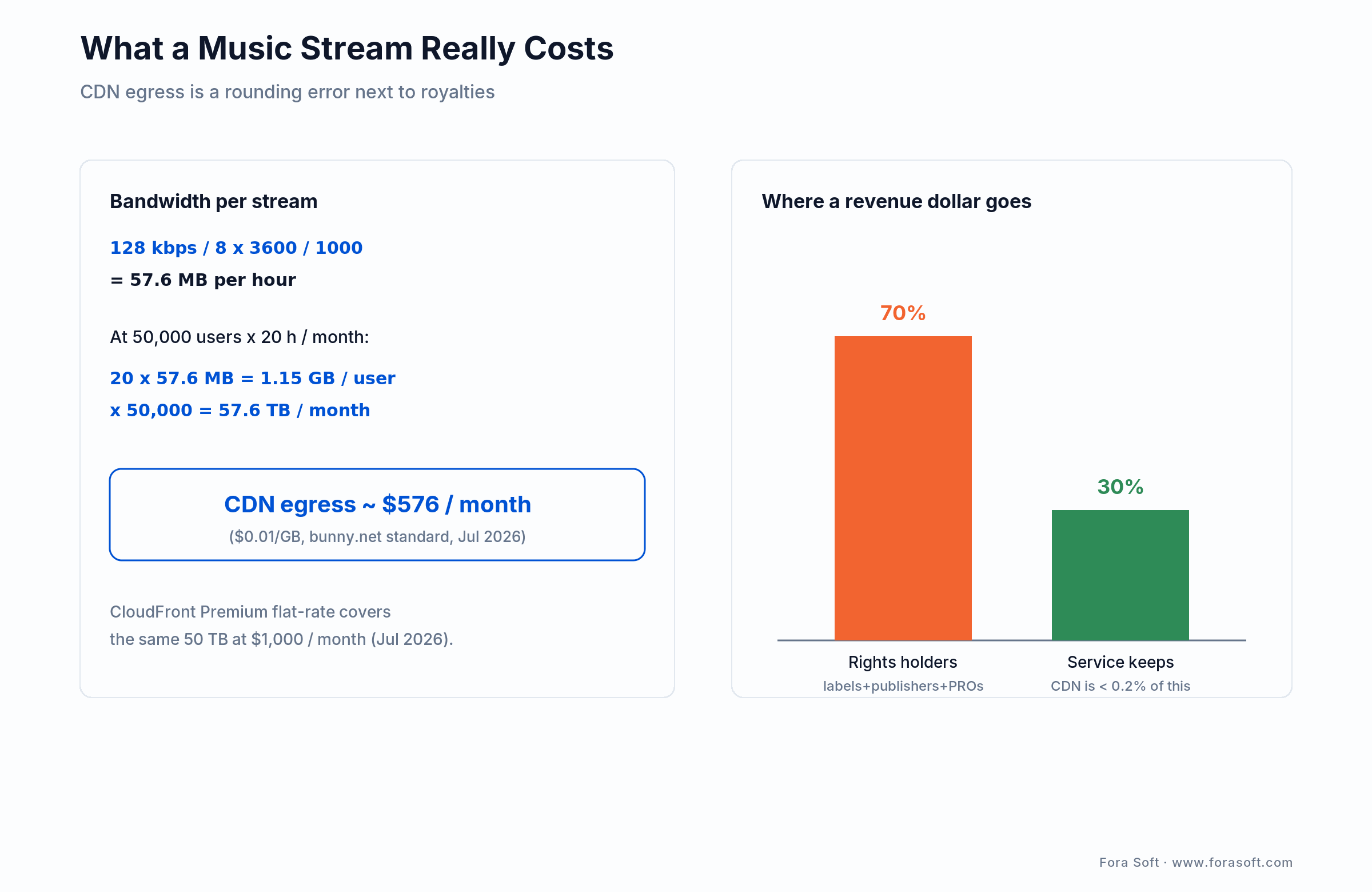
Figure 4. The cost math. CDN egress at scale is a few hundred to a thousand dollars a month; royalties consume roughly 70 cents of every revenue dollar.
Hold that $576 against royalties. On the Spotify model, rights holders receive about 70% of revenue. If those 50,000 users pay $8 a month, that’s $400,000 in revenue and roughly $280,000 owed to labels, publishers, and PROs, every month. Your CDN is 0.2% of that. The lesson every experienced music-app team internalizes: optimize the deal, not the server bill. For the revenue side, see our breakdown of monetization strategies for streaming platforms.
Reach for a value CDN when: egress is your visible cost but tiny in context. Save the negotiating energy for label and publisher terms, where a single point of margin is worth more than your entire hosting bill.
Mini-case: Franchise Record Pool at 720,000 tracks
Franchise Record Pool (FRP) is a music platform for DJs that we built and still run. The brief was demanding: a fully licensed catalog, a way for DJs to find exactly the right version of a track fast, and proof-of-play data flowing back to rights owners. The catalog grew to 720,000 tracks — 250,000 originals plus 470,000 attached versions (intros, outros, remixes) — serving 12,000 DJs with content from Sony Music, Virgin, Universal, and independent producers.
Two AI systems do the heavy lifting. A voice agent builds crates from plain language — ask for “Italian pop, 90s, around 140 BPM” and it assembles the set. A recommendation engine using FAISS similarity search learns from download history, Serato play data, and BPM and key patterns to suggest what a DJ will actually spin. On upload, a Shazam-style fingerprint matches the melody itself, not the filename, so duplicates and ownership disputes are caught before a track is ever distributed. The same recognition, running from a microphone in a club, credits plays back to owners.
It ships as a web app, a desktop downloader that sits on top of Serato, and React Native mobile apps, on a $19.99-a-month subscription. The build touched every hard part of this article — licensing verification, catalog scale, audio recognition, cross-platform playback — which is why we can price and de-risk a music product with real numbers. Want a similar assessment for your catalog? Book a 30-minute call and we’ll walk your specifics.
Monetization: how music apps actually make money
Because rights holders take most of the revenue, monetization has to clear that 70% before you keep a cent, so the model matters as much as the price. Three approaches dominate, and hybrids win.
1. Subscription. Predictable revenue and the cleanest math against per-subscriber royalty floors. It’s the default for on-demand products, and it’s why almost every mainstream service pushes you toward a monthly plan.
2. Ad-supported free tier. Grows the funnel and monetizes users who won’t pay, but ad revenue per stream is thin and royalties still apply, so free tiers usually exist to convert, not to profit.
3. Vertical and niche models. This is where independents win. FRP charges DJs a professional subscription; fitness and wellness apps bundle music into a broader product; creator tools sell licensed music into videos. A focused audience with a clear job to be done pays more reliably than a general listener, and often needs only a royalty-free catalog, which keeps far more margin.
Build, white-label, or aggregate: five questions
Answer these five in order and the right path usually names itself. The goal is to match your catalog needs and budget to the least complex option that still wins.
1. Does your product need the mainstream catalog? If users expect today’s hits, you’re into direct label deals or an aggregator. If not, royalty-free is on the table and your margins improve dramatically.
2. Must it be on-demand? Interactive playback forces master licenses. If radio-style stations satisfy the use case, the SoundExchange statutory license removes the hardest negotiation.
3. Can you fund advances and minimum guarantees? Label deals demand money up front. No war chest means an aggregator or royalty-free path, not the majors.
4. What’s your differentiation? If it’s the catalog, you’re a distribution business and should buy speed. If it’s the experience — recommendations, a vertical workflow, audio recognition — you’re a software business and building custom pays off.
5. What scale are you underwriting? At tens of thousands of users the whole stack is modest; at millions, encoding, storage tiering, and royalty reporting become their own projects. Build for the next 12 months, not the fantasy. If you’re unsure on any of these, that’s exactly the conversation we have on a scoping call.
Five pitfalls that sink music streaming projects
1. Building playback before pricing rights. The most common failure. Teams ship a beautiful player, then discover the catalog they assumed would cost a few thousand dollars needs six-figure advances. Sequence licensing first, always.
2. Confusing interactive and non-interactive. Assuming a statutory license covers on-demand play is a legal landmine. On-demand needs direct master deals; get this wrong and you’re infringing from day one.
3. Sloppy metadata and identifiers. Missing or wrong ISRC and ISWC codes mean royalties can’t be attributed, which breaks reporting obligations and sours label relationships. Clean identifiers at ingest, not later.
4. Ignoring royalty reporting until launch. The MLC and labels expect detailed monthly usage reports per offering. Bolt that on at the end and you’ll rebuild your analytics; design it into playback tracking from the start.
5. Over-engineering DRM you don’t need. If your catalog is royalty-free, multi-DRM adds cost and support load for no benefit. Add protection only where a license actually requires it.
When NOT to build a music streaming app
Sometimes the right call is not to build, and we’ll tell you when. If you want a general-purpose Spotify competitor with no differentiation beyond “also has songs,” don’t — you’ll pay the same 70% royalties as the incumbents with none of their scale, and you’ll lose.
Skip the custom build if a white-label platform already fits, if your only edge is the catalog (buy access instead), or if you can’t fund the licensing your product design demands. And if the feature you actually need is background music inside a bigger app, a royalty-free API is a two-week integration, not a streaming platform.
Custom development earns its cost when the experience is the product: a vertical audience, a recommendation or recognition edge, a workflow no off-the-shelf platform serves. That’s the FRP story, and it’s where we add the most value.
Not sure whether to build or buy?
Tell us your catalog source and audience and we’ll tell you honestly which path wins — even if the answer is “don’t build it.”
FAQ
How much does music streaming app development cost?
A licensed MVP using an aggregator catalog runs roughly $50,000 to $90,000; a full custom platform with recommendations, multi-DRM, and native apps runs $150,000 to $300,000 and up. The bigger ongoing cost is royalties — about 70% of revenue — not development or hosting.
Do I need licenses to build a music streaming app?
Yes. Every track carries two copyrights — the composition and the recording — and streaming clears mechanical, performance, and (for on-demand) master rights. You pay mechanicals through The MLC, performance royalties through ASCAP, BMI, SESAC and GMR, and license masters directly from labels or through an aggregator.
Can I avoid dealing with record labels?
Partly. On-demand streaming of major-label recordings requires direct deals, but a non-interactive radio model qualifies for the SoundExchange statutory license, and royalty-free catalogs like Epidemic Sound skip label negotiations entirely. Aggregators like 7digital also handle the licensing for you at the cost of thinner margins.
How long does it take to build a music streaming app?
A licensed MVP is typically four to six months of engineering; a full custom platform is nine to fifteen months. Licensing negotiations run in parallel and can take longer than the code, especially with major labels, so start them on day one.
What tech stack is best for a music streaming app?
A common, proven shape is React Native apps, a Node.js or Python service backend, PostgreSQL plus Elasticsearch for catalog and search, S3-compatible object storage, an FFmpeg or managed transcode ladder producing AAC/Opus/FLAC, and a CDN delivering HLS or DASH. Add multi-DRM only where licenses require it.
What does the MLC mechanical royalty cost in 2026?
The all-in mechanical royalty is 15.3% of service revenue in 2026, rising to 15.35% in 2027 under the Copyright Royalty Board’s Phonorecords IV determination (2023–2027). It’s calculated per offering against a total-content-cost prong and per-subscriber floors, with performance royalties already paid to PROs subtracted.
How do music apps handle offline downloads?
The app downloads encrypted audio segments plus a persistent DRM license that carries an expiry. The device decrypts in a protected path only while the license is valid, which is how a lapsed subscription stops offline playback. Royalty-free catalogs can often skip DRM entirely.
Which codec and bitrate should a music app use?
AAC is the compatible default, Opus wins at low bitrates on mobile, and FLAC covers lossless premium tiers. Offer a ladder around 96, 160, and 320 kbit/s for lossy, matching Spotify’s public tiers, and add lossless only if your audience and licenses justify the extra bandwidth.
What to read next
Development
Media Streaming Software Development
The general media backbone — video and mixed media — behind this music vertical.
Technologies
AI Content Recommendation Systems
How to solve cold-start and build the recommendation layer users come back for.
Cases
Shazam-Style Audio Recognition at FRP
The fingerprinting and audio-search build behind Franchise Record Pool.
Services
Monetization Strategies for Streaming
Clearing the 70% royalty wall: subscription, ads, and vertical models that work.
Ready to build your music streaming app?
Music streaming app development is a licensing project wearing an engineering costume. The stack — ingest, a transcode ladder, adaptive HLS or DASH, a metadata catalog, offline caching, recommendations — is well understood and ships predictably. The hard, decisive work is clearing two copyrights and four rights, choosing between direct label deals, an aggregator, or a royalty-free catalog, and accepting that royalties, not servers, own your P&L.
We’ve done it at 720,000-track scale with AI playlists and audio recognition, and we’ll give you honest numbers and an honest recommendation — including when not to build. Explore our music streaming development services, brush up on the fundamentals in our audio engineering learn track, or see the Franchise Record Pool project in detail.
The handbook · 7 volumes
Fora Soft Video Engineering Handbook
Licensing decides whether a music app launches, but the listening experience comes down to the audio pipeline described above. Our seven-volume handbook covers it in depth: Volume 4 on sampling, Opus and AAC codecs and loudness in LUFS, Volume 2 on HLS and MPEG-DASH packaging, and Volume 3 on ABR, CDNs, players and DRM. Written by Nikolay Sapunov, CEO at Fora Soft.
Browse the handbook on Amazon →7 volumes · 9,000+ pages · Kindle & paperback
Let’s scope your music platform
Bring your catalog source and audience; leave with a licensing path, an architecture sketch, and a fixed-scope estimate from engineers who have shipped this.