


Speech-to-speech translation takes spoken audio in one language and returns captions or synthesized speech in another, in real time, either by chaining three models (speech-to-text, then machine translation, then text-to-speech) or by running one end-to-end model. In 2026 four systems lead enterprise procurement: DeepL Voice, KUDO AI Speech Translator, Interprefy Aivia, and Meta SeamlessM4T-v2. They differ sharply in what they publish, in latency, and in cost, and the differences matter more than the marketing suggests.
Key takeaways
• Accuracy data is asymmetric. Meta SeamlessM4T-v2 publishes reproducible FLEURS and CVSS numbers; DeepL leans on its text-translation record; KUDO and Interprefy publish marketing-tier claims with no test set.
• First-chunk latency is the metric. Time to the first translated word, not average latency, decides the room. Under 800 ms feels live; past 2 s, listeners talk over the feed.
• Cost spans about 30×. From roughly $0.02–$0.05 per minute self-hosted to $0.60–$1.25 on event-platform tiers, for the same source audio.
• Cascades win procurement, end-to-end wins demos. Three separate logs are easier to debug and to defend in a compliance review than one black box.
• Public data narrows the shortlist; a private pilot picks the winner. Run two weeks on your own audio before you sign anything.
What speech-to-speech translation is
Speech-to-speech translation (S2ST) is the real-time conversion of spoken audio in a source language into spoken audio or captions in a target language. A cascaded system runs three stages: automatic speech recognition (ASR) turns audio into text, machine translation (MT) turns that text into the target language, and text-to-speech (TTS) turns it back into audio. An end-to-end system does the same job with a single model. Both are in production in 2026; the trade-offs, not the label, decide which fits your product.
The reason buyers struggle is that the four leading vendors do not describe the same thing when they say “accurate” or “real-time.” One publishes word error rates on a public test set; another quotes a listener-preference study it paid for; a third says “near-instant” and leaves the number to your imagination. This comparison reads what each vendor and each academic source has actually published, flags the gaps, and tells you what the public record will and will not support as a procurement claim.
Why Fora Soft wrote this comparison
We build real-time translation and interpretation systems for a living. Since 2005 we have delivered 250+ video and real-time communication projects with a team of 50 in-house engineers, and a good share of that work is multilingual. We built TransLinguist, an interpreter video platform that won the NHS national framework for language services across the UK and runs 75+ languages with a marketplace of 30,000+ certified interpreters. We built VOLO.live, which delivered live translated captions and voiceover to 22,000+ attendees at Black Hat 2025. We took over and stabilized Rafiky, a cloud interpretation platform running 30,000+ events on 200+ languages.
That work means we have integrated most of these engines behind real traffic: Whisper and Deepgram for ASR, DeepL and GPT-4o for translation, Google and ElevenLabs for voice, over WebRTC and LiveKit transports. This is not a listicle assembled from vendor home pages. It is the reference we wish existed when a client asks “which one should we buy?” For the architecture background behind the numbers, see our real-time speech translation architecture guide.
Need a vendor decision on your own audio?
Thirty minutes with a senior engineer who has shipped real-time translation on WebRTC, LiveKit, and custom SFUs. Bring a vendor quote or a napkin sketch.
Speech-to-speech versus speech-to-text
The short answer: speech-to-text stops at captions in the target language; speech-to-speech goes one stage further and produces audio the listener hears. That last stage, TTS, is where prosody, voice preservation, and a chunk of your latency budget live. If you only need subtitles under a video call, you can skip it and save both money and delay. If you need a voice in the listener’s ear, you pay for the synthesis and the extra hop.
There is a third distinction that trips up buyers: cascaded versus end-to-end. A cascade is three models bolted together, so you can log and swap each stage independently. An end-to-end model does speech-in to speech-out inside one graph, with fewer error hops and better prosody, but you cannot inspect the intermediate text. The diagram below shows both shapes side by side.
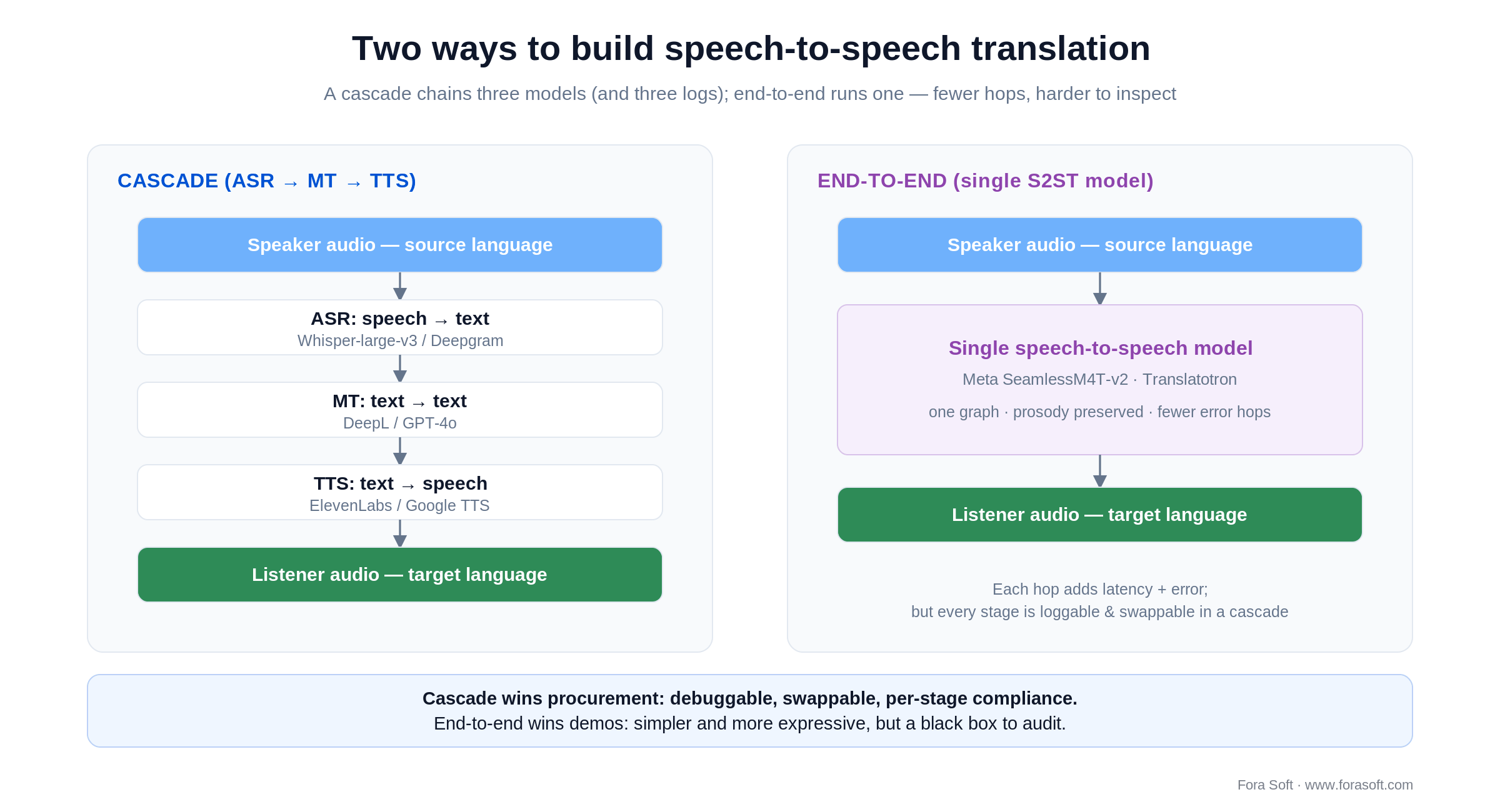
Figure 1. Cascade chains three models and three logs; end-to-end runs one graph. Cascades are easier to debug and to defend in a compliance review.
Methodology: what we synthesized
For each of the four systems we pulled every publicly available figure on accuracy, latency, and cost from named sources: vendor pages and engineering blogs (DeepL, KUDO, Interprefy, Meta AI), the two Meta papers on SeamlessM4T and Seamless streaming, Hugging Face model cards, the Open ASR Leaderboard, and trade coverage from Slator. Three gaps shape what that record can support.
Methodology mismatches. Vendors report on different test sets. Meta reports FLEURS and CVSS. DeepL publishes selected pair-wise quality on WMT-derived benchmarks. KUDO and Interprefy publish demonstration metrics with no standardized test set. The numbers below are comparable to themselves, not to each other across vendors.
Metric mismatches. Word error rate (WER) is the ASR metric. BLEU, chrF, and COMET are text-translation metrics. ASR-BLEU is BLEU computed on an ASR pass over the translated audio, used in the SeamlessM4T paper to score end-to-end output. A “best WER” ranking across vendors who report different metrics is incoherent.
Vendor self-reporting. Most marketing-page accuracy claims arrive with no test set, no confidence interval, and no third-party check. We include them where they exist, and flag them plainly. Nothing in the public record tells you how these systems perform on your audio, in your language pair, with your glossary.
Read the tables this way: treat each vendor’s numbers as internally consistent, never as a cross-vendor ranking. The only apples-to-apples accuracy test is running all four on 2 to 4 hours of your representative audio.
Accuracy: what each vendor publishes
Meta SeamlessM4T-v2 is the most reproducibly benchmarked of the four. The Hugging Face model card reports a FLEURS word error rate of 18.5% across 77 languages, a 56% reduction versus Whisper-large-v2’s 41.7% on the same set, and the papers publish both the metrics and the code. A team with a GPU can rerun the evaluation. That reproducibility is the single strongest argument for shortlisting it. The caveat: FLEURS and CVSS lean toward clean studio audio, so real conference audio with echo, crosstalk, and code-switching is not measured in any public source we found.
DeepL Voice, launched in late 2024 and now spanning 40+ languages, publishes no Voice WER table. What it does have is the strongest text-translation record of the four: public WMT benchmarks place DeepL Translate at or near the top for major European pairs on COMET and BLEU. Those numbers do not transfer cleanly to streaming speech, which stacks ASR error on top of MT error, but they point to a strong MT stage inside the Voice cascade.
KUDO and Interprefy are the honest gap in the field. KUDO has claimed “accuracy comparable to human interpreters” in press material without disclosing the test set, the pair, or the listener methodology. Interprefy launched Aivia in 2023 with accuracy-improvement claims and no released numbers, and publishes satisfaction scores rather than WER or BLEU. Both are widely deployed at large remote-interpretation events, which is a real signal of operational reliability. It is not a substitute for a benchmark.
| System | Best public accuracy artifact | Comparable across vendors? |
|---|---|---|
| Meta SeamlessM4T-v2 | FLEURS WER 18.5% / 77 langs; CVSS BLEU; ASR-BLEU | Yes, to other FLEURS/CVSS-reported models |
| DeepL Voice | Text-translation BLEU/COMET on WMT | Partially; text only, no ASR stage measured |
| KUDO AI Speech Translator | Vendor claim: “comparable to human” | No; no methodology disclosed |
| Interprefy Aivia | Vendor claim: accuracy improvements | No; no methodology disclosed |
The asymmetry is itself the finding. Two of the four leading vendors do not publish independently verifiable accuracy numbers. A buyer who treats all four as equivalent on the strength of marketing is comparing two known quantities against two unknowns.
A few field anchors set expectations. Whisper-large-v3 lands at 8% to 12% WER on FLEURS for high-resource languages and 20% to 35% on low-resource pairs such as Tamil, Swahili, and Kazakh, tracked live on the Open ASR Leaderboard. Deepgram Nova-3 reports about 5.26% WER on general English. Expect 1.5× to 2× the published WER on real-world domain audio before glossary tuning.
Latency: first-chunk versus total
Every vendor quotes “real-time” without saying which point in the pipeline they mean. The number that predicts user satisfaction is first-chunk latency: the time from when the speaker starts talking to when the listener hears the first translated word. Average latency hides the stutter that makes people talk over each other.
Two standards bracket the field. ITU-T G.114 puts comfortable one-way mouth-to-ear delay for ordinary conversation below 150 ms, with anything past 400 ms degraded. The AIIC standard for remote simultaneous interpretation treats 3 to 5 seconds end-to-end as the sustainable upper bound. Between them sits the practical budget: under 800 ms to the first word feels live, 800 ms to 1.5 s works for a keynote or lecture, and past 2 seconds listeners begin to talk over the translation.
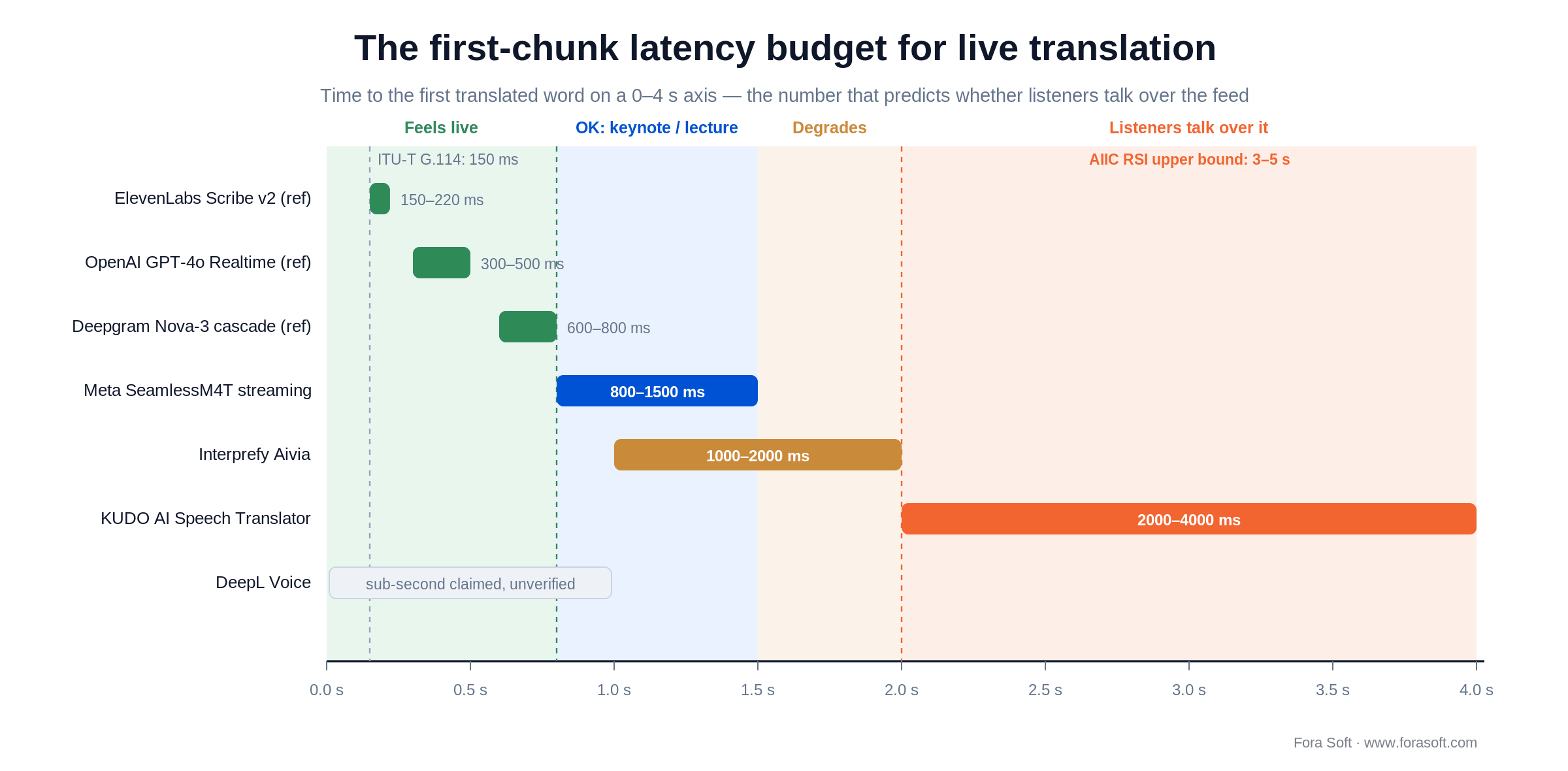
Figure 2. First-chunk latency on a time axis. Reference systems sit in the “feels live” band; event platforms drift toward “listeners talk over it.”
| System | First-chunk claim | Field-observed 2026 |
|---|---|---|
| Meta SeamlessM4T (streaming) | ~2 s (paper, SeamlessStreaming) | 800–1,500 ms with tuning and infra |
| DeepL Voice | “Real-time,” sub-second implied | Not independently measured |
| Interprefy Aivia | “Comparable to human” | 1 to 2 s in field reports |
| KUDO AI Speech Translator | “Near-instant” | 2 to 4 s in field reports |
| GPT-4o Realtime / ElevenLabs (ref) | ~300 ms / ~150 ms first-partial | 300–500 ms / ~150 ms |
The vendor number is rarely the number a user feels. Almost every production deployment adds a WebRTC jitter buffer (80 to 200 ms), a backend queue (50 to 100 ms), and TLS round trips between your server and the vendor (20 to 80 ms per hop, often two or three hops deep). Budget 500 to 700 ms of overhead on top of any published figure, then measure end-to-end from real client devices in your target regions. We break the transport side of this down in our note on real-time translation in a WebRTC call and in earbuds.
Cost per minute: the cleanest dimension
Pricing is the least ambiguous of the three axes. Vendors publish list prices, self-hosted models price out to GPU rental, and event-tier vendors quote standard packages with negotiation expected. The span is roughly 30× across the field, and the shape of the bill tells you what you are really buying.

Figure 3. List price per minute of source audio, 2026. Solid bar is the low end, the lighter extension is the high end.
| System | List price / min of source audio | Notes |
|---|---|---|
| Meta SeamlessM4T (self-hosted) | ~$0.02–$0.05 | A100 on-demand, amortized across streams |
| Custom Whisper + GPT-4o stack | ~$0.08–$0.14 | Full control of the model-swap path |
| DeepL Voice (API) | ~$0.07–$0.20 | Enterprise contact-sales; annual commit lower |
| Interprefy Aivia | ~$0.60–$1.00 | Event tier; per-attendee fees extra |
| KUDO AI Speech Translator | ~$0.80–$1.25 | Event tier; interpreter management bundled |
KUDO and Interprefy bundle interpreter management and event-platform UX into the price. If you run standalone events, that bundle earns its keep. If you embed translation into your own product, you pay for features your users never see. Watch two surprises: most vendors charge per language pair rather than per session, so a four-language event is four bills, and overage on multi-day commits runs 1.5× to 3× the contracted rate.
The four systems at a glance
One table, five dimensions, no marketing adjectives. Use it to build a shortlist, then pilot the top two on your own audio.
| System | Architecture | Published accuracy | Field latency | Best for |
|---|---|---|---|---|
| DeepL Voice | Cascade (API) | Strong MT record; no Voice WER | Sub-second claimed | European-pair webinars, GDPR |
| KUDO | Platform + engine | Marketing claim only | 2–4 s | Managed RSI events |
| Interprefy Aivia | Platform + engine | Marketing claim only | 1–2 s | Human+AI, compliance-heavy |
| Meta SeamlessM4T-v2 | End-to-end (open weights) | FLEURS 18.5% / 77 langs | ~0.8–2 s | Self-host, data residency, scale |
| Custom stack (reference) | Cascade (yours) | Whisper 8–12% WER + your MT | 0.6–1 s achievable | Product-embedded, full control |
System by system: wins and breaks
DeepL Voice
Where it wins. The best-established text-translation record of the four, which carries into a strong MT stage. Clean streaming API, competitive pricing, documented GDPR compliance with EU data residency. Where it breaks. A smaller language roster than Google or the Meta model, no published Voice WER, no voice cloning in the production tier as of mid-2026, and limited custom-glossary support for live streams.
Reach for DeepL Voice when: your dominant pairs are major European, GDPR is a hard requirement, and a single clean vendor relationship matters more than a published benchmark.
KUDO AI Speech Translator
Where it wins. A strong end-user experience across 60+ languages, tight integration with the KUDO event platform, and one-click hybrid workflows that hand a session to a human interpreter. HIPAA-grade infrastructure is available on the enterprise tier. Where it breaks. No published WER or BLEU, field latency at the high end of the band, and event-platform pricing that makes embedding into a custom product awkward.
Reach for KUDO when: you already run events on the KUDO platform, you are paying for the platform rather than the engine, and a 2 to 4 second band is acceptable for the room.
Interprefy Aivia
Where it wins. A mature compliance story, including a HIPAA tier and documented EU data residency, plus a large remote-interpretation customer base that understands enterprise events. Clean Aivia API with good documentation. Where it breaks. No published accuracy metric on a standardized set, latency reported as variable under load, and a smaller language roster than DeepL or Google.
Reach for Interprefy when: you want one vendor for human RSI plus an AI fallback, your events are predominantly European, and the latency variance fits the experience you promise.
Meta SeamlessM4T-v2
Where it wins. The most rigorous public benchmarks of the four, open weights (CC-BY-NC 4.0) that give full data residency and no per-minute marginal cost past the GPU bill, roughly 100 speech-input languages, about 100 text languages, 35 speech outputs, and voice preservation through SeamlessExpressive. Where it breaks. You own the deployment: GPU operations, serving, scaling, monitoring, and fallback. New language support lags the closed APIs by months, and the non-commercial license means the “free” model needs legal review before commercial use.
Reach for SeamlessM4T when: volume justifies a couple of A100s, data residency is mandatory, or voice preservation at scale is required and a per-minute TTS bill is not.
Cascade or end-to-end architecture
The architecture choice outlives the vendor choice, so make it first. A cascade gives you three inspection points. When a translation goes wrong, you can read the intermediate transcript and tell whether the ASR misheard or the MT mistranslated. You can swap Whisper for Deepgram without touching the MT stage, apply a glossary between ASR and MT, and keep a per-stage audit log that a compliance reviewer can actually read. That debuggability is why cascades still win procurement.
End-to-end models collapse the three stages into one graph. Fewer hops mean less accumulated latency and better prosody, because the model never throws away the tone of voice by flattening it to text. The cost is opacity: there is no intermediate transcript to inspect, and a mistranslation is harder to attribute. End-to-end wins demos and expressive use cases; cascades win regulated ones. Many production systems we ship are hybrids, with an end-to-end model on the dominant language pair and a cascade on the long tail.
Build versus buy: the self-hosting math
Self-hosting looks free until you price the GPU. A single A100 80GB on AWS on-demand serves roughly 60 to 80 concurrent SeamlessM4T-v2 streams. The fixed monthly cost is the same whether you run one stream or a hundred, so the per-minute number falls as usage rises. Here is the arithmetic, rounded and conservative.
An A100 on-demand runs about $2,200 to $2,900 per month reserved. Take $2,600. At 70 concurrent streams running 8 hours a day, 22 working days a month, that is 70 × 8 × 22 × 60 = 739,200 minutes. $2,600 / 739,200 = about $0.0035 per minute of infrastructure, before the DevOps salary to run the fleet. Now compare a cloud API at $0.10 per minute over the same 739,200 minutes: about $73,900 a month. The crossover is not subtle.
The honest caveats: that A100 rarely runs at 70 streams all day, GPU fleet management is real engineering time, and lightly loaded self-hosting is more expensive than the cloud, not less. Below roughly 60 concurrent streams sustained, cloud APIs win on total cost. Between 60 and 150 it is a judgment call, usually decided by compliance rather than dollars. Above 150 sustained, self-hosting pays back in 6 to 9 months if you have the DevOps capacity. A custom cascade on Whisper-large-v3, GPT-4o, and ElevenLabs Multilingual v2 behind a LiveKit agent lands around $0.08 to $0.14 per minute at moderate volume, competitive with DeepL Voice and fully under your control. We have shipped that exact pattern in production, and we scope it through our AI integration and real-time streaming teams.
Deciding between an API and a self-hosted build?
We will model your concurrency, latency budget, and compliance needs and give you the crossover number for your case, not a generic one.
Mini-case: an interpreter platform on the NHS framework
The situation. TransLinguist came to us to turn a video-conferencing product into an interpretation platform that could win public-sector tenders. Public-sector language services demand reliability, audit trails, and a very wide language roster, and the incumbent tools were hardware-bound interpreter booths that did not scale to remote events.
The build. We built a marketplace of 30,000+ certified interpreters and a real-time stack on MediaSoup and WebRTC, with AI speech-to-speech translation across 16+ languages and closed captioning in 22, layered on Google Cloud Speech-to-Text, Deepgram, Speechmatics, and Google TTS. Human interpretation and AI translation share one session, so a live interpreter can take over when the stakes rise, which is exactly the hybrid pattern the accuracy asymmetry above argues for.
The outcome. TransLinguist won the NHS (NOE CPC) national framework for language services across the UK, now runs 75+ languages, and reports 50% cost savings, an 80% reduction in interpreting costs, a 30% lift in engagement, 53% higher attendance, and 2× ROI within two years. It has been featured twice in Slator as a disruptive AI-driven player. Want a similar assessment of your stack? Book a 30-minute call and bring your language list and latency target.
How to read these numbers for your room
The right system depends on the room, not on a leaderboard.
Internal corporate webinars with one to four languages and low stakes: DeepL Voice on a single API endpoint, with a glossary for product names. Cost per minute is the floor here and accuracy is fine. If GDPR matters, this is the cleanest closed-source path.
Paid public events where the audience is paying attention: Interprefy or KUDO. The bundled event features earn their keep, and you are paying for the platform rather than the engine. Run the pilot in the actual room with the actual moderators, and lean on customer references rather than accuracy claims.
Multi-day conferences where cost compounds: SeamlessM4T-v2 self-hosted, or a hybrid with the Meta model on the dominant pair and a closed vendor on the long tail. Product-embedded translation running 24/7: follow the build-versus-buy math above. For the meeting-platform angle specifically, our comparison of real-time meeting translation platforms and our guide to multilingual translation in video calls go deeper.
A decision framework in five questions
Answer these in order and the shortlist writes itself. The tree below encodes the same logic.

Figure 4. Which speech-to-speech system fits your room, by deployment model and event stakes.
1. Are you embedding into your own product, or running events? Embedding points to an API or a self-hosted model; running events points to a platform vendor.
2. Is data residency mandatory? A yes narrows you to a self-hosted model or a cascade inside your own VPC, and rules out several closed APIs.
3. What is your sustained concurrency? Under 60 streams, buy. Over 150, self-hosting starts to pay back. In between, let compliance break the tie.
4. What is your first-chunk latency ceiling? If you need sub-800 ms, plan a lean cascade or a low-latency reference engine, not a 2 to 4 second event platform.
5. Do you need voice preservation or human fallback? Voice preservation points to SeamlessExpressive or a premium TTS; guaranteed fallback points to Interprefy or KUDO with human interpreters on standby.
Five pitfalls that derail translation projects
1. Trusting average latency. A system with a great average can still stutter on the first chunk of every sentence, which is exactly when listeners talk over it. Measure first-chunk, from real devices, in your regions.
2. Comparing marketing numbers as if they were benchmarks. Two of the four leaders publish no standardized accuracy metric. A side-by-side table of vendor claims is a table of unlike things.
3. Forgetting the glossary. Product names, drug names, and acronyms wreck raw WER. Budget for a custom glossary between the ASR and MT stages, which is far easier in a cascade than in an end-to-end model.
4. Missing per-language billing. Pricing is quoted per pair, not per session. A four-language event is four meters running, and multi-day overage can triple the rate.
5. Skipping the consent story for voice cloning. If you clone a speaker’s voice, you need explicit consent and a disclosure, or you inherit a legal problem the vendor will not own.
KPIs: what to measure in a pilot
Quality KPIs. WER and BLEU on your own transcribed ground truth, not the vendor’s test set, plus a human adequacy rating on 100 sampled utterances per language pair. Track terminology accuracy separately, because that is where domain audio fails first.
Cost KPIs. Effective cost per translated minute at your real concurrency, including per-language and per-attendee fees, plus the DevOps hours if you self-host. Compare against the cloud-API baseline every quarter as usage shifts.
Reliability KPIs. First-chunk latency p50 and p95 from real client devices, dropped-session rate under load, and time-to-failover when a stage misbehaves. A system that is accurate but drops one session in twenty will lose the room anyway.
Compliance: HIPAA, GDPR, and the EU AI Act
Compliance is often the tiebreaker the accuracy tables cannot settle. For healthcare, Google Cloud, Azure, AWS, and Deepgram all offer a BAA; DeepL and Interprefy offer HIPAA tiers; OpenAI offers a limited BAA on specific tiers. For maximum control, a self-hosted SeamlessM4T or Whisper inside your own HIPAA-compliant VPC removes the vendor from the trust boundary entirely.
For EU users, GDPR data residency is a real constraint, and DeepL’s documented EU residency is a genuine advantage in that market. The EU AI Act adds a transparency duty: under Article 50, providers must disclose when users interact with AI-generated or AI-manipulated audio, and that obligation applies from 2 August 2026. A synthesized translated voice falls squarely inside it, so build the disclosure into the product now rather than retrofitting it. Voice cloning raises the bar again: explicit, recorded consent from the speaker is the floor, not a nice-to-have.
When not to use AI speech translation
Honesty sells better than hype, so here is the counter-position. For low-stakes internal communication, AI speech translation is often good enough today. For legal proceedings, medical-of-record interactions, and high-stakes diplomatic or conference settings, it is not a replacement for a certified human interpreter, and treating it as one is a liability, not a saving. The right move in those rooms is human interpretation with AI as a captioning aid or a fallback, which is what platforms like Interprefy and KUDO are built around.
Skip AI-only translation when your language pair is low-resource enough that WER climbs past 25%, when a mistranslation carries safety or legal consequences, or when you cannot secure consent for voice cloning. For a fuller walk through the human-versus-AI call, see our guide to AI tools for real-time language interpretation and our overview of running a video call with a translator.
FAQ
What is speech-to-speech translation?
Speech-to-speech translation is the real-time conversion of spoken audio in one language into spoken audio or captions in another. Systems use either a cascaded architecture (speech-to-text, then machine translation, then text-to-speech) or a single end-to-end model. In 2026 latency ranges from about 300 ms to 4 seconds depending on the system.
What is the difference between speech-to-speech and speech-to-text translation?
Speech-to-text translation stops at captions in the target language. Speech-to-speech adds a text-to-speech stage and returns audio the listener hears. Speech-to-speech costs more and adds latency, but delivers a spoken voice; speech-to-text is cheaper and faster when subtitles are enough.
Which is the most accurate real-time speech translation system in 2026?
The public data does not allow a direct ranking. Meta SeamlessM4T-v2 publishes the most rigorous benchmarks (FLEURS WER 18.5% across 77 languages). DeepL has the strongest text-translation record but no published Voice WER. KUDO and Interprefy publish no standardized accuracy metric. Run a private evaluation on your own audio before committing.
How fast is fast enough for live translation?
First-chunk latency under 800 ms feels live. Between 800 ms and 1.5 seconds works for keynotes and lectures. Past 2 seconds, participants talk over the translation. AIIC standards for sustainable remote simultaneous interpretation cite 3 to 5 seconds end-to-end as the absolute upper bound.
How much does real-time speech translation cost per minute?
Budget about $0.07 to $0.20 per minute on cloud APIs at moderate volume, roughly $0.02 to $0.05 self-hosted on saturated GPUs, and $0.60 to $1.25 on event-vendor platforms that bundle interpreter management. Most vendors bill per language pair, so a four-language event is four bills.
Is AI speech translation HIPAA-compliant?
It can be. Google Cloud, Azure, AWS, and Deepgram offer BAAs; DeepL and Interprefy offer HIPAA tiers; OpenAI offers a limited BAA on specific tiers. For maximum safety, self-hosted SeamlessM4T or Whisper inside your own HIPAA-compliant VPC removes the vendor from the trust boundary.
Can AI replace human simultaneous interpreters?
For low-stakes, internal, real-time speech, often yes. For legal proceedings, medical-of-record interactions, and high-stakes diplomatic or conference settings, no. The reliable pattern is human interpretation with AI as a captioning aid or fallback.
Should we build a custom stack or buy a vendor API?
Below about 60 concurrent streams sustained, a cloud API wins on total cost. Above 150 sustained, self-hosting SeamlessM4T or a custom Whisper plus GPT-4o cascade pays back in 6 to 9 months if you have DevOps capacity. Between the two, compliance and data residency usually decide.
What to read next
Architecture
Real-Time Speech Translation for Live Video
The architecture overview and engineering constraints behind these numbers.
Comparison
Real-Time Meeting Translation Platforms
Zoom, Meet, and Teams translation compared for meetings.
Video calls
Multilingual Translation for Video Calls
Design patterns for embedding translation into WebRTC.
Interpretation
AI Tools for Real-Time Language Interpretation
Interpreter vs translator vs AI, and the pitfalls to avoid.
Services
Custom AI Language Interpretation
Work directly with the team that builds these systems.
Ready to pick a speech-to-speech vendor?
Real-time speech translation in 2026 is a four-system shortlist for buyers and a four-architecture choice for builders, held to a strict latency budget and a consent story for voice cloning. Meta SeamlessM4T-v2 publishes the most rigorous benchmarks and gives full data residency in exchange for owning the deployment. DeepL Voice brings a strong text-translation record and clean pricing, though the Voice-specific accuracy numbers are not in the public record. KUDO and Interprefy sell the event-platform bundle, not a benchmarked engine.
The single most useful thing you can do with a shortlist is run a two-week private pilot on representative audio. Public data narrows the field; private data picks the winner. If you want a second set of hands on that pilot, or an architecture that is yours to keep, that is the work we do every week.
The book · Volume 7 of 7
AI for Video: A Complete Guide to Intelligence in Video Products: From Real-Time Pipelines and Agents to Serving, Cost, Compliance, and Verticals
Benchmarks pick a vendor; running that vendor inside a live room is a separate engineering problem. Volume 7 covers it: live subtitles and translation under a real-time budget, how AI slots into a WebRTC call, model serving with vLLM, Triton and TensorRT, and what each stream-hour costs once you self-host. Written by Nikolay Sapunov, CEO at Fora Soft.
Read it on Amazon →Kindle & paperback · Fora Soft Video Engineering Handbook
Let’s pressure-test your interpretation stack
Thirty minutes, one senior engineer, zero fluff. Bring your latency number, your vendor shortlist, or just a napkin sketch.
