

Key takeaways
• The feed is the product, not the camera. Anyone can ship a vertical video player in a month. The reason people open TikTok is the ranked For You feed, and that recommender is where most clones quietly fail.
• Recommendation is a two-stage system. Candidate generation narrows millions of clips to a few hundred; a ranking model orders them by predicted watch-through. ByteDance published how their Monolith system does it in real time.
• Delivery and moderation dominate your bill, not encoding. Transcoding a 30-second clip costs fractions of a cent; serving it to millions and keeping it legal is where the money and the risk live.
• Moderation is a legal obligation, not a nice-to-have. US law requires you to report child sexual abuse material to NCMEC the moment you know about it. You need automated scanning plus human review on day one.
• We have shipped the hard parts. We built TapeReal, a creator-first social video platform running for 52,000+ members with monetization, discovery, and screen-capture protection on a stack we designed.
Why listen to us on short-video apps
Most teams that ask us to build an app like TikTok arrive with a feature list (vertical feed, filters, duets, a coin store) and no plan for the one thing that actually keeps people scrolling. They budget for the player and forget the recommender, the moderation queue, and the delivery bill that arrives the month a video goes viral. We’ve seen founders spend six months on camera effects and then discover the feed feels random and nobody comes back.
Fora Soft has built video, real-time, and AI media products since 2005: 250+ projects, a 50+ person in-house team, and a 99% job success score on Upwork. We built TapeReal, a creator-first social video platform with paid content, in-app currency, and a discovery feed, serving 52,000+ members across 20+ topic communities. This guide is what we tell clients on the first call: how the feed really works, what the pipeline looks like, what it costs, and when you shouldn’t build it at all. On the delivery side, our scalable video streaming engineers size the ABR ladder and multi-CDN setup so a viral week doesn’t break the player or the budget.
We’ll name real 2026 vendor prices, show the arithmetic, and point you to the primary sources instead of hand-waving. If you leave convinced that a clone script or a white-label is the right call for your budget, we did our job.
Scoping a short-video or social app?
We’ll map your feed strategy, moderation plan, and a realistic budget in one call — no slide deck, just engineers who have shipped social video.
What building an app like TikTok actually involves
Building an app like TikTok means shipping five systems that have to work together: a capture-and-upload client, a transcode-and-delivery pipeline, a recommendation engine that ranks a personalized feed, a moderation layer that keeps illegal and harmful content out, and the social graph and monetization around it. The vertical player is the easy fifth. The other four are the product.
Here’s the honest split. Recording, uploading, playing, following, and liking are solved-problem territory in 2026, and a competent team ships them predictably. What separates an app people open twice a day from one they delete is the feed quality and how cleanly you handle abuse at scale. Get the recommender and moderation right and you have a product. Get them wrong and you have an expensive video player with a legal problem.
This guide walks the recommender first because it decides retention, then cold-start, the video pipeline, the reference architecture, moderation and the law, features, a worked cost model, and finally a decision framework so you can pick the right path.
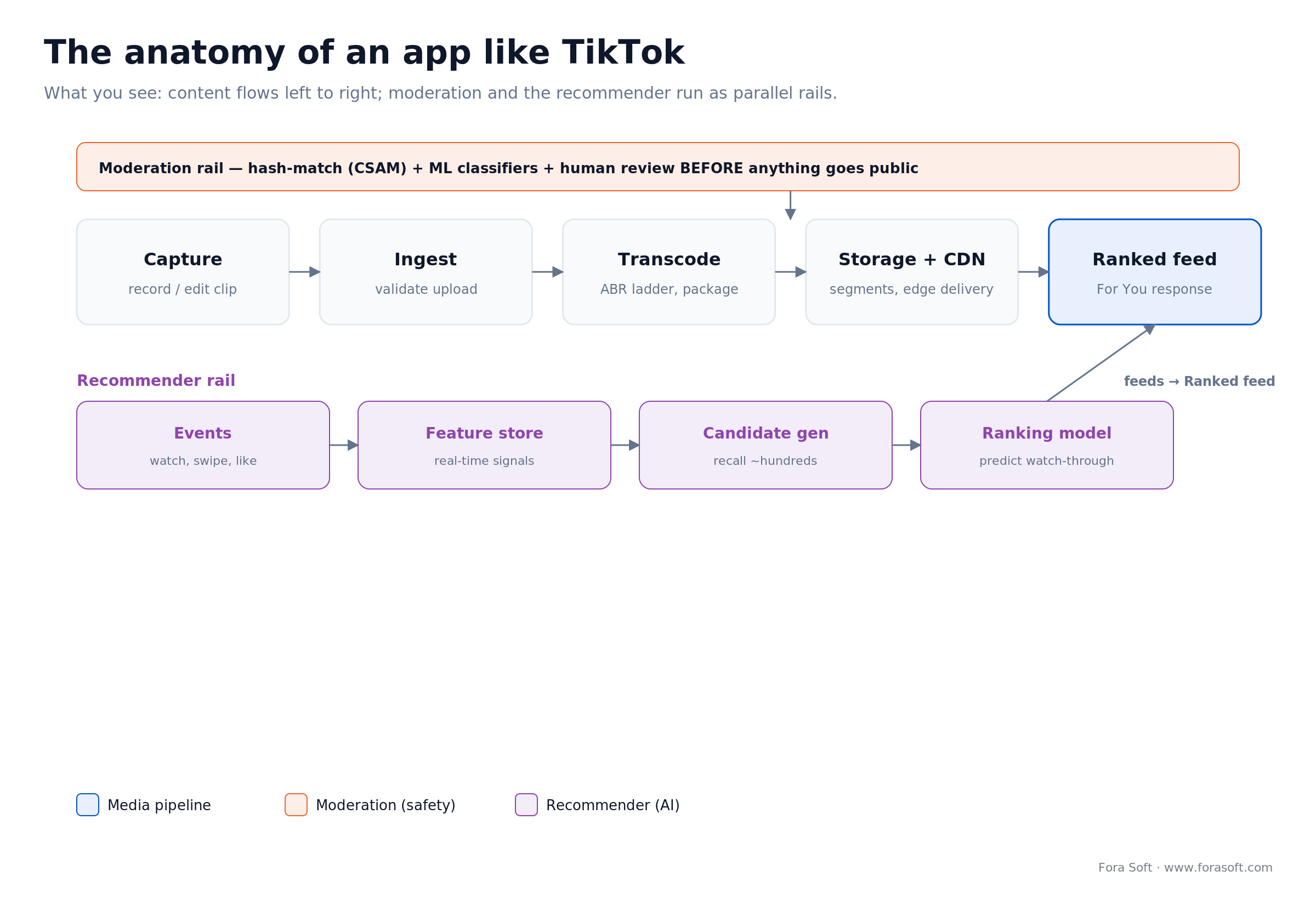
Figure 1. The anatomy of a short-video app: content flows from capture through transcode and CDN to the ranked feed, with moderation and recommendation running as parallel rails.
The feed is the product: how TikTok’s recommender really works
TikTok’s For You feed works in two stages: candidate generation narrows the entire catalog down to a few hundred plausible videos, then a ranking model scores those candidates by how likely you are to watch, replay, and share, and serves the highest scores. That shape, recall then rank, is how every large recommender works, and it’s the part clone scripts skip.
ByteDance published the design in a paper worth reading: “Monolith: Real Time Recommendation System With Collisionless Embedding Table” (arXiv, 2022). Two ideas matter for your build. First, a collisionless embedding table: user and video features are stored as vectors in a hash map that avoids the collisions ordinary fixed-size tables suffer, with rarely-seen and stale features expired to cap memory. Second, online training: the model updates from fresh engagement in near-real-time, so a video’s early watch-through can lift it within minutes rather than the next day.
The signals are unglamorous and specific: watch time, whether you finished or replayed, swipe-away speed, likes, comments, shares, and follows, weighted by recency. Completion and replay carry far more weight than a like, because they’re harder to fake and better predict the next watch. You do not need ByteDance’s scale to start; a gradient-boosted ranking model over those signals beats a chronological feed on day one. But you do need to design for it from the first schema, because retrofitting event capture into a live app is painful.
Reach for a proper recommender when: your retention depends on discovery rather than the people a user already follows. If the value is a known social graph (friends’ posts), a chronological or lightly-ranked feed is fine and far cheaper. TikTok’s bet is that the algorithm knows you better than your follow list — copy that only if it’s true for your product.
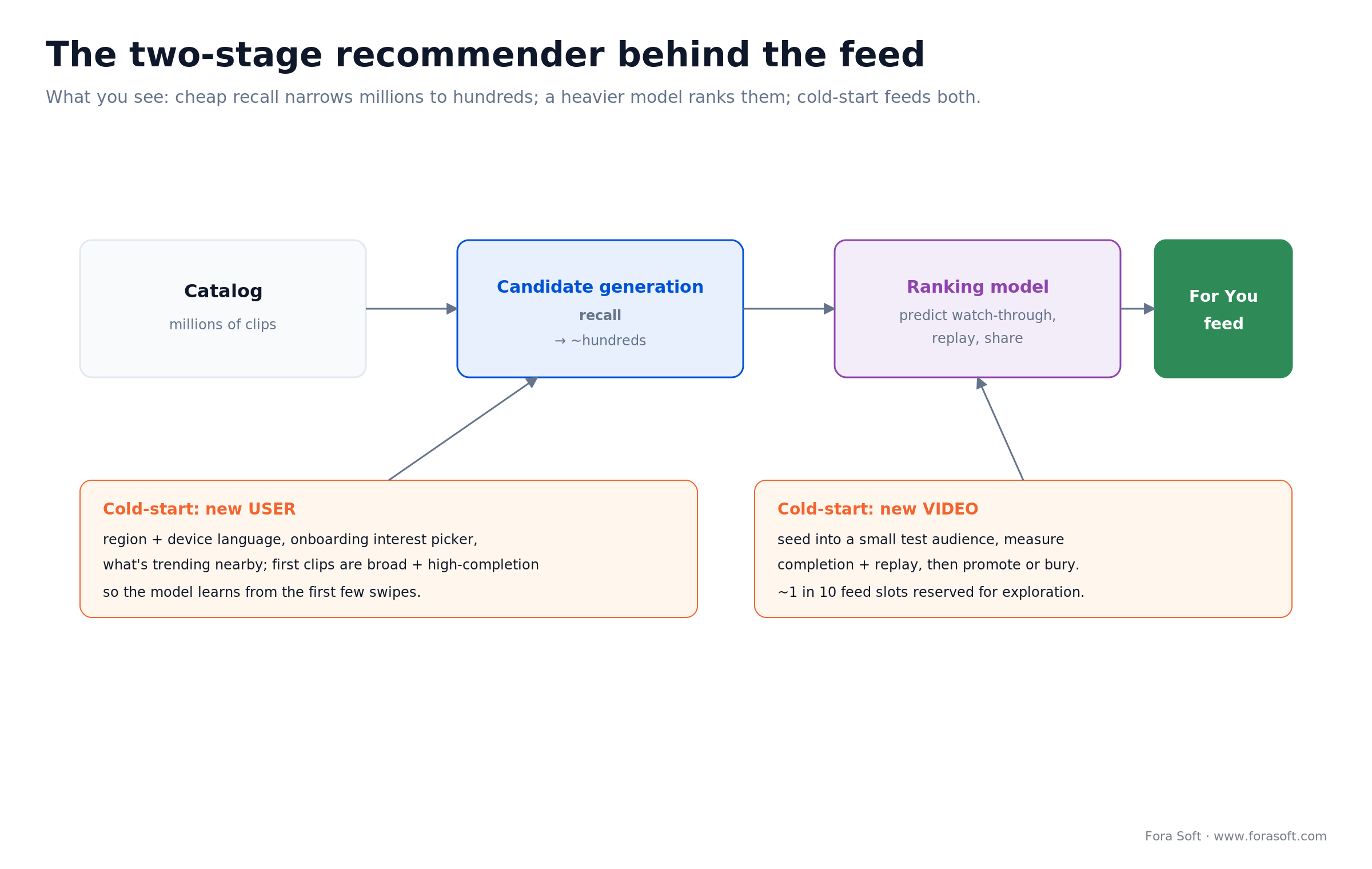
Figure 2. The two-stage recommender: cheap recall pulls candidates, a heavier ranking model orders them by predicted engagement, and cold-start paths handle new users and new videos.
We keep the recommender deliberately shallow here because it deserves its own treatment. For the modeling detail — embeddings, ranking objectives, and how to evaluate a feed offline — see our guide to AI content recommendation systems.
Solving cold-start: the problem that sinks new short-video apps
Cold-start is the chicken-and-egg problem where a brand-new user has no history to personalize against and a brand-new video has no engagement to rank on. It’s the single biggest reason a fresh app’s feed feels empty or random, and TikTok’s early growth came largely from solving it well.
For a new user, you fall back to signals you do have: device language and region, a lightweight interest picker at onboarding, and what’s trending near them right now. The first ten videos should be broadly appealing, high-completion clips that let the model learn fast from the first few swipes. For a new video, you seed it into a small test audience, measure completion and replay, and promote or bury it from there — an exploration step that keeps fresh content flowing instead of only recycling proven hits.
The practical trap is over-exploiting. A model that only shows proven winners starves new creators, and a short-video app with no new creators dies. Budget a slice of every feed (TikTok-style, roughly one in ten slots) for exploration, and accept that it costs you a little watch time today to keep the catalog alive tomorrow.
The video pipeline: upload, transcode, deliver at scale
Every clip a user posts runs the same path: the app uploads the raw file, a transcode step produces several renditions at different bitrates, a packager wraps them for adaptive streaming, and a CDN delivers the right rendition to each viewer’s connection. Short clips are tiny, but the volume is enormous, so the pipeline has to be cheap per video and horizontally scalable.
On codecs, H.264/AVC is the compatibility baseline that plays everywhere. AV1 and HEVC compress noticeably better, and bit-efficient codecs can cut CDN and storage costs by up to ~30% (AWS Media blog), but they cost far more to encode and aren’t universal on older devices. The pragmatic 2026 default: ship H.264 for reach, add AV1 for your highest-traffic clips where the delivery savings pay back the encode premium. On packaging, deliver adaptive HLS (Apple) or MPEG-DASH so playback drops to a lower bitrate on weak connections instead of stalling.
You don’t have to run FFmpeg yourself. Managed encoders price by the minute: AWS Elemental MediaConvert’s Basic tier — the one AWS recommends for user-generated and short-form content — prices 1080p H.264 single-pass at roughly $0.015 per output minute (a 2× HD normalization on the $0.0075 base rate, captured July 2026), with AV1 running about 3.5× that at matching resolution (MediaConvert pricing). Mux bundles encode, storage, and delivery per minute with the first 100,000 delivery minutes free each month (captured July 2026). We cover the build-versus-buy math for encoders in our video encoding learn track.
Reach for a managed encoder when: you’re pre-product-market-fit and every engineer-hour matters. Self-hosted FFmpeg on spot instances is cheaper per minute at scale, but only after your volume is predictable enough to keep the fleet busy. Start managed, move heavy renditions in-house once the bill justifies the ops.
Reference architecture: from camera to For You feed
A short-video app is a set of services around a media pipeline and a feed API. The client captures and uploads; an ingest service validates and hands off to transcoding; a moderation service scans before anything goes public; a catalog stores video metadata and the social graph; an events pipeline captures every watch and swipe; and a feed service joins the recommender’s output with the catalog to answer “what next?” in under a couple hundred milliseconds.
The non-obvious design choice is the event pipeline. Watch-time and swipe events are the fuel for the recommender, and they arrive at the same volume as views — millions per minute at scale. You want a streaming backbone (Kafka or a managed equivalent) feeding both a real-time feature store for ranking and a warehouse for training. Design this early; bolting analytics onto a request-response backend after launch is the rework that eats a quarter.
| Layer | Job | Common choice |
|---|---|---|
| Client | Capture, edit, upload, adaptive playback | React Native or native iOS/Android, HLS/DASH player |
| Ingest & transcode | Validate, produce renditions, package | MediaConvert / Mux, or FFmpeg on autoscaled workers |
| Storage & CDN | Store segments, deliver globally | S3-compatible object store + CDN edge |
| Moderation | Scan before publish, route to review | Hive / AWS Rekognition + human queue |
| Events & features | Capture watch/swipe, serve features | Kafka + real-time feature store + warehouse |
| Recommender & feed | Recall, rank, assemble For You | Candidate service + ranking model + feed API |
Content moderation and the law you can’t skip
Content moderation for a user-generated video app is a legal requirement before it’s a product feature. Under US federal law (18 U.S.C. §2258A), electronic service providers must report known child sexual abuse material (CSAM) to the National Center for Missing & Exploited Children’s CyberTipline. If users can upload video, this applies to you from your first upload, not at some future scale.
The working pattern is layered. Before a video goes public, run it through hash matching against known-bad databases — Thorn maintains 57M+ known CSAM hashes, and providers like Hive wire that plus NCMEC reporting into one API — then ML classifiers for nudity, violence, and other policy categories (AWS Rekognition and Hive both do this at scale). Anything the classifiers flag as uncertain goes to a human review queue, and users get a report button and an appeals path. Automation catches volume; humans catch context.
Two mistakes we see. Teams treat moderation as a phase-two feature and launch exposed, or they buy a classifier and skip the human queue, which means false positives silently kill legitimate creators and real edge cases slip through. Budget both the API cost and the review staffing from the start — it’s a recurring operating cost, not a one-time build.
Reach for a specialist moderation vendor when: you accept public uploads from strangers, which is the whole premise of an app like TikTok. Building CSAM detection in-house is the wrong place to save money — the hash databases are access-controlled and the legal reporting flow is exacting. Buy this; build your differentiation elsewhere.
The feature set: what’s MVP and what’s later
A short-video MVP needs enough to test whether people come back, and no more. That’s: record or upload a vertical clip, basic trim and music overlay, a ranked feed (even a simple one), follow and like, comments, a report button, and the moderation pipeline behind it. Everything else — duets, stitches, live streaming, a coin economy, advanced effects — is a fast-follow once retention proves out.
The temptation is to copy TikTok’s full surface on day one. Don’t. The effects and creator tools are enormous engineering, and they don’t matter if the feed doesn’t retain. We tell clients to spend the MVP budget on feed quality and upload reliability, then earn the fancy features with real usage data.
| Phase | Features | Why here |
|---|---|---|
| MVP | Upload/record, trim + music, ranked feed, follow/like, comments, report, moderation | Tests retention and legality — the two make-or-break unknowns |
| Fast follow | Duets/stitch, richer effects, search, hashtags, notifications, creator analytics | Earned once the feed retains; deepens engagement |
| Monetization | Coins/gifts, creator payouts, ads, subscriptions, shopping | Needs an audience and payment/compliance work first |
The tech stack we reach for
There’s no single right stack, but a proven, boring shape gets you to market fastest: React Native (or native Swift/Kotlin where camera performance matters) on the client, a Node.js or Python service backend, PostgreSQL plus a search index for the catalog and social graph, S3-compatible object storage for segments, a managed encoder or FFmpeg workers for transcoding, Kafka for the event pipeline, and a CDN for delivery. Add a ranking model served behind a low-latency feature store, and a moderation vendor in front of publish.
Two stack decisions carry the most weight. Native versus cross-platform is really a question of how custom your camera and effects are — heavy real-time filters push you native; a standard recorder is fine on React Native. And managed versus self-hosted media infrastructure is a cost-timing decision, not a taste one: managed to launch, selectively self-hosted once volume justifies the ops. For the client-side playback details, our custom video player guide and our notes on optimizing Android video apps go deeper.
What you’re up against: the scale of short video
The short-video opportunity is enormous and brutally competitive at once. TikTok runs on the order of a billion-plus monthly active users with roughly 23 million videos uploaded a day (industry trackers, 2026), and the broader short-video platforms market is projected to reach about $3.24 billion by 2030 at roughly 10% CAGR (Grand View Research). Treat those aggregate figures as directional; the point is the shape, not the decimal.
Those numbers cut two ways. The market is real and monetizable, which is why founders keep funding short-video apps. But the incumbents have spent years and billions tuning their feeds, so a general “TikTok competitor” walks into a fight it can’t win on the algorithm alone. The winners of the last few years — niche creator platforms, regional apps, vertical communities — won by serving an audience the giants under-serve, then applying the short-video format there.
Reach for a vertical wedge when: you’re entering a space TikTok already dominates. A defensible short-video app targets a specific community, content type, or geography where you can build a catalog and creator base the incumbents ignore. “TikTok for X” beats “TikTok but better” almost every time.
What it costs to build and run (worked numbers)
A short-video MVP with a real feed and moderation runs roughly $50,000 to $90,000; a production platform with a tuned recommender, native apps, effects, and monetization runs $150,000 to $300,000 and up. Those are conservative ranges — we use Agent Engineering to move faster than typical shops, and we quote fixed scope after a discovery call rather than selling you a padded estimate. But the number that surprises founders isn’t the build; it’s the monthly bill once videos are flowing.
Here’s the arithmetic that matters. Take 100,000 daily active users, each watching about 8 minutes of video a day, and assume 2% of them upload one 30-second clip daily.
Encoding. 2,000 uploads × 0.5 min = 1,000 source-minutes/day × 30 = 30,000 source-minutes/month. A single 1080p H.264 rendition at MediaConvert Basic’s ~$0.015/output-min is about $450/month; a real 4–5-rung adaptive ladder multiplies the output minutes, landing encoding near $1,000–$2,000/month. Either way it’s a rounding error.
Delivery. 100,000 users × 8 min/day at roughly 1.5 Mbps averages about 90 MB per user per day, or ~9 TB/day — call it ~270 TB/month of egress. At a conservative planning rate of $0.02–$0.04 per GB (CDN rates vary by provider and commit), that’s roughly $5,400 to $10,800/month. This is your dominant cost, and it grows with watch time.
Moderation. 60,000 videos/month through automated scanning plus a human review queue lands in the low thousands of dollars a month, before you count reviewer salaries. It scales with uploads, not views.
The lesson: budget for delivery and moderation as ongoing operating costs from day one, because a viral week multiplies them overnight while your encode bill barely moves. We size these against your real growth curve on the first call, not from a spreadsheet of averages. If you want that model before any code is written, our MVP planning service turns it into a prioritized feature list and a launch blueprint within a week.
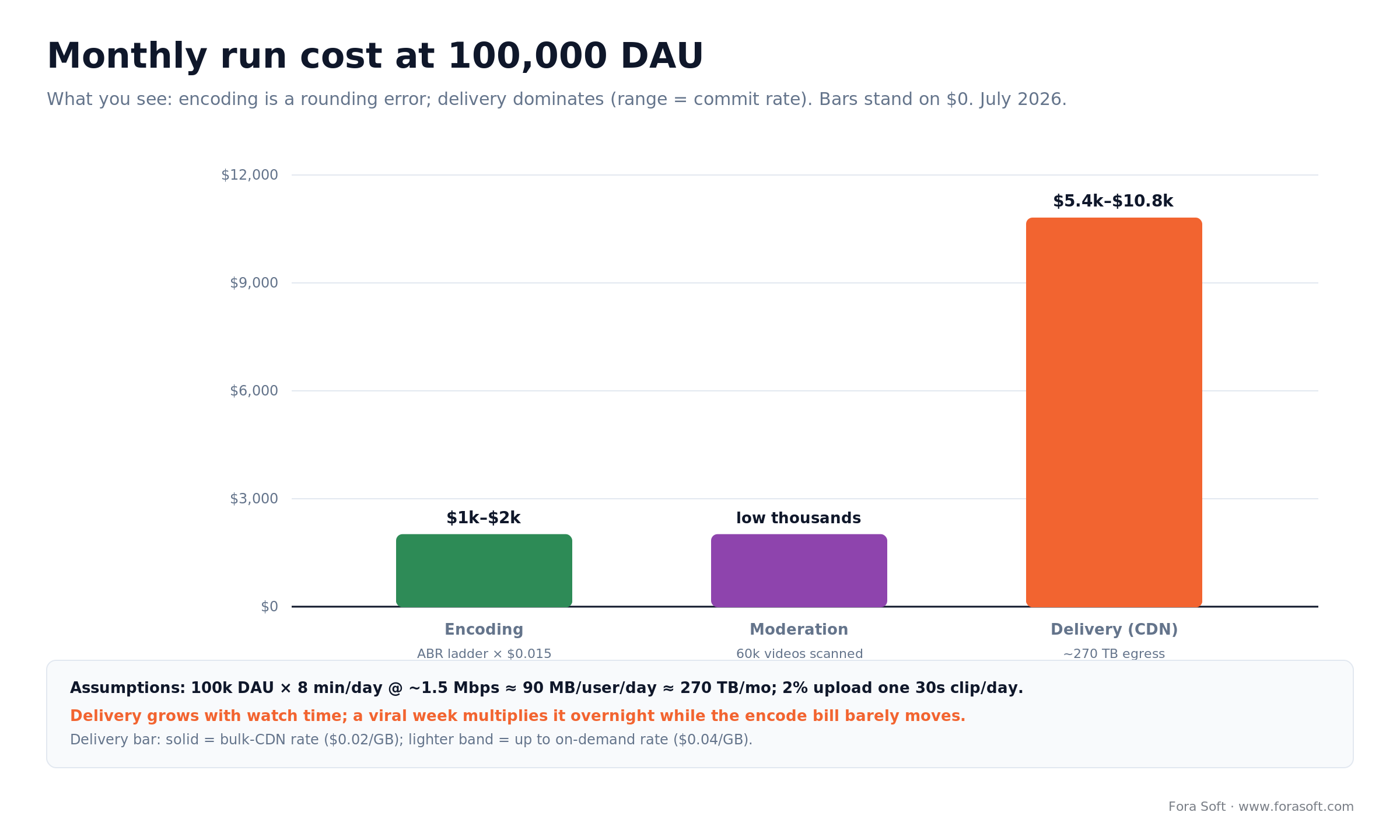
Figure 3. Worked monthly operating cost at 100,000 DAU: encoding is negligible, delivery dominates, and moderation is a real recurring line. Delivery and moderation, not encode, decide your unit economics.
Want a real number for your app?
Bring your target audience and growth curve; leave with a fixed-scope build estimate and a monthly run-cost model — from engineers who have shipped social video.
How short-video apps actually make money
Short-video apps make money four ways: virtual gifts and coins that fans send creators (with the platform taking a cut), in-feed advertising, premium subscriptions, and shoppable commerce. Most start with none of them and earn the right to monetize once they have an audience worth monetizing.
The order matters. Coins and gifts are the fastest to stand up and align your revenue with creator success, which is why they anchor most consumer short-video economics. Advertising needs scale and a clean brand-safety story before advertisers pay real rates. Subscriptions work when creators offer something worth paying for behind a paywall. Commerce — tapping to buy the product in a clip — monetizes best but adds payments, fulfillment, and returns to your build. Pick one to launch, instrument it well, and add the rest as the audience earns them.
Each model carries build weight you should price in: coins and payouts mean payment processing, fraud controls, and tax reporting; commerce means a catalog and checkout. On TapeReal we shipped an in-app currency (RealCoins, convertible to USD) with paywalled posts, so we know the compliance and payout work these features actually take.
Mini-case: a creator-first social video platform at 52,000 members
A serial founder came to us to build TapeReal, a creator-first social video platform positioned as a YouTube alternative where creators, not an algorithm, control their audience and monetization. The hard requirements were the same ones any app like TikTok faces: reliable video and audio capture, a discovery mechanism, paid content, and protection against people ripping off creators’ work.
We built it on iOS and web with WebRTC, Swift, GraphQL, and AWS. Creators publish video and audio, lock exclusive posts behind custom paywalls, and earn RealCoins — an in-app currency convertible to USD. A “Channel Swipe” discovery feature surfaces creators to new viewers, and screen-capture protection guards paid content from being lifted.
Today TapeReal serves 52,000+ members across 20+ topic communities, with creators monetizing directly through paid posts and RealCoins on the strength of a shipped, working product. The honest contrast with TikTok is instructive: TapeReal deliberately skips the ranking algorithm in favor of creator control. If you want the algorithmic feed, that’s the piece you add on top of exactly this social-video foundation — which is why we know where the real cost and risk sit. Book a call and we’ll walk you through it.
Clone script vs custom build: five questions
The market sells “TikTok clone scripts” for a few thousand dollars, and for the right project they’re a reasonable start. For most, they become the thing you rebuild in year one. Answer these five questions before you decide.
1. Is discovery your differentiator? If retention hinges on feed quality, a clone script’s canned recommender won’t cut it — build custom. If your value is a niche community, a clone gets you live faster.
2. How much traffic do you expect? Clone scripts rarely survive a viral spike. If you’re planning for scale, you need architecture you control.
3. Do you have moderation and legal covered? Many scripts ship without CSAM detection or NCMEC reporting. If yours does, that’s a non-negotiable gap you must close before launch.
4. Will you need to customize deeply? Effects, monetization, and unusual content types fight against a clone’s assumptions. Heavy customization erases the time savings.
5. Who maintains it? A cheap script with no source access or support is a liability the first time it breaks. Custom code you own is an asset. If three or more answers point to scale, differentiation, or ownership, build custom — and that’s the work we do.
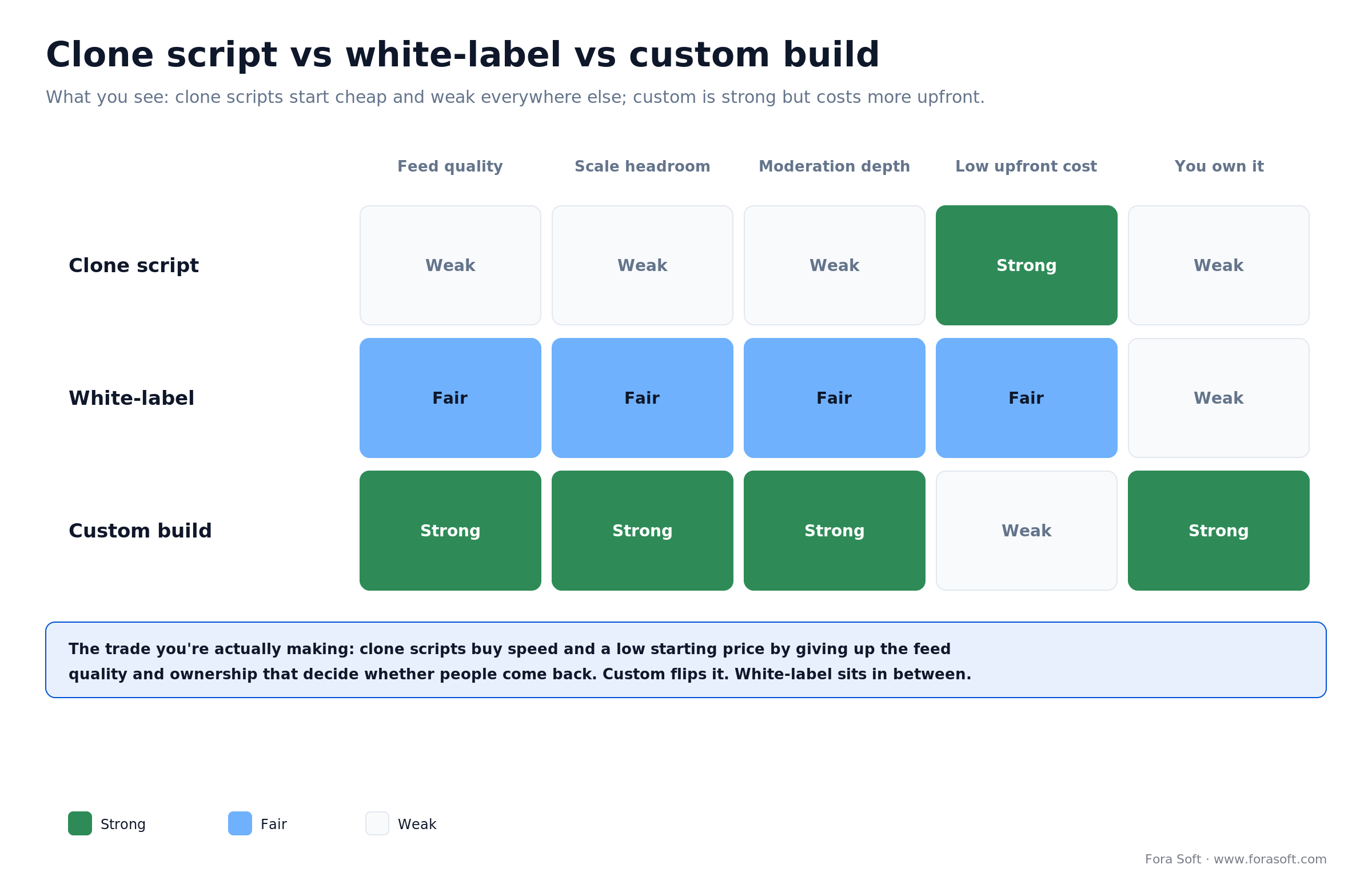
Figure 4. Clone script vs white-label vs custom build, scored across the five factors that decide the call: feed quality, scale, moderation, cost, and ownership.
How long it takes to build
A focused short-video MVP takes four to six months of engineering; a full custom platform with a tuned feed, native apps, and monetization runs nine to fifteen months. The recommender and moderation are what stretch timelines, so a sensible plan ships a usable feed early and improves it with real engagement data rather than waiting for a perfect algorithm.
| Phase | Typical duration | What ships |
|---|---|---|
| Discovery | 2–3 weeks | Scope, architecture, moderation and cost model |
| MVP | 4–6 months | Upload, ranked feed, social basics, moderation pipeline |
| Feed tuning | ongoing | Better ranking, cold-start, exploration, A/B tests |
| Scale & monetize | 3–6+ months | Effects, coins/ads, native apps, infra hardening |
Five pitfalls that kill short-video app projects
1. Building the player, not the feed. Teams polish the camera and ship a random feed. People swipe once and leave. Feed quality is the retention lever — fund it first.
2. Ignoring cold-start. A new app with no history and no exploration serves an empty-feeling feed to exactly the users you’re trying to win. Design the fallbacks before launch.
3. Treating moderation as phase two. Launching public uploads without a CSAM plan is reckless: US law (18 U.S.C. §2258A) makes it a crime to fail to report known CSAM to NCMEC, and while the statute doesn’t compel proactive scanning, you can’t report what you never detect. This is a day-one system.
4. Under-budgeting delivery. The encode bill is trivial; the egress bill scales with every minute watched. A viral week can 10× your CDN cost overnight if you didn’t model it.
5. Not capturing events from day one. Watch-time and swipe events train the recommender. If you don’t log them from launch, you can’t improve the feed later without a painful retrofit.
When NOT to build an app like TikTok
Don’t build a general TikTok competitor. The consumer short-video market is a winner-take-most fight against platforms with billions of users and years of algorithm tuning, and “TikTok but slightly different” has no wedge. Every viable short-video app we’d take on has a specific reason to exist that TikTok can’t serve.
Skip it if your real need is a known-friends social graph, since a chronological feed is cheaper and better for that. Skip it if you can’t staff moderation, because the legal exposure is real and unforgiving. And skip the full algorithmic build if you’re pre-audience: start with a vertical, a community, or a creator niche where discovery matters less, prove retention, and add the recommender when you have the engagement data to train it. The best version of “an app like TikTok” is usually TikTok’s format applied to a market it ignores.
FAQ
How much does it cost to build an app like TikTok?
A short-video MVP with a real feed and moderation runs roughly $50,000 to $90,000; a full custom platform with a tuned recommender, native apps, and monetization runs $150,000 to $300,000 and up. The bigger surprise is the monthly run cost — delivery (CDN egress) and moderation, not encoding, dominate the bill and scale with watch time.
How does the TikTok algorithm actually work?
In two stages: candidate generation narrows the catalog to a few hundred videos, then a ranking model scores them by predicted watch-through, completion, replay, and shares. ByteDance published the design as “Monolith” (arXiv 2022), which uses a collisionless embedding table and online training so fresh engagement updates the model in near-real-time. Completion and replay weigh more than likes.
How long does it take to build a short-video app?
A focused MVP is typically four to six months of engineering; a full custom platform with a tuned feed and native apps is nine to fifteen months. The recommender and moderation are the parts that expand timelines, so scope the MVP around feed quality and upload reliability first.
Should you use a TikTok clone script?
A clone script can get a niche community live fast, but it usually falls short on feed quality, scale, and moderation — many ship without CSAM detection or NCMEC reporting, which is a legal gap you must close. If discovery is your differentiator or you expect real traffic, build custom code you own.
What tech stack is best for a TikTok-like app?
A proven shape: React Native or native iOS/Android clients with an HLS/DASH player, a Node.js or Python backend, PostgreSQL plus a search index, S3-compatible storage, a managed encoder (MediaConvert or Mux) or FFmpeg workers, Kafka for the event pipeline, a CDN for delivery, and a ranking model behind a feature store. Add a moderation vendor in front of publish.
Is content moderation legally required?
Yes. Under US law (18 U.S.C. §2258A), electronic service providers must report known child sexual abuse material to NCMEC’s CyberTipline. If users can upload video, you need automated hash matching and ML scanning plus a human review queue from your first upload — not at some future scale.
What’s the biggest hidden cost of a short-video app?
CDN delivery. Encoding a 30-second clip costs fractions of a cent, but serving millions of watch-minutes is where the money goes. At 100,000 daily users watching 8 minutes a day, egress alone can run several thousand to over ten thousand dollars a month, and a viral week multiplies it. Moderation is the second recurring cost.
How do you solve the cold-start problem?
For new users, fall back to region, language, an onboarding interest picker, and trending content, and show broadly-appealing high-completion clips so the model learns fast. For new videos, seed them to a small test audience, measure completion and replay, and promote from there. Reserve roughly one in ten feed slots for exploration so new creators aren’t starved.
What to read next
Technologies
AI Content Recommendation Systems
The engine behind the For You feed: embeddings, ranking, and evaluating recommendations.
Development
Build a Streaming Service Like Netflix
The long-form, on-demand counterpart — a licensed library instead of short-form UGC.
Development
Custom Video Player Development
The client-side playback layer: adaptive streaming, buffering, and a smooth vertical feed.
Services
Video & Audio Streaming Development
How we build streaming and social video products end to end, from pipeline to feed.
Ready to build your short-video app?
An app like TikTok is a recommendation and moderation product wearing a video player’s clothes. The camera, upload, and playback are well-understood and ship predictably. The decisive work is a feed that retains, a cold-start plan so it doesn’t feel empty on day one, moderation that keeps you legal, and a delivery bill you modeled before it arrived. Copy the format, not the whole surface — win a market TikTok ignores.
We’ve built social video at real member scale, and we’ll give you honest numbers and an honest recommendation — including when to use a clone script or not build at all. Explore our video and audio streaming development services, see the TapeReal project in detail, or compare notes with our general video streaming app guide.

The handbook · 7 volumes
Fora Soft Video Engineering Handbook
The cost math made it plain: encoding is a rounding error, while delivery and moderation decide the unit economics of a short-video app. Our seven-volume Fora Soft Video Engineering Handbook covers that whole stack. Begin with Volume 3 on ABR ladders, CDN caching and delivery economics, then use Volume 1 for transcoding vertical clips and Volume 6 for computer vision checks on uploads. Written by Nikolay Sapunov, CEO at Fora Soft.
Browse the handbook on Amazon →7 volumes · 9,000+ pages · Kindle & paperback
Let’s scope your short-video platform
Bring your niche and audience; leave with a feed strategy, an architecture sketch, and a fixed-scope estimate from engineers who have shipped social video.