

Pet owners want to see a vet the way they see their own doctor: from the couch, on video, tonight. The demand is real and the market is growing more than 25% a year. But veterinary telemedicine has one constraint human telemedicine doesn’t, and it decides your entire product: in most of the United States a veterinarian legally cannot establish care over video. The veterinarian-client-patient relationship, the VCPR, is the hinge the whole platform swings on, and only eight states let you form it remotely. Build the video calling and skip the VCPR logic and you’ve shipped software that’s illegal to use across most of the country. We’ve built HIPAA-grade telemedicine on WebRTC before (a multi-state subscription practice and a cross-border video marketplace), so this guide is the builder’s version: what to build, where the law bites, what it costs, and when to buy instead.
Key takeaways
• The VCPR is the product, not a footnote. Federal guidance holds that a VCPR “cannot be established solely through telemedicine” (FDA, via AVMA). As of mid-2026 only eight states let a vet form that relationship over video; the rest require a prior in-person exam. Your booking flow has to enforce this per state, per veterinarian license.
• There’s no HIPAA for pets, but you’re not off the hook. Animal records aren’t protected health information, yet the owner is a human whose payment data (PCI DSS) and personal data still need protecting. Vet telemedicine trades HIPAA for VCPR and prescribing law, not for “no rules.”
• Prescribing is where the law gets specific. California’s AB 1399 (effective January 1, 2024) allows a video-established VCPR but caps general prescriptions at six months, antimicrobials at 14 days, and bars controlled substances without an in-person exam. Encode these rules; don’t leave them to the vet to remember mid-call.
• The stack is WebRTC plus integrations. Real-time video is the easy 20%. The value is the wiring: practice-management software (PIMS), an e-prescribing and home-delivery pharmacy path, payments, and state-aware scheduling. An agent that talks but can’t write to the practice’s records is a demo.
• Most single clinics should buy; build when you’re a network or a platform. Off-the-shelf tools (TeleVet, Vetster, Airvet) fit one practice. Building pays off when you run many clinics, need integrations no product offers, or you’re launching a telehealth product of your own and the compliance engine is your moat.
Why Fora Soft wrote this guide
We build real-time video and telemedicine software, and we’ve shipped the exact parts a veterinary platform is made of. Fora Soft has delivered 250+ projects since 2005 (that’s more than 20 years) with a team of 50+ in-house specialists, much of it on WebRTC video and healthcare-grade systems where compliance is designed in rather than bolted on.
Two builds sit right under this article. We built CirrusMed, a browser-based telemedicine platform on WebRTC, React, Node.js, Twilio, and Stripe for a Direct Primary Care practice — subscription plans, peer-to-peer video visits, prescription management, medical records, and multi-state practice support across 48+ US states. Swap the human EMR for a veterinary PIMS and the multi-state licensing logic for VCPR-by-state, and you have most of a vet platform. We also built AirDoctor, a telemedicine marketplace connecting travelers with local doctors, with video consults in 21 languages across dozens of countries — the same marketplace shape Vetster uses for pets.
So when this guide talks about VCPR enforcement in the booking flow, e-prescribing hand-offs, or PIMS sync, it’s from shipping those things under real regulatory load. If you want the short version of how we’d scope yours, our telemedicine development team does these builds; the rest of this page is how the decision should go. This is the veterinary companion to our broader telemedicine platform development guide, which covers the human-health version where HIPAA, not the VCPR, is the governing constraint.
What a veterinary telemedicine platform actually is
A veterinary telemedicine platform is software that lets a licensed veterinarian care for an animal patient remotely: a pet owner books a visit, joins a live video call (or sends photos and messages), the vet assesses the animal, gives advice or a diagnosis where the law allows, and where appropriate writes a prescription and schedules follow-up. Under the hood it’s a scheduling system, a real-time video layer, a clinical-notes and records store, a prescribing path, and payments — all wrapped in rules about who may do what, where.
It helps to name what it is not. It’s not a generic video-calling app with a paw-print logo; a Zoom link can’t check whether this vet is licensed in the owner’s state or whether a VCPR exists. And it’s not a human telemedicine platform re-skinned; the compliance model is different in ways that reach all the way into your database schema. The useful mental model is a booking-and-records system with a video pipe through the middle and a compliance engine around the edge.
The market backdrop is why this keeps landing on product roadmaps. Estimates diverge widely by firm, but they agree on direction: Fortune Business Insights put the veterinary telehealth market at roughly $2.05 billion in 2025 growing toward $2.61 billion in 2026 at about 27% a year, and separate research cited by the National Law Review projects around $6.4 billion by 2030 at a 25.5% CAGR. Treat any single figure as directional; the growth rate is the real signal.
Vet vs human telemedicine: VCPR, not HIPAA
If you’ve built human telemedicine, unlearn one reflex: HIPAA does not apply to pets. HIPAA protects a person’s health information, and an animal’s medical record isn’t protected health information. That removes a familiar constraint — and replaces it with two less familiar ones that are, in practice, harder to get right.
The first is the VCPR. The second is state prescribing law, which we cover below. Where a human platform asks whether the data is encrypted and access-logged to HIPAA’s standard, a vet platform asks “is this veterinarian legally allowed to diagnose and prescribe for this animal, in this state, over video, right now.” That question has to be answered in code, before the call connects, for every visit.
The one-line difference: human telemedicine is governed by how you handle the data (HIPAA); veterinary telemedicine is governed by whether the relationship and the prescription are legal (VCPR + state pharmacy law). We split those intents on purpose — the HIPAA-centric build lives in our human telemedicine platform guide; this page is strictly the veterinary version.
The VCPR problem: which states let you start care by video
The veterinarian-client-patient relationship is the legal basis for practicing on a specific animal. The AVMA Model Veterinary Practice Act defines it through a handful of conditions: the vet takes responsibility for clinical judgments and the client agrees to follow them; the vet has enough knowledge of the animal from a timely examination or appropriate visits; the vet is available for follow-up and has arranged emergency and continuing care; the vet oversees treatment and outcome; and records are kept. The phrase that decides your architecture is “timely examination.”
Federal guidance is blunt about it. The FDA, in a letter quoted by the AVMA, states that “a VCPR cannot be established solely through telemedicine.” The rest — around 42 states plus the District of Columbia — use language essentially the same as the FDA’s. As of mid-2026, only eight states allow a veterinarian to establish the VCPR remotely (an electronic or E-VCPR), and a handful more (Massachusetts, Michigan, New Hampshire, and Rhode Island among them) have bills in flight. Because this map keeps changing, treat the live source as the truth and design for change; the Veterinary Virtual Care Association maintains a state-by-state map worth wiring into your compliance review.
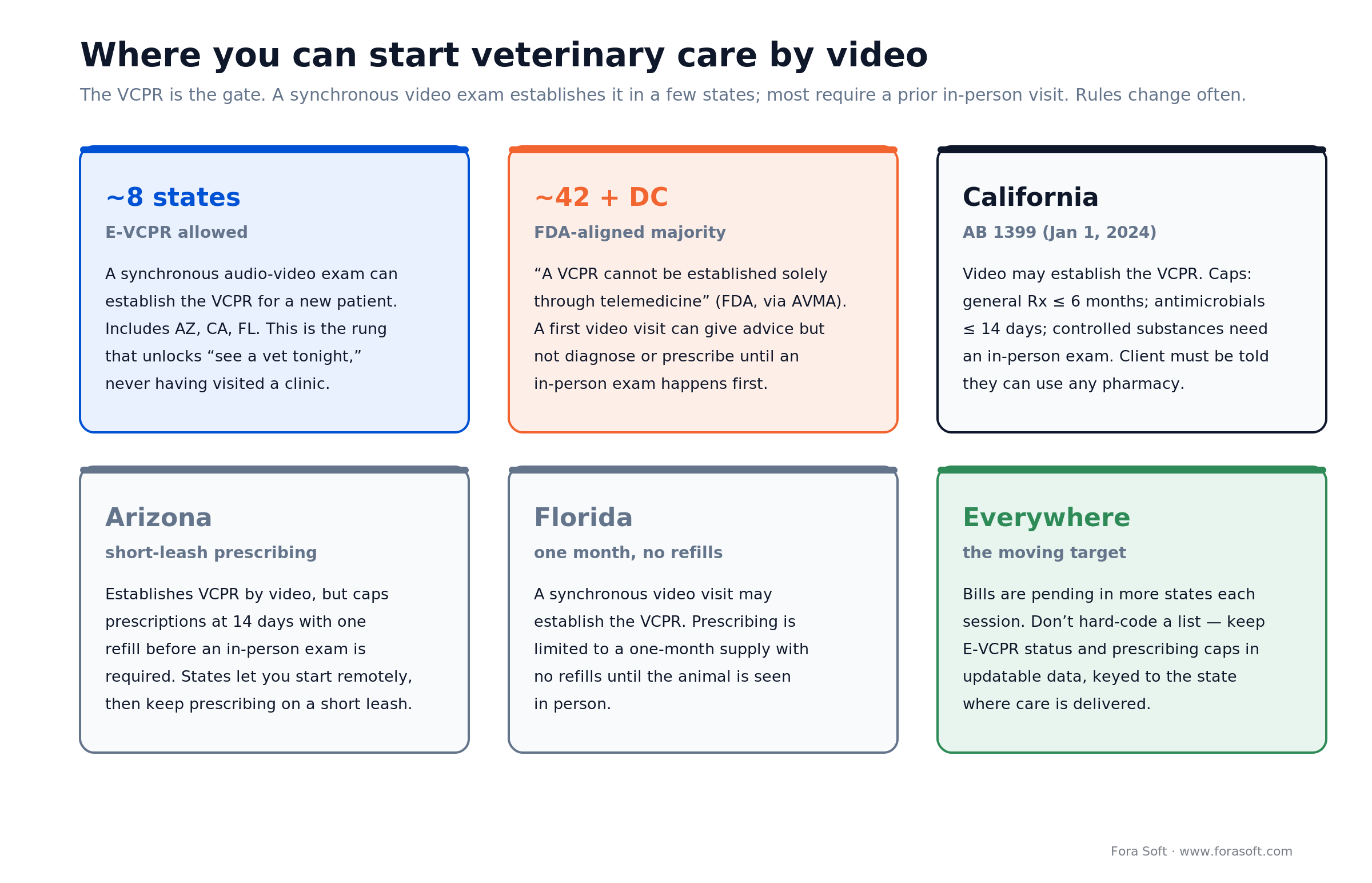
Figure 1. The patchwork you have to encode. A minority of states let you form the VCPR by video; most require a prior in-person exam. Treat the live VVCA map as canonical.
What this means for the build: your scheduling logic has to know the owner’s state, the vet’s licensed states, and whether a VCPR already exists for this animal-and-vet. In a no-E-VCPR state, a first-time video visit can offer general advice but must stop short of diagnosis or a prescription until an in-person exam happens. In an E-VCPR state, a synchronous video visit can establish the relationship. Miss this and you’re not shipping a feature bug — you’re helping a vet practice unlicensed medicine.
The four service models you can offer
“Telemedicine” is one point on a spectrum, and the spectrum matters because each rung has a different legal footing. Scope your product around which of these you actually offer:
1. Teletriage. Helping an owner decide whether and how urgently to seek care. It doesn’t require a VCPR because it isn’t diagnosis, which makes it the safest first product and a common wedge for 24/7 “talk to a vet nurse” lines.
2. Teleadvice. General, non-patient-specific guidance. Also VCPR-free, and also barred from diagnosing or prescribing for a specific animal.
3. Telemedicine within an existing VCPR. The workhorse. A vet who has already examined the animal in person follows up by video: rechecks, medication adjustments, post-op questions. Legal almost everywhere, because the relationship already exists.
4. Telemedicine that establishes the VCPR. The hardest and most valuable: forming the relationship by video for a brand-new patient. Legal only in E-VCPR states. This is the rung that makes “see a vet tonight without ever visiting a clinic” possible, and it’s the one your compliance engine has to gate hardest.
Anatomy of a veterinary telemedicine platform
A production platform has five layers, and the video that everyone pictures is only one of them. Clients (a pet-owner app and a vet-facing console) sit on top of an API that enforces the rules. Beneath the API run the real-time media layer, the clinical data store, and the outbound integrations that let the visit actually accomplish something: a prescription, a records update, a payment.

Figure 2. The five layers. The compliance engine wrapping the API is what separates a vet platform from a generic video app.
The real-time layer is WebRTC, routed through a media server (an SFU) once you have group visits, a vet plus an owner plus a translator, or you want server-side recording of the consult for the record. For one-to-one calls a peer connection is fine; the moment you record or add a third party, you want the media on a server you control.
The layer people underestimate is the compliance engine around the API. It answers the VCPR and licensing questions before a call connects, applies the prescribing caps we cover below, and writes an auditable trail of what was decided and why. It’s unglamorous and it’s the reason to build carefully; get it right once and every downstream feature inherits it.
How one video consult actually flows
Walking a single visit end to end shows where the engineering really goes. It starts before anyone joins a call and ends after it.

Figure 3. One consult, five stages. The compliance check happens before the video, and the prescribing caps apply after it.
Intake and triage. The owner describes the problem, uploads photos or a short video of the limp or the rash, and picks a slot. Good intake structures this so the vet reads it in seconds, and asynchronous photo review (store-and-forward) handles a lot of cases without a live call at all.
Compliance check. Before the visit is confirmed, the platform resolves the owner’s state, the vet’s licensure, and whether a VCPR exists. The result decides what this visit is allowed to be: a full telemedicine consult, or advice-only.
The video exam. Synchronous audio-video, which several state laws specifically require to establish a VCPR. Latency and reconnection handling matter here; an owner holding a squirming cat can’t also babysit a flaky call.
Prescription and records. Where allowed, the vet writes a prescription within the legal caps, the platform routes it to a pharmacy or home-delivery partner, writes the visit into the record, charges the card, and schedules any recheck. That last mile — the prescription and the record — is what makes it medicine instead of a video chat.
Not sure which states your product can legally serve?
Bring your target states and service model. We’ll map the VCPR and prescribing rules into a compliance engine spec before a line of the video layer gets written.
E-prescribing and the pharmacy problem
Prescribing is where vet telemedicine law stops being abstract and starts being specific numbers you have to encode. California’s AB 1399, effective January 1, 2024, is the clearest template because it spells everything out. It permits establishing a VCPR by synchronous audio-video, then constrains what that VCPR can do: a general prescription may run no longer than six months from the exam, an antimicrobial no longer than 14 days before an in-person visit is required to renew it, and controlled substances and xylazine require a prior in-person physical exam. The vet must also tell the client, in writing, that they can fill the prescription at any pharmacy they choose.
Other states draw the lines differently. Arizona caps prescriptions from a telemedicine-established VCPR at 14 days with one refill before an in-person exam; Florida allows a one-month supply with no refills. The pattern is that states let you start remotely but keep a short leash on prescribing until someone lays hands on the animal. Your prescribing module should carry these limits as data, per state, so a vet physically can’t issue a 90-day antimicrobial from a video visit in a state that forbids it.
Design rule: prescribing caps belong in a rules table, not in a vet’s memory or a help doc. Duration limits, drug-class bans, and refill counts should be enforced at the moment of writing, keyed to the state where care is delivered — and the client’s pharmacy-choice disclosure should be generated automatically, not left to a checkbox.
On the fulfillment side, owners increasingly expect the prescription to arrive at their door. That means an integration to a home-delivery pharmacy or a distribution partner, plus a clean way to hand a written script to the owner when they’d rather use a local pharmacy. Whichever you build, keep the prescription itself in the record; it’s both a clinical artifact and, if a board ever asks, your evidence the caps were honored.
The features that actually matter
It’s tempting to build a long feature list. Resist it, and put the effort where visits succeed or fail. Five features carry a vet platform.
State-aware scheduling. The booking flow is your first line of compliance: it should surface only vets legally able to serve this owner, in this state, for this kind of visit, and mark whether a VCPR already exists. Everything else depends on this being right.
Reliable video plus store-and-forward. Live WebRTC for the exam, and asynchronous photo/video/message review for the many cases that don’t need a scheduled call. Offering both cuts cost and fits how owners actually reach out.
Clinical notes and records. Structured visit notes that either live in your system or sync to the clinic’s PIMS. A visit that doesn’t land in the record is a visit that didn’t happen, medico-legally.
Prescribing with guardrails. The rules-driven module above, wired to a pharmacy path.
Payments and, often, memberships. Per-visit charges plus, increasingly, subscription plans — the model CirrusMed used for human care and that pet startups like Dutch and Airvet have adopted. For a fuller catalog of what “good” looks like, our must-have telemedicine features guide maps the human-side equivalents you can adapt.
Data, privacy, and payments without HIPAA
“No HIPAA” is the most misread fact in this space. It’s true that animal records aren’t protected health information, so the specific HIPAA machinery (business associate agreements, the breach-notification rule, the whole compliance apparatus) doesn’t attach to the pet’s chart. It does not mean you can be careless.
The owner is a person. Their name, contact details, and especially their card data are regulated: card handling falls under PCI DSS, and consumer-privacy laws in states like California govern the personal data you collect. Recordings of a consult can show the inside of someone’s home. And veterinary records themselves are covered by state veterinary practice acts that dictate retention and release. So the honest posture is: build to a high security bar because it’s good engineering and it protects the humans, just don’t claim “HIPAA-compliant” where it doesn’t apply.
Practical baseline: encrypt in transit and at rest, keep card data out of your servers by handing capture to a compliant processor, log who accessed which record, and set retention to match the strictest state you operate in. You’ll end up near a HIPAA-grade posture anyway — you just get there because it’s right, not because a pet law forces it.
Integrations: PIMS, pharmacy, and scheduling
A vet platform earns its keep through the systems it connects to. Talking to the owner is table stakes; the value is in the wiring, and three integrations carry most of it.
Practice-management software (PIMS). Clinics already run on systems like ezyVet, Cornerstone, AVImark, Digitail, or Pulse. If your telemedicine visit doesn’t write back to the PIMS, you’ve created a second chart the staff has to reconcile by hand. Two-way sync of the patient, the visit note, and the prescription is what makes a clinic adopt you instead of tolerate you.
Pharmacy and home delivery. The prescribing path from the last section needs somewhere to go — a home-delivery pharmacy, a distribution partner, or a clean hand-off to the owner’s pharmacy of choice, which some states require you to offer explicitly.
Payments, scheduling, and comms. A processor for cards and memberships, calendar logic that respects licensure, and SMS/email for reminders and the visit summary. None of these are exotic, and all of them are where a “90% done” platform reveals the missing 10%. The same real-time and integration patterns show up across our video work; our telemedicine learning hub goes deeper on the building blocks.
The platforms you can buy today
Before you build, know what you’d be replacing. The market has two shapes: clinic-facing tools that add telemedicine to an existing practice, and direct-to-consumer apps that connect owners to vets. They differ most on who the customer is and whether they touch your PIMS.

Figure 4. The buy options at a glance. Pricing is a consumer-facing snapshot from July 2026; confirm current numbers on each vendor’s site.
TeleVet is clinic-facing: it bolts telemedicine onto a practice, integrates with existing practice-management software, and handles scheduling, invoicing, and prescription requests for the clinic’s own clients. Vetster is a marketplace — owners pick a vet and book a 24/7 video slot, roughly $30–$90 for a 20-minute consult, with its own VetsterRx pharmacy. Airvet is on-demand and consumer-first, advertising sub-90-second wait times, with a subscription around $19/month or à-la-carte visits near $30, plus pharmacy and insurance add-ons. And a custom build is the option when none of these fit your integrations, your states, or your business model.
| Option | Who it’s for | Pricing (July 2026) | Watch out for |
|---|---|---|---|
| TeleVet | A clinic extending its own care | Clinic subscription (quote) | Fits their workflow, not a new product |
| Vetster | Owners wanting any vet, 24/7 | ~$30–$90 per 20-min visit | Marketplace owns the client, not you |
| Airvet | On-demand consumer + employers | ~$19/mo or ~$30 à-la-carte | Advice-heavy where VCPR blocks care |
| Custom build | Networks, product companies | One-time engineering + hosting | Up-front cost; you own compliance |
Vendor pricing and features shift, and the consumer numbers above come from third-party roundups in July 2026, so confirm current terms on each provider’s own site before you commit.
What it costs to build, with the arithmetic
Two costs matter: the one-time build and the per-visit running cost. We keep build estimates conservative and scope-dependent, so rather than quote a single headline number, here’s how to reason about both.
The running cost is genuinely low. The variable cost of a video consult is mostly media. WebRTC media through your own SFU runs on commodity compute; a 20-minute one-to-one visit costs cents in bandwidth and server time, and even a recorded, server-routed call stays well under a dollar. Add a card-processing fee on the payment and an occasional SMS, and the marginal cost of a visit is small enough that it never drives the build decision — the economics are about volume against fixed cost, not per-minute media. That profile is why our video chat app development builds start from a one-to-one WebRTC core the clinic owns, not a per-minute API.
The build cost scales with integrations and states. A focused MVP — scheduling, one-to-one video, notes, payments, and a single state’s compliance rules — is a modest project. What moves the number is breadth: every PIMS you integrate, every state’s prescribing rules you encode, the pharmacy path, memberships, and mobile apps for both owner and vet. That’s why the honest first question isn’t “how much” but “how narrow can the first version be.”
The worked comparison: a marketplace like Vetster takes a cut of every $30–$90 visit forever; a custom platform trades that recurring take-rate for a one-time build and low per-visit cost. Across a few hundred visits a month the marketplace fees add up fast, but the build only pays back if you can actually fill those visits. Do that arithmetic with your real visit volume before you build — it’s the whole decision. Our telemedicine platform cost breakdown walks the human-side numbers you can adapt.
Build, buy, or white-label
There are three honest endpoints, and for a single clinic the answer usually isn’t “build.” Match the path to who you are.
Buy off-the-shelf when you’re one clinic or a small group and want to offer telemedicine to your existing clients. TeleVet-style tools get you live in weeks against your current PIMS for a predictable fee. There’s no engineering return in rebuilding this.
White-label or heavily configure when you want your own brand and some custom flows but not a from-scratch platform. It’s a middle path: faster than building, more yours than a marketplace, but you inherit the vendor’s ceilings on integrations and states.
Build custom when you run a network of clinics, you’re launching a telehealth product where the compliance engine is your moat, or you need integrations and multi-state logic no product offers. This is where owning the code and the data pays for itself — and where we come in.
Mini-case: a multi-state WebRTC telemedicine build
The situation. A private practice wanted to offer subscription-based virtual care — a “Netflix for medicine” model where patients pay a flat membership for unlimited video visits and messaging instead of per-visit fees — and to serve patients across many US states, each with its own licensing rules. It’s the human-health mirror of exactly the multi-jurisdiction problem a national vet platform faces.
The build. We built CirrusMed from scratch on WebRTC, React, Node.js, AWS, Twilio, and Stripe: subscription and one-time plans, peer-to-peer video visits, 24/7 asynchronous messaging, an EMR tracking history and prescriptions, video recording of consults, lab and imaging orders, collaborative document sharing, and scheduling with SMS and email reminders — all in a single browser-based system, with multi-state practice support. Membership started at $39/month for unlimited video visits.
Why it maps to vet. Swap the human EMR for a veterinary PIMS, the state medical-license logic for VCPR-by-state, and the human prescribing rules for the veterinary caps above, and the architecture is the same: real-time video, records, prescribing, payments, and a compliance layer that varies by state. The practice reached 48+ states on this model. Want the same assessment for a vet build? Grab a 30-minute call and we’ll map it.
Five pitfalls that wreck these projects
1. Treating VCPR as content, not code. A disclaimer that says “check your state’s rules” isn’t compliance. If the platform lets a vet diagnose over video in a state that forbids it, you’ve built the liability in. Enforce it in the booking flow.
2. Hard-coding one state’s law. The rules differ by state and change often, with new bills every session. Prescribing caps and E-VCPR status belong in data you can update, not in logic you have to redeploy.
3. Skipping the PIMS write-back. A visit that doesn’t land in the clinic’s existing records makes staff do double entry, and adoption dies quietly. Two-way sync isn’t a phase-two nice-to-have.
4. Claiming “HIPAA-compliant” to look serious. It doesn’t apply to animal records, and saying it invites scrutiny you’ll fail. Describe your actual security posture instead; it’s more credible and more true.
5. Underbuilding the video. Owners join from backyards and cars, one-handed, holding an animal. If reconnection, low-bandwidth handling, and mobile behavior aren’t solid, the clinical visit fails no matter how good the compliance engine is.
Building a network or a vet-tech product, not one clinic?
Once you’re across many clinics or launching your own telehealth product, owning the compliance engine and the data is the point. We’ll scope the build, the states, and the integrations with you.
KPIs: what to measure once it’s live
Access KPIs. Time-to-first-visit (how fast an owner gets seen), share of visits handled async versus live, and after-hours visits captured. This is the “care people couldn’t otherwise get” story that justifies the product.
Quality and compliance KPIs. Video call completion rate (visits that connect and finish cleanly), reconnection rate as a proxy for network problems, and — the one unique to this domain — a clean compliance record: zero visits where a diagnosis or prescription was issued outside the rules for that state.
Business KPIs. Visit-to-membership conversion if you run subscriptions, repeat-visit rate, prescription fulfillment rate, and the clinic-side one that predicts retention: how much staff time the platform saves versus adds. A platform that creates double entry loses even with great video.
When not to build — or even offer it
Sometimes the right answer is don’t build, and we’ll say so. A single clinic serving its own clients almost always wins by buying a clinic-facing tool: faster to launch, cheaper to run, and no compliance engine to maintain. Rebuilding TeleVet for one practice is effort with no return.
And sometimes the answer is to narrow the offering rather than skip it. If your target states are mostly no-E-VCPR states, a full “see a new vet by video” product is legally boxed in, and a teletriage or existing-VCPR-follow-up product is the honest, useful thing to ship instead — real value, without pretending the law allows more than it does.
Build when you’re a network where the compliance engine amortizes across many clinics, a product company where owning that engine is the moat, or you need integrations and multi-state logic nothing off the shelf provides. Below that line, buying or white-labeling isn’t the lazy choice. It’s the correct one. If you’re also weighing the human-health version, the same reasoning drives our telehealth software development guide.
FAQ
Is veterinary telemedicine legal in the US?
Yes, but with a big condition. Telemedicine within an existing veterinarian-client-patient relationship (VCPR) is legal in nearly every state. Establishing a new VCPR by video — seeing a brand-new patient remotely — is allowed in only about eight states as of mid-2026; federal guidance holds a VCPR “cannot be established solely through telemedicine,” and about 42 states plus DC follow that. Your platform has to enforce the difference per state.
What is a VCPR and why does it matter for the software?
The VCPR is the legal relationship that lets a vet practice on a specific animal. It generally requires the vet to have examined the animal in a timely way, be available for follow-up, oversee treatment, and keep records. It matters because your scheduling and consult flow must know whether a valid VCPR exists before allowing a diagnosis or prescription — it’s the single rule your compliance engine is built around.
Does HIPAA apply to a veterinary telemedicine platform?
No. HIPAA protects human protected health information, and an animal’s medical record isn’t PHI. But the pet owner is a person, so their payment data (PCI DSS) and personal data are still regulated, and state veterinary practice acts govern the records. Build to a high security bar regardless — just don’t market the pet chart as “HIPAA-compliant,” because that label doesn’t apply.
Can a vet prescribe medication over a video call?
In states that allow a video-established VCPR, yes, within limits. California’s AB 1399, for example, caps a telemedicine prescription at six months, antimicrobials at 14 days, and bars controlled substances without an in-person exam. Arizona caps at 14 days with one refill; Florida allows one month, no refills. In no-E-VCPR states a vet generally can’t prescribe for a new patient by video at all. Encode these caps per state.
Which states allow veterinary telemedicine to establish care?
As of mid-2026 about eight states permit establishing a VCPR remotely, including Arizona, California, and Florida, each with its own prescribing rules. Several more states have legislation pending. Because this changes frequently, don’t hard-code a list — treat a maintained source like the Veterinary Virtual Care Association’s state map as canonical and make the rules updatable in your platform.
How much does it cost to build a veterinary telemedicine platform?
It depends almost entirely on scope. A focused MVP — scheduling, one-to-one video, notes, payments, and one state’s rules — is a modest project; cost climbs with each PIMS integration, each state’s prescribing rules, the pharmacy path, memberships, and native mobile apps. Running costs are low: WebRTC media for a 20-minute visit costs cents. We keep estimates conservative and scope-driven, so the first question is how narrow the first version can be.
Should I build or buy a veterinary telemedicine platform?
Buy if you’re a single clinic adding telemedicine for your own clients — TeleVet-style tools integrate with your PIMS in weeks. Build if you run a network of clinics, are launching a telehealth product where the compliance engine is your moat, or need multi-state logic and integrations no product offers. White-labeling is a middle path when you want your own brand without a from-scratch build.
What technology stack powers a vet telemedicine app?
Real-time video is WebRTC, routed through a media server (SFU) once you add group calls or recording. Around it sit a web and mobile client, an API with the compliance engine, a records store, and integrations to practice-management software, a pharmacy path, and a payment processor. Our CirrusMed build used WebRTC, React, Node.js, AWS, Twilio, and Stripe — a representative stack you can adapt for veterinary use.
What to read next
Human-health parent
Telemedicine Platform Development: The 2026 Guide
The HIPAA-governed version of this build, where data handling, not the VCPR, is the constraint.
Cost breakdown
Telemedicine Platform Cost: What Drives the Number
The scope-by-scope cost math you can adapt to a veterinary build.
Feature depth
Must-Have Telemedicine Features: Good to Great
What separates a usable platform from one clinicians and clients love.
Learning hub
Telemedicine Engineering: The Building Blocks
The real-time video and integration fundamentals under any telemedicine platform.
Ready to build the compliant version?
A veterinary telemedicine platform is five layers — clients, a compliance-aware API, WebRTC video, records, and integrations — pointed at one hard problem the human-health version doesn’t have: the VCPR. Get the compliance engine right and the rest is well-trodden video engineering. Get it wrong and no amount of polish saves you. For a single clinic, buy; white-label when you want your brand without the build; and build when you’re a network or a product company and owning the compliance engine is the point.
We’ve shipped multi-state WebRTC telemedicine with records, prescribing, and payments — the exact spine a vet platform needs. If you’re weighing your own, the fastest way to the right answer is 30 minutes with someone who’s built it.



The handbook · 7 volumes
Fora Soft Video Engineering Handbook
A vet consult only works when the clinician can see the animal and hear the owner clearly over a phone connection. Our seven-volume handbook covers the stack underneath: start with the volume on WebRTC and real-time delivery, add the audio volume on noise suppression and echo cancellation, and the real-time AI volume for transcription and visit notes. Written by Nikolay Sapunov, CEO at Fora Soft.
Browse the handbook on Amazon →7 volumes · 9,000+ pages · Kindle & paperback
Let’s scope your veterinary telemedicine build
Tell us your target states, your service model, and the PIMS you need to touch. We’ll map the compliance engine, the video stack, and a conservative cost — and tell you straight whether to buy or build.
Fora Soft builds real-time video and telemedicine software — 250+ projects since 2005. Explore our AI & video engineering learning hub or our human telemedicine platform guide to go deeper on the video and compliance layers.