

Key takeaways
• The camera is the cheap part. Video telematics is a data platform — capture, on-device AI, cellular upload, event pipeline, storage, coaching, all wrapped around a dash cam. The dash cam is maybe 10% of the work.
• Driver monitoring has to run on the edge. A drowsiness or phone-use alert is useless three seconds late, so detection runs on the camera’s AI chip (Ambarella CVflow, Qualcomm Dragonwing). The cloud handles analytics, review and model training.
• Buy for speed, build for control and margin. A managed AI dash cam runs roughly $40–$60 per vehicle per month (Samsara, 2026). Custom pays off when you own thousands of assets, need data ownership, or resell telematics yourself.
• Driver-facing cameras are a legal minefield. Lytx settled a biometric-privacy suit for $4.25M in 2025; Samsara for $3.95M. Consent, on-device face handling and geofencing are architecture decisions, not afterthoughts.
• We build these systems. Fora Soft has shipped real-time incident detection and edge-AI video for 21 years. This guide is the playbook we use to scope a video telematics build.
Why Fora Soft wrote this guide
Most articles ranking for “video telematics” are written by companies that want to sell you a subscription. They stop at “here’s how it works in four steps” because the fifth step, actually building the thing, is where their pitch falls apart. This guide is written for the person on the other side of that pitch: the operations lead, VP of engineering, or founder deciding whether to buy an off-the-shelf AI dash cam or build a platform they control.
Fora Soft has built video and AI software since 2005: 250+ projects, 50 engineers, and a specialty in the hard parts of real-time video and computer vision. We shipped real-time incident detection for retail security, and our VALT platform runs video capture and evidence workflows for 770+ organizations and 50,000+ active users. We know what it takes to move a video frame from a lens to an AI model to an alert on someone’s phone, and how the cost of that pipeline behaves when you multiply it by a thousand vehicles. That pipeline is the core work of our AI video recognition software practice, on edge hardware like NVIDIA Jetson.
So this is not a brochure. It’s the same scoping conversation we have with fleet operators who come to us after a near-miss, a nuclear verdict scare, or a renewal quote that doubled. We’ll cover what the platform is made of, where the AI runs, what the silicon costs, when to buy versus build, and how to keep driver-facing cameras out of court. Where a number comes from a vendor’s own marketing, we say so.
Weighing a video telematics build against another SaaS contract?
We’ll scope the architecture, hardware and cost honestly — and tell you if buying is the smarter call.
What video telematics actually is
Video telematics is fleet telematics with a camera and an AI model bolted into the loop. Classic telematics answers where a vehicle is and how it’s being driven — GPS position, speed, harsh braking from an accelerometer, engine data off the CAN bus. Video telematics adds what actually happened: a road-facing camera watches the traffic scene, a driver-facing camera watches the cab, and an on-board AI chip turns that footage into events like “driver looked at phone” or “following too close.”
The device most people picture — an AI dash cam — is just the sensor. What makes it “telematics” is everything behind it: the platform that ingests events from every vehicle, stores the clips, ranks drivers by risk, pushes coaching, and exposes an API so the data lands in your fleet management system, your insurer’s portal, or your safety team’s dashboard. Strip away the platform and you have a car accessory. Keep it and you have a safety program.
The difference from a consumer dash cam is the direction of data flow. A consumer cam records to an SD card you pull out after a crash. A fleet AI dash cam decides, in the moment, that something risky happened, clips the relevant 10–60 seconds, tags it with GPS and speed, and uploads it over cellular while the driver is still on the road. That real-time judgement is why the AI has to sit on the device, and it’s the single biggest engineering decision in the whole system.
One naming note, because the market muddles it: “AI dash cam,” “video telematics camera,” and “connected dash cam” all point at the same hardware category. When a vendor says “video telematics solution,” they mean the camera plus the cloud platform plus the coaching workflow, sold as one bundle. The rest of this guide takes that bundle apart so you can see which pieces are commodity and which are the ones worth owning.
Why fleets are switching to video telematics in 2026
Three forces are pushing fleets from “we have GPS trackers” to “we need cameras with AI.” The first is the crash data. In 2023 the U.S. saw 3,275 people killed in distraction-affected crashes (about 8% of all traffic deaths), with another 324,819 injured, per NHTSA’s 2023 research note. For commercial fleets, U.S. FMCSA crash data (2021) lists distraction and inattention as the second most common driver-related factor in fatal large-truck crashes. A camera that catches the behavior before it causes a crash is now a defensible safety investment, not a nice-to-have.
The second force is litigation math. In trucking, a “nuclear verdict” means an award over $10 million. The American Transportation Research Institute found the average size of verdicts above $1M grew from $2.3M in 2010 to $22.3M in 2018, a 967% jump, and reported a median nuclear verdict around $36M in 2022. When a single crash can end a mid-size carrier, video that exonerates a not-at-fault driver stops being an expense and starts being insurance you actually control.
The third is regulation catching up. The EU’s General Safety Regulation now mandates driver-attention systems in new vehicles: Driver Drowsiness and Attention Warning has applied to all new vehicles since July 2024, and Advanced Driver Distraction Warning, which triggers when a driver’s gaze stays off the road beyond 3.5 seconds above 50 km/h, extends to all new vehicles from July 2026 under Delegated Regulation 2023/2590. The detection stack fleets are buying today is the same stack regulators are making mandatory.
The market reflects the pull. Analyst estimates vary widely. Installed base sits near 10 million units in 2026 with double-digit growth rates depending on who’s counting, but the direction is not in dispute. The question for most operators is no longer whether to run video telematics. It’s whether to rent it or own it.
The anatomy of a video telematics platform
A video telematics platform is six layers, and the value is not evenly spread across them. From the vehicle outward: sensors capture the scene, an edge AI chip decides what matters, an event trigger clips and tags footage, a cellular link ships it, cloud ingestion sorts it, and an application layer turns it into coaching, dashboards and API feeds. Understanding where each layer’s difficulty and cost lives is how you decide what to build.
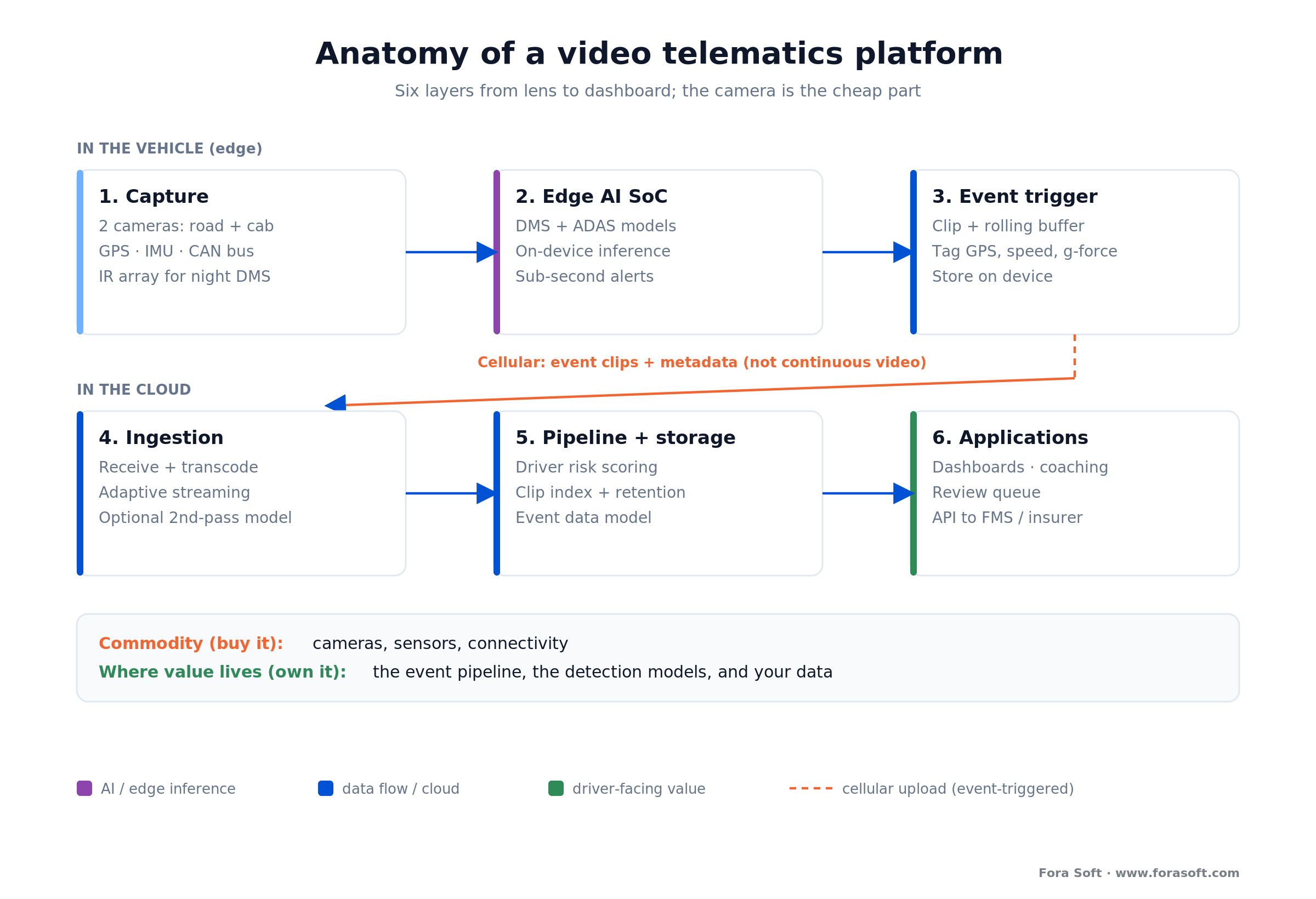
Figure 1. The six layers of a video telematics platform. The camera and sensors are commodity; the event pipeline, model, and data ownership are where a custom build earns its keep.
1. Capture. One or two cameras (road-facing for the traffic scene, driver-facing for the cab), plus a GPS receiver, an accelerometer/IMU for g-force events, and a CAN-bus or OBD tap for speed and engine data. Infrared illuminators let the driver-facing camera see at night without blinding anyone.
2. Edge inference. An on-device AI accelerator runs the detection models on the live video. This is the layer that separates an AI dash cam from a recorder, and it’s where the design lives or dies. More on the silicon below.
3. Event trigger and buffer. The device continuously buffers recent video, and when the model flags an event, it saves the surrounding window (say, 10 seconds before and after) and attaches GPS, speed and g-force at that instant. Continuous HD upload over cellular is a non-starter, so this triggered-clip logic is what keeps data costs sane.
4. Connectivity. A cellular modem uploads event clips and metadata, with on-device storage covering gaps in coverage. Good systems degrade gracefully: metadata first, video when bandwidth allows, full continuous footage retrievable on demand.
5. Cloud ingestion and pipeline. The backend receives events, transcodes video for streaming, runs any heavier second-pass models, scores driver risk, and stores clips with a retention policy. This is a real streaming-media and data-engineering job, not a CRUD app.
6. Applications. Dashboards for the safety team, a coaching workflow for drivers, a review queue for disputed events, and an API so the data flows into your fleet management system, insurer, or payroll. The platform is only as useful as this layer makes it.
What the AI actually detects: DMS versus ADAS events
Detection splits cleanly by which camera is looking. Driver-facing models — the driver monitoring system, or DMS — watch the cab for distraction, drowsiness, phone use, no seatbelt, smoking and eating. Road-facing models — advanced driver assistance, or ADAS — watch the scene for forward-collision risk, tailgating, lane departure and stop-sign violations. Motion sensors add the physics events: harsh braking, hard cornering, speeding against posted limits.
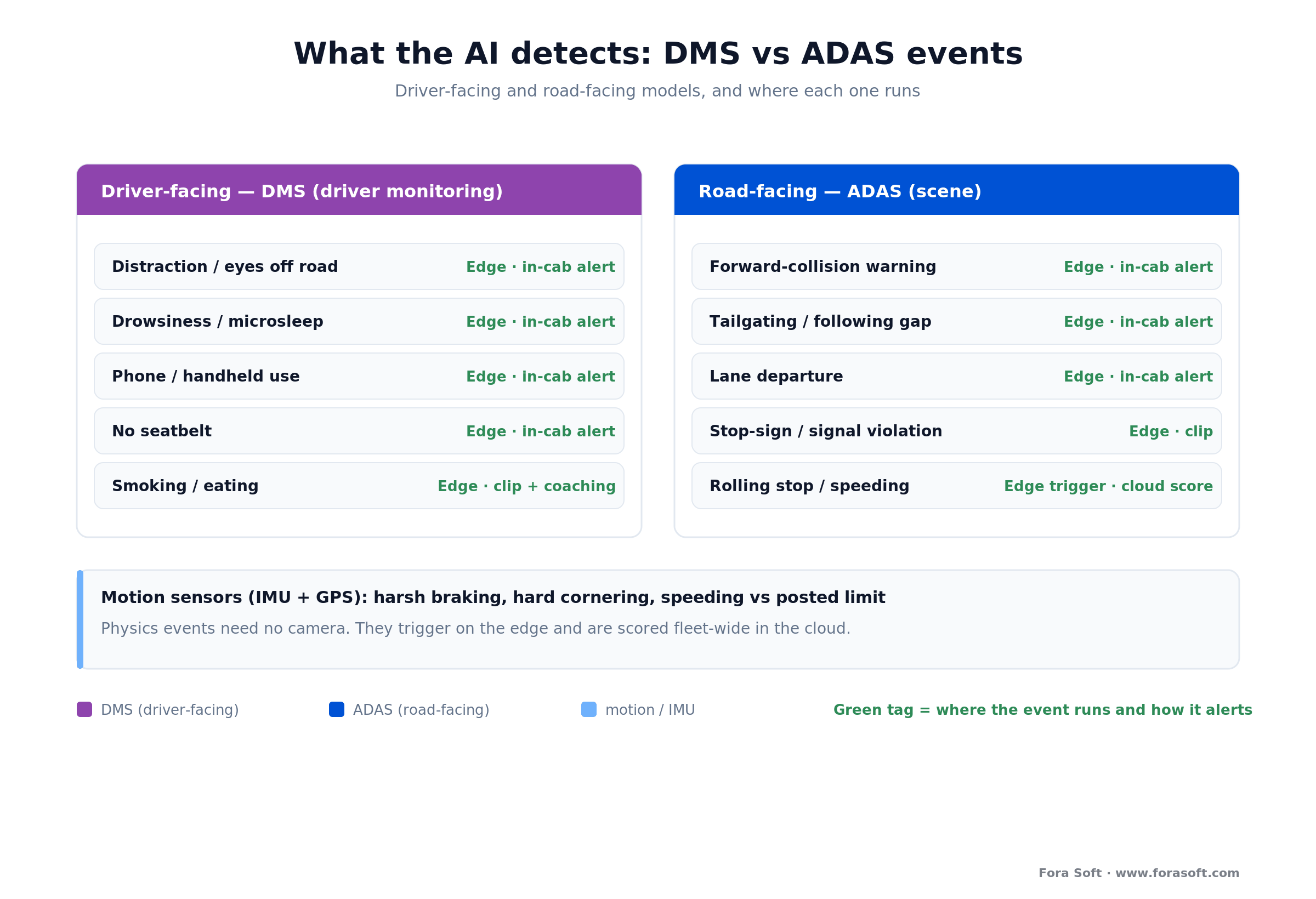
Figure 2. The event taxonomy. Safety-critical, in-the-moment alerts run on the edge; slower analytics and review can run in the cloud.
Vendors advertise accuracy numbers on these events, and they’re worth reading with a skeptical eye. Motive publishes “up to 99% AI accuracy” across 20-plus events, with per-event figures like 99% on distraction and 96% on seatbelt (Motive, 2026). Lytx claims around 95% across its in-cab behaviors on 311 billion-plus miles of data (Lytx, 2026). These are vendor-reported, on their own test sets, and “accuracy” without a false-positive rate is half a metric. One more data point, worth reading with the same eye: a 2024 Virginia Tech Transportation Institute test, commissioned by Nauto, found Nauto detected 100% of smartphone-distraction cases and alerted up to 4× faster than a 2023 benchmark of Lytx, Motive and Samsara devices.
Why does speed matter more than a headline accuracy percentage? Because a distraction alert exists to interrupt the behavior. An in-cab chime at the moment a driver reaches for a phone changes what happens next; the same detection surfaced in a dashboard an hour later only helps you write a coaching note. That’s the whole argument for edge inference, and it’s the next section.
Edge versus cloud: where the inference runs
Safety-critical detection runs on the device; everything else runs in the cloud. That single rule resolves most of the architecture. A drowsiness or phone-use alert has to fire in under a second to change the driver’s behavior, and you can’t make a round trip to a data center over a flaky cellular link in that budget. So the DMS and ADAS models live on the camera’s AI chip. The cloud gets the resulting events for the slower work: fleet-wide analytics, risk scoring, manual review, and training the next model version.

Figure 3. The split. Real-time alerting and bandwidth savings force detection onto the edge; the cloud owns scale, review and retraining.
There’s a bandwidth argument on top of the latency one. Streaming continuous HD video from every vehicle over cellular is economically absurd: it would run to hundreds of gigabytes per vehicle per month. Running detection on the edge means you upload only the seconds that matter, which drops the data bill by two orders of magnitude. The edge chip is doing double duty: it makes alerts fast and it makes the network affordable.
Run inference on the edge when: the alert has to reach the driver in real time (distraction, drowsiness, collision warning), or when uploading the raw video would blow your cellular budget. That covers nearly every in-cab and forward-collision event.
Push work to the cloud when: latency doesn’t matter and scale or accuracy does — fleet risk scoring, second-pass review of ambiguous clips, dashboards, and retraining models on the hard cases the edge got wrong. If we shipped the answer next week and nobody died, it belongs in the cloud.
If you want the deeper version of this trade-off, we wrote a dedicated piece on edge AI versus cloud AI for video that walks through the cost and accuracy curves. The short version for telematics: the edge is not optional, and pretending otherwise is how projects miss their latency target after the hardware is already bought.
Inside the camera: the silicon that makes it work
The AI chip is the component that decides what your platform can detect and how many models it can run at once. Two silicon families dominate fleet dash cams, and knowing them tells you whether a device is future-proof or already dated.
Ambarella CVflow. Ambarella’s vision SoCs are the workhorse of the category. The CV22 powers Motive’s AI dash cam, handling front ADAS plus infrared driver monitoring at 1440p; the CV25 targets mainstream DMS cameras. The current generation, the 5nm CV72AX and CV75AX (2024), runs transformer neural networks and vision-language models on-device without fan cooling. That gap is the difference between spotting “phone in hand” and understanding “driver is arguing with a passenger and not watching the road.” Ambarella doesn’t publish official TOPS ratings for these parts, only relative performance multipliers, so compare devices on demonstrated detections, not spec-sheet math.
Qualcomm. Qualcomm’s automotive silicon shows up in the newest wave. Lytx’s Surfsight AI-12 uses a quad-core Snapdragon, and Motive’s AI Dashcam Plus, launched January 2026, runs on the Qualcomm Dragonwing QCS6490 with claims of 3× the compute of its predecessor and 30-plus concurrent AI models. That concurrency is the point: the more models you can run in parallel on one frame, the more event types you cover without adding cameras.
The rest of the bill of materials matters less but still bites: an HDR image sensor that survives a backlit windshield, an IR illuminator array for night DMS, a cellular modem, onboard storage sized for hours of buffered footage (Samsara’s CM34 holds up to 87 trip-hours), and a thermal design that survives a dashboard in Arizona summer. None of it is exotic, but all of it has to be automotive-grade.
A build note worth money: most vendors don’t disclose their SoC. Samsara, Netradyne and Nauto keep it under wraps, so if you’re sourcing a white-label device, ask for the chip by name and generation before you commit — it’s the single best predictor of how long the hardware stays capable.
Fusing video with GPS, CAN and IMU data
The feature that makes video telematics more than a dash cam is data fusion: every video event carries the exact GPS coordinate, speed, and g-force from the same millisecond. Get the time-sync wrong and a “harsh braking” clip shows the driver calmly stopped at a light, because the accelerometer spike and the video frame are half a second apart. Clock discipline across the camera, GPS and CAN interface is unglamorous work that decides whether anyone trusts your events.
On the wire, the model is event-driven, not stream-driven. The device buffers continuously but transmits selectively: a lightweight event record (type, time, location, severity) goes up first, the associated clip follows when bandwidth allows, and full continuous footage stays on the device for on-demand retrieval. That’s why Samsara’s older CM32 uploaded 60-second clips while the CM34 keeps continuous recording you can pull from the cloud — a direct trade of onboard storage and data cost against how much you can review after the fact.
The cloud side is a streaming-media pipeline. Clips get transcoded to adaptive formats so a safety manager can scrub them on a phone; heavier models can run a second pass on ambiguous events; and everything indexes against the driver, vehicle and trip. If you’ve built HLS video delivery before, this will feel familiar; if you haven’t, it’s the part teams routinely underestimate. Our edge-AI video surveillance architecture guide covers the same ingest-and-pipeline pattern in depth.
Finally, compliance data. In the U.S., commercial fleets already run electronic logging devices for hours-of-service, and a video telematics platform that ignores that context is fighting the operator’s existing workflow. The valuable integrations are boring: push events into the fleet management system the dispatcher already uses, and expose an API the insurer can pull from. Nobody logs into a seventh dashboard.
Build versus buy: three realistic paths
There isn’t a binary here. There are three paths, and the right one depends on fleet size, whether data ownership is strategic, and whether you plan to resell telematics yourself. Buying a managed platform gets you live in weeks. Building on white-label hardware gets you control without a silicon project. Building fully custom gets you a product you own end to end. On either build path, our computer vision development services cover the DMS and ADAS models, the in-cab runtime and the fleet dashboard. Here’s how they compare.
| Dimension | Buy managed SaaS | White-label + your platform | Full custom |
|---|---|---|---|
| Time to live | Weeks | 3–6 months | 9–18 months |
| Upfront cost | Low (per-vehicle fee) | Medium (platform dev) | High (hardware + platform + models) |
| Data ownership | Vendor holds it | You own it | You own everything |
| Detection models | Vendor’s, fixed | Vendor’s or licensed | Yours to train and tune |
| Per-vehicle economics at scale | Fixed rent, forever | Drops as you scale | Lowest at high volume |
| Best fit | Under ~200 vehicles, need it now | Mid fleets, want control, no chip project | Large fleets or telematics resellers |
Vendor pricing and timelines are 2026 estimates; confirm any per-vehicle quote directly, and treat build timelines as scope-dependent.
Reach for managed SaaS when: you run under ~200 vehicles, need coverage this quarter, and don’t treat the telematics data as a strategic asset. Renting is the right call more often than builders admit.
Reach for white-label plus your own platform when: you want to own the data, dashboards and driver experience, but a custom camera program would be a distraction. You source proven hardware and build the software that differentiates you.
Reach for full custom when: you operate thousands of assets, or telematics is your product and you resell it. At that scale the per-vehicle savings and the ability to tune your own models pay back the hardware and ML investment.
Not sure which of the three paths fits your fleet?
Tell us your fleet size and goals; we’ll map the honest build-vs-buy math for your case in one call.
What it costs to build a video telematics platform
The short version: renting a managed AI dash cam runs about $40–$60 per vehicle per month in 2026, while building shifts the money to one-time hardware plus a platform that’s cheap to run afterward. Let’s put real arithmetic on a 100-vehicle fleet over a three-year horizon, because that’s the honest way to compare renting against building. We’ll keep every number conservative and cite where it comes from.
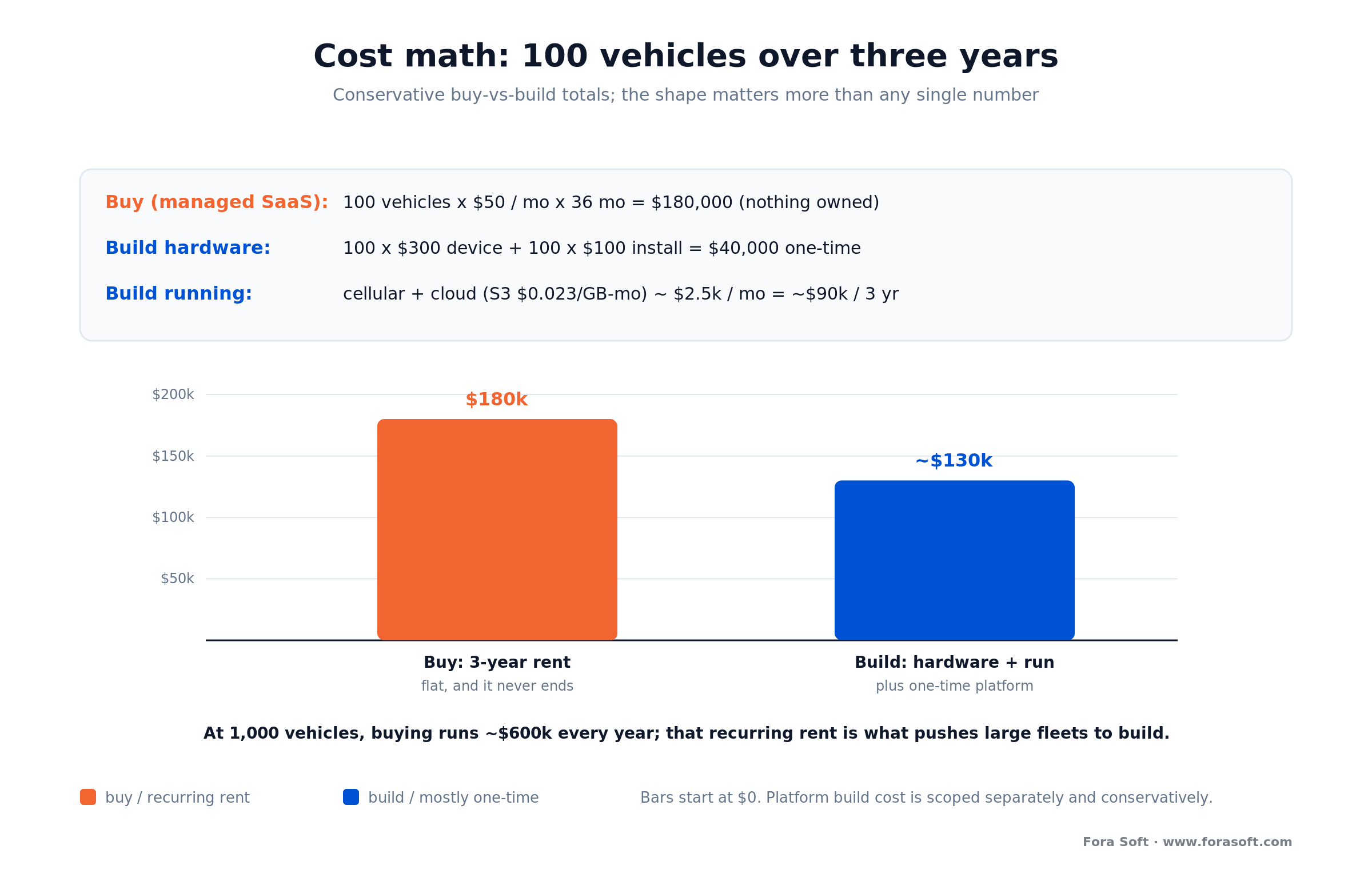
Figure 4. A conservative three-year total for 100 vehicles. Renting is cheaper to start; a build’s per-vehicle cost keeps falling as the fleet grows.
Buy path. A managed AI dash cam with dual-facing camera runs roughly $40–$60 per vehicle per month in 2026 (Samsara’s published tier lands here; confirm with a quote). Take the midpoint, $50. The math is simple: 100 vehicles × $50 × 36 months = $180,000 over three years, with hardware bundled and nothing owned at the end.
Build path, hardware. White-label AI dash cams in fleet volumes land in the low hundreds of dollars each. Budget $300 per device: 100 × $300 = $30,000, plus roughly $100/vehicle installation = $10,000. Call it $40,000 in one-time hardware, refreshed maybe once in the three years.
Build path, running cost. Cellular for event-clip upload runs a few dollars per vehicle per month; budget $10/vehicle = $1,000/month. Cloud storage is genuinely cheap: at AWS S3 Standard’s $0.023 per GB-month (AWS pricing, captured July 2026), even 50 GB of retained clips per vehicle is about $115/month for the whole fleet. Add compute and egress and call running cost $2,000–$3,000/month, or ~$100,000 over three years.
Build path, software. The platform is the real investment: ingestion, pipeline, dashboards, coaching, mobile review, API. With Fora Soft’s Agent Engineering approach, a focused first version is far cheaper than the traditional agency quote, and we scope it conservatively before we commit a number. The point of the arithmetic isn’t a single figure — it’s the shape: buying is a flat rent that never ends, building is front-loaded and then cheap to run.
The crossover follows fleet size. At 100 vehicles, renting is usually cheaper for the first few years. At 500 or 1,000 vehicles, the $50-per-vehicle rent compounds into real money — 1,000 vehicles is $600,000 a year, every year — while a build’s incremental cost per vehicle is a camera and a trickle of data. That’s the number that sends large operators and resellers toward custom.
How the platform pays for itself
The cost side is only half the decision. Video telematics earns its keep in three places, and it’s worth being precise about which claims are solid and which are marketing.
Exoneration. When your driver isn’t at fault, footage ends the dispute fast. Against the litigation backdrop (average $1M-plus trucking verdicts hit $22.3M by 2018 per ATRI), one avoided nuclear verdict can outweigh a decade of platform cost. This is the most defensible ROI because it’s a documented clip, not a projection.
Behavior change. In-cab alerts reduce risky driving over time. Vendors report large drops — Samsara’s 2025 safety report cites mobile-phone use falling 84% by six months across 2,600-plus fleets, and roughly a 75% crash-rate reduction over 30 months for fleets on its full AI solution. Read these as vendor-reported outcomes on self-selected customers, not guarantees; the mechanism (fewer distracted miles) is real, the exact percentage will be yours to measure.
Insurance. Many insurers now price telematics-equipped fleets more favorably, and some share data directly. The savings are real but vary by carrier and loss history, so we won’t quote a headline percentage — ask your broker what your data is worth to them.
The honest summary: exoneration and behavior change are where the money is, insurance is a bonus that depends on your carrier, and every figure a vendor hands you should be read as a best case from a happy customer. Build your business case on the avoided-crash and avoided-verdict math, and let the rest be upside.
Want the cost model run against your real fleet numbers?
Send us your vehicle count and current spend; we’ll build the three-year buy-vs-build comparison with you.
Privacy and biometric compliance by design
Driver-facing cameras collect faces, and faces are biometric data. In the U.S. that runs straight into Illinois’ Biometric Information Privacy Act, and the settlements are not hypothetical. Lytx paid $4.25 million to resolve a BIPA class action over driver-facing cameras, with final approval in July 2025 covering roughly 85,000 drivers; Samsara settled a similar suit for $3.95 million in 2025. BIPA sets statutory damages of $1,000 per negligent and $5,000 per intentional violation, and after Cothron v. White Castle (2023) each scan can count as a separate violation — the exposure math gets frightening quickly.
The good news for builders: compliance is an architecture problem you can solve up front. Written consent before any face data is captured. A clear, documented retention policy. On-device handling of biometric features so raw face data never needs to leave the vehicle. And geofencing that adjusts behavior by jurisdiction — Lytx shipped exactly this in 2025, a feature that disables in-cab cameras when a truck enters Illinois. If you build, you bake these in; if you buy, you verify the vendor has.
The map is wider than Illinois. Texas and Washington have their own biometric statutes, and in Europe the GDPR treats biometric data as a special category requiring explicit consent. At the same time, EU safety rules are mandating the very driver-attention detection these laws constrain, so the design target is a system that watches attention without unnecessarily banking identity. That’s a solvable tension, and getting it right is a selling point with drivers, not just regulators.
Design rule: treat driver consent, on-device biometric processing, retention limits and per-state geofencing as first-class requirements in the spec — not features you add after a lawyer reads the contract. Retrofitting privacy into a shipped fleet is how you end up in a settlement headline.
Mini-case: real-time incident detection we shipped
The hardest part of video telematics isn’t the dashboard — it’s making an AI model reliably flag an incident from a live feed, in the moment, without drowning the operator in false alarms. That’s the same problem whether the camera is on a dashboard or a wall, and it’s work we’ve done. For a retail security client, we built real-time incident detection that watches video streams and raises alerts the instant something goes wrong.
The plan looked a lot like a telematics build. Get detection running where the latency budget demands it. Tune the model against real footage until the false-positive rate is low enough that humans keep trusting the alerts — the metric that actually decides whether a safety system gets used or muted. Then wire the events into a review workflow so a person can confirm, dismiss, or escalate in seconds.
The transferable lesson: the model and the review loop are the product, and the camera is a detail. On our VALT platform the same discipline scales to 770+ organizations and 50,000+ active users handling sensitive video. If you’re scoping a video telematics build and want a similar assessment of what’s hard and what’s cheap, book a 30-minute call and we’ll walk your specifics.
A build-or-buy decision framework in five questions
Skip the feature checklists. Five questions settle the direction for most fleets.
1. How many vehicles, and where are you headed? Under ~200 and stable, renting almost always wins. Over 1,000, or growing fast, the flat per-vehicle rent turns into a number that funds a build.
2. Is the telematics data strategic to you? If the driving data feeds your pricing, your product, or a service you resell, owning it matters. If it’s purely internal safety hygiene, a vendor holding it is fine.
3. Do you need detections a vendor won’t build? Off-the-shelf models cover the common events well. If your risk is niche — specific cargo, equipment, or maneuvers — only a custom model gets you there.
4. How exposed are you on biometric privacy? Heavy Illinois, Texas or EU operations raise the stakes on how face data is handled. Building lets you design consent and on-device processing exactly; buying means auditing the vendor hard.
5. Can you carry software you own? A platform is a living thing that needs maintenance, model updates and support. If you have (or will hire) that capacity, build. If not, rent — or bring in a partner who runs it with you. That last row of the table is a native sales hook, and we mean it: this is exactly the kind of build we run alongside operators.
KPIs to measure once you ship
A video telematics platform that nobody trusts gets muted, so measure the things that decide trust and outcomes, not vanity counts of events.
Quality KPIs. Detection precision and recall per event type, and above all the false-positive rate — the number that determines whether drivers and safety managers believe the alerts. Track alert latency too: an in-cab warning is only worth building if it fires in under a second.
Business KPIs. Preventable-crash rate over time, disputed claims resolved with footage, coaching sessions triggered and completed, and insurance outcomes at renewal. These are the numbers that justify the budget in front of a CFO.
Reliability KPIs. Device uptime, percentage of events that upload successfully within a target window, and cellular data cost per vehicle against budget. A camera that’s offline or a clip that never arrives is a safety gap you can’t see, so instrument it.
Five pitfalls that sink video telematics builds
1. Chasing continuous cloud upload. Teams new to this assume they’ll stream every camera to the cloud, then discover the cellular bill and the latency. Event-triggered clips with on-device buffering isn’t a compromise; it’s the correct design.
2. Ignoring the false-positive rate. A model with great headline accuracy but noisy false alarms gets switched off by drivers within a week. Tune for trust, and measure it before you scale to the whole fleet.
3. Treating biometric privacy as legal’s problem. Consent, retention and on-device face handling are engineering requirements. Bolt them on after launch and you inherit the settlement risk that cost Lytx and Samsara millions.
4. Buying hardware before you know the chip. The AI SoC sets the ceiling on what you can ever detect. Commit to a device without knowing its silicon generation and you may be locked out of the models you’ll want in two years.
5. Building a seventh dashboard. Dispatchers won’t log into another tool. If your events don’t flow into the fleet management system and workflows people already use, adoption stalls no matter how good the detection is.
When not to build your own video telematics
Building is the wrong call more often than a development company is supposed to admit, so here’s the honest version. If you run a small or mid-size fleet, need coverage this quarter, and treat driving data as internal safety hygiene rather than a strategic asset, buy a managed platform. Samsara, Motive, Lytx and Netradyne have spent years and hundreds of millions refining models and hardware; you will not out-engineer that in a first release, and you shouldn’t try.
Building makes sense when the economics or the control genuinely tip: thousands of vehicles where flat rent compounds into real money, a need for detections no vendor offers, telematics as a product you resell, or biometric-privacy exposure you want to engineer precisely. Even then, the smart first move is usually a hybrid — proven white-label cameras under a platform you own — not a from-scratch hardware program.
The tell that you’re ready to build: you’ve outgrown a bought platform, you know exactly which of its limits is costing you, and owning the data or the model would change your business. If you can’t name that limit yet, keep renting and revisit in a year. We’d rather tell you that on a call than sell you a build you don’t need.
FAQ
What is video telematics?
Video telematics is fleet tracking with cameras and on-device AI added. Alongside GPS location and speed, a road-facing camera watches the traffic scene and a driver-facing camera watches the cab, while an AI chip turns that footage into safety events like distraction, tailgating or harsh braking — then uploads the relevant clips to a cloud platform for coaching and review.
How does video telematics improve fleet safety?
Two ways. In the moment, in-cab alerts interrupt risky behavior — a chime when a driver reaches for a phone changes what happens next. Over time, the platform ranks drivers by risk and drives coaching. Vendors report large drops in phone use and crash rates (Samsara cites mobile-phone use down 84% by six months across 2,600-plus fleets), though those are self-reported outcomes on their own customers.
How much does a video telematics system cost?
Managed AI dash cams run roughly $40–$60 per vehicle per month in 2026 for a dual-facing camera with AI (confirm with a vendor quote), usually on a 36-month term with hardware bundled. Building custom shifts the money to upfront hardware (low hundreds of dollars per device) plus a platform investment, after which running costs — cellular and cloud — are low. Buying is cheaper to start; building wins at large fleet scale.
Video telematics versus regular GPS telematics: what’s the difference?
Regular telematics tells you where a vehicle is and how it’s driven from GPS and sensor data. Video telematics adds the visual proof — what the driver and the road actually did — plus AI that interprets it into events. The video is what exonerates a not-at-fault driver and what makes coaching concrete instead of a number on a report.
Does the AI run on the camera or in the cloud?
Safety-critical detection runs on the camera’s AI chip, because an alert has to reach the driver in under a second and can’t wait for a cloud round trip. On-device inference also slashes cellular cost by uploading only event clips instead of continuous video. The cloud handles the slower work: fleet analytics, risk scoring, manual review and training the next model.
Are driver-facing cameras legal?
Yes, but driver-facing cameras collect biometric data and must comply with laws like Illinois’ BIPA, which requires written consent and carries statutory damages of $1,000–$5,000 per violation. Lytx ($4.25M, 2025) and Samsara ($3.95M, 2025) both settled BIPA class actions over in-cab cameras. Compliant designs get consent up front, limit retention, process biometric features on-device, and geofence behavior by jurisdiction.
What AI chip powers a fleet dash cam?
Most run Ambarella CVflow SoCs (the CV22 powers Motive’s dash cam; the 5nm CV72AX and CV75AX run vision-language models on-device) or Qualcomm automotive silicon (Motive’s 2026 AI Dashcam Plus uses the Dragonwing QCS6490). The chip generation sets the ceiling on how many models a camera can run and what it can detect, so it’s the first spec to check when sourcing hardware.
Should we build or buy a video telematics platform?
Buy if you run under ~200 vehicles, need it soon, and the data is internal-only. Build (usually starting hybrid, on white-label hardware) if you operate thousands of vehicles, need data ownership, want custom detections, or resell telematics. The deciding factors are fleet size, whether the data is strategic, and whether you can carry software you own.
What to read next
Architecture
Edge AI Video Surveillance Architecture
The ingest-to-pipeline pattern behind any camera-to-cloud AI system.
Edge vs cloud
Edge AI vs Cloud AI for Video
The latency and cost curves that decide where inference should run.
Case study
Real-Time Incident Detection
How we tuned an AI model to flag incidents from live video without false-alarm fatigue.
Services
Video Surveillance Development
How Fora Soft builds AI video and surveillance platforms end to end.
Learn
Video Surveillance, Explained
Our engineering primer on how AI video surveillance systems are built.
Ready to build your video telematics platform?
Here’s the whole guide in five lines. Video telematics is a data platform with a camera on the front, and the camera is the cheap part. Safety detection has to run on the edge, on an AI chip whose generation sets your ceiling. Buying gets you live in weeks; building wins on control, data ownership and per-vehicle economics once your fleet is large. Driver-facing cameras carry real biometric-privacy risk you design around, not past. And the model plus the review loop, not the hardware, is what makes any of it work.
If you’re weighing that decision, the fastest way to a clear answer is a conversation with people who’ve built the hard parts. We’ll tell you honestly whether to buy, build, or start hybrid — and if you build, we’ll scope it conservatively and ship it with you.


The handbook · 7 volumes
Fora Soft Video Engineering Handbook
A dash cam platform pays off only when edge inference, upload cost and biometric rules all line up. We wrote seven volumes on the video stack behind products like this. Volume 7 is the first stop for edge serving, cost per stream-hour and BIPA-style biometric compliance, Volume 6 covers detection and driver-monitoring models, and Volume 1 the encoding that keeps cellular uploads affordable. Written by Nikolay Sapunov, CEO at Fora Soft.
Browse the handbook on Amazon →7 volumes · 9,000+ pages · Kindle & paperback
Let’s scope your video telematics platform
21 years of video and AI engineering, an honest build-vs-buy read, and a conservative estimate — in one 30-minute call.