


Key takeaways
• Vonage isn’t shutting down. The bill is the problem. The OpenTok SDK line is legacy and consolidated into the unified Vonage account, and the headline $0.00410 per participant-minute is only the raw-video rate. Recording, HD broadcast composition and monthly platform fees stack on top.
• The Vonage Video API alternatives split three ways. A managed SDK swap (Daily, Zoom Video SDK, Agora, 100ms), a LiveKit Cloud-to-self-host hybrid, or pure self-hosting on MediaSoup, LiveKit OSS, Janus, Kurento, Jitsi or Ant Media.
• The cost curves cross near ~475 concurrent users. Below that an SDK is cheaper because the vendor amortises infra and compliance. Above it, self-hosting wins and the gap widens.
• Compliance is a priced tier, not a freebie. Vonage’s HIPAA BAA is “contact sales” and encryption runs $550/mo each; self-hosted compliance parity (SOC 2 plus HIPAA) is 6–12 months and roughly $50–150K. LiveKit Cloud is the easy bridge.
• We’ve shipped on every option here. Fora Soft has built video products on OpenTok/Vonage, Kurento, MediaSoup and LiveKit, plus custom SFU layers — 250+ projects since 2005.
Vonage is one of several ways out of a legacy SDK. All vendor comparisons, in one place.
Why Fora Soft wrote this playbook
We’ve built video products on every real-time stack a Vonage migration might land on: OpenTok/Vonage Video API, Twilio Video, Kurento, Janus, MediaSoup, LiveKit and bespoke SFU layers. That’s not a slide claim; it’s the path our own case studies took. For BrainCert, the virtual-classroom LMS now serving 100K+ customers and 500M+ real-time classroom minutes, we built a custom WebRTC + HTML5 media path from scratch rather than renting one per minute. For VocalViews we ran server-side media on Kurento; ProVideoMeeting combines Kurento and FreeSWITCH for SIP dial-in.
So this is the same conversation we walk with clients, written down. Three migration paths, six self-hosted media servers, the per-minute math with 2026 numbers, the bandwidth and egress reality, the compliance lift, and the point where self-hosting starts to pay. We use Agent Engineering, an AI-assisted internal delivery process, to compress the calendar and cost on each build, which keeps migration budgets tight. Where a number is a rule of thumb rather than a quote, we say so.
Migrating off Vonage Video API?
A 30-minute call with our video engineering leads gets you a target architecture, a cost projection and a realistic calendar — the compliance lift included.
Is Vonage Video API being shut down?
No. As of 2026 there is no announced end-of-life for the Vonage Video API. What changed is the packaging and the economics. The old OpenTok / TokBox brand is gone, the SDK line that carried it is legacy, and credentials and dashboards were folded into the unified Vonage account under Ericsson ownership. The platform still runs; the reasons teams leave are cost, single-vendor risk, and data-residency control — not a shutdown notice.
Auth model moved. Older API Key / Secret pairs are being replaced by Application ID plus Private-Key JWT auth. Every current SDK ships a migration guide, so this is a scheduled chore rather than a fire.
Single-vendor risk is real, though. Twilio’s Programmable Video showed how fast this category can move: an end-of-life was announced in December 2023, extended in March 2024, then reversed in October 2024. Twilio Video is still supported today, and Vonage was even pitched as a landing spot for its refugees. If your whole product rides one video API with no contingency, that volatility is the argument for a portable stack.
On Twilio instead? The trade-offs there are close cousins of these, and we mapped them in the Twilio Video migration guide.
The real Vonage bill: what the $0.0041 rate hides
The number you’ll see quoted is $0.00410 per participant-minute. That’s the raw-video rate and nothing else. The moment you record, compose a broadcast, add captions, or need a compliance tier, the effective rate climbs — and a chunk of the bill turns into fixed monthly fees that don’t appear in a per-minute comparison at all.
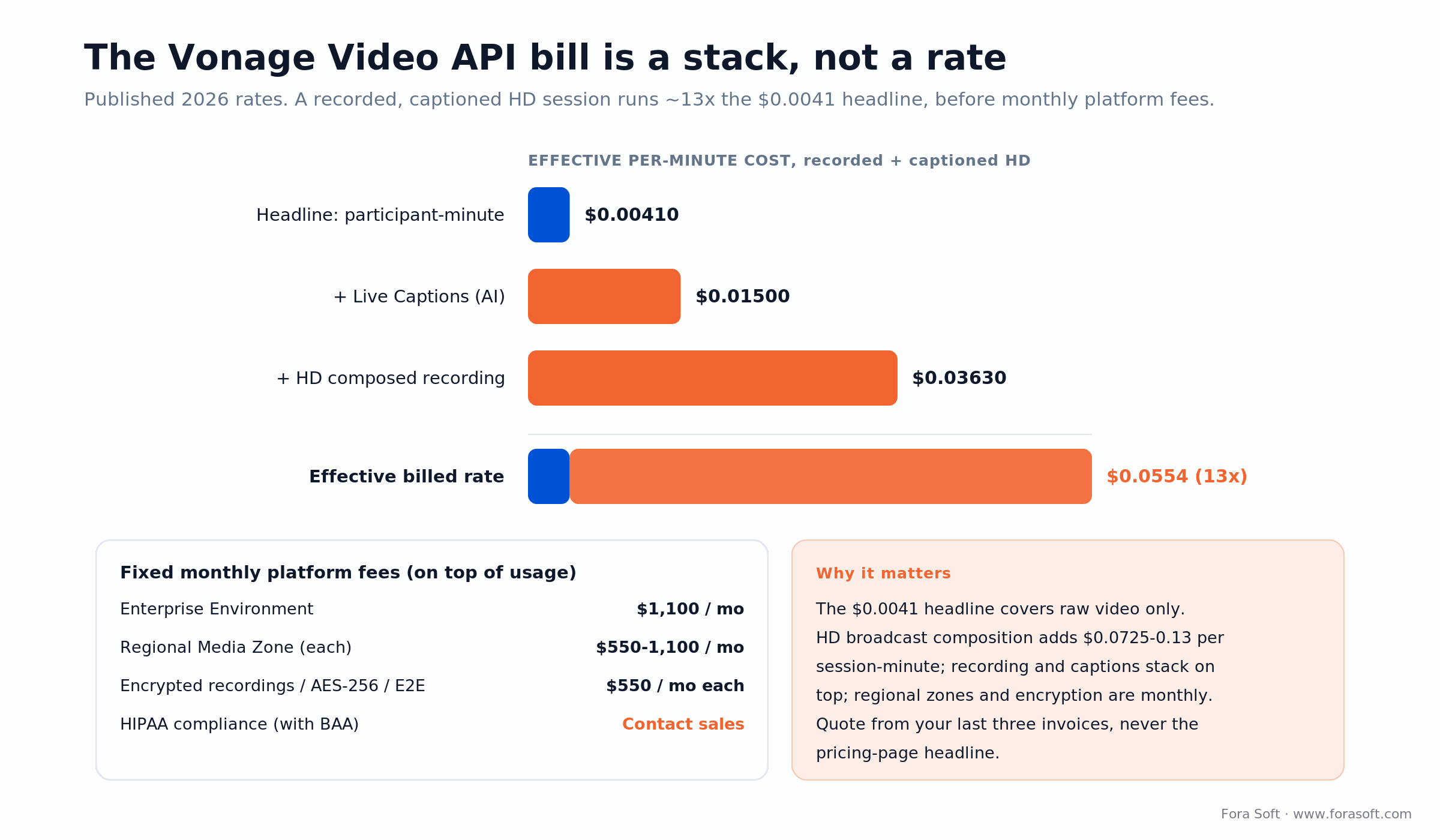
Figure 1. Vonage’s published 2026 rates: a recorded, captioned HD minute is roughly 13× the headline, before monthly platform fees.
Here’s the arithmetic from Vonage’s own 2026 pricing page. Take a recorded, captioned HD session: base video $0.00410 + HD composed archive $0.03630 + Live Captions $0.01500 = $0.05540 per participant-minute. That’s about 13× the headline before you’ve streamed a single broadcast minute. Full-HD broadcast composition is billed separately at $0.10350–$0.13000 per session-minute, and HLS delivery adds $0.00155–$0.00310 per viewer-minute.
Then the monthly fixed fees land on top: an Enterprise Environment is $1,100/mo, each Regional Media Zone is $550–$1,100/mo, encrypted recordings and AES-256 or end-to-end media encryption are $550/mo each, and a HIPAA BAA is a “contact sales” line rather than a checkbox. None of that shows up when someone compares “$0.0041 vs a competitor.” The practical rule: quote from your last three invoices, never the pricing-page headline.
Three migration paths, picked by ops appetite
The Vonage Video API alternatives worth considering land on one of three shapes. The right one is decided by three things: how many concurrent users you peak at, your compliance regime, and how much operational load your team wants to carry.
| Path | Effort | Where it wins | Where it breaks |
|---|---|---|---|
| A. Managed SDK swap (Daily / Zoom / Agora / 100ms) | 3–6 weeks | Fast cutover, compliance bundled, predictable cost | Lock-in repeats; per-minute fees still scale linearly |
| B. Hybrid — LiveKit Cloud now, self-host later | 4–8 weeks | Same code Cloud ↔ OSS; compliance via vendor; future cost lever | Two ops models over time; you’ll need K8s skills eventually |
| C. Pure self-hosted (MediaSoup / LiveKit OSS / Janus) | 3–6 months | Best unit economics at scale, full data-residency control | Compliance, on-call and feature-gap work sit on your team |
Reach for Path B when: you want a clean cutover this quarter and the option to self-host once you cross ~500 concurrent users — without rewriting application code, because LiveKit Cloud and LiveKit OSS share the same SDKs and APIs.
Per-minute economics of the alternatives
On raw list price, the managed SDKs cluster tightly around Vonage’s base rate. The real difference shows up at volume, where per-minute vendors discount and plan-based or self-hosted options pull away. The chart normalises everything to dollars per 1,000 participant-minutes.
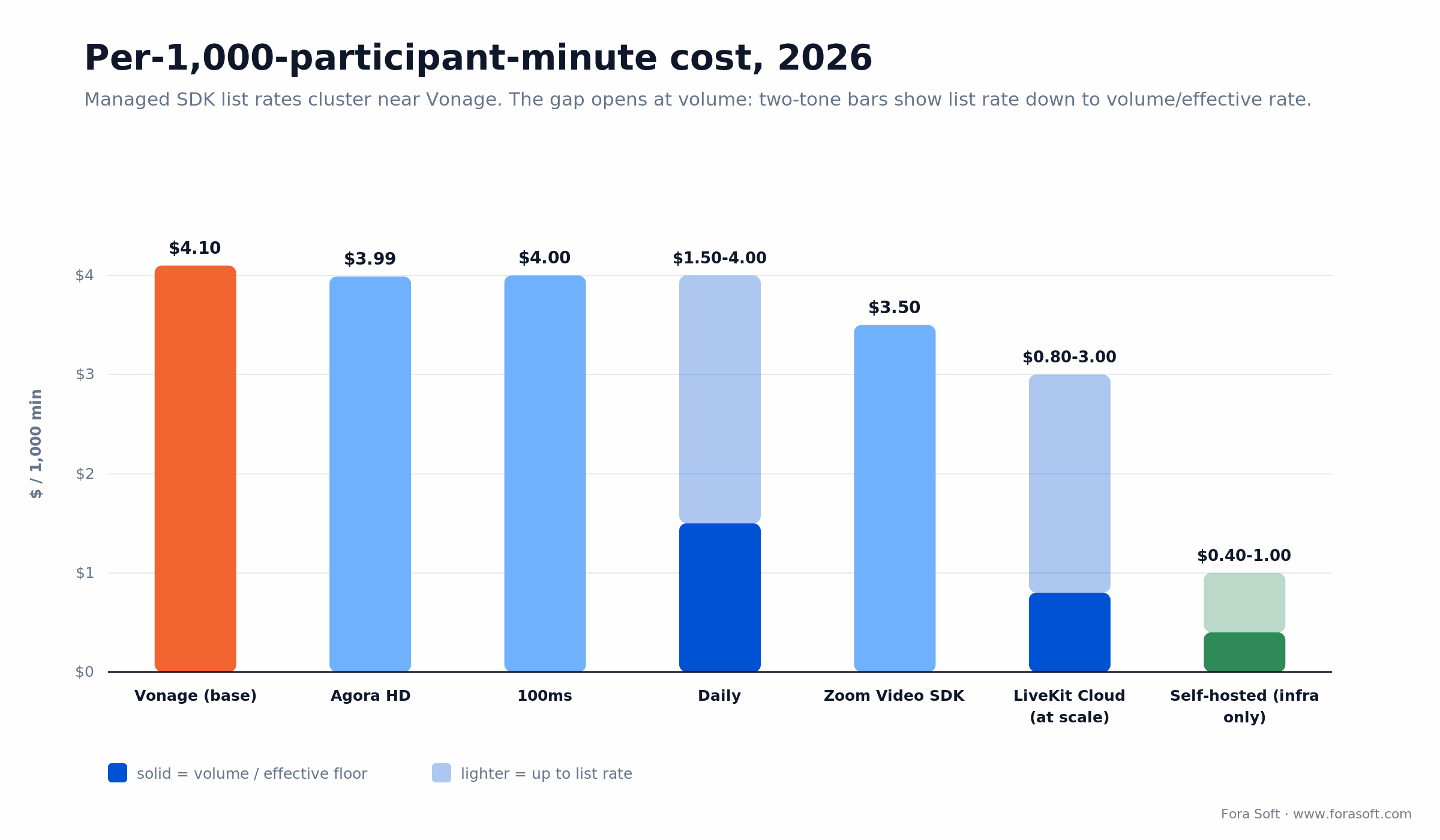
Figure 2. List rates cluster near $4/1K min; the gap opens at volume. Two-tone bars show the volume/effective floor up to the list rate.
| Vendor | 2026 list rate | Notes |
|---|---|---|
| Vonage Video API | $4.10 / 1K min | Base only; recording, broadcast and platform fees add up fast |
| Agora | $3.99 / 1K min HD | $0.99/1K audio; 10K free min/mo; volume tiers |
| 100ms | ~$4.00 / 1K min | 10K free min/mo; native polls and analytics |
| Daily | $4.00 → $1.50 / 1K min | Scales down with volume; SOC 2 + HIPAA-ready; clear billing |
| Zoom Video SDK | $3.50 / 1K min | 10K free session-min/mo; volume discounts at 1–5M/mo |
| LiveKit Cloud | ~$0.80–3.00 / 1K min at scale | Plan-based; 5K free min/mo; same code as OSS |
| Self-hosted (LiveKit OSS / MediaSoup) | ~$0.40–1.00 / 1K min | Infra only; break-even vs SDKs near ~475 concurrent |
Reach for a managed SDK when: you’re under ~200K minutes a month and want compliance and infra off your plate. Daily and 100ms tend to beat Vonage’s real bill at that size; Zoom Video SDK is the cheapest list rate. We break the flip points down further in the Daily.co alternatives guide.
Self-hosted media servers, compared
If you go self-hosted, the SFU field has six credible engines. They are not interchangeable: the right pick is shaped by your team’s skills, your license tolerance, and the feature mix you actually use. Walk the selector top to bottom and take the first branch that matches.
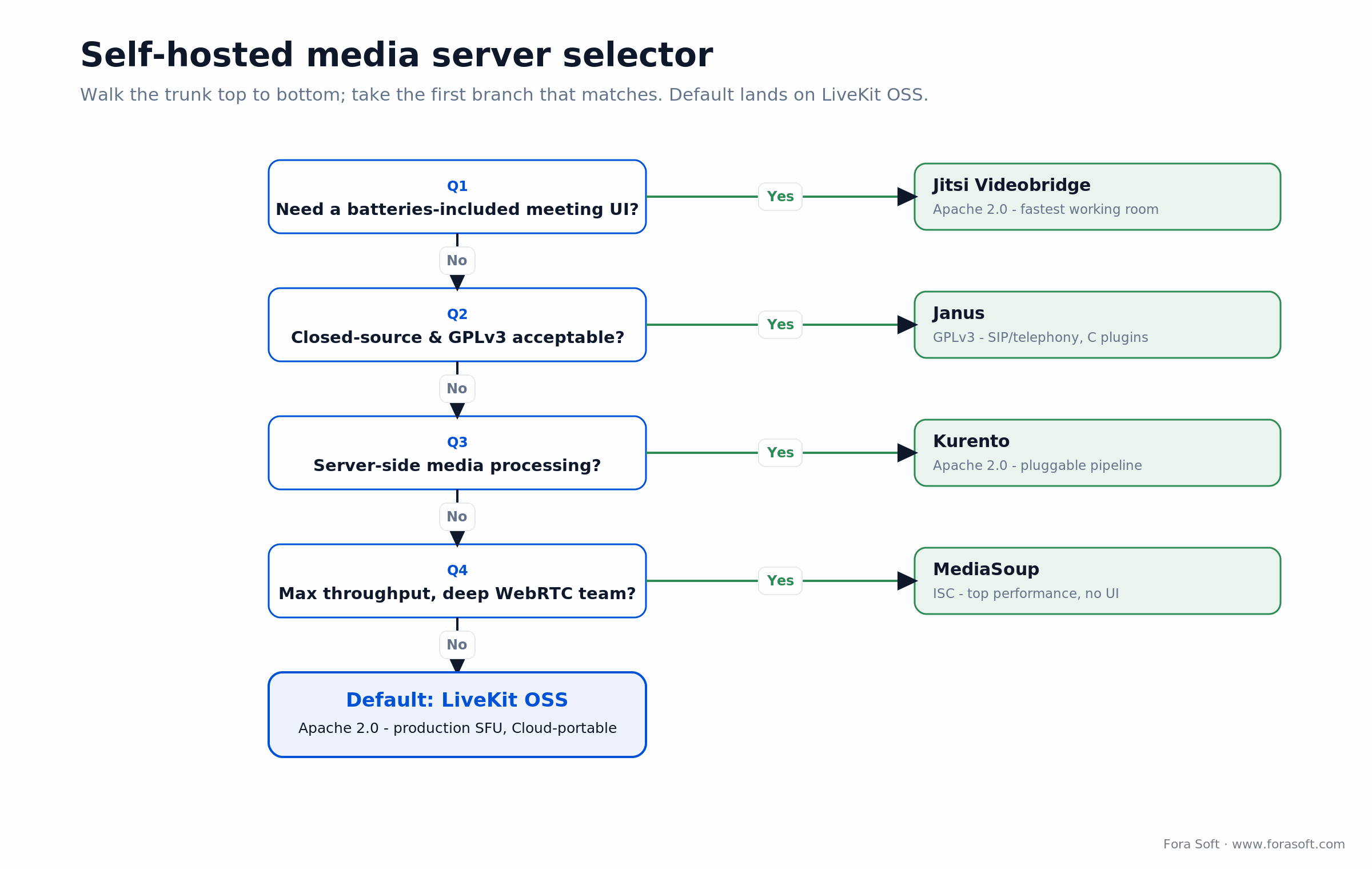
Figure 3. A decision trunk for the self-hosted SFU. The default, when nothing special applies, is LiveKit OSS.
| Engine | License | Where it wins | Best for |
|---|---|---|---|
| MediaSoup | ISC | Highest raw throughput; Node.js or Rust control, C++ workers | High-volume products, custom recording, a deep WebRTC team |
| LiveKit OSS | Apache 2.0 | Production SFU, built-in TURN, egress/recording, Cloud-portable | Fastest path to a self-hosted SFU; hybrid teams |
| Janus | GPLv3 | Mature C plugins (recording, SIP, streaming); carrier-grade | SIP/PBX bridging, telephony interop, regulated workloads |
| Kurento | Apache 2.0 | Pluggable media pipeline with CV/ML hooks | Server-side processing, vision overlays, recording pipelines |
| Jitsi (JVB) | Apache 2.0 | Batteries-included meeting UI, large community | Internal tools, community instances, simple meetings |
| Ant Media | Apache 2.0 + paid Enterprise | Sub-second WebRTC latency, SRT/RTMP/CMAF/LL-HLS | Live broadcast products with interactive audiences |
Reach for LiveKit OSS when: you want the fastest production-ready SFU and the option to swap to LiveKit Cloud (or back) without rewriting code. Reach for MediaSoup (mediasoup.org) when raw performance beats ramp-up time, and Kurento, covered in our Kurento explainer, when server-side media processing is the differentiator.
SFU vs MCU: what to keep, what to rebuild
Keep the SFU topology; rebuild MCU behaviour only where you truly need it. Vonage routes with an SFU by default and reaches for MCU-style composition only for archives and broadcast. Nearly every replacement stays on SFU, and the CPU economics are the reason.
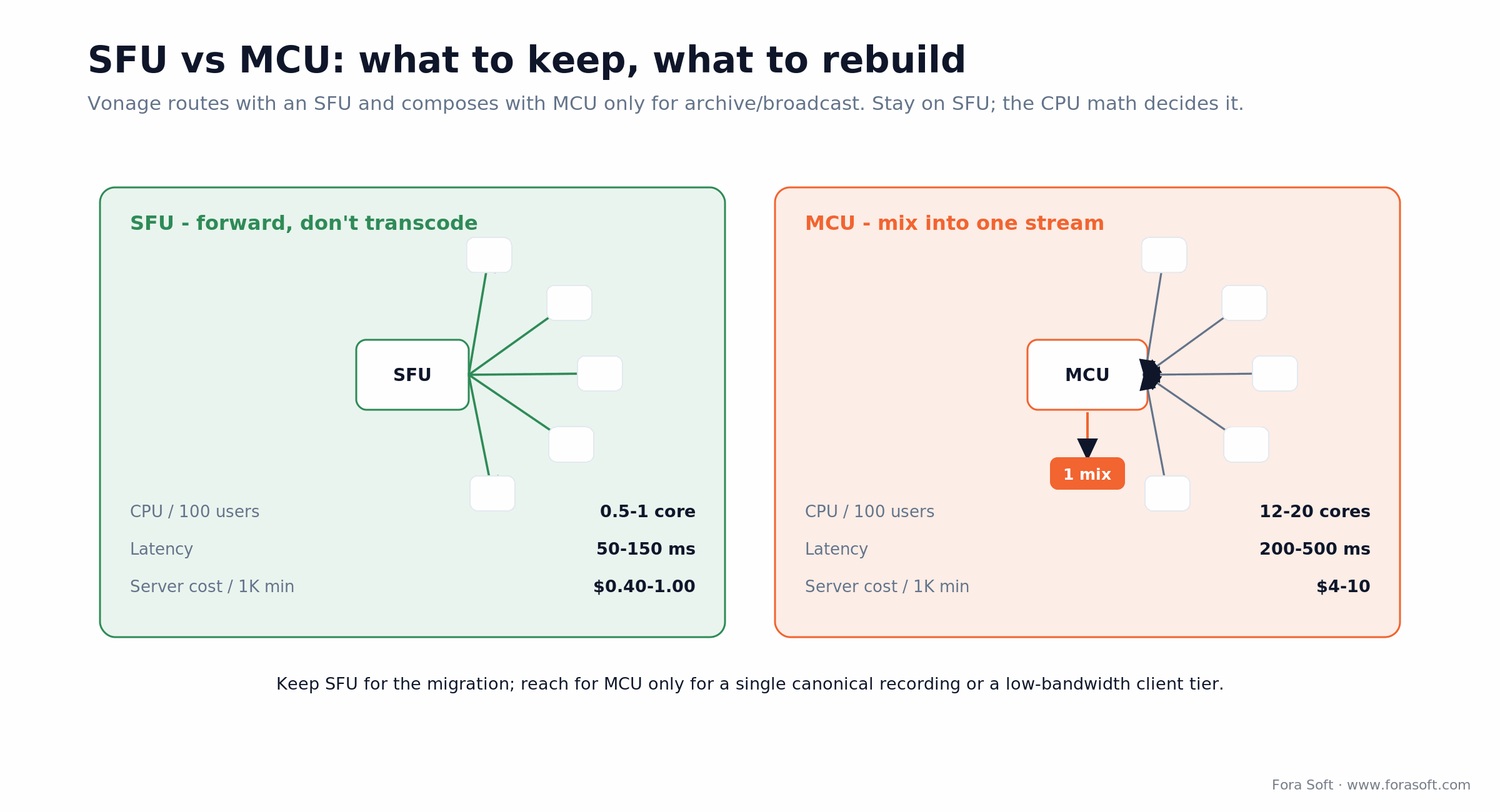
Figure 4. An SFU forwards streams without transcoding; an MCU mixes them into one, at roughly 10–20× the CPU. Figures are engineering rules of thumb.
| Metric | SFU | MCU |
|---|---|---|
| CPU per 100 users | ~0.5–1 core | ~12–20 cores |
| Latency | 50–150 ms | 200–500 ms |
| Client downlink (20-user room) | ~47 Mbps total | ~2.5 Mbps single stream |
| Server cost / 1K participant-min | ~$0.40–1.00 | ~$4–10 (CPU bound) |
Stay on SFU for the migration; reach for MCU only when you need a single canonical recording or a low-bandwidth client tier for weak devices. The full topology breakdown lives in our P2P vs MCU vs SFU guide, and the cost side in the WebRTC architecture cost breakdown.
Stuck choosing between MediaSoup, Janus, LiveKit and Ant Media?
We’ve run production deployments on all of them. In one call we’ll pick the engine that fits your team, your scale and your compliance regime.
Bandwidth and egress math
The cheap-looking infra bill stops being cheap once you fan video out to every participant. Egress, not the server license, is what decides self-host economics, and where you buy it matters more than almost anything else.
| Profile | Per stream | 20-user SFU room downlink |
|---|---|---|
| 720p30 H.264 | ~1 Mbps | ~19 Mbps |
| 1080p30 + simulcast | 2–3 Mbps | ~47 Mbps |
| 4K30 + SVC | 5–8 Mbps | ~120 Mbps |
| Egress price (indicative) | AWS ~$0.09/GB vs bare-metal ~$0.0015/GB | 60× swing on the same traffic |
Worked example. A 1080p simulcast room of 20 users pushes ~47 Mbps of downlink; run it for an hour and that’s ~21 GB. On AWS egress at $0.09/GB that hour costs ~$1.90 in transfer alone; on a bare-metal host with bandwidth at ~$0.0015/GB it’s about $0.03. Multiply by thousands of room-hours a month and the egress line, not the server, becomes the whole argument. Two rules follow: default to 720p30 with simulcast, and put the SFU close to your users — LiveKit, Janus and MediaSoup all support multi-region — so traffic exits on cheaper edges.
Recording and archive
Recording is the feature most migrations underestimate, because Vonage’s server-side composition (up to 16 video and 50 audio streams per recording, MP4 H.264/AAC) sets a reference shape that most alternatives can match. The engineering question isn’t whether they record — it’s where the recorder lives.
Server-side composite (LiveKit Egress, Kurento, Ant Media; Janus records per-track and composes in post). One composed file, lower playback bandwidth, higher CPU. Right for legal hold, audit and broadcast archive.
Per-track / single-file-out. Each participant’s track recorded separately, lower server CPU, larger storage footprint. Right for editing, post-production or per-speaker analytics.
Hybrid. Record per-track, compose on demand with FFmpeg or Mux. Best when most sessions are never watched but a small fraction need a final cut. It’s the cheapest default for products where recording is a “just in case,” not the point.
Security and compliance: the silent cost
Compliance is the part of a Vonage bill that self-hosting quietly moves onto your team. Vonage ships SOC 2 Type 2 and a GDPR DPA, and offers a HIPAA BAA — but as a “contact sales” tier, alongside $550/mo encryption add-ons and the $1,100/mo Enterprise Environment. That bundled coverage is part of what made the per-minute price tolerable. Rebuild it yourself and the work is real.
1. SOC 2 Type 2. Roughly 6–12 months of readiness plus audit, about $25–40K to start and $15–25K/year ongoing. Estimates, not quotes — your auditor and scope move them.
2. HIPAA. A BAA with your cloud provider, AES-256 at rest, TLS 1.2+ and SRTP in transit, audit logging on every replay, plus staff training. Budget roughly $20–50K on top of a self-hosted build for the controls and review.
3. GDPR. Lawful basis, a DPIA where the processing is high-risk, EU data residency, and the right to erase individual recordings. Lighter than HIPAA, still real.
4. Path B is the bridge. LiveKit Cloud carries SOC 2 and offers BAAs, and because the OSS build shares its code, the compliance work on the self-hosted track stays optional and incremental instead of a big-bang audit before launch.
Where the cost curves cross
The break-even between a managed SDK and self-hosting sits near ~475 concurrent users. Below it, the SDK wins because the vendor spreads infra, on-call and compliance across its whole customer base. Above it, self-hosting wins and the gap only widens with scale.
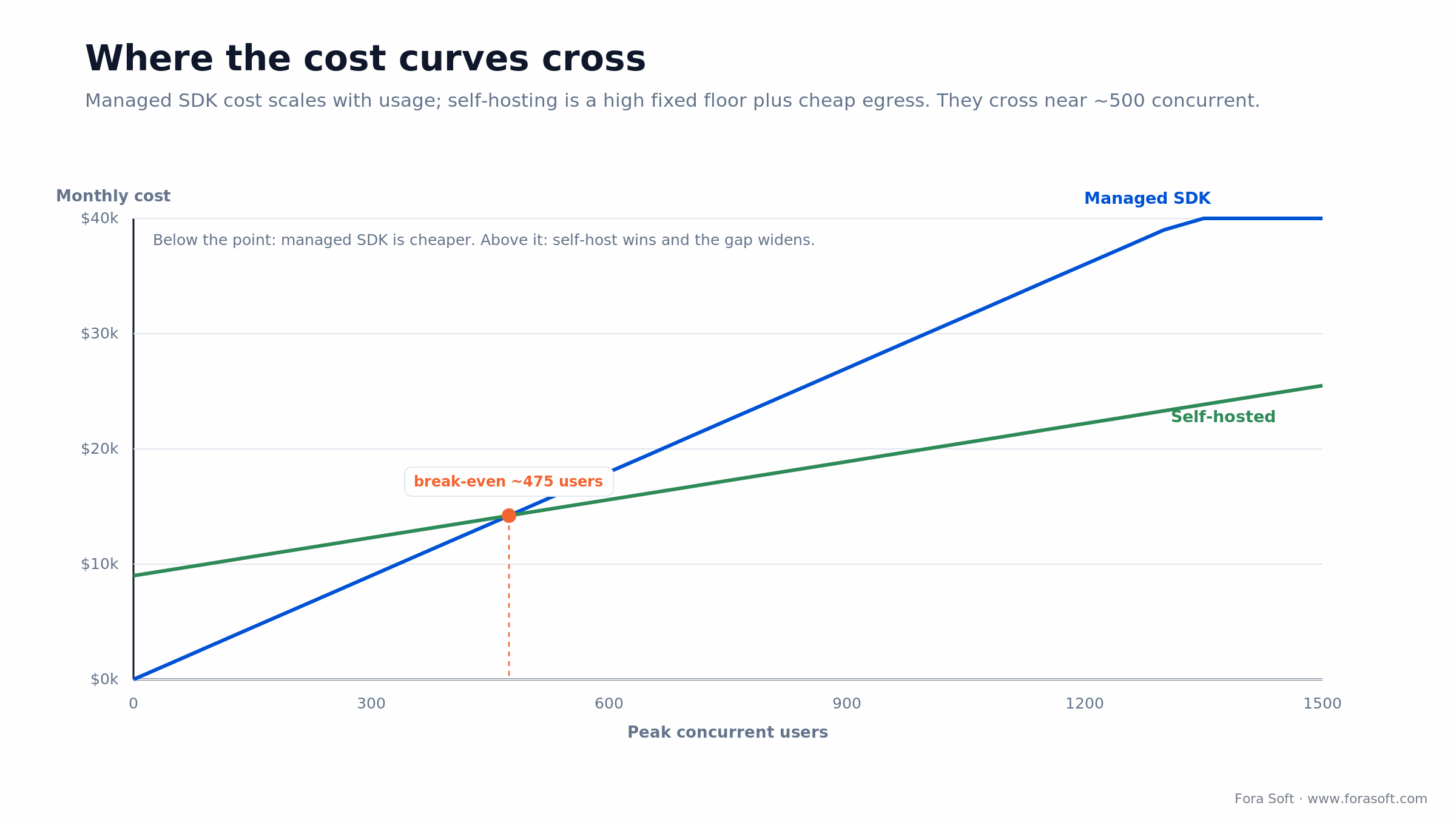
Figure 5. Managed SDK cost scales with usage; self-hosting is a high fixed floor plus cheap egress. Illustrative model, not a quote.
The model behind the chart: a managed SDK runs about $30 per concurrent user per month at a blended rate, so a linear line from zero. Self-hosting is a fixed floor near $9K/month (a fraction of an SRE plus baseline infra) plus roughly $11 per user for egress and compute. Set them equal, $30u = $9,000 + $11u, and you get u ≈ 474. Your slopes will differ with codec, region and how hard you drive simulcast, but the shape holds: fixed floor versus linear meter. The crossover is ~475; give yourself headroom and treat ~500 as the practical switch point.
Reach for self-hosting when: you consistently peak above ~500 concurrent users, you need EU or in-country data residency, and you have (or will hire) WebRTC ops. Below that line, the fixed floor eats any per-minute saving.
The migration playbook, kickoff to cutover
A migration runs in seven steps over roughly 8–10 weeks for the managed and hybrid paths; steps 4–6 run in parallel while 1–3 are sequential. Pure self-hosting stretches the same shape to 3–6 months.
| Step | Window | What happens |
|---|---|---|
| 1. Inventory & gates | Week 1 | Map every Vonage feature in use; define the cutover gate (parity, performance, compliance) |
| 2. Engine pick | Week 2 | Choose SDK swap, hybrid or self-hosted; lock the target engine |
| 3. PoC + load test | Week 3–4 | Run 10–20% of real traffic; confirm latency, recording and HD parity |
| 4. App migration | Week 4–8 | Swap SDKs in client apps, port signalling, auth and webhooks |
| 5. Recording migration | Week 4–8 (parallel) | Export Vonage archives, build the new pipeline, validate retention/access |
| 6. Compliance review | Week 4–8 (parallel) | Penetration test, BAA with new vendor/cloud, document audit-log coverage |
| 7. Cutover | Week 8–10 | Staged rollout 10% → 50% → 100%, then decommission Vonage |
Mini-case: a virtual classroom on custom WebRTC
BrainCert needed native HD virtual classrooms inside a learning platform, at a scale where a metered per-minute video vendor would have taxed every lesson and capped their margins as usage grew into the hundreds of millions of minutes. The classroom was the product, not a bolt-on, so renting it by the minute was the wrong shape.
We built the media path ground-up on a custom WebRTC + HTML5 stack rather than an SDK, so classroom minutes carried infrastructure cost instead of a per-minute vendor fee, and the compliance surface (SOC 2, HIPAA, GDPR, PCI DSS) was designed in rather than bolted on. The same SFU-first principles in this article shaped the build: forward, don’t mix; put media close to users; record per-track and compose on demand.
Today BrainCert runs $3M in revenue (2024, up 58% year over year), 100K+ customers and 500M+ real-time classroom minutes across 10 datacenters at 99.995% uptime — on media it owns rather than rents. That’s the upside self-hosting buys once you’re past the flip point. Want a similar assessment of your video stack?
Cost model: what each path runs
Build cost and run-rate move in opposite directions across the three paths. The ranges below are scoping estimates — your feature surface and compliance regime move them — not fixed quotes.
| Path | Build (indicative) | Calendar | Run-rate vs Vonage |
|---|---|---|---|
| A. Managed SDK swap | $25K–$60K | 3–6 weeks | 10–30% per-minute saving |
| B. LiveKit Cloud now, OSS later | $40K–$90K | 4–8 weeks | 30–60% saving once you self-host |
| C. Pure self-hosted | $80K–$220K | 3–6 months | 60–80% saving at 500+ concurrent |
Add roughly $20–50K for HIPAA hardening if your vertical demands it, and another ~$15–25K/year of SOC 2 audit on the self-hosted path. If those numbers make the SDK look better for now, that’s the honest answer; the flip point is a threshold, not a slogan. For a fuller cost teardown, see our WebRTC development cost guide.
A decision framework in five questions
1. How many concurrent users do you peak at? Under 200 → managed SDK. 200–500 → hybrid. Over 500 → self-hosting is now the cheaper option.
2. What is your compliance floor? HIPAA or PCI → managed SDK with a BAA, or LiveKit Cloud. Public-sector or EU data residency → self-hosted in-region.
3. Do you have WebRTC ops in-house? No → SDK or LiveKit Cloud first. Yes, or willing to hire → LiveKit OSS or MediaSoup.
4. How much of Vonage’s feature surface do you actually use? Standard meeting plus recording → almost any alternative covers it. SIP bridging or interactive broadcast at 5K+ → Janus or Ant Media.
5. What is your cutover deadline? Under 8 weeks → managed SDK. 8–14 weeks → hybrid. 16+ weeks → pure self-hosted is feasible. When two answers disagree, the compliance floor and the deadline win — they’re the hardest to move.
Pitfalls we watch migration teams fall into
1. Quoting from list prices. The real Vonage bill lands well above the headline once recording, broadcast and platform fees stack. Pull the last three months of invoices and compare like-for-like before you approve a budget.
2. Ignoring archive export. Old recordings need their own migration plan: export, re-store, re-index. Assume roughly one engineer-week per million minutes of archive, and preserve metadata so internal links keep resolving.
3. Picking Janus without reading GPLv3. If you ship a closed-source product, GPLv3 forces source disclosure or a commercial dual-license. Plan for it, or choose an Apache/ISC engine instead.
4. Skipping load tests. SFU performance turns non-linear above ~200 concurrent rooms. Test with realistic traffic shapes — join storms, screen shares, reconnect spikes — before cutover, not after.
5. Treating compliance as a v2 task. SOC 2 and HIPAA retrofitted onto self-hosted infra cost far more than designing them in. Budget the compliance pack from sprint 1, or pick a path that carries it for you.
KPIs to measure during and after migration
Quality. p95 join time under 4 s, p95 video-freeze rate under 1%, audio MOS above 4.0, recording success above 99.5%, and archive parity with Vonage at 100%.
Business. Per-minute cost against the Vonage baseline, gross-margin uplift, support-ticket volume through cutover, and customer-reported quality (NPS).
Reliability. SFU uptime 99.95%, incident MTTR under 30 minutes, audit-log completeness 100%, and a first-attempt pass on the compliance audit.
When not to migrate off Vonage
Sometimes the right move is to stay. Don’t migrate if you hold an enterprise contract with negotiated rates well below list, if you peak under ~50 concurrent users where the migration cost outweighs a year of savings, or if you have a compliance audit in flight that a platform change would disrupt. In each case, renegotiate the contract and parallel-pilot an alternative for the next renewal, which keeps your negotiating position without betting the product on a rushed cutover.
Stay on Vonage when: your negotiated rate already beats the alternatives’ real bill, your volume is small enough that the fixed migration cost never pays back, or an active audit makes any platform change a risk this quarter.
Want a migration plan in writing?
A 30-minute call gets you a concrete target architecture, a calendar and a budget — including the parts to skip on sprint 1.
FAQ
Is Vonage Video API being discontinued?
No. There is no announced end-of-life as of 2026. The old OpenTok/TokBox brand is retired and its SDK line is legacy, but the platform is active. Teams migrate over cost, single-vendor risk and data residency, not a shutdown.
Is OpenTok or TokBox still supported?
Vonage Video API is the platform formerly branded OpenTok and TokBox. The OpenTok-branded SDK line is legacy and in maintenance, and credentials now live in the unified Vonage account, but the underlying service still runs and there is no announced shutdown. New builds should target the current Vonage Video API SDKs.
What does Vonage Video API actually cost in 2026?
The base rate is $0.00410 per participant-minute. A recorded, captioned HD minute is about $0.055 once you add HD composed archive ($0.03630) and Live Captions ($0.01500), plus monthly platform fees like a $1,100 Enterprise Environment and $550 encryption add-ons.
What is the cheapest credible alternative for high-volume video?
Self-hosted LiveKit OSS or MediaSoup once you cross ~500 concurrent users. Below that, Daily, Zoom Video SDK or 100ms usually beat Vonage’s real bill, and Agora is competitive at high volume thanks to tier discounts.
Can self-hosted video products be HIPAA compliant?
Yes, but compliance moves to your team. Plan 6–12 months and roughly $50–150K to reach the parity Vonage bundles. LiveKit Cloud with a BAA is the easier bridge if you need coverage before launch.
How long does a Vonage migration take with Fora Soft?
Three to six weeks for a managed SDK swap, four to eight for a LiveKit Cloud hybrid, three to six months for pure self-hosting. Our Agent Engineering delivery process keeps these calendars tight.
Can we keep our Vonage archives after we migrate?
Yes. Vonage’s API exposes archive URLs you can download and re-store in your own object storage. Plan about one engineer-week per million minutes, and preserve metadata as you go so existing internal links keep resolving.
Why is Janus listed differently from MediaSoup and LiveKit?
Janus is GPLv3, which forces source disclosure or a commercial dual-license for closed-source products. MediaSoup (ISC), LiveKit (Apache 2.0) and Kurento (Apache 2.0) carry no such restriction. Pick by license and feature mix together.
Is LiveKit Cloud worth using if we plan to self-host eventually?
Yes. LiveKit Cloud and LiveKit OSS share the same SFU code, SDKs and APIs, so you can ship on Cloud now and move to self-hosted later without rewriting application code. That is a meaningful de-risk for a time-pressured migration.
What to read next
Migration
Twilio Video migration guide 2026
The sibling playbook for teams leaving Twilio Video instead of Vonage.
Architecture
P2P vs MCU vs SFU
Pick the topology for your post-migration stack, with the trade-offs spelled out.
Cost
WebRTC development cost in 2026
What a custom or self-hosted build actually costs, startup to enterprise.
Media server
What is Kurento Media Server
The pipeline engine we ran on VocalViews — useful when recording or ML overlays matter.
Ready to leave Vonage without breaking your product?
Choosing among Vonage Video API alternatives isn’t a research project anymore. Three credible paths exist, the per-minute math is favourable in two of them, and the self-hosting engines are mature. The choice comes down to three numbers you already know: your peak concurrent users, your compliance floor, and your cutover deadline. Below ~475 concurrent, a managed SDK is the honest answer; above it, self-hosting pays and keeps paying.
If you want a target architecture, a budget and a calendar in writing, the fastest next step is a call with the team that has shipped video on every alternative here — including the times we told a client to renegotiate with Vonage instead. We’ll scope the migration or talk you out of it, whichever is right. Prefer to start with the service overview? See our WebRTC development services and custom software development, or the video streaming learn track.
Talk to our video engineering leads
Book a 30-minute call. We’ll scope the migration (engine, calendar, budget, compliance) in one session.

