


Why This Matters
If your product generates images or video with a diffusion model, speed is not a nice-to-have — it is most of your cloud bill and most of your user's waiting time. A clip that takes fifty passes through the model costs roughly ten times what the same clip costs at five passes, and the user feels every extra second. This lesson is for the founder, product manager, or engineering lead who has heard the words "LCM" or "Lightning LoRA" in a planning meeting and needs to know what they buy, what they cost in quality, and when to reach for them. It builds directly on the self-hosting open-weights lesson, which costs the own-the-model path, and the closed-API pricing lesson, which costs the rent-it path — because acceleration is the single biggest lever on both bills.
Why Diffusion Is Slow — The "Step Tax"
Start with the reason the trick is needed at all, because everything else follows from it.
A diffusion model — the kind of AI that powers most image and video generators — does not paint a picture in one stroke. It starts from a frame of pure random static, the visual equivalent of TV snow, and removes a little of that noise at a time until a clean picture emerges underneath. Each round of noise-removal is called a denoising step, or just a step. Think of it like developing an old photograph in a darkroom tray: the image does not appear instantly; it fades in gradually as the chemistry works, pass after pass.
The catch is how many passes it takes. A standard generator runs somewhere between twenty-five and fifty steps to produce a quality image, and each step is a full, expensive run through the model's billions of internal numbers. The cost of one clip is, near enough, the cost of one step multiplied by the number of steps. Write the arithmetic out:
cost per clip ≈ cost per step × number of steps
at 50 steps:  1 unit × 50 = 50 units of GPU work
at 4 steps:   1 unit × 4  =  4 units of GPU work
So dropping from fifty steps to four is not a 10% saving — it is more than a twelve-fold cut in the work, and therefore in both the GPU bill and the wait the user sits through. That multiplier is why "how many steps?" is one of the most consequential numbers in any generative-video product, and why an entire research field grew up around shrinking it. We will call that field's goal the same thing throughout: few-step generation — getting the same picture in a handful of steps instead of dozens.
For video, the step tax bites even harder. A video is many frames, and a video diffusion model spends steps not only making each frame look right but keeping motion smooth between frames. Fifty steps across a clip's worth of frames is a lot of GPU time, which is exactly why, until recently, generated video could not be produced fast enough to watch live. The acceleration tricks below are what changed that.
 Figure 1. The step tax. Cost scales with the number of denoising passes, so cutting fifty steps to four cuts the work — and the bill — by roughly twelve times. Acceleration methods teach a model to take the big jumps safely.
The One Idea Behind Every Trick: Distillation
Before the individual methods, learn the single concept they share, because once you have it the rest is variation.
The concept is called distillation. In plain terms, you have a slow but accurate model — call it the teacher — that takes the full fifty steps and produces a beautiful result. You then train a second model — the student — to imitate the teacher's final answer in far fewer steps. The student watches what the teacher produces and learns to jump most of the way there in one move instead of creeping there in fifty. The analogy is a master craftsman teaching an apprentice: the master works slowly and explains every move, and over time the apprentice learns to reach the same result with a few confident strokes.
Two more terms recur, so define them now. A LoRA — short for Low-Rank Adaptation — is a small bundle of extra weights, a few tens of megabytes, that you stack on top of a big base model to change its behaviour without retraining the whole thing. (Remember, the "weights" are the model's billions of learned numbers; a LoRA is a small patch over them.) Some acceleration tricks ship as a LoRA, which means you can clip them onto a model you already have, like a lens filter on a camera, and pop them off again. The other recurring term is classifier-free guidance, or CFG — a dial that controls how hard the model is pushed to follow your prompt. Standard generation turns this dial up, which doubles the model's work per step; most distilled models bake the guidance in and turn the dial off, which is part of how they save time. Keep both terms handy — they appear in every method below.
The methods differ in how the student is trained to take big jumps. There are two broad schools, and most named products are a blend of them. The first school, consistency / trajectory preservation, trains the student to stay on the same path the teacher walks, just with longer strides — LCM is its flagship. The second school, adversarial distillation, adds a referee model that tries to spot whether an image came from the fast student or is "real", which pushes the student toward sharper, more convincing results at very low step counts — SDXL-Turbo and SDXL-Lightning are its flagships. Hyper-SD, cleverly, fuses both. We will take them in that order.
Family 1 — Consistency Models and LCM: The Universal Speed Plug
The first family is the most widely used, and the easiest to bolt onto an existing system.
It begins with an idea called a consistency model, introduced by researchers at OpenAI in 2023. Recall the darkroom photo fading in over many passes; a consistency model is trained so that from any point along that fade — early, middle, or late — it can jump straight to the finished picture in one move. It is "consistent" because every jump, no matter where it starts, lands on the same final image. That property is what makes one-step or few-step generation possible at all.
Latent Consistency Models (LCM) brought that idea to the image generators people actually use. Published in October 2023 by a team led by Simian Luo, LCM applies the consistency trick inside the compressed "latent" space where Stable Diffusion does its work — hence the name. The headline result was that an LCM produces a high-quality image in just one to four steps instead of twenty-five-plus, and the model that does it can be trained in only about thirty-two hours on a single high-end data-centre GPU. That is cheap enough that the technique spread within weeks.
Then came the move that made LCM ubiquitous. A follow-up in November 2023, LCM-LoRA, packaged the acceleration not as a whole new model but as a LoRA — that small, stackable patch we defined above. The paper's own title calls it "a universal Stable-Diffusion acceleration module", and universal is the operative word: you take the LCM-LoRA, clip it onto Stable Diffusion 1.5, SDXL, or many community-tuned variants, and the model that needed twenty-five steps now needs four. You did not retrain anything; you added a small file. For a product team this is the appeal in one sentence — acceleration you can switch on without touching the base model you already validated.
The cost is honesty about quality. At one or two steps an LCM image can look a little softer or less detailed than the slow original, and very fine textures or text can suffer. At four steps the gap narrows to where most users never notice. LCM is the method you try first precisely because it is the cheapest to try: a small LoRA, no retraining, reversible in an afternoon.
Family 2 — Adversarial Distillation: Turbo, Lightning, and Hyper-SD
The second family chases the hardest target — a usable image in a single step — and it does so with a referee.
The shared trick is borrowed from a different corner of AI called a GAN, where two models compete: one generates images and a second, the discriminator, tries to tell the generated ones from real ones. Training the generator to fool the discriminator pushes it toward sharp, realistic output. Adversarial distillation bolts that referee onto the teacher-student setup: the student learns both to imitate the teacher and to fool a discriminator, and the discriminator is what keeps one-step images from going blurry. Three named methods matter.
SDXL-Turbo, from Stability AI, was the first to make this work at one to four steps, using a technique its paper calls Adversarial Diffusion Distillation (ADD). It runs three models during training — the fast student, a frozen copy of the full SDXL model as teacher, and the discriminator referee — and the result is a model that produces a serviceable image in a single step. Turbo proved the idea; its trade-off is reduced variety and some loss of the finest detail.
SDXL-Lightning, from ByteDance, refined the approach with progressive adversarial diffusion distillation. "Progressive" means it does not jump straight to one step; it distils in stages — first compressing the step count with a simpler objective, then bringing in the discriminator and halving the steps in order, thirty-two to eight to four to two to one. The staging produces cleaner low-step images than a single leap would, and ByteDance released checkpoints for one, two, four, and eight steps so you can pick your own quality-versus-speed point. Lightning became a default in many community pipelines for exactly this reason.
Hyper-SD, also from ByteDance and presented at the NeurIPS 2024 conference, is the most sophisticated of the three because it refuses to pick a school. Its insight is that the two ways of teaching a student — keep it on the teacher's exact path, or let it find a new shorter path — each break in different ways, so Hyper-SD blends them. It distils in segments along the path (a method it calls Trajectory Segmented Consistency Distillation), adds human-feedback learning so the low-step images match what people actually prefer, and ships a single unified LoRA that works across all step counts. The measurable payoff: in one-step generation Hyper-SDXL beats SDXL-Lightning by a small but real margin on both prompt-matching and aesthetic-quality scores. If you need the best possible single-step image, Hyper-SD is the current answer in this family.
A note on naming, because the marketing blurs it: "Turbo", "Lightning", and "Hyper" are all adversarial-distillation methods that produce one-to-eight-step models. They differ in training recipe and in who made them, not in what they are for. When a vendor advertises a "Lightning" or "Turbo" version of a model, they mean a distilled, few-step version of it — read that as "the fast one".
Family 3 — Video: AnimateDiff-Lightning and Cross-Model Distillation
Everything so far accelerates image generators. Video needs one more idea, and a 2024 method named AnimateDiff-Lightning supplied it.
The starting point is AnimateDiff, a popular way to turn a still-image Stable Diffusion model into a short-video generator by adding a motion module — a component that learns how pixels should move between frames. AnimateDiff is good but slow, because it inherits the full step count. AnimateDiff-Lightning, from ByteDance researchers Shanchuan Lin and Xiao Yang, distilled it with the progressive-adversarial method from SDXL-Lightning, adapted for the fact that the output is now a moving clip rather than one frame. The result generates video more than ten times faster than the original, with released checkpoints at one, two, four, and eight steps.
Its genuinely new contribution is in the name's second half: cross-model distillation. Here is the problem it solves. The Stable Diffusion world has hundreds of community-tuned base models — one tuned for anime, one for photorealism, one for a particular art style. A motion module distilled against just one of them tends to move poorly on the others. AnimateDiff-Lightning trains the student against several base models at once, so the single distilled motion module it produces moves well across many styles. For a product that lets users pick their own visual style, that breadth is the difference between one fast model and a fast model that actually works on the styles your users chose.
Common mistake — leaving guidance turned up. Distilled video models like AnimateDiff-Lightning expect classifier-free guidance (the prompt-pushing dial, CFG) to be turned off — set to 1.0. Teams port a prompt from a slow pipeline, leave CFG at the old value of 7 or 8, and get washed-out, over-cooked clips, then conclude the fast model is "low quality". It is not; the dial is wrong. The model's own documentation is explicit about this. Whenever you switch a pipeline to a distilled few-step model, the first thing to check is that guidance is set to the value the distilled model expects, almost always 1.0.
The 2026 Video Frontier: From Fast Clips to Real-Time Streams
The methods above shrink the number of steps. The newest work, much of it from 2025 and early 2026, goes further and changes how the video is built so it can be generated live, frame after frame, as you watch — the difference between rendering a clip and streaming one.
The first breakthrough was CausVid (late 2024), which made a generated video stream in real time for the first time. Standard video models look at the whole clip at once to keep it consistent, which is accurate but impossible to stream — you cannot show frame one until the model has finished thinking about frame one hundred. CausVid trains a model that builds the video left to right, one chunk at a time, each new chunk depending only on the chunks before it, the way a sentence is spoken word after word. It pairs that with a distillation method called Distribution Matching Distillation (DMD), which trains the fast streaming student to match the overall look the slow full-context teacher would have produced, rather than copying it frame for frame. The payoff is a model that streams video in real time while keeping quality close to the slow original.
Two refinements followed quickly. Self Forcing (mid-2025) fixed a subtle training flaw in the streaming approach — the model was trained on perfect inputs but, at use time, had to build on its own slightly-imperfect earlier frames, and the mismatch let errors pile up over a long clip. Causal Forcing (early 2026) pushed quality further still, reporting double-digit-percent gains over Self Forcing on motion richness, visual preference, and how faithfully the clip follows the prompt. The direction of travel is clear: each year the gap between "real-time generated video" and "slow, beautiful generated video" narrows.
For a product team in 2026 the practical news is simpler. You do not have to train any of this yourself. The open-weights video models from the self-hosting lesson now ship with off-the-shelf acceleration. Alibaba's Wan 2.2, for instance, has a community distillation called Wan2.2-Lightning (built on the LightX2V project) that cuts its standard forty steps to roughly four to eight, using an LCM-style sampler and guidance turned off, for about a four-times speed-up at a small quality cost — and it drops into the common ComfyUI pipeline as a LoRA, exactly like LCM-LoRA does for images. Lightricks' LTX-2, open-sourced in January 2026, was built for speed from the start: it generates synchronised 4K video and audio fast enough for interactive use on a single consumer GPU, and runs roughly eighteen times faster than the comparable Wan model on the same data-centre card. The lesson is that acceleration has moved from research papers into the models you can download today.
Side-By-Side: The Methods at a Glance
The table below puts the named methods in one place. Read the "best for" column first — it tells you which problem each one solves.
| Method | Type | Typical steps | Ships as | Best for | Licence note |
|---|---|---|---|---|---|
| LCM / LCM-LoRA | Consistency | 1–4 | LoRA (stackable) | Fastest way to accelerate an existing image model | Open (MIT) |
| SDXL-Turbo | Adversarial (ADD) | 1–4 | Full model | Single-step images, proof-of-concept speed | Non-commercial research licence |
| SDXL-Lightning | Progressive adversarial | 1–8 | Full model + LoRA | Tunable speed/quality on SDXL | Open (OpenRAIL) |
| Hyper-SD | Both, fused | 1–8 | Unified LoRA | Best-quality single-step images | Open (research-leaning; check version) |
| AnimateDiff-Lightning | Progressive adversarial (video) | 1–8 | Motion-module checkpoint | Fast short video across many styles | OpenRAIL-M |
| Wan2.2-Lightning / LightX2V | DMD-style distill (video) | 4–8 | LoRA | Accelerating an open video model you already run | Apache 2.0 base; check LoRA |
| CausVid / Self Forcing / Causal Forcing | Causal + DMD (video) | few-step, streaming | Research models | Real-time, streamed, interactive video | Research code |
The step counts are the practical sweet spots, not hard limits. Licences move — confirm the licence on the exact version you intend to ship, exactly as in the self-hosting lesson.
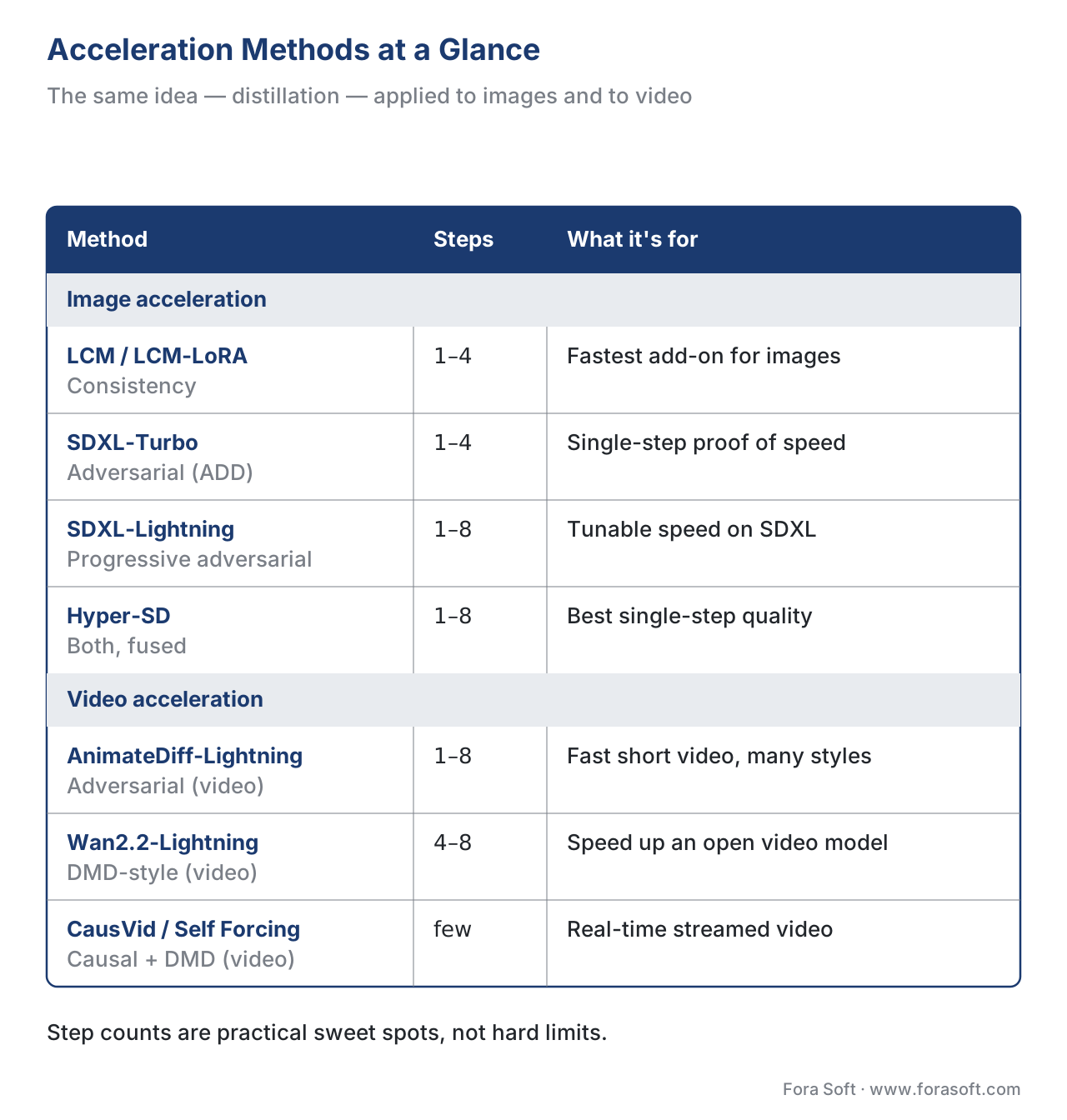 Figure 2. The acceleration methods side by side. The image-acceleration methods (top) and the video-acceleration methods (bottom) share the same core idea — distillation — applied to different output types.
How to Decide: Step Count First, Method Second
You do not need to memorise the methods. You need a decision, and it comes in two questions, asked in this order.
First, how many steps can your product afford to spend? This is set by your latency budget and your cost budget, not by taste. A batch job that renders clips overnight can spend thirty steps and use no acceleration at all — quality is free when nobody is waiting. A user-facing feature where someone taps "generate" and watches a spinner wants the clip back in a couple of seconds, which means four to eight steps. A live, interactive feature — a generated background that reacts as the user moves — needs real-time streaming, which means the causal methods (CausVid and its successors) or a purpose-built real-time model like LTX-2. Set the step budget from the experience you are building, then read off the method.
Second, given that budget, which method fits how you already run the model? If you run an image model and want it faster with the least work, reach for LCM-LoRA — it stacks on, comes off, and needs no retraining. If you need the sharpest possible one-step image, Hyper-SD earns its extra complexity. If you generate short video and your users pick their own art styles, AnimateDiff-Lightning's cross-model breadth is the reason to choose it. If you run an open video model like Wan, check whether it already has a Lightning or LightX2V distillation before you build anything — most of the popular ones now do. And if you need video that streams as it is made, you are in causal-model territory, where the field is moving fastest and you should expect to re-evaluate every few months.
The arithmetic from the start of this lesson is the whole reason to care. Cutting steps from thirty to six is a five-fold cut in GPU cost and wait time on every single generation your product ever runs. On a product that generates at scale, that is not a tuning detail — it is the difference between a feature that pays for itself and one that does not.
 Figure 3. The two-question decision. The experience sets your step budget; the step budget and how you already run the model pick the method.
Where Fora Soft Fits In
Acceleration is where generated video stops being a demo and becomes a product feature with a defensible cost. In the video conferencing, OTT and Internet TV, e-learning, and telemedicine systems we build, the difference between a thirty-step and a six-step pipeline is the difference between a feature that strains the budget and one that ships. We treat the step count and the acceleration method as first-class engineering decisions, sized to the latency the experience demands and the cost the business can carry, and we re-test them as the open models and their distillations move — which, in 2026, they do every quarter. The point is not to chase the newest paper; it is to pick the cheapest method that meets the experience your users actually feel. That sizing is part of every generative AI development engagement we run, and the same pipelines feed the video processing software we build for products that generate or restyle footage at scale.

The book
AI for Video: A Complete Guide to Intelligence in Video Products: From Models and Inference to Computer Vision, Speech, Search, and Generative Video
This lesson sets a step budget; volume 6 of the handbook is where the machinery behind it lives — how diffusion models are built, what a model artefact and an inference run actually are, and how generative video fits beside computer vision, speech, and search in a product. Volume 7 carries the same thread into real-time pipelines, serving stacks, and cost per stream-hour, which is where a four-step model becomes a bill you can predict. Written by Nikolay Sapunov, CEO at Fora Soft.
Scoping a feature that generates images or video?
Tell us the experience you have in mind and we will size the step budget, the method, and the GPU bill with you before anything gets built — 250+ video products shipped since 2005.
See our case studies
Case study
Layers (LAYRS)
A diffusion model in production: IC-Light on Stable Diffusion 1.5 merges three bracketed photos into one HDR listing image in seconds, 30% faster to market than manual editing — the step budget is the product's speed.
Case study
Mindbox
50+ self-hosted AI video deployments reading 500,000+ vehicle plates a day at about 95% accuracy — when you run the models yourself, every pass you cut is your own GPU bill.
Case study
WorldCast Live
Live video at 0.4–0.5 s glass-to-glass for 10,000 viewers on a 1.5 Gbit/s feed — the kind of budget that forces causal, streaming generation rather than rendering a clip.
What to read next
Open weights
Self-Hosting Open-Weights Video — HunyuanVideo, CogVideoX, Mochi, LTX-Video
The own-the-model path these speed-ups bolt onto.
Closed APIs
Closed-API Integration And Pricing — Sora, Runway, Kling, Pika, Luma
What the rent-it path costs per clip, where step counts are not yours to set.
Edge
Distillation + Quantization For Edge Video AI
The same distillation idea, aimed at phones and cameras.
Cost
The Cost Model — What AI In Video Actually Costs At Scale
Where the step count lands on the monthly bill.
References
- Luo, S., Tan, Y., Huang, L., Li, J., Zhao, H. "Latent Consistency Models: Synthesizing High-Resolution Images with Few-Step Inference." arXiv:2310.04378, October 2023. — The foundational LCM paper; 1–4 step inference, ~32 A100 GPU hours to train, probability-flow-ODE framing.
- Luo, S., et al. "LCM-LoRA: A Universal Stable-Diffusion Acceleration Module." arXiv:2311.05556, November 2023. — Packages LCM as a stackable LoRA for SD-1.5, SSD-1B, SDXL.
- Song, Y., et al. "Consistency Models." 2023. — The consistency-model idea LCM builds on (jump to the final image from any point on the trajectory).
- Sauer, A., et al. "Adversarial Diffusion Distillation." Stability AI, 2023. — The ADD method behind SDXL-Turbo; student + frozen teacher + discriminator, 1–4 step.
- Lin, S., Wang, A., Yang, X. "SDXL-Lightning: Progressive Adversarial Diffusion Distillation." arXiv:2402.13929, ByteDance, 2024. — Staged distillation 128→32→8→4→2→1; checkpoints for 1–8 steps.
- Ren, Y., et al. "Hyper-SD: Trajectory Segmented Consistency Model for Efficient Image Synthesis." arXiv:2404.13686, ByteDance, NeurIPS 2024. — Fuses trajectory preservation and reformulation; +0.68 CLIP and +0.51 Aes over SDXL-Lightning at 1 step.
- Lin, S., Yang, X. "AnimateDiff-Lightning: Cross-Model Diffusion Distillation." arXiv:2403.12706, ByteDance, March 2024. — Progressive adversarial distillation for video; >10× faster than AnimateDiff; cross-model motion module. Model card: huggingface.co/ByteDance/AnimateDiff-Lightning (CFG=1.0 guidance, 1/2/4/8-step checkpoints, licence creativeml-openrail-m).
- "From Slow Bidirectional to Fast Causal Video Generators" (CausVid). arXiv:2412.07772, 2024. — First real-time-streaming AR video diffusion matching bidirectional quality, via Diffusion Forcing + Distribution Matching Distillation.
- Huang, X., et al. "Self Forcing: Bridging the Train-Test Gap in Autoregressive Video Diffusion." arXiv:2506.08009, 2025. — Fixes the exposure-bias flaw in streaming video distillation.
- "Causal Forcing: Autoregressive Diffusion Distillation Done Right for High-Quality Real-Time Interactive Video Generation." arXiv:2602.02214, 2026. — Reports +19.3% Dynamic Degree, +8.7% VisionReward, +16.7% Instruction Following over Self Forcing.
- ModelTC. "Wan2.2-Lightning (LightX2V): Speed up Wan 2.2 via distillation." github.com/ModelTC/Wan2.2-Lightning, 2025. — Cuts ~40 steps to ~4–8 with an LCM-style sampler; ~4× faster; ships as a ComfyUI LoRA.
- Lightricks. "LTX-2." ltx.io/model/ltx-2, open-sourced 6 January 2026. — Synchronised 4K+audio single-pass video, real-time on consumer GPUs; ~18× faster than Wan 2.2 14B on the same H100 (vendor-reported).
- Hugging Face Diffusers documentation. "Latent Consistency Distillation" and "Inference with LCM-LoRA." huggingface.co/docs/diffusers. — Practical step counts and pipeline configuration.
