


Why This Matters
This article is for the founder, product lead, or post-production head at a streaming service who has watched generative video cross from a toy into something that can fill a real timeline, and now needs to know what an internal b-roll service actually costs, how long it takes to build, which parts are bought versus built, and where the law and the lawyers draw hard lines. It is equally for the engineer who has read the individual generative-video lessons and wants them welded into one deployable pipeline with named technologies, real prices, and a quality bar. It assumes you have met the underlying ideas already, because a capstone assembles rather than re-derives; the cross-links point back to each foundational lesson when you need the detail. By the end you will be able to draw the production pipeline on a whiteboard, name the exact 2026 technology in every box, defend the cost per clip to a finance team, sequence the build so a first version ships in weeks, and tell a design a rights-and-standards review will pass from one a studio's legal team will stop at the door.
What You Are Building, Stated Precisely
Fix the product before any technology. The shots that carry a story — the host talking, the match being played, the interview subject answering — are called the A-roll. The supporting footage cut in over the top of it — the city skyline behind a news anchor, the close-up of hands on a keyboard, the establishing drone shot before a scene — is called the b-roll, and it is the connective tissue of almost every finished video. A streaming service burns through enormous quantities of it: recap montages, "previously on" openers, promotional trailers, filler behind a voiceover, establishing shots a crew never captured. Traditionally that footage is either filmed, or licensed from a stock library, or pulled from an archive. You are building a fourth source: a service that generates the b-roll on demand from a text or image brief, using AI video models, and delivers it already cleared and encoded for the platform.
Two acronyms in that sentence carry weight. OTT stands for "over-the-top" — video delivered to viewers over the open internet rather than through a cable or satellite box, which is what every modern streaming service is. Post-production is everything that happens to footage after it is captured: the editing, the colour, the sound, the assembly into a finished programme. So the product is an AI b-roll generator wired into the post stage of an OTT platform, where editors assemble shows — not a consumer app, but an internal tool that a post-production team calls the way it calls a stock-footage library today.
The scope line that matters most is what the service is allowed to produce. It generates supporting, non-factual, non-identifying footage — a generic city at dusk, an abstract data visualisation, a sweeping landscape, a texture behind titles. It does not generate footage that asserts something happened, that depicts a real identifiable person, or that could be mistaken for news or documentary record. Hold that line and the service is a creative tool that saves an editor a stock-library search. Cross it — let the generator manufacture a "real" event or a real face — and you have built a misinformation engine, a likeness-rights lawsuit, and, as the compliance section shows, a direct collision with disclosure law. The whole architecture below is shaped to keep the service on the safe side of that line by construction, not by good intentions.
The Spine: Two Rules That Outlast The Models
Two ideas carry the entire build. Get them right and everything else is detail — and, unusually for this course, both rules exist because the technology underneath is moving faster than any single article can track.
The first rule is the model is a part, not a partner. Put every video model behind an abstraction layer — a single internal interface that takes a brief and returns a clip, with the actual vendor chosen at run time — so that swapping Runway for Google's Veo, or adding a new model, or dropping one that got switched off, is a configuration change and not a rewrite. This is not theory. In 2026 OpenAI deprecated its Sora video models and its Videos API: developers were notified on 24 March 2026, the consumer app went dark on 26 April 2026, and the API itself shut down on 24 September 2026, after which the associated data was deleted. Any team that had hard-wired its pipeline to Sora's specific calls spent that summer rewriting under deadline. A team that had put Sora behind a router changed one line. The model layer is the fastest-moving, least durable part of the whole system; build it to be replaced.
The second rule is generate cheaply, gate strictly. Generation is now the cheap, fast, low-stakes step — a few cents and a few seconds per clip. The expensive, high-stakes step is deciding whether a generated clip is good enough to ship and clear enough to ship, and that decision is where your service earns its keep. So every clip passes two gates before it reaches an editor's timeline. The quality gate asks: is this technically clean and aesthetically usable, or does it have the warping, the flicker, the garbled on-screen text that marks a bad generation? The rights-and-provenance gate asks: was this made by a model we are licensed to use commercially, is it labelled as AI-generated the way the law now requires, and is its origin recorded so we can prove it later? A clip that fails either gate never ships. The gates, not the generator, are the product.
Hold the two rules together and the platform has a clean shape. The first rule decides where the volatility lives — in a thin, swappable model layer, walled off from everything stable around it. The second rule decides what the service is actually for — not making clips, which is now easy, but deciding which clips are safe to use, which is hard. Everything in the rest of this article fills in the boxes between those two rules, decides what you build versus buy, and prices it.
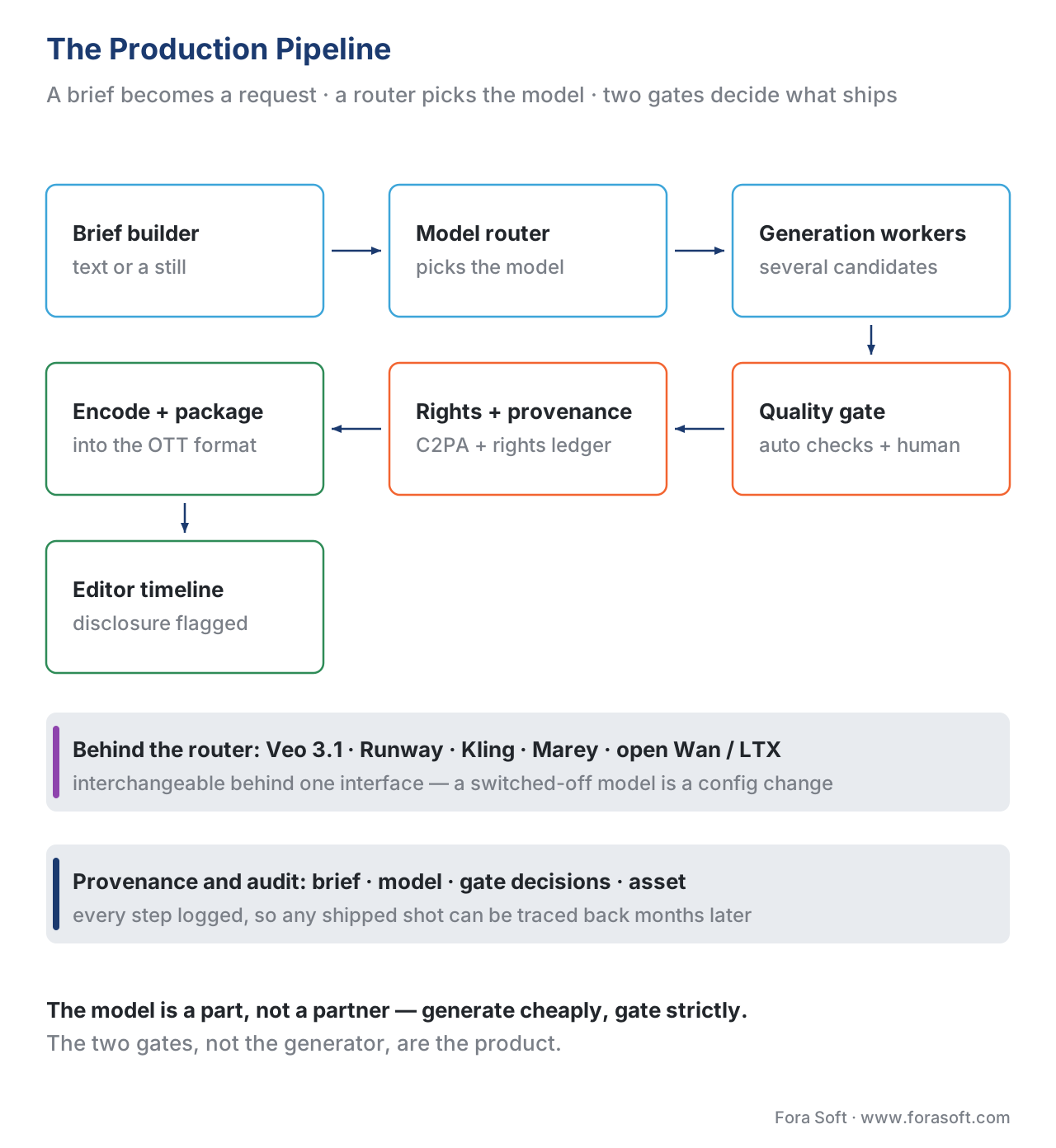
Figure 1. The production pipeline. A brief becomes a request, a router picks an interchangeable model, two gates decide what is allowed to ship, and a cleared clip is encoded into the OTT pipeline — with provenance recorded at every step.
The Production Architecture, Box By Box
A real deployment is more than a call to a video model. Eight kinds of component show up in every generative-b-roll service we have scoped, and naming them precisely is the first hour of any project.
The brief-and-prompt builder is the editor-facing front door. An editor does not want to write a model prompt; they want to type "slow aerial over a winter coastline at dawn, cool tones, 6 seconds" and get a clip. This component turns a short human brief, optionally with a reference still image, into the structured request the rest of the pipeline needs — the prompt text, the duration, the aspect ratio, the look, and any constraints. In 2026 the industry has shifted from pure text-to-video toward image-to-video for cinematic b-roll, because starting from a controlled reference frame yields far fewer of the warping artifacts that text-only generation produces; the brief builder is where that reference frame is chosen or generated.
The reference and asset store holds the inputs the brief builder draws on: approved style references, brand look-up tables, the platform's existing footage for matching, and the reference stills that seed image-to-video generations. It is ordinary object storage with metadata, but it is what lets the service produce footage that matches a show's grade instead of generic AI gloss.
The model router is the abstraction layer from the first rule, and it is the most important box you build. It exposes one internal interface — brief in, clip out — and behind that interface it holds adapters for each video model the platform is allowed to use. At run time it picks a model based on policy: cost ceiling, the look the brief asks for, whether the clip needs synchronized audio, and, above all, whether the use case requires a commercially-safe model. Adding or removing a model is editing this box and nothing else. The per-model engineering of these APIs is the subject of the API integration and pricing lesson.
The generation workers do the actual calls. Generating a clip takes seconds to a few minutes and is naturally bursty, so this layer is a queue of workers that call the chosen model's API (or run a self-hosted model on a GPU), retry on failure, and return candidate clips. You usually generate several candidates per brief, because the cheapest way to get one good clip is to make four and keep the best.
The quality gate is the first of the two gates and the first place a human may touch the work. It runs automated technical checks first — resolution, duration, frame-rate, gross corruption, and a check for the garbled lettering that AI models still produce when they try to render text — and scores each candidate. Clips that clearly pass go forward; clips that clearly fail are discarded; the borderline middle is routed to a human reviewer who picks the best candidate or rejects them all. This mix of cheap automated screening and focused human judgment is what keeps quality high without a human watching every clip.
The rights-and-provenance layer is the second gate and the legal heart of the service. Before a clip is allowed forward it confirms three things and records all three. First, that the model which made it is one the platform is licensed to use for commercial output — a question with real teeth in 2026, covered below. Second, it attaches a content credential — a tamper-evident label, following the C2PA standard, that marks the clip as AI-generated and records what made it — so the platform can disclose the clip's nature the way the law now requires. Third, it writes the brief, the prompt, the model, the licence terms, and the credential into a rights ledger, so that months later anyone can prove where a shot came from. The standards and disclosure engineering here are the subject of the quality, cost, C2PA, and EU AI Act lesson.
The conform, encode, and package layer turns a cleared clip into something the OTT pipeline can actually use. The clip is conformed to the platform's frame-rate and colour space, encoded to the platform's mezzanine and delivery codecs, and packaged into the streaming container the platform ships. This is the box where the generative service meets the rest of the streaming stack, and it is deliberately built on the platform's existing encoding and packaging rather than reinvented; the engineering of that pipeline lives in the OTT platform development playbook.
The review-and-publish surface is where the editor receives the cleared, encoded clip, drops it into the timeline, and — for any clip that will reach viewers — confirms the disclosure obligation is met. It is ordinary creative-tool integration, but it is the gate that keeps a human in the loop on what actually airs.
The provenance, audit, and cost layer runs underneath all of the above. It logs every brief, every model call and its cost, every gate decision, and every published asset, so the service can be reconstructed, audited, and budgeted. For a service that spends real money per clip and carries real legal weight per clip, this layer is not optional infrastructure — it is what lets the service be trusted and paid for.
Build Versus Buy: The 2026 Verdict, Component By Component
A capable team does not write all of this from scratch, and does not buy all of it either. The rule of thumb mirrors the other capstones in this course: adopt the mature infrastructure, buy or adopt the fast-moving models, and build only the part that is your actual product — here, the router, the two gates, and the provenance ledger. Those are the boxes that make the service safe and durable; everything else is bought.
| Component | Build or buy | Concrete 2026 choice | Why |
|---|---|---|---|
| Video models | Buy / self-host | Veo 3.1, Runway Gen-4.5, Kling, Marey (licensed), or open Wan / LTX | The fastest-moving part; never your moat, always rented |
| Model router / abstraction | Build | Your own adapter interface | This is rule one — it must be yours |
| Brief / prompt builder | Build on an LLM | Your prompt logic over a frontier LLM | The editor experience is your product |
| Generation workers | Build on a queue | Your queue + an aggregator API (fal.ai-class) | Standard async plumbing; the aggregator hides per-model APIs |
| Quality gate (auto + human) | Build | Automated checks + a review queue | The quality bar is your product |
| Rights & provenance | Build on a standard | C2PA content credentials + your rights ledger | Your legal obligation; cannot be delegated away |
| Conform / encode / package | Integrate | The platform's existing OTT encoder + packager | A solved, hard domain; never rebuild it |
| Provenance / audit / cost log | Build on cloud | Your logging + object storage | Your obligation and your budget control |
Two cells deserve a note because they are where teams go wrong. The video-models cell is marked "buy or self-host" and the choice between those two is a real fork: a managed API is faster to ship and always current, while self-hosting an open-weights model keeps every frame and every prompt inside your own infrastructure — which matters when the briefs themselves are confidential, such as an unannounced show. The self-hosting path is the subject of the open-weights lesson. The rights-and-provenance cell is marked "build", and it is the one teams are most tempted to skip — generation is exciting, provenance is paperwork. Skipping it is the single most expensive mistake available, because in 2026 it is the difference between a tool a broadcaster can deploy and one its legal team bans on sight.

Figure 2. What to build and what to adopt. Rent the models and integrate the OTT encoder; build the router, the two gates, and the provenance ledger — the parts that make the service safe and durable.
Choosing The Model — And Why You Abstract It Anyway
The model layer is where founders want to spend all their time and where they should spend the least, because the right answer changes every quarter. What follows is the mid-2026 landscape, but read it as a snapshot behind your router, not a marriage.
At the top of the quality range sit two managed models. Google's Veo 3.1 is the most broadcast-ready output most teams can buy, with strong prompt adherence and, unusually, native synchronized audio generation — and it runs on Vertex AI, which carries the compliance certifications (SOC 2, GDPR) and service-level agreements an enterprise buyer expects. Runway Gen-4.5 is the creative-tooling incumbent with a mature API and fine-grained control. Below them on price, Kling has been the value option for multi-shot cinematic sequences, and ByteDance's Seedance 2.0, released in February 2026, pushed multimodal control further by accepting many reference inputs at once. The detail and the trade-offs among these are the whole subject of the generative-video landscape lesson; the point here is that the leaderboard is crowded and reshuffles constantly.
For an OTT service, though, raw quality is the second question. The first is commercial safety — whether the model's training data exposes you to a copyright claim on footage you put in a paid programme. Here two models stand apart. Adobe's Firefly Video is trained only on licensed and public-domain content and ships with an IP indemnification offer on its paid and enterprise plans, meaning Adobe contractually backs you if a generated clip is challenged. Moonvalley's Marey, released to the public in mid-2025, went further as the first video model marketed as fully "commercially safe", trained entirely on licensed footage — roughly four-fifths of it B-roll that filmmakers and agencies licensed on purpose, secured through partnerships rather than scraped. For a streaming service putting clips into monetised shows, an indemnified, licensed-training model is often worth a quality compromise, which is exactly why the router must be able to send commercially-sensitive briefs to Marey or Firefly and everyday texture work to a cheaper general model.
| Model (mid-2026) | Rough API price | Native audio | Commercial-safety posture |
|---|---|---|---|
| Google Veo 3.1 (Vertex AI) | ~$0.15–0.40 / sec (with audio) | Yes | Enterprise terms; verify indemnity in contract |
| Runway Gen-4 / 4.5 | ~$0.05 / sec (Gen-4 Turbo) and up | No | Standard commercial terms |
| Kling | ~$0.10 / sec | Partial | General web-trained; check use terms |
| Adobe Firefly Video | Plan / credit based | Limited | Licensed training + IP indemnification on paid plans |
| Moonvalley Marey | Credit based (via aggregators) | No | Fully licensed training; marketed commercially safe |
| Open weights (Wan, LTX) | Your GPU cost only | Varies | You control data; you also own the legal review |
Notice what the table makes obvious: price, audio, and safety do not rank the same way, so no single model wins. The general models are cheap and capable but carry training-data uncertainty; the licensed models are safer but pricier and sometimes a step behind on raw fidelity; the open models put everything inside your walls but hand you the GPU bill and the legal homework. A service that hard-codes one of them optimises for one column and loses the others. A service that routes — cheap general models for abstract or heavily-stylised work where copyright risk is low, indemnified licensed models for anything photoreal that ships in a paid title — gets the right trade on every clip. And when one of these vendors raises prices, ships a new version, or shuts down the way Sora did, the router absorbs it.
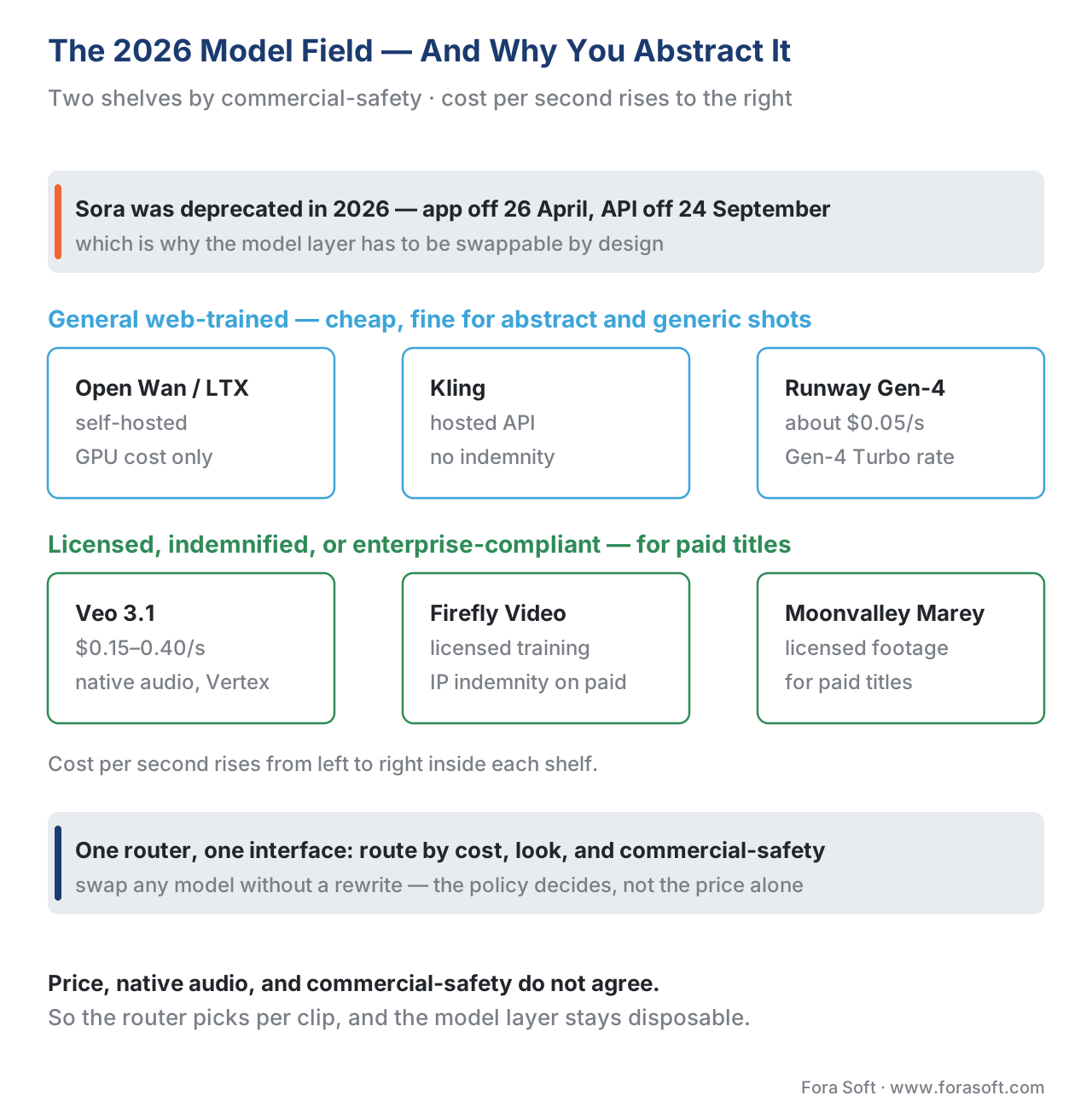
Figure 3. The model field is crowded and unstable — Sora was switched off in 2026. Price, audio, and commercial safety do not agree, so the router picks per clip instead of betting the service on one vendor.
Following One Brief From Request To Delivered Clip
Numbers and boxes become concrete when you trace a single request through the system. Follow one job: an editor cutting a nature documentary's recap needs a six-second establishing shot of a misty mountain valley at dawn that no one filmed.
The editor opens the brief builder and types the shot in plain language, sets six seconds and the show's aspect ratio, and tags it "ships in a paid title". Because of that tag, the brief builder marks the request commercially-sensitive and, to reduce artifacts, first generates a single reference still of the valley for the editor to approve, so the motion clip will start from a controlled frame rather than from text alone.
The request enters the model router. Seeing the commercially-sensitive tag, the router does not send it to the cheapest general model; it routes to a licensed-training, indemnified model, because this clip will sit inside a monetised programme. The router records which model it chose and why.
The generation workers call that model four times in parallel, producing four candidate six-second clips. Four candidates for one good clip is the cheapest path to quality, and at a few cents each the extra tries are noise against an editor's time.
The four candidates hit the quality gate. Automated checks run first: each clip is the right length and resolution, none is grossly corrupted, and none contains the warped pseudo-text that AI models still produce. Two candidates pass cleanly, one has a flickering ridgeline, one warps a tree into a smear. Because the brief was tagged for a paid title, the two clean candidates are routed to a human reviewer, who picks the better one in a few seconds. The reviewer is judging taste, not hunting for corruption — the machine already did that.
The chosen clip enters the rights-and-provenance gate. The gate confirms the model used was the licensed, indemnified one the policy required; embeds a content credential marking the clip as AI-generated and naming the tool; and writes the brief, the prompt, the reference still, the model, the licence terms, and the credential into the rights ledger. Only now is the clip allowed forward.
The cleared clip is conformed, encoded, and packaged into the platform's format and lands in the editor's timeline, already the right frame-rate and codec. The editor drops it into the recap. Because the clip will reach viewers, the publish surface reminds the editor that the show's AI-content disclosure must cover it — a duty the embedded credential already documents. Every step — brief, reference, model choice, four candidates, gate decisions, credential, encode, publish — is in the audit log, so weeks later anyone can prove exactly how a shot of a place that does not exist came to be in the show.
Notice the discipline. The volatility lived in one swappable box; the money was spent generating freely; and the two gates, not the generator, decided what shipped and proved it was clean and clear. That shape is what keeps the service fast for the editor, safe for the platform, and defensible to a reviewer.

Figure 4. One brief, end to end. The model is chosen by policy, four candidates are generated cheaply, two gates decide what ships, and a provenance-stamped clip is encoded into the platform — every step logged.
The Quality Problem You Must Design Around
A clip that looks almost right is more dangerous than one that looks obviously broken, because it slips past a tired editor and into a show. Three failure modes matter in this service, and the architecture has to be built around all three rather than trusting the model to avoid them.
The first is the visible artifact — the warping, the flicker, the object that morphs between frames, the extra finger. Generative video has improved enormously, but it still fails in characteristic ways, most reliably when it tries to render legible text or precise repeated structure. The defence is the automated half of the quality gate: cheap, deterministic checks that catch gross corruption and garbled lettering before a human ever looks, so human attention is spent on taste rather than on spotting smears. A useful rule is to never let a generative model produce on-screen words you care about; generate the visual, add real text in the edit.
The second is the consistency failure — the same place or object looking different from shot to shot, or drifting within a single clip, because the model has no memory of what it made a moment ago. For a one-off texture this does not matter; for a sequence that has to feel like one location it matters a great deal. The defence is partly the image-to-video approach, anchoring each generation to a shared reference frame, and partly scope: a generative b-roll service is excellent at standalone cutaways and weak at continuous narrative, so point it at the former. The engineering of cross-shot consistency is its own subject, covered in the consistency lesson.
The third is unique to the content of what is generated: the plausible fabrication you did not want. Ask for "a city at dusk" and you may get a recognisable real skyline, a real-looking brand logo on a building, or a face that resembles a real person — none of which you can safely ship. This is not a technical artifact; the clip is clean. It is a content problem, and the defence is the rights-and-provenance gate plus the scope line from the top of the article: the service generates non-identifying, non-factual footage, and anything that drifts toward a real person, a real mark, or a real place presented as real is rejected regardless of how good it looks.
The engineering answer to the first two failure modes is the generate-many, gate-hard pattern. Because a single clip is cheap, you generate several and let the gate keep the best, which turns quality from a property you hope the model has into a property the system enforces. The answer to the third is scope discipline plus the rights gate — the subject of the next section.

Figure 5. The quality strategy. Generate several cheap candidates and let a hard gate keep the best; design around three distinct failure modes, only two of which are technical.
The Rights And Provenance Problem — The Part That Decides Whether You Can Ship
This is the section that separates a demo from a deployable service, and it has three layers.
The first is commercial safety of the source model. When a generated clip goes into a paid programme, the question a studio's legal team asks is not "does it look good" but "can someone sue us over it". The risk is that the model was trained on copyrighted footage without permission, and a court later decides outputs derived from that training infringe. The 2026 market answered this with a tier of licensed-training models. Adobe's Firefly Video is trained only on licensed and public-domain material and offers IP indemnification on paid plans — Adobe contractually defends qualifying claims. Moonvalley's Marey was released as the first fully "commercially safe" model, trained entirely on licensed footage. For a streaming service, routing paid-title work to an indemnified model is not caution for its own sake; it is the difference between a tool legal approves and one it bans. This is why the router treats commercial-safety as a first-class routing input, not an afterthought.
The second layer is provenance — recording and disclosing that a clip is AI-generated. The industry standard for this is C2PA, the Coalition for Content Provenance and Authenticity, which defines a tamper-evident "content credential": a cryptographically-signed package of metadata, attached to the file, that states how the content was made and by what. By 2026 this stopped being optional polish. Adobe's Creative Cloud — Premiere Pro and Firefly — attaches content credentials by default; OpenAI added C2PA metadata to its generated media; YouTube began surfacing AI-content labels; and Sony shipped a camera that signs footage with C2PA at the point of capture. Your service embeds a content credential on every generated clip at the provenance gate, so the platform can always answer "what is this and where did it come from".
There is a hard engineering caveat here that teams discover too late: provenance metadata is fragile on the way to the viewer. The same transcoding and re-encoding that the OTT delivery pipeline performs — and that social platforms perform on upload — routinely strips embedded C2PA manifests. So provenance cannot live only inside the file. The durable design records the credential in your own rights ledger keyed to the asset, and treats the embedded manifest as a bonus that survives when the pipeline is provenance-aware and is reconstructable from the ledger when it is not. Design for the metadata being stripped, because in the general case it will be.
The third layer is disclosure law, and in 2026 it has a date. The European Union's AI Act, Regulation (EU) 2024/1689, sets transparency obligations in Article 50: providers and deployers of AI systems that generate synthetic video must mark the output as artificially generated in a machine-readable form, and deployers must disclose AI-generated or manipulated content to the public, with the core obligations applying from 2 August 2026. A 2026 "Digital Omnibus" agreement granted a short grace period — to 2 December 2026 — for the machine-readable marking requirement on systems already on the market before August, but the broader transparency duties stay on the August schedule. C2PA's AI assertion is the standard way to satisfy the machine-readable-marking part. The deployer-disclosure part is a product decision: the publish surface must make sure any AI-generated clip that reaches an EU viewer is disclosed. The full regulatory engineering, including the interaction with likeness and consent law, is the subject of the disclosure-engineering lesson and the regulatory lesson. This is engineering context, not legal advice; confirm the current dates and your obligations with counsel before you ship.

Figure 6. The four rights gates. Route by commercial safety, stamp and ledger the provenance, hold the scope line against real people and places, and meet the August 2026 disclosure duty — with the ledger as the durable record.
A Cost Model With The Arithmetic Shown
Pricing this service correctly means reasoning per clip, because that is the unit that scales with a growing slate of shows. The arithmetic is simple, and it decides the build-versus-buy and the make-versus-license conversation, so do it once. Walk through one six-second b-roll clip.
Start with generation. Managed video models in 2026 price per second of output, and the spread is wide. A general model like Runway's Gen-4 Turbo runs around $0.05 per second; Google's Veo 3.1 with audio runs roughly $0.15 to $0.40 per second; a licensed model sits in a similar premium band. Take a mid-figure of $0.15 per second for a safe, audio-capable model, and remember you generate four candidates to keep one:
generation: 6 sec × $0.15/sec × 4 candidates = $3.60 per delivered clip
Add the brief and gate compute — the language-model call that expands the brief, the automated quality checks, the reference-still generation. These are small next to the video generation: call it $0.10 to $0.40 per clip.
brief + gates:  ~$0.10–0.40 per clip
delivered-clip compute total:  ≈ $3.70–4.00
Round to about $4 of compute per delivered six-second clip on a premium, commercially-safe model — and as little as $1.50 if you route to a cheap general model and generate fewer candidates. Now compare the alternatives at the same unit. A single clip of licensed stock footage from a premium library typically runs $50 to $200, and a custom shoot — crew, location, day rate — is measured in thousands of dollars for a few usable seconds. Even the expensive, indemnified generative path is one to two orders of magnitude cheaper than licensing, and three to four cheaper than shooting.
That gap is why the build pays off, and it also tells you the break-even. The fixed cost of the service — the router, the gates, the integration, the always-on infrastructure — is real, but it is amortised across every clip. Industry guidance in 2026 puts the crossover where a team needs more than roughly twenty to thirty b-roll clips a month before generation beats a stock subscription; a streaming platform's post-production operation clears that bar in a single show. Keep the always-on infrastructure cost on a separate line from the per-clip compute, because the first is fixed and the second scales, and conflating them hides where the money actually goes. The per-feature cost discipline is the subject of the cost-optimization lesson and the real-cost-of-AI lesson.
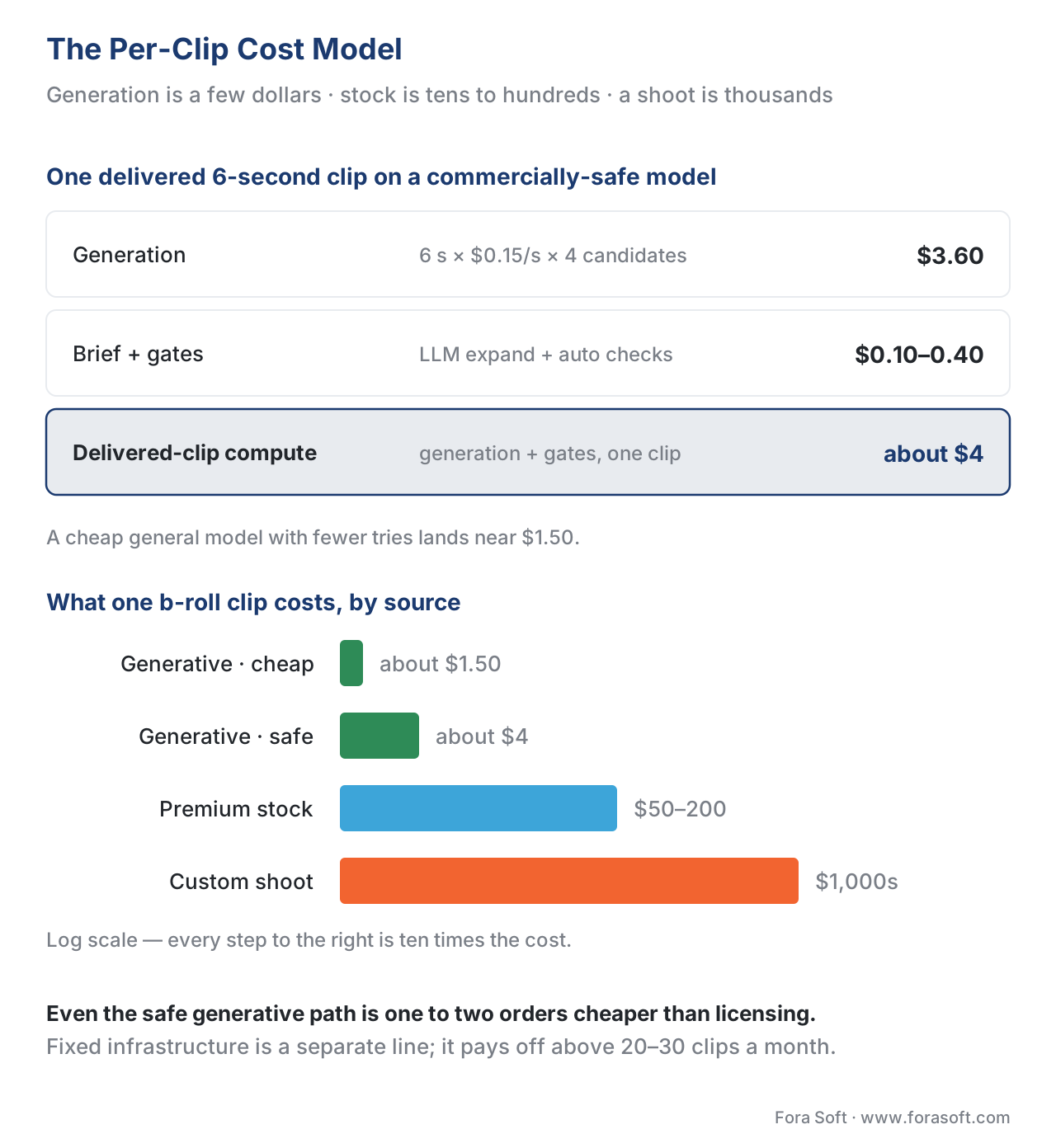
Figure 7. The per-clip economics. Generation is a few dollars against tens to hundreds for stock and thousands for a shoot; the fixed service cost pays off within a single show's worth of clips.
Common Mistake: Marrying The Model And Skipping The Gate
Two failures account for almost every generative-b-roll project that stalls, and they are the inverses of the two spine rules.
The first is marrying the model. A team finds a model they like, wires their whole pipeline directly to that vendor's specific API, and ships fast — and then the vendor raises prices, changes the API, or, as OpenAI did with Sora in 2026, switches the product off entirely with a few months' notice. The team that hard-wired spends the grace period rewriting under deadline instead of building features. The fix costs almost nothing if you do it first: one internal interface, adapters behind it, the vendor chosen at run time. Build the router before you build anything that calls a model, and the most volatile part of the system stops being able to hurt you.
The second is skipping the gate. A team treats generation as the product and provenance as paperwork to add later. The demo dazzles, the service ships, and then a clip with a real-looking logo airs, or a legal review asks "prove this footage is cleared" and the answer is a shrug, or the August 2026 disclosure duty arrives and nothing in the pipeline records what is AI-generated. Retrofitting rights and provenance into a running service is far harder than building the gate from milestone one, because every clip already shipped is now un-provenanced. The gate is not a finishing step; it is the load-bearing wall. The model makes clips; the gate is what makes a service.
Both mistakes share a root: mistaking the exciting part for the valuable part. Generation is the exciting part and it is now cheap and easy. The valuable parts are the boring ones — the abstraction that survives a vendor, and the gate that decides what is safe to ship. Build those first.
The Build Plan: Five Milestones, Value At Every Step
Sequence the build so a usable tool exists early and each milestone ships something a post-production team can actually use, rather than a year of plumbing before the first clip.
Milestone one — the gated single-model tool. Wire one video model behind a minimal router, add the brief builder, and put the automated quality check and a human review step in front of delivery. Even with one model and one editor, this is a working b-roll generator that produces screened clips. Crucially, build the router and the gate now, thin but real, so the two spine rules are in the foundation rather than bolted on later.
Milestone two — provenance and the rights ledger. Add the C2PA content-credential embedding and the rights ledger that records every clip's model, prompt, and licence. This is the milestone that turns a clever tool into a deployable service, and doing it second — not last — is the whole point of the common-mistake section.
Milestone three — the multi-model router. Add adapters for two or three more models, including at least one licensed, indemnified model, and the routing policy that sends commercially-sensitive briefs to the safe model and everyday work to a cheaper one. Now the service optimises every clip and is immune to any one vendor.
Milestone four — the OTT encode-and-package integration. Wire the conform-encode-package step into the platform's existing streaming pipeline so cleared clips land in the editor's timeline already in the right format. This is the milestone that moves the service from "exports a file" to "part of post-production".
Milestone five — scale, cost controls, and disclosure. Add the cost dashboard, per-show budgets, candidate-count tuning, and the publish-surface disclosure flow that satisfies Article 50 for clips reaching EU viewers. This is the milestone that makes the service cheap to run at slate scale and safe to run under the law.
Order it so a usable product exists after milestone one and the safeguards arrive early, not last. A team that ships milestone one and then jumps to encode integration, leaving provenance for "later", has built exactly the service the common-mistake section warns against.
Production Concerns: Encoding, Observability, And Moderating Your Own Output
Three operational realities decide whether the service survives contact with a real platform.
The first is the encode-and-package handoff. Generated clips arrive in whatever the model produced — a particular resolution, frame-rate, and colour space — and the OTT pipeline expects its own mezzanine and delivery formats. The conform step that bridges them is where provenance metadata is most likely to be stripped, which is the practical reason the rights ledger, not the file, is the source of truth for what a clip is. Build on the platform's existing encoder and packager rather than a parallel one; the streaming-side engineering lives in the OTT platform playbook.
The second is observability and cost control. Because every clip costs real money and you generate several candidates per delivered clip, an un-instrumented service can quietly burn a budget. Log every model call with its cost, track candidates-per-delivered-clip as a tunable number, and put per-show budgets in front of the generation workers. The same cost levers that apply to any video-AI feature apply here, and they are catalogued in the cost-optimization lesson.
The third is moderating your own output. A generative model will occasionally produce something you cannot ship even though no one asked for it — a violent or sexual image from an innocent prompt, a real-looking person, a trademark. The quality gate's automated stage should include a content-safety check, not only a corruption check, so unsafe generations are caught before a human reviewer's time or an editor's timeline is involved. This is the same content-moderation discipline the course covers for user-generated video, applied inward to footage your own system produced.
Free download: Generative B-Roll Service Build BlueprintOne page: the router-first reference architecture, the build-versus-buy verdict per component, the 2026 model field with per-second prices, the per-clip arithmetic against stock and a shoot, and the five-milestone build order.Where Fora Soft Fits In
Fora Soft has built video software since 2005, and OTT and streaming platforms are among the verticals we ship, alongside video conferencing, e-learning, telemedicine, and surveillance. The service described here — a brief builder over a model router, a generate-many quality gate, a C2PA-and-ledger provenance gate, and a conform-encode-package handoff into an existing streaming pipeline — is the shape of the generative-AI work we scope for post-production teams. The build order and the build-versus-buy verdicts in this article are not theory for us; they are the checklist we apply, because they are the difference between a tool that saves an editor a stock-library search and one that quietly ships an un-cleared clip into a paid title. The provenance map is part of that checklist too: we put the router and the gate in the foundation, route commercially-sensitive work to indemnified models, and treat the rights ledger as the durable record because the file's metadata will not survive the encoder. Our work here lives in OTT, streaming, and the AI software around them, where a swappable model layer and a strict gate are the core of the product rather than a decoration. We build that router and gate as part of our generative AI development services, and the handoff into encoding and packaging is the core of our OTT and Internet TV platform development.
The book
AI for Video: A Complete Guide to Intelligence in Video Products
This capstone prices one clip and names the two gates it has to pass; volume 7 works that production layer out in full — serving and queues, cost per stream-hour, and the regulatory surface this article lives on, from EU AI Act Article 50 to C2PA content credentials, with the vertical playbooks a service like this ships inside. Volume 6 sits underneath it with the capability itself: what a video model is, how generative video actually works, and what it can and cannot be asked for. Written by Nikolay Sapunov, CEO at Fora Soft.
Wiring a generative b-roll service into your OTT pipeline?
Tell us what your post team needs and we will scope the router, the two gates, and the encode-and-package handoff, price a delivered clip on both a cheap and a commercially-safe model, and say plainly which parts you should not build. 250+ video products shipped since 2005.
See our case studies
Case study
Speed.Space
A remote video production platform already used on Netflix, Electronic Arts and HBO productions, recording at 1080p and 8 Mbps — over 5× the quality of standard conferencing — which is the post-production standard a generated clip has to match.
Case study
ShortKlips
A video project platform with frame-by-frame commenting and side-by-side version comparison, used by Nokia, the World Bank and the US Coast Guard, cutting turnaround by 30% — the kind of review queue a quality gate feeds.
Case study
Mindbox
An AI video management system in 50+ deployments, running RTSP to FFmpeg to HLS with 99.5%+ face recognition — AI output in a setting where a wrong call carries legal weight, which is the discipline the rights gate needs.
What to read next
Generative video
Generative video in 2026 — the integration landscape
The model field this router picks from, closed APIs and open weights, model by model.
Compliance
Quality, cost, C2PA, and EU AI Act Article 50 disclosure
The two gates from this article, engineered out in full.
OTT
OTT platform development — the AI engineering playbook
The platform a cleared clip is conformed, encoded and packaged into.
Cost
The cost model — what AI in video actually costs at scale
The same arithmetic run across a whole product instead of one clip.
References
- C2PA — Coalition for Content Provenance and Authenticity, Technical Specification (v2.x, 2025–2026). Defines the tamper-evident "content credential", its cryptographic signing, and the AI-generation assertion used to mark synthetic media in a machine-readable form. The de-facto standard the EU AI Act's machine-readable-marking requirement is satisfied by. https://c2pa.org/specifications/specifications/
- Regulation (EU) 2024/1689 (EU AI Act) — Article 50 (transparency obligations for providers and deployers). Providers of generative AI must mark synthetic audio/video as artificially generated in machine-readable form; deployers must disclose AI-generated or manipulated content. Core obligations apply from 2 August 2026. https://artificialintelligenceact.eu/article/50/
- European Commission / Council — Digital Omnibus on AI, provisional agreement (2026). Grants a grace period to 2 December 2026 for the Article 50(2) machine-readable-marking requirement on systems placed on the market before 2 August 2026; broader transparency duties remain on the August schedule. (Confirm final adopted text before relying on dates.) https://digital-strategy.ec.europa.eu/en/policies/code-practice-ai-generated-content
- ISO/IEC 23000-19 — Common Media Application Format (CMAF). The container standard a cleared b-roll clip is packaged into for OTT delivery at the conform-encode-package step; cited for the streaming-pipeline handoff. https://www.iso.org/standard/85623.html
- AOMedia — AV1 Bitstream & Decoding Process Specification, v1.0.0-errata1. The royalty-free codec increasingly used to encode delivery renditions of generated b-roll in modern OTT pipelines; cited for the encode step. https://aomedia.org/av1/specification/
- OpenAI — "What to know about the Sora discontinuation" (Help Center) and API deprecations (Developer docs). Sora 2 / Sora 2 Pro video models and the Videos API deprecated 24 March 2026; Sora web/app discontinued 26 April 2026; API shut down 24 September 2026; associated data deleted thereafter. The concrete case for a swappable model layer. https://help.openai.com/en/articles/20001152-what-to-know-about-the-sora-discontinuation
- Google Cloud — Veo 3.1 on Vertex AI: pricing and capabilities (2026). Per-second pricing roughly $0.15–0.40/sec with native synchronized audio; Vertex AI enterprise compliance (SOC 2, GDPR) and SLAs. https://cloud.google.com/vertex-ai/generative-ai/pricing
- Runway — API Pricing & Costs (developer docs, 2026). Credits at $0.01 each; Gen-4 Turbo video at 5 credits/sec (~$0.05/sec), Gen-4.5 video at a higher credit rate; API credits separate from subscription allocations. https://docs.dev.runwayml.com/guides/pricing/
- Adobe — Firefly: a commercially safe AI approach and Firefly Video (2026). Firefly models trained on licensed and public-domain content; IP indemnification on paid Creative Cloud and Firefly for Enterprise plans; Content Credentials embedded by default; third-party models (Runway, Veo) integrated under a do-not-train clause. https://business.adobe.com/products/firefly-business/firefly-ai-approach.html
- Moonvalley — Marey: a fully-licensed, "commercially safe" AI video model (public release July 2025; BusinessWire / CineD coverage). Trained entirely on licensed footage (~80% intentionally-licensed B-roll, secured via partnerships such as Vimeo) for professional production. https://www.businesswire.com/news/home/20250708099256/en/Moonvalley-Releases-First-Fully-Licensed-AI-Video-Model-for-Professional-Production
- Content Authenticity Initiative — "The State of Content Authenticity in 2026." C2PA adoption across Adobe Creative Cloud (credentials by default), OpenAI, YouTube AI-content labels, and Sony's C2PA-signing camera; plus the practical limitation that transcoding and social upload strip embedded manifests. https://contentauthenticity.org/blog/the-state-of-content-authenticity-in-2026
- Industry workflow reporting (2026) — generative vs stock B-roll economics and the image-to-video shift. The 2026 move from text-to-video to image-to-video for cinematic b-roll to reduce artifacts; generation beats a stock subscription above roughly 20–30 clips/month; premium stock clips $50–200; custom shoots in the thousands. (Trade press; corroborated across multiple 2026 sources — treat as directional, not normative.) https://www.opus.pro/blog/best-ai-b-roll-generators-short-form-video
