

The psychoacoustic model is the part of a lossy encoder that decides what to throw away, based on how human hearing actually works. It predicts, frame by frame, which sounds the ear will and won't perceive — chiefly through masking, where a loud tone hides quieter ones near it in frequency or time, and through the threshold of hearing, below which nothing is audible. The encoder then allocates bits accordingly, coding audible detail accurately and quantizing masked detail coarsely or not at all, so the missing information is, ideally, information you could never have heard. The quality difference between two codecs at the same bitrate is largely the quality of their psychoacoustic models.
The book · Volume 4 of 7
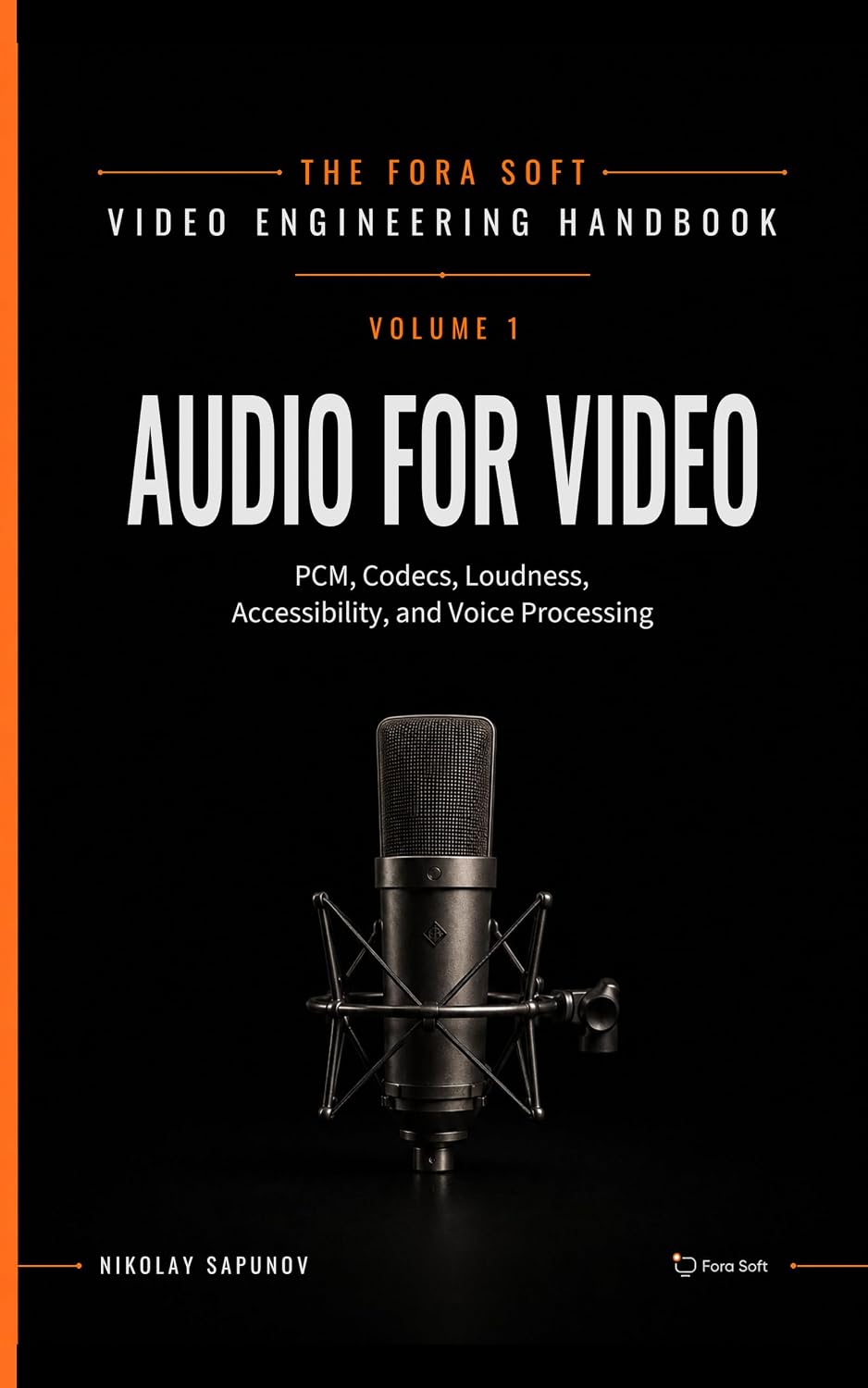
Audio for Video: A Complete Guide to Sound in Video Products: From PCM and Codecs to Loudness, Accessibility, and Real-Time Voice Processing
The psychoacoustic model is the part of an encoder that decides what you will never hear, and its tuning separates clean audio from swirly artifacts at the same bitrate. This volume explains psychoacoustics in depth with masking, the MDCT and bit allocation in AAC and Opus, so you can judge encoders on more than bitrate. Written by Nikolay Sapunov, CEO at Fora Soft.
Comparing encoders and wondering how their psychoacoustic models affect quality?
Send us test material and candidate encoders and we will compare them with listening tests and metrics and recommend the best fit. 250+ video products shipped since 2005.
